About 8% to 10% of parents regret their baby-name choice. In many cases, the problem is easy to spot early: the name is hard to spell, hard to say, too tied to one era, or pushed by someone else.
If I wanted a name I’d still feel good about years later, I’d keep it simple. I’d pick a name that:
- is easy to say and spell
- works for a child and an adult
- doesn’t create awkward initials or bad nicknames
- fits with siblings and family background
- feels right to both parents
That’s the whole idea of this guide. It comes down to a short set of checks before I commit.
Here’s the fast version:
- Set non-negotiables first
- Check paperwork limits in your state
- Test pronunciation and spelling
- Review initials, nicknames, and teasing risk
- Look at popularity trends and similar spellings
- Picture the name on a résumé, email, and school list
- Make sure it fits your family
- Live with the top 2–3 names for a few days before choosing
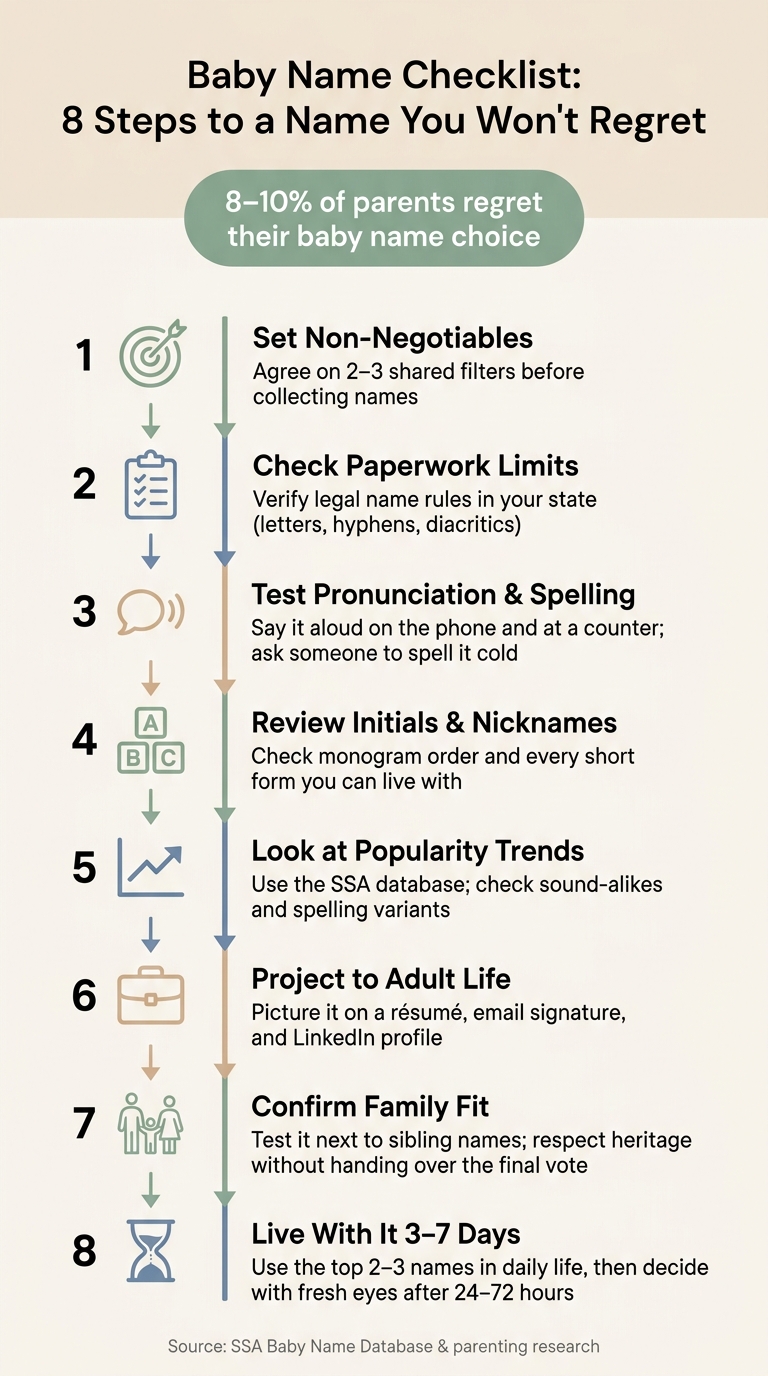
Baby Name Checklist: 8 Steps to a Name You Won't Regret
Quick comparison
| Check | What I’d ask |
|---|---|
| Pronunciation | Will people say it right after hearing it once? |
| Spelling | Will I need to correct it all the time? |
| Initials | Do the initials spell something awkward? |
| Nicknames | Can I live with the short forms other people may use? |
| Popularity | Is it more common than it looks because of regional baby name trends or sound-alikes? |
| Adult fit | Does it still sound right at age 30? |
| Family fit | Does it work with siblings, family meaning, and boundaries? |
| Final choice | Do both parents still like it after a short trial run? (You can even swipe baby names together to find matches faster.) |
Bottom line: I wouldn’t choose a baby name on emotion alone. I’d choose the one that keeps passing these daily-life checks and still feels good after a few days of using it.
sbb-itb-f13f980
Set Your Rules Before You Start Collecting Names
Start with shared rules. That way, you’re judging every name by the same standard instead of arguing case by case.
List Your Values and Non-Negotiables
Each partner should rank five filters: heritage, usability, professional feel, uniqueness, and family expectations. Then agree on two or three non-negotiables that rule a name out right away. Common examples include "must stay outside the SSA top 50" or "must reflect our heritage."
Write these down. It sounds simple, but it helps a lot. A fuzzy preference turns into a clear filter you can both use the same way.
If trendiness matters to you, look at a name’s SSA rank over the past 10 to 20 years. A sharp rise followed by a drop can be a sign that the name may feel tied to a certain moment.
Once these rules are in place, every name gets the same first-pass check.
Check Practical Limits on Forms and Records
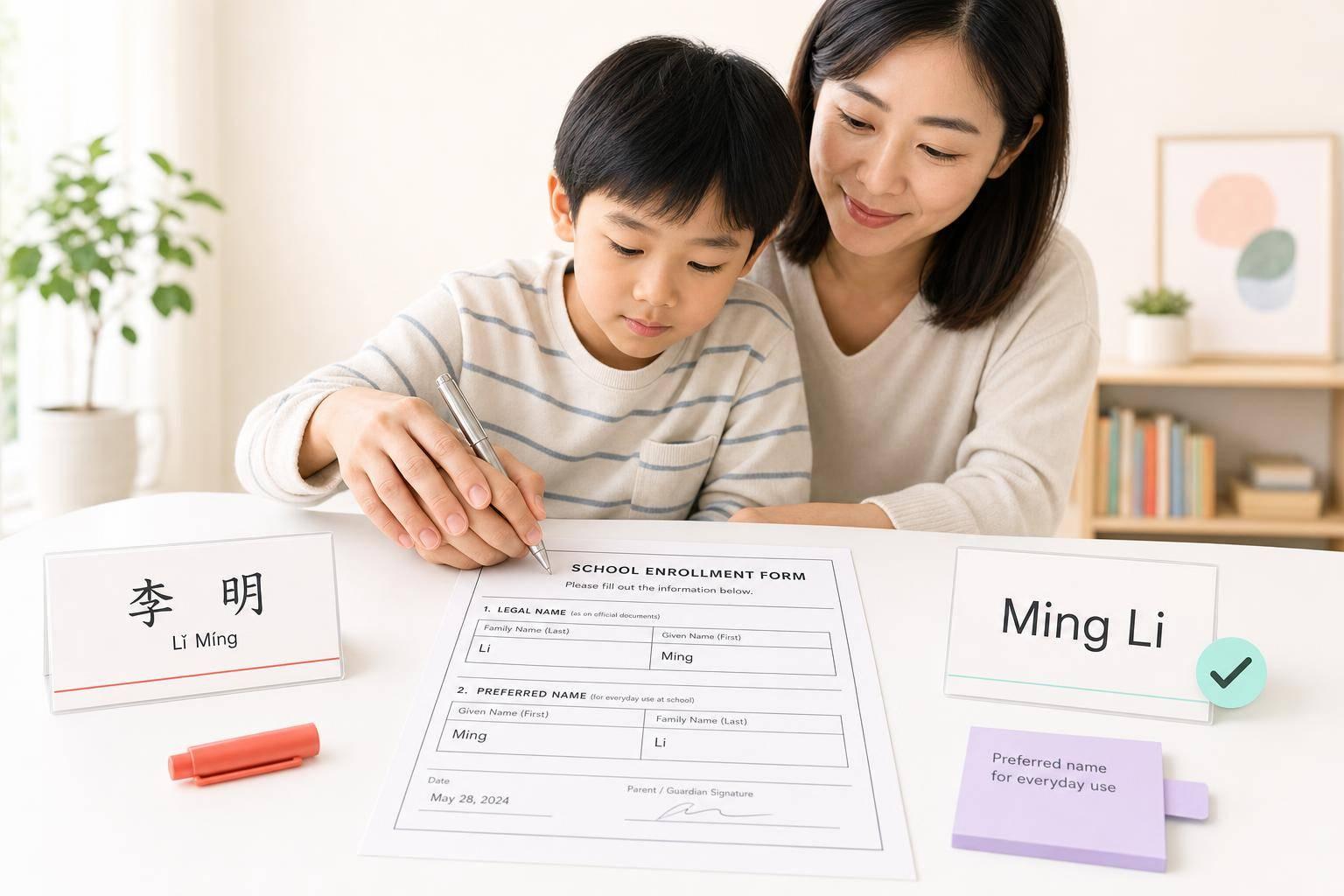
Before you get too attached to a name, do a quick check against U.S. legal and paperwork limits. Rules differ by state, but many allow only standard English letters. Hyphens or apostrophes may be allowed in some places. Diacritics often get stripped out of official records, and that can lead to a lifetime of mispronunciation on documents.
Test the full legal name on a school or pediatric form. If it doesn’t fit cleanly, fix it now.
With your ground rules set, the next step is to stress-test each name for the issues that lead to the most regret.
Four Tests That Catch the Biggest Regret Triggers
Before you settle on a serious contender, run it through four simple checks. This is where vague feelings turn into a short list you can actually trust.
| Test | What to Do | What Problem It Catches | When to Use It |
|---|---|---|---|
| Pronunciation & Spelling | Test the name aloud in two settings: on the phone and at a counter | More common than the rank suggests, or tied to one narrow era | For every name on your shortlist |
| Initials, Nicknames & Teasing | Write out first–middle–last initials, check monogram order (first–last–middle), and list every short form you can live with | Unwanted acronyms, slang, or brand-like initials; rhyming teasing | Before committing to any full-name combination |
| Popularity & Spelling Variants | Check the SSA database for current rank and trend direction; check common spelling variants and sound-alikes | More common than the rank suggests, or tied to one narrow era | When uniqueness is a priority or the name feels familiar |
| Adult-Life Projection | Write the name in professional contexts: email signature, résumé heading, and bio; ask, "Does it read like a name that will still work at 30?" | Overly cutesy names, strongly trend-dated picks, names that don't transition to adulthood | When you're choosing between your final two or three names |
Pronunciation and Spelling Test
Say the name out loud in two everyday situations: on the phone and at a counter. Then ask someone to spell it after hearing it once. If you need to explain it twice, odds are that won't be a one-time problem.
Names like Siobhan or Anaïs may need repeated explanation in many U.S. English-speaking settings. And altered spellings like Madyson instead of Madison often lead to constant fixes on school forms and online accounts. If a spelling only works after repeated correction, and there's no clear family or cultural reason behind it, that's a strong sign to move it off the shortlist.
If the name still feels solid in conversation, the next step is to test the full legal name.
Initials, Nicknames, and Teasing Check
Write the initials in both standard order and monogram order: first–middle–last and first–last–middle. This catches awkward acronyms, slang, and initials that sound more like a brand than a person.
Then list every nickname you can live with, not just the one you hope will stick. Kids, teachers, and friends tend to make their own edits. A U.K. poll found that 6% of mothers regretted their child's name because they disliked the shortened version their child ended up being called. That stat may sound small, but when you're choosing a name you'll hear for years, it matters. If you both dislike every likely short form of a name you otherwise love, don't brush that off.
Popularity and Adult-Life Test
Check the SSA baby name database to see the name's current rank, then look at the trend over the last 10 to 20 years. A name climbing fast into the top 20 can feel much more common in a kindergarten class than it looks on paper right now.
Also look at spelling variants and sound-alikes. Isabella, Izabella, and Isabela are counted separately in SSA data, but on a playground they sound the same. So the real-life frequency can be higher than any one ranking suggests.
Rising pressure to find a "perfect" name often leads to second-guessing later.
Now put the name into adult settings: an email signature, a résumé heading, or a LinkedIn profile. This sounds a little dry, but it's one of the best gut checks. Names like James, Nora, Samuel, or Maya tend to read well across age ranges and job titles. By contrast, names tied to a sharp, narrow surge in use - like Jennifer in the late 1970s and 1980s, or the Kayden/Jayden/Brayden cluster of the 2000s - can feel stamped to one generation. Ask yourself: does it still read like a name that works at 30?
Once a name clears these checks, the next step is seeing whether it still fits your family.
Make Sure the Name Fits Your Family
Once a name clears the practical checks, give it one more test: does it fit your family? A name can work on paper and still feel off at home. It should sit well with sibling names, reflect family background in a respectful way, and avoid drama you can see coming.
Sibling Fit Without Forced Matching
Now look at the name next to your other children's names. The aim is coordination, not matching. Each child should have a name that stands on its own, while the set still feels like it belongs together. You're looking for a shared style, not the same first letter, ending, or theme.
Think of siblings named Nora, Lucas, and Elena. The names differ in length and sound, but they share a current, international feel, so the group sounds balanced.
Say the names out loud the way you'd use them in daily life: "Lily, James, and Mateo, dinner's ready!" This small test tells you a lot. Listen for awkward rhythms, accidental rhymes, or names that sound so close they'll get mixed up all the time.
Then write the names together the way they'd show up on a school form or holiday card. If one name looks like it came from a totally different era or style, that's worth noting.
Watch for two common problems:
- Near-duplicates, like Jayden, Jaden, and Jaiden. That kind of overlap can turn daily life into a mess at school and at home.
- Sharp style clashes, like pairing a formal old-school name with casual modern ones, such as Archibald with Jax and Kylie.
Heritage Meaning and Family Boundaries
Heritage can give a name more meaning. But it also asks a bit more from you. Before you choose a name tied to a certain heritage, check its meaning and pronunciation with native speakers or trusted faith or community leaders. Don't rely on guesses.
It also helps to decide early whether your family is okay with a name that will need regular explanation. Sometimes that's fine. Sometimes it becomes tiring. A name can honor family history without handing the final vote to relatives.
A middle name is often a good middle ground. It can carry a tribute without becoming the name used every day. If relatives are pushing hard for one choice, you can respect the intention while keeping the final call with the parents. For example, you might honor Grandpa Luis in the middle name and pick a first name that fits the child and your home life better.
Here's a simple table to compare your top picks across the family-fit points that matter most:
| Factor | Name 1 | Name 2 | Name 3 |
|---|---|---|---|
| Matches siblings' overall style | |||
| Avoids confusingly similar sounds to siblings | |||
| Comparable length and formality | |||
| Shares or respects family heritage | |||
| Clear plan for honoring relatives | |||
| Reduces rather than increases family conflict |
Use the names that do best here to shape your shared shortlist. Once a name feels right for the family, move it forward and compare the last few options side by side. You can also use baby name tools to narrow your list and finalize your choice.
Build a Shortlist Together and Make the Final Call
After the family-fit check, cut your list down to two or three finalists. This part goes better with a clear structure, not a long back-and-forth that circles the same names, which is why baby name lists don’t work for couples. At this stage, you're not brainstorming anymore. You're making the call.
Use NameHatch to Find Overlap Faster
A shared shortlist tool can save a lot of time and prevent you from revisiting every name from square one. NameHatch lets each partner swipe on names on their own, then pulls the names you both like into one shared list.
Live With the Finalists Before You Decide
Next, test your finalists in daily life for three to seven days. Use each name in normal moments. Say it when you're talking about the baby, write it in a note, and try phrases like "Time for dinner, Eliot" or "This is my daughter, Maren."
Some uncertainty is normal. That doesn't mean the name is wrong.
After the trial period, step away for 24 to 72 hours. Then come back and look at your top choice again with fresh eyes. If you keep avoiding saying the name out loud, take that seriously. That's often a sign something isn't clicking. But if it's just a general sense of nerves, that's usually part of the process.
Conclusion: Choose the Name That Passes the Real Tests
Confidence in a baby name usually comes from trusting the process you used together. You set your values and non-negotiables, checked pronunciation, initials, popularity, and adult-life fit, and made sure the name works for your family.
Pick the name that keeps holding up across those checks and still feels right after the trial period.
| Name | Pronunciation (1–5) | Initials (1–5) | Partner Score (1–5) | Gut Feeling (1–5) |
|---|---|---|---|---|
Fill in this table for your two or three finalists. If one name keeps scoring well across the columns - and still gets a strong gut-feeling score after the trial period - that's usually your answer.
FAQs
How do we choose if we love very different names?
If you and your partner love very different names, start with an honest conversation. Don’t just trade favorites back and forth. Talk about why each name matters.
Sometimes the reason runs deeper than taste. One person may care about family history. The other may care about identity, sound, or a certain style. Once those reasons are on the table, it usually gets easier to spot where you can meet in the middle.
After that, make it practical. You can use NameHatch to look for overlap, let one person pick the first name while the other picks the middle name, or settle on a short list and try each name out for a few days.
What if we love a family name that causes daily spelling or pronunciation problems?
You could use it as a middle name to honor the family tie, then pick a more practical first name for everyday life.
If you want to keep it as the first name, say it out loud in school and work settings. Try a few nicknames too. Then balance the family meaning with the chance of day-to-day frustration for your child.
How can we tell if a baby name will feel too trendy later?
Look beyond a name’s current rank. A name can feel more common than the chart suggests if it’s climbing fast or showing up a lot for both boys and girls.
Check the 10-year trend line. If the line shoots up, the name may hit peak use by the time your child starts school. If it stays flat or starts to dip, that often points to a steadier pick. It also helps to look at spelling variants, nicknames, and state-level popularity.