Where you live influences the names parents choose for their children. Baby name trends in the U.S. reflect regional preferences shaped by culture, heritage, and demographics. While names like Liam and Olivia dominate nationally, state-level data shows unique patterns. For example:
- South: Names like William, John, and Beaux are popular, reflecting traditional and French Creole influences.
- Southwest: Hispanic roots shine with names like Mateo, Santiago, and Ezekiel.
- West Coast: Nature-inspired choices such as Aurora and Hazel stand out.
- Northeast: Polished names like Maeve, Charlotte, and Theodore are common.
- Midwest: Classic names like Oliver and Evelyn lead.
The Social Security Administration (SSA) tracks these trends with state-level data, while tools like NameHatch use AI to provide personalized name suggestions based on preferences and location. Together, they help parents balance national trends with local popularity, ensuring their choice feels meaningful and relevant.
How Baby Name Trends Differ by US Region
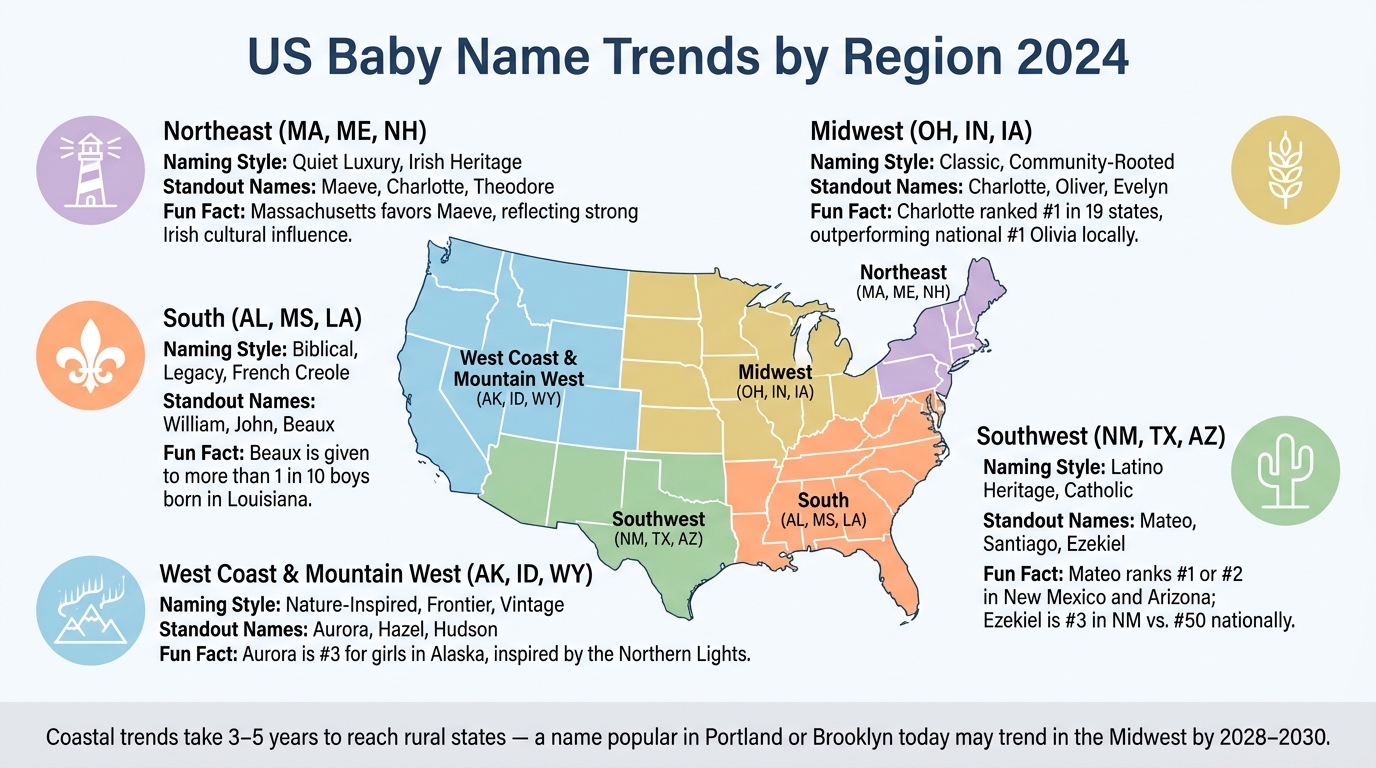
US Baby Name Trends by Region 2024
Regional data offers a fascinating glimpse into how culture and geography influence baby name choices in the U.S. The country isn’t just one unified naming culture - it’s a mosaic of regional traditions and preferences, as revealed by SSA state-level data.
In the South, tradition takes center stage. States like Alabama and Mississippi lean toward timeless choices like William and John, while Louisiana reflects its French Creole heritage with names like Beaux, given to more than 1 in 10 boys born there. Meanwhile, the Southwest showcases its Hispanic Catholic roots. Mateo frequently ranks #1 or #2 in New Mexico and Arizona, and Ezekiel holds the #3 spot in New Mexico, far higher than its national rank of #50.
The West Coast and Mountain West thrive as hubs for creative naming trends. Alaska embraces nature with Aurora (#3 for girls), inspired by the Northern Lights. Idaho has a soft spot for vintage names like Hazel, while Wyoming opts for rugged frontier names such as Hudson and Bridger. Over in the Northeast, parents often choose names with a polished, heritage-driven feel. Massachusetts favors Maeve, reflecting Irish influence, while the region as a whole leans toward classics like Charlotte and Theodore.
| Region | Naming Style | Standout Names (2024) |
|---|---|---|
| South (AL, MS, LA) | Biblical, legacy, French Creole | William, John, Beaux |
| Southwest (NM, TX, AZ) | Latino heritage, Catholic | Mateo, Santiago, Ezekiel |
| West Coast & Mountain West | Nature-inspired, frontier, vintage | Aurora, Hazel, Hudson |
| Northeast (MA, ME, NH) | "Quiet Luxury", Irish heritage | Maeve, Charlotte, Theodore |
| Midwest (OH, IN, IA) | Classic, community-rooted | Charlotte, Oliver, Evelyn |
This regional breakdown highlights how cultural heritage and local demographics shape naming preferences across the country. Interestingly, trends often begin in coastal urban areas and take about 3–5 years to reach rural states. For example, a name gaining popularity in places like Portland or Brooklyn today might become a favorite in the Midwest by 2028–2030.
To go beyond the raw data, personalized tools like a baby name trend analyzer offer a modern way to explore names that align with both regional trends and individual preferences. By combining AI-driven suggestions with filters such as Nature-Inspired, Global, or Classic, these tools help parents find names that resonate with their local culture while reflecting their own unique style.
sbb-itb-f13f980
1. SSA State-Level Baby Name Data
The Social Security Administration (SSA) provides an incredible resource for exploring baby name trends at the state level. Their database includes over 104,819 unique names spanning 145 years (1880–2024), capturing every name given to at least five babies in a single year. This data offers a fascinating glimpse into how naming preferences vary across the country.
One of the most striking aspects of SSA data is how it highlights the difference between national and local trends. For example, while Olivia was the #1 name nationally in 2024, Charlotte actually ranked first in 19 states, covering regions like the Northeast, Heartland, and parts of the South. Similarly, Kaia, a name that ranked #3 for girls in Hawaii in 2024, was only #180 on the national list. These variations reflect unique cultural and demographic influences shaping state-level naming choices.
"Analyzing the 2024 SSA state-by-state data reveals more than just a list of popular names - it's a map of American identity." - The Art of Naming
The SSA website allows users to access the Top 100 names for any state and year or compare the Top 5 names across all 50 states. This comparison tool is especially handy for identifying "naming belts", where a particular name or style dominates a region. For instance, in 2023, over 10% of girls born in Vermont, Rhode Island, and Wyoming had a Top 5 name. By contrast, in states like Texas, Mississippi, and Georgia, that percentage dropped below 4.6%. This kind of information can be invaluable if you're looking to avoid your child sharing their name with multiple classmates. This is a key step in naming your baby without stress.
Here’s a tip: use the SSA's historical data to filter by year and compare recent rankings (2024–2025) with data from five years earlier. Names that are rapidly rising in popularity in your state might soon feel overused. The latest comprehensive state-level data includes births through 2024. Armed with these insights, the next section will explore how AI-powered tools can take your baby name search to the next level.
2. NameHatch AI-Powered Baby Name App
The SSA database is a great resource, but let’s face it - digging through raw government data can feel like a chore. That’s where NameHatch steps in. This ad-free, AI-powered baby name app is designed for couples who want personalized suggestions without dealing with endless spreadsheets.
NameHatch takes the raw data and turns it into something much easier to work with, especially for exploring regional trends. Its state-by-state breakdown feature is perfect for uncovering how popular a name is in your area. For example, if you’re in Charleston and wondering if "Eliza" is already everywhere, or in Phoenix curious if "Sage" is about to take off, NameHatch provides that local insight. Plus, the app’s AI Name Consultant customizes suggestions based on your preferences, including your cultural background and naming style. You can filter by categories like Classic, Modern, Soft, Strong, Nature-Inspired, and Mythical, making the process feel tailored to you.
Another standout tool is the visual trend overlay, which lets you compare multiple names on a single popularity chart. This feature helps you quickly spot whether a name is steadily gaining traction or if it’s just a flash-in-the-pan trend. It’s a huge time-saver compared to manually combing through SSA charts.
For couples, the app’s swipe-based interface and real-time partner sync make collaboration seamless. Both partners can rate names on their own, and the app instantly shows where their preferences align - no more endless text threads or mismatched lists. Pricing is straightforward: there’s a Free plan (30 swipes with basic filters), a $3/month plan for unlimited access, or a six-month option for $12, offering a $6 discount.
Pros and Cons
When comparing AI vs. traditional baby naming, SSA and NameHatch bring different strengths to the table for exploring regional trends. Here's a quick side-by-side comparison:
| Feature | SSA Data | NameHatch |
|---|---|---|
| Cost | Free | Free plan (30 swipes); $3/month or $12 for 6 months |
| Data Source | 100% of Social Security card applications | Uses SSA data enhanced with AI-driven suggestions |
| Regional Breakdown | Top 100 names by state and year; top 5 for all states | State-by-state popularity with visual trend overlays |
| Customization | Filter by state and year only | Filter by style, origin, and vibe |
| Ease of Use | Best for parents with a specific state or year in mind | Designed for discovery with a swipe-based interface |
| Partner Collaboration | None | Real-time partner sync with a shared shortlist |
| Data Freshness | Slight reporting delay; excludes names with fewer than 5 occurrences | Reflects current trends through AI-powered suggestions |
Each tool shines in its own way, catering to different needs. SSA is the go-to for official, detailed statistics by state and year, making it ideal for those who want precise, historical data. On the other hand, NameHatch is all about discovery, offering a more interactive experience with filters for style and origin, plus a swipe-based interface to make the process fun and engaging.
Some parents even combine both tools: they start with NameHatch to explore names and trends, then use SSA data to confirm their favorites. This blend of exploration and verification provides a well-rounded view of regional naming trends.
Conclusion
Where you live can shape the names that resonate most. For instance, Waylon feels perfectly at home in West Virginia, while Mateo is a standout in the Southwest. Meanwhile, Charlotte claimed the top spot in 28 states in 2025, even though Olivia reigned as the national favorite. These trends highlight how local preferences often diverge from national rankings, reflecting each region's distinct personality.
The main takeaway? National popularity doesn't always dictate local appeal. A name might feel fresh and unique in your community, even if it's widely used elsewhere. Recognizing this balance can help you choose a name that feels both personal and rooted in your surroundings.
For parents who love a data-driven approach, SSA state-level data provides a reliable and easily accessible resource - it's free, official, and updated every year. Tools like NameHatch take it further, refining searches to reflect local trends. Whether you're filtering by style, origin, or vibe, or syncing choices with your partner in real time, these tools help you dive deeper into the naming process. Whether you're confirming if a name is trending locally or searching for one that matches your regional vibe, there's a resource to fit every approach.
"Naming a child is no longer just about following a national list - it's about choosing a 'vibe' that reflects your geography, your values, and the energy you want to put into the world." - The Art of Naming
FAQs
How can I tell if a name is popular in my state?
To see if a name is trending in your state, take a look at state-level data from the Social Security Administration. They provide a list of the top 100 names for any state and year, or you can even compare the top five names across different regions. Naming trends often begin in urban coastal areas before moving inland, so state-specific rankings give a clearer picture of local preferences compared to national stats.
Why do baby name trends vary so much by region?
Regional baby name trends across the US are influenced by a mix of local culture, geography, and lifestyle. For instance, states like Massachusetts often reflect their Irish heritage in popular names, while Louisiana's French Creole history shapes many naming choices there. Nature and local industries also leave their mark - Hawaiian names often draw inspiration from the islands' natural beauty, while Wyoming's rugged lifestyle can influence simpler, nature-inspired names. Pop culture and religious traditions also play a big role, especially in the South and Southwest, where biblical names frequently top the charts.
How do I pick a name that feels unique locally?
To find a name that stands out in your community, take a look at state-level birth records provided by the Social Security Administration. A name that doesn't appear in the top 500 nationally might still be popular locally, influenced by regional traditions or heritage. For instance, Louisiana often features French-inspired names, while Alaska leans toward nature-themed ones. Names ranked between 500 and 1000 on the national list strike a nice balance - they're recognizable but still uncommon enough to feel distinctive.