My starting point for these 9 girl names: choose a sound you like, then check its roots. “Ay” is a shared spelling - not a shared meaning or pronunciation.
Here’s how I’d narrow the list:
- Ayla and Aylin: Short Turkish names linked to a moon halo.
- Ayana: A flowing name with several reported origins and meanings.
- Ayesha: An Arabic form of Aisha, often linked to “alive” or “living.”
- Ayumi: A Japanese name whose meaning depends on its written form.
- Aya and Ayah: Short options with Arabic uses; Aya also has Japanese uses.
- Ayra and Ayza: Compact names with less settled origins and meanings.
Quick Comparison
I’d use this snapshot to compare sound and roots - not popularity.
| Name | Pronunciation guide | Meaning or origin check |
|---|---|---|
| Ayla | AY-luh or EYE-luh | Moon halo in Turkish; other roots are reported |
| Ayana | ay-AH-nuh or eye-AN-uh | Confirm the intended language and meaning |
| Ayesha | eye-EE-shuh | Arabic; related to Aisha |
| Ayumi | AH-yoo-mee | Japanese; check the written characters |
| Aya | EYE-uh or AH-yah | Japanese meaning varies; Arabic “sign” or “verse” |
| Ayah | AH-yah | Arabic “sign,” “miracle,” or Qur’anic verse |
| Aylin | EYE-lin | Turkish; moon halo |
| Ayra | EYE-rah | Meaning and origin need checking |
| Ayza | AY-zah or EYE-zah | Etymology is uncertain |
These pronunciations are English guides; family and language usage can differ. Before choosing, I’d <u>say the full name aloud</u>, ask someone to spell it after hearing it, and confirm its meaning and original spelling. Then I’d check initials, nicknames, and how it sounds beside siblings’ names.
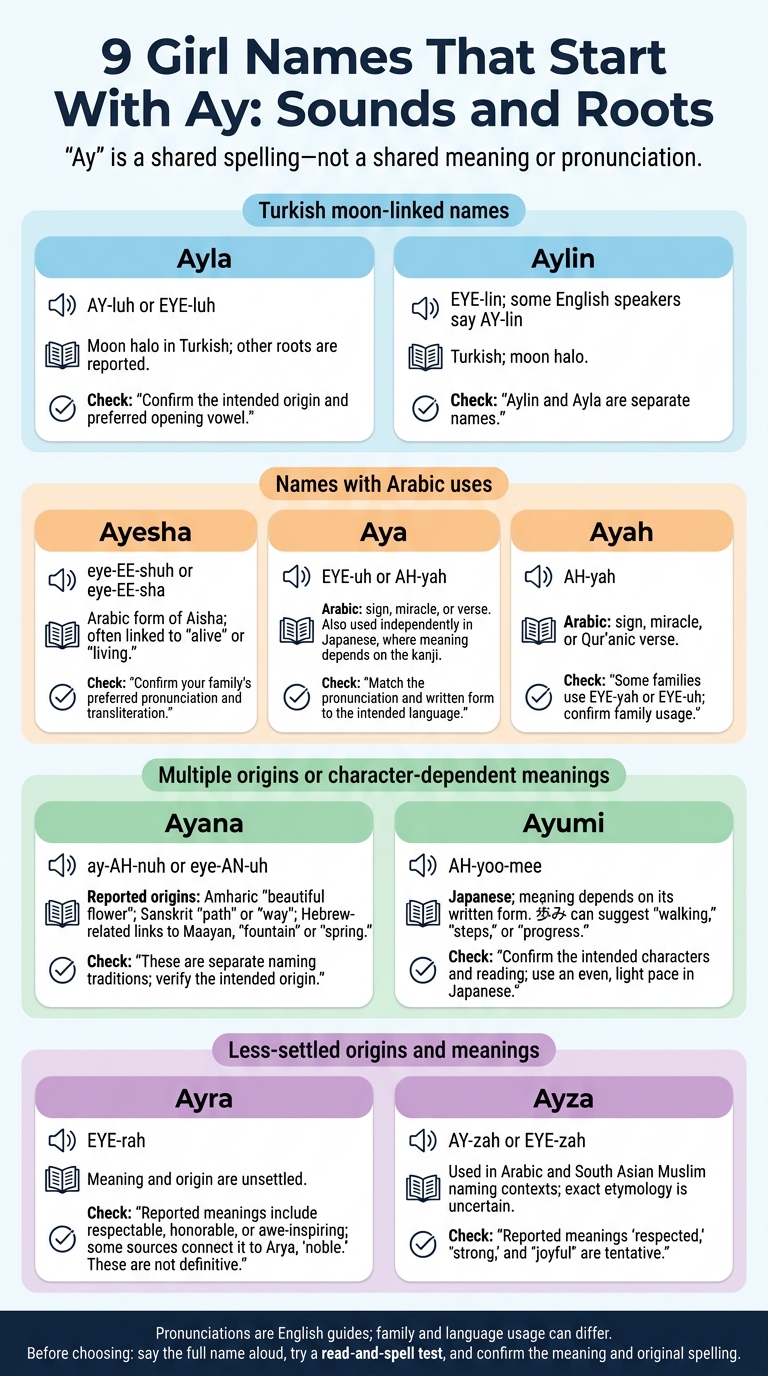
9 Girl Names That Start With Ay: Sounds and Roots
How Ay Names Differ in Sound and Origin
Before comparing meanings, separate spelling from origin and pronunciation. “Ay” is a shared spelling, not a shared sound or meaning. In Turkish, ay means “moon,” but that meaning doesn’t apply to every name that starts with these letters.
Choose either the original pronunciation or an English-adapted version, and use it consistently. Transliteration can produce alternate spellings and blur differences in sound. Keep origin, meaning, and usage separate - a name’s current use doesn’t always tell you where it came from.
For Japanese names, the written characters determine the meaning. Kana can show the reading, while different kanji can change the meaning. A Romanized spelling alone doesn’t establish one meaning, so compare the names below using their written forms, pronunciations, and origins together.
For each name, note the preferred pronunciation, intended language, and original spelling. If meaning matters to you, check the specific written form rather than relying on the “Ay” opening.
sbb-itb-f13f980
1. Ayla
Pronunciation and Sound
AY-luh, sometimes EYE-luh.
Meaning and Origin
In Turkish, Ayla means the halo around the moon. Other sources link it to separate Hebrew-related or tree-linked roots, so its meaning depends on the origin cited.
Style
Ayla has a short, open sound that makes it easy to compare with other Ay names. It feels light and a little different, with a soft lunar image. It’s familiar in the U.S., making it recognizable rather than rare.
Spelling Notes
Ayla has more than one common English pronunciation, so spelling matters. Ayala is a separate, longer name - not another spelling of Ayla. Aylin, generally pronounced EYE-lin in English, is also a separate name, though it shares the Turkish moon element. Use your preferred pronunciation consistently across the full name.
2. Ayana
Pronunciation and Sound
ay-AH-nuh or eye-AN-uh; the first starts like day, the second like eye.
Meaning and Origin
Ayana has several reported origins: Amharic beautiful flower, Sanskrit path or way, and Hebrew-related links to Maayan, meaning fountain or spring. These come from separate naming traditions, so they shouldn’t be treated as one shared meaning.
Style
Compared with Ayla, Ayana feels longer and more fluid. Three syllables and open vowels give it a melodic rhythm and a youthful feel. The “n” adds structure while keeping the name graceful and easy to say.
Spelling Notes
If you like Ayana’s sound, Ayanna and Aiyana are close spellings to consider. Their origins and meanings may differ from Ayana’s, though. Before choosing, compare their spelling and pronunciation - and think about how often you’d need to spell the name out.
3. Ayesha
Pronunciation and Sound
Say eye-EE-shuh or eye-EE-sha, with the stress on the middle syllable. Check with the family to confirm which pronunciation they prefer.
Meaning and Origin
Ayesha is an Arabic transliteration of Aisha, often linked to “alive” or “living.” The name also connects to Aisha bint Abi Bakr, one of the Prophet Muhammad’s wives, known for her scholarship and hadith transmission. This history gives the name meaning in faith and heritage for many Muslim families.
Style
Ayesha has a soft, lyrical sound and a more classic feel than the shorter Ay names. Its three-syllable rhythm sounds softer than Aya.
Spelling Notes
Aisha, Aysha, Aishah, and Aiesha are related transliterations. Choose the spelling your family uses most, and include a pronunciation cue if needed. Its longer sound adds useful contrast within the Ay list.
4. Ayumi
Ayumi takes the list into Japanese naming, showing how Ay names can cross languages and still keep a light, youthful sound.
Pronunciation and Sound
AH-yoo-mee is a common English approximation. In Japanese, give all three syllables an even, light pace rather than stressing “YOO.”
Meaning and Origin
Ayumi is a Japanese feminine given name.
If written as 歩み, it can suggest “walking,” “steps,” or “progress.”
Style
Ayumi has a gentle, bright rhythm and a soft, youthful feel.
Spelling Notes
Ayumi can be written in hiragana, katakana, or kanji. Roman letters alone don’t establish its meaning, so confirm the intended characters and reading.
5. Aya
After Ayumi’s longer flow, Aya offers the shortest, sharpest sound on the list.
Pronunciation and Sound
Aya is usually pronounced EYE-uh in English or AH-yah in Japanese and Arabic contexts. Families should confirm their preferred pronunciation rather than assume one reading. Its brief sound also makes it easy to compare with the other Ay names.
Meaning and Origin
Aya appears in both Japanese and Arabic. In Japanese, its meaning depends on the kanji.
Forms such as 彩 may suggest “color” or “colorful,” while 綾 can suggest a woven pattern or design.
In Arabic, آية means “sign,” “miracle,” or “verse,” especially a verse of the Qur’an.
Style
With just three letters, Aya feels compact, youthful, and lyrical. EYE-uh sounds bright, while AH-yah feels softer. The short spelling gives it a clean, modern look.
Spelling Notes
Aya and Ayah can be related in Arabic contexts, but they aren’t automatically interchangeable. Aya also has independent Japanese uses, while Ayah more directly signals the Arabic spelling and Qur’anic association.
Roman letters can hide differences in script and meaning, so choose the spelling that fits your family’s language and usage.
6. Ayah
Ayah keeps the airy feel of the shorter Aya, while pointing more clearly to Arabic usage.
Pronunciation and Sound
AH-yah is the common English pronunciation guide, though some families say EYE-yah or EYE-uh. The name has two open syllables.
Meaning and Origin
In Arabic, an ayah is a sign, evidence, or miracle. In Qur’anic use, it refers to a numbered verse in a surah (chapter). The plural is ayat.
Style
Ayah feels soft, lyrical, and youthful. The final h sets the spelling apart visually.
Spelling Notes
Ayah is the clearest choice when you want to emphasize the Arabic form. Aya is shorter, but it also appears in Japanese and Hebrew contexts, so its origin is less clear. Aayah makes the long opening vowel more apparent, though you may need to explain the spelling more often. Use the same spelling on all official documents.
7. Aylin
If you want a moon-inspired baby name that feels a little sleeker than Ayla, Aylin is a strong next choice.
Pronunciation and Sound
In Turkish, Aylin is usually pronounced EYE-lin. Some English speakers say AY-lin.
Meaning and Origin
Aylin is a Turkish feminine name meaning “moon halo”; “of the moon” is another common gloss.
Style
Aylin feels modern and sleek. Its light, two-syllable rhythm keeps Ayla’s softness, while the -lin ending feels more tailored than Ayla’s open ending.
Spelling Notes
Aylin is the standard spelling. Variants such as Aelyn, Aylinn, and Eylin offer a different look but may prompt questions about pronunciation.
8. Ayra
Pronunciation and Sound
Ayra is commonly pronounced EYE-rah, with two syllables and stress on the first. Its bright opening and soft ending give it an airy, gentle sound.
Meaning and Origin
Unlike the more clearly moon-linked names above, Ayra is a shorter option with less settled origins. Ayra’s meaning is unsettled. Some sources define it as respectable, honorable, or awe-inspiring. Others connect it to the Sanskrit name Arya, meaning noble.
Style
Ayra’s simple spelling gives it a modern look, while its soft ending makes it feel approachable.
Spelling Notes
Compare Ayra, Aira, and Arya carefully - their pronunciation and backgrounds differ.
9. Ayza
Pronunciation and Sound
Ayza is usually pronounced AY-zah or EYE-zah, with the stress on the first syllable. Stick with one pronunciation when introducing the name.
Meaning and Origin
Ayza shares the short, airy sound of the names above, though its origins are less clear. It’s used in Arabic and South Asian Muslim naming contexts, but its exact etymology is uncertain. Reported meanings include “respected,” “strong,” and “joyful,” though none is definitive. Treat these meanings as tentative unless your family’s tradition confirms one. You can also use a baby name meaning finder to explore other cultural interpretations.
Style
Ayza’s appeal starts with its sound: light, compact, and modern. The crisp y-z combination gives its two syllables a youthful, energetic feel.
Spelling Notes
Aiza, Ayeza, Aizah, and Aaiza may be related spellings, but their pronunciation and background can differ. Say Ayza aloud with your surname, using your preferred pronunciation, to see how it flows with your last name.
Compare Your Ay-Name Shortlist
Uncertain meanings need a closer check, especially if a name’s connection to your family’s heritage matters to you.
Use this chart to compare sound, meaning, and how much spelling help each name may need.
| Name | Pronunciation | Commonly Reported Meaning | Language or Origin | Style | What to Consider |
|---|---|---|---|---|---|
| Ayla | AY-luh or EYE-luh | Meaning varies by source; linked to a moon halo in Turkish. | Turkish; other origins are reported. | Nature-inspired | Confirm your preferred opening vowel. |
| Ayana | ay-AH-nuh or eye-AN-uh | Several meanings are reported; verify the one tied to your family’s tradition. | Multiple origins are reported. | Melodic | Check which pronunciation your family expects. |
| Ayesha | eye-EE-sha or eye-EE-shuh | Linked to the Arabic name Aisha and often glossed as “alive.” | Arabic; linked to Aisha. | Lyrical | Choose your family’s preferred spelling. |
| Ayumi | AH-yoo-mee | Meaning depends on the kanji. | Japanese. | Gentle | Choose the kanji first. |
| Aya | AH-yah or EYE-uh | Depends on the kanji in Japanese; “sign” or “verse” in Arabic. | Japanese or Arabic, depending on use. | Compact | Match the pronunciation to your intended language. |
| Ayah | AH-yah | Sign, miracle, or Qur’anic verse. | Arabic. | Clear Arabic and Qur’anic association. | Decide whether you want an explicit religious connection. |
| Aylin | EYE-lin or AY-lin | Moon halo / moonlight. | Turkish. | Sleek | Specify the first vowel. |
| Ayra | EYE-rah | Meaning varies by source. | Origins are less settled. | Soft | Check whether listeners hear Arya or Ira. |
| Ayza | AY-zah or EYE-zah | Meaning and origin vary; verify the tradition you intend. | Etymology is uncertain. | Crisp | Check whether listeners confuse it with Aiza or Aisha. |
Try a simple read-and-spell test: have someone read your finalists aloud, then spell them back without prompts. This can help you spot which names need the least correction.
When you’re down to two or three names, weigh how each fits your family’s pronunciation, spelling habits, and heritage with a guide to naming your baby without stress.
Choose an Ay Name for Your Family
Once you’ve narrowed your shortlist to a few names, try the full name in everyday situations. Use it in introductions, call it across a room, and test likely nicknames. Add the middle name to check for awkward pauses or repeated sounds. Then ask someone to write the full name after hearing it once.
Write the initials in both standard and monogram order, checking for unwanted words or abbreviations. Say siblings’ names together, too. Look for a shared feel without making the names so similar that they’re hard to tell apart.
Separate style from fact-checking. Note what you love about the name, then confirm its pronunciation, meaning, and original spelling through language dictionaries, references about its language and community of origin, or native speakers. If the name uses different writing systems, choose one consistent spelling for school, medical, travel, and government records.
Save your finalists in one place so you and your partner can compare them. NameHatch is a baby-name app that lets you save favorites, filter by style, and compare names privately with a partner.
FAQs
How can I verify conflicting name meanings?
Research the name in each language tied to your family and background, then compare reliable sources. The same name can have different linguistic roots. If sources disagree about its meaning, get a second opinion.
If the name comes from a culture outside your own, check its meaning and associations with native speakers or community members. Choose meanings that reflect your family’s values and carry positive associations in every language you use.
Can I choose an Ay name outside my heritage?
Yes, you can choose a name from outside your heritage. In the United States, people choose names from around the world based on personal values, sound, or style.
Before deciding, research the name’s meaning, origins, and pronunciation, including how it’s used in the community it comes from. Think about how easy it will be to spell and pronounce where you live. Check for unintended meanings or sacred associations that could make the name inappropriate outside its original community.
Will a youthful Ay name suit an adult?
A name’s fit depends on how well it can grow with the person and how you picture it over time. A playful name might suit a child, but does it also feel right for an adult at work? Nicknames can offer a casual option in childhood and a more formal one later. Try saying the name with a formal title or picture it in a workplace to get a sense of how it might age.