A baby name should do 3 jobs at once: feel uncommon, fit your family, and be easy to live with every day.
Keep it simple: set your rules for finding rare names first, check the data, search beyond the usual lists, and test each name out loud before you decide. That matters because a name can seem rare and then climb fast. In the article, Kaeli moved up 1,692 spots in U.S. rankings in 2023, and Truce jumped more than 11,000 places in one year to reach #991. A name that feels low-use now may not stay that way.
Here’s the short version:
-
Define what “unique” means to you
- Outside the top 100
- Outside the top 500
- Low-use in your state or area
- Low-use but starting to climb
-
Don’t trust your friend group as data
- A name can feel rare in your circle and still be moving up across the U.S.
-
Check trend direction, not just current rank
- Stable
- Rising
- Peaking
- Falling
-
Look in better places
- Family records
- Older generations
- Surnames
- Nature
- Books
- Places
- Heritage
-
Test the name in daily life
- Full name out loud
- Initials
- Nicknames
- Mishearings
- Spelling issues
-
Compare finalists side by side
- Rarity
- Trend
- Pronunciation
- Style fit
- Nickname risk
A few points stand out. Rare is not the same as unfamiliar. A name can be low-use and still easy to say and spell. That’s often the best middle ground. Also, one survey in the article says 1 in 5 parents later disliked their choice, most often because other people picked the same name.
If you were doing this with a partner, start with 3 to 5 rules, then run every finalist through the same checks. The best pick is usually the one that still feels good after you’ve said it, spelled it, and heard it used over and over.
| Step | What to do | What to watch for |
|---|---|---|
| 1 | Set your rules | Don’t use vague ideas like “not too common” |
| 2 | Check U.S. data | Watch for names climbing fast |
| 3 | Search deeper | Family, surnames, books, nature, places |
| 4 | Test in daily use | Pronunciation, spelling, initials, nicknames |
That’s the whole idea: pick a name that is rare enough for you, easy to use, and tied to something that matters to your family.
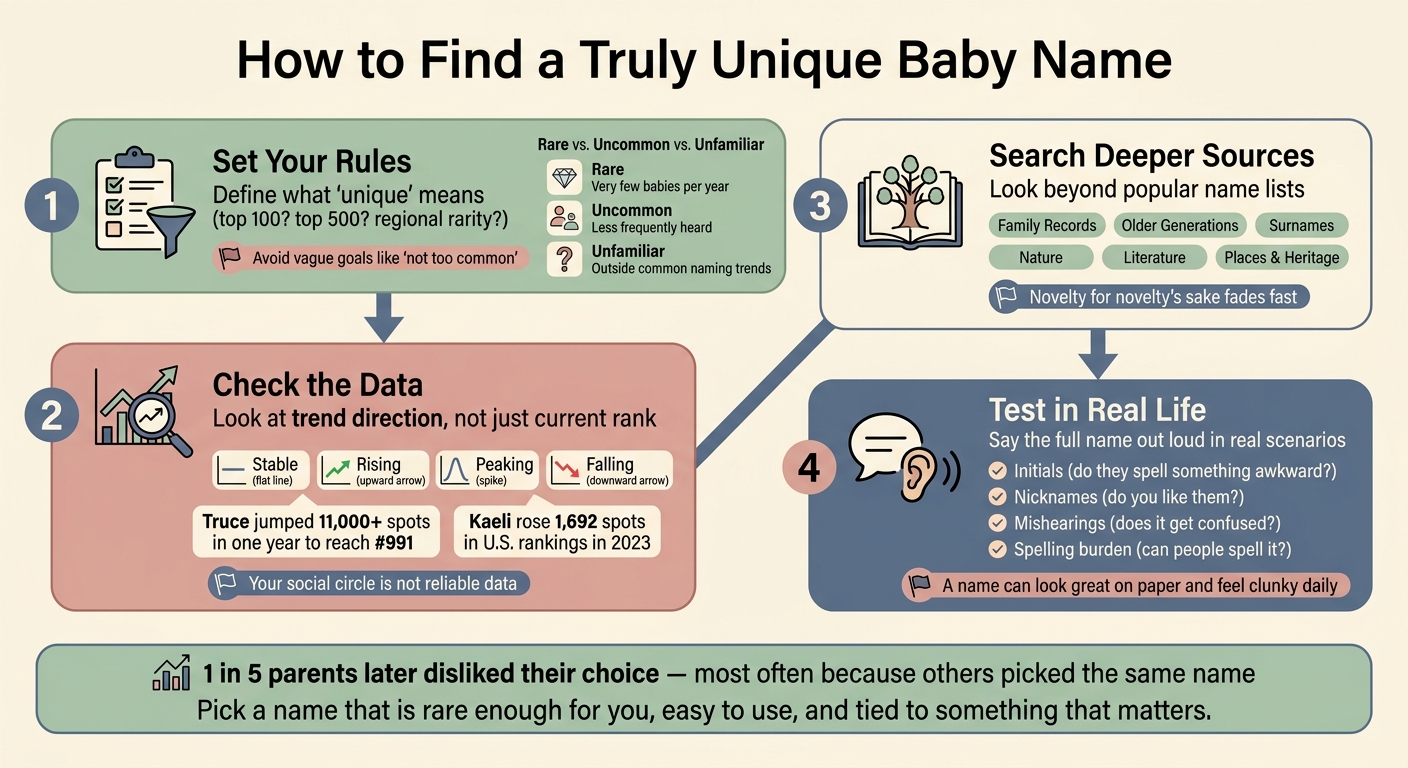
How to Find a Unique Baby Name: 4-Step Process
Step 1: Decide What 'Unique' Means to You
Start by turning that three-part test into something you can actually use.
Before you look through names, get clear on what unique means for your family. If you don't agree on the target first, it's easy to burn time on names that one of you was never going to like anyway.
The Difference Between Rare, Uncommon, and Unfamiliar Names
These words don't mean the same thing.
| Category | What It Means | Example |
|---|---|---|
| Rare | Appears very infrequently in U.S. Social Security Administration data - often outside the top 1,000 or used in fewer than a few hundred births per year nationally | Ansel, Calder, Liora |
| Uncommon | Shows up in the data but well below the top ranks - unlikely to be shared in class | Margot, Silas, Imogene |
| Unfamiliar | May be rare or common, but creates pronunciation or spelling friction for most Americans on first contact | Names with diacritical marks, silent letters, or non-English phonetic patterns |
A good sweet spot? Rare, but still easy to say and spell.
Once you know what kind of uniqueness you're after, set the limits together.
Set Your Non-Negotiables as a Couple
Before you browse, agree on a short list of non-negotiables. Have each partner write down the must-haves first. Then compare notes, find the overlap, and settle on 3–5 rules.
For example: "Must be easy to spell in English, outside the current top 100, and not a name anyone in our immediate family already has."
That gives you a shared filter instead of a vague feeling.
Then take one more step and turn those preferences into a clear rarity range.
Pick a Uniqueness Range, Not Just a Yes-or-No Rule
Use real U.S. data to set the range:
- Outside the top 100 nationally - you may still run into another child with the name, but it won't feel overused
- Outside the top 500 - not likely to be shared in class, while still showing up in SSA records
- Under-the-radar regionally - ranks in the middle nationally but is rarely used in your state or metro area
- Quietly rising - starting to gain traction without feeling too common
You can Use a baby name popularity calculator to see how rare a name really is, then cross-check rarity with popularity data to spot names that are rising or staying under the radar.
That way, you have a clear filter in place before you dig into trend data.
sbb-itb-f13f980
Step 2: Check Rarity and Naming Trends Before You Commit
Now put that range to the test with actual data. First, check whether the name is rare where it counts.
Why Personal Familiarity Is Not Reliable Data
Your social circle is a tiny sample. A name can seem uncommon because no one around you uses it, while at the same time it may be climbing fast in national rankings or showing up often in regions, groups, or age ranges you rarely see.
That’s how names like Aiden or Harper can feel new in one circle even though they were already moving up fast across the country. So treat personal experience as anecdotal, not proof. Then check whether that gut feeling lines up with the data.
Check Whether a Name Is Stable, Rising, or Peaking
A name’s direction matters just as much as its current rank. A name sitting outside the top 500 but climbing year after year is a very different pick from one that has barely moved in a decade.
| Trend Pattern | What the Data Looks Like | What It Means for You |
|---|---|---|
| Stable | Flat line, consistent annual count | Likely to stay rare; lower risk |
| Rising | Steady upward slope, climbing rank | Could feel much more common in 3–5 years |
| Peaking | Sharp spike, then plateau | Already mainstream or close to it |
| Falling | Downward slope from a prior high | Becoming less common; may feel dated |
To see how rare a name really is, look at the last 10–15 years, the latest annual count, and any sudden jumps. For example, Truce jumped more than 11,000 places in a single year to rank #991. That’s exactly the kind of spike you want to catch before you commit.
Cross-Check Rarity With Popularity Data
Once you’ve checked the trend line, use a popularity calculator and trend tool to compare rarity with popularity data and confirm where the name stands today. Use both tools to verify the current rank and the direction of the trend.
A name with low usage and a flat or falling trend is usually a good sign. A name with modest usage and a steep climb usually isn’t.
Step 3: Search Sources Most Parents Overlook
Next, look for names with history and low visibility. The goal here isn't novelty for novelty's sake. It's finding names that have some weight behind them.
Family Records, Older Generations, and Surname Names
Your own family tree is one of the most overlooked places to search. Grandparents, great-grandparents, and even old immigration records can turn up names most people aren't considering. Names from the early 1900s often hit a sweet spot: they feel rooted in history, but you don't hear them everywhere.
Surnames can also work well as first names. Occupational surnames like Archer or Fletcher, and place-based surnames like Holland or Dale, already sound natural as first names in the U.S. Just keep two things in mind: the name should be easy to say and easy to spell. And it shouldn't come with an awkward link you didn't notice at first.
If a family name or surname jumps out, don't rely on gut instinct alone. Run it through trend data before you decide. Once you land on a surname you like, see how rare a name really is before you commit.
Nature, Literature, Places, and Cultural Roots
Nature names tend to work best when they feel specific. Think plants, animals, landscapes, stars and planets, or weather. That usually gives you more substance than broad theme-based picks.
For literature, start with books that mean something to you. For place names, look first at locations that matter in your own life. A name usually feels stronger when there's a story behind it.
When you're drawing from heritage or community roots, accuracy matters. If the name connects to your own background, check the pronunciation with native speakers or family elders. Then make sure the name works in day-to-day use. It's also smart to avoid names with sacred or ceremonial meaning if you're choosing them only for the sound. Pick names tied to something real in your life, not just something that sounds nice.
Use NameHatch to Compare Style Fit Together
This is where the search gets more practical as a couple. comparing NameHatch vs BabyName vs Kinder shows how swipe-based discovery lets each partner react to names fast and on their own. That helps you spot overlap without getting stuck on one early favorite.
The style filters can help, too. If you agreed on a direction back in Step 1, you can use filters like:
- vintage
- nature-inspired
- surname-style
- others that match your lane
After both partners have swiped, the shared shortlist shows only the names you both liked. From there, run each option through the popularity calculator to check its current rank, then compare that with trend data. That way, your shortlist reflects both taste and data.
Then move the strongest names into practical testing.
Step 4: Test Each Name and Build a Final Shortlist
Once you share the shortlist, put each name through a real-life test. And before you lock anything in, run every finalist through the trend analyzer and baby name analytics one more time.
Say the Full Name Out Loud and Check Daily Usability
Say the full name in the kind of places where people will actually use it: during school roll call, at a pediatric appointment, on a voicemail greeting, in a casual introduction, or on a form at the doctor’s office.
A name can look great on paper and still feel clunky in daily life. That’s why this step matters.
Check a few basics:
- Initials: Do they spell something awkward? Look out for initials that turn into odd words or acronyms.
- Nicknames: Write down every clear shortening or rhyme. If you don’t like Gus for August, Sera for Seraphina, or Cash for Cassius, that’s worth knowing now.
- Mishearings: Try the name in a noisy place and ask someone to repeat it back. If Arden keeps coming back as Garden, or Nola as Lola, that may mean a lot of daily corrections.
- Spelling burden: Show the name in writing and ask people to pronounce and spell it without help. If errors keep happening, that’s a sign the name may be harder to use than you want.
After the usability check, compare the names that are still standing with the same set of criteria.
Compare Your Top Options Side by Side
Once a few names pass the usability test, place them next to each other. A simple comparison table helps turn a gut feeling into something more concrete.
| Name | Rarity level | Trend direction | Ease of pronunciation | Style match | Nickname risk |
|---|---|---|---|---|---|
| Finalist 1 | Rare enough for your preference? | Rising, stable, or peaking? | Easy, medium, or hard? | Fits the surname and sibling names? | Any short forms you dislike? |
| Finalist 2 | Rare enough for your preference? | Rising, stable, or peaking? | Easy, medium, or hard? | Fits the surname and sibling names? | Any short forms you dislike? |
| Finalist 3 | Rare enough for your preference? | Rising, stable, or peaking? | Easy, medium, or hard? | Fits the surname and sibling names? | Any short forms you dislike? |
Score each name the same way so the tradeoffs are easy to see. A name may be rare enough for your taste and still stumble on pronunciation or clash with the last name.
Pick the Name That Holds Up After Practical Testing
Use your top names at home for a few weeks when talking about the baby. Pay attention to the one you both reach for without forcing it.
Then stretch the name a bit. Does it fit a toddler? Does it still work for an adult? Picture it in a work setting too: Judge Imani Rhodes, Dr. Caspian Lee, or Professor Amara Collins.
Keep the names that still feel easy to use after hearing, saying, and repeating them over time.
Once a name passes these tests, you have a shortlist ready for the final choice.
Conclusion: Choose a Name That Is Rare, Usable, and Right for Your Family
A good baby name does three jobs at once: it stays rare, works in daily life, and fits your family.
Once you’ve checked the data and put the name through a simple usability test, the best option is usually the one that still feels solid outside the baby-name list and in day-to-day life.
The process is pretty straightforward:
- Decide what “unique” means to you
- Check rarity with data
- Look through less obvious sources
- Test how the name works in daily use
- Compare your top picks side by side to narrow your list
That said, rarity is just one filter. A name can look great on paper and still be a poor long-term pick if people stumble over the pronunciation, if it sounds off with your last name, or if it doesn’t hold up in normal use. In one survey of 2,000 parents, one in five later disliked their choice, most often because others chose the same name.
Before you make the final call, analyze naming trends and cross-check with the popularity calculator to make sure the name is still rare and not climbing too fast.
The aim is simple: pick a name that reflects your family’s values, passes practical tests, and still feels right years from now. A family tie, a place connection, or a cultural link can also make a name easier to keep loving even as naming trends change. If it’s rare, usable, and meaningful, you’ve likely found the right one.
FAQs
How rare is rare enough?
How rare is “rare enough” comes down to your own balance between individuality and practicality. Some parents want a name that sits outside the top 1,000. Others feel that names in the 500s or 600s stand out plenty without seeming too far off the beaten path.
To figure out what feels right for your family, look at how rare a name actually is and use the baby name popularity calculator to compare rarity and popularity.
How can I tell if a name is about to get popular?
Use the Baby Name Trend Analyzer to see whether a name is moving up or down over time. The timeline lays out popularity year by year, so you can spot when a name is on the rise, hits its high point, or starts to fade.
It’s especially handy if you’re looking at less common, under-the-radar names. You can use it to see how rare a name really is and analyze naming trends without guessing. For an extra check, compare your findings with the Baby Name Popularity Calculator.
What makes a unique name easy to live with?
A less common name is easier to live with when it stands out without feeling hard to use day to day. If it’s easy to spell and say, your child is less likely to spend years correcting people.
It also helps to see how rare a name is by looking at naming trends, then using a baby name popularity calculator to compare rarity with current use. The sweet spot is often a name that feels right on a toddler, a teenager, and an adult.