Most parents don’t need more name ideas. They need a better stopping rule.
If I want to use a baby name generator without feeling buried in options, I keep the process short and strict: set filters first, review names in small batches, test each name out loud, and stop at 3–5 strong finalists. That matters because too many choices can wear down judgment, and long search sessions often leave people less sure, not more sure.
Here’s the short version:
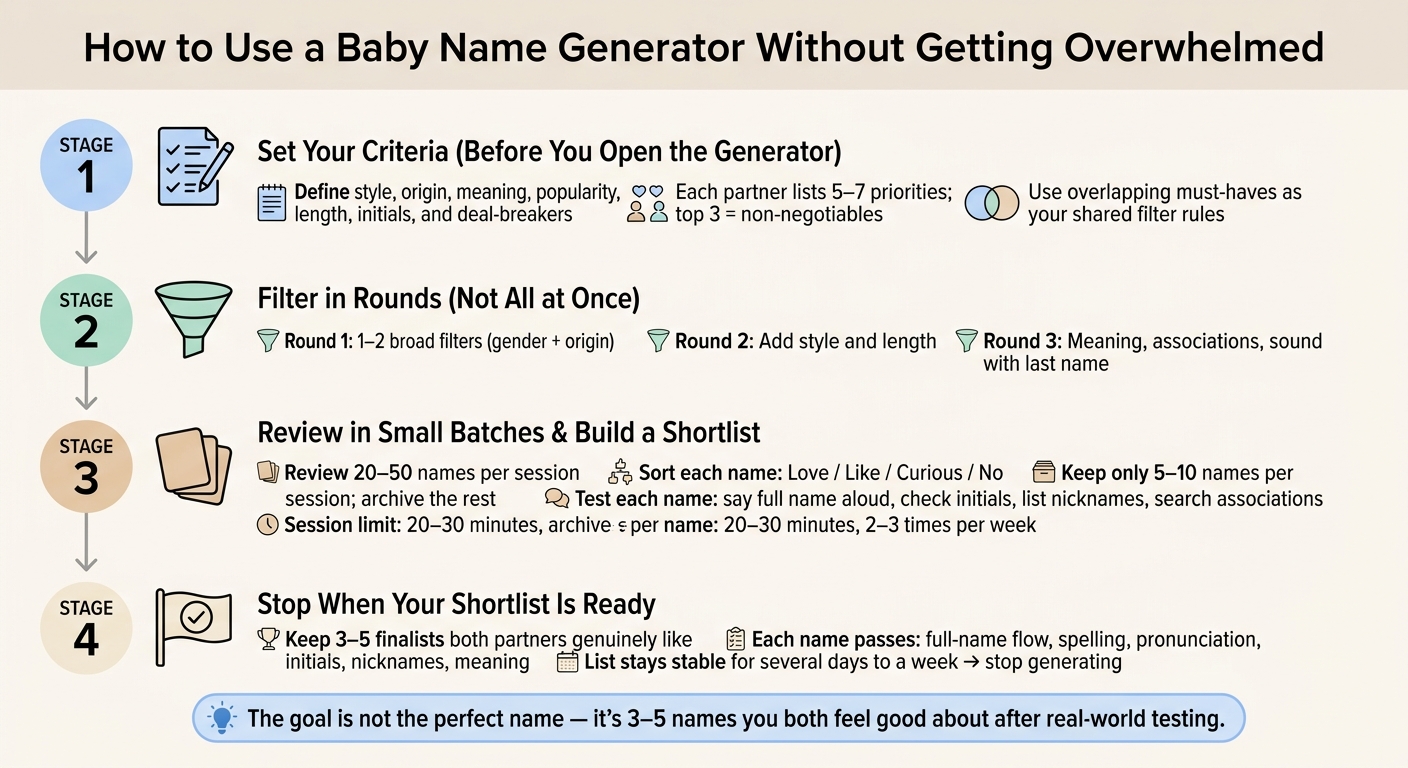
- Start with clear rules: style, origin, meaning, popularity, length, initials, and deal-breakers
- Use filters in rounds: broad first, then narrower
- Limit each session: about 20–30 minutes, 2–3 times per week
- Review only 20–50 names at a time
- Sort fast: love, like, curious, or no
- Keep only 3–5 finalists
- Test each finalist: full name flow, initials, nicknames, spelling, pronunciation, and public associations
- Stop when the list stays steady for several days to a week
A baby name generator works best as a sorting tool, not a final judge. If I go in without a plan, I get endless scrolling, too many “maybe” names, and more second-guessing. If I use a short list of rules and hard limits, the search feels lighter and the final choice gets easier.
The main idea is simple: fewer sessions, fewer saves, and tighter filters usually lead to a better shortlist.
How to Use a Baby Name Generator Without Getting Overwhelmed
Step 1: Set your name criteria before you open the generator
Define your family's name criteria
Start with a one-page name brief before you do anything else. Keep it simple. A few bullet points are enough.
Include the basics:
- style
- origin
- meaning
- popularity range
- length
- initials
- names you want to rule out
For popularity, be specific. “Outside the top 100 but within the top 500” works much better than “not too popular.”
Writing this down gives both partners the same yardstick. Instead of judging names on the fly, you’re working from one shared set of rules. That turns random browsing into a clear process.
A good way to do this: each partner writes down 5–7 priorities, then marks the top 3 as non-negotiables. When you compare lists, the overlap becomes your shared must-haves. Everything else goes in the nice-to-have pile. That list can help break ties later, but it doesn’t need to kill a name during the search.
Once you’ve set the rules for your shortlist, use filters in rounds instead of piling them on all at once.
Use filters to narrow results in rounds, not all at once
Apply filters in stages so your list stays broad enough to be useful. If you filter too hard at the start, you can box yourself in fast.
In Round 1, use only 1–2 broad filters. Gender, if known, and origin are a solid place to start. Move through names fast and save only the clear fits.
In Round 2, add style and length to narrow the pool.
By Round 3, you can focus on meaning, associations, and how each name sounds with your last name.
This round-by-round approach gives each session a clean stopping point. That makes the whole process easier to do in short bursts instead of one long, draining scroll.
The table below shows which filter to use first based on your biggest concern:
| Filter type | What it controls | Why it helps |
|---|---|---|
| Origin | Language or cultural background | Avoids names that feel out of place or are hard to pronounce in your community |
| Meaning | The name's definition or theme | Prevents choosing a name with an unwanted meaning or association |
| Popularity | How common the name is in the U.S. | Avoids names that feel too common or too rare for your comfort level |
| Style | Overall vibe - classic, modern, vintage, etc. | Keeps the name's feel consistent with your taste and family naming style |
Start with your biggest concern, then add one filter per round.
After the filters are set, limit each session so the shortlist grows in stages.
sbb-itb-f13f980
Step 2: Limit each session and build a shortlist in stages
Use a small-batch method for every naming session
Set a firm cap of 20–50 names per session. That range keeps each round from turning into a blur.
Open the generator, apply your filters from Step 1, and save up to 30 names. Then sort each one into love, like, curious, or no. Cut the “no” names right away. After each session, keep only 5–10 names and archive the rest.
That small-batch approach helps you stay clear-headed. Instead of staring at an endless stream of options, you’re making a few solid choices at a time.
Then test each saved name before it reaches the final list.
Test names before they reach the final list
Run each name through a few simple checks.
Say the full name aloud - first, middle, and last - several times, at normal speed and like you’re calling across a playground. Listen for awkward rhythm, tongue-twisters, or sounds that run together. Then write out the initials and make sure they don’t spell an unintended word or acronym. After that, list the likely nicknames, including ones you wouldn’t pick yourself, and decide whether you can live with all of them.
Finally, search for unwanted associations. Check for public figures, brands, or recent controversies you’d rather not link to your child’s name. Then picture the name on a preschool cubby, a diploma, and a résumé. If it only feels cute for a little kid or sounds awkward on an adult, it may not belong on your finalists list.
Compare finalists in one organized place
Once a name passes, add it to the finalists list. Keep 3–5 finalists, and put every serious option in one shared place - not spread across screenshots or random notes apps.
A simple comparison table makes the last review much easier:
| Name | Full name flow | Nicknames | Meaning / Origin | Popularity (U.S.) | Partner A Rating | Partner B Rating |
|---|---|---|---|---|---|---|
| James Alexander Smith | Smooth, no repeated sounds | Jamie, Jim | Supplanter / English | Top 10 | 5/5 | 4/5 |
Fill out each row together. Then look for names where both ratings are high and the practical columns show no red flags. When your list is down to a few finalists, move it into NameHatch's shared tools for side-by-side review.
Step 3: Use NameHatch features to keep the process simple and shared
Set up NameHatch with filters and clear limits before you start
Once you’ve set your criteria, bring them into NameHatch through one shared search. Before you start swiping, pick 1–2 filters that fit what you want and set a hard cap on how many swipes and saves you’ll allow in that session.
If you’re leaning toward a certain theme, premium filters can trim the list right away. Options like Nature-Inspired, Global, Mythical, or Unique help you start with a smaller, more focused pool instead of scrolling through everything.
Use swipe decisions and partner matching to find overlap fast
At this point, move fast and trust your first reaction. Swipe right if you like a name, swipe left if you don’t, and avoid spending too much time on any single option.
Each partner swipes on their own, and NameHatch marks mutual likes for you automatically. That means the same names land in one shared place for both people, which cuts down a lot of the usual back-and-forth. From there, you can use those matches to trim the list and then review each feature at the right point in the process.
Match each NameHatch feature to the right stage of your search
Each feature does its best work at a different stage. Use them in sequence so your search gets tighter over time instead of drifting outward.
| Feature | How It Reduces Overwhelm | Stage |
|---|---|---|
| Smart Filters | Limits the pool to one style direction at a time | Exploration |
| Premium Filters | Targets niche themes (Nature-Inspired, Mythical, etc.) | Exploration |
| Swipe Interface | Encourages fast, gut-level yes/no decisions | Shortlist Creation |
| Partner Sync | Finds overlap automatically - no manual list-matching needed | Shortlist Creation |
| Shared Favorites | Keeps mutual likes in one place for side-by-side review | Final Review |
Conclusion: Build a calm naming routine and stop when your shortlist is ready
This method works best when you keep it structured, brief, and shared. Once those pieces are in place, the job changes. You’re no longer trying to find more names. You’re trying to protect the shortlist you already have.
Use short, scheduled sessions instead of searching constantly
At this stage, the search should be narrow, not endless. Aim for 20–30 minute sessions, two or three times per week. That kind of schedule is easier to keep up with and can help cut decision fatigue.
A simple way to handle each session:
- Each partner reviews names alone first and saves only the ones that honestly feel like contenders
- Then compare lists, look for overlap, and move shared favorites ahead
Why does this help? Because making too many choices back-to-back wears down your judgment.
Know when to stop generating and commit to your shortlist
Stop when your shared list has 3–5 names that both partners genuinely like. Each name should also pass the practical checks: full-name flow, spelling, pronunciation, initials, nicknames, and meaning.
One more signal matters here: the list should stay stable for several days to a week. If that happens, generating more names usually doesn’t help. It just adds noise.
No name is going to feel 100% perfect. That’s the trap. Chase perfection, and the list keeps growing. The goal is much simpler: 3–5 names you both feel good about, after real-world testing and a few days to sit with them. Then stop generating and start choosing.
FAQs
What if my partner and I like completely different names?
If you and your partner have different tastes, NameHatch can make the process feel a lot easier. Instead of debating every name in the moment, you can each browse and swipe on your own time. That takes some of the pressure off and makes disagreements feel less intense.
Then NameHatch pulls together a shared shortlist of names you both liked. So rather than sorting through every option, you can focus on the ones you already agree on.
If you're still stuck, it helps to talk about why each of you likes certain names. Maybe one of you cares about meaning, while the other likes how a name sounds. That kind of conversation can help you find common ground.
How do I know when to stop searching for more names?
Stop once you have a short list of names that both you and your partner love. Quality matters more than a huge list. As you narrow things down, pay attention to patterns. You may notice you're both drawn to the same style, sound, or feel.
Then live with your top pick for a full week. Say it out loud. Picture using it in everyday life. If you're both still excited at the end of that week, there's a good chance you've found the one. If not, go back to your shortlist and try the same approach with another favorite.
Should I choose a name that is unique or easy to spell?
That’s a personal call, but it’s worth a minute of thought. Ask yourself if the name is easy to spell, or if your child might spend years correcting people.
The aim is to find a middle ground between a name that reflects your family’s story and one that works well in daily life. Clear filters can help narrow the list to names that match what you want.