Picking a name for U.S. life usually comes down to one simple rule: choose a setup early, then use it the same way everywhere. That means the same spelling, the same name order, and the same spacing on school forms, passports, clinics, and work records.
If I were summarizing the full guide in plain English, I’d put it this way:
- I need to decide whether my child will use traditional vs. modern names—an East Asian name, an English name, or both
- I need to lock in one legal format for first / middle / last fields
- I need to pick one romanized spelling and keep it fixed
- I need to plan for school use, home use, travel, and later job records
- I should think about pronunciation early, because about 75% of international students report name mispronunciation, and nearly 50% link it to feeling less connected at school
A few issues show up again and again: family-name-first vs. U.S. first-name-first order, missing hyphens, middle-name fields that don’t fit, and school systems that show one version while passports show another. The good news is that most of this can be handled with a clear naming plan.
Quick comparison
| Option | Main upside | Main downside | Common setup |
|---|---|---|---|
| East Asian name only | Keeps family meaning visible | More pronunciation and record issues | Legal and daily use match |
| English name only | Easier in many U.S. settings | Family background is less visible in the first name | East Asian name may move to middle name or home use |
| Both names | Keeps family link while easing daily use | More versions to track | English first + East Asian middle, or legal East Asian name + social English name |
I’d read this article as a practical guide to one goal: pick a name that fits your family, then make it easy to use in daily U.S. life without losing the name story behind it.
sbb-itb-f13f980
How East Asian Naming Systems Work on U.S. Forms and Records
Most U.S. forms expect names in first, middle, last order. That sounds simple until it runs into East Asian naming patterns, where the family name usually comes first and the given name comes second. That mismatch shows up fast in school enrollment, passport applications, medical records, and payroll systems. In day-to-day life, the way a name fits U.S. paperwork can shape whether parents stick with one name or use two.
Chinese, Korean, and Japanese Naming Patterns Parents Should Know
Chinese names usually have a one-syllable family name followed by a one- or two-syllable given name. The given name gets its meaning from the Chinese characters, and English spelling can change based on romanization. So the same surname may appear as Wang or Wong, depending on dialect and romanization.
Korean names follow the same family-first pattern, and the given name is often two syllables. Parents may write that given name as one word, with a hyphen, or with a space. The main thing is simple: pick one version and stick to it across every record.
Japanese names also put the family name first. When the name is romanized, it helps to keep the spelling exactly the same on all documents.
Common U.S. Paperwork Problems and How Families Handle Them
A child named Zhang Wei might show up as "Wei Zhang" on a school roster but "Zhang Wei" on a passport. That kind of mismatch can hold up medical care or travel.
Two other common problems are hyphens disappearing and middle-name fields causing trouble. Many clinic and payroll databases drop hyphens on their own, so Wei-Chen turns into Weichen without anyone spotting it until a record no longer matches an ID. On top of that, many East Asian names do not have a middle name, but U.S. forms often ask for one anyway.
Families usually deal with this by settling on one fixed format early and using it everywhere. In practice, that often means:
- leaving the middle-name field blank
- using part of a two-syllable given name as a middle name
- using an English first name and placing the East Asian name in the middle field, such as Michael Wei-Chen Zhang
Pick one spelling and one name order early, then use that same format on every form. Once that paperwork choice is set, the next step is deciding whether to use the East Asian name, an English name, or both.
Choosing an East Asian Name, an English Name, or Both
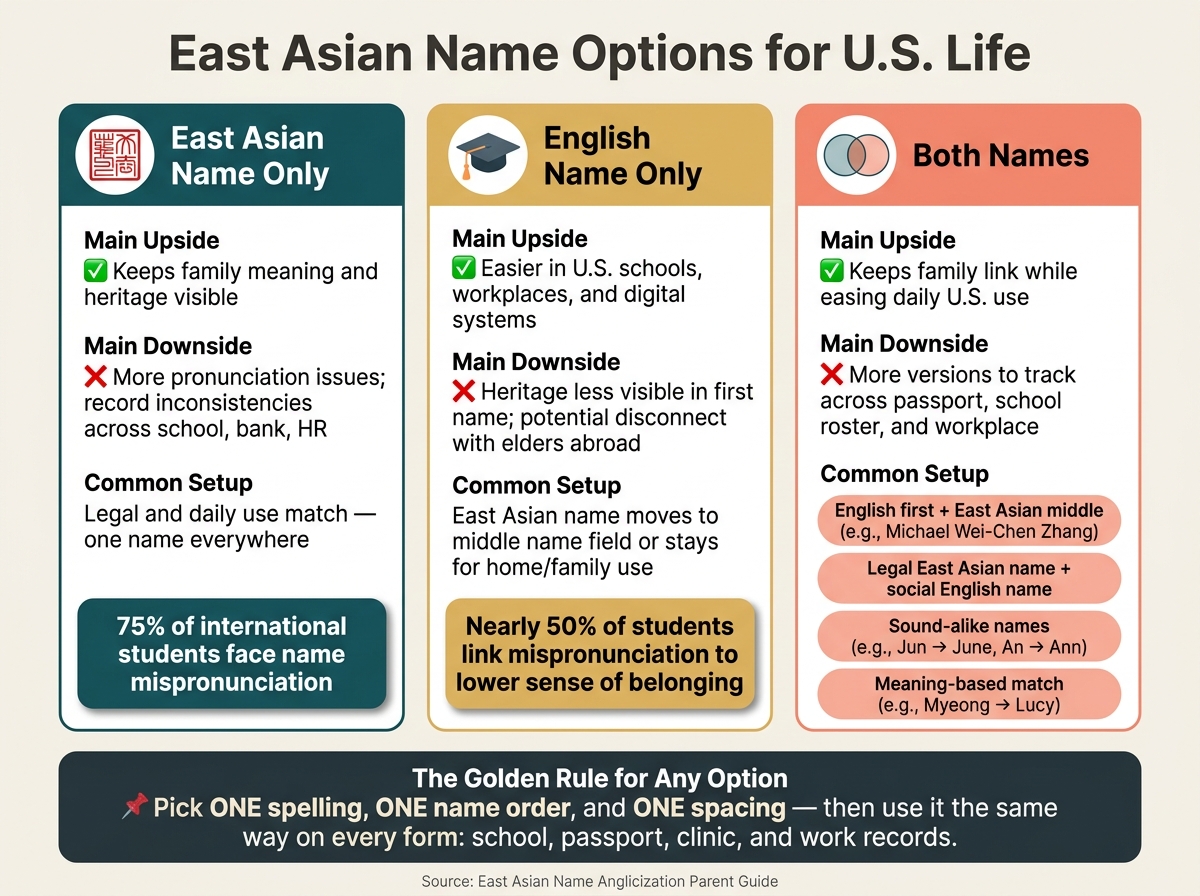
East Asian Name Options for U.S. Life: Heritage vs. Ease Comparison
Once the legal format is set, families have another choice to make: should the name used every day match the legal name, or should it be different? There isn't one right answer for everyone. What helps is looking at the tradeoffs in plain terms. For most families, the decision comes down to heritage, ease, and how much change they want to deal with in daily life.
Option 1: Using an East Asian Name
An East Asian name keeps lineage, language, and family meaning front and center. For many parents, that's the whole point. A name can carry history. It can tie a child to grandparents, extended family, and a language spoken at home.
The flip side is day-to-day friction. Mispronunciations happen often, and records don't always stay consistent across schools, banks, and HR systems. Some parents also think about the chance of name-based bias in hiring.
- Benefit: Strong heritage continuity - the name carries cultural meaning and connects the child to extended family and language.
- Tradeoff: Administrative hassle and spelling inconsistencies across school, bank, and HR systems.
Option 2: Using an English Name
An English name tends to make life simpler in U.S. settings. It usually fits more smoothly into school rosters, workplace systems, and online forms. That's a big reason some families go this route.
But there can be a cost. The child's heritage may be less visible in the first name, and some children feel a gap when elders or relatives abroad don't know the name they use every day.
For some families, the middle name helps bridge that gap. Using the East Asian name as a legal middle name keeps that family link in place, even if the heritage name mostly stays within the family or appears only in legal records.
- Benefit: Maximum ease in U.S. schools, workplaces, and digital systems.
- Tradeoff: Less visible heritage in the first name; potential disconnect with elders.
Option 3: Dual Naming Strategies That Balance Heritage and Ease
Many families land in the middle and use a dual naming setup. This gives them room to keep one name for legal use and another for certain social settings. It can work well, but only if the rules are clear from the start.
Here are the most common setups:
- Legal English first name + East Asian middle name - keeps the heritage name on legal documents while making everyday use simpler, such as Michael Wei-Chen Zhang.
- Legal East Asian name + everyday English social name - keeps the heritage name official while cutting down on daily hassle.
- Sound-alike names - one name works across both languages, such as Jun → June or An → Ann.
- Meaning-based match - an English name reflects the meaning of the heritage name, such as Myeong, meaning "bright", becoming Lucy or Clara.
Dual naming gives families flexibility, but it also adds moving parts. A passport, a school roster, and a self-introduction might each show a different version of the name. Picking one consistent legal name early helps avoid most of that confusion.
After the naming path is set, the next choices are spelling, romanization, and pronunciation.
Romanization, Spelling, and Pronunciation Choices in American English
Once the legal name order is set, spelling is the next call to make. That choice shapes how people say the name and how smoothly it works in U.S. systems.
Romanization Systems and Legacy Spellings
Romanization differs by language, and many families pick the spelling that matches their history and everyday life.
For Chinese names, Pinyin is the current standard in Mainland China, with forms like Zhang, Chen, and Xu. But many families from Taiwan, Hong Kong, or Southeast Asia still use older spellings tied to Wade-Giles or dialect-based forms such as Cantonese or Hokkien. The same character 陳 can appear as Chen in Pinyin, Chan in Cantonese, and Tan in Hokkien. Sticking with a familiar spelling like Chan or Wong can make the name easier to say while also matching family identity and past records.
For Korean names, the Revised Romanization of Korean was adopted in 2000 and was made to work well in computer systems, without diacritics or apostrophes. Even so, older spellings like Lee and Park are still common in the U.S. because English speakers know them and many families have used them for years.
For Japanese names, Hepburn is the main international standard. Macrons like ō and ū show long vowels, but they are often dropped on U.S. forms since many digital systems do not handle them well.
Pick one spelling and use it the same way on every record.
After that, the next step is simple: help people say it right.
Spelling Decisions: Hyphens, Long Vowels, and Readability
Beyond the romanization system itself, smaller spelling choices can change how a name looks and how Americans read it.
| Spelling Choice | How Americans may read it | Best for heritage accuracy | Form issues |
|---|---|---|---|
| Hyphenated (e.g., Wei-Chen) | Helps distinguish syllables | High; keeps syllables distinct | Some systems reject hyphens |
| Combined (e.g., Weichen) | May blur into one sound | Moderate; looks like a single unit | Most compatible with databases |
| Separate (e.g., Wei Chen) | Clear, but "Wei" may read as a middle name | High; preserves individual character sounds | Often leads to middle name confusion |
| Older spelling (e.g., Park, Lee) | Very easy for Americans to say | Low; often drifts from official romanization | Very standard in U.S. systems |
Before you lock in a spelling, try a simple test: write it down and ask a few native English speakers to read it aloud cold. If what they say sounds far from the original, it may be worth changing the spelling. Pinyin forms with zh, q, or x - such as Xinpei - often trip up English readers.
For Korean given names, using a space between the two syllables is often clearer than combining them.
How to Help Teachers, Doctors, and Family Say the Name Correctly
A clear spelling goes a long way, but a short pronunciation guide can help even more. About 75% of international students deal with name mispronunciation, and nearly 50% connect that experience to a lower sense of belonging.
A small step can make a big difference. Add a one-line phonetic guide to school enrollment forms or medical intake paperwork. You can also record a short pronunciation clip and send it to a teacher at the start of the school year. For relatives, share both the pronunciation and the meaning so the name carries its full weight.
"The effort of learning names correctly, or at least trying to, can transform classrooms." - April Mao, Student and Author
Making the Name Work at School, at Home, and Later at Work
Once the legal spelling is set, the next test is everyday use: school records, home life, and later, work documents. The big rule is simple: keep one spelling, one order, and one spacing pattern across records. Even small differences can cause delays.
School Use: Rosters, Roll Call, and Preferred Name Planning
Many U.S. schools separate a student's legal name from their preferred name on enrollment forms. If your child will use an English name in class, put the legal East Asian name in the field that asks for the legal name, then add the English name in the preferred-name field. That keeps school records correct while making daily use easier for teachers and classmates.
Substitute teachers are often where names get tested the hardest. A main classroom teacher may learn the pronunciation fast, but a substitute may only have the roster in front of them. It helps to share a phonetic spelling guide with the school before the first day. It also helps to teach your child a short, easy introduction for the name they use.
| School Situation | Potential Challenge | Practical Response |
|---|---|---|
| Enrollment Forms | Legal name must match birth certificate, but the child uses a different day-to-day name | Put the legal name in the official field and the English name in the preferred-name field |
| Roll Call | Teacher mispronounces a romanized East Asian name | Share a phonetic spelling guide before the first day of school |
| Substitute Teachers | Substitutes often only see the roster, which can lead to mispronunciation | Have the primary teacher leave a note in the sub-plan, and teach the child a simple way to introduce the name they use |
| Standardized Testing | Name on ID doesn't match the pre-printed test label | Make sure the school uses the exact legal spelling and order on all testing registrations |
Before school starts, pick one approved short form if you plan to use one. That way, classmates don't make one up on their own.
Those school habits often spill into home life too.
Mixed-Language Families and Cross-Cultural Everyday Use
This is where dual naming stops being an idea on paper and becomes part of daily life. In homes where one parent speaks Mandarin, Korean, or Japanese and the other does not, a name may do two jobs at once. Grandparents abroad may use the East Asian name, while school, doctors, and other U.S. settings use the English one. Many children learn to answer to both names without confusion.
If siblings share a naming pattern, keep that pattern steady from child to child. When a family has a naming custom that matters, it helps to carry it through.
| Family Language Situation | Naming Considerations | Good-Fit Strategy |
|---|---|---|
| One East Asian parent, one non-East Asian parent | Ensuring both parents feel connected to the name | Choose a name both parents can pronounce easily (e.g., Kai, Hana, Mia) |
| Bilingual household with relatives abroad | Grandparents may struggle with Western names | Give the child a legal Western first name and a legal East Asian middle name for use with family |
| Mixed-language siblings | Maintaining a coherent naming pattern across children | Use a shared family naming pattern for East Asian names while choosing distinct English names |
Keeping the Name's Meaning While Simplifying Daily Use
Making a name easier for daily U.S. use does not mean giving up what the name means. One smart step is to write down the name story: the original characters, their meanings, the values or images behind them, and why the name was chosen. Keep that record somewhere your child can find later.
NameHatch can help parents compare English names by meaning, sound, and style, then build a shared shortlist together.
For adulthood, one of the clearest resume formats is English first name + East Asian middle name + family name, such as Michael Wei-Chen Zhang. It keeps the heritage name on official documents while reading cleanly in U.S. professional settings. The goal is to choose a structure that works in school now and still looks clean in adult records.
That leaves the last step: picking the version that fits daily life without shutting down later use.
Conclusion: A Naming Plan That Respects Heritage and Works in Daily U.S. Life
After looking at paperwork, pronunciation, school use, and family expectations, the choice usually comes back to two things: heritage and day-to-day ease.
There isn’t one perfect answer. An East Asian name, an English name, or a mix of both can all work. The best fit is the one that matches your family’s values and the way you live each day in the U.S.
Once you choose a name, consistency is what matters most. Keep the spelling, order, and spacing exactly the same across every document. That small detail can help you avoid mix-ups and delays in school, medical, and job settings.
NameHatch can help parents compare meaning, sound, and style, then build a shared shortlist. The aim is simple: follow a guide to finding your perfect baby name that feels right for your family and works well in daily U.S. life.
FAQs
Should my child’s legal name match the name used at school?
There’s no one right answer. It comes down to your family’s preferences and what works best day to day.
A lot of families use both an East Asian name and an English name. The English name might be used at school because it’s simpler in that setting, while the East Asian name is used at home to keep a close link to family, culture, and heritage.
What if relatives use one name but U.S. records use another?
Many families deal with this by using two names, which is a common, practical setup in the United States.
A Western name might appear on official documents for school or work, while an ethnic name is used at home and within the community.
Some parents also use the ethnic name as a legal middle name. Over time, many children learn to switch between the two names naturally, depending on the setting.
How do I choose a spelling that works in English?
Balance family tradition with ease of reading. If your family already uses a spelling like Lee, Chan, or Wong, it’s usually best to keep it instead of chasing a perfect phonetic match.
For new names, pick a spelling that feels easy to read in English. If people often ask how to say it, a small tweak can help. You can also look at common diaspora variants or pinyin alternatives.