Names shape who we are. They influence personal identity, connect us to our families, and play a role in how others perceive us socially. From early childhood, names help us form a sense of self and belonging. Here are the key takeaways:
- Identity Formation: Names impact self-perception and tie individuals to family and cultural roots. First names highlight individuality, while last names signify group identity.
- Early Development: Infants recognize their names as early as 4 months, and by age 6, most children see their names as a core part of who they are.
- Social Impact: Names can shape first impressions, influence peer bonding, and even affect how teachers and employers treat individuals.
- Challenges with Uncommon Names: Mispronunciation or name changes for social ease can lead to feelings of exclusion or loss of identity.
- Practical Tips for Parents: Choose names that balance uniqueness with ease of use and honor cultural significance by following a guide to naming your baby.
Names are more than labels - they’re a lifelong source of identity and connection. Using a name correctly shows respect and reinforces belonging, especially for children.
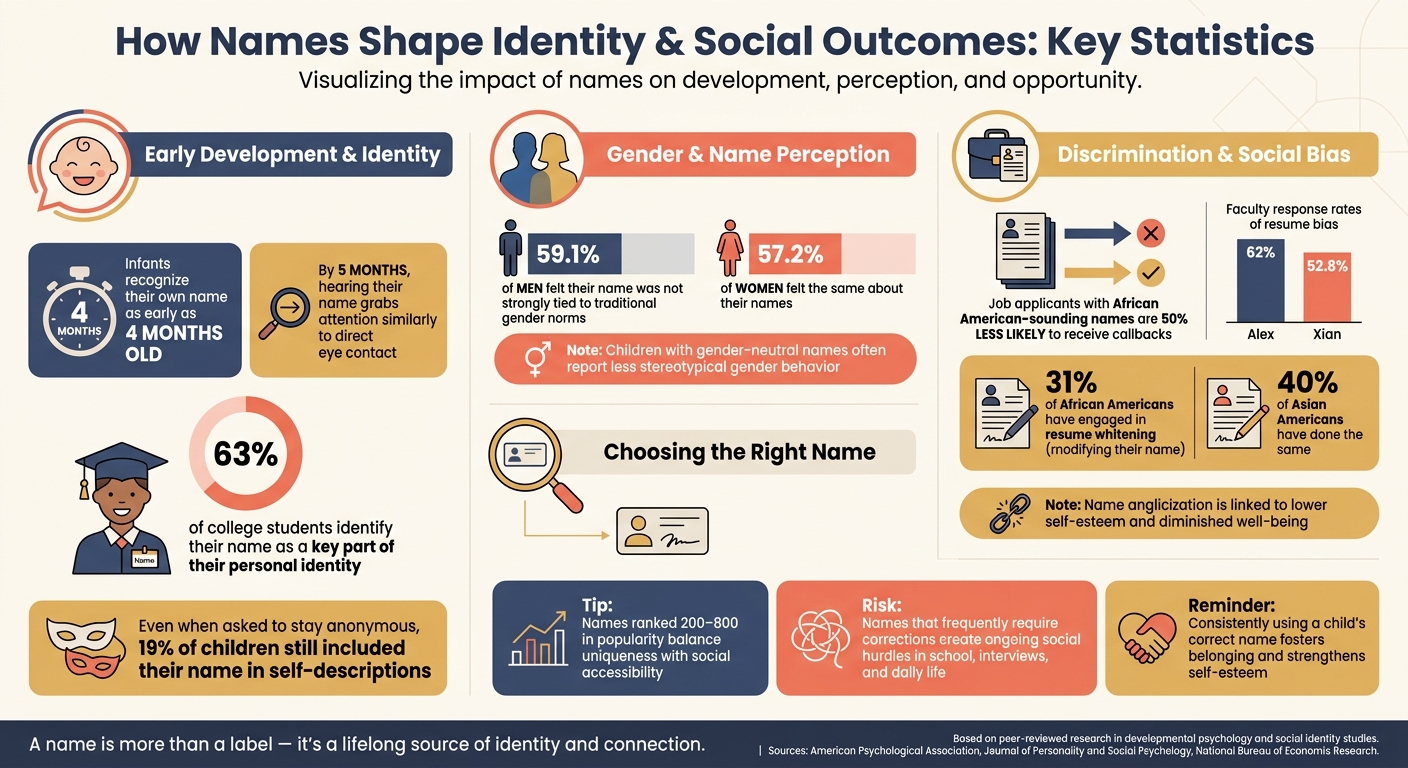
How Names Shape Identity & Social Outcomes: Key Statistics
How Names Influence Personal and Social Identity
Names and Self-Concept in Early Childhood
A name is one of the first identifiers a child encounters. Studies show that even at just 4 months old, infants recognize their own name, paying more attention to it than to other words or names. By the time they reach 5 months, hearing their name - much like making direct eye contact - grabs their attention in a meaningful way.
Research using ERP (event-related potential) studies has shown that by 5 months old, infants can distinguish their name from others based on the very first sound. This early connection to their name carries forward, as seen in a study where 63% of college students identified their name as a key part of their identity. Sociologist Chad Gordon highlights this idea:
"An individual's name... serves as his [her] more or less unique 'identity peg,' it also locates him [her] in his [her] family and serves as a handy indication of his [her] sex."
The gendered nature of names can also play a role in shaping a child’s identity. Names that are less strongly associated with a particular gender - referred to as "gender-weak" names - can influence how children view themselves and behave socially. For example, children with such names often report less stereotypical gender behavior during childhood. A study found that 59.1% of men and 57.2% of women felt their names were not strongly tied to traditional gender norms. These perceptions can influence how children see themselves and how they fit into social groups.
But a name isn’t just about individual identity - it also connects people to broader social and cultural groups.
Names as Signals of Social and Group Identity
Names do more than define a person; they also act as markers of social and cultural identity. They can reveal a person’s heritage, ethnicity, religion, and even social class - often before a single word is spoken. Professor Monica Biernat calls names "vital signifiers of identity" that place individuals within specific cultural or community contexts.
For children from immigrant or mixed-heritage families, names can carry dual meanings. A culturally rooted name can provide a sense of pride and belonging. At the same time, research highlights the challenges such names can bring. For instance, job applicants with African American–sounding names are 50% less likely to receive callbacks compared to those with White-sounding names. Similarly, a doctoral student named "Alex" received responses from 62% of faculty, while the same person using the name "Xian" got replies from only 52.8%.
These realities can push individuals to "whiten" their names - adopting anglicized versions to avoid discrimination. While this strategy may reduce bias in professional or academic settings, it often comes at a personal cost. Studies show that name anglicization is linked to lower self-esteem and diminished well-being among ethnic minorities. As Edwards observed:
"In not adopting an English name, students... retain a sense of their own cultural and personal identity in the face of what they feel is pressure to renounce this."
Ultimately, names play a powerful role in shaping both self-perception and social belonging. How a name is treated within families, schools, and communities can significantly impact a child's confidence and sense of identity.
sbb-itb-f13f980
How Names Affect Peer and Adult Interactions
First Impressions and Name-Based Assumptions
Names play a pivotal role in shaping first impressions, often setting the tone for social interactions. They are typically the first piece of information we learn about someone, and research shows that names can immediately lead to assumptions about a person’s ethnicity, social status, and even personality traits like warmth or competence. These judgments happen almost instantly - before any real interaction even begins.
This phenomenon is particularly impactful in school environments. Jochen E. Gebauer, a personality psychology researcher at Humboldt-Universität zu Berlin, highlights the potential long-term effects:
"Negative names evoke negative interpersonal reactions, which in turn influence people's life outcomes for the worse."
Teachers are not immune to these biases. Studies suggest that stereotypical names and implicit bias can influence their expectations, leading to scenarios where children with less popular names may receive less attention or face lower expectations. This is sometimes referred to as interpersonal neglect. Such early judgments can ripple through a child’s interactions with both peers and adults, shaping their social experiences over time.
Nicknames and Peer Bonding
Nicknames often emerge within social groups as a way to signal closeness and familiarity. Unlike formal names, they are personal and reflect a deeper level of connection, showing that someone knows you beyond just your official identity.
According to research published in Frontiers in Psychology, nicknames perceived as "warm" can significantly boost prosocial behaviors like helping, sharing, and offering support. This demonstrates how warmth and social appeal, often tied to a nickname, can influence how peers interact.
"Perceiving warmth signals safety and benevolence, which fundamentally drives the motivation to approach rather than avoid."
While nicknames can strengthen bonds, variations in how a name is used or altered might lead to different social reactions, underscoring the importance of how names are treated in group dynamics.
Social Effects of Unusual or Hard-to-Pronounce Names
The ease with which a name can be pronounced has a surprising influence on how individuals are perceived. The name-pronunciation effect suggests that people with simpler, easier-to-pronounce names are often judged more favorably than those with complex or unfamiliar ones. This is tied to cognitive fluency - the idea that our brains process simple information more easily, creating positive associations with it.
Simon M. Laham explains this concept succinctly:
"Easy-to-pronounce names (and their bearers) are judged more positively than difficult-to-pronounce names."
However, the issue of mispronunciation goes beyond ease of processing. In educational settings, it can be considered a racial microaggression, particularly when it involves ethnic or heritage names. Tina Bonnett and Bonika Sok of Fanshawe College highlight the widespread nature of this issue:
"Name mispronunciation and modification are pervasive and that teachers are often central contributors to this phenomenon."
For children with culturally significant names, repeated mispronunciations can create a disconnect between their identity and their heritage. This subtle yet persistent exclusion can make them feel as though they don’t fully belong, adding an emotional burden to their daily social interactions. It’s a stark reminder of how names - and the way they are treated - can deeply influence a child’s sense of belonging and social development.
How Names Are Used in Family, School, and Community
How Families Use Names to Build Connection
A name is often the first gift a child receives. Throughout life, it carries significant meaning, showing up in everything from moments of affection to times of discipline. From the beginning, a name helps a child feel grounded and connected to the world.
At home, a name creates a sense of safety and familiarity. It becomes a reflection of the child, offering a sense of authenticity and belonging. For families that choose traditional or heritage names, this connection deepens, linking the child to ancestors, cultural icons, and family traditions. When parents consistently use a child’s full name and share its story or meaning, it strengthens the child’s sense of identity. This early use of names within the family often sets the tone for how names are used in other spaces, like school or social settings.
Name Use in the Classroom
In a classroom, correctly using a student’s name sends a powerful message: this child is valued. On the other hand, mispronouncing or altering a name, even unintentionally, can have serious consequences.
"When the child enters school and teachers - consciously or not - mispronounce, disregard or change the name, they are in a sense disregarding the family and culture of the students as well." - Rita Kohli, Assistant Professor, University of California, Riverside
Studies show that students who feel pressured to anglicize or adjust their names to fit in often experience lower self-esteem, which can negatively affect their mental and physical health. Proper name usage isn’t just about pronunciation; it’s about honoring a student’s identity and making them feel part of a supportive community. Teachers can address this by prioritizing accurate name use as part of their professional practice. Simple actions, like avoiding "easier" nicknames, normalizing corrections, and exploring the meanings of names in classroom activities, help create a more inclusive environment.
"Honoring all students' names is a building block in creating welcoming, inclusive classrooms. This is about making sure every student knows they are important." - Philimena Owona, Educator and Parent
Names in Play and Peer Group Bonding
Outside the classroom, names play a key role in social interactions and group dynamics. During play, children often use names to assign roles, establish group membership, and affirm belonging. In peer groups, names serve as markers of identity and status. When coaches, community leaders, or organizers make an effort to use a child’s correct name during events like roll calls or team activities, it reinforces their place in the group. On the flip side, mispronouncing or ignoring a name can subtly suggest that the child’s identity is less valued.
"When names are mispronounced or disrespected, what could be a ritual of recognition is one of erasure." - Amina Yousaf, Associate Head, Early Childhood Studies, University of Guelph-Humber
Whether at home, in school, or within the community, consistently using names correctly fosters a sense of belonging. Neglecting or altering names, however, can slowly chip away at that vital connection.
What Parents Should Know When Choosing and Using Names
Weighing Originality Against Social Ease
A child's name plays a big role in shaping their social interactions and sense of identity. Research suggests that names ranked between 200 and 800 in popularity strike a balance between being unique and socially accessible. Such names are familiar enough to spell and pronounce easily but uncommon enough that a child is unlikely to share their name with multiple classmates in kindergarten.
Names that frequently require corrections can create ongoing social hurdles. These challenges often follow a person through school, job interviews, and daily life. On the other hand, altering a culturally significant name to make it "easier" can come at a cost. Studies reveal that 31% of African Americans and 40% of Asian Americans have engaged in "resume whitening" - modifying their names to avoid discrimination. This practice is linked to lower self-esteem and diminished mental well-being.
"Names are vital signifiers of identity and tools for communication. They may convey the wishes and desires of parents and reflect important gender, racial, and cultural associations." - Monica Biernat, Professor of Psychology, University of Kansas
To test a name’s practicality, try using it in simple, everyday exchanges - like ordering at a deli counter - to see if it’s easily understood and spelled. For those navigating these decisions, technology offers helpful solutions.
Using Technology to Help Choose a Name
Digital tools can make the process of choosing a name less daunting. With so many factors to consider - cultural heritage, family traditions, personal preferences, and practicality - finding the right name can feel overwhelming. AI-powered tools like NameHatch help streamline the process. NameHatch offers a swipe-based interface that suggests names based on specific criteria like style, origin, or vibe. Partners can sync their accounts, swipe on names individually, and match on those they both like, making the naming process smoother and more collaborative. The app works on both mobile and desktop, with free plans available and premium options starting at $3/month or $12 for six months. These tools are part of a growing trend where parents use baby name analytics to navigate cultural and social naming trends.
How Daily Name Use Builds Belonging and Self-Esteem
The way a name is used daily is just as important as the name itself. Consistently using a child’s name correctly fosters a sense of belonging and strengthens self-esteem from infancy onward. Early and intentional name use helps reinforce a child’s identity and sense of value.
Simple habits can make a big difference: greet your child using their full, preferred name, avoid shortening it without their consent, and display their name prominently in their personal space. These practices send a clear message that their identity is respected and valued. As psychologist Kenneth L. Dion explained:
"The name given a person influences the identity she/he develops."
Over time, the consistent and thoughtful use of a name becomes a foundational part of a child’s understanding of who they are. It not only affirms their individuality but also strengthens their connections with others.
Conclusion: Why Names Matter for Identity and Connection
A name is far more than just a label - it’s a cornerstone of identity, shaping how we see ourselves from the very beginning of life. Research shows that most people view their names as central to their sense of self. In fact, even when children were asked to remain anonymous, 19% still included their names in self-descriptions. This simple statistic reveals just how deeply names are tied to personal identity.
But names don’t just define us internally - they also have a ripple effect on our social lives. Names can influence how teachers interact with students, how peers form connections, and even the impressions people form before a word is spoken. H. Edward Deluzain captured this influence perfectly:
"A person's name has an impact on the process of building a self-concept because the name helps determine the messages other people send the child."
Over time, these interactions shape confidence, belonging, and social inclusion.
As explored earlier, the choice of a name and its consistent use play a critical role in both personal development and social integration. When a child’s preferred name is used respectfully and consistently, it sends a powerful message: their identity matters. Research suggests that names that are easy to pronounce, carry cultural significance, and are chosen with care create a strong foundation for self-esteem and connection. In essence, a name becomes one of the earliest and most enduring gifts of identity.
The way names intertwine identity and social connection highlights their importance throughout life. For modern parents, tools like NameHatch offer a fresh approach to this timeless tradition. NameHatch, an AI-powered and ad-free baby name discovery app, helps couples find names that balance personal meaning with social harmony - making the process of naming both intentional and meaningful.
FAQs
How can I help my child correct people who mispronounce their name?
Teaching your child how to calmly and confidently address mispronunciations of their name is an important skill. Practice at home through role-playing, using gentle phrases like, "Actually, it’s pronounced this way, but no worries - it happens all the time." This approach helps them feel prepared and at ease in real-life situations.
Encourage your child to share the meaning or story behind their name. This not only fosters a sense of pride but also helps them build resilience. If you're still searching for a name that resonates with your family's values and style, tools like NameHatch can assist in finding the perfect fit.
Should we use a nickname at school if our child’s name is often misunderstood?
Choosing a nickname for school should focus on your child’s comfort and sense of identity. Since their name is an important part of who they are, it’s worth considering how they feel about it. Mispronunciations can be annoying or even upsetting, but a well-chosen nickname might help them feel more confident and make social interactions smoother. Encourage your child to politely correct others if their name is said wrong, and always check in to ensure they’re happy with any nickname they use. Respect and confidence go hand in hand when it comes to names.
How can I choose a culturally meaningful name that works in daily life?
When choosing a name, think about how to balance its deeper meaning with everyday usability. Decide if you want the name to be strongly cultural, carry symbolic weight, or take a more understated approach. If the name is complex, you could use a simplified or anglicized version for the first name while keeping the original as a middle name. Opt for phonetic spellings to minimize mispronunciations, and try saying the name in real-life situations to see how it feels. Most importantly, pick a name that resonates with your values and fits seamlessly into daily life.