A child’s name can affect teacher expectations before class even starts. Research in one Florida district found that, even among siblings with the same test scores, a boy named Damarcus was 2% less likely to be sent to a gifted program than his brother named Dwayne. Another study found that teachers rated the same student description as less motivated when it used African American-sounding names.
If I boil this down, the article makes four main points:
- Names act like a fast signal for family background, parent education, and school support.
- Those first guesses can shape class decisions like praise, referrals, help, grading, and discipline.
- Early grades matter most because young kids are still forming their school identity.
- Parents can weigh school-read factors along with family meaning, identity, and daily use when picking the perfect baby name.
Here’s the short version: a name does not decide a child’s future, but it can shape first impressions in a U.S. classroom. The issue is not the child. It’s the way adults may read the name before they know the student.
To think it through, I’d keep these questions in mind:
- Will a teacher read the name with ease?
- Will they spell it the same way often?
- Could the name trigger the wrong assumption?
- How does that tradeoff compare with family meaning and identity?
That’s the core idea of the article: name-based bias is about perception, not ability, and those early perceptions can affect access to chances at school.
How Teachers Form Early Expectations
Teachers can start forming expectations before they’ve seen any schoolwork. In many cases, that first impression begins as soon as a class roster shows up.
Names as a First-Day Mental Shortcut
On the first day, a name does more than identify a student. It can also work like a mental shortcut, leading a teacher to make fast guesses about a child’s background before there’s any direct proof of that student’s ability or behavior. Research by University of Florida economist David Figlio found that teachers use a child’s name as a signal for background factors they can’t yet see, such as a parent’s education level, socioeconomic status, and commitment to their child’s education.
Names that seem to point to a certain cultural or economic background can shape early assumptions long before a teacher gets to know the student. In a large Florida district study, children whose names signaled lower socioeconomic status were referred to gifted programs less often than siblings with more common names.
How Early Assumptions Play Out in Class
Once a teacher forms an assumption, it can quietly affect day-to-day classroom choices. That can mean who gets called on first, who gets extra help, and who is viewed early as advanced, disruptive, or struggling. On their own, these moments may look small. Put together, they can have a big effect.
In a study of elementary teachers, identical students were rated as less motivated when the vignette used African American-sounding names. The description was identical; only the name changed.
Lower expectations can shrink a student’s access to opportunities and feed the same bias that started the problem. Over time, those first assumptions can shape grading, discipline, and the amount of attention a child gets each day.
sbb-itb-f13f980
How Names Can Trigger Bias in School Settings
Name-based bias usually doesn’t show up as one big, obvious act. It tends to slip into small classroom calls: who seems motivated, who comes across as disruptive, and whose work gets a more generous read. Those split-second judgments can shape how teachers interpret effort, behavior, and writing.
Assumptions About Achievement and Motivation
How name sounds can cue the idea that a child has strong support at home. A less familiar name can lead to the opposite judgment before the student has even spoken.
A 2008 study of 130 elementary school teachers put that pattern into focus. Researchers gave teachers the same student descriptions and changed only the name. Teachers rated students with African American-sounding names much lower on motivation than students with Caucasian-sounding names. In plain terms, the gap came from the name, not from anything the student did.
Behavior and Discipline Judgments
That same mental shortcut doesn’t stop at academics. It can shape discipline too. Names can influence who gets seen as needing correction, and teachers may assign blame more quickly when a name triggers stereotypes.
Name-Based Assumptions vs. Evidence-Based Teaching
Evidence-based teaching moves in the other direction. It leans on what a student actually does: observed behavior, clear rubrics, and the work in front of the teacher, not guesses tied to a name.
Why Early Expectations Have Lasting Effects
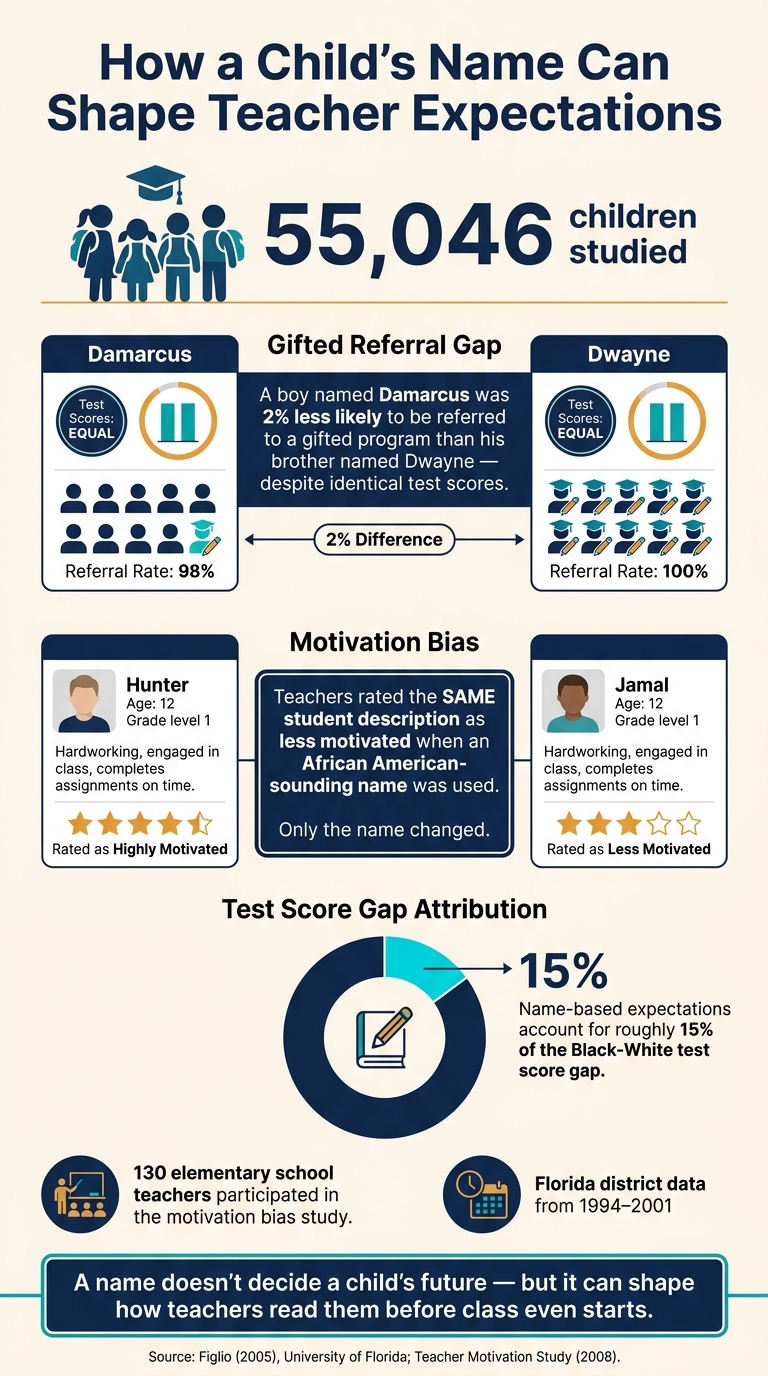
How Baby Names Shape Teacher Expectations: Key Research Stats
Once a teacher forms an early impression, it can show up in dozens of small choices across the school day. None of those choices may look huge on their own. But together, they can steer a child toward more support, more praise, and more chances to grow, or away from them.
Small Classroom Decisions That Add Up
Teachers make constant judgment calls: who gets called on, whose answer gets praised, who gets another try, who gets encouraged, and who gets recommended for extra support. When those choices are shaped again and again by an assumption tied to a student’s name, the effect stacks up.
David Figlio, an economist at the University of Florida, found a striking case in a study of 55,046 children from a large Florida school district using data from 1994 to 2001. Even among siblings with identical test scores, a boy named Damarcus was 2% less likely to be referred to a gifted program than his brother named Dwayne. That’s how a name-based assumption can turn into uneven access to advanced opportunities.
Figlio argued that lower expectations can mean less attention and less instruction, which can set off a self-fulfilling cycle. His research also found that name-based expectations account for roughly 15% of the black-white test score gap. In plain terms, early assumptions don’t just shape a moment in class. They can shape later placement, attention, and access.
Why the Early Grades Are Especially Sensitive
These effects hit hardest in the early grades, when children are still figuring out what kind of learner they are. The early elementary years matter because students are still building their sense of themselves at school. Signals from teachers about belonging, ability, and effort can shape that view fast.
If low expectations keep showing up, children can start to absorb them. After a while, the message doesn’t stay outside them. It becomes part of how they judge their own ability.
Choosing a Name With School Life in Mind
Early expectations can shape how a child is treated in class, so it makes sense to think about school life before you settle on a name. In a classroom, a name can matter. It shouldn't be the only thing driving the choice, but it deserves a place in the conversation alongside meaning and family ties.
A Simple Framework for Discussing Names Together
A simple way to talk through each option is to run three quick checks:
- Will teachers read it easily?
- Will they spell it the same way each time?
- Could they attach the wrong signal to it?
Some name patterns are more likely to trigger snap judgments about background. It's better to say that out loud than pretend it doesn't happen. The tradeoff is real, and it's worth talking through together before you decide.
Balancing Meaning, Identity, and Practical Concerns
Social perception and first impressions are one part of the picture, not the whole picture. A name can carry heritage or family meaning, and that matters just as much as day-to-day use and teacher impressions. The aim is to choose something that fits both identity and daily school life.
One helpful way to frame it is to weigh four things at the same time: personal meaning, cultural identity, everyday use, and social signaling in a U.S. school context. Most names come with some give-and-take. What matters most is that you and your partner agree on which tradeoffs feel right.
Using NameHatch to Build and Compare a Shortlist
If you want to compare options as a team, a shared shortlist can keep the discussion clear and grounded. It helps move the conversation from vague opinions to actual side-by-side choices. NameHatch is an AI-powered, ad-free baby name discovery app that helps couples filter by style, origin, or vibe and build a shared shortlist.
Conclusion: What Parents Can Take From the Research
Put it all together, and one practical point stands out: a name can shape first impressions before a child has had any chance to show who they are in class. As David Figlio noted, teachers may infer parental education and school commitment from a child's name.
Those judgments are often unconscious, and they tend to matter most at the start, when a teacher is still forming an opinion and has less hard evidence to work with. Later on, as students get older and teachers can see grades, work habits, and class performance more clearly, the effect may fade. Even so, name-based bias can still matter, even if the name itself seems like a small detail.
This isn't about trying to predict a child's life from a baby name. It's about looking at one school-related factor alongside meaning, identity, and family ties. A name does not decide a child's future. It can, however, shape how adults first read the child.
So go in with your eyes open. Know what the research says, weigh it honestly, and then make the choice that feels right for your family. Family heritage, personal connection, and what the name means to you still matter most. Choose a name that fits your values, while staying aware of how it may read in a U.S. classroom.
FAQs
Can a name affect school opportunities?
Yes. Research suggests that first names can shape teachers’ expectations. And those expectations can affect grading, behavior judgments, and the day-to-day tone of teacher-student interactions.
Some names, especially those tied to certain ethnic groups or lower-income backgrounds, are judged more harshly. That can start early and quietly snowball. A teacher may expect less, respond differently, or read the same behavior in a harsher way.
Over time, those early assumptions can turn into a self-fulfilling pattern, shaping a child’s self-concept and school performance.
Do these name effects matter most in early grades?
Yes. These effects often show up most in the early school years, when teachers may lean on a child’s name to make first guesses about ability or family background.
Those early expectations can shape how a student is treated in class and which chances they get. That can mean lower test scores over time or fewer referrals to gifted programs. In that sense, assumptions tied to a name can become self-fulfilling.
How should parents weigh bias against meaning?
Parents should know that a name can shape what a teacher expects before a child even speaks. And those early assumptions can affect classroom interactions, feedback, and academic judgments. Some names may set off implicit bias linked to class or ethnic background.
That matters because these first impressions can turn into self-fulfilling patterns. A child who’s seen one way may be treated one way, and over time, that can affect confidence and performance. So when choosing a name, it may help to weigh personal meaning alongside the social signals that name might send.