Slavic names are more than just identifiers - they carry deep meanings rooted in mythology, nature, and ancient beliefs. Using a baby name style planner can help you explore these themes further. These names often reflect personal destiny, connection to the divine, and cultural traditions. Many are formed using a dithematic structure, combining two meaningful elements like Miroslav (mir = peace, slav = glory) or Vladimir (vlad = rule, mir = peace). Others draw inspiration from nature, such as Vuk (wolf) or Zora (dawn).
The spread of Christianity altered Slavic naming customs, but many names survived through adaptations or revivals. Today, names like Ziva (life goddess) and Lada (goddess of love) are gaining popularity for their rich history and unique appeal. Slavic cosmology, duality (light vs. shadow), and figures like Veles (god of the underworld) or Morana (goddess of winter) further enrich these names' meanings. For modern use, simplified forms or combining bold names with familiar middle names can make them accessible while honoring their origins—a key part of the process for finding the perfect baby name.
Foundations of Slavic Mythology and Symbolism
Slavic Cosmology and Its Connection to Names
The ancient Slavs envisioned the universe as consisting of three interconnected realms. Yav represented the tangible, physical world of the living. Nav was a shadowy underworld inhabited by spirits and ancestors. Finally, Prav symbolized the highest realm, home to divine law and celestial harmony. These realms were connected by the World Tree (Drevo Zhizni), which served as a bridge between the physical, spiritual, and divine planes.
This cosmological view deeply influenced naming traditions. For instance, names like Radomir (meaning joy or peace) reflect the vitality and life associated with Yav, while a name such as Dobroslav (good glory) aligns with the divine order of Prav. Similarly, names linked to Veles, the god associated with the underworld, capture the mysterious wisdom and transformative nature of Nav. These naming practices highlight how Slavic cosmology shaped personal and cultural identity, creating a framework for the symbolic contrasts found throughout Slavic mythology.
Light and Shadow: Duality in Slavic Beliefs
A central theme in Slavic beliefs was the interplay between opposing forces. Belobog (White God) and Chernobog (Black God) personified light and darkness, as well as order and chaos. This duality was not seen as a conflict to be resolved but as a balance to be maintained.
"One of the keystones of Slavic myth is the idea that the world is carefully balanced. There is just as much bad as there is good in the world." - Cierra Tolentino, Author
This balance was also reflected in the legendary rivalry between Perun and Veles. Their opposition was so integral to Slavic culture that legal oaths often invoked both gods - Perun for justice and law, and Veles for wealth and negotiation. Names inspired by these deities carried distinct symbolic meanings, offering a glimpse into the values and beliefs of the time. Over the centuries, this duality continued to evolve, particularly as Christianity began to merge with traditional Slavic practices.
How Christianization Shaped Slavic Names
The spread of Christianity between the 8th and 13th centuries introduced significant changes to Slavic naming traditions, but it didn’t completely replace them. Instead, many traditional names were preserved through the practice of dvoeverie, or "double faith", where individuals adopted both a Christian and a Slavic name. For example, the princes Boris and Gleb were baptized as Roman and David, respectively.
Rather than erasing traditional symbolism, the Church often absorbed it. Perun’s association with thunder and justice was transferred to St. Elijah, allowing old beliefs to coexist with new Christian narratives. Names with religious elements, such as Bogdan ("given by God") or Bogumił ("dear to God"), became widely accepted because they aligned with Christian monotheism. Later, traditional Slavic names like Bronisław and Radosław experienced a revival as parents explored their baby name heritage during the national movements of the 19th and 20th centuries, ensuring their legacy endured.
sbb-itb-f13f980
Dark and Mysterious Names from Slavic Mythology
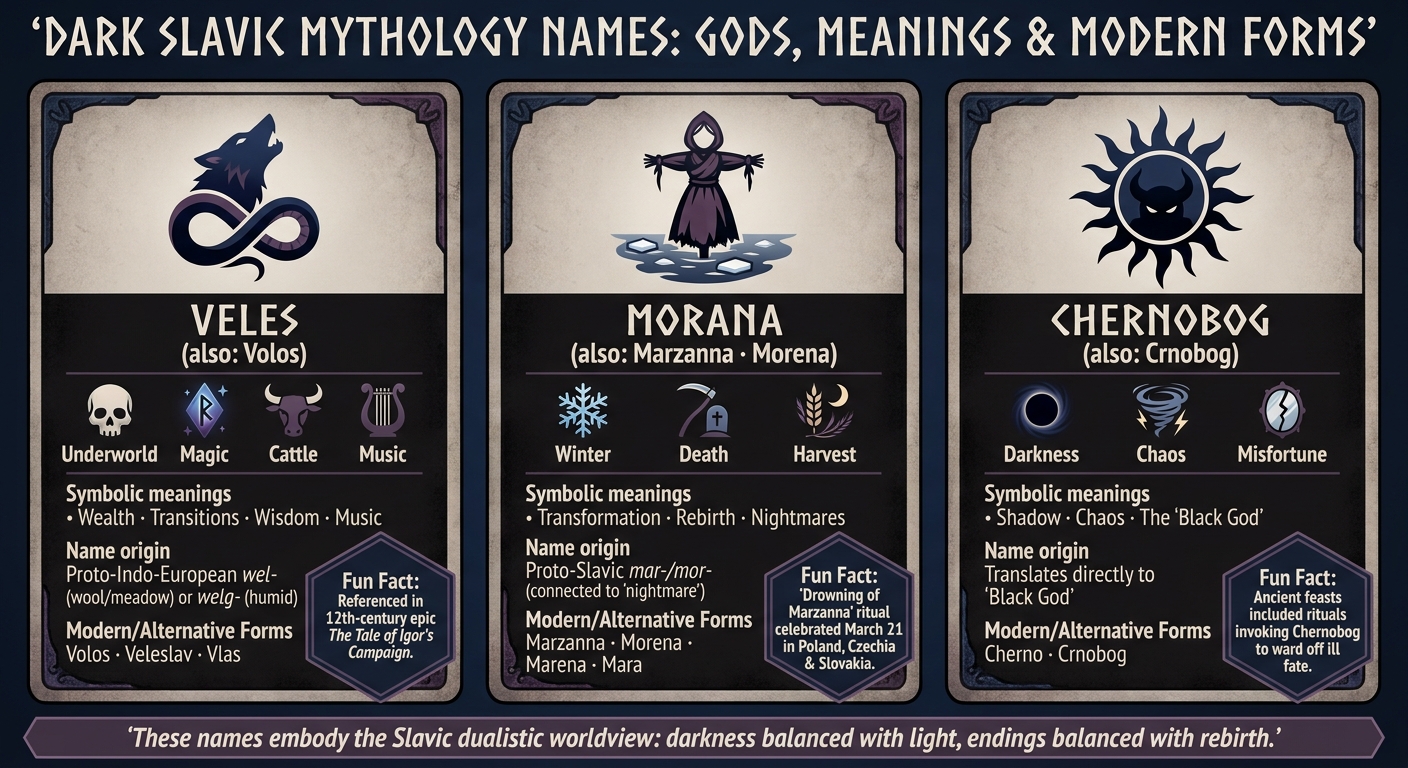
Dark Slavic Mythology Names: Gods, Meanings & Modern Forms
Continuing with the interplay of light and shadow in Slavic mythology, this section delves into figures rooted in darkness. These mythic names, tied to death, shadow, and transformation, reveal the depth and complexity of Slavic beliefs.
Not every name in Slavic lore radiates warmth. Some emerge from the darker realms of the pantheon, representing the mysteries of life, death, and the unknown. Among these enigmatic figures, the god Veles stands out.
Veles: God of the Underworld and Magic
Veles, also known as Volos, was a central figure in Slavic mythology, revered across the region. He governed the underworld, magic, music, and wealth, while also acting as a bridge between the worlds of the living and the dead. His name is thought to originate from the Proto-Indo-European roots wel- (wool, hair, meadow) or welg- (humid, wet).
"Veles is a perfect representation of how the Slavic people saw their gods. Morally ambiguous, complex, and an integral to the Slavic worldview." - Yordan Zhelyazkov
Veles’ influence extended to the arts, as seen in the 12th-century epic The Tale of Igor's Campaign, which refers to the bard Bojan as "the grandson of Veles." This connection highlights his role as a patron of poets and musicians. After the Christianization of Slavic regions, his protective duties over livestock were attributed to Saint Blaise. For those inspired by Veles, names like Veleslav (meaning "glory of Veles") offer a formal choice, while simpler options like Volos or Vlas provide approachable alternatives found on the best baby name apps.
Morana: Goddess of Winter and Death
Morana, also called Marzanna in Polish and Morena in Slovak, embodies winter, death, and nightmares. Her name is derived from the Proto-Slavic root mar-/mor-, which connects to the English word "nightmare." Despite her ominous associations, Morana symbolizes the cyclical nature of endings and beginnings.
One enduring tradition tied to Morana is the "Drowning of Marzanna" ritual. Celebrated on March 21 in regions like Poland, Czechia, and Slovakia, this ceremony marks the end of winter. The practice was so ingrained in local culture that the Synod of Poznań attempted to ban it in 1420. Today, her name remains relevant, seen in figures such as Croatian journalist Morana Kaštelan and actress Morana Perišić. For English speakers, nicknames like Mo, Ana, or Rana make the name more accessible.
As winter fades under Morana’s domain, another figure emerges from the shadows - Chernobog.
Chernobog: The God of Darkness and Misfortune
Chernobog, whose name translates to "Black God", represents darkness, chaos, and misfortune. A central figure in the Slavic dualistic worldview, Chernobog was believed to be the source of misfortune. During ancient feasts, participants would pass a bowl and curse in his name, reflecting the belief in his influence over ill fate.
For those drawn to bold and dramatic names, Chernobog offers a striking choice, while the shorter Cherno maintains its edge. Over time, Chernobog has transcended mythology, becoming a recurring archetype in modern fantasy and pop culture.
| Name | Primary Domain | Symbolic Meanings | Modern/Alternative Forms |
|---|---|---|---|
| Veles | Underworld, Magic, Cattle | Wealth, transitions, wisdom, music | Volos, Veleslav, Vlas |
| Morana | Winter, Death, Harvest | Transformation, rebirth, nightmares | Marzanna, Morena, Marena, Mara |
| Chernobog | Darkness, Misfortune | Shadow, chaos, the "Black God" | Cherno, Crnobog |
Using Slavic-Inspired Names Today
Slavic mythological names, like Chernobog's commanding presence or Morana's ties to the cycle of life, carry rich meanings. But choosing one today means balancing the depth of ancient lore with practical considerations and cultural sensitivity.
Respecting the Origins of Slavic Names
Slavic names are steeped in history and identity, reflecting the cultural legacy they represent. For example, traditional names such as Bolesław (derived from boľe meaning "large" and slava meaning "glory") often express a hopeful wish for the individual. Before choosing a name, it’s worth understanding the deeper meaning behind it.
Regional significance is another key factor. A name like Lech resonates strongly with Polish patriotism, while Vesna is more common in Southern Slavic regions. Being aware of these regional ties can help avoid unintended associations.
"Names in Slavic culture are not just labels; they embody history, identity, and a connection to the past." - Slavic Mythology Worldwide
Making Slavic Names Work for English Speakers
One of the biggest challenges with Slavic names is pronunciation. As noted, "Slavic first names have a tricky pronunciation, especially for those unfamiliar with the language and its phonetic features". However, there are ways to make these names more approachable.
- Use diminutives: Slavic cultures often employ affectionate shortened forms of names, such as Mila for Milena, Radek for Radoslav, or Vlad for Vladimir. These nicknames are simpler, easier to pronounce, and still honor the original name's roots.
- Drop diacritics: Simplifying names by removing diacritical marks can make them more accessible. For instance, Živa becomes Ziva, and Danica becomes Danika.
- Pair bold names with familiar middle names: Combining a mythological name with a more common middle name provides flexibility. For example, Perun James or Morana Claire offers an alternative if the primary name proves challenging in daily life.
These adjustments make it easier to honor Slavic heritage while ensuring the name fits comfortably in an English-speaking environment.
Using NameHatch to Find Slavic-Inspired Names
Once you’ve considered these strategies, tools like NameHatch can simplify the search for a Slavic-inspired name. This platform uses AI-powered filters to help you explore themes like Mythical, Unique, or Global, surfacing names such as Perun, Lada, Mokosh, or Zorya along with their meanings and origins.
For those seeking softer, more accessible options, NameHatch also offers filters for simplified variants. Its partner sync feature allows both parents to collaborate on a shortlist, making the decision process less overwhelming. Premium access, available at $3/month or $12 for 6 months, unlocks specialized filters like Mythical and Unique, perfect for exploring Slavic names with ease.
Conclusion: The Symbolism Behind Slavic Names
Key Takeaways on Symbolic Slavic Names
Slavic mythological names carry centuries of meaning and tradition. Names like Dobroslav and Radomir combine meaningful roots, reflecting hopes and values from the past. As Willy van Langendonck explains:
"In the case of Old Germanic and Old Slavic personal names, the dithematic name form contained a wish for the new-born child. These wishes pertained to the values that obtained in these early times."
These names often embody a dualistic worldview - balancing light and shadow, life and death, peace and war. Even names with darker connotations, such as Morana or Chernobog, symbolize essential aspects of existence.
Although the Council of Trent led to a decline in the use of many Slavic names, they survived through noble families and later saw a revival during 19th and 20th-century national movements. Today, names like Ziva and Lada remain popular, ranking among the Top 50 in Slovenia and Top 100 in the Czech Republic, respectively.
These historical and cultural insights offer a meaningful framework for incorporating Slavic names into modern naming traditions.
Embark on Your Journey with Slavic Names
To honor this legacy, explore the deeper meanings behind each name. Consider how the combination of its elements reflects values or aspirations you hold dear. For instance, Casimir means "preacher of peace", while Miroslav blends mir (peace/world) and slav (glory). This guide to naming your baby not only helps you choose a name but also connects you to a rich cultural heritage.
For a more streamlined and respectful way to discover Slavic-inspired names, tools like NameHatch can help. Its Mythical and Global filters highlight names such as Perun, Zorya, and Lada, complete with their origins and meanings. The platform also allows parents to collaborate through its partner sync feature. Premium access is available for $3/month or $12 for 6 months, providing access to specialized filters ideal for exploring mythological names.
FAQs
Are names like Veles or Morana appropriate for a baby name?
Names like Veles and Morana have strong ties to Slavic mythology, each carrying rich historical meaning. Veles, for instance, is known as the god of the underworld, while Morana represents death and rebirth. Though using these exact deity names is less common, variations such as Veleslava appear more frequently.
If you're captivated by these symbolic names, tools like NameHatch can assist in exploring and organizing options to help you find the perfect match.
How do I pronounce Slavic names correctly in English?
The resources currently available focus on the origins, meanings, and historical context of Slavic names, but they don't include pronunciation guides in English. If you're thinking about choosing a Slavic name, NameHatch can assist by generating a customized list tailored to your preferences for style and origin, helping you find the ideal name.
How can I tell if a Slavic name is tied to a specific country or region?
To figure out whether a Slavic name is linked to a particular country or region, look for spelling differences and naming traditions specific to that area. These names often have ties to saints, historical icons, or local folklore. For instance, Poland and Slovakia have distinct celebrations for name days, which highlight unique naming customs. Some names are also influenced by geography, like cities named after legendary characters. Resources like NameHatch can offer insights into these cultural connections.