The short answer: small spelling changes can shift a name’s meaning, root, sound, and how it feels in the U.S. If you’re choosing between forms like Amina/Ameena, Leila/Layla, or Zain/Zayn, the main tradeoff is simple: one spelling may stay closer to family roots, while another may be easier for people in the U.S. to read and say.
I’d sum up the article like this:
- Some pairs share one root, but the spelling changes the signal, like Layla/Leila or Zain/Zayn
- Some look alike but come from different roots, like Mira/Myra and Samira/Sameera
- U.S. use varies a lot, from common forms like Layla (#37 in 2024) to rare ones like Ilian (57 births in 2025)
- Pronunciation matters in daily life, especially for names like Nadya, Thuraya, and Ilian
- Meaning can shift by language, as with Nadia/Nadya and Amina/Ameena
If I were using this guide to pick a name, I’d look at four things first: meaning, language root, U.S. rank, and how often I’d need to correct people.
Quick Comparison
| Name Pair | Core Difference | U.S. Use Today | Main Choice |
|---|---|---|---|
| Amina / Ameena | Same Arabic root family; spelling can point to a different meaning reading | Amina #307 (2024) | Source spelling vs clearer long “ee” sound |
| Leila / Layla | Same root; spelling changes how mainstream it feels | Layla #37, Leila #267 (2024) | Familiar U.S. form vs heritage signal |
| Mira / Myra | Similar look, different roots and sound | Mira #380, Myra #645 (2024) | Global sound vs vintage English feel |
| Nadia / Nadya | One form reads more international, the other more Slavic/Arabic-linked | Nadia near #565 by 2025 | Easy U.S. use vs closer family sound |
| Soraya / Thuraya | Same star-based root, different language path | Soraya #645 (2025) | Easier English use vs Arabic form |
| Zain / Zayn | Same sound, different spelling signal | ~10.2K vs ~13.2K U.S. births recorded | Simpler spelling vs clearer Arabic tie |
| Elian / Ilian | Similar sound, different root and community use | Elian #146, Ilian #3,385 (2025) | Common U.S. option vs rarer Balkan form |
| Samira / Sameera | Similar sound, different language lines in many cases | Samira is the main U.S. form | Broader use vs South Asian-style spelling |
In other words, this article is less about “what’s the prettiest name?” and more about what each spelling tells people the moment they see it.
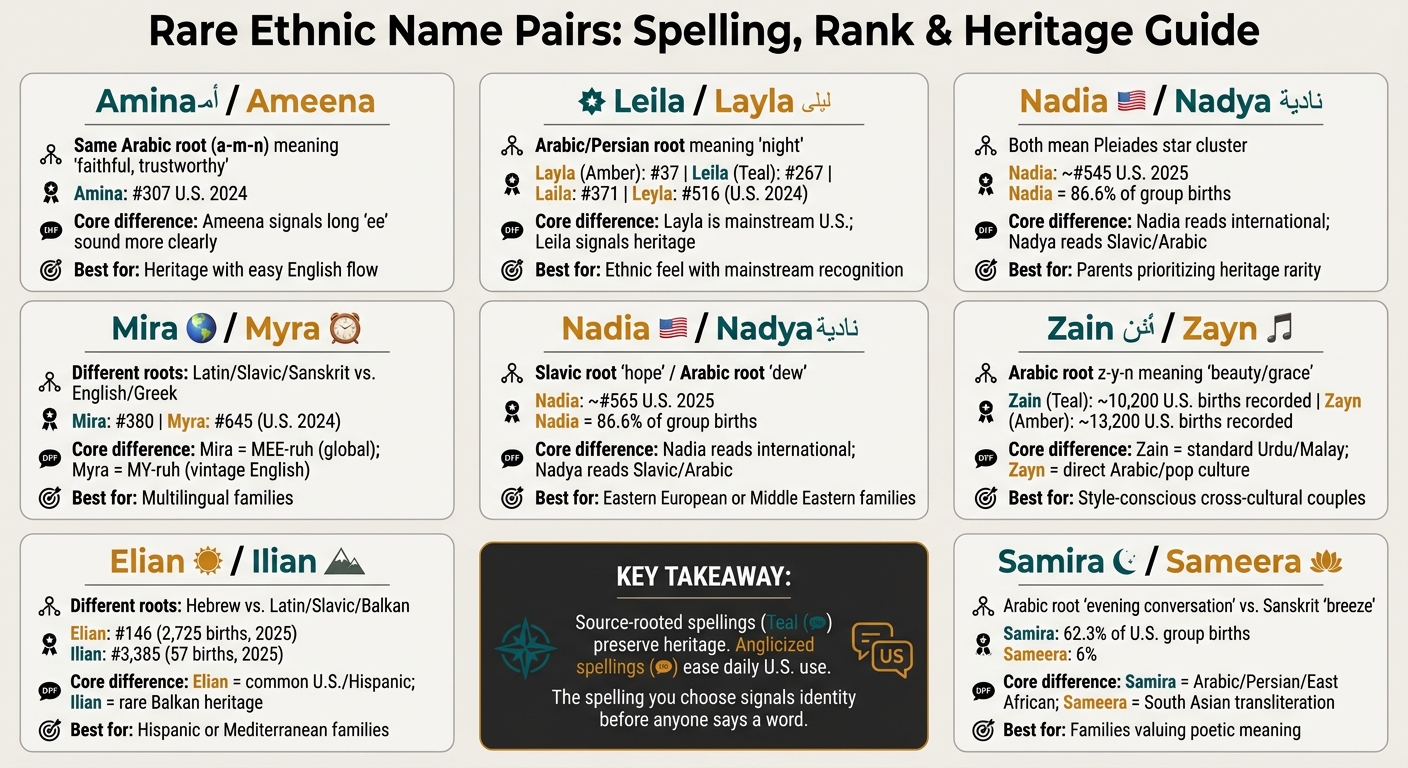
Rare Ethnic Name Pairs: Spelling, Rank & Heritage Guide
1. Amina / Ameena
Meaning
In English, Amina can point to two Arabic names that often get blended together. ʾĀmina (آمِنَة) means "safe", "protected," or "secure." ʾAmīna (أمينة) means "faithful", "trustworthy," or "honest."
That’s where Ameena helps. It’s the anglicized form of ʾAmīna, so the spelling does more of the work if you want that meaning to come through. Here, spelling isn’t a small detail. It changes which Arabic name people are likely to read into it.
Linguistic Roots
Both forms come from the Arabic triliteral root a-m-n (أ-م-ن), tied to ideas of safety, trust, faith, and peace. The same Semitic root connects to the Hebrew root aman, meaning "to be faithful."
You can see that shared base in regional forms such as:
- Aminata in French-speaking West Africa
- Amna in South Asia
- Amine in some Turkish and North/West African diaspora contexts
That shared root helps explain why the name moves so easily across regions and diaspora communities.
Spelling and Pronunciation
Amina is the most common U.S. spelling and shows up across Arabic, English, and French settings. Aminah keeps the final Arabic sound more visible. Ameena does a better job signaling the long "ee" sound and helps avoid the ah-MY-nah reading.
Modern Use and Family Fit
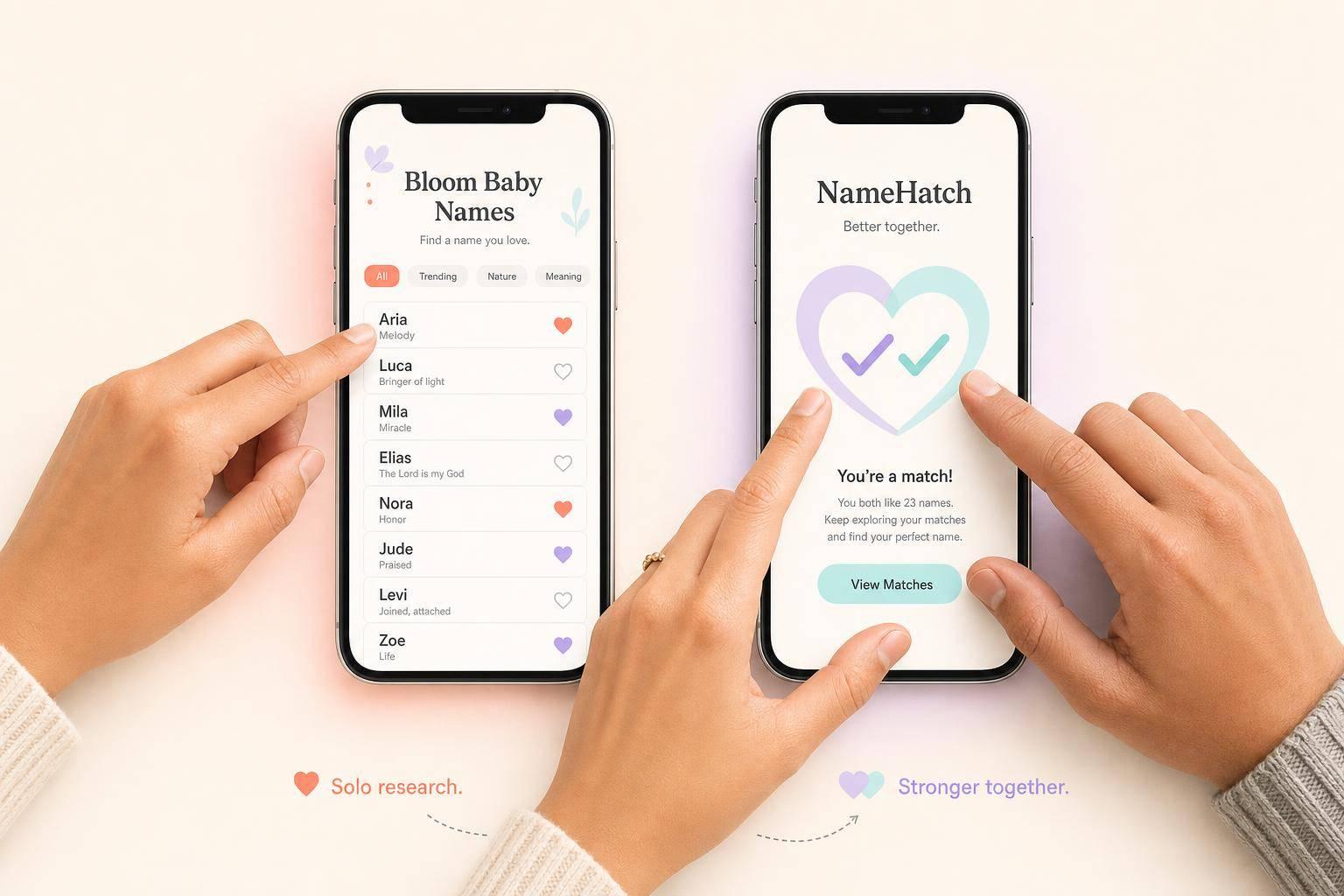
Finding a name that balances heritage with modern appeal is easier when using a baby name app for couples to sync preferences.
Amina ranked #307 in the U.S. in 2024, after climbing 593 spots over the past 20 years. That growth is linked in large part to East African and Muslim-American families.
The name group has recorded 30,200 U.S. births across 19 spellings since 1943, and three out of four people named Amina alive in the U.S. today are age 6 or younger. So while the name has deep roots, its U.S. profile feels young.
For day-to-day use, nicknames like Mina or Ami can make it feel a bit softer and more casual.
Leila and Layla show a similar spelling split, though that pair has a broader regional spread.
sbb-itb-f13f980
2. Leila / Layla
Like Amina, this pair splits between spellings that stay closer to the source and spellings that feel more Anglicized.
Meaning
Both Leila and Layla come from the Arabic word layl, which means "night." The name was often given to girls born at night. In Persian literature, Nizami Ganjavi's 12th-century poem Layla and Majnun helped keep the name alive across generations.
In Hebrew, the parallel form Lailah also means "night" and is linked to an angel of the night in Jewish tradition.
Linguistic Roots
The Semitic root layl ties the Arabic and Hebrew forms together in a direct way. Persian usage took in the Arabic root and helped spread the name across diaspora communities from North Africa to South Asia. One small but important note: don't mix it up with Nordic Laila or Sanskrit Leela. Those names are unrelated.
Spelling and Pronunciation
In the U.S., Layla is the most common spelling, and most people read it as LAY-la. Leila is less fixed. Depending on the reader, it may come out as LAY-la, LEE-la, or LY-la.
Some spellings also point more clearly to family background: (You can use a heritage finder to explore other names with similar roots.)
- Leyla often suggests a Persian or Turkish background.
- Lejla is the standard form in Bosnian and Balkan communities.
- Laila appears in Arabic- and Urdu-speaking families, and also in Nordic countries for unrelated reasons.
Modern Use and Family Fit
Layla ranked #37 in the U.S. in 2024, down from its peak of #23 in 2019. Leila ranked #267 and is rising. Laila sat at #371 and Leyla at #516. Since 1880, more than 307,700 births have been recorded across 26 spellings, and Layla alone makes up 42.0% of all births in this name group.
Eric Clapton's 1970 song "Layla" helped move the name into mainstream U.S. use. That matters because these spellings don't just differ in popularity. They also send different signals. Some read as more clearly Arabic or Persian, while others feel more at home in the U.S. For diaspora families, Leila or Laila can strike a practical middle ground between ease and heritage.
| Spelling | 2024 U.S. Rank | Primary Cultural Association |
|---|---|---|
| Layla | #37 | Mainstream U.S., Arabic |
| Leila | #267 | Persian, Arabic, literary |
| Laila | #371 | Arabic, Urdu, Nordic (Sami) |
| Leyla | #516 | Persian, Turkish, Azerbaijani |
The same spelling pattern shows up again in the next names, where one root branches into several forms.
3. Mira / Myra
Mira and Myra look close on the page, but they don't come from the same place. They also don't land the same way when people say them out loud. This pair is a good example of how a small spelling change can shift a name's history, sound, and social feel.
Meaning
Mira is a cross-cultural name with more than one root. In Latin, it comes from mirus, meaning "wonderful" or "astonishing." In Slavic languages, it connects to mir, meaning "peace" or "world." In Sanskrit, it carries meanings tied to the sea or boundary. What's striking here is that Mira shows up in several naming traditions on its own, not as one single line that spread everywhere.
Myra has a different path. It's often traced to 17th-century poet Fulke Greville, possibly as an anagram of Mary, with links to Greek myrrha, the fragrant resin, and to the Latin sense of "wonder."
In the U.S., though, most people respond first to the sound and spelling, not the etymology.
Linguistic Roots
The overlap between these names is mostly visual. Mira pulls from Latin, Slavic, and Sanskrit roots that developed separately. Myra is tied more closely to English poetic history and Greek links to myrrh.
So even if the names look like twins, their background tells a different story.
Spelling and Pronunciation
The biggest split is simple: pronunciation.
- Mira is usually said MEE-ruh
- Myra is usually said MY-ruh
That one vowel sound does a lot of work in daily life. It changes the rhythm, the feel, and often the assumptions people make about the name.
In South Asian families, Meera is a more common spelling, closely tied to the 16th-century poet-saint Mirabai and the Bhakti devotional tradition. Families with Slavic roots often use Mira on its own or as a short form of Miroslava. In the U.S., Myra tends to read as a vintage English name.
Modern Use and Family Fit
In the U.S., Mira ranked #380 in 2024 with 820 births and has climbed 526 spots over the last 20 years. According to 2020 Census data, about 14,200 people in the U.S. are named Mira, with a racial distribution of 58% White and 20.4% Asian/NHPI. That range helps show why the name moves so easily across different communities.
Myra ranked #645 in 2024 with 453 births and is seeing a mild vintage comeback in the U.S. For many parents, the choice comes down to feel: Mira often sounds more global and flexible, while Myra can feel more tied to a specific English-language style or family line. That's what makes this pair useful. A one-letter shift doesn't just change spelling. It can change identity, expectation, and tone.
| Feature | Mira | Myra |
|---|---|---|
| Primary Meaning | Wonderful; peace; sea/boundary | Myrrh; wonder |
| Pronunciation | MEE-ruh | MY-ruh |
| 2024 U.S. Rank | #380 | #645 |
4. Nadia / Nadya
Meaning
Nadia and Nadya are a good example of how one name can point to different histories. In Slavic languages, both come from Nadezhda, which means "hope". In Arabic, the name connects to Nadiyyah and nada, with meanings tied to tenderness, dew, and freshness.
So the meaning can shift a lot based on the family background behind it. For one family, it may center on hope. For another, it may lean more toward softness and dew-like imagery.
Linguistic Roots
In Slavic languages, Nadezhda means "hope", and Nadia and Nadya started as short forms. In many Western countries, those shorter forms later became stand-alone names, in part because Nadezhda can be hard for English speakers to say.
The Arabic line is separate. Nadiyyah developed on its own and is not tied to the Slavic form. Other languages show the same pattern in their own way: Ukrainian uses Nadiya with the stress on the i, Czech uses Naďa, and French speakers often use Nadège. Each spelling follows the sound habits of that language.
Spelling and Pronunciation
The split between Nadia and Nadya usually points to a sound difference too. Nadia is most often pronounced with three syllables: NAH-dee-uh. Nadya is more often compressed into two: NAH-dyuh. That shorter sound can hint at a stronger Russian or Eastern European link.
In the U.S., Nadia is by far the more common form. It makes up 86.6% of all births in this name group. Other recorded spellings include Nadiya, Nadja, and Nadiyah.
Modern Use and Family Fit
Nadia took off in the U.S. after Nadia Comaneci's perfect 10 in 1976. The name jumped from 85 girls in 1975 to 586 in 1976. That same year, it entered the U.S. Top 1,000 at #358, and it later reached its high point at #176 in 2005 with 1,923 births.
Since then, usage has fallen by about 67% to 72% by 2025, with the name sitting near #565. Even so, it still feels cross-cultural in a very everyday way. Based on 2020 Census data, about 56,000 living people in the U.S. have the name, with a demographic mix of 37.7% White, 30.1% Hispanic, 18.1% Black, and 7.6% Asian.
In practice, Nadia tends to read as more international, while Nadya more clearly points to Slavic or Arabic roots. That small spelling shift can change what people hear, assume, or connect it to in daily life.
5. Soraya / Thuraya
This pair follows the same pattern as the names above: one root, two spellings, and two different levels of heritage visibility.
Meaning
Both names refer to the Pleiades star cluster in Taurus. The Arabic root ث-ر-ي carries the idea of abundance, while Persian use adds royal and excellent associations. That shared star-based meaning is a big reason the name has moved so easily across Arabic, Persian, and European use.
Linguistic Roots
Thuraya, sometimes written as Thurayya, is the Arabic form. Soraya is the Persian form, and it later spread into Spanish, French, and Portuguese. Princess Soraya Esfandiary-Bakhtiari, the wife of the last Shah of Iran, helped bring the name international attention in the 1950s. Regional forms include Suraya in Afghanistan and Surayyo in Tajikistan.
That split helps explain the name's feel today. Thuraya reads as more directly tied to Arabic, while Soraya tends to feel more global and easier to place in many settings.
Spelling and Pronunciation
In U.S. English, Soraya is usually pronounced soh-RAH-yah or suh-RYE-yuh. Its open vowel sounds skip the Arabic th, which makes it simpler for many English speakers to say.
Thuraya keeps the original Arabic th sound, an interdental consonant that many non-Arabic speakers find harder to pronounce. It's usually rendered as THOO-ra-yah.
Modern Use and Family Fit
Soraya first entered the U.S. Top 1,000 in 2021 and hit a high point of 313 births in 2025, ranking #645. Thuraya keeps the Arabic form more directly. For many families, the trade-off is pretty clear: Soraya tends to be easier in English, while Thuraya holds closer to the source.
6. Zain / Zayn
Like the earlier pairs, Zain and Zayn show how spelling can hint at either closeness to the source form or ease in English. The meaning stays the same. What changes is the signal each spelling sends about origin, audience, and identity.
Meaning
Both spellings come from the Arabic root z-y-n, which means beauty, grace, or adornment. So this is a clean case where one name moves across languages without changing how it sounds.
Linguistic Roots
The name has deep roots in Islamic history through Zayn al-Abidin, which means "Adornment of the Worshippers." Zain became the standard form in Urdu and Malay, which helps explain why it appears so often in South Asian Muslim communities. Related forms also show up in Hebrew and, in some Hindu use, with similarly positive meanings.
Spelling and Pronunciation
The pronunciation doesn’t change. The spelling does the identity work.
| Feature | Zain | Zayn |
|---|---|---|
| Cultural tie | Standard in Urdu and Malay | Direct Arabic transcription |
| U.S. recorded births | ~10.2K | ~13.2K |
| Perception | Often mistaken for Zane in the U.S. | More clearly tied to Arabic roots and pop culture |
| Pronunciation | /zeɪn/ | /zeɪn/ |
Modern Use and Family Fit
In the U.S., the name got a major visibility boost from Zayn Malik of One Direction. Zain has also moved up 276 spots over the past 20 years, going from #831 into the 500s. That gives the pair a nice balance: short, familiar, and easy to carry across school lists, family settings, and paperwork.
For multicultural couples, the main trade-off comes down to spelling. Zain can get read as Zane, while Zayn keeps a clearer tie to Arabic roots. That puts Zain/Zayn in the same spelling-and-identity pattern seen in the names above.
That contrast in spelling sets up the next pattern: how small shifts in letters can shape heritage, sound, and daily use.
7. Elian / Ilian
Like the pairs above, Elian and Ilian sound close, but they point to different family and language histories.
Meaning
Both names come from more than one naming stream, but their main roots are not the same. Elian is most often linked to the Hebrew Eliyahu, meaning "my God is Yahweh." Ilian is more often treated as a Slavic and Balkan form of Elijah or Ilya, and is sometimes linked to Ilium (Troy).
Linguistic Roots
Elian comes through Hebrew, Spanish, Dutch, and Greek traditions. Ilian comes from Latin, Slavic, and Balkan use, with a strong place in Bulgarian and Romanian naming, where it works as a local Elijah form.
You can hear that split most clearly in how the names are said.
Spelling and Pronunciation
In English, Elian is usually said EL-ee-un, while Spanish use often shifts it to eh-LYAN. Ilian is usually IL-ee-an, though in Slavic use it may sound closer to ee-LYAN.
| Feature | Elian | Ilian |
|---|---|---|
| Primary Meaning | "My God is Yahweh" | "From Troy" / Slavic form of Elijah |
| Linguistic Origin | Hebrew, Spanish, Dutch, Greek | Latin, Slavic, Balkan |
| English Pronunciation | EL-ee-un | IL-ee-an |
| 2025 U.S. Births | 2,725 | 57 |
| U.S. Rank (2025) | #146 | #3,385 |
There’s also a practical side to this. Ilian is often misheard as Julian or Elian, while Elian can get confused with Elliot. Saying each one out loud with your last name is a key part of finding your perfect baby name and saving yourself from second-guessing.
Modern Use and Family Fit
Elian is far more common in the United States. It had 2,725 births in 2025, ranked #146, and grew 116% over five years. About 87% of U.S. bearers are Hispanic or Latino, and the Elián González case kept the name in public view.
Ilian is still rare in the U.S., with 57 births in 2025 and a rank of #3,385, though it grew 73% over five years. For Bulgarian and Romanian families, that may be part of the appeal. The name carries a strong tie to heritage, and in Bulgaria, Ilian’s name day falls on July 20, linked to the feast of the Prophet Elijah. For diaspora families, that kind of built-in family custom can mean a lot. It also helps to choose a baby name both partners agree on when balancing these cultural traditions.
8. Samira / Sameera
Meaning
Like the earlier pairs, Samira/Sameera keeps a familiar sound while changing the signal it gives. In Arabic, Samira comes from the root s-m-r and is tied to evening conversation. In Sanskrit, Sameera means breeze or gentle breeze.
Linguistic Roots
These Arabic and Sanskrit forms come from separate language families, so the similarity is coincidental. The roots are unrelated. In Persian communities, the name may also be connected to Semiramis, the legendary Assyrian queen. The name also spread through Ottoman and diaspora use.
Spelling and Pronunciation
Both spellings are usually pronounced suh-MEER-uh, though local stress can shift a bit. Samira is more common in Arabic, Persian, Turkish, and East African use. Sameera shows up more often in South Asian English transliteration.
| Spelling | U.S. Birth Share | Peak Year |
|---|---|---|
| Samira | 62.3% | 2022 |
| Samirah | 14% | 2013 |
| Samyra | 8% | 2007 |
| Sameera | 6% | 2016 |
| Semira | 4% | 2017 |
| Sameerah | 3% | 1978 |
Modern Use and Family Fit
In the United States, three out of four people named Samira alive today are age 8 or younger and were born after 2017. The name appears most often in states with large Arab-American, Iranian-American, and South Asian populations.
According to 2020 Census data, 41.9% of U.S. bearers are Non-Hispanic White, 23.0% are Non-Hispanic Black, 18.4% are Hispanic or Latino, and 10.7% are Non-Hispanic Asian or Pacific Islander. That range shows how far the name has traveled beyond its first communities.
For couples weighing heritage, sound, and day-to-day ease, who want to swipe baby names together to find a match, Samira gives you a melodic option with clear depth. It also shortens neatly to Sami, Sam, or Mira. The shared sound and split spelling make this pair a good example of how heritage and pronunciation can pull in different directions - and lead straight into the spelling choices below.
How Spelling Shifts Affect Sound, Identity, and Heritage
These patterns aren't just about meaning. Spelling also shapes how a name sounds, looks, and lands in daily life.
Why one root produces several spellings
When a name moves from one script to another, the spelling often shifts too. That's why one root can lead to a few accepted Latin spellings instead of just one.
Pop culture plays a big part here. It can lock one version into public memory, the way Layla did in English. Once that happens, that spelling often becomes the default in U.S. use.
Which spellings feel source-rooted versus Anglicized
Some spellings feel closer to the source language. Others read as more Anglicized in U.S. use.
| Name Root | Source Language | U.S. Pronunciation | Major Variants | How Far the Spelling Moves |
|---|---|---|---|---|
| Layla | Arabic / Persian | LAY-luh | Leila, Leyla, Laila | Low to Moderate |
| Zain | Arabic | ZAYN | Zayn, Zane, Zayne | Low |
| Soraya / Thuraya | Persian / Arabic | so-RAY-ah / thu-RAY-ah | - | High (Transliteration) |
| Mira | Sanskrit / Slavic | MEER-ah | Myra, Meera | Low (Cross-cultural) |
Leyla, spelled with a "y", is the form that most directly signals Persian roots, while Layla is the Arabic-derived form more common in U.S. usage. Neither is wrong - they simply point to different places on the map.
How spelling choices play out in daily life
This tends to show up fast in school, at work, and during introductions. Familiar spellings usually mean fewer corrections. Source-rooted spellings hold onto heritage more clearly, but they also invite more mispronunciations.
A more Anglicized spelling can soften the heritage signal. The source-rooted form keeps that link easier to see, though it may come with extra pronunciation notes.
These tradeoffs hit hardest when couples are trying to balance sound, heritage, and ease of use.
Once spelling starts shaping sound and identity, the next step is deciding how couples sort through those tradeoffs together. If you can't agree on baby names, finding a middle ground on spelling is a great place to start.
Pros and Cons for Couples Choosing Across Cultures
Spellings are only one part of the decision. Couples also have to think about sound, family fit, and how a name works day to day. The real test is simple: how it sounds, how easily family members can say it, and what it signals in daily life. That makes spelling and heritage feel less abstract and more like a practical family call.
Main strengths of names with layered roots
Some names make that balancing act easier.
Names like Amina, Nadia, and Samira share the same upside: they feel familiar across languages while still standing out in the U.S. In a U.S. classroom, they can feel a bit different without being hard to read or say, thanks to their simple, vowel-forward shape. They also come with handy nickname options - Ami or Mina for Amina, and Sami or Mira for Samira - so a child has room to choose what fits later on.
Main tradeoffs to weigh before choosing
Those spelling differences also turn into day-to-day tradeoffs.
Soraya and Thuraya sound regal and rare, but Thuraya is tougher for many English speakers to pronounce. Zain/Zayn is short and modern, though it may bring to mind certain pop culture figures. Elian has a soft sound, but people may first hear it as Ian or Ethan.
| Name | Pros | Cons | Nickname Potential | Best-Fit Scenario |
|---|---|---|---|---|
| Amina / Ameena | Deep Arabic roots; meaning "trustworthy"; globally accessible "A" ending | Multiple spellings can cause paperwork confusion | Ami, Mina | Families prioritizing heritage with easy English flow |
| Leila / Layla | Highly recognizable in the U.S.; musical sound | Very common; may lose its rare feel | Lei, Lulu | Couples wanting a name that feels both ethnic and mainstream |
| Mira / Myra | Strong cross-cultural flexibility | Myra can feel dated or Anglicized | Mimi | Multilingual families, such as Indian-European or Japanese-American |
| Nadia / Nadya | Classic, elegant, clear pronunciation | Nadya often prompts corrections in the U.S. | Nadi, Nana | Families bridging Eastern European and Middle Eastern roots |
| Soraya / Thuraya | Distinctive, regal, rich in Persian/Arabic history | Thuraya is hard for many English speakers to pronounce | Sora, Ray | Parents prioritizing heritage signaling and rarity |
| Zain / Zayn | Short, modern, easy to spell | Pop culture association; Z may shift to S in some Spanish dialects | Z | Style-conscious couples wanting a sleek cross-cultural name |
| Elian / Ilian | Soft and melodic; works in Spanish and English | Can be misheard as Ian or Ethan | Eli, Ian | Hispanic or Mediterranean families seeking a soft masculine name |
| Samira / Sameera | Meaning tied to evening conversation; rhythmic | Three syllables can feel long in quick speech | Sami, Mira | Families who value poetic meanings and traditional roots |
One practical rule helps: check the name’s meaning in every language your family uses. A name that sounds graceful in one language might carry an unintended meaning in another.
The next step is trying it in real life.
How couples can test a name before deciding
Say the full name out loud a few times with the middle and last name. Then try the nickname people are most likely to use. After that, see whether both families can say it with ease.
If both partners are comparing names from different backgrounds, it can help to build a shared shortlist that shows both sides. NameHatch helps couples compare names together with swipe-based suggestions, partner sync, and shared shortlists on mobile or desktop.
The final choice usually comes down to a simple pull: heritage signaling or everyday ease.
Conclusion
Rare ethnic names often carry layers of meaning, spelling, and pronunciation across different communities. In pair after pair, even a small change in spelling can shift how a name sounds, where people think it comes from, and how easy it feels in day-to-day life. That same pattern runs through this whole article: one root, several spellings, and different signals tied to each version.
The main tradeoff is pretty clear. Source-rooted spellings tend to keep a close tie to heritage. Anglicized forms usually make life a bit easier in everyday settings.
Before you choose, say the name out loud in real conversation, not just on a screen or on paper. Check the meaning and pronunciation with both families first. You can also use a checklist for finding rare baby names with AI to ensure your choice meets all your criteria. The spelling you pick will shape a child's daily life for years.
Know the roots, compare the spellings, and choose the form that fits your family's story.
FAQs
How do I choose between heritage spelling and ease in the U.S.?
Balance identity with day-to-day ease. Names with a clear sound-to-letter match tend to make life simpler because they usually don’t need constant spelling or pronunciation fixes. If you keep a heritage spelling with diacritics or other less common characters, it may cause some friction on forms and in computer systems.
A middle path can work well. You might use the heritage name with family or in formal settings, pick a nickname that feels easy and natural, or move the heritage name to the middle-name spot. It also helps to say the name out loud, imagine it on official forms, and check what it means in both languages.
Which of these names are most likely to be mispronounced?
Names usually get mispronounced when they use sounds, stress patterns, or consonant clusters that aren't part of a speaker's main language.
In English-speaking settings, this happens a lot with names from East Asian, Arabic, or Slavic backgrounds. Names with letters like J, H, G, or Z also tend to get read in different ways. And in many cases, longer names - or names whose pronunciation isn't obvious at first glance - are more likely to be said incorrectly.
Can similar spellings come from different name roots?
Yes. Names that look alike can come from very different language roots. That happens because naming patterns often overlap across places and groups.
For example, Miya may be an English form of Mia. It can also be a Japanese name tied to meanings like palace or shrine. Liah may be a form of the Hebrew name Leah. It can also blend the Chinese name Li with a diminutive marker.