Names can return to daily life when communities control maps, family naming, and language records.
I’d sum up this article in a simple way: the strongest efforts bring Indigenous names back through official place-name changes, home and school language use, and online archives people can search. The examples here span the U.S., Canada, New Zealand, Hawaiʻi, and Finland, and they include results such as 625 Inuktitut names approved in Nunavut in 2017, 13 Tlingit names restored in British Columbia in August 2023, and more than 800 Tŝilhqot'in place names documented.
Here’s the core idea:
- Place names return through government boards, tribal campaigns, and public maps
- Personal names stay in use when families can learn spelling, sound, and naming customs
- Language tools matter because names often disappear when a language falls out of daily use
- Digital maps and archives help people find names even before governments update records
- Policy support matters because names last longer when they appear on signs, maps, and records
A few cases show the pattern fast:
- Denali was restored in 2015, then a January 2025 executive order directed a return to Mount McKinley
- Canada reports close to 30,000 official place names of Indigenous origin
- Turtle Island Decolonized gathered nearly 300 Indigenous names across about 150 languages
- In Inari Sámi revival work, about 100 young speakers had come through language nests by February 2026
- In North America, about 155 Indigenous languages are still spoken, and 135 are spoken only by elders
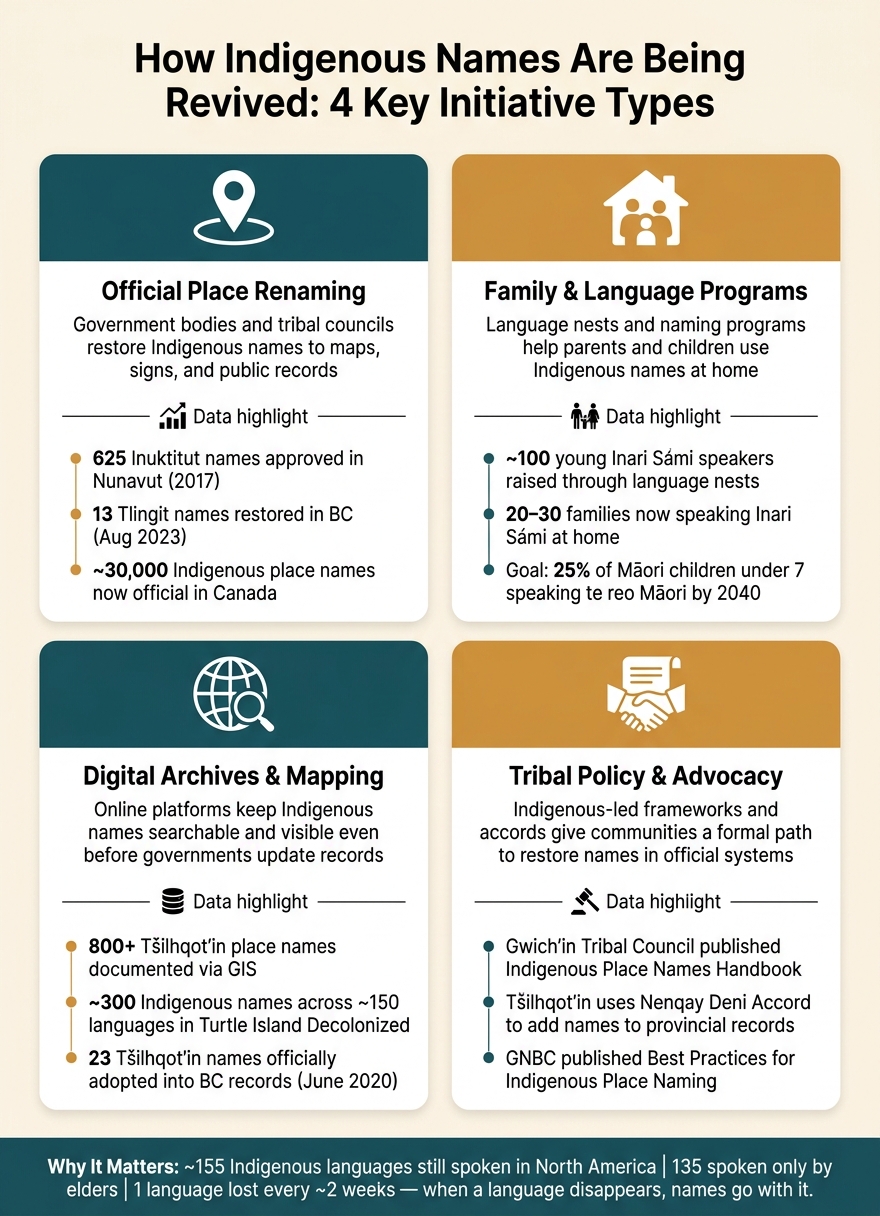
Indigenous Name Revival: 4 Key Initiative Types & Their Impact
Quick Comparison
| Initiative type | What it does | Example in the article | Result |
|---|---|---|---|
| Official renaming | Changes names in public records and maps | NZGB, GNBC, Nunavut, Tlingit renaming work | Names appear on maps, signs, and government systems |
| Family and language programs | Helps parents and children use Indigenous names at home | A Hua He Inoa, Te Mātāwai, Inari Sámi language nests | Better use of name spelling, sound, and meaning |
| Digital archives and mapping | Records names online for public use and community memory | Alaska Native Place Names Project, Kanyen'kehá:ka atlas | Names stay visible and searchable |
| Tribal policy and advocacy | Gives communities a path to restore names | Gwich'in handbook, Tŝilhqot'in work with BC | Names move into official records |
My takeaway: this isn’t just about swapping labels. It’s about language, land, and family memory staying in use. The article shows that name revival lasts longer when it is community-led, tied to living language, and backed by records people can actually use.
sbb-itb-f13f980
Place-Name Restoration Initiatives With Visible Public Impact
The strongest name revival efforts show up in places people can actually see: maps, road signs, school materials, and government records. That’s when a name moves from memory into daily life.
Aotearoa New Zealand: Restoring Māori Place Names Through Official Processes
The New Zealand Geographic Board Ngā Pou Taunaha o Aotearoa (NZGB) is the legal body that makes place names official in New Zealand. It works with iwi and hapū to restore original Māori names through Treaty of Waitangi settlements, historical research, and public consultation.
In July 2023, Toitū Te Whenua Land Information New Zealand released the second edition of the Tangata Whenua place name maps for Te Ika-a-Māui (North Island) and Te Waipounamu (South Island). The update restored hundreds of original names as part of Treaty settlements. The work drew on Kā Huru Manu, a heritage atlas developed by Te Rūnanga o Ngāi Tahu, and used standardized orthography, including macrons, so names would appear correctly across digital systems.
NZGB says its role includes protecting Māori place names, advising on Treaty settlement redress, restoring original names, and standardizing Māori spelling, including macrons.
Dual naming and digital maps have also helped make Māori names part of everyday use. What once sat outside the public eye now appears in the same places people check every day.
Canada and the Arctic: Inuit and First Nations Mapping and Renaming Projects
Canada's Geographical Names Board of Canada (GNBC) coordinates naming authorities across federal, provincial, and territorial governments. It has published Best Practices for Indigenous Place Naming to help communities move through the restoration process. Today, close to 30,000 official place names in Canada are of Indigenous origin.
Some of the clearest examples come from the Arctic. The Nunavut territorial government officially renamed two major communities: Hall Beach became Sanirajak and Cape Dorset became Kinngait. These were full restorations that replaced colonial names. In 2017 alone, Nunavut approved 625 names in Inuktitut in the Cape Dorset area.
The Northwest Territories took a different path. The government approved five Indigenous names for the Mackenzie River, each tied to the language of peoples living along it:
- Dehcho (South Slavey)
- Deho (North Slavey)
- Grande Rivière (Michif)
- Kuukpak (Inuvialuktun)
- Nagwichoonjik (Gwich'in)
That approach matters. It treats the river not as a place with one fixed label, but as a place known in more than one language and history.
In British Columbia, the Taku River Tlingit First Nation completed a six-year process with the BC Geographical Names Office and formally reclaimed 13 traditional names, which were added to all provincial maps in August 2023. Among them were K'iyán Mountain (formerly Minto Mountain) and T'ooch' Héeni (formerly Fourth of July Creek). Elder Wayne Carlick said the restored names help youth grow up using their ancestors' language.
Taken together, these cases show that revival can move forward through both state action and community-led mapping.
United States: Tribal Efforts to Restore Traditional Names on Maps and Public Lands
In the United States, official restoration often moves slowly. So many tribal efforts have focused on keeping traditional names visible through digital maps, public history work, and campaigns to remove derogatory terms from official records. But the goal goes beyond removal. Tribes have also pushed to restore traditional names on maps, signs, and public lands.
Projects such as the Atlas of Kanyen'kehá:ka Space and Turtle Island Decolonized help do that work in public view. Turtle Island Decolonized compiled nearly 300 Indigenous names for major cities and historical sites across North America, representing about 150 languages. These projects keep Indigenous names present online even when formal approval is still pending.
As researchers Rebekah R. Ingram and Kahente Horn-Miller of Carleton University note:
"Indigenous place names contain knowledge of the landscape and encode unique perceptions of landscapes with which Indigenous Peoples have interacted for hundreds, often thousands of years."
Digital projects don't replace the slower work of getting names into government records. They help build public familiarity first, which can make later official adoption more likely.
Language Programs That Help Families Reclaim Indigenous Personal Names
Restoring place names happens in public. Reclaiming personal names is more intimate. It happens at home, in daily speech, and across generations. After public maps, the next step is the family itself. Language nests and naming programs can help families recover the spelling, pronunciation, and meaning of Indigenous personal names.
Hawaiian Language Immersion and Personal Naming Guidance
In Hawaiʻi, reclaiming a personal name is tied to genealogy, place, and spiritual meaning. That kind of work calls for guidance. A Hua He Inoa ("Calling Forth a Name") was created in 2017 through a collaboration between the ʻImiloa Astronomy Center and the College of Hawaiian Language at UH Hilo. It trains students and cultural practitioners in Hawaiian naming protocols and roots the process in an Indigenous worldview. For families, that support matters. It helps them choose names with the right spelling, pronunciation, and meaning.
Māori and Sámi Language Revitalization and Its Role in Personal Naming
The same idea shows up in other language revival efforts.
Te Mātāwai, the Māori language authority in Aotearoa New Zealand, has made Tukuihotanga - deliberate intergenerational transmission - its main strategy. The aim is for 25% of Māori children under age seven to speak te reo Māori as their first language by 2040. When a language is used at home every day, pronunciation stays alive. So do naming customs.
The Inari Sámi experience in Finland shows what can happen even when a language is critically endangered. The Inari Sámi Language Association, founded in 1986, launched language nests in 1997. In 1995, only two families spoke Inari Sámi to their children. By February 2026, the language nests had helped raise about 100 young speakers, with 20 to 30 families using Inari Sámi at home.
That shift is striking. Children who enter the program speaking only Finnish often begin speaking Inari Sámi fluently within six months. The Sámi Education Institute also offers intensive one-year adult education courses for parents who did not grow up speaking the language. That gives them a path to pass both names and language on to their own children. The Sámi language nest model was inspired by Māori immersion programs in New Zealand.
Organizations, Rights Frameworks, and Digital Projects Supporting Name Revival
Beyond language programs, Indigenous name revival also depends on institutions that can place names into official records and digital systems.
Advocacy Organizations That Support Control Over Indigenous Names
Language revitalization programs help families use Indigenous names at home. But if those names are going to last - on maps, in legal records, and across generations - communities also need policy tools and Indigenous-led institutions.
The GNBC works with First Nations, Inuit, and Métis communities to restore old names through its Best Practices for Indigenous Place Naming.
The Gwich'in Tribal Council's Indigenous Place Names Handbook offers a practical path that other communities can learn from when bringing back place names. In British Columbia, the Tŝilhqot'in National Government uses the Nenqay Deni Accord framework to work with the BC Geographical Names Office and add old names to official provincial records.
That matters for a simple reason: names are easier to keep in daily use when people can find them in archives, maps, and public systems.
Digital Archives, Mapping Platforms, and Online Name Resources
Policy sets the rules. Digital tools help people find and use Indigenous names in everyday life.
The Alaska Native Place Names Project maintains a multilingual map database built from the knowledge of Native language experts across Alaska. Instead of leaning only on colonial archives, the project treats Indigenous speakers as the main source.
The Tŝilhqot'in National Government has documented and mapped more than 800 ancestral place names since the 1990s using GIS. In June 2020, 23 Tŝilhqot'in place names were officially adopted into British Columbia's provincial records.
"Place names are of deep ancestral significance... They connect language, history, cultural practice, traditional knowledge, and mythology to the places and features that make up territories." - Tŝilhqot'in National Government
The Atlas of Kanyen'kehá:ka Space documents Mohawk landscape language and place names through community participatory mapping, using the Nunaliit Atlas Framework.
| Project/Platform | Region | Name Focus | How It Works | Notable Outcome |
|---|---|---|---|---|
| Alaska Native Place Names Project | Alaska, U.S. | Place names across Native languages | Multilingual map database; Native language expert input | Brings together knowledge from Native language experts across the state |
| Tŝilhqot'in National Government | British Columbia, Canada | Ancestral place names | Elder-led oral history + GIS mapping | 23 names officially adopted into provincial records (June 2020) |
| Atlas of Kanyen'kehá:ka Space | Mohawk Territory | Language and landscape | Community participatory mapping; Nunaliit Atlas Framework | Documents Mohawk landscape-related language and place names |
| GNBC (Canada) | Canada (National) | Official toponymy | Federal/Provincial/Territorial collaboration | Uses Best Practices for Indigenous Place Naming |
| Gwich'in Tribal Council | Gwich'in Territory | Ancestral place names | Indigenous-led documentation | Published the Indigenous Place Names Handbook |
Using NameHatch Thoughtfully When Exploring Indigenous Names
For families starting a name search, digital tools can help with discovery. But when it comes to Indigenous names, cultural verification needs to come from Indigenous sources.
If you're exploring Indigenous names, NameHatch can help narrow options by origin or style. It can be useful at the start, but final decisions should rely on Indigenous-led language resources.
Conclusion: What the Strongest Indigenous Name Revival Efforts Have in Common
Across place-name restoration, language programs, and digital archives, the strongest efforts tend to share three things. They are community-led, grounded in language, and backed by policy, funding, archives, and education. Put those pieces together, and revival has a much better chance of lasting.
That sense of urgency helps explain why this work matters so much. In North America, only about 155 Indigenous languages remain spoken, and 135 are spoken only by elders. An Indigenous language is lost about every two weeks. When a language disappears, names often go with it. And languages do not stay alive without the communities, institutions, and resources that support them.
Indigenous place names hold landscape knowledge and cultural memory.
For readers looking into Indigenous names, that context matters. A name is not just a label. It is living knowledge tied to land, ancestors, and history. Respectful use starts with learning what a name means, where it comes from, and which community carries it forward. It also means turning to Indigenous-led language programs and archives. The strongest revival efforts do not treat names like style or decoration. They treat them as community knowledge. That is the bar these initiatives set. That is what makes Indigenous name revival last.
FAQs
Why do Indigenous names matter?
Indigenous names matter because they are tied to identity, sovereignty, and heritage. Restoring them is about more than language. It is a cultural and legal act that reasserts Indigenous authority over land, history, and long-held relationships with place.
Bringing these names back also helps correct colonial erasure and past harms. It supports continuity across generations, affirms Indigenous laws and identities, and pushes people toward a more honest understanding of land and history.
How do communities restore place names?
Communities bring place names back through reclamation, revitalization, and legal recognition that put Indigenous authority and ties to the land at the center. That can mean rematriation or replacing colonial names with Indigenous ones. These acts help repair both law and memory.
They also use community-led mapping, storytelling, education, and workshops to reconnect people with ancestral names and the stories tied to them. In plain terms, the goal is to keep those names alive, pass them on, and strengthen identity and sovereignty for the generations that follow.
What makes name revival last?
Lasting revival happens when Indigenous names return to their original languages and meanings, not when they’re used as symbols with no deeper tie. That shift matters. It pushes back against colonial narratives and helps reassert Indigenous identity, culture, and long-standing relationships to land and history.
It also has a better chance of lasting when communities lead the work themselves. When elders, youth, and local residents take part, revived names are more likely to become part of daily life instead of staying stuck in policy documents or maps. Education, public signage, and digital resources all help make those names usable, familiar, and passed down across generations.