You do not need to give up a family name to make it feel more current. In most cases, make just one small change: use a newer nickname, pick a close variant, or balance the first name with a more modern middle.
Here’s the short version:
- Keep the part of the name that matters most: meaning, sound, nickname, or family tie
- Then check whether the name is coming back, steady, or still falling
- If it feels dated, change only one thing
-
The safest options are:
- a nickname like Theodore → Theo
- a related form like Matthew → Matteo
- a modern middle like Margaret Wren
A lot of older names are already back in use in the U.S. Names like Eleanor, Theodore, Hazel, and Henry have returned to many parents’ lists. That matters, because a name with a comeback curve often needs less work than one still far past its peak.
We suggest using this simple filter:
| What I want to keep | Best move |
|---|---|
| Family link | Keep the full name, change the nickname |
| Meaning or origin | Use a close form from the same root |
| Sound | Pick a similar-sounding version |
| Formal first name | Add a shorter, newer middle |
The main idea is simple: refine the style, keep the story. The rest of the article walks through how to do that without overdoing it.
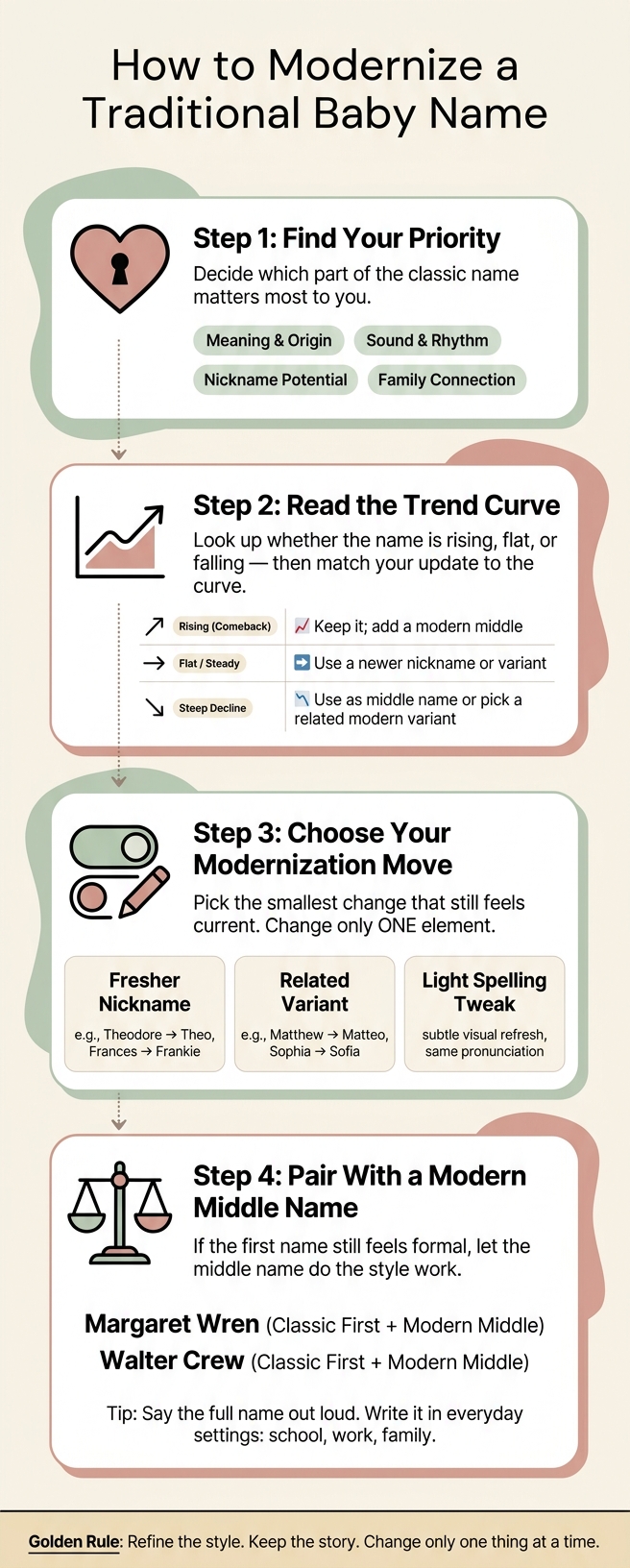
How to Modernize a Traditional Baby Name: A 4-Step Guide
Step 1: Identify Which Part of the Classic Name You Want to Keep
Start by choosing the part of the name you care about most. A classic name can hold a lot at once: meaning, sound, nickname options, family history, and even initials. For most people, the big four are meaning, sound, nickname potential, and family connection. Once you know your top priority, it gets much easier to make a small update that still feels like the same name.
Keep the Meaning and Origin Intact
If meaning and origin come first for you, begin there. Before you compare versions of a name, it helps to look up the name's full meaning and origin. You can use a baby name heritage finder to explore these roots.
That gives you a clear starting point. Then you can look for forms that keep the same roots without drifting too far from what made the name matter in the first place.
Decide Whether Sound, Nickname Potential, or Family Connection Matters Most
Once you know what the name means to you, ask yourself a simple question: what would be hardest to lose?
If it's the sound, look at related forms that keep a similar rhythm but feel a bit lighter or newer. Matteo instead of Matthew, or Anya instead of Anna, are good examples. Same basic feel, different surface.
If it's the nickname potential, a longer classic name can give you more room to play. Elizabeth is a good example because it can turn into Elsie, Libby, or Liza. That way, the formal name stays classic, but the everyday name can feel more current.
If the family link matters most, keep the formal name and update the day-to-day version. A child named Thomas, for example, can use a more current nickname while still carrying the family name on paper. And if initials matter too, you can keep those the same as well.
sbb-itb-f13f980
Step 2: Use Trend Data to Decide How Much to Modernize
Once you know what you want to keep, use the trend line to figure out how much to update the name. A name usually feels dated because of its trend, not just its age. That’s the key difference. Look at whether the name is rising, holding steady, or falling. If the sound, nickname, or family tie matters most, the trend can show how much change makes sense.
Before you settle on an update, use a baby name trend analyzer to see how this name is trending today. It shows how a name has shifted year by year in the U.S.
Check Whether the Name Is Coming Back or Still Falling
The trend curve gives you a practical read on how much modernization the name needs. If a name is already climbing, you may not need to do much. A small tweak, like pairing it with a modern middle name, can be enough.
If the name is in a steep drop, that’s a different story. In that case, a bigger update often works better, such as a shorter form, a related variant, or a light spelling change. Names that sit flat or steady often work best when paired with cleaner, more current companion names.
A helpful benchmark is whether the name still appears in the top 1,000 most-used names in the U.S. That gives you a quick sense of how much current use it still has.
Match the Update to the Trend Curve
Match the update to the curve:
| Trend Curve | What It Means | Best Modernization Move |
|---|---|---|
| Rising (Comeback) | Already regaining favor | Keep it; pair with a modern middle name |
| Flat / Steady | Stable and consistent | Use a newer nickname or a related variant |
| Steep Decline | Feels dated | Use as a middle name or choose a related modern variant |
Use the smallest change that fits the name’s trend.
Step 3: Choose the Best Way to Modernize the Name
If Step 2 showed the name needs more than a middle-name swap, make the smallest change that still feels current. In most cases, that means one of three things: a newer nickname, a related variant, or a small spelling update.
Use a Fresher Nickname or Short Form
One simple move is to keep the full name on the birth certificate and use a shorter nickname in daily life. This tends to work well both at school and later at work.
Examples include Frances → Frankie, Theodore → Theo, and Eleanor → Ellie.
The legal name stays the same, but the nickname does the day-to-day heavy lifting. And if your child later wants to use the full name, they can. That flexibility is a big plus.
Try a Related Variant or a Light Spelling Tweak
A related variant keeps the same root and meaning but gives the name a more current feel. Sofia instead of Sophia is a good example. It already feels familiar in the U.S., and it looks clean on the page.
Before you pick a variant or spelling change, look up the name's full meaning and origin to make sure the updated form still connects to what made the original matter to you.
A light spelling tweak can also work well, but only if it's subtle. The best version is one most people can still read and pronounce correctly at first glance. If the change leads to constant corrections, it's probably doing too much.
Comparison Table: Nickname, Variant, or Spelling Tweak
Use the chart below for a quick side-by-side look.
| Strategy | What It Preserves | What Makes It Feel Current | Pros | Cautions |
|---|---|---|---|---|
| Fresher Nickname | Formal heritage on birth certificate | Everyday use in school and social settings | Low risk; child can choose later | May not be used consistently by others |
| Related Variant | Core meaning and origin | Updated sound or international familiarity | Keeps the name recognizable while refreshing the style | May lose a direct link to a specific namesake |
| Light Spelling Tweak | Original sound and pronunciation | Cleaner visual style | Updates the look without changing the sound | Can cause frequent spelling corrections |
Change only one element at a time.
If you want the name to feel even more current, the next step is the full-name combination. You can also use a baby name style planner to explore modern themes that fit your family's aesthetic.
Step 4: Balance the Classic Name With a Modern Full-Name Combination
If the first name still feels a bit formal, shift the update to the middle name instead of changing the heart of the name. When you keep the classic first name as-is, the middle name becomes your style lever. The first name holds the family link, and the middle name gives the full name a more current feel.
Pair a Classic First Name With a Shorter Modern Middle
A classic first name often sounds lighter with a short, current middle. Think Margaret Wren or Walter Crew. The first name carries the family meaning. The middle does the style work.
Say the full name out loud. Listen for the rhythm. Then check that the initials work well with the last name.
Comparison Table: Classic First Plus Modern Middle vs. Classic First Plus Family-Surname Middle
Use the table below to pick the version that matches your family's style.
| Combination Style | Best Use Case | Pros | Cautions | Overall Feel |
|---|---|---|---|---|
| Classic First + Modern Middle | Softening a long or formal vintage first name | Smooth flow; broadly accepted across the U.S. | Some modern middles can date the birth decade more strongly | Rooted, warm, subtly updated |
| Classic First + Family-Surname Middle | Honoring a family surname or adding a current edge | Crisp rhythm; slightly preppy look | Can feel like two surnames if the first name is also unisex, and can cause confusion if the middle is an active family last name | Classic but modern-American, tailored, and stylish |
Both paths can work well. If you like a clean, pared-back style, a short modern middle like Sage or Lane often fits with ease. If you lean preppy or want to honor a maternal surname, a family-surname middle like Hayes or Beckett may land better.
Use NameHatch to Build a Shared Shortlist Together
Once you have two or three strong combinations, compare them side by side. NameHatch lets each partner react on their own, then shows shared favorites and filters for classic first names and modern middles so your shortlist stays focused.
Conclusion: Keep the Heritage, Update the Style
Once you know what parts of a name matter most, the last step is simple: refine it, don’t replace it. A modern take on a classic name keeps the story, but makes the name easier to use in daily life.
Before you make a final call, do two fast checks: meaning and trend. Start with what you already love about the name. Then look up the name's full meaning and origin before you change anything. After that, see how this name is trending today by checking the top baby names so you can tell whether it needs just a small adjustment or maybe a newer nickname or middle name.
Go with the smallest change that still feels right. That could be:
- a nickname
- a related variant or modern alternative
- a modern middle name
Then do one last gut check. Say the full name out loud. Write it down in a few everyday settings: school, work, and family use. If it feels natural in all three, you’re probably in a good place.
The best modernized name still feels personal, but it also works in the world your child will grow up in.
FAQs
How do I modernize an old-fashioned name without losing the family connection?
Keep the family connection by holding on to the name’s main meaning or the sound that makes it stand out, while giving it a more current feel.
You could shorten it - William to Liam, Alexander to Xander - change the spelling, like Catherine to Kathryn, use it as a middle name, or match it with a modern favorite. You can also see how this name is trending today or look up the name's full meaning and origin.
When should I use a nickname instead of changing the full name?
Use a nickname if you want to keep a classic full name but make it feel more current and easygoing.
That way, you can hold on to family history and personal meaning while giving the name a lighter, more youthful feel for day-to-day life.
How can I tell if a classic name is coming back or still feels dated?
Check how popular it has been over time and what kind of vibe it has now. A dated name often spikes in one past era and then fades, while a timeless name tends to stay steady or even start climbing again.
You can see how this name is trending today with the Baby Name Trend Analyzer and look up the name's full meaning and origin with the Baby Name Meaning Finder to help decide if it fits the modern image you want.