A baby name can look fine on one list and still feel common once you check spellings, nicknames, your state, and the trend line. That’s the short answer.
If you want to know whether a name is too popular, don’t stop at one rank. Check:
- National rank: where the name sits in the U.S.
- Birth count: how many babies got that name
- Spelling variants: like Sophia + Sofia
- Nickname overlap: like Ellie coming from many full names
- Both sex lists: for names like Riley or Avery
- State use: because a name can be common in one state and much less so nationwide
- 10-year trend: because a mid-ranked name can still be on its way up
A few numbers from the article show why this matters: 12.2% of births in 2024 involved names that appeared on both boys’ and girls’ SSA top-1,000 lists, and names like Kaia can sit at #3 in Hawaii while being only #180 nationally.
If you were boiling the whole process down, use this simple order: set a cutoff, check SSA rank and count, combine main spellings, compare national vs. state use, then look at the trend. That gives me a much better read than rank alone.
| Check | What I’m looking for | Why it matters |
|---|---|---|
| National data | Rank + birth count | Shows how common the name is across the U.S. |
| Variants | Main spellings and shared nicknames | A name can sound common even if one spelling looks lower |
| Cross-list use | Boys’ + girls’ list presence | Total exposure can be higher than one list suggests |
| State data | Local rank and count | A name may feel much more common where I live |
| Trend | Up, flat, or down over 10 years | Today’s rank may not match school-age reality later |
Bottom line: a name is “too popular” only if it crosses your comfort line after looking at rank, total use, local concentration, and direction of travel.
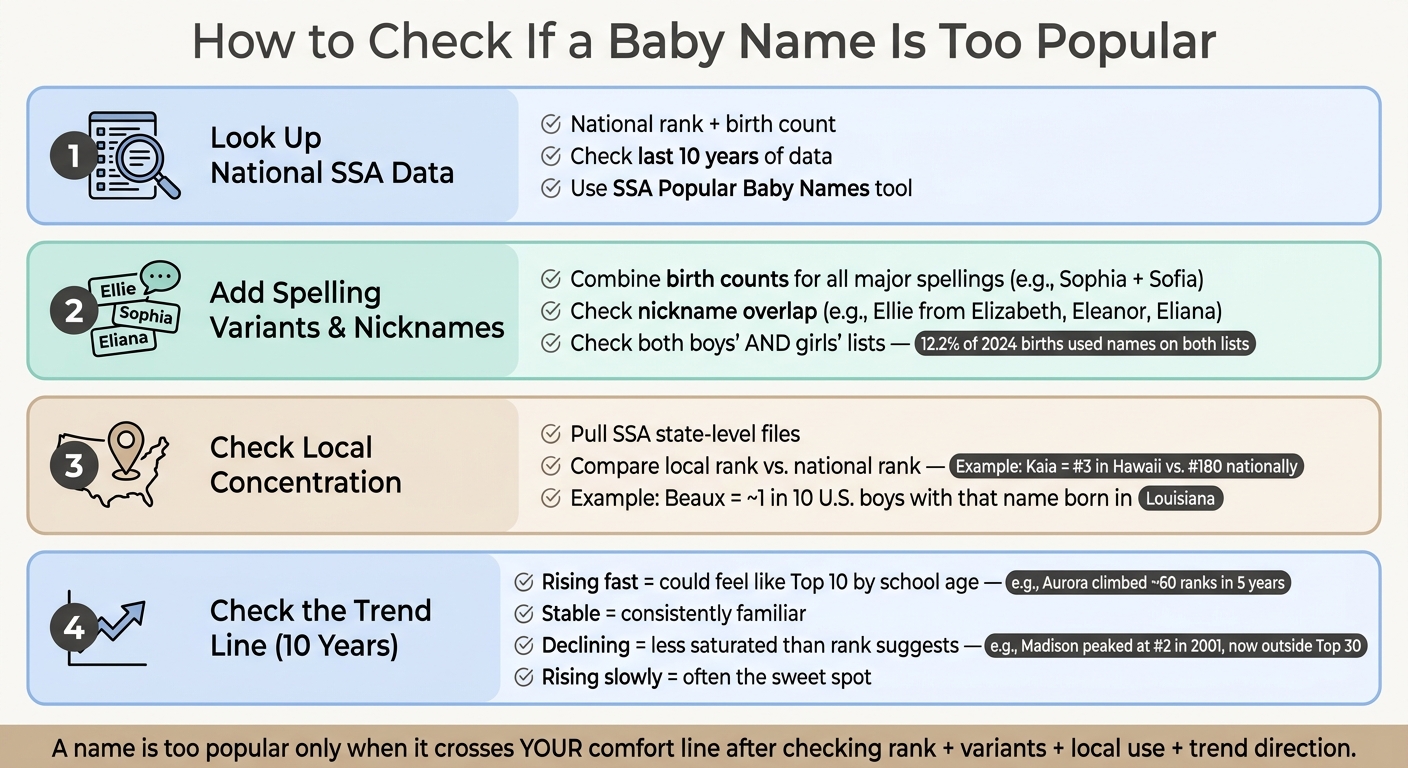
How to Check If a Baby Name Is Too Popular: A 4-Step Process
Step 1: Look up the name in recent U.S. popularity data
Start with the latest SSA rank and birth count. That gives you a quick read on whether a name is common enough to be a concern. Go to the SSA's Popular Baby Names page, pick the latest available birth year, choose a sex, and open the full top 1,000 list. If you want a faster starting point, check popular baby names using the latest SSA data. If the name still seems common, check spelling variants, nicknames, and gender-neutral use next.
Read SSA rankings, birth counts, and year-by-year data
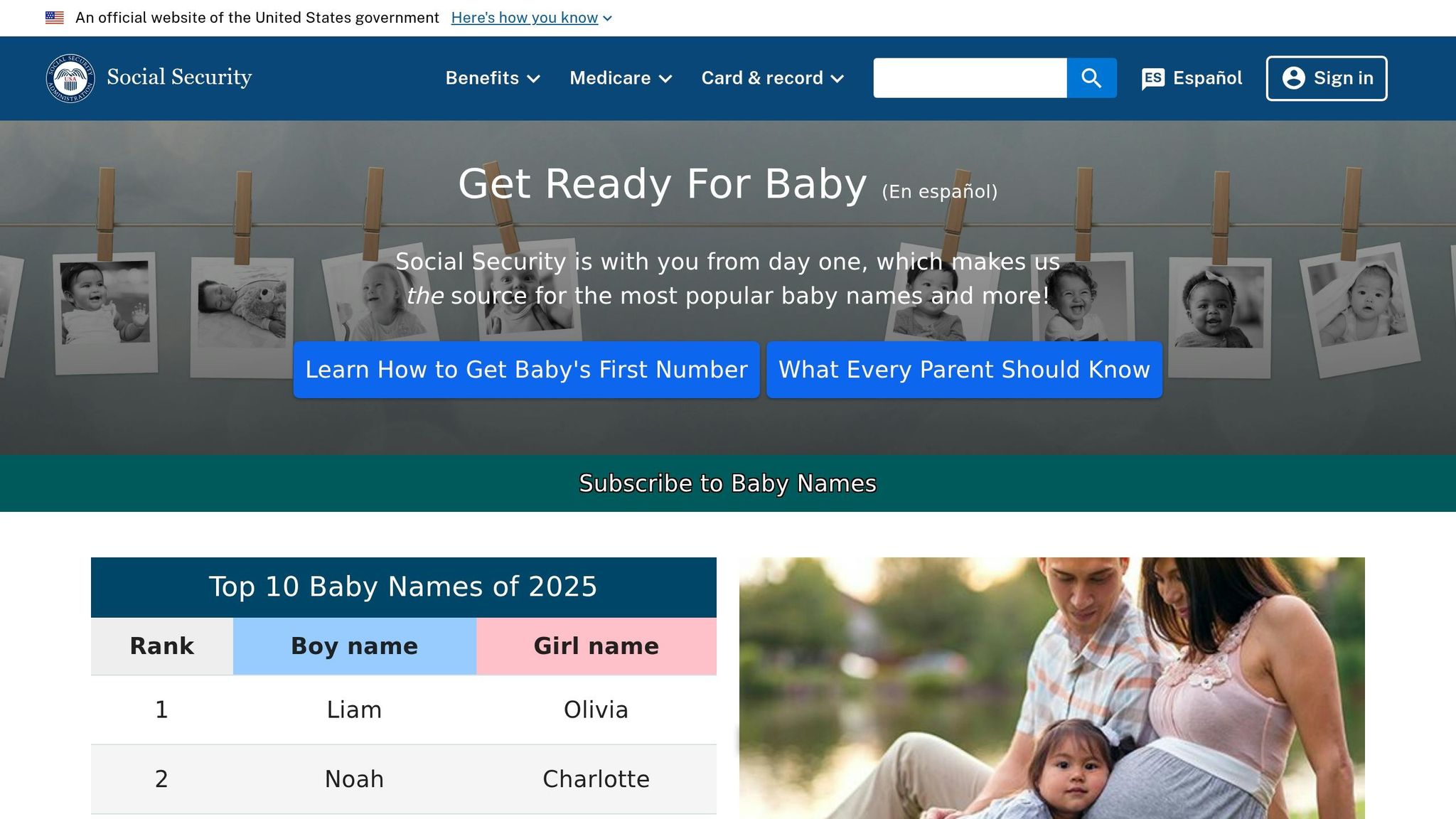
Rank and birth count work best together. Rank shows where the name sits compared with other names. Birth count shows how many babies actually got that name that year. Put those two numbers side by side, and you get a much clearer view of how common the name is.
It also helps to look at the past few years. Has the name stayed in about the same range, or has it shot up fast? Those are two very different cases. A steady name sets one expectation. A fast-rising name can feel like a different story.
Use a calculator for a faster answer
If you're checking a few names, a calculator can save time. Enter a name once and see its latest national rank and birth count right away. Run each option through the NameHatch Popularity Calculator, then compare the results with the cutoff you and your partner agreed on.
If a name lands in the gray area, use the Trend Analyzer to see whether usage is going up or down. If it still feels borderline, move on to spelling variants next.
sbb-itb-f13f980
Step 2: Account for Spelling Variants, Nicknames, and Gender-Neutral Use
After you check the raw rank, look at how the name shows up in daily life. People hear names more than they read them. That gap between sound and spelling is often where a name’s actual exposure gets missed.
Add Up Major Spellings to Get a Clearer Picture
The SSA tracks each spelling on its own, even when the names sound the same. Sophia and Sofia have separate ranks, and Aidan, Aiden, and Ayden are listed separately. So one spelling can look less common on paper even when the sound of the name is all over the place.
A simple way to check this: add the birth counts for the main spellings. Stick with spellings that appear again and again in the SSA top 1,000. Those are the versions your child is most likely to run into. Using a checklist for finding rare baby names can help you identify if rare or invented spellings with very low counts will change the big picture. Then look at the combined total before you decide how common the name feels.
Check Nickname Overlap and Use on Both Boys' and Girls' Lists
Nicknames add another wrinkle. Ellie can come from Elizabeth, Eleanor, Eliana, or Elliot. So even if the full name you pick sits in the middle of the rankings, the nickname your child uses every day may be shared with lots of other kids whose full names are completely different. A child can end up with a very common everyday name even when the formal name seems less common.
Names used on both boys' and girls' lists create the same kind of blind spot. Names appearing on both the boys' and girls' SSA top-1,000 lists accounted for 12.2% of all births in 2024. If a name like Riley or Avery ranks in the top 200 for girls and the top 200 for boys, it can work more like a top-100 name when you look across both lists. Check both lists, then look at the combined total before deciding whether the name feels too common. If a name appears on both lists, judge the total exposure, not just one rank.
Step 3: Compare national data with your state and local area
A national rank shows how common a name is across the country. A state rank shows whether that same name is common where you live. That gap matters, because national data can hide local pockets where a name is much more common.
Use state-level data to see local concentration
Once you’ve checked the national rank, look at your state next. The SSA’s state files let you compare local rank and birth count against the national data you already found. Pull up your state’s file and check both numbers side by side.
If a name ranks much higher in your state than it does nationwide, that’s a sign the name is more concentrated in your area than the national numbers suggest.
Some names show just how big that gap can be. Kaia, for example, ranks #3 in Hawaii but only #180 nationally. Beaux is heavily concentrated in Louisiana, where about 1 in 10 boys with that name in the entire country are born there. Patterns like that can make the same name feel common in one state and rare in another.
Build a simple comparison table before deciding
Before you make a call, put the numbers in one place. You can also use a baby name swipe app to organize your favorites and compare them with your partner. After you’ve gathered national and state data for your shortlisted names, a simple table makes it easier to spot the difference between broad rank and local use.
Fill in the SSA data, add the combined spelling estimate from Step 2, and then use your own local exposure as a last gut check. In plain English: compare what the national number says with what life in your area actually feels like.
| Name | National rank | State rank | Combined spellings | Local exposure |
|---|---|---|---|---|
| Ava | #7 | #3 | Very high (all spellings similar) | Very common locally |
| Isla | #33 | #55 | Moderate | Occasional, not constant |
| Madelyn/Madeline | #72 | #40 | High once variants are combined | Feels common in our area |
"Local exposure" should reflect what you actually see in your area.
Step 4: Check whether the name is rising or falling in use
After rank, spelling, and location, look at momentum. A name’s current rank tells you where it sits today. It does not tell you where it’s going.
That part matters more than many parents expect. A name that’s moving up fast can feel far more common by the time your child starts school, even if the rank still looks fairly moderate right now.
Read trend lines before making a final call
To read a trend the right way, check at least 10 years of SSA data for the name. One year’s rank can mislead you. The line over time tells the bigger story.
- A steep rise means the name is gaining ground fast
- A flat line means the name is holding steady
- A downward slope means the name is losing ground
Aurora climbed about 60 ranks in five years to reach the top 15 girls' names. On the other hand, Madison peaked at #2 in 2001 and has continued to fall by 8–12 ranks per year, now sitting outside the top 30.
Those paths tell you a lot more than a single rank ever could.
The SSA’s yearly "Change in Name Popularity" list also points out the biggest one-year jumps and drops.
Use a trend tool to see how a name moves over time
Reading raw SSA tables year by year can be a slog. If you want a faster visual check, run the name through our Baby Name Trend Analyzer or compare AI baby naming apps to find the best tool for your search.
It charts rank and birth counts over time, so you can spot the full arc at a glance. That makes it easier to tell whether a recent jump is new or just one part of a longer pattern. If a name suddenly takes off, you’ll see it. If it has been inching up for years, you’ll see that too.
Add a trend comparison table to guide your final decision
Once you know a name’s trend type, it gets easier to guess how it may feel in your child’s peer group a few years from now. This table turns trend patterns into plain-English expectations.
| Trend type | Current rank | Likely feel in early school years | What it means for your comfort zone |
|---|---|---|---|
| Rising fast | Moderate | Much more common; could feel like a Top 10 name | Avoid if you want to stay ahead of peak saturation |
| Stable | Mid to high | Consistently popular; familiar without being a sudden surge | Safe choice if you don't mind a well-known name |
| Declining | High to mid | Less saturated than rank suggests; may feel slightly dated | Good if you like the name's sound but want less "of-the-moment" feel |
| Rising slowly | Low | Slightly more common but still feels fresh | Often the sweet spot for parents who want recognizable but not common |
Use these trend signals alongside rank, variants, and location.
Conclusion: Use rank, variants, location, and trends together
No single number tells the full story.
Start with the cutoff you set together, then judge each name against it. From there, look at rank, spelling variants, local use, and trend as a group.
Before you lock anything in, use our Popularity Calculator to check a name’s current rank and birth count.
The same national rank can feel very different once you factor in spellings, local concentration, and momentum.
Popularity is a preference, not a rule.
If you want to see whether a name is rising or falling, run it through our Baby Name Trend Analyzer for a year-by-year view. Then pick the name you both feel good saying out loud using AI naming tools in everyday life.
FAQs
What rank is too popular?
There’s no single ranking that makes a name “too popular.” It comes down to what feels fine to you, plus the people around you and the kind of social circle you’re in.
If you want to check, you can look up a name's popularity ranking with our Popularity Calculator. And if you want to see whether that name is going up or down over time, take a look at our Baby Name Trend Analyzer.
Should I combine different spellings?
It depends on what you want from the name: familiarity, style, or something a bit less seen. A classic spelling like Catherine can feel more old-school, while Katharine or Kathryn may come across as less common.
If you want to see how often a certain spelling shows up, check the name's popularity ranking or run it through our Popularity Calculator. And if you want the bigger picture, use our trend analyzer to see whether that version is going up or down over time.
Why does state popularity matter?
State-level popularity matters because a name’s rarity often depends on where you live and the people around you. A name that sounds uncommon in your town might be common in another part of the country - and the reverse is just as true.
So if you want a name to feel more unusual or more familiar in your area, check the name’s popularity ranking or run it through our Popularity Calculator. You can also use the Baby Name Trend Analyzer to see whether the name is going up or down over time.