You can blend two names into one by taking parts that sound good together, then testing the result for sayability, spelling, initials, and family fit.
If I wanted to do this well, I’d keep the process simple:
- Split both names into parts like beginnings, syllables, and endings
- Pick what must stay from each name
- Try 4 blend patterns:
- beginning + ending
- syllable swap
- shared-letter bridge
- nickname + ending
- Say the full name out loud
- Check spelling, initials, and nicknames
- Make sure it fits your family’s background and daily use
- Compare 3–5 finalists before choosing one
This works because a blended name is more than a mash-up. It has to sound like one first name, not two names pushed together. Examples from the article include Emivia from Emma + Olivia and Danijah from Daniel + Elijah.
A big point here: easy pronunciation and spelling matter a lot. The article notes that 71% of parents care about pronunciation and 64% care about spelling. So if a name looks good on paper but feels awkward out loud, I’d move on.
Here’s the short version: keep the parts that matter, make several options, test them in daily life, and pick the one that still feels right after you hear it, spell it, and picture using it for years.
| Step | What I’d do | What I’m checking |
|---|---|---|
| 1 | Break both names into parts | starts, endings, syllables, nicknames |
| 2 | Make several blends | smooth sound, clean structure |
| 3 | Test each name | pronunciation, spelling, initials, nicknames |
| 4 | Narrow finalists | side-by-side comparison and family fit |
If you want one clear takeaway, it’s this: the best blended baby name is easy to live with, not just fun to invent.
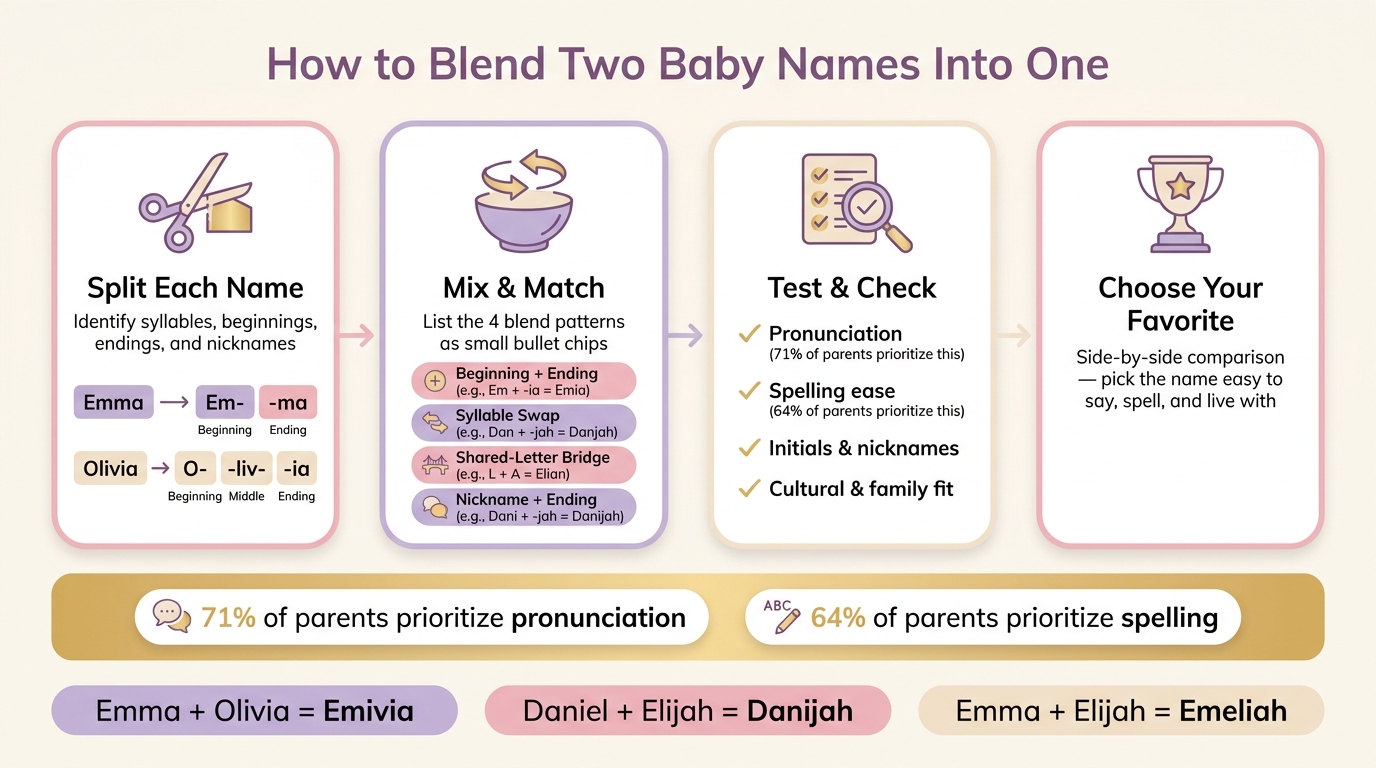
How to Blend Two Baby Names: 4-Step Visual Guide
Step 1: Break Both Source Names Into Usable Parts
Start by writing each source name in full. Then note any nicknames and middle-name parts you want to keep. In a lot of cases, nicknames give you the easiest sounds to work with.
Mark Syllables, Beginnings, and Endings
Say each name out loud, slowly, and tap once for each syllable. Then sort the parts you can reuse with the table below:
| Name | Syllable Split | Start | Core | End |
|---|---|---|---|---|
| Emma | Em-ma | Em- | - | -ma |
| Olivia | O-liv-ia | O- | -liv- | -ia |
| Daniel | Dan-iel | Dan- | - | -iel |
| Elijah | E-li-jah | Eli- | - | -jah |
Endings like -ia, -iel, and -jah already show up in familiar names - Amelia, Gabriel, Josiah - so they often sound smooth at the end of a blend. Keep consonant clusters together so the name doesn't come out clunky or hard to say. These parts are the raw material for the four blending methods in the next step.
Choose the Parts You Want to Keep
Next, decide which sounds, letters, or meanings need to stay. Make a short must-keep list before you begin mixing parts together. Then sort each item into three buckets: must-keep, preferred, and optional.
For example, if you want Daniel's -iel ending, shape the blend around that sound. If both names share a sound - like the li in Olivia and Elijah - that overlap gives you a nice bridge to build from. Shared sounds often make the final name feel more natural.
Put everything into a simple grid: original name, syllable chunks, starts, ends, nicknames, initials, and your must-keep notes. You'll use that grid to test blends in Step 2.
sbb-itb-f13f980
Step 2: Try 4 Ways to Blend the Names
Use your syllable grid to test a few blend patterns. Come up with several options, then look at them side by side. That makes it much easier to spot the ones that sound smooth and the ones that feel a bit off.
Merge a Beginning With an Ending
Start with the most direct option. Take the first part of one name and join it to the last part of the other. Then reverse the order, because one version often sounds better than the other.
Emma + Olivia becomes Emivia. Flipped, it becomes Olma, which can smooth into Alma. In many cases, cutting one consonant or changing a vowel is enough to turn a rough blend into something that feels easy to say every day.
If that still sounds forced, try swapping syllables instead.
Swap Syllables or Shorten Sounds
Take one full syllable from each name and combine them. This tends to work best when both names have more than one syllable.
Dan- and -jah from Daniel and Elijah make Danjah, which can soften into Danja. Flip it around and Eli- plus -iel gives Eliel. If you notice doubled letters or extra syllables, trim them. The goal is a name that sounds clean, not crowded.
If the blend still feels awkward, shared letters can help.
Use Shared Letters or a Vowel Bridge
When a direct blend feels clunky, look for consonants that show up in both names and use them as the frame. Then adjust the vowels until the name flows better.
With Daniel and Elijah, the shared letters l, a, and e appear in both. If you keep L and A in place and add a connecting vowel, you get options like Lian, Elan, or Elian. Good bridge vowels to test are a, e, i, and sometimes o.
Combine a Nickname With a Full-Name Ending
Nicknames often hold the most familiar sound from a name, so they can make blends feel more natural. Take a common nickname from one name and pair it with the ending of the other.
From Daniel and Elijah, Dani (from Daniel) plus -jah makes Danijah. It feels personal, but it still sounds like a given name. From Emma and Olivia, Em plus -ia gives Emia, which can also stretch into Emilia if you want a finish that feels more familiar. If the blend comes out a little harsh, soften a consonant or add a last vowel.
Once you have a shortlist, check the sound, spelling, and overall fit in Step 3.
Step 3: Check Pronunciation, Spelling, and Cultural Fit
Now test each option in everyday life before you decide. Step 3 is where you find out if the name still works once people actually say it, spell it, and use it.
Say the Full Name Out Loud
Say the full first, middle, and last name together a few times at a normal pace. Then say it louder, like you're calling across a room.
Listen for a few common issues. Hard consonant joins can make a name feel awkward fast, especially when the first name ends with a hard sound and the last name starts with one too. Repeated sounds can make the full name feel a bit too samey. And an unintended rhyme between the first and last name, like "Mia Diaz", might sound fun to one family and distracting to another.
A simple trick: record yourself on your phone and play it back. That often shows whether you stumble, pause, or change the stress without noticing. After that, think about how the name sounds in day-to-day use.
Test Spelling, Initials, and Everyday Use
Try the name in the places where it will actually show up: on a birth form, a school roster, an email address, and over a phone call. If you have to spell it every single time, that may be a sign to move it lower on your list.
Write out the full initials - first, middle, last - and check for accidental words or acronyms. Then think through the most likely nicknames. If a blended name will probably shorten into something you don't like, decide now whether you can live with that, because people often shorten names on their own.
| Candidate Name | Pronunciation Clarity | Spelling Ease | Initials | Likely Nicknames | Cultural Meaning/Fit |
|---|---|---|---|---|---|
| Emalia | Clear on first hearing | Standard spelling | Check with surname | Emma, Lia | Modern spin on Amalia/Emilia; fits U.S. and European naming traditions |
| Danijah | Sometimes misread | Multiple likely spellings | Check for acronyms | Dani, Nijah | Biblical roots from both source names |
| Olivienne | Clear but may need repeat | Needs spelling out | Check with surname | Liv, Vivi | Olivia + Vivienne; French-style ending |
Then take one more pass and ask whether the name still fits your family's language, heritage, and customs.
Check Meaning, Heritage, and Family Context
If the name has religious, cultural, or bilingual roots, make sure it still lines up with your family's meaning and any language spoken at home. Sometimes a blended first name leans more modern, and that's fine. In that case, a meaningful middle name can carry more of the family tie.
You're aiming for a name that feels chosen on purpose, easy to wear, and personal - not one that just happened by drift.
If two blends still feel close, use naming tools to compare similar-sounding options and trim the list.
Step 4: Use NameHatch to Refine Your Shortlist
Once you’ve got 3–5 finalists, use NameHatch to compare close variations FAST. The goal here is simple: narrow down names that already have promise, not blow up the process and start from scratch.
Use NameHatch to Find Similar-Sounding Name Options
NameHatch is a browser-based, ad-free naming tool built for couples. There’s no download required. Add your favorite blends from Steps 1–3 as saved originals - say, Emeliah (Emma + Elijah) or Lianora (Liam + Nora) - then use the swipe discovery interface to look through similar-sounding options.
Swipe right on names that feel close. Swipe left on anything that misses the mark. If both partners swipe right on the same name, it moves to a shared shortlist.
The style filters help shape the tone of what you see. Turn on Soft and Modern if you want names with flowing vowels and current usage - think Eliana, Emalia, or Amelia as close neighbors to Emeliah. Switch to Strong and Unique if your blend feels punchier or less common. The Classic filter works well when you want the name to feel timeless instead of trend-driven.
Use swipe discovery, partner sync, and AI suggestions to compare close blends and save mutual favorites.
Compare Saved Names With Your Original Blends
Pin your saved originals at the top of the list, then place suggested variations under each one. For example, put Emeliah first, then save Emilia, Eliana, and Amalia below it. That setup keeps things tidy and makes comparison easier. You’re not sorting through a messy pile of names. You’re comparing small groups of related options.
After both partners have swiped on their own, the shared shortlist shows where your instincts line up. From there, run the same pronunciation, spelling, and fit checks on the names that are still standing. Then you’re down to the blend you can say, spell, and use with ease every day.
Conclusion: Pick the Blend That Sounds Right, Feels Personal, and Works Day to Day
At this point, you’ve gone from two source names to a blended name you can use in daily life. Now the job is simple: test each option in real situations and see how it holds up.
A blended name can be clever, but it also has to be easy to live with. Being original by itself isn’t enough. In the U.S., ease of pronunciation and spelling matter a lot when people choose names: 71% point to pronunciation, and 64% point to spelling. So even if a blend looks smart on paper, that doesn’t mean it will work well day to day.
There’s no one perfect blend, either. Sometimes the best clue is pretty simple: does the name still make both of you smile when you say it out loud? That matters. So do the names you keep coming back to when you picture real moments - "Emalia, come to dinner" or "Congratulations, Liviana!" If one option keeps popping up in your head, pay attention to that.
Before you make the call, do one last check on the basics:
- Pronunciation
- Spelling
- Initials
- Cultural fit
If you still have a few front-runners, NameHatch can help you compare them and show similar-sounding options. Then do one final side-by-side check and go with the name that still feels right, sounds good, and fits everyday life.
FAQs
How do I make a blended baby name sound natural?
Focus on rhythm and flow. Keep the key sounds that make each original name feel like itself, but smooth out any awkward combos.
Say the name out loud. Test the pronunciation, the rhythm, and how it sounds with your last name. A good match feels natural, easy to spell, and easy to use every day.
What if our blended name is hard to spell or pronounce?
If your blended name is tough to spell or say, keep it simple enough to work in day-to-day life. Write it down and ask native English speakers to read it out loud without any help. If what they say is far off from what you meant, make a few small spelling tweaks.
You can also use name analyzers to check rhythm, balance, and pronunciation. And if you decide to keep an unusual spelling, add a one-line phonetic guide on school or medical forms.
How can we honor both family names without forcing the blend?
Consider options that honor family background without forcing a mixed first name. One simple route is to use one name as a middle name. Another is to keep an ethnic name alongside a legal first name.
You can also divide the choice between parents: one picks the first name, and the other chooses the middle name. That way, both sides of the family are part of the name.