Classic girl names starting with "L" have remained popular for decades due to their soft, flowing sounds, meaningful origins, and timeless appeal. From historical icons to modern trends, these names offer a blend of elegance and versatility. Here’s a quick overview of the 12 featured names:
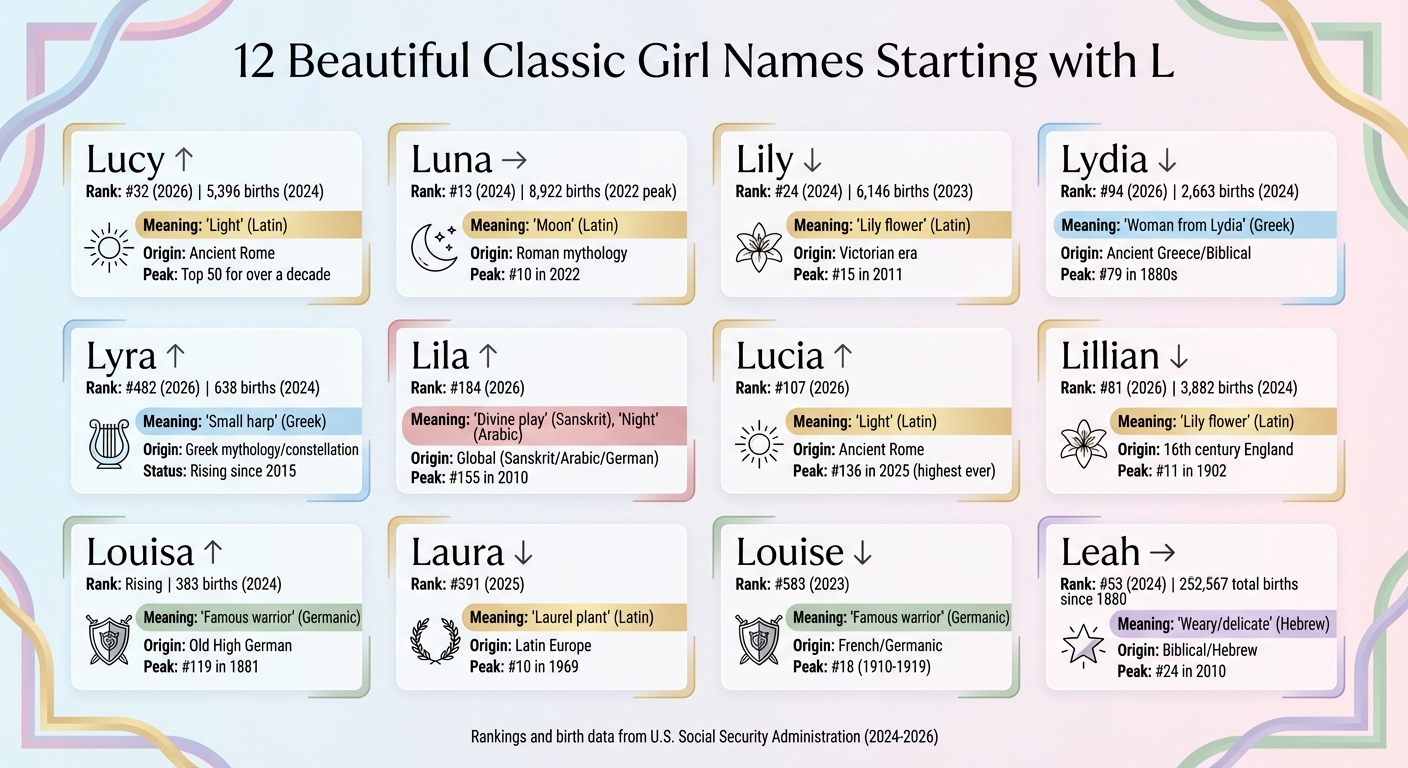
- Lucy: Latin for "light", with roots in Ancient Rome and strong literary and cultural ties.
- Luna: Latin for "moon", with celestial and mythological significance.
- Lily: Symbolizes purity and grace, inspired by the flower.
- Lydia: Ancient Greek for "woman from Lydia", with biblical and literary connections.
- Lyra: Greek for "lyre", tied to mythology and the Lyra constellation.
- Lila: Sanskrit for "divine play" and Arabic for "night", with global roots.
- Lucia: Latin for "light", celebrated in various cultures, including Sweden’s Saint Lucia’s Day.
- Lillian: Derived from "lily flower", blending floral beauty with historical depth.
- Louisa: Germanic for "famous warrior", with literary and royal associations.
- Laura: Latin for "laurel plant", symbolizing victory and honor.
- Louise: French for "famous warrior", popular in royal and Catholic traditions.
- Leah: Hebrew for "weary" or "delicate", with biblical significance.
These names combine history, meaning, and enduring charm, making them perfect choices for parents seeking timeless yet stylish options.
12 Classic Girl Names Starting with L: Meanings, Origins & Popularity Rankings
1. Lucy
Meaning
Lucy comes from the Latin word lux, meaning "light." This gives the name a sense of brightness, clarity, and hope - a perfect foundation for its rich history.
Cultural Origin
Lucy traces back to Ancient Rome as the feminine form of Lucius. It gained prominence through Saint Lucy of Syracuse, a 4th-century martyr and the patron saint of the blind. After the Norman Conquest, Lucy made its way to England, where literary works like Dante's The Divine Comedy and 19th-century novels helped solidify its place in history. These deep historical ties contribute to its enduring charm for modern parents.
Enduring Popularity
Lucy remains a favorite in the U.S., ranking #32 as of February 25, 2026. In 2024 alone, 5,396 baby girls were named Lucy. Its vintage revival since the early 2000s has kept it securely within the Top 50 for over a decade.
"Lucy is the perfect choice for parents seeking a name that is timeless but not tired. It offers the history of a saint and the energy of a firecracker."
Timelessness
What makes Lucy so appealing is its simplicity and universal recognition. From Lucy Pevensie in The Chronicles of Narnia to comedy legend Lucille Ball and even The Beatles' "Lucy in the Sky with Diamonds", the name effortlessly bridges vintage charm and modern vibrancy. It's a name that feels both classic and fresh, making it a perennial favorite.
sbb-itb-f13f980
2. Luna
Luna brings a celestial touch to the timeless appeal of names like Lucy, offering a radiant and enchanting option.
Meaning
The name Luna comes from the Latin word for "moon" and the Proto-Indo-European root "leuk", which means "light." This gives Luna a luminous and radiant essence, perfectly tied to its celestial origins.
Cultural Origin
In Roman mythology, Luna was the goddess of the Moon, often portrayed guiding a white chariot across the night sky. Beyond mythology, the name is also the word for "moon" in Spanish and Italian, adding to its broad cultural resonance. In the United States, Luna was rarely used after 1922 but made a notable comeback in 2003.
Enduring Popularity
Luna's revival began in 2003, partly thanks to the character Luna Lovegood in J.K. Rowling's famous series. Celebrities also played a role in its rise - John Legend and Chrissy Teigen named their daughter Luna Simone in 2016, boosting the name's visibility. By 2016, Luna had entered the top 100 names in the U.S., and in 2022, it peaked at #10, with 8,922 babies given the name that year. As of 2024, Luna holds the #13 spot in the United States.
"Luna is a defining name for the generation born in 2026. It is the perfect choice for parents seeking a name that is universally recognized yet retains a sense of magic."
- MomLovesBest
Timelessness
With its mythological roots and simple, modern sound, Luna strikes a balance between the past and present. Its two-syllable, vowel-rich structure fits perfectly alongside other popular names like Ava and Mia. Luna's appeal isn't limited to the U.S.; it consistently ranks among the top 100 names for girls in over 15 countries. It’s a shining example of how a name can feel both magical and contemporary at the same time.
3. Lily
Lily represents a blend of delicate beauty and enduring strength.
Meaning
Derived from the Latin word lilium (flower), Lily is a symbol of purity, innocence, passion, and rebirth. In Christian tradition, it signifies the Virgin Mary's purity and grace, as well as the resurrection of Jesus Christ [27, 29]. Greek mythology adds a different dimension, linking the flower to Hera's breast milk, making it a symbol of motherhood. These rich associations contribute to Lily's lasting charm.
Cultural Origin
The name Lily gained popularity in the mid-19th century, coinciding with the Victorian era's fascination with floral names [29, 30]. Beyond its botanical roots, it also has Hebrew origins as a diminutive of Elizabeth (Elisheva), which translates to "my God is an oath" [29, 30]. Variations of the name appear across the globe, such as Liliya in Russian, Lilja in Finnish and Icelandic, and Lilia in Polish and Spanish [27, 28, 30].
Enduring Popularity
Lily has held a spot in the U.S. top 50 names for over 15 years. After barely making the top 1,000 in the 1970s, it climbed to the top 500 by 1992 and peaked at #15 in 2011 [27, 29]. In 2023, 6,146 girls in the U.S. were named Lily, with additional variations like Lilly (1,194) and Lillie (409) also gaining traction. As of 2024, Lily ranks #24. The name received a boost in attention with the 2021 birth of Prince Harry and Meghan Markle's daughter, Lilibet "Lili" Diana.
"Floral favorite Lily is an ecovintage pick that bridges classic Charlotte and Eleanor to modern River and Willow."
- Abby Sandel, Founder, Appellation Mountain
Timelessness
Lily strikes a balance between historical significance and modern appeal, much like names such as Lucy and Luna. It works well as a standalone name or as a nickname for Elizabeth or Lillian [29, 32, 33]. Its popularity has consistently surpassed other floral names like Rose, Violet, and Daisy. Lily's presence in literature (e.g., Lily Potter in Harry Potter and Lily Bart in The House of Mirth) and pop culture (e.g., Lily Aldrin in How I Met Your Mother) further cements its status as a name that feels both fresh and familiar [27, 31, 33].
4. Lydia
Lydia weaves together the richness of ancient history with a modern-day allure.
Meaning
The name Lydia has its roots in Ancient Greek, derived from Λυδία (Ludía), which translates to "woman from Lydia." This refers to a prosperous Iron Age kingdom in what is now western Turkey, known for its wealth under King Croesus, flourishing trade, and the production of regal purple dye. The name is also often associated with meanings like "beautiful one" or "noble one."
Historical and Literary Origins
Lydia's charm is amplified by its biblical and literary connections. In the New Testament, Lydia of Thyatira is celebrated as a successful merchant dealing in purple cloth and the first European to convert to Christianity. On the literary front, Lydia appears in Jane Austen's Pride and Prejudice as Lydia Bennet and in pop culture through the film Beetlejuice, adding layers of recognition to the name.
Enduring Popularity
Lydia has consistently appeared in the U.S. Top 1,000 names for over a century. It reached its peak popularity in the 1880s, ranking at #79. After a dip during the mid-20th century, it surged back into the top 100 and has held its place for the past decade. In 2024, 2,663 baby girls in the United States were named Lydia, and by early 2026, it ranked #94. Beyond English-speaking countries, Lydia takes on different forms, such as Lidia in Spanish and Italian, Lydie in French, and Lidiya in Russian and Bulgarian, showcasing its global appeal.
Timeless Appeal
Lydia effortlessly bridges the past and present with its melodic, three-syllable rhythm that feels both classic and contemporary. Its biblical roots, literary connections, and enduring popularity make it a timeless choice for parents. Those drawn to Lydia often consider similar names like Olivia, Lila, or Leah for their lyrical and elegant qualities.
"Lydia stands as a timeless tessera in the mosaic of ars longa, vita brevis."
- Claudia Renata Soto, Assistant Editor, Name.baby
5. Lyra
Lyra brings together ancient musical traditions, Greek mythology, and celestial beauty, offering a name that feels both classic and fresh.
Meaning
Derived from the Greek word lyra, meaning "small harp", Lyra evokes images of harmony and artistic expression. In mythology, it’s tied to Orpheus, the legendary musician whose lyre could enchant all who heard it. After his passing, Zeus honored Orpheus by placing his lyre in the heavens as the Lyra constellation, home to Vega, one of the brightest stars visible from Earth.
Cultural Origin
Lyra’s roots trace back to Greek and Latin traditions. The constellation itself has been recognized since the 7th century BC, making it one of the oldest known star patterns. As a personal name, Lyra was historically uncommon but has gained traction in recent years. Its rise can be attributed to Philip Pullman’s His Dark Materials trilogy (1995–2000), where the protagonist is named Lyra Belacqua, as well as modern influences like Ed Sheeran, who named his daughter Lyra Antarctica Seaborn Sheeran in 2020.
Enduring Popularity
Lyra first entered the top 1,000 baby names for girls in the U.S. in 2015. By 2024, 638 baby girls in the country were named Lyra. As of February 2026, it ranks #482 in U.S. births and holds the #62 spot on BabyNames.com. Beyond the U.S., it has been a top-100 name in England and Wales since 2020 and joined Ireland’s top 300 list in 2021.
Timelessness
Lyra’s growing popularity reflects its lasting charm.
"Lyra is an exceptional choice for a baby born in 2026. It sits in the 'Goldilocks' zone of popularity; it is recognizable and easy to spell, yet it remains distinct enough that your child won't be one of three Lyras in their kindergarten class." - Mom Loves Best
The name strikes a perfect balance between ancient mythology, classical music, and modern-day science. Its melodic quality draws comparisons to names like Aria and Luna. Pronunciations vary, with "LIE-ruh" and "LEER-ah" being the most common.
6. Lila
Lila weaves together spiritual, natural, and global influences, creating a name that feels both timeless and meaningful.
Meaning
The name Lila holds diverse meanings across different traditions. In Sanskrit, it means "divine play" or "amusement", reflecting the Hindu concept of the universe as a joyful and spontaneous creation by the gods - a poetic reminder of life's beauty and creativity [56, 59]. In Arabic and Hebrew, it comes from "laylah", signifying "night" or "dark beauty" [56, 57, 60]. Additionally, in German and Persian contexts, Lila is linked to the lilac flower and the color purple, adding a botanical and aesthetic charm [56, 59, 61]. This rich tapestry of meanings offers parents a name that is both profound and versatile.
"Lila is a linguistic chameleon that manages to be both ethereal and grounded. It carries a soft, liquid sound that fits perfectly with current trends, yet it possesses a vintage backbone." - Cate Hoepner, Professional Blogger
Cultural Origin
Lila's origins stretch across continents, making it a truly global name. It entered English-speaking circles in the 19th century, partly thanks to Lord Byron, who used the variation "Leila" in his 1813 poem The Giaour. The name also serves as a diminutive of Delilah and as the feminine form of the French name Lyle, which means "island" [57, 59, 61]. This multicultural background makes Lila an appealing choice for families seeking a name that bridges traditions and beliefs.
Enduring Popularity
In the U.S., Lila has seen fluctuations in popularity over the years. It ranked #191 in 1900 and peaked at #170 in 1930 [58, 59]. After a decline from the 1970s to the 1990s, it experienced a revival in the 2000s, reaching #155 in 2010 [57, 59]. By February 2026, Lila was ranked #184 in the U.S.. Meanwhile, the alternative spelling "Lyla" has gained even more attention, placing #110 in 2021 compared to Lila's #223. Famous figures with this name include model Lila Moss and journalist Lila Diane Sawyer [57, 59], adding to its modern appeal.
Timelessness
Lila strikes a perfect balance between vintage elegance and contemporary style. It fits neatly into the "grandma chic" trend while maintaining a fresh, modern vibe. As part of the growing popularity of "L-l" names like Lily, Luna, and Layla, Lila stands out as a less common yet equally stylish option [59, 61].
"The name carries an implicit duality: nightfall's tranquility on one flank, playful creativity on the other - a pairing that lends it both repose and sparkle." - Laura Gibson, Assistant Editor
7. Lucia
Lucia combines the rich heritage of ancient Rome with a modern global touch. Its name, rooted in Latin, directly translates to "light."
Meaning
Derived from the Latin word lux, meaning "light", Lucia represents hope, clarity, warmth, and illumination. As the feminine counterpart to the Roman name Lucius, it carries a sense of timeless elegance. While Lucy feels more casual, Lucia offers a refined, international flavor that appeals to many.
Cultural Origin
Lucia's history is deeply tied to ancient Roman traditions, but its influence extends far beyond. The name spread across Europe and became a cultural symbol in Sweden, where it is celebrated annually on December 13 during Saint Lucia's Day. This festival features a candlelit procession led by a girl wearing a wreath of candles, symbolizing the return of light during the dark winter months. Variations of Lucia appear in several languages, including Spanish (Lucía), Portuguese (Lúcia), and Italian (Lucia), showcasing its widespread appeal.
Enduring Popularity
Lucia has maintained a steady presence in the United States for over a century. Historical records show it peaked in popularity around 1900 and consistently ranked among the top 1,000 names. After some fluctuation in the late 20th century, its popularity began climbing again in 2004. By 2025, Lucia reached its highest-ever ranking at #136, and as of February 2026, it had risen to #107. The name is especially beloved in Hispanic communities and has been a favorite in Spain, where it topped the charts for girls' names. Its charm also resonates in Latin America and New Zealand, reinforcing its widespread appeal.
Timelessness
Lucia offers a perfect balance for parents seeking a name that feels both classic and contemporary. It is sophisticated yet approachable, blending modern romantic trends with vintage charm. The name’s flexibility is another draw, with both the Italian pronunciation "loo-CHEE-ah" and the English/Spanish "loo-SEE-ah" being equally embraced. Many parents choose Lucia for its formal elegance, appreciating the option of the nickname "Lucy" while enjoying the full three-syllable beauty of the name in official contexts.
8. Lillian
Lillian blends floral grace with timeless elegance, making it a standout choice among classic L names.
Meaning
Lillian traces its roots to the Latin word lilium, meaning "lily flower", and shares a connection with Elizabeth, which translates to "God is my oath." This dual heritage reflects both natural beauty and a sense of spiritual devotion, adding depth to its enduring charm.
Cultural Origin
The name Lillian gained traction in England during the 16th century and became a favorite in American households by the early 1900s, aligning with the popularity of floral-inspired names. The lily also holds deep symbolism in Christian art, representing purity, which further solidified the name’s appeal across Western traditions.
Enduring Popularity
Lillian hit its peak popularity in the U.S. at #11 in 1902, accounting for 1.093% of births that year. It made a strong comeback in the early 2000s, re-entering the top 100 in 2001 and reaching #22 in both 2010 and 2011. In 2024, 3,882 baby girls were named Lillian, and as of February 2026, it ranks #81 in the U.S.. Its consistent presence in the top 50 from 2005 onward highlights its lasting appeal.
Timelessness
Lillian strikes a perfect balance between formal sophistication and everyday charm. With versatile nicknames like Lily, Lil, or Lillie, it adapts effortlessly to different personalities and stages of life. Pop culture has also embraced the name, with notable references ranging from silent film icon Lillian Gish to Queen Lillian in Shrek and Lillian van der Woodsen in Gossip Girl. This mix of historical significance and modern-day relevance secures Lillian’s place as a "vintage comeback" name - classic yet refreshingly current.
9. Louisa
Louisa is a name that effortlessly combines strength and elegance, making it a standout among classic L names.
Meaning
Louisa means "famous warrior" or "renowned in battle." Its roots trace back to the Old High German name Hludwig (hlud meaning "fame" and wig meaning "battle"), giving it a strong and resilient undertone.
Origins and History
Louisa is the Latinized feminine form of Louis, stemming from the French Louise and German Luise. By the 18th century, it was embraced by European royalty and nobility before becoming popular in English-speaking countries. In American history, Louisa Catherine Adams, wife of John Quincy Adams, holds the distinction of being the only foreign-born First Lady of the United States until 2016. The name also shines in literature, thanks to Louisa May Alcott, the beloved author of Little Women. Jane Austen’s novel Persuasion features a character named Louisa Musgrove, further cementing the name's literary legacy.
Popularity Over Time
Louisa reached its height of popularity in 1881, ranking at #119. It remained in steady use through the early 1900s but disappeared from the top 1,000 between 1970 and 2013. However, it has seen a resurgence in recent years, with 383 U.S. baby girls named Louisa in 2024, up from 344 in 2023. This revival reflects a growing interest in vintage names.
A Name That Endures
Louisa offers a perfect blend of timeless sophistication and everyday charm. Its versatility is enhanced by endearing nicknames like Lou, Lula, and Lulu. With its three-syllable structure and consonant-rich sound, Louisa feels both vintage and fresh. As Susan Clarke, Assistant Editor at Name.baby, explains:
"These linguistic, historical, and demographic vectors collectively endow Louisa with an image that is at once classical and quietly resilient, appealing to parents who value heritage without succumbing to ubiquity."
10. Laura
Laura has long been a name that radiates grace and charm. With its roots steeped in history and culture, it continues to hold a special place among classic girl names beginning with L.
Meaning
The name Laura traces back to the Latin word laurus, which refers to the "bay laurel plant". In ancient Greco-Roman times, laurel leaves were crafted into crowns for victors and heroes, symbolizing triumph, honor, and fame.
Cultural Origin
Laura’s origins are firmly anchored in Latin Europe, especially Italy, and it has been part of the English-speaking world since the 13th century. Its prominence grew in the 14th century thanks to the Italian poet Petrarch, who famously dedicated his sonnets to a woman named Laura. The name also carries religious depth, tied to Saint Laura, a 9th-century Spanish martyr. Its adaptability is evident in international variations like Laure (French), Lára (Icelandic), and Lowri (Welsh).
Enduring Popularity
In the United States, Laura hit its peak popularity in 1969, ranking at number 10. Even though its position has declined - ranking at number 391 as of 2025 - it has never dropped out of the top 1,000 names in U.S. history. Its appeal has also been strong in Europe; in 2009, it was a top 10 favorite in countries like Austria, Belgium, Denmark, Spain, and Switzerland. Famous Lauras include author Laura Ingalls Wilder and former First Lady Laura Bush, further cementing its legacy.
Timelessness
Laura is often described by modern parents as "classic" and "refined". Steffi O’Brien beautifully summed it up:
"Laura - a timeless name derived from the Latin for laurel, symbolizing victory, strength, and honor - remains a beloved choice!"
With its rich history and literary connections, Laura effortlessly balances tradition with a sense of enduring charm.
11. Louise
Louise stands tall among classic "L" names, offering a timeless charm with a rich history. As the French feminine counterpart to Louis, its roots trace back to the Old High German Hluodowig, which later transformed through Medieval Latin Ludovicus into its modern French form.
Meaning
Louise is derived from the Germanic elements hlud (famous) and wig (battle), giving it the powerful meaning of "famous warrior." This blend of strength and elegance sets it apart while maintaining a historical connection to its variant, Louisa.
Historical Roots
Louise's history dates back to the 9th century, with figures like Louise of Saxony, a Frankish noblewoman, leaving their mark. It gained prominence in English-speaking countries during the 19th century, thanks in part to Queen Victoria naming her daughter Princess Louise. The name also holds significance in Catholic traditions due to Saint Louise de Marillac, a 16th-century co-founder of the Daughters of Charity. Variants like Luise, Luisa, and Lovisa highlight its appeal across different languages and cultures.
Popularity Over Time
Louise enjoyed its peak in the U.S. between 1910 and 1919, ranking as high as number 18. Though it fell out of the top 1,000 by 1991, it made a notable comeback, reaching #583 in 2023. Globally, Louise remains a favorite, ranking as the number one girl name in France and holding steady in countries like England, Ireland, Scotland, Sweden, and Wales. Celebrity parents such as Mandy Moore (Louise Everett Goldsmith, 2024) and Emma Stone (Louise Jean McCary, 2021) have also brought renewed attention to the name. While it’s less common as a first name in the U.S. today, Louise continues to be a popular choice for middle names.
A Name for the Ages
"Louise is a classic German name meaning 'famous warrior.' It carries strength and timeless appeal, connecting you to a rich cultural heritage."
– BabyCenter
With nearly 98% of those named Louise being female, the name embodies a sense of history, elegance, and enduring sophistication. It’s a name that bridges the past and present, resonating with royalty, strength, and grace.
12. Leah
Leah has stood the test of time, holding a spot on the U.S. Social Security Administration's top 1,000 names every single year since 1900. This enduring biblical name offers a mix of historical depth and modern charm, making it a favorite for generations of parents.
Cultural Origin
Leah’s roots run deep in Hebrew tradition, originating from the Hebrew word "Le'áh." In the Book of Genesis, Leah is a significant figure - Jacob's first wife and the mother of six sons who became the ancestors of the 12 tribes of Israel. While the name was mainly used by Jewish communities during the Middle Ages, it gained traction among English Christians after the Protestant Reformation, thanks to the Puritans. Interestingly, Leah also connects to Old English through the word "léah", which means "meadow" or "clearing." This connection is echoed in many Anglo-Saxon place names, adding another layer to its history.
Meaning
The name Leah carries multiple meanings, each adding to its richness. Derived from the Hebrew root la'ah, it is often interpreted as "weary" or "delicate". Some scholars also link it to the Akkadian word littu, meaning "wild cow", a symbol tied to fertility and divinity in ancient cultures. Meanwhile, the Old English association evokes images of serene landscapes, like open meadows and peaceful clearings, giving the name a natural, tranquil feel.
Enduring Popularity
Leah’s layered history has made it a consistent favorite. Its lowest ranking came in 1946 at #431, but since then, it has steadily climbed, peaking at #24 in 2010. As of 2024, Leah holds the #53 spot in the U.S., with nearly 252,567 recorded births since 1880. For the past two decades, it has remained in the top 100, particularly thriving in New Jersey, where it ranked #9 in 2024. Globally, Leah is also a top-10 name in Ireland and Northern Ireland, with appealing international variations like Léa in France and Lia in Italy and Portugal.
"Leah stands today as a historically grounded yet stylistically restrained choice, offering parents a name that is at once unmistakably biblical and comfortably contemporary."
– Miranda Richardson, Assistant Editor, Name.baby
Conclusion
These 12 L names carry a certain timeless charm and grace. From the radiant simplicity of Lucy and Lucia to the celestial allure of Luna and Lyra, each name offers a smooth, flowing sound that has stood the test of time. Whether you're drawn to the biblical depth of Leah, the floral beauty of Lily and Lillian, or the strength and elegance of Louise and Louisa, there's an L name to suit nearly every family’s preferences and traditions.
What makes these names even more appealing is how they blend tradition with a modern aesthetic.
"L fits right in with our love of smoothly flowing liquid names. This is the age of Ella and Mia, Elena and Aurora. A great many girl names starting with L fit this style perfectly."
– Abby Sandel, Founder, Appellation Mountain
When choosing a name for your daughter, think about what resonates most with your family - whether it’s the simplicity of Lucy or the refined sophistication of Lucia. Reflect on the cultural and personal significance behind the name, as it will carry meaning for years to come.
These names have proven their staying power, weathering trends and remaining fresh and beautiful. Choosing one of these enduring names ensures a choice that you and your daughter can cherish for a lifetime.
FAQs
What is the most popular L name for girls in the U.S. right now?
As of 2023, the most popular girl name starting with "L" in the U.S. is Luna. It has consistently held its place as a favorite, with its popularity expected to continue through 2026. The name's elegance and widespread appeal make it a go-to choice for many parents.
How do you pronounce Lucia and Lyra?
Lucia is pronounced as "loo-SEE-ah" in both English and Italian, while in Spanish, it's pronounced "loo-CHIA", with subtle differences depending on the specific accent. On the other hand, Lyra is generally pronounced "LYE-ruh" in English.
What are good nickname options for these L names?
Nicknames for girl names that start with "L" often come from shortening the original name or adding a sweet twist. For instance, "Liz" is a common choice for Elizabeth, while "Lia" works well for Eliana. If the name is Lillian, you might go with "Lulu".
Other ideas include "Liv" for Olive, "Lyd" for Lydia, or "Lou" for Louisa. For names like Leah or Lillian, a more neutral nickname like "Lee" could also fit. Ultimately, the nickname often depends on personal style or family traditions.