Girl names starting with "E" have timeless appeal, offering a mix of grace, historical depth, and cultural significance. Popular choices like Eleanor, Emma, and Eliana remain favorites due to their rich meanings and versatility. Each name on this list has unique origins, historical connections, and modern relevance, making them perfect for parents seeking something meaningful and stylish. Here's a quick look at the highlights:
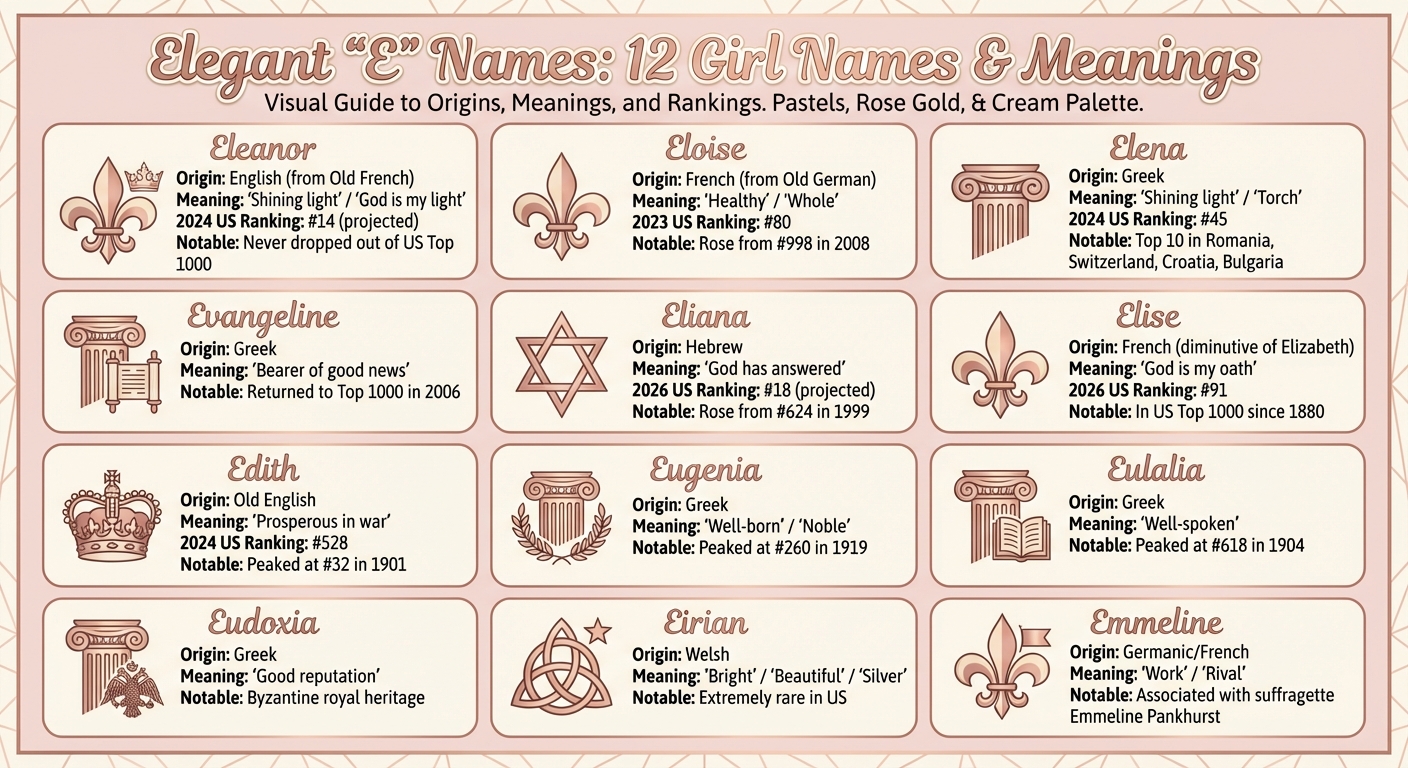
- Eleanor: English name meaning "shining light", tied to royalty and figures like Eleanor Roosevelt.
- Eloise: French origin, meaning "healthy" or "whole", popularized by literature and shows like Bridgerton.
- Elena: Greek for "shining light", with global recognition in countries like Spain and Italy.
- Evangeline: Greek for "bearer of good news", with literary and spiritual roots.
- Eliana: Hebrew for "God has answered", rising in popularity due to its melodic sound.
- Elise: French diminutive of Elizabeth, meaning "God is my oath", known for its simplicity and charm.
- Edith: Old English for "prosperous in war", a vintage name enjoying a revival.
- Eugenia: Greek for "well-born", associated with royalty and elegance.
- Eulalia: Greek for "well-spoken", tied to saints and poetic beauty.
- Eudoxia: Greek for "good reputation", reflecting Byzantine grandeur.
- Eirian: Welsh for "bright" or "beautiful", rare and radiant.
- Emmeline: Germanic origin, meaning "work" or "rival", linked to suffragette Emmeline Pankhurst.
These names combine historical richness with modern appeal, offering options that suit diverse tastes and backgrounds.
12 Elegant Girl Names Starting with E: Origins, Meanings, and Popularity Rankings
1. Eleanor
Meaning and Origin
Eleanor is an English adaptation of the Old French name Elienor, which itself comes from the Provençal Alienòr. It gained prominence in the 12th century, largely thanks to Eleanor of Aquitaine. Originally named Aenor and later called alia Aenor to differentiate her from her mother, Eleanor's name carries a fascinating mix of meanings. It’s linked to the Greek word eleos (mercy) and Helen (shining light), while an Arabic interpretation translates to "God is my light." This layered history reflects the name's enduring appeal and significance.
Historical and Cultural Significance
Eleanor of Aquitaine's influence cemented the name's place in European royalty, and her legacy was carried forward by other notable figures like Eleanor of Provence and Eleanor of Castile. In more recent history, Eleanor Roosevelt - the longest-serving U.S. First Lady and a champion of human rights - became one of its most iconic namesakes.
"The popularity of the name Eleanor in England during the Middle Ages was due to the fame of Eleanor of Aquitaine, as well as two queens of the following century: Eleanor of Provence... and Eleanor of Castile." - Behind the Name
Eleanor has also left its mark on literature and pop culture. It appears in Jane Austen's Sense and Sensibility, William Shakespeare’s works, and Virginia Woolf’s writings. In modern times, it gained recognition through the Beatles’ song “Eleanor Rigby” and characters in shows like The Good Place and Stranger Things.
Stylistic Appeal and Timelessness
Eleanor strikes a balance between vintage elegance and contemporary charm. Today’s parents often see it as a name that is both sophisticated and empowering. Its versatility is enhanced by a variety of nicknames, such as Nora, Ella, Ellie, Elle, and Nell, offering options that can evolve with a child.
The name’s popularity has also stood the test of time. It peaked at 28th in 1915, made its way back into the top 100 in 2014, and is projected to rank 14th nationally by 2024, with an even higher placement - 9th - in Virginia. Remarkably, Eleanor has never dropped out of the top 1,000 in the United States, a testament to its enduring appeal.
Cross-Cultural Usability
Eleanor’s adaptability makes it a favorite for families with diverse backgrounds. It translates seamlessly into various languages, with versions like Leonor (Spanish/Portuguese), Eleonora (Italian/Polish/Dutch), Éléonore (French), and Ellinor (Scandinavian). This global versatility makes it an excellent choice for parents seeking a name that resonates across different cultures and languages.
sbb-itb-f13f980
2. Eloise
Meaning and Origin
Eloise is the English version of the French names Éloïse or Héloïse, which trace back to the Old German name Helewidis. This name combines heil (meaning "healthy", "whole", or "safe") with wid or wit (meaning "wide", "wood", or "forest"). Despite occasional claims linking Eloise to helios or Louise, there’s no historical basis for these connections.
Historical and Cultural Significance
The name Eloise owes much of its historical charm to Héloïse, a 12th-century French scholar and philosopher. Her legendary romance and correspondence with Peter Abelard have cemented her place in history. Brought to England by the Normans, Eloise faded in popularity after the 13th century but experienced a revival during the Victorian era.
In recent years, the name has been revitalized by pop culture. Eloise Bridgerton, a character in the Bridgerton series, has brought attention to the name with her strong and independent persona. Additionally, the Eloise at the Plaza children's books have kept the name familiar and beloved across generations. This blend of historical depth and modern relevance makes Eloise a name with enduring charm.
Stylistic Appeal and Timelessness
Eloise is often described as a name that feels "classic", "refined", and "upper class", while still maintaining a playful edge. It perfectly combines a scholarly, romantic feel with a modern vibrancy, making it both elegant and empowering.
The name has seen a remarkable rise in popularity over the past decade. From a low point at #998 in 2008, Eloise climbed to #80 in 2023. In 2024, 3,430 baby girls in the U.S. were named Eloise. Historically, its previous peak was in 1921, when it ranked #165 and accounted for 0.108% of baby girls. Its timeless appeal ensures it resonates with parents across generations.
Cross-Cultural Usability
Eloise has variations that make it accessible in many languages and regions. In Spanish, it becomes Eloísa; in Italian, Eloisa; and in Portuguese, Heloísa. Heloísa is particularly popular in Brazil, where it ranks as one of the top names for girls. Globally, Eloise is on the rise, ranking #45 in Quebec, #61 in Canada overall, #62 in New South Wales, Australia, and #106 in England and Wales as of 2022–2023. This adaptability adds to its universal appeal.
3. Elena
Elena follows Eloise with its radiant charm, weaving together a legacy of myth and modern recognition.
Meaning and Origin
Elena is a feminine name with Greek roots, stemming from the word helene, which translates to "shining light" or "torch." As a European variant of Helen, it has found its way into Spanish, Italian, Slavic, and Romanian naming traditions. The name's luminous meaning has captivated parents for generations, conjuring images of Helen of Troy's legendary beauty.
Historical and Cultural Significance
Elena’s historical significance is steeped in both Greek mythology and Christian tradition. It is famously tied to Helen of Troy, whose beauty is said to have sparked the Trojan War. Beyond mythology, the name has been borne by saints and historical figures, adding depth to its story. In modern times, prominent figures like U.S. Supreme Court Justice Elena Kagan, Italian author Elena Ferrante, and Spanish royalty such as Infanta Elena, Duchess of Lugo, have carried the name, reinforcing its timeless resonance.
Stylistic Appeal and Timelessness
Elena’s three-syllable melody gives it a refined and sophisticated feel, making it a favorite among modern parents over the more traditional Helen. In 2024, it ranked #45 in the U.S., with 4,261 births recorded in 2023. Its rhythmic simplicity ensures it’s both easy to pronounce and spell, adding to its lasting allure.
Cross-Cultural Usability
Elena’s universal appeal shines through its use across Romance, Slavic, Germanic, and Baltic languages. It holds top spots in countries like Romania (#3), Switzerland (#6), Croatia (#10), and Bulgaria (#10), and remains popular in Italy (#29), Spain (#39), and Germany (#48). In the U.S., it resonates with families from diverse backgrounds. Its flexibility is further highlighted by its many nicknames, including Lena, Ellie, Ella, Laney, and Nellie, making it a name that feels at home across cultures and generations.
4. Evangeline
Evangeline carries an air of literary charm, symbolizing hope and a rich historical narrative. Let’s delve into its roots, historical journey, stylistic allure, and global variations.
Meaning and Origin
Evangeline originates from Greek, combining eu (good) and angelma (news), translating to "bearer of good news." It stems from euangelion, meaning "gospel", and entered English through French influence, with the feminine –ine suffix adding a romantic touch that feels timeless.
Historical and Cultural Significance
The name gained prominence thanks to Henry Wadsworth Longfellow’s 1847 poem, Evangeline, A Tale of Acadie. The story follows a young Acadian woman’s journey during the expulsion of the Acadians, and Longfellow’s line, "Fairest of all the maids was Evangeline", cemented the name’s poetic legacy. The name resonated strongly with Acadian and Cajun communities, peaking in popularity around 1900 before fading from use for decades. It reappeared in the U.S. Top 1000 in 2006, likely spurred by actress Evangeline Lilly’s role in Lost and Disney’s 2009 film The Princess and the Frog.
Stylistic Appeal and Timelessness
With its graceful four-syllable rhythm, Evangeline carries a vintage sophistication. It pairs beautifully with nicknames like Eva, Evie, and Angie, and complements short, classic middle names such as Rose, Grace, Claire, or Pearl.
Cross-Cultural Usability
Evangeline transitions effortlessly across languages and cultures. Variations include Evangelina in Spanish and Italian, Evangelia in Greek, and Evangeliya in Bulgarian and Russian. Its popularity extends to the United Kingdom, Canada, and African American communities, maintaining its spiritual ties to the gospel while appealing to diverse audiences.
5. Eliana
Eliana blends spiritual meaning with poetic elegance and has seen a remarkable rise in popularity within the United States. It jumped from rank 624 in 1999 to an impressive #18 as of February 2026.
Meaning and Origin
Eliana has roots in multiple languages. In Hebrew, it combines elements meaning "God" and "answered", translating to "My God has answered" or "God has answered my prayer." From Latin and Greek origins, it serves as the feminine form of the Late Latin name Aelianus, linked to the Roman family name Aelia and derived from the Greek word helios, meaning "sun". These varied origins give the name a rich and layered history.
Historical and Cultural Significance
The name traces back to Saint Eliana, an early Christian martyr from Pontus, and is often considered the feminine counterpart to the biblical name Elijah. Its spiritual depth has fueled its steady rise since the 1990s, aided by the popularity of names like Ella and Anna. Eliana broke into the U.S. top 100 by 2018 and climbed to #34 by 2023. It holds particular appeal in states with significant Latin American communities, reflecting its strong ties to Spanish and Italian traditions.
Stylistic Appeal and Timelessness
Eliana’s soft, vowel-rich sound (E-li-a-na) gives it a graceful flow, while its versatility shines through in nicknames like Ellie, Elle, Liana, and Lana. Naming expert Mitchell Jones captures its charm, describing Eliana as "classic yet contemporary, uncommon yet accessible, spiritual yet universal".
Cross-Cultural Usability
Eliana is embraced across languages, retaining the same spelling in Hebrew, Italian, Portuguese, Spanish, and English [45, 50]. Variants include Éliane (French), Ileana (Romanian), and Iliana (Greek). Famous namesakes include Brazilian TV host Eliana Michaelichen Bezerra, journalist Eliana Johnson of The Washington Free Beacon, and Palestinian-Chilean singer-songwriter Elyanna (born Elian Marjieh).
6. Elise
Among the elegant E names, Elise shines with its understated charm and timeless allure. This name, a French diminutive of Elizabeth, has gracefully evolved into a classic in its own right. It offers a lighter, more delicate alternative to its traditional counterpart. Elise has consistently appeared in the U.S. Top 1000 since 1880, yet it has never surged into the Top 100. As of February 2026, it holds the #91 spot, with 252 births recorded.
Meaning and Origin
Elise traces its roots to the Hebrew name Elisheva, which translates to "God is my oath" or "God is abundance". The name combines the Hebrew elements El (God) and shava (oath). Originally a diminutive of Elizabeth in French and German-speaking regions, Elise has since carved out its own identity, gaining recognition across both Europe and North America.
Historical and Cultural Significance
Elise carries a rich cultural legacy. It’s immortalized in Beethoven's iconic composition "Für Elise" and features prominently in Hans Christian Andersen's 1838 fairy tale "The Wild Swans". The name also boasts notable bearers, such as Belgian tennis star Elise Mertens, U.S. Congresswoman Elise Stefanik, and actress Elise Neal.
Stylistic Appeal and Timelessness
"Elise manages to be vintage without feeling dusty, and elegant without feeling pretentious." – MomLovesBest
Naming expert Abby Sandel, Founder of Appellation Mountain, aptly describes it:
"Call Elise a classic, a name that's both beautifully timeless and surprisingly uncommon."
Elise’s two-syllable rhythm (ih-LEES) gives it a soft, melodic quality. Unlike fleeting trends, this name has held steady for more than a century, embodying a style that resonates across generations.
Cross-Cultural Usability
Elise’s adaptability makes it a favorite in various linguistic and cultural settings. It’s particularly popular in Belgium and Estonia, where it ranks in the Top 10, and enjoys steady usage throughout Scandinavia. The name’s simplicity ensures it’s easy to spell and pronounce worldwide. In English and French, it’s commonly pronounced with two syllables (ih-LEES), while in German and Scandinavian languages, it often takes on a three-syllable pronunciation (eh-LEE-zeh).
Elise continues to be a name that bridges elegance and simplicity, making it a timeless choice for parents.
7. Edith
Edith is one of those names that carries both historical weight and a touch of timeless elegance. It’s a rare Anglo-Saxon gem that continues to resonate across generations. In 2024, Edith held the #528 spot in the United States. Over in England, however, it’s enjoying a steady revival, staying in the top 100 since 2017. Its rich history and meaning make it a name worth exploring.
Meaning and Origin
Edith has its roots in the Old English name Eadgyð, which combines two powerful elements: 'ead' (wealth or prosperity) and 'guð' (battle or strife). Together, these parts give Edith the meaning “prosperous in war” or “rich in war”. Anglo-Saxon names often carried layered meanings, and Edith is no exception, reflecting both strength and success.
Historical and Cultural Significance
Edith’s historical pedigree is impressive. Figures like Saint Edith of Wilton (961–984), the daughter of King Edgar the Peaceful, and Edith of Wessex (1025–1075), a Queen of England, helped cement the name’s royal appeal. In the U.S., Edith was a powerhouse name from 1880 to 1927, even reaching #32 in popularity in 1901. More recently, pop culture has given it a fresh boost, thanks to Lady Edith Crawley from Downton Abbey.
Stylistic Appeal and Timelessness
The nickname Edie adds a modern touch to Edith’s vintage charm. This softer, more playful version makes the name feel approachable and adaptable. Edith also pairs well with other vintage names like Beatrice, Frances, and Matilda, which are favored by parents with a taste for classic elegance.
Cross-Cultural Usability
Edith’s appeal isn’t confined to English-speaking countries. Variants such as Édith (French), Edyta (Polish), Edita (Czech/Slavic), and Edit (Hungarian) show how the name has been embraced across cultures. It’s also celebrated in several European name-day traditions: May 14 in Estonia, September 16 in France, Hungary, Poland, and Lithuania, and October 31 in Sweden. Its popularity in Europe is evident, with Edith ranking #38 in Sweden and #127 in England in 2024. This global reach adds another layer to its enduring appeal.
8. Eugenia
Eugenia carries an air of timeless sophistication. Although it has been absent from the U.S. top 1000 names since the mid-1980s, its rarity makes it a standout choice for parents looking for something elegant and distinctive. Its rich history and meaning add to its charm.
Meaning and Origin
Eugenia originates from the Greek name Eugenios, which combines eu (meaning "well" or "good") and genes (meaning "born" or "descent"). Together, the name translates to "well-born" or "noble." While it appeared sporadically in England during the Middle Ages, Eugenia gained more consistent use in the 19th century.
Historical and Cultural Significance
Eugenia boasts an impressive history. Saint Eugenia of Rome, a 3rd-century martyr, is remembered for disguising herself as a man to join a monastery. The name saw renewed popularity in the 19th century, thanks to Empress Eugénie de Montijo (1826–1920), the wife of Napoleon III. Eugenia reached its peak in the U.S. in 1919, ranking at #260 and accounting for 0.052% of baby girls born that year. Today, its regal charm continues, with modern bearers like Princess Eugenie of York (born 1990) keeping the name in the spotlight.
Stylistic Appeal and Timelessness
With its deep roots, Eugenia also offers a contemporary appeal. The name feels polished and formal, yet it lends itself to fun and approachable nicknames like Genie, Gina, and Enya. It aligns with the growing trend of reviving vintage names - those classic gems from a century ago that are finding fresh relevance. Adding to its charm, Eugenia shares its name with a botanical species in the myrtle family, further connecting it to nature.
Cross-Cultural Usability
Eugenia is a name that transcends borders effortlessly. The French variation, Eugénie, brings a touch of Parisian flair, while the Russian form, Yevgeniya, and the Spanish version retain the name's noble essence. It is celebrated on name days across Europe, including December 25 in countries like Austria, Romania, and Spain, and September 6 in Poland. Whether in London, Madrid, or Moscow, Eugenia's elegance and versatility make it a fitting choice worldwide.
9. Eulalia
Eulalia follows Eugenia with its blend of historical depth and graceful sophistication.
Eulalia stands out as a name full of charm and elegance. With its Greek origins and a rich historical background, it offers a meaningful choice for parents seeking something rare yet timeless. It reached its peak popularity in the U.S. back in 1904, ranking at #618 with a usage rate of just 0.011%. Today, its rarity adds to its allure, combining a sense of history with modern appeal.
Meaning and Origin
The name Eulalia comes from the Greek words eu (meaning "good" or "well") and lalein (meaning "to talk" or "to chatter"), translating to "well-spoken." Its roots trace back to ancient Greece, where it carried a sense of eloquence and virtue. Over time, it became tied to stories of martyrdom during the Medieval and Renaissance periods. By the 19th century, it had gained attention in literary circles, further cementing its cultural importance.
Historical and Religious Significance
Eulalia holds a special place in religious and cultural history. It is associated with two 4th-century Spanish saints: Saint Eulalia of Mérida and Saint Eulalia of Barcelona, the latter being a co-patron saint of Barcelona. The name also appears in literature, such as Edgar Allan Poe's poem "Eulalie", and has been referenced by other notable writers. In several European countries, including Austria, Denmark, Italy, Poland, and Spain, Eulalia is celebrated on February 12, with Spain observing an additional feast day on December 10.
Style and Enduring Appeal
Eulalia carries a rhythmic beauty and vintage sophistication that feel both serene and stylish. Its soft yet confident tone appeals to those who appreciate understated elegance. For a modern touch, diminutives like Laia, Lalia, or the French Eulalie provide fresh variations, making it adaptable to different tastes.
Global Presence
Eulalia is a name with international reach, featuring variations in Spanish, Italian, Polish, English, French, and Portuguese. While it remains relatively uncommon in the U.S., it holds strong cultural significance in Europe, particularly in Spain and France. Regional Spanish forms like Olalla and Olaya highlight its versatility and evolution, ensuring Eulalia retains its reputation as a name of grace and lasting beauty.
10. Eudoxia
Eudoxia is one of those names that carries an undeniable air of sophistication. With its Greek roots and ties to Byzantine royalty, it’s a name that feels both elegant and powerful.
Eudoxia comes from the Greek words meaning "good reputation" or "good fame". It’s a name that speaks to virtue and character, offering parents a choice that’s rich in meaning. Beyond its definition, the name itself feels grand - like it belongs in a story of empires and palaces.
Historical and Cultural Significance
One of the most famous bearers of this name is Empress Aelia Eudoxia, a figure from Byzantine history whose legacy adds to the name’s imperial charm. It’s part of a lineage of Greek and Roman names that have left their mark on Western naming traditions. Eudoxia stands alongside other "Eu-" names like Eudora ("good gift"), Eugenia ("well-born"), and Euphemia ("well-spoken"), all of which exude grace and refinement.
Timeless Elegance
Eudoxia isn’t just a name - it’s a statement. It carries a sense of quiet authority and timeless beauty. For parents looking for something rare and sophisticated, this name offers a unique blend of intellectual depth and antique charm. Its rarity makes it feel like a hidden treasure, perfect for those who want to steer away from more common choices.
A Global Appeal
Although Eudoxia is uncommon in English-speaking regions, its Greek origins and Byzantine heritage give it a worldly allure. It’s a name that resonates with families who appreciate classical history and the grandeur of ancient civilizations. Whether you’re drawn to its historical significance or its refined sound, Eudoxia is a choice that stands out while remaining steeped in tradition. Its ties to the Byzantine Empire create a meaningful connection between ancient Greek culture and European history, making it both unique and universally resonant.
11. Eirian
Let’s dive into another elegant name with Welsh origins. Eirian is a stunning choice that brings to mind the brilliance and beauty of sunlight dancing on water.
Meaning and Origin
Eirian comes from Wales and carries the meanings "bright" and "beautiful." It’s linked to the Welsh word arian, meaning "silver", which adds an extra layer of splendor to its interpretation as "splendid." Essentially, the name is steeped in imagery of light and radiance.
Stylistic Appeal and Timelessness
Eirian strikes a perfect balance between classic and modern. It feels polished and wholesome while still being fresh and approachable. Its rarity and charm make it a standout choice for parents looking for a name that’s refined yet distinctive.
Cross-Cultural Usability
While deeply rooted in Welsh traditions, Eirian has also gained appreciation among English and Gaelic speakers. Its pronunciation is versatile, with common variations including "AIR-ee-an", "ehr-YAHN", and "ey-RYAE-N". In the U.S., Eirian is incredibly rare - only 6 in every million babies were given this name in 2017, and it remains outside the top 1,000 baby names. This makes it a hidden treasure for parents seeking a name that’s meaningful and unique. With its blend of heritage and modern charm, Eirian is a true gem in the world of baby names.
12. Emmeline
Closing out our list is Emmeline, a name that combines a soft, graceful charm with undeniable strength. This vintage gem carries a sense of history, elegance, and a touch of romance.
Meaning and Origin
Emmeline comes from Germanic and French roots, meaning "work" or "rival". It gained popularity during the 19th-century Romantic era, becoming a favorite with its flowing, lyrical sound. The name was a regular feature in Victorian records and literature, cementing its place in the late 1800s and early 1900s. Variations include Emmaline, Emmelyn, Emmiline, and the more modern Emmalynn.
Historical or Cultural Significance
Emmeline is famously tied to Emmeline Pankhurst, the trailblazing leader of the British suffragette movement. Her legacy of determination and advocacy for women's rights gives the name a powerful association with progress and resilience.
Stylistic Appeal and Timelessness
"Emmeline Pankhurst led the British suffragettes, giving this name backbone and history. Its delicate shape softens the strength, a rare blend of satin and steel." - Cradlewise Staff
This quote encapsulates Emmeline's allure. It pairs a romantic, lace-like sound with a strong historical foundation. For parents looking for something less common than Emma or Emily, Emmeline offers a vintage alternative with a sophisticated edge. It fits perfectly into the trend of reviving classic names that marry Old World grace with modern sensibility.
Cross-Cultural Usability
With its French and Germanic origins, Emmeline is well-suited for use across Europe and North America. While Emma remains a dominant choice in the U.S., Emmeline offers a more unique option that shares its roots but carries added depth and individuality. It transitions effortlessly between English-speaking countries while maintaining its international flair.
How to Choose the Right E Name
When it comes to selecting the ideal "E" name for your child, there's more to consider than just how it sounds. Start by saying the full name - first, middle, and last - out loud. This simple test helps you figure out if the name flows smoothly or feels awkward when spoken together. As Woman's Day points out, choosing a name isn’t just about what’s popular, but about finding one that feels like the perfect fit when you see your child for the first time.
Think about your family’s heritage and values. The meaning behind a name, like Eleanor’s association with "light" or Elizabeth’s connection to "God is my oath", can add a deeper, personal significance to your choice.
Pay attention to the rhythm of the name, especially in combination with your last name. Longer names like Evangeline or Elizabeth often sound best with shorter surnames, while shorter names like Elle, Etta, or Em can serve as ideal middle names to balance out a longer first or last name. This balance ensures the full name feels harmonious and not overly complicated.
It’s also worth testing out potential nicknames. For example, Elizabeth offers a range of options like Lilibet, Eliza, or Bess, while Emma tends to stand on its own. Make sure any nicknames you favor work well with your last name, as they might be used just as often as the full name.
For a more modern approach, tools like NameHatch can simplify the process. This AI-powered app lets you swipe through names based on your preferences - whether you’re drawn to classic, modern, soft, or bold styles. You can filter suggestions by origin, theme, or vibe, and even collaborate with your partner by syncing preferences. Premium features include options like nature-inspired, global, or mythical names, helping you discover the perfect "E" name effortlessly.
Conclusion
Girl names that begin with "E" combine a sense of grace with a rich historical legacy. Whether it's the regal charm of Elizabeth and Eleanor or the global appeal of Eliana and Elena, these names have stood the test of time, crossing borders and eras while symbolizing qualities like light, elegance, and resilience.
The popularity of "E" names lies in their balance of familiarity and adaptability. With roots in Biblical, Greek, Roman, and Medieval traditions, they carry a sense of timelessness that appeals to many generations.
As you explore these refined options, keep the practical naming tips in mind. Say the full name out loud to hear how it flows, reflect on the meanings behind your favorites, and think about potential nicknames. Whether you're drawn to a name's connection to historical figures like Emmeline Pankhurst or Edith Wharton, or you simply enjoy the lyrical sound of a name like Eirian, these suggestions offer inspiration that can honor your family's heritage and traditions.
Let your instincts guide you, and select an "E" name that beautifully reflects your family's unique journey.
FAQs
Which E names are easiest to pronounce in the U.S.?
In the U.S., the easiest 'E' girl names to pronounce are those that are short, familiar, and feature clear vowel sounds. Popular choices like Ella, Emma, and Evelyn are simple and widely recognized, making them easy for most people to say. Slightly longer names such as Elsa and Elizabeth are also common and straightforward due to their familiarity. Generally, shorter and well-known names tend to be the most effortless to pronounce.
What are the best nickname options for these E names?
Elegant girl names that start with 'E' often come with delightful nickname possibilities. Take Emma, for instance - it can be shortened to Em, Emmy, or even just M. Evelyn offers options like Eve, Evie, or Lyn. With Elizabeth, you can choose from Liz, Beth, or Eliza. And Eleanor lends itself to charming nicknames like Ellie or Nora. These names strike a balance between formal elegance and casual charm, giving plenty of flexibility to match different personalities and preferences.
Which E names are rare yet timeless?
Some rare yet timeless girl names starting with 'E' include Ersilia (which means "dew"), Estella (meaning "star"), and Étaín (an Irish name meaning "envy"). These names are not commonly heard today, but they carry a refined and lasting allure. Often connected to history or tradition, they offer a blend of uniqueness and grace that can leave a lasting impression across generations.