If you want a boy name that feels polished but not common, Ph names are a smart place to look. In this list, I’d group the best options into a few clear lanes: classic (Philip), bold (Phoenix, Pharaoh), bookish (Phineas, Philo), French-leaning (Philippe), and Irish or modern surname-style (Phelan, Pharrell).
Here’s the short version:
- Most familiar in the U.S.: Philip and Phoenix
- Most dramatic: Pharaoh
- Most literary: Phineas and Philo
- Most refined: Philippe
- Most rare: Phelan and Pharrell
A few fast takeaways stand out:
- Philip peaked near #52 in the U.S. and now sits near #520
- Pharaoh had about 73 births in 2025
- Phineas had about 105 births in 2025
- Phelan had only 5 births in 2025
- Many of these names are easy to say, but Philippe, Phineas, and Pharaoh may need spelling help now and then
If I were narrowing this list fast, I’d say this:
- Pick Philip if you want a safe, polished name
- Pick Phoenix if you want something current and myth-linked
- Pick Pharaoh if you want a name with rank and force
- Pick Phineas if you want an old name with a warm, bookish feel
- Pick Philippe if you like a French sound
- Pick Philo, Phelan, or Pharrell if you want something less seen
Quick Comparison
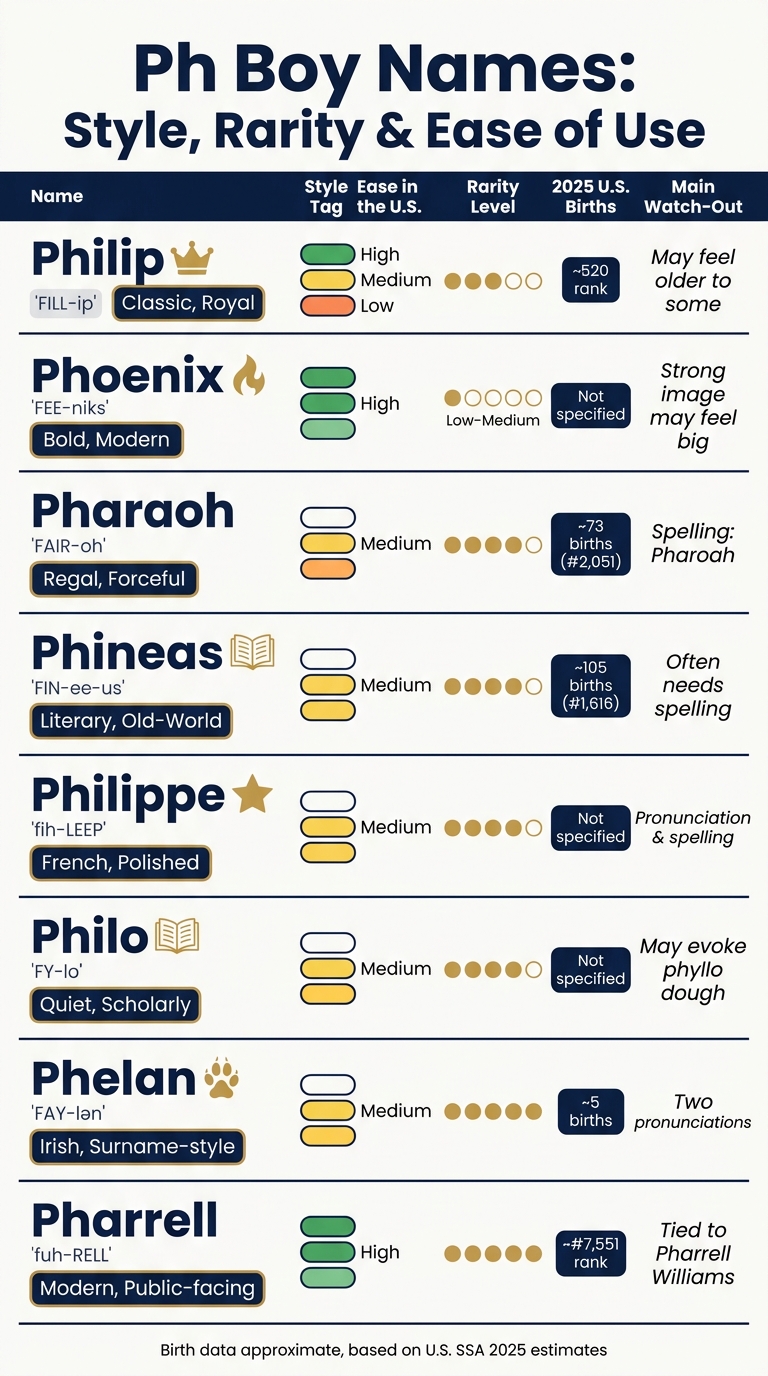
Ph Boy Names Compared: Style, Rarity & Ease of Use
| Name | Main feel | Ease in the U.S. | Rarity level | Main watch-out |
|---|---|---|---|---|
| Philip | Classic, royal | High | Medium | May feel older to some |
| Phoenix | Bold, modern | High | Low to medium | Strong image may feel big |
| Pharaoh | Regal, forceful | Medium | High | Spelling mix-ups like Pharoah |
| Phineas | Literary, old-world | Medium | High | Often needs spelling |
| Philippe | French, polished | Medium | High | Pronunciation and spelling checks |
| Philo | Quiet, scholarly | Medium | High | Some may think of phyllo dough |
| Phelan | Irish, surname-style | Medium | Very high | Two common pronunciations |
| Pharrell | Modern, public-facing | High | Very high | Strong tie to Pharrell Williams |
Bottom line: these names stand out without being hard to use. If you want a name that sounds smart, calm, and a little different, this group gives you a lot to work with.
sbb-itb-f13f980
Why Ph Boy Names Feel Strong and Sophisticated
These names feel strong without sounding hard or sharp. A big part of that comes from their Greek roots, which give them a classic, deliberate feel on the page.
Sound matters too. The "ph" creates a crisp /f/ sound, but the spelling makes the name feel a little softer overall. Names like Philip, Phoenix, and Phineas put the stress right at the start - PHIL-ip, PHOEN-ix, PHIN-eas - and that gives them a firm, confident rhythm. In American English, that first-syllable stress tends to sound direct and self-assured.
History gives these names more weight. Philip is a long-established U.S. classic, while Phineas comes from Hebrew roots.
What’s nice is that strength doesn’t show up the same way in every name. Philip feels classic and royal. Phoenix feels bold and mythic. Pharaoh feels commanding. Phineas leans literary and old-world. Each one points to a different kind of strength, which makes it easier for parents to find a name that fits their own taste.
That’s the appeal of Ph names: they’re rare, but they don’t feel unfamiliar. They stand out, yet they’re still easy to wear in daily life. That balance comes through clearly in the names below.
1. Philip
Origin: Ancient Greek | Meaning: "Lover of horses" | Pronunciation: FILL-ip (/ˈfɪl.ɪp/)
Philip is a clean example of that classic, polished style. The name comes from the Greek Philippos, which means "lover of horses." In ancient Greece, horses were linked with nobility and military power, so the name carries an old sense of rank and polish.
You can see that history in the people who wore it. Philip II of Macedon and Philip the Apostle give the name royal and biblical weight. More recent figures like Philip Glass and Philip Roth add an intellectual, literary edge.
That long track record still works well in the modern U.S. Philip has stayed a steady classic. It hit its high point around 1941 at about #52, and now sits near #520 - familiar, but uncommon enough to feel fresh.
Phil or Pip can make it softer and more playful for a child, while Philip still sounds polished in formal settings. That balance helps the name grow well with its owner. It feels understated and refined - strong and classic without feeling too heavy.
2. Phoenix
Origin: Greek | Meaning: "Dark red" or "crimson"; associated with the mythical bird of rebirth | Pronunciation: FEE-niks (/ˈfiː.nɪks/)
Phoenix comes from Greek and means "dark red" or "crimson." Over time, the word became tied to the mythic bird that rises from its ashes, so the name carries ideas of rebirth, renewal, resilience, and change.
That symbolism gives Phoenix a lot of energy. At the same time, the spelling is clean and the two-syllable sound keeps it sleek and easy to say. It has that rare mix of myth and simplicity, which helps it stand out among unique baby boy names starting with Ph.
In the U.S., Phoenix feels familiar enough to use in everyday life without sounding too common. Most Americans already know how to pronounce it, so you probably won't have to correct people often. It also wears well at every age, from childhood to adulthood, with a modern and distinctive feel.
Phoenix doesn't need a nickname, but some parents use Finn or Nix now and then. Its sleek spelling and mythic link make it one of the more striking Ph names available to parents today. If you want something more classic, the next name goes in a different direction.
3. Pharaoh
Origin: Ancient Egyptian | Meaning: "Great house" or royal palace; later used as the title for Egypt's supreme ruler | Pronunciation: FAIR-oh (/ˈfɛroʊ/)
Pharaoh comes from the ancient Egyptian per-aa, meaning "great house" or "royal palace." Over time, it became the title for Egypt's ruler, and many baby-name sources gloss it as "ruler." That backstory gives the name a strong, formal presence.
In American English, the pronunciation is simple: FAIR-oh. It has two syllables, with stress on the first. The main day-to-day issue is spelling. Pharoah is a common misspelling, so someone named Pharaoh may end up correcting it now and then.
The spelling feels scholarly and historical, with a lot of weight behind it.
Pharaoh is rare, bold, and still workable in daily life. In 2025, about 73 boys in the U.S. were named Pharaoh, which put it at about #2,051 nationwide. It also fits neatly into the U.S. pull toward title-based names. People know the word, but they don't hear it often as a given name, which helps it stand out without making pronunciation a hassle for Americans. If you like it but want a less forceful spot for it, it also works well in the middle-name slot - Pharaoh James and Pharaoh Jude both sound strong.
If you want that same polished feel in a softer, more classic form, the next name moves in that direction.
4. Phineas
Origin: Hebrew, with possible Egyptian roots | Meaning: Oracle, serpent's mouth, or the Nubian | Pronunciation: FIN-ee-us (/ˈfɪniəs/)
Phineas comes from Phinehas, the Old Testament priest known for zeal and faithfulness. Its meaning isn't settled, and sources give a few readings: oracle, serpent's mouth, or the Nubian. For U.S. parents, that gives Phineas the feel of a rare biblical name with a lot of history behind it.
At first glance, the name looks harder than it is. The pronunciation is pretty straightforward: FIN-ee-us, with the stress on the first syllable. It has a smooth three-syllable rhythm that fits American English well. The bigger hurdle is spelling. You'll probably have to repeat and spell it out from time to time. Some parents go with the more phonetic Finneas, but Phineas has the older form and deeper historical ties.
Phineas feels strong and polished because it mixes scriptural weight with an old-school, bookish charm. It belongs in the same general lane as Atticus, Silas, and Ezra, but it's rarer than each of them, which gives it a bit more edge. That mix of biblical seriousness and literary style helps it feel distinguished, not trendy.
In 2025, about 105 boys were named Phineas in the United States, placing it around #1,616 nationally. That's uncommon enough to stand out, but not so far out there that it feels hard to use. The Disney series Phineas and Ferb also gives the name a friendly, playful link, which helps balance the gravity of its ancient roots.
It also ages well. Finn or Phin are easy nickname options. Later on, the full Phineas has a quiet, distinguished feel. For middle names, short and solid picks like Phineas James or Phineas Cole keep it grounded, while Phineas Alexander leans more into that scholarly style.
If you want a more French-leaning version of this polished style, Philippe is next.
5. Philippe
Origin: French, from the Greek Philippos | Meaning: Lover of horses | Pronunciation: fih-LEEP (/fɪˈliːp/)
If you want the French form of Philip, Philippe is the polished pick. It comes from the Greek Philippos, which means "lover of horses", and in American English it's usually said fih-LEEP. That stress on the second syllable gives the name a smoother, more musical feel.
There’s also a bit of French royal history here, and that gives Philippe a formal, established tone. In the U.S., it stands out without feeling hard to use.
The catch is the spelling. Some people will look at it first and say FILL-ip. Even so, Philippe feels classic, refined, and easy to live with.
6. Philo
Origin: Greek, from philos | Meaning: Loving, friend | Pronunciation: FY-lo (/ˈfaɪloʊ/)
Philo is shorter and more literary than Philippe. It’s also the quietest choice in this group. The name comes from Greek and means "loving" or "friend." Its root, philos, gives it a brief, scholarly feel.
In American English, it’s usually said as FY-lo. Some people may confuse it with phyllo dough.
Its clearest historical tie is Philo of Alexandria, the Hellenistic Jewish philosopher. That connection gives the name a scholarly edge. Among Ph names, it feels rare, easy to spot, and intellectually grounded. The short form also makes it simple to say, even if you may need to explain the spelling now and then.
7. Phelan
Origin: Irish/Gaelic, from Faolán | Meaning: Wolf, little wolf | Pronunciation: FAY-lən (/ˈfeɪ.lən/) or FEE-lən
If Philo feels a bit too brief, Phelan gives you a longer Irish choice with that same crisp opening sound. It’s an Irish name with a polished, compact feel and a quiet kind of strength. The name comes from Ó Faoláin, from faol ("wolf") plus -án, so the meaning is "little wolf." That gives it a sense of courage without making it sound harsh.
In American English, FAY-lən is the pronunciation most people use, though FEE-lən also shows up in name guides. That first vowel is where people tend to hesitate, so a pronunciation note will help.
Phelan also has that surname-style look, which gives it a modern edge. And its clean two-syllable rhythm helps it feel easy to say. The Ph spelling adds a slightly literary touch, which makes the wolf meaning feel more reflective than fierce.
In 2025, only 5 boys received the name in the U.S., so it stands out without looking made up. Since 1949, 649 American babies have been named Phelan, with about 90% boys and 10% girls. Nicknames like Phel, Lanny, or Wolf give it some range. It sits in that sweet spot between familiar and uncommon, which makes it a nice bridge to the next, more public-facing Ph name.
8. Pharrell
Origin: Modern English given name, inspired by Irish/Gaelic Farrell (Ó Fearghail) | Meaning: Generally linked to bravery, heroism, or "man of valor" | Pronunciation: fuh-RELL (/fəˈrɛl/)
After the older, literary feel of Phelan, Pharrell shifts into a more modern, surname-style lane. It’s a modern English given name inspired by the Irish surname Farrell, from Gaelic Ó Fearghail. In U.S. use, the name tends to carry a brave, heroic feel instead of one fixed historical meaning.
The pronunciation is simple: fuh-RELL. In the U.S., many people know the name because of Pharrell Williams, the Grammy-winning producer, songwriter, and designer. That name recognition helps. It feels familiar, so it’s easy to say and easy to use in day-to-day life.
Pharrell has that polished surname-style sound that feels current without trying too hard. It’s rare in the U.S., but not hard to wear at any age. One recent U.S. source ranked it around #7,551 for boys in 2025. So it stands out a bit, but still feels easy to place when you hear it.
The quick comparison below shows how Pharrell stacks up against the rest of the list.
Quick Comparison of the Top Ph Boy Names
After the individual profiles, this table makes the differences easier to spot. These five names show a broad mix of Ph styles, from classic picks to names with more flair. Use it to line up the name with the mood you want: classic, bold, regal, literary, or refined.
| Name | Origin | Meaning | Pronunciation | Style Tags |
|---|---|---|---|---|
| Philip | Greek | Lover of horses | FIH-lip | Classic, royal, timeless |
| Phoenix | Greek | Rebirth, renewal | FEE-niks | Bold, modern, energetic |
| Pharaoh | Ancient Egyptian | Great house; ruler | FAIR-oh | Regal, dramatic, uncommon |
| Phineas | Hebrew | Oracle; mouth of brass | FIN-ee-us | Vintage, literary, playful |
| Philippe | French | Lover of horses | fee-LEEP | Refined, European, elegant |
The biggest difference comes down to style. Philip and Philippe feel the most polished. Phoenix and Pharaoh lean more dramatic. Phineas lands somewhere in the middle, with a literary side and a playful edge.
Day-to-day use also matters. Philip is the easiest to spell, say, and use in daily life. Philippe will need the most spelling clarification. Phoenix, Phineas, and Pharaoh stand out more. Of the five, Phoenix is the most common right now. Philip feels familiar, but it shows up less often. The other three still feel more unusual.
If none of these is quite right, AI tools can help you find more Ph names with a similar feel.
Use AI Tools To Find More Names Like These
If you want more Ph names with that polished feel, NameHatch can help you dig deeper. It’s a browser-based AI baby-name tool with a database of over 62,000 names. That kind of depth matters, especially for a narrower group like Ph boy names.
You can start with a seed name like Philip or Phoenix, then add filters such as strong, classic, or modern to pull up similar options. It can also surface variants like Filip or Filippo.
The tool also has a partner-matching feature, which is handy when two parents are pulling in different directions. Each partner rates names on their own, and the tool points out shared favorites. That feature works best on Premium.
If you want to see how it fits into your search, start with the Free plan. Free gives you basic browsing. Premium adds unlimited swipes, favorites, and collaboration for $3/month or $12 for six months. Free is enough for a test run, while Premium makes more sense if you want to search in more depth with a rare name checklist.
Conclusion
Ph boy names hit a rare sweet spot. They’re uncommon enough to stand out, but still easy to live with in everyday American life.
The names above fall into four clear styles. Pick the one that matches the feel you want: classic leans toward Philip or Phineas, bold shows up in Phoenix or Pharaoh, scholarly points to Philo, and polished suits Philippe or Pharrell.
For a last gut check, say the full name out loud with your last name. Then picture it on a résumé, an email signature, and a wedding invitation. If it feels right in all three places, you’re probably on the right track.
The best Ph name is the one that feels natural every time you say it. That’s the balance that makes Ph names worth a closer look.
FAQs
Which Ph boy name is easiest to live with?
A name tends to feel best over time when it hits a simple balance: easy to say, easy to spell, and smooth with your last name. Among Ph names, Philip is often the safest pick because it’s classic, familiar, easy to spell, and easy to pronounce.
Whatever name you choose, say it out loud with your surname. That quick test can help you catch clunky rhythm, odd initials, or pronunciation problems.
Which Ph names feel rare without being too hard to use?
Look for Ph names that rank between 200 and 800 in popularity. That range tends to hit a sweet spot: the names are familiar enough that most people can say and spell them without a lot of back-and-forth, but not so common that your child is likely to have the same name as several kids in the same class.
It also helps to lean toward phonetic, standard spellings instead of invented or less common versions. That keeps the name simple to use in daily life, from school forms and email addresses to introductions, job applications, and social settings.
How do I choose between Philip, Phoenix, and Phineas?
Choose the one that matches the feel you want. Philip comes across as classic and timeless. Phineas has a polished feel and stands out a bit more. Phoenix feels bold, modern, and full of energy.
It also helps to say each name out loud with your last name. That’s often the easiest way to catch whether it flows well. Then think about how the name will work in daily life, at school, and later on a professional resume.
If standing out matters to you, you might also want to check name popularity trends in your state.