Boy names starting with "Lu" are on the rise globally, offering a mix of tradition, history, and modern appeal. Names like Lucas, Luca, and Luis dominate charts in countries like the U.S., Sweden, and Argentina, while others like Luther and Lucien bring vintage and European flair. Many of these names share roots in Latin, often symbolizing "light" or "brightness", making them uplifting choices for parents. Celebrity endorsements and pop culture references have further fueled their popularity.
Here are 12 standout "Lu" names for boys:
- Lucas: A timeless favorite, meaning "to shine." Popular in the U.S. and Europe.
- Luke: Simple yet strong, tied to biblical and pop culture icons.
- Luis: A Spanish classic meaning "famous warrior."
- Luca: A global hit, soft yet bold, meaning "bringer of light."
- Louis: A name of royalty with historical depth.
- Luka: A Slavic variation, rising thanks to sports and pop culture.
- Lucien: French elegance with historical ties.
- Lucca: Inspired by the Italian city, full of charm.
- Louie: A friendly, phonetic take on Louis.
- Luther: Strong and historical, linked to Martin Luther.
- Lucian: Polished and lyrical, meaning "bringer of light."
- Lukas: A European twist on Lucas, popular in Germany and Scandinavia.
These names offer options for every preference, from classic and biblical to modern and international. Whether you're drawn to the strong simplicity of Luke or the stylish edge of Luka, there's a "Lu" name to suit your taste.
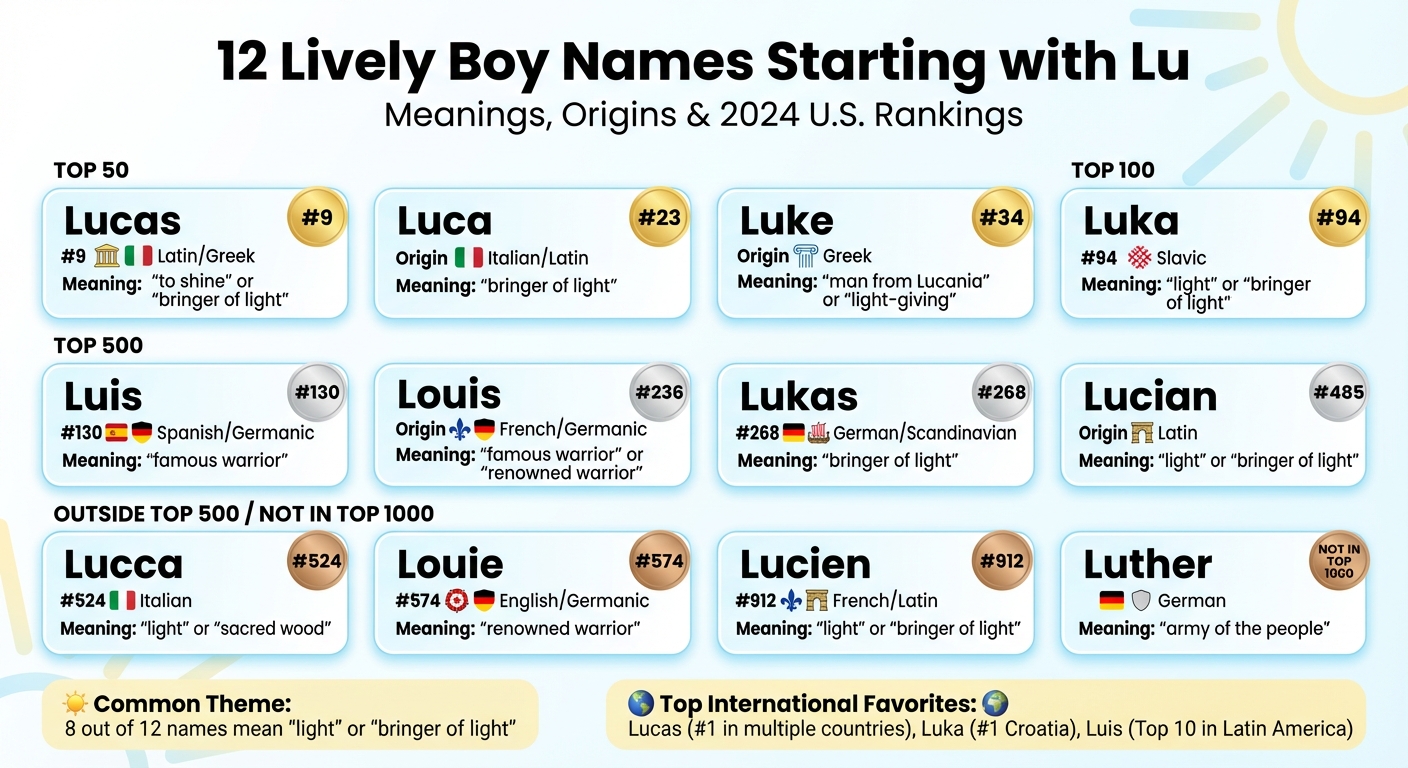
12 Boy Names Starting with Lu: Meanings, Origins and Popularity Rankings
1. Lucas
Meaning and Origin
The name Lucas has its roots in Latin, originating from the Greek name Loukas. It stems from lucere, which means "to shine." Additionally, it can be interpreted as "man from Lucania", a region in southern Italy whose name is linked to meanings like "white" or "light." Some scholars also connect Lucas to Lucius, meaning "bright one" or "born at dawn", or even to the Etruscan name Lauchum, which translates to "king".
Lucas holds a special place in biblical history, thanks to Luke the Evangelist. As the author of the third Gospel and the Book of Acts, Luke is a patron saint for doctors, artists, and creatives. This historical and religious significance adds depth to the name's enduring appeal.
Popularity and Cultural Relevance
In 2024, Lucas ranked as the 9th most popular name for boys in the United States. It first entered the Top 10 in 2018 and has remained there ever since. Its rise began in 1980 when it debuted in the Top 100 at rank 98, eventually climbing into the Top 25 by 2013. The name's growing popularity has been tied to cultural phenomena like the 1977 release of Star Wars, which introduced the world to George Lucas and the legendary character Luke Skywalker. More recently, characters such as Lucas Sinclair from Stranger Things and Lucas Scott from One Tree Hill have kept the name in the spotlight. Beyond the U.S., Lucas has also achieved top 10 status in countries like France (by 1997), Canada (by 2008), Australia (by 2010), and Spain (by 2015).
Modern Appeal and Uniqueness
Lucas strikes a balance between timeless tradition and contemporary style. It's often described as "classic, durable, and effortlessly cool", making it suitable for both casual and formal settings. The name also offers a variety of nicknames, including Lou, Louie, Luke, and Lucky, adding to its charm. Moreover, its adaptability across languages such as English, Spanish, French, Dutch, Portuguese, and Greek makes it an excellent choice for families with international ties or those looking for a name that resonates globally. This combination of history, versatility, and modern flair ensures Lucas remains a popular and appealing choice for parents.
2. Luke
Meaning and Origin
Luke is the English version of Lucas, which comes from the Greek name Loukas. It translates to "man from Lucania" or "light-giving." The name's most famous association is with Luke the Evangelist, known for writing the Gospel of Luke and Acts. Brought to England by the Normans in the 12th century, Luke has remained a constant favorite. Saint Luke, celebrated as the patron saint of doctors and artists, adds a spiritual and artistic depth to the name's legacy.
Popularity and Cultural Relevance
As of 2024, Luke holds the #34 spot in the United States, a ranking influenced by pop culture phenomena like Star Wars and popular TV storylines. The name gained significant traction after the 1977 release of Star Wars, which introduced Luke Skywalker to the world. Beyond the U.S., Luke ranks #18 in Ireland, #39 in Canada, and #40 in New Zealand.
Modern Appeal and Uniqueness
Luke’s enduring charm lies in its simplicity and versatility. Its short, strong sound makes it memorable and easy to use without nicknames - though options like Lou, Lukie, or Lucky are sometimes embraced. The name effortlessly blends a rugged, Western vibe with its deep biblical history, appealing to both modern and traditional sensibilities.
"Luke suggests a person of purpose, capable of great insight and imbued with a strong moral compass."
The meaning tied to "light" and "illumination" gives the name an uplifting quality, symbolizing wisdom and positivity. Add to that the cultural cachet of iconic figures like Luke Skywalker, and the name carries a heroic, adventurous edge. This mix of timeless strength and contemporary cool makes Luke a name that feels both classic and current.
3. Luis
Meaning and Origin
Luis is the Spanish and Portuguese form of the Germanic name Hludowig, which combines hlūd (meaning "fame") and wīġ (meaning "warrior" or "battle"). This gives the name the meaning "famous warrior" or "famous in battle". It originated from Old Frankish Hludwig (hlūd: "fame" and wīġ: "warrior") and later evolved into the Latinized Clovis and French Louis. Over time, it became Luis in Spanish and Portuguese. The name carries a rich history, often associated with royalty, such as Louis I, son of Charlemagne, and Saint Louis IX. Historical figures like King Luis I of Portugal have further cemented its regal connection.
Popularity and Cultural Relevance
Luis reached its peak popularity in the U.S. around the year 2000, ranking #49 with a usage rate of 0.367%. By 2024, it had dropped to #130 (0.151%), but it remains twice as popular as "Louis". The name has shown incredible staying power, appearing on the U.S. Top 100 list for over three decades since 1980. It’s especially common in states like California and Texas, where it counts 82,937 and 51,862 individuals, respectively. Internationally, Luis is a Top 10 favorite in countries like Argentina, Brazil, Mexico, Peru, and Puerto Rico.
Modern Appeal and Uniqueness
Luis strikes a perfect balance between historical significance and modern charm, making it a popular choice across generations. It offers a sleek, international alternative to other "Lu-" names while maintaining its traditional roots. The name's appeal is amplified by well-known personalities such as Puerto Rican singer Luis Fonsi, Mexican icon Luis Miguel (often called "El Sol"), and Uruguayan football star Luis Suárez. Its smooth, vowel-rich sound adds to its charm, and affectionate nicknames like Luisito and Lucho make it even more endearing. In Spain, Luis is celebrated on several name days, including April 28, June 21, August 25, and October 9.
4. Luca
Meaning and Origin
The name Luca stems from Latin and Italian origins, translating to "bringer of light" (from lux). It also carries meanings like "man from Lucania" or ties to lucus, meaning "sacred wood." Beyond its linguistic roots, Luca has a deep religious connection through Saint Luke the Evangelist, the patron saint of artists and physicians. This layered history has played a key role in its growing appeal worldwide.
Popularity and Cultural Relevance
Luca has seen a remarkable rise in popularity in the United States. Back in 2000, only 297 babies were named Luca, but by 2022, that number had skyrocketed to 7,803. By 2024, it claimed the #23 spot among boys' names. Internationally, Luca has made its mark too, ranking #1 in Scotland, #2 in the Netherlands, #3 in New Zealand, and #7 in Germany during 2023. The release of Disney-Pixar's animated film Luca in June 2021 gave the name even more visibility, presenting it as adventurous and approachable to audiences worldwide. Celebrities have also embraced Luca - actress Hilary Duff and Mike Comrie named their son Luca Cruz Comrie in 2012, while actor Colin Firth chose it for his son.
Modern Appeal and Uniqueness
Luca fits seamlessly with the trend of short, vowel-ending names like Noah, Ezra, and Mateo. Clare Green of Nameberry highlighted its ascent as:
"an astonishing success story for a name that was virtually unknown a generation ago."
She pointed out that in 1980, only 13 boys in the U.S. were named Luca. Its soft yet sturdy sound reflects the balance of gentleness and strength that many parents seek today. The name’s global adaptability is another strong point - it’s easy to pronounce in languages like English, Spanish, Italian, German, and Dutch. On top of that, nicknames such as Lu, Lou, and Luke make it even more versatile. These qualities ensure Luca stands out as a modern, stylish choice for parents.
5. Louis
Meaning and Origin
The name Louis translates to "famous warrior" or "renowned warrior." Its origins are rooted in Germanic elements: hlud (meaning fame or loud) and wig (meaning warrior or battle). Over time, the Old Frankish name Chlodowig evolved into the Latinized Ludovicus, eventually becoming the French version we know today.
Louis carries an impressive royal legacy - 18 French kings bore this name, starting with Louis I, the son of Charlemagne. This regal history has cemented its place as a name of distinction and influence.
Popularity and Cultural Relevance
Louis has had an interesting journey in the U.S. Over a century ago, it was a top choice, peaking at #19 in the 1880s and reaching its highest usage in 1914, when 0.804% of baby boys were named Louis. While its popularity waned for decades, the name began regaining traction in 2014. By 2024, it ranked #236, with about 0.081% of male births.
A major boost came in April 2018, when Prince William and Catherine named their third child Prince Louis. As Linda Rosenkrantz, Co-founder of Nameberry, observed:
"Kate and William shocked the world when they announced that they'd named their third child Louis... we've been predicting a comeback for this classic name for a long time."
Beyond royalty, Louis is woven into American culture through icons like jazz legend Louis Armstrong, scientist Louis Pasteur, and designer Louis Vuitton. Even celebrities, such as Sandra Bullock - who adopted her son Louis Bardo Bullock in January 2010 - have helped keep the name in the public eye.
Modern Appeal and Uniqueness
Louis’s historical depth fits perfectly with the current trend of reviving vintage names. It also offers versatility in pronunciation: "LOO-iss" is commonly used in the U.S., while "LOO-ee" is favored in the UK and France, giving parents a choice based on their preference.
Globally, Louis continues to thrive, ranking #3 in France, #4 in Belgium, and #7 in Switzerland as of 2024. Its international charm, combined with its royal heritage and modern celebrity connections, makes it a sophisticated name that balances tradition and contemporary appeal. Pop culture references, from Louis de Pointe du Lac in Interview with a Vampire to Louis Litt in Suits, further ensure its relevance for today’s generation.
6. Luka
Meaning and Origin
The name Luka translates to "light" or "bringer of light", stemming from the Latin word lux. It can also mean "a person from Lucania", referring to an ancient region in southern Italy. Luka is the Slavic version of Lucas, widely used in Eastern European countries like Croatia, Serbia, Slovenia, Russia, and Georgia, where it holds deep cultural importance. While Luca is more common in Italy and Romania, the spelling Luka dominates in Slavic-speaking areas.
Popularity and Cultural Relevance
Luka's popularity has soared in the United States over recent decades. Back in 1980, only 5 out of every million babies were named Luka. By 2025, that number skyrocketed to 3,197 per million. The name climbed to #94 on the U.S. baby name charts in 2024, up from #115 in 2021.
This surge can be credited to global sports icons like NBA star Luka Dončić and Croatian soccer legend Luka Modrić. Beyond sports, the name has found its way into pop culture through Suzanne Vega's 1987 hit song "Luka" and characters like Dr. Luka Kovač from ER and Luka Couffaine from Miraculous: Tales of Ladybug & Cat Noir. Fashion-forward figures like model and actor Luka Sabbat have also added a modern, edgy vibe to the name.
Globally, Luka continues to make waves. It ranked #1 in Croatia and #4 in Slovenia in 2024, #3 in New Zealand in 2023, and #27 in Canada in 2022. In Croatia, it was the most popular masculine name throughout the 2000s, cementing its lasting appeal.
Modern Appeal and Uniqueness
Luka strikes a balance between biblical roots and contemporary European style. Its sharp "k" gives it a bold edge, while its smooth, flowing sound fits perfectly into the trend of "liquid names" - those with soft consonants and a high concentration of vowels, which feel both gentle and dynamic.
MomLovesBest highlights Luka's broad appeal for modern parents:
"Luka is a choice for a baby born in 2026. It offers the 'sweet spot' of popularity, recognizable and easy to spell, yet distinctive enough to stand out from the sea of standard biblical names."
- MomLovesBest
Its ending aligns with other popular names like Noah and Ezra, while its ties to athletic excellence and pop culture give it a fresh, contemporary edge. Luka is a name that effortlessly blends tradition with modern flair, making it a standout choice for today's parents.
7. Lucien
Meaning and Origin
Lucien, the French variant of Lucianus, translates to "light" or "bringer of light", stemming from the Latin roots lux (light) and lucere (to shine). Historically, it has been associated with nobility and saints, such as Saint Lucien of Beauvais. This deep historical significance gives the name a timeless appeal, blending classical roots with a contemporary elegance.
Popularity and Cultural Relevance
As of 2024, Lucien ranked #912 in the U.S., while enjoying greater popularity in Europe - coming in at #89 in France and #64 in Belgium. The name saw its peak in the early 1910s but has experienced a revival, partly thanks to its presence in modern fantasy literature. A key example is Lucien Vanserra, a character from Sarah J. Maas's A Court of Thorns and Roses series [64,65,69]. Beyond fiction, Lucien has left its mark on popular culture through figures like actor Lucien Laviscount (Emily in Paris), artist Lucien Freud, and Lucien Bonaparte, Napoleon's brother [64,67,69].
Modern Appeal and Uniqueness
Lucien stands out as a sophisticated alternative within the "Lu" name trend. According to MomLovesBest, it’s described as "a name that exudes soft sophistication and French flair". For parents drawn to names like Lucas, Lucien offers a rarer choice with an elegant European touch. Its smooth pronunciation and understated rarity make it a compelling option. While names like Luke carry a straightforward charm, Lucien adds a layer of intellectual refinement, making it an appealing pick for 2026.
sbb-itb-f13f980
8. Lucca
Meaning and Origin
Lucca carries Italian origins, often interpreted as "light" or "bringer of light", tying back to its Latin roots. It also connects to the historic city of Lucca in Tuscany, famously the birthplace of composer Puccini. Beyond this, the name may stem from the Latin word lucus (meaning "sacred wood") or possibly a Celtic term translating to "marshy" [39,72–74]. These layered meanings give the name a rich and multifaceted heritage.
Popularity and Cultural Relevance
In the U.S., Lucca made its debut in the Top 1000 baby names in 2012 and has steadily risen, reaching #524 in 2024. Although still relatively rare stateside, it enjoys broader appeal globally. For instance, it ranked #29 in Brazil in 2024, partly due to Brazilian soccer star Neymar Jr., who named his son Davi Lucca in 2011. The name has also been chosen by notable figures, such as musicians Chantal Kreviazuk and Raine Maida, who named their son Lucca Jon Maida in 2005. Lucca has even made its mark in pop culture, appearing in the video game Chrono Trigger (Lucca Ashtear) and the TV series The Good Fight (Lucca Quinn).
Modern Appeal and Uniqueness
Lucca stands out with its double-C spelling, offering a fresh take on the more common Luca while maintaining the same approachable and melodic sound. As Emily McNamara from The Bump describes:
"Lucca brings all the warm, sunny vibes with it".
This name aligns perfectly with the modern trend of vowel-ending boy names, making it a stylish and contemporary choice with a touch of timeless charm.
9. Louie
Meaning and Origin
Louie is a casual, phonetic take on the classic name Louis, ensuring the pronunciation "LOO-ee" is unmistakable. Its roots trace back to the Old German name Hludwig, a combination of hlud ("fame") and wig ("warrior"), giving it the powerful meaning of "renowned warrior." Over time, "Louie" emerged in the United Kingdom as a more relaxed spelling, designed to reflect the name's spoken form while maintaining its strong heritage . This evolution has allowed Louie to stand on its own as a name that's both approachable and meaningful.
Popularity and Cultural Relevance
In the United States, Louie ranked #574 for boys in 2024, continuing its steady rise since rejoining the Top 1000 in 2015. Globally, it enjoys even greater popularity, ranking #28 in England and Wales, #32 in New Zealand, and #71 in Australia. Interestingly, since 2022, Louie has consistently outperformed the traditional spelling Louis on UK baby name charts. The name also holds a special place in pop culture, appearing in the iconic rock anthem "Louie Louie" by The Kingsmen and in beloved characters like Disney's Louie Duck and King Louie from The Jungle Book. Famous namesakes include Olympic athlete and World War II hero Louis "Louie" Zamperini, as well as comedian Louie Anderson .
Modern Appeal and Uniqueness
Louie captures the growing preference for names that feel warm and approachable, often resembling nicknames. As The Bump puts it:
"If you feel like baby will have a strong, fiery personality with a heart of gold, an angelic-sounding but fearless name like Louie might be the perfect fit."
The name also eliminates the confusion that often surrounds the pronunciation of Louis in the U.S., making "LOO-ee" clear and straightforward . With its short and easy-to-spell format, Louie is a versatile and charming choice.
10. Luther
Meaning and Origin
Luther comes from the Old German name Leuthar, combining liut (meaning "people") and heri ("army"), which translates to "army of the people." Originally used as a surname, its connection to the Protestant reformer Martin Luther has made it particularly popular among Evangelical Protestants. This strong historical background adds depth to its appeal.
Popularity and Cultural Relevance
Luther had its heyday in the early 20th century, peaking in 1905 when it ranked #79 and was given to 0.215% of boys born in the U.S.. After 1968, the name experienced a resurgence as a tribute to Martin Luther King Jr.. Despite this, it last appeared in the top 1,000 names in 1994, at #992. Notable figures bearing the name include R&B icon Luther Vandross (1951–2005) and renowned botanist Luther Burbank (1849–1926).
Modern Appeal and Uniqueness
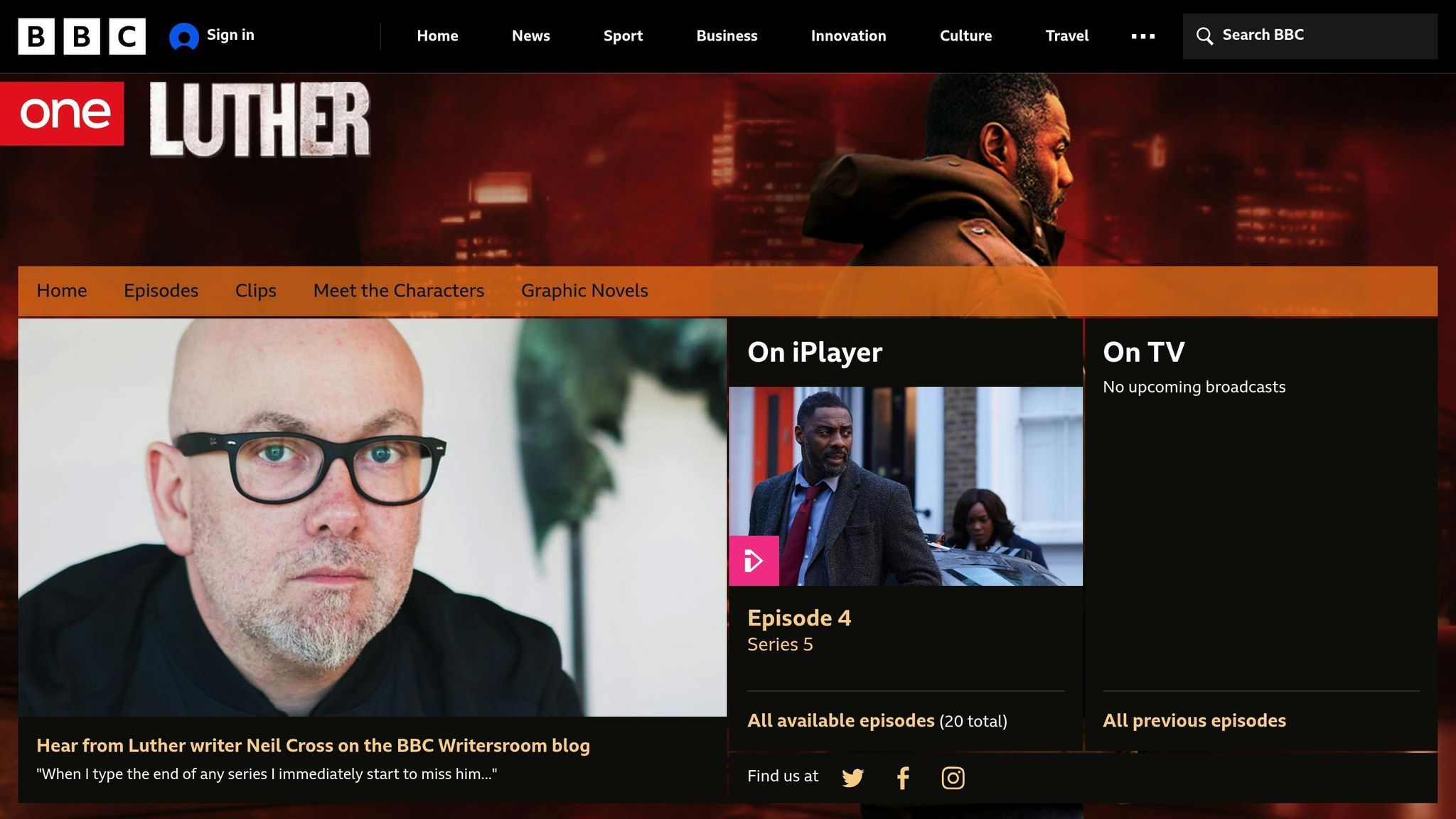
Today, Luther resonates with parents looking for a name with historical weight and a vintage flair. Its association with characters like DCI John Luther from the BBC series Luther and Luther Hargreeves from The Umbrella Academy adds a contemporary edge. It also fits the trend of "-er" ending names, such as Archer and Wilder. Being outside the top 1,000 gives it a rare quality, making it a great choice for those who want a name that's both recognizable and distinctive. Its timeless and mature feel makes it stand out.
11. Lucian
Meaning and Origin
The name Lucian comes from the Latin Lucianus, which translates to "light" or "bringer of light." It serves as the masculine counterpart to Lucy. Some interpretations also tie it to the meaning "soothing." Variations of the name include Lucien (French), Luciano (Italian, Spanish, and Portuguese), and Lucio (Spanish).
Popularity and Cultural Relevance
Lucian's historical depth adds to its growing popularity today. In the United States, it climbed from #847 in 2005 to #485 by 2024. The name carries literary and religious weight, thanks to figures like Lucian of Samosata, a 2nd-century satirist often called the "father of science fiction", and Saint Lucian of Antioch, a 4th-century scholar and martyr.
In modern times, it has been borne by notable individuals such as British painter Lucian Freud, the grandson of Sigmund Freud, and Lucian Buscemi, son of actor Steve Buscemi. The name also appears in popular culture, featured in the Underworld film series and the video game League of Legends. These connections give Lucian a blend of intellectual, artistic, and contemporary appeal.
Modern Appeal and Uniqueness
Lucian fits seamlessly into the trend of stylish "Lu" names, offering a polished alternative to names like Lucius. As Nameberry describes it:
"a sleeker, more sophisticated version of Lucius that is climbing in tandem with other Lu-starting names".
It bridges the gap between modern favorites like Luca and timeless classics such as Julian. Often associated with "Cool Vintage", "Dark Academia", and "Mystical" name lists, Lucian carries a sense of mystery and intellect. Its lyrical quality makes it an attractive choice for parents looking for a name that feels both elegant and contemporary.
12. Lukas
Meaning and Origin
Lukas is the German, Scandinavian, Dutch, and Lithuanian version of Lucas or Luke. Its roots trace back to the Greek name Loukas, which translates to "bringer of light." This name also carries a strong connection to Saint Luke, the physician and author of the third Gospel in the New Testament. The spelling variation gives it a regional charm and a slightly different flavor compared to its counterparts.
Popularity and Cultural Relevance
In the United States, Lukas held the #268 spot in 2024, with 1,287 boys given this name that year. While Lucas is more prevalent in the U.S., Lukas enjoys significant popularity in Europe. It ranked #7 in Lithuania, #11 in Austria, and #20 in Germany during the same year. This version of the name strikes a balance between being familiar yet offering a fresh spin.
Famous individuals named Lukas include actor Lukas Haas, soccer player Lukas Podolski, singer Lukas Forchhammer, and musician Lukas Nelson. The name also appears in pop culture, such as in Minecraft Story Mode.
Modern Appeal and Uniqueness
Lukas fits well alongside other "Lu" names but stands out thanks to its "K", which adds what Pamela Redmond describes as an "extra kick" - giving it a worldly, cosmopolitan vibe. She explains:
"Lukas now feels like a solid, safe option for boys... a tried-and-tested, safe but substantial option".
This international flair makes it a great choice for parents seeking a name that blends American and European influences. When grouped with its variations - Lucas, Luca, and Luka - this name family is collectively more common in the U.S. than Oliver. Its smooth consonants and flowing vowels align with the trend of "liquid names", which are known for their elegance and modern appeal.
Conclusion
The twelve "Lu" names highlighted here offer a variety of choices for parents. Whether you prefer timeless biblical names like Luke, elegant options like Lucien or Lucian, or modern international picks such as Luca and Luka, there's something for every taste. These names may differ in style, but many share a common origin: the Latin word for "light". Others, like Louis (from a Germanic term meaning "renowned warrior") and Luther (interpreted as "soldier of the people"), carry connotations of strength and courage.
This list reflects a global perspective. For instance, Lucas is a top choice in Sweden and Belgium, Luka is popular in Croatia and Slovenia, and Luis has been a familiar name in the U.S. since the 1880s. Parents can explore various cultural takes on these names, from the Italian Luca or Lucca to the German and Scandinavian Lukas, or the Spanish-influenced Luis. As Linda Rosenkrantz, co-founder of Nameberry, observes:
"After a rash of girls' names beginning with the 'Loo' sound - Lucy and Lucille and Luna and Lulu - we're suddenly seeing an even bigger bounce for boys' names with that beginning syllable".
FAQs
Why are 'Lu' names becoming so popular for boys?
Names starting with 'Lu' have become a favorite among parents, thanks to their global charm and meaningful roots. Classics like Lucas and Luke trace back to Latin, Scandinavian, and other European languages, which hold a strong appeal in the United States. Their upbeat, modern vibe fits right in with today's naming trends, making them a fashionable pick.
Another reason for their popularity is the positive meanings often tied to 'Lu' names. Words like light, love, and peace are universally cherished, and names such as Luan or Lubomir bring these sentiments to life while also honoring cultural heritage. As families embrace multicultural influences, names that feel both unique and relatable are becoming the go-to choice.
What do 'Lu' names mean in different languages?
Names starting with "Lu" carry a variety of meanings depending on their linguistic and cultural roots. For example, in Albanian, Luan translates to "lion", a symbol of power and bravery. In Slavic traditions, names like Lubomir mean "love and peace", embodying harmony and kindness. From Latin origins, names such as Lucius or Lucian are tied to "light", symbolizing enlightenment and clarity.
These examples showcase the wide-ranging significance of "Lu" names, offering parents meaningful choices that evoke qualities like courage, love, and illumination.
Why are boy names starting with 'Lu' becoming more popular?
Boy names that begin with 'Lu' are becoming increasingly popular, blending modern appeal with a classic touch. Names such as Lucas, Luke, and Luis have a polished yet friendly vibe, making them a favorite for parents who want something that feels both current and enduring.
The 'Lu' sound has a soft, uplifting quality that aligns well with today’s naming trends. For parents searching for names that are unique without feeling too unusual, 'Lu' options provide a standout choice while still feeling approachable and familiar.