Looking for boy names starting with "El"? Here's a curated list of 15 names that combine timeless appeal with modern trends. Rooted in diverse cultures, from Hebrew to Old English, these names often carry deep meanings like "God is my strength" or "noble ruler", making them meaningful and stylish options for families.
Highlights:
- Biblical Roots: Names like Eliel and Eliakim offer spiritual depth.
- Nature-Inspired: Elon ("oak tree") and Elio ("sun") connect to the natural world.
- Historical Charm: Elwood and Elbridge bring vintage flair.
- Modern Edge: Elon and Emir feel current and versatile.
- Global Appeal: Enrique and Eladio resonate across cultures.
Whether you're drawn to religious significance, nature themes, or unique heritage, this list has something for every taste. Below, explore each name's meaning, origin, and style.
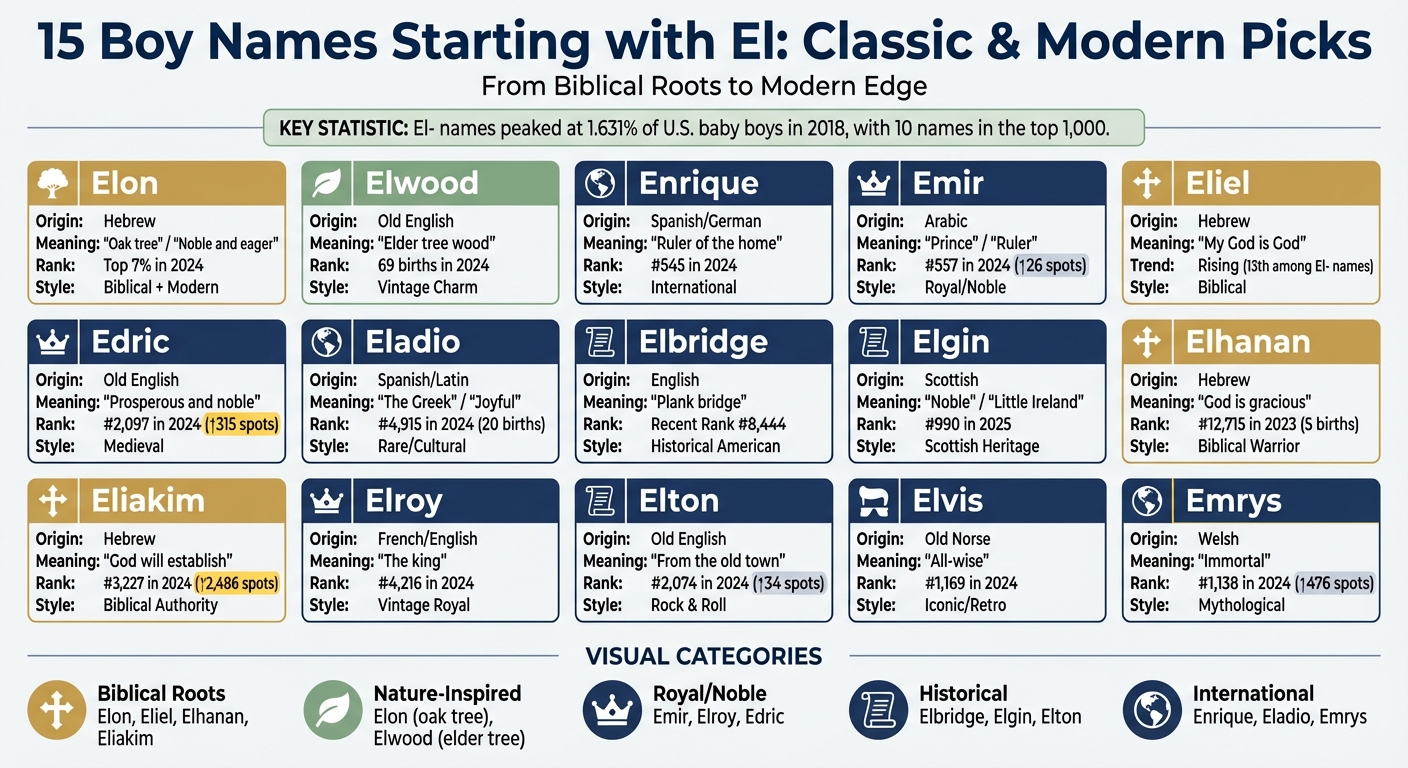
15 Boy Names Starting with El: Meanings, Origins & Popularity Rankings
1. Elon
Meaning and Origin
The name Elon has Hebrew roots and translates to "oak tree", often interpreted as symbolizing "noble and eager". It stems from the Hebrew word El (אֵל), meaning "God." The imagery of the oak tree brings to mind qualities like strength, resilience, and natural beauty, creating a strong connection to nature.
Cultural or Historical Significance
Elon carries significant cultural weight, particularly in Hebrew traditions. It appears in the Old Testament as the name of a judge of Israel. This biblical association makes the name particularly meaningful for families who value spiritual and historical traditions.
Popularity Trends in the US
In recent years, Elon has gained traction, ranking among the top 7% of favored boy names. In 2018, 1.631% of baby boys in the U.S. were given names starting with "El-", with ten of these names making it into the top 1,000.
Stylistic Appeal
Elon bridges the gap between timeless and contemporary. Its biblical background gives it a classic feel, while its connection to modern figures like Elon Musk adds a forward-thinking, tech-savvy vibe. Pronounced either as "EE-lahn" or "eh-LON", its nature-inspired meaning and versatility make it appealing for a variety of preferences.
sbb-itb-f13f980
2. Elwood
Meaning and Origin
Elwood comes from Old English roots, combining the meanings of "elder tree" and "wood." Some interpretations also connect it to ideas of elf rule or nobility. Historically, it began as a surname tied to a place name and even appeared in the Domesday Book of 1086, where it was linked to English landholdings. The elder tree itself has long been valued for its healing properties and as a symbol of prosperity.
Cultural or Historical Significance
Elwood has made its mark in American entertainment and history. The name is perhaps most recognizable from Elwood Blues, the iconic character played by Dan Aykroyd on Saturday Night Live and in The Blues Brothers film. Another famous fictional Elwood is Elwood P. Dowd, the lovable protagonist from the play and movie Harvey. Outside of fiction, notable figures include Elwood Haynes, an inventor and metallurgist, and Elwood Richard Quesada, a U.S. Air Force Lieutenant General.
Popularity Trends in the US
Elwood enjoyed its peak popularity in the early 20th century but saw a sharp decline afterward. Recently, however, it has experienced a small resurgence, with 69 boys named Elwood in 2024. Pennsylvania stands out as the state where the name is most commonly used.
Stylistic Appeal
Elwood offers a mix of vintage charm and modern appeal. While some might see it as a bit old-fashioned, others are drawn to its strong, wholesome vibe. Name expert Abby Sandel from Appellation Mountain described it perfectly:
He's half-edgy cool and half-humble homespun.
Its connection to the elder tree gives it an earthy, natural feel that aligns with the current trend of botanical names like Forest and Rowan. Popular nicknames such as Woody, El, and Wood add versatility. This balance of timeless charm and contemporary style positions Elwood as a potential favorite among the "El" names.
3. Enrique
Meaning and Origin
Enrique is the Spanish version of the German name Heinrich, which evolved into Henry in English. The name comes from the Germanic roots heim (meaning "home") and rik (meaning "power" or "ruler"), translating to "ruler of the home". Some sources also suggest a connection to the Basque language. Common nicknames for Enrique include Kike, Kiko, and Quique, reflecting its rich linguistic heritage.
Cultural or Historical Significance
Today, the name Enrique is perhaps most famously associated with pop icon Enrique Iglesias, whose global success has brought the name even more recognition.
Popularity Trends in the US
Enrique has gained traction in the United States in recent years. In 2024, it held the #545 spot on the popularity charts and continued to see movement in the years that followed.
Stylistic Appeal
Enrique combines a sense of timeless tradition with a worldly touch. While it shares the enduring elegance of its English counterpart, Henry, it offers a unique international charm. The name is often described as classic, formal, wholesome, and strong. This balance of tradition and global appeal makes Enrique a compelling choice for modern families.
4. Emir
Meaning and Origin
Emir is a name with a strong and commanding presence. This Arabic name translates to "prince", "ruler", "commander", or "chief". It comes from the Arabic root a-mr, which means "to command". The term made its way into the English language in 1593 through French. Today, Emir is embraced across various cultures, including Turkish and Bosnian communities.
Cultural or Historical Significance
Historically, Emir was more than just a name - it was a title of nobility in the Muslim Middle East. During the Umayyad and Abbasid caliphates, it served as a military rank for commanders and provincial leaders. The second caliph, Umar, famously adopted the title Amir al-Mu'minin ("Commander of the Faithful"), a designation that carried significant weight until 1924. Even today, the title Emir holds an official place in modern monarchies, such as those in Qatar and Kuwait, and is used by all members of Saudi Arabia's royal family. This rich historical background adds depth to its growing popularity as a given name.
Popularity Trends in the US
In the United States, Emir has been steadily climbing the charts. It ranked #557 in 2024, moving up 26 spots from the previous year. Between 2008 and 2018, its usage surged by 83.3%. This rise is part of a broader trend favoring "El-" names, a pattern that has been gaining momentum since the 1960s.
Stylistic Appeal
Emir effortlessly blends modern charm with a sense of timeless nobility. Its royal associations give it a sophisticated edge, yet it remains approachable and versatile. Often described as princely, polished, and preppy, Emir is a strong choice for families wanting a name that feels both international and meaningful. It stands out as a refined yet accessible alternative to more common names.
5. Eliel
Meaning and Origin
Eliel is a Hebrew name meaning "My God is God". It’s a theophoric name, combining Eli (my God) and El (God). This ties it to other biblical names like Eli, Elijah, and Eliezer, giving it a strong connection to religious tradition.
Cultural or Historical Significance
The "El" in Eliel firmly roots it in Judeo-Christian heritage. While the name appears in biblical texts, it stands out as a less common choice compared to more familiar names like Elijah or Elias, offering a distinctive yet meaningful option.
Popularity Trends in the US
Eliel's popularity is on the rise, ranking 13th among "El" names based on recent search data. This reflects a growing interest in "Eli-" names, such as Elian, Elio, and Eliam, which continue to gain traction.
Stylistic Appeal
Eliel offers the perfect blend of uniqueness and simplicity. Its short, easy-to-pronounce structure, combined with its flowing vowel sounds, gives it a sense of depth and elegance. This makes it a modern yet enduring choice for parents seeking a name with both meaning and style.
6. Edric
Edric brings a touch of medieval charm to the lineup of "El" names, standing out with its unique historical roots.
Meaning and Origin
This name comes from Old English, combining "ead" (meaning wealth or fortune) and "ric" (meaning ruler or king). Together, Edric translates to "prosperous and noble" or "rich and powerful", evoking an era where leadership and prosperity were highly valued.
Historical and Cultural Connections
Edric is deeply rooted in medieval Britain and Anglo-Saxon traditions. Its style bridges the gap between classic names like Cedric and the more fantastical vibe of Eddard, making it resonate with fans of both history and literature.
Popularity Trends in the US
In 2024, Edric climbed to #2,097 on the list of U.S. boys' names, marking an impressive rise of 315 spots from the previous year. This upward trend suggests growing interest among parents who are drawn to names with historical significance and timeless appeal.
Why Choose Edric?
Edric is an elegant, standout name that carries an air of nobility and strength. Its medieval roots and meaningful heritage make it a perfect pick for families looking for something classic yet refreshingly uncommon.
7. Eladio
Eladio stands out among the "El" names with its rich heritage and lyrical quality. This name carries a distinct Spanish influence, making it a rare yet captivating choice.
Meaning and Origin
Eladio has roots in Spanish and Latin, primarily translating to "The Greek" or "Man from Greece". Some interpretations also connect it to the Latin word laetus (meaning "joyful") and the Greek term eleáō ("to have mercy"). Originating from Ancient Greece, the name was later adapted into Latin as Heladius or Helladius. It is pronounced ay-LAH-dee-oh.
Cultural and Historical Significance
Eladio carries historical weight through notable figures such as Eladio de Toledo, a Spanish bishop from the 6th century; Eladio Verdura, a Hollywood designer active in the early 20th century; and Eladio Dieste, an influential engineer from Uruguay. These individuals highlight the name’s association with creativity, leadership, and innovation.
Popularity Trends in the US
In the United States, Eladio remains rare. In 2024, only 20 baby boys were given this name, ranking it at #4,915. Its peak popularity occurred in 1981, with 42 births. Internationally, the name sees greater use in countries like Mexico, Peru, and Paraguay.
Stylistic Appeal
Eladio is part of the fashionable "El-" name trend but retains its individuality - it has never entered the U.S. top 1,000. Its heroic sound and meanings, which range from "joyful" to "merciful", make it a heartfelt and culturally rich option. Balancing tradition with a modern twist, Eladio is a name that resonates deeply while remaining refreshingly uncommon.
8. Elbridge
Elbridge carries a slice of American history and a vintage flair, offering a classic alternative to more modern names.
Meaning and Origin
Elbridge is a masculine name of English origin that translates to "plank bridge" or "old bridge". Often affectionately shortened to "El", the name reflects strength and durability, much like the sturdy structures it describes. Its timeless meaning pairs seamlessly with its historical roots.
Historical and Cultural Significance
Elbridge Gerry (1744–1814) is the most notable figure to bear this name. As a Founding Father, he signed the Declaration of Independence and later became the fifth Vice President of the United States. This connection to early American history gives the name a sense of depth and significance, making it a meaningful choice for history enthusiasts.
Popularity Trends in the US
Elbridge enjoyed its heyday in the late 1800s, appearing on U.S. baby name charts during that period. However, it has since fallen out of favor, ranking at #8,444 in more recent years. While other "El-" names like Elijah have soared in popularity - Elijah peaked in 2018 - Elbridge remains a rarity, adding to its unique appeal.
Stylistic Appeal
Elbridge combines old-fashioned elegance with a touch of modern practicality. Its formal, 19th-century vibe is balanced by the approachable nickname "El", making it a versatile option. For families looking for a name with deep American roots and a distinctive edge, Elbridge offers a perfect blend of history and individuality.
9. Elgin
Elgin combines Scottish heritage with a touch of vintage charm, making it an appealing choice for parents who appreciate a name with historical depth.
Meaning and Origin
Elgin is primarily a Scottish name, originating from the town of Elgin in Moray, Scotland. Its roots likely trace back to the Gaelic Eilginn, meaning "little Ireland", or the Gaelic Ailgen, which translates to "noble." Some interpretations also tie it to Old English, either blending eald ("old") with dun ("hill") or deriving from Ælfgēn ("elf joy"). These varied origins give Elgin meanings like noble, high-minded, and white, showcasing its rich linguistic and historical background.
Cultural and Historical Significance
Elgin carries a notable legacy. It is famously associated with the Elgin Marbles, the renowned sculptures from the Parthenon. Additionally, the name has ties to the Elgin National Watch Company, a symbol of precision and craftsmanship. In the world of sports, Elgin Baylor, an NBA Hall of Famer, brought further prominence to the name, even inspiring R&B singer Ginuwine.
Popularity Trends in the US
Historically, Elgin saw its peak popularity between 1890 and 1930, ranking as high as #715 in 1905 and #904 during the 1910s. Its usage later waned, with rankings of #890 in 2020, #905 in 2023, and #990 by late 2025. Interestingly, the name experienced a 353% surge in search interest during the final week of 2025, suggesting a renewed curiosity about its charm.
Stylistic Appeal
With its aristocratic undertones and deep ties to Scottish heritage, Elgin offers a sophisticated yet distinctive option for families looking for a name that stands out while honoring history and culture.
10. Elhanan
Elhanan blends deep biblical heritage with a distinct and uncommon sound, making it a meaningful choice for parents looking for a spiritually rich and rare name.
Meaning and Origin
Elhanan comes from Hebrew and is formed by combining אֵל (ʾel), meaning "God", and חָנַן (ḥanan), meaning "to be gracious." This gives the name its central meaning: "God is gracious". Some interpret it as "Grace of God". In the Old Testament, Elhanan is the name of two individuals, including a celebrated warrior in King David's army, known for slaying the brother of Goliath. In the Greek Septuagint, the name appears as "Elchanan", a version that influenced later Latin translations in medieval Europe.
Cultural and Historical Significance
Elhanan carries a strong connection to divine favor and strength, making it a meaningful name in Jewish and Christian traditions. The story of the biblical warrior adds a heroic and courageous dimension, appealing to families who value names with a deep spiritual foundation and a legacy of faith and bravery.
Popularity Trends in the US
Elhanan is a rare name in the United States. It first appeared in 2018, ranking at #1,372 with just 7 births. By 2023, it had dropped to 5 births, ranking at #12,715. Despite its low numbers, the name has seen a gradual increase in interest over the past five years, as more parents turn to distinctive biblical names.
Stylistic Appeal
Elhanan offers a timeless and dignified alternative to more familiar "El-" names like Elijah or Elias, while standing out for its unique biblical significance. Its rarity ensures that it remains distinctive, and its strong roots give it a sense of weight and history. For a modern touch, parents might use the nickname "Elan", which adds a fresh, approachable twist to this classic name.
11. Eliakim
Eliakim carries a deep spiritual meaning: "God will establish" or "God raises". This four-syllable name (pronounced eh-LYE-uh-kim) has a melodic rhythm that sets it apart from shorter "El-" names, while still maintaining strong biblical roots. Its combination of musicality and historical significance makes it stand out as both timeless and meaningful.
Meaning and Origin
Rooted in Hebrew, Eliakim appears multiple times in the Bible, often associated with individuals who rose to positions of authority. One notable example is Eliakim, the son of Hilkiah, who served as a trusted official under King Hezekiah. Variations of the name include Eliakem, Eliaquim, and Elikim.
Cultural and Historical Significance
While its biblical heritage is its foundation, Eliakim has also been carried by notable figures throughout history. These include Union Army Brigadier General Eliakim P. Scammon, mathematician Eliakim Moore, and tennis player Eliakim Coulibaly. The name also graces a village in northern Israel, further emphasizing its historical and geographical relevance.
Popularity Trends in the US
Though still relatively uncommon, Eliakim has seen steady growth in popularity. It ranked 7,294 in 1987, climbed to 6,424 in 2006, and reached 5,713 in 2023. The most dramatic rise occurred between 2023 and 2024, when it jumped 2,486 spots to land at #3,227, with its usage peaking at 18 per million U.S. births.
Stylistic Appeal
Eliakim offers a formal, multi-syllabic alternative to names like Elijah or Elias, while still providing approachable nickname options such as Eli, Kim, Akim, or Elia. Its aspirational meaning - symbolizing hopes for a child to be "raised up" to a position of greatness - makes it especially appealing to parents seeking a name with both depth and spiritual resonance.
12. Elroy
Elroy (pronounced EL-roy) is an English variation of Leroy, offering a charming, vintage vibe as an alternative to modern royal-inspired names like Royal or Reign.
Meaning and Origin
Elroy has roots in both French and English, with its most common meaning being "the king", derived from the French phrase le roi. Some interpretations suggest a blend of Hebrew El (God) and French roy (king), translating to "God and king." Another possible origin ties it to Old English, combining ælf (elf) and rīġe (king), leading to the meaning "elf king."
Cultural and Historical Significance
Elroy gained recognition through pop culture, most notably as the name of Elroy Jetson from the animated series The Jetsons. It also carries a legacy in sports, thanks to NFL Hall of Famer Elroy "Crazylegs" Hirsch of the Los Angeles Rams. Other notable uses include Elroy P. Lobo from The Misadventures of Sheriff Lobo and Elroy "Lucky" Kleinschmidt from King of the Hill.
Popularity Trends in the US
Elroy reached its peak popularity in the 1920s, ranking #486, and was a common choice in the early 20th century. However, it last appeared in the top 1,000 U.S. boy names in 1966 at #947. Fast forward to 2023, only 5 babies were named Elroy, making up just 0.0004% of births, and it ranked #4144. By 2024, it had dropped slightly to #4216. Today, there are an estimated 8,483 people in the United States with this name, with Texas boasting the highest number of residents named Elroy.
Stylistic Appeal
Emmy Samtani, Founder of Kiindred, highlights the name’s enduring charm:
Overall, Elroy is a timeless and classic name that carries a sense of regality and sophistication.
Elroy stands out as a vintage choice with historical depth and a sense of refinement. Its royal meaning and leadership connotations make it distinct among "El-" names, while the nickname Roy offers a friendly and approachable touch. This blend of uniqueness and tradition makes it a compelling pick for parents seeking a name with character and history.
13. Elton
Elton is a name with roots in Old English, originally used as a habitational surname tied to various towns across England. It combines the Old English elements Ella or Elli with tun, meaning "enclosure", "settlement", or "town".
Meaning and Origin
At its core, Elton means "from the old town", though it can also be interpreted as "from the old estate" or "God's fighter". Initially a surname and place name in regions like the British Isles, the United States, and Canada, Elton eventually transitioned into a first name. This shift highlights its historical depth and cultural resonance.
Cultural and Historical Significance
Elton is perhaps most famously linked to Sir Elton John, the iconic British musician whose career spans decades and includes over 300 million records sold globally. He’s also one of the few artists to achieve EGOT status, having won an Emmy, Grammy, Oscar, and Tony. Born Reginald Kenneth Dwight, he adopted "Elton" as part of his stage name, inspired by saxophonist Elton Dean.
The name also appears in classic literature and pop culture. Jane Austen featured it in her 1815 novel Emma through the character Philip Elton (Mr. Elton). More recently, it made an appearance in the 1995 teen comedy Clueless. Beyond these examples, other notable figures include former NBA player Elton Brand and country music singer Elton Britt.
Popularity Trends in the US
Elton enjoyed its peak popularity in the 1910s, ranking at #301. Over the years, it saw a decline, dropping to #544 by 2000 and further to #1980 by 2018. However, the name has shown signs of revival in recent years. By 2024, it climbed 34 spots to #2074 and gained another 184 places by late 2025. Today, approximately 11,243 individuals in the U.S. share this name, with Texas leading the count at 2,870.
Stylistic Appeal
Elton offers a mix of historical charm and modern flair, making it a standout among "El" names. Its association with Sir Elton John adds a touch of rock 'n' roll energy to its vintage roots. As noted by The Bump's Baby Names Content Team:
The talented star [Elton John] added some vivacity to the vintage name coupled with an etymology to remind baby of their humble roots before hitting the big time.
Elton is often grouped with categories like "Rock Star", "Classic Rock", and even "Jane Austen" baby names. Popular nicknames include El, Elt, Eli, Ton, and EJ.
14. Elvis
Elvis holds a special place in the history of rock and roll, carrying a name that’s as rich in meaning as it is in legacy. Its roots trace back to Old Norse Alvis, meaning "all-wise", and it even hints at Irish influences through historical saints. Some sources also connect it to Old English, combining aelf ("elf") and wine ("friend") to mean "elf-friend". This layered etymology adds an intriguing depth to the name's story, making it a fascinating blend of mythology and cultural significance.
Meaning and Origin
The name Elvis, at its core, means "all-wise", a nod to its Scandinavian and Old Norse origins. It stems from Alvis, a dwarf in Norse mythology renowned for his wisdom. Over time, the name has crossed cultural boundaries, finding its way into Spanish, French, Portuguese, and even Indonesian contexts. This evolution highlights its timeless appeal, rooted in ancient tradition but still resonating in modern times.
Cultural and Historical Significance
When you hear "Elvis", chances are you think of Elvis Presley (1935–1977), the "King of Rock and Roll." Presley didn’t just revolutionize American music; he transformed its culture, earning accolades like the Presidential Medal of Freedom. His iconic appearance on The Ed Sullivan Show in September 1956 drew a staggering 60 million viewers, capturing 82.6% of the television audience - a record-breaking moment in TV history.
Historian Marty Jezer summed up Presley’s cultural impact perfectly:
Presley, more than anyone else, gave the young a belief in themselves as a distinct and somehow unified generation - the first in America ever to feel the power of an integrated youth culture
. Beyond Presley, the name has graced other prominent figures, including British singer-songwriter Elvis Costello, Canadian figure skater Elvis Stojko, and American singer Elvis Perkins.
Popularity Trends in the US
Elvis reached its peak popularity in 1999 and, as of 2024, ranks #1,169 for boys. While not a common choice today, it has seen a 1% increase in interest over the past year. Even high-profile parents, like director Roman Polanski, have chosen this name for their children, showing its enduring charm.
Stylistic Appeal
Elvis brings a retro, edgy vibe that blends the glamour of Hollywood with the nostalgia of mid-century Americana. Often described as "Hipster", "Aesthetic", and "Historical", it appeals to parents looking for a name with both musical heritage and historical depth. It’s a perfect pick for those who want something classic yet unconventional - familiar enough to recognize but rare enough to stand out in today’s world of baby names.
15. Emrys
Emrys weaves together elements of magic and mystery, deeply rooted in Welsh tradition and Arthurian legend. Pronounced "EM‑riss", this name is the Welsh version of Ambrose, which comes from the Greek name Ambrosios, meaning "immortal", "undying", or "everlasting". Its ancient lineage gives it a timeless quality while still feeling fresh and modern.
Meaning and Origin
Emrys draws its origins from Welsh culture, carrying the profound meaning of "immortal". Its journey began with the Greek name Ambrose, evolving over centuries into its current Welsh form. Along the way, it has picked up a few charming nicknames like Em, Ry, and Emry.
Cultural and Historical Significance
Emrys holds a special place in British mythology, famously serving as an epithet for Merlin (Myrddin Emrys). The name is also tied to Emrys Wledig, also known as Ambrosius Aurelianus, a 5th-century Romano-British leader who defended Britain against Anglo-Saxon invasions. More recently, the BBC series Merlin gave the name a modern boost by featuring Emrys as the secret identity of the legendary warlock. These rich associations have helped the name resonate with contemporary parents, adding to its growing popularity.
Popularity Trends in the US
In the United States, Emrys is steadily gaining traction, ranking #1,138 for boys in 2024 - a significant leap of 476 spots from the previous year. Over 180 boys were given this name in a recent year. On Nameberry, it climbed to #196 in 2025, establishing itself as one of the fastest-rising names heading into 2026. Across the Atlantic, Emrys ranks #490 overall in the United Kingdom and has even landed in the top 100 names in Wales.
Stylistic Appeal
With its rich historical roots, Emrys stands out as a refined alternative to more familiar Welsh names like Dylan or Evan. It exudes a magical charm and literary sophistication that sets it apart. Emily McNamara, Senior Content Writer at The Bump, captures its essence beautifully:
A truly distinguished and unique name, Emrys holds a level of sophistication and mystery sure to intrigue those who hear it
. Its connection to Dark Academia and fantasy aesthetics makes it particularly appealing to parents seeking a name that bridges ancient heritage with a modern, stylish edge.
Conclusion
The 15 'El' names we've explored range from timeless Hebrew classics with profound spiritual meanings to modern options with a contemporary twist. What makes 'El' names so captivating is their variety: some are deeply rooted in connections to God, while others highlight themes like nature, nobility, or heritage.
Since the 1960s, 'El' names have seen a steady rise in popularity, reaching a peak usage of 1.631% in 2018. This growing trend reflects their enduring appeal among American parents.
When choosing the perfect name, think about what resonates most with your family's values. If a spiritual connection feels important, consider traditional Hebrew names like Eliel or Eliakim. For those inspired by nature, names like Elon, meaning "oak tree", or Elwood, which evokes images of wooded landscapes, offer a meaningful nod to the natural world. If you're looking for something rare and distinctive, options like Eladio or Elhanan - both currently outside the top 1,000 - can provide that unique touch.
These names weave together stories from across centuries and cultures, from medieval England to ancient Welsh myths and modern-day influences. Each name holds the potential to shape your son's identity in a meaningful way. Trust your instincts and choose the 'El' name that feels like the perfect fit for your family.
FAQs
What is the cultural and historical significance of names starting with 'El'?
Names beginning with El carry rich historical and spiritual significance, deeply rooted in tradition. In Hebrew, El translates to "God" and features prominently in many biblical names like Eli, Elijah, and Elisha, often reflecting a connection to the divine or godly attributes. These names gained popularity among Puritans in the 17th century and became a staple in early American naming practices.
But the influence of El isn’t limited to Hebrew. In Greek, it appears in names such as Eleanor and Helen, often linked to meanings like "light" or "sunbeam." Today, names starting with El continue to resonate with parents in the U.S., offering a blend of timeless biblical roots and a fresh, uplifting tone that feels both meaningful and modern.
How do names like Elon and Elwood combine modern and timeless appeal?
Names like Elon and Elwood strike a perfect balance between modern appeal and timeless charm. Elon exudes a sleek, contemporary vibe, often linked to innovation and forward-thinking - a great pick for parents looking for something modern and dynamic. Meanwhile, Elwood carries a rich Old English heritage, with meanings tied to nature and folklore, such as "elder-tree wood" or "elf rule", offering a nostalgic and classic touch.
These names highlight the range and versatility of "El" names, blending freshness with enduring qualities. Whether you're after something cutting-edge or rooted in tradition, "El" names deliver a distinctive mix of style and depth.
Why are boy names starting with 'El' so popular in the U.S.?
Boy names beginning with 'El' are gaining traction in the U.S., thanks to their blend of classic charm and modern flair. Names like Elijah and Elliot stand out not only for their stylish sound but also for their deep roots in tradition, often tied to biblical or historical origins.
The prefix 'El' carries uplifting meanings - such as 'God' in Hebrew or 'light' in Greek - making these names particularly appealing to parents looking for something meaningful yet uncomplicated. They're also incredibly adaptable, pairing well with middle names and fitting seamlessly into sibling name sets. Striking the perfect mix of tradition, significance, and contemporary style, 'El' names have become a go-to option for many American families today.