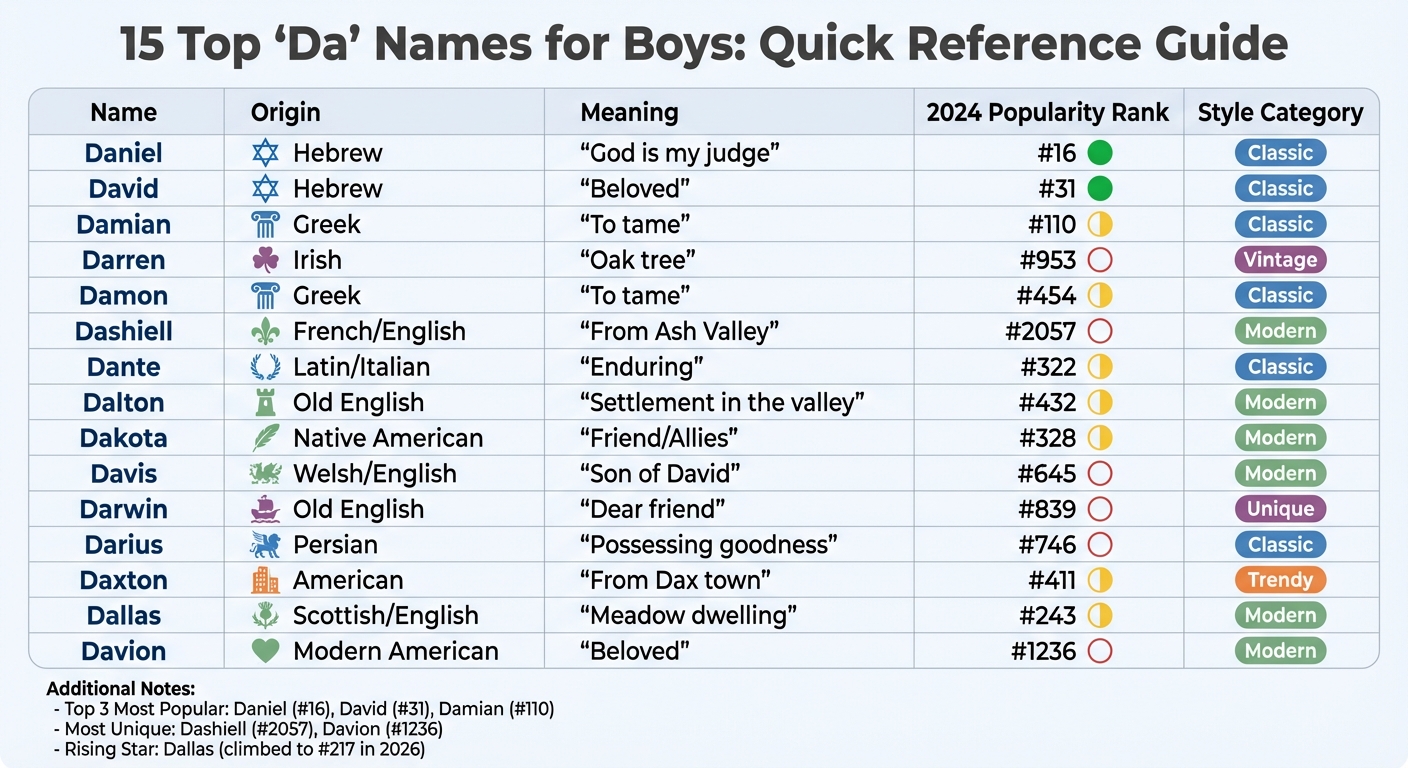
Choosing a name for your baby boy is a big decision, and names starting with "Da" offer a mix of history, meaning, and style. Whether you're looking for timeless classics like Daniel and David, or modern picks like Daxton and Dallas, there's something for every preference. Here's a quick look at 15 "Da" names, their origins, meanings, and trends:
- Daniel: Hebrew, "God is my judge"; a classic, consistently popular.
- David: Hebrew, "beloved"; rich in biblical and historical significance.
- Damian: Greek, "to tame"; associated with strength and resilience.
- Darren: Irish, "oak tree"; peaked in the 1960s, still familiar today.
- Damon: Greek, "to tame"; tied to loyalty and friendship.
- Dashiell: French/English, "from Ash Valley"; literary and modern flair.
- Dante: Latin/Italian, "enduring"; linked to the poet Dante Alighieri.
- Dalton: Old English, "settlement in the valley"; rugged and steady.
- Dakota: Native American, "friend" or "allies"; unisex with a Western vibe.
- Davis: Welsh/English, "son of David"; a fresh take on a classic.
- Darwin: Old English, "dear friend"; associated with Charles Darwin.
- Darius: Persian, "possessing goodness"; ancient yet modern.
- Daxton: American, "from Dax town"; trendy and contemporary.
- Dallas: Scottish/English, "meadow dwelling"; tied to the Texas city.
- Davion: Modern, "beloved"; creative fusion of classic elements.
These names vary in cultural roots, popularity trends, and modern appeal, making it easier to find one that fits your family's story. Whether you prefer timeless or trendy, short or long, this list has you covered!
15 Boy Names Starting with Da: Origins, Meanings, and Popularity Rankings
1. Daniel
Daniel stands out as a name with a rich history and timeless charm.
Origin and Meaning
The name Daniel comes from the Hebrew words din (to judge) and el (God), translating to "God is my judge". It originates from the Old Testament, where the prophet Daniel is celebrated for his unwavering faith, his ability to interpret dreams, and his survival in the lions' den. The name represents strength, resilience, and devotion.
Historical and Cultural Significance
Daniel became popular in England during the Middle Ages but saw a decline by the 15th century. It regained favor during the Protestant Reformation, as biblical names came back into style, and it has remained a classic ever since. Variations of Daniel can be found across many languages, such as Daan (Dutch), Daniele (Italian), Danyal (Turkish), and Taneli (Finnish). Notable historical figures include Daniel Defoe, author of Robinson Crusoe; mathematician Daniel Bernoulli; and American frontiersman Daniel Boone. In modern times, the name is associated with actors like Daniel Radcliffe, Daniel Day-Lewis, and Daniel Craig.
Popularity Trends in the United States
Daniel has been a staple in the top 50 baby names for boys in the United States for over a century, never dropping out of the top 100. Its popularity steadily grew from the 1920s, entering the top 20 in 1952 and the top 10 in 1976. The name reached its peak at #5 in 1985, 1990, 2007, and 2008. As of 2024, Daniel remains a favorite, ranking as the 16th most popular boys' name in the country.
Pronunciation and Spelling
In English, Daniel is typically pronounced as DAN-yuhl. Common nicknames include Dan and Danny, and the name boasts over 100 variations worldwide. Up next, we'll dive into another noteworthy "Da" name.
sbb-itb-f13f980
2. David
David carries a legacy that resonates through history and culture.
Origin and Meaning
David is a name of Hebrew origin, derived from דָּוִד (Dawiḏ) and linked to the word "dod" or "dôwd", meaning "beloved." This heartfelt meaning has helped the name endure across centuries, deeply rooted in biblical and historical significance.
Cultural and Historical Background
The name David boasts a rich tapestry of cultural and historical associations. In the Bible, King David is celebrated not only for defeating Goliath but also for composing many of the Psalms. St. David, the 5th-century patron saint of Wales, adds a spiritual dimension to the name's heritage. Beyond religious figures, David has been carried by influential individuals like philosopher David Hume, explorer David Livingstone, iconic musician David Bowie, and soccer legend David Beckham.
The Star of David, a symbol central to Judaism, further highlights the name's enduring importance. Additionally, surnames such as Davis, Davidson, Davies, Dawson, and Davidov trace their origins back to this timeless name, showcasing its widespread influence.
Popularity Trends in the United States
David has consistently been a favorite in the United States, holding a spot in the top 35 names since 1880. Its popularity soared to its peak in 1960, when it became the #1 boy name in America, and it remained in the top 10 from 1934 to 1992. Over the past century, David ranked in the top five for 39 years. Currently, about 2,967,000 people in the U.S. bear the name, making it the fifth most common masculine name overall. While it dropped out of the top 10 in 1993, David still holds strong, ranking #31 in 2024.
Pronunciation and Spelling
In English, David is pronounced as DAY-vid (/ˈdeɪvɪd/). Popular nicknames include Dave, Davey, Davie, and Davy. The name also takes on unique forms in other languages, such as Dafydd or Dewi in Welsh, Daoud in Arabic, Davide in Italian, Daveed in Russian, and Taavetti in Finnish. Up next, we’ll dive into another "Da" name with its own story to tell.
3. Damian
Damian blends a rich historical legacy with a modern, approachable charm.
Origin and Meaning
The name Damian originates from the Greek name Damianos (Δαμιανός), which stems from the Greek word damazo (δαμάζω), meaning "to tame". This meaning gives the name a sense of strength and control, making it a timeless choice for parents.
Cultural and Historical Background
Rooted in Greek tradition, Damian's history is filled with notable figures who have shaped its reputation. One of the earliest and most influential was Saint Damian, a 4th-century physician and martyr, who, along with his twin brother Cosmas, became the patron saint of physicians. Another prominent figure was Peter Damian, an 11th-century Italian cardinal and theologian, remembered for his contributions to church reform. In the 19th century, Father Damien, also known as Saint Damien of Molokaʻi, gained recognition for his compassionate work with leprosy patients in Hawaii.
The name's popularity took a slight hit in the late 1970s after the release of the horror film The Omen, which featured a character named Damien as the embodiment of evil. However, the name has since regained its positive image, bolstered by associations with heroic and influential figures like Damian Wayne, the fictional son of Batman, and real-life celebrities such as actor Damian Lewis and NBA star Damian Lillard.
Popularity Trends in the United States
Damian has maintained a steady presence in American naming trends, much like classic names such as Daniel and David. It first appeared in the Social Security Administration's top 1,000 names in 1952 and has been a top 200 favorite since 2001. The name reached its highest ranking at #98 in 2013 and stood at #110 in 2024, accounting for 0.175% of male births. Since 2017, it has consistently remained within the top 120, striking a balance between being familiar and not overly common.
Pronunciation and Spelling
In American English, Damian is pronounced as DAY-mee-un (/ˈdeɪ.mi.ən/). While the most popular spelling in the U.S. is Damian, the French-inspired Damien is a common alternative. Other international versions include Damiano (Italian), Damián (Spanish), and Damjan (Croatian, Serbian, Slovenian). For those looking for nicknames, options like Dame, Dames, Dami, and Damo offer a casual touch.
4. Darren
Origin and Meaning
The name Darren is believed to stem from the Irish names Darragh or Dáire, which translate to "oak tree." In Irish lore, the oak tree symbolizes strength and wisdom, making Darren a name tied to endurance and resilience. In Welsh, the name carries a different meaning, referring to "edge" or "rocky hill." The modern spelling gained traction thanks to American author Zane Grey, who used "Daren Lane" as the hero’s name in his 1922 novel The Beast. These varied origins give Darren a connection to both nature and cultural storytelling.
Cultural and Historical Background
Darren enjoyed its heyday in the United States during the 1960s and 1970s. This surge in popularity was influenced by public figures like actor Darren McGavin, singer Bobby Darin, and the character Darrin Stephens from the hit TV series Bewitched. The name peaked in 1965, ranking #52 on the charts, with 0.313% of baby boys receiving it that year. Today, Darren is still associated with notable namesakes, including film director Darren Aronofsky, actor Darren Criss, and Australian singer Darren Hayes.
Popularity Trends in the United States
Darren’s popularity has steadily waned since its peak in the 1960s, though it remains a familiar choice. In 2024, it ranked #953, with 238 boys given the name, showing a slight rise of 33 spots from the previous year. However, early data from 2026 indicates a drop to #1049, a decline of 94 spots compared to 2025. While no longer a top contender, Darren still holds its place among the top 1,000 names, maintaining a quiet but enduring presence.
Pronunciation and Spelling
Darren is pronounced "DAIR-uhn" (/ˈdɛər.ən/) in American English. While the traditional spelling remains the most widely used, variations like Darrin, Darin, Daren, and Darian are also common. For those seeking a nod to its Irish roots, the original form Darragh offers a more traditional option. Popular nicknames include Daz, Dazza, Dare, and Ren, adding flexibility to this timeless name.
5. Damon
Origin and Meaning
The name Damon comes from the Greek word damazo (δαμάζω), which translates to "to tame". It reflects qualities of strength and control, rooted in its ancient Greek origins. While closely related to names like Damian, Damien, and Damiano, each has carved out its own unique historical journey.
Cultural and Historical Background
Damon is forever tied to the legendary story of Damon and Pythias from 4th-century BC Greece. In this tale, Damon volunteered to take Pythias's place in prison, allowing his friend time to settle his affairs before facing execution. Their loyalty deeply moved the king, who ultimately pardoned them both. Beyond this iconic narrative, Damon has appeared in history through figures like Damon of Athens, a 5th-century BC musicologist, and Damon of Thessalonica, a 2nd-century BC statesman. Despite its ancient roots, the name only became common in English-speaking countries during the 20th century. Its historical depth has contributed to its evolving popularity over time.
Popularity Trends in the United States
Damon reached its peak popularity in the 1970s, climbing to #104 in 1976 and maintaining an average rank of around #138 during that decade. However, by 2024, it had fallen to #454 and dropped further to #528 by early 2026.
Pronunciation and Spelling
Damon is pronounced DAY-mon (/ˈdeɪ.mən/). Variations in spelling include Daymon, Daman, Damen, and Daemon, but the traditional spelling remains the most common. The name has also gained recognition through modern media, appearing in characters like Damon Salvatore from The Vampire Diaries and Damon Baird from the Gears of War video game series.
6. Dashiell
Origin and Meaning
Dashiell is an English name with French origins, stemming from the topographical surname "de Chiel" from northern France. While its exact meaning remains unclear, it’s often interpreted as "from Ash Valley" or linked to Normandy. Other interpretations tie it to the French word ciel (heaven) or the Scottish term chiel (young boy).
Cultural and Historical Background
The name gained prominence in the United States thanks to mystery writer Dashiell Hammett, who used his mother's maiden name as his first name. Hammett's influential detective novels gave the name a literary flair. Historically, Dashiell appeared in 16th-century England and was also used by early American Puritans. More recently, the character Dashiell "Dash" Parr from Disney Pixar's The Incredibles (2004) brought the name into pop culture. Its appeal has been further boosted by celebrities like Cate Blanchett, Alice Cooper, and Jason Priestley, who chose it for their sons. These associations lend Dashiell a balance of historical depth and modern charm.
Popularity Trends in the United States
Dashiell stands out as a rare yet intriguing choice. It first appeared in U.S. records in 1979 and reached its highest ranking of #1220 in 2015. By 2024, it was given to 73 boys, climbing 382 spots to rank at #2057. The name is particularly popular in states like California, where it accounts for 31% of births, followed by Texas and Washington, each with 24%. While it saw steady growth from 2008 to 2015 - peaking at 174 babies per million - it has since declined, dropping to 106 per million in 2025.
Pronunciation and Spelling
Dashiell is typically pronounced DASH-uhl, similar to "castle", though an alternative pronunciation is də-SHEEL. Variations include Dashiel, Dashell, Dashel, and Dashall. Common nicknames are Dash, Sheel, Shiel, Dell, and Dashy.
7. Dante
Origin and Meaning
Dante, rooted in Latin and Italian, is a medieval abbreviation of Durante, meaning "enduring" or "steadfast." Its origin traces back to the Latin word durare. The name gained prominence through Dante Alighieri, the celebrated poet known as "il Sommo Poeta", who revolutionized Italian literature. This rich literary connection continues to make Dante a name of timeless appeal.
Cultural and Historical Background
Dante carries a blend of historical depth and contemporary charm. While it remains especially beloved in Italy, Spain, and the United States, it also enjoys steady usage in the United Kingdom and Canada. The name has strong ties to the Italian-American community and is a popular choice on Hispanic baby name lists. Beyond its literary roots, Dante has found a place in modern pop culture, most notably as the lead character in the Devil May Cry video game series. Alternate spellings like Donte and Daunte have declined in popularity, leaving Dante as the preferred version.
Popularity Trends in the United States
Dante reached its peak popularity in 1997, ranking at #200, with 0.080% of baby boys receiving the name. It saw a slight increase in 1998, when usage rose to 0.082%. Although its popularity has gradually waned since then, Dante remains a consistent choice. In 2024, it ranked #322, with 1,067 boys - about 0.058% of male births - given the name. Over the past decade, its ranking has stayed relatively stable, fluctuating between #301 and #344.
Pronunciation and Spelling
In English, Dante is most often pronounced as DAHN-tay, though some use DAN-tee. The Italian pronunciation is DAN-te. The name is made up of two syllables, with the final "e" always pronounced. Variations in spelling include Dantae, Dantay, Daunte, Dontae, and Donte. Common nicknames for Dante include Dan, Danny, Tee, D, and Ante.
8. Dalton
Origin and Meaning
Dalton traces its roots back to Old English, combining dæl (meaning "valley") and tūn ("town" or "settlement"), which translates to "settlement in the valley." Another theory suggests a Norman origin, connecting it to d'Autun, derived from the Latin Augustodunum. This Latin term merges Augustus with the Gaulish dūn, meaning "hill" or "fort". Initially an English surname, Dalton has transitioned over time into a widely recognized first name [69, 70].
The name's layered history gives it a sense of depth and connection to both geography and heritage.
Cultural and Historical Background
Dalton carries a mix of rugged charm and intellectual prestige. On one hand, it evokes the grit of the Old West, thanks to the infamous Dalton Gang. On the other, it brings to mind academic excellence through New York's esteemed Dalton School [69, 72].
Famous individuals have added their own flair to the name. John Dalton, known as the "Father of Atomic Theory", brought scientific significance. Screenwriter Dalton Trumbo left a mark on Hollywood, while actor Timothy Dalton gave the name a touch of cinematic elegance [72, 75].
Popularity Trends in the United States
Dalton's popularity skyrocketed in the late 1980s, jumping from #474 in 1989 to #193 in 1990. It reached its peak at #86 in both 1994 and 1999. At its height in 1998, 0.225% of baby boys in the U.S. were named Dalton [68, 71, 74].
Since then, its usage has gradually declined, landing at #432 in 2024. However, there's a hint of resurgence - early 2026 data predicts a rise to #409, climbing 71 spots from the previous year [70, 72, 73]. Impressively, Dalton has consistently ranked among the top 1,000 U.S. baby names every year since at least 1900 [71, 75].
Pronunciation and Spelling
Dalton is commonly pronounced as either "DAWL-tən" or "dal-ton" [68, 69, 71]. While "Dalton" remains the standard spelling, there are at least 28 variations, including Daulton, Dalten, Daltyn, and Delton [68, 71].
Though primarily a boy's name, it occasionally appears on girls' birth certificates. For instance, in 2024, six baby girls in the U.S. were named Dalton. This versatility, combined with its rich history, continues to make Dalton a name with enduring appeal.
9. Dakota
Origin and Meaning
The name Dakota originates from the Native American Dakota people and translates to "friend", "friendly", or "allies" in the Yankton-Yanktonai and Santee dialects of the Dakota language [76–78]. It reflects a deep connection to the Dakota Territory and its historical significance [76–77]. Variations like Lakota and Nakota stem from different dialects, further highlighting its linguistic and cultural richness.
Cultural and Historical Background
The Dakota people are historically renowned for their courage, intelligence, and strong values, earning a reputation as fierce warriors. Notable figures with this name include NFL quarterback Dak Prescott and Dakota Meyer, a U.S. Marine and Medal of Honor recipient.
The name Dakota first appeared in U.S. census records during the 1850s and 1860s, coinciding with a 19th-century trend of using unique place names. Its modern rise in popularity for boys began in the mid-1980s, influenced by a character on the soap opera Ryan's Hope.
Popularity Trends in the United States
Dakota entered the top 1,000 boy names in 1985, debuting at #857. By 1986, it climbed to #488, and by 1994, it had surged to #69. The name reached its peak in 1995 at #56, with 0.327% of baby boys receiving the name that year [79,80].
Although its popularity has waned since its peak, Dakota has remained a steady choice. By 2024, it ranked #328 for boys, with 1,053 baby boys given the name [79,82]. Over time, Dakota has also become a unisex name, and since 2010, it has been slightly more popular for girls than boys.
Pronunciation and Spelling
Dakota is pronounced /də.ˈkoʊ.tə/ (da-KOH-tah) [77,78]. While "Dakota" is the most common spelling, variations like Dakotah, Dakoda, Dacotah, Dekota, and Dekowta also exist [76,78]. Its clear pronunciation and flexible spelling options make it both easy to use and distinctive.
10. Davis
Origin and Meaning
Davis is a name with roots in Welsh, English, and Scottish traditions, meaning "son of David." The name David itself comes from Hebrew, translating to "beloved" or "loved by God." While Davis has long been a common surname - ranking 8th overall in the United States - it has recently gained traction as a first name. It offers a fresh, modern take on the classic David, giving it a new kind of appeal [83,84,86,87,89].
"Davis offers a modern twist on David, effectively spinning the traditional surname into a distinctive first name." – Clare Green, Nameberry
Historical and Cultural Background
Davis carries a strong connection to Welsh heritage, particularly through St. David, the patron saint of Wales from the 6th century [91,92]. In Wales, the surname "Davies" is more common, while "Davis" is prevalent in Southern England and the United States [87,89]. Over the years, several influential figures have carried the name, including jazz icon Miles Davis, golfer Davis Love III, and Confederate President Jefferson Davis [84,85,92].
Popularity Trends in the United States
Davis first made its mark on U.S. naming charts in 1880, ranking at #425 [90,92]. Its popularity waned during the 1960s but bounced back in the 1980s as the trend of using surnames as first names caught on. The name hit its highest point in 2001, ranking #363, with 0.035% of baby boys given the name that year [85,86,90]. However, its usage has declined since, dropping from #645 in 2024 (429 births) to #727 in 2026 [83,84,90].
Pronunciation and Spelling
Davis is pronounced as DAY-viss (/DEY-VihS/) and is straightforward to say and spell. While the standard "Davis" is the most popular for first names, variations like Davies, Daviss, Davidson, and Davison also exist. In Great Britain, "Davies" ranks as the 6th most common surname, whereas "Davis" comes in at 45th. In the U.S., however, "Davis" is the clear favorite. Its simplicity and familiarity make it a practical and approachable choice for a first name. Keep reading to discover other distinctive "Da" names in our ongoing list.
11. Darwin
Origin and Meaning
The name Darwin comes from the Old English Dēorwine, combining dēor (meaning "dear") and wine (meaning "friend"). Together, it translates to "dear friend". Originally a surname, Darwin later became a first name and may also reference Darwen, a town in Lancashire, England. This blend of historical and linguistic roots gives the name a rich background.
Cultural and Historical Background
Darwin is most famously associated with Charles Darwin (1809–1882), the renowned naturalist whose groundbreaking work shaped modern evolutionary biology. His grandfather, Erasmus Darwin (1731–1802), was also a notable figure - a physician and poet who introduced early evolutionary ideas. For parents drawn to science and intellectual heritage, the name carries strong appeal. Beyond its scientific prominence, Darwin has also made its way into pop culture, such as the character Darwin Watterson from The Amazing World of Gumball.
Popularity Trends in the United States
In the U.S., Darwin has maintained a steady presence among popular boy names, consistently ranking within the top 1,000. It reached its highest point at #297 in 1938. By 2020, it had declined to #901, but between 2023 and 2024, it experienced a notable jump, climbing 131 spots to rank at #839.
Pronunciation and Spelling
Darwin is pronounced DAR-win (/ˈdɑɹ.wɪn/). With its two simple syllables, it’s easy to spell and pronounce. Common nicknames include Dare, Win, and Darry, offering a variety of options for personalization.
12. Darius
Origin and Meaning
Darius is a strong, masculine name with Persian roots. It comes from the Old Persian name Dārayavauš, which combines dāraya (meaning "to hold" or "possess") and vahu (meaning "good"). Together, the name translates to "possessing goodness."
Cultural and Historical Background
Darius carries a rich history tied to its Persian origins. One of the most famous figures with this name is Darius I (the Great), who ruled the Achaemenid Empire from 521–486 BCE. During his reign, he expanded the empire to its largest size, constructed the Royal Road, and introduced standardized weights and measures. The name also appears in the Bible as Darius the Mede, a king of Babylon.
In modern times, Darius remains popular, especially within African-American communities. Notable individuals include Darius Rucker, the former lead singer of Hootie & the Blowfish who transitioned into a successful country music career, and Darius Garland, a professional basketball player for the Cleveland Cavaliers. This mix of ancient significance and modern-day prominence keeps Darius relevant and appealing.
Popularity Trends in the United States
Darius enjoyed its peak popularity in 1991, ranking at #152. During the 1990s, over 2,000 babies were given this name. However, by 2024, its ranking had dropped to #746, with 343 boys named Darius that year.
Pronunciation and Spelling
Darius offers flexibility in pronunciation, which adds to its charm. It can be pronounced da-RYE-us (/dəˈraɪəs/) or DARE-ee-us (/ˈdɛəriəs/). Variations in spelling include Darrius, Darious, Darian, and Darien. International versions of the name include Dariush (Persian), Dariusz (Polish), and Dario (Italian/Spanish). For those who prefer nicknames, options like Daris, Derry, and Darek are popular choices.
13. Daxton
Origin and Meaning
Daxton is a modern name with American roots, blending "Dax" with the Old English suffix "-ton", which means "town" or "estate." This gives the name the interpretation of "from Dax town", referencing the town of Dax in southwestern France, or "Daecca's town", drawing from Old English and Germanic origins.
The name "Dax" itself gained attention after Harold Robbins' 1966 novel The Adventures introduced a character who used it as a nickname. Actor Dax Shepard also played a role in popularizing this name. Daxton combines these elements into a fresh, contemporary choice that's been steadily gaining traction in the U.S.
Popularity Trends in the United States
Daxton made its debut on the U.S. Top 1000 baby names in 2007, landing at #998. The name quickly gained momentum throughout the 2010s, peaking at #279 in 2019 with 1,269 boys given the name that year. However, its popularity has since waned, dropping to #411 in 2024, with 784 boys named Daxton. Like other names starting with "Da", Daxton mirrors modern naming styles while maintaining a distinctive vibe.
Names ending in "-ton", such as Paxton, Braxton, and Easton, have been trending, and Daxton fits right in. It's especially favored in states like Michigan, Oklahoma, Utah, Ohio, and West Virginia. Notably, popular YouTubers like Shay Carl (Shaytards) and Mindy McKnight (CuteGirlsHairstyles) have chosen this name for their sons, further boosting its appeal.
Pronunciation and Spelling
Daxton is most commonly pronounced as "DAKS-ton" or "DAK-stun." Variations in spelling include Daxten, Daxtan, Daxtun, Daxson, and Daxtyn. For nicknames, options like Dax, Daxie, Dex, and Ton are frequently used, adding versatility to this modern name.
14. Dallas
Origin and Meaning
The name Dallas has roots in multiple traditions. The Scottish origin ties it to a place near Forres, blending the British words dol (meadow) and gwas (dwelling) to mean "meadow dwelling." Meanwhile, the English origin comes from Old English dæl or Old Norse dalr (valley) combined with hus (house), translating to "valley house." In Irish usage, the name is interpreted as "skilled."
Of course, most people associate Dallas with the city in Texas, thought to be named after George M. Dallas, the 11th Vice President of the United States, who served under President James Polk from 1845 to 1849. This connection lends the name a strong American, Western vibe that appeals to many parents today. With such a layered history, Dallas stands out as a name with rich cultural and geographic significance.
Cultural or Historical Background
Dallas has left its mark on literature, film, and sports. One of its most notable literary appearances comes from Dallas Winston, a key character in S.E. Hinton's 1967 novel The Outsiders. The 1983 film adaptation, featuring Matt Dillon as Dallas Winston, brought the name even further into the spotlight. In film, Korben Dallas, the protagonist of the 1997 sci-fi hit The Fifth Element (played by Bruce Willis), is another iconic example.
In sports, Dallas Goedert, born in January 1995, has made a name for himself as a tight end for the Philadelphia Eagles. These cultural touchpoints have helped keep the name fresh and relevant.
"Dallas isn't just for Texans, you know. It's ideal for fans of 80s TV shows, baby names that are place names, or those looking for nature-inspired names." - Emma Lawler, Senior Content Writer, The Bump
From literary heroes to modern athletes, Dallas continues to resonate across generations.
Popularity Trends in the United States
Dallas has shown remarkable staying power in the U.S., consistently ranking in the top 1,000 baby names since 1880. It reached its highest point at #214 in 1995, representing 0.068% of male births that year. After dipping to #384 in 2003, the name made a comeback, climbing to #243 in 2024 and rising further to #217 by early 2026. Its popularity is particularly strong in Southern and Western states.
Pronunciation and Spelling
Pronounced /DAL-uhs/, Dallas is a simple, two-syllable name. While "Dallas" is the standard spelling, variations like "Dallis" and "Dalles" occasionally pop up. Common nicknames include "Dal" or "Al", offering easy, casual alternatives. Though traditionally more popular for boys, Dallas is a gender-neutral name, with boys accounting for about 93% of its use over the past 125 years.
15. Davion
Origin and Meaning
Davion is a modern American name that combines the timeless appeal of the Hebrew name David with elements from names like Darrion, Dion, or Ian. At its core, Davion means "beloved", a nod to its connection with David. It can also carry meanings like "God is gracious" or "to tame." This blend of classic roots and modern creativity places Davion among the standout "Da" names of today.
Cultural or Historical Background
Though relatively new, Davion has made its mark, particularly in sports and pop culture. NBA player Davion Mitchell, who earned the 2022 NBA Rookie of the Year award, is one of the most prominent individuals with this name. Another notable figure is professional basketball player Davion Lamont Berry. Beyond sports, the name appears in the animated series Dota: Dragon's Blood, where a character named Davion adds a touch of fantasy to its growing recognition.
"Davion is a modern American name derived from the Hebrew name David, meaning 'beloved' or 'friend.' It has African American and English origins, and its use has evolved over time to become a popular given name." - Emmy Samtani, Founder, Kiindred
Popularity Trends in the United States
Davion first entered the U.S. Top 1,000 in 1991 and reached its peak in 2005, ranking at #427 with 649 babies per million receiving the name. Since then, its popularity has gradually declined. By 2024, only 161 boys were named Davion, dropping it to #1,236. As of mid-2025, it ranked even lower at #1,298, with both Davion and its variant Davian showing a downward trend.
Pronunciation and Spelling
The name is most commonly pronounced da-vee-on with three syllables, though some prefer variations like DAY-vee-an. Popular nicknames include Davi, Avi, Dae, Vion, and Nave. Spelling variations range from straightforward options like Davian, Daveon, Davyen, and Davien to more stylized forms such as Da'Vion, Dav'Ion, and Dai'Vion. It's worth noting that Davion is overwhelmingly used for boys, with 98% of its usage being male. Next, explore tips for pairing these "Da" names with complementary middle and last names.
How to Pair 'Da' Names with Middle and Last Names
If you're exploring "Da" names, knowing how to pair them with middle and last names can make all the difference in creating a name that flows naturally. The key is to focus on rhythm and balance. Start by thinking about syllable distribution - most "Da" names for boys are two syllables long. To avoid a repetitive or monotonous sound, mix up the syllable patterns in the full name. For example, if you pick a two-syllable name like David or Damon, pair it with a one-syllable middle name, such as James, or a three-syllable name like Oliver. This approach helps create a smooth, pleasant flow.
The way names sound together is just as important. Many popular "Da" names end with "-on" or "-an". To keep the name from sounding awkward, avoid pairing it with another name that has a similar ending (e.g., Damon and Mason). If the "Da" name ends in a vowel sound, like Dakota, choosing a middle name that starts with a consonant can help create a clearer and more distinct transition.
"Ensure the name pairs well with your surname and is easy to say." - MomVerse Expert, Apollo Pharmacy
Once you've nailed the syllable variety, test the full name's auditory flow. Say it out loud in different scenarios to catch any awkward transitions or tongue-twisters. For shorter names like Dax, consider balancing them with a longer middle name, such as Dax Alexander. On the flip side, longer names like Damario or Darius work best with a shorter, one-syllable middle name to keep the overall name from sounding too heavy.
Your surname's rhythm also plays a big role. A short and lively name like Dax pairs beautifully with a longer last name, while a three-syllable name like Darius works well with shorter surnames. For families with multicultural roots, names like Daniel, David, and Dante are great choices - they're easy to pronounce in multiple languages and transition well across different cultures. Whether you're drawn to timeless classics like Daniel or modern picks like Daxton, aim for consistency: traditional "Da" names pair best with classic middle names, while contemporary options work better with modern pairings.
Conclusion
Deciding on the perfect name for your son is a personal journey, and "Da" names offer a wide range of options to suit any family's preferences. Whether you’re drawn to timeless choices like Daniel and David or leaning toward modern picks like Daxton and Dallas, this list showcases names with unique histories and distinctive charm. Over time, these names have shown that while classic options remain beloved, newer ones can be just as appealing.
Take some time to explore the meanings behind these names, say them out loud with your last name, and reflect on how they connect to your heritage or personal values. Whether you’re inspired by tradition or prefer something with a contemporary feel, the right name will resonate with your family’s story.
Picture your son growing into the name you choose, and let that vision guide your decision. Somewhere in this collection, the perfect "Da" name is waiting to become part of your family’s legacy.
FAQs
What is the origin and meaning of the name Daxton?
The name Daxton is thought to originate from French, meaning "from the town of Dax." It aligns with both French and English naming traditions. However, some believe Daxton is a more modern creation, giving it a fresh and contemporary feel.
Whether you appreciate its historical connection or its modern charm, Daxton stands out as a stylish and adaptable choice for a baby boy's name.
How has the name David’s popularity changed over the years?
The name David has long been a favorite for boys in the United States. For 39 years over the past century, it held a spot among the top five most popular boy names, showcasing its enduring charm. Though its rank has shifted in more recent years, it continues to be a classic choice that holds a special place across generations.
What should I keep in mind when choosing a middle name for a boy name starting with 'Da'?
When picking a middle name for a boy whose first name starts with "Da", the goal is to find a pairing that feels natural and meaningful. Focus on how the names flow together - the combination should sound smooth and avoid any awkward transitions. For instance, timeless choices like Daniel or David often work well with a wide variety of middle names.
You might also want to think about the origins or linguistic background of the names. A name like Damian, which has Slavic roots, could pair nicely with a middle name that shares a similar heritage. Beyond that, consider the meanings of the names - choosing names with complementary or uplifting meanings can add a personal touch and deeper connection.
Lastly, take a moment to review the initials and possible nicknames to steer clear of any unintended or undesirable combinations. By balancing sound, meaning, and practicality, you can create a name pairing that feels just right for your little one.