Botanical baby names are still strong in 2026, but the mix is shifting. I see three clear patterns: flower names still hold their place, tree and herb names are moving up, and gender-neutral plant names are getting more attention.
If you want the short version, here it is:
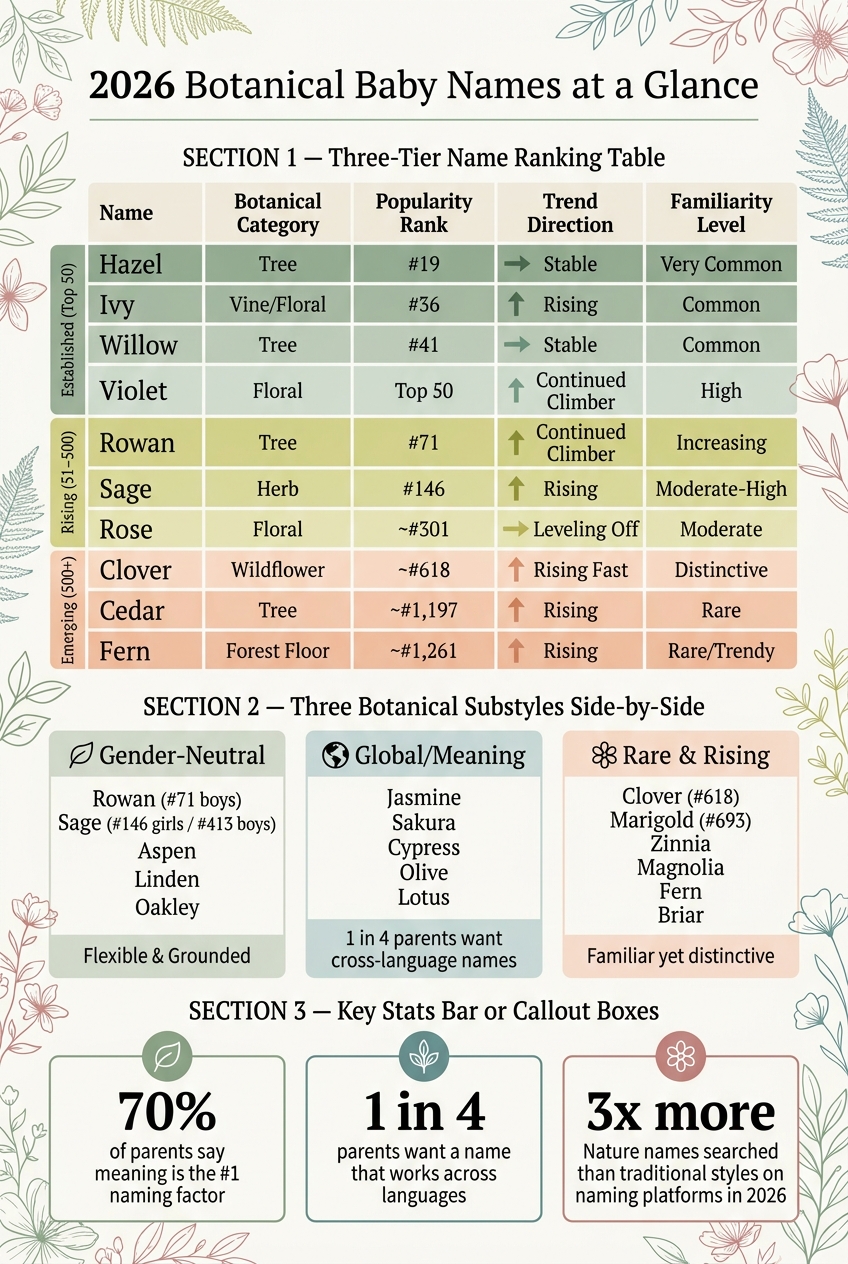
- Top botanical names still include Hazel (#19), Ivy (#36), Willow (#41), Violet (#15), Rowan (#71), and Sage (#146).
- Flower names like Lily, Violet, and Iris stay common, while Rose and Jasmine look more steady than fast-moving.
- Woodsy names like Rowan, Juniper, Briar, Cedar, and Cypress are getting more interest.
- Rare picks like Clover (#618), Marigold (#693), Fern, and Magnolia feel more usable now.
- Meaning matters: about 70% of parents say meaning is their top naming factor, and 1 in 4 want a name that works across languages.
- Search data also points the same way: nature-related styles are being searched about 3x more than older-school naming styles on some naming platforms.
This means if you want a botanical name in 2026, you’re not limited to floral picks. You can look at established names like Hazel and Violet, rising names like Rowan and Sage, or emerging names like Clover, Cassia, and Fern.
Quick Comparison
| Group | Names I’d Put Here | What It Means |
|---|---|---|
| Established | Hazel, Violet, Ivy, Willow, Lily | Common and easy to recognize |
| Rising | Rowan, Sage, Juniper, Iris | Moving up and showing more interest |
| Emerging | Clover, Marigold, Fern, Cedar, Cassia | Less common and still newer in feel |
If I were narrowing a shortlist, I’d look at rank, direction, sound, and meaning - not rank alone. That makes it easier to tell whether you want a name that feels familiar, less used, or a bit more offbeat.
sbb-itb-f13f980
Scope and methodology for 2026 botanical name trends
Sources used to track botanical naming patterns
This analysis uses SSA birth data as the baseline. That means it reflects actual birth registrations, not search interest alone.
For 2026, SSA data is paired with current search and page-view data from parenting platforms and user-submitted name databases, including a database with 77,000+ names. Those data points are then used to rank each name in the sections that follow.
One pattern stands out right away: nature-related styles are being searched at 3x the rate of more old-school names on specialized naming platforms in 2026.
How names are grouped and compared
Names are grouped by botanical type and by their typical U.S. use: girl, boy, or unisex. Trend direction is based on SSA rank plus year-over-year search growth. From there, the names are sorted into simple trend groups.
This article uses three labels throughout:
- Established: Top 50 or Top 100 names with stable or growing use, such as Violet at #15 and Ivy at #36
- Rising: Names in the Top 100 to Top 500 with clear growth, such as Sage at #146 for girls and Rowan
- Emerging: Names outside the Top 500 or mostly found in narrower style circles, such as Clover and Cassia
These labels make side-by-side comparison easier. You can look at a long-used pick like Violet and a newer option like Clover without mixing them into the same bucket.
| Name | Botanical Category | U.S. Usage | Trend Direction |
|---|---|---|---|
| Violet | Flower | Girl | Established |
| Sage | Herb | Unisex | Rising |
| Clover | Wildflower | Unisex | Emerging |
With the method in place, the next section looks at which botanical names are leading, rising, or emerging in 2026.
Popular botanical names and where they stand heading into 2026
2026 Botanical Baby Names: Established, Rising & Emerging Trends
Floral classics still leading U.S. usage
Floral names are holding steady as we head into 2026. Lily is still a top-50 mainstay. Violet has made its way back into the national top 50 and now looks firmly set there. Iris is moving up too, with that old-school charm many parents still like.
A bit lower down, Jasmine (#199) and Rose (#301) are still familiar picks. But neither is moving up the charts the way it did before. They’re steady, not sprinting.
That gap between long-set favorites and names with more current movement helps explain the next wave.
Tree, herb, and green names gaining ground
The strongest movement is coming from tree, herb, and woodland names. Hazel leads the pack at #19, which makes it the highest-ranked botanical name in current U.S. SSA data. Ivy (#36) and Willow (#41) are right behind it, and both now sit comfortably in the top tier of U.S. baby naming.
Rowan is also one of the most-searched names in 2026, landing near the top for search interest. Juniper didn’t enter the top 1,000 until 2011, and it has since climbed into the top 150. Sage (#146) stands out as the herb name that feels easiest to use in the U.S. right now.
"Nature names are still having their moment, but 2026 takes them off the garden path and into the woods. Think Willow, Rowan, Juniper, Marigold and Clover - names that feel airy, green and a little off-the-grid." - Briana Engelbrecht, Associate Editor, Babylist
You can see that pull most clearly in the names parents are putting on shortlists first.
Established names versus names still on the rise
Some botanical names have already crossed into everyday use. Hazel, Lily, and Willow fit that group. Others, especially names ranked between #500 and #1,000, still feel a bit more open and less overused. Clover (#618) and Briar (#522) are good examples: familiar enough to recognize, but not everywhere yet.
| Name | Category | Popularity Tier | Recent Direction | Likely 2026 Familiarity |
|---|---|---|---|---|
| Hazel | Tree | Top 20 (#19) | Stable | Very Common |
| Ivy | Vine/Floral | Top 50 (#36) | Rising | Common |
| Willow | Tree | Top 50 (#41) | Stable | Common |
| Violet | Floral | Top 50 | Continued Climber | High |
| Rowan | Tree | Top 100 (#71) | Continued Climber | Increasing |
| Sage | Herb | Top 150 (#146) | Rising | Moderate-High |
| Rose | Floral | ~#301 | Leveling Off | Moderate (Vintage) |
| Clover | Wildflower | ~#618 | Rising Fast | Distinctive |
| Fern | Forest Floor | ~#1,261 | Rising | Rare/Trendy |
| Cedar | Tree | ~#1,197 | Rising | Rare |
Next, the article turns to the botanical substyles driving that demand.
Botanical name substyles rising in 2026
The big headline names get most of the attention. But underneath that, three botanical substyles are standing out in 2026.
Gender-neutral botanical names
Gender-neutral botanical names are still the clearest shift for 2026. Rowan, Sage, and Aspen lead the group, while Linden and Oakley bring in more of a surname-style vibe.
Rowan ranks #71 for boys and is also widely used for girls. Sage ranks #146 for girls and #413 for boys.
That mix helps explain the appeal. These names feel soft without sounding overly frilly, and grounded without feeling stiff.
Botanical names chosen for global roots or personal meaning
Parents also pick botanical names because those names can carry family, heritage, or personal meaning. Some stand out because they travel well across countries and languages. Jasmine, Sakura, Cypress, Olive, and Lotus fit that lane.
Nearly 70% of parents say meaning is the most important factor in their naming choice, and 1 in 4 specifically want a name that works across languages and cultures. Names like Jasmine and Olive do that well.
For many families, that matters a lot. A name isn't just something that sounds nice. It may need to work at home, at school, and across more than one language.
Rare plant names moving into wider use
The third pattern is the rise of botanical names that once felt a little niche. Names like Clover, Zinnia, Marigold, Magnolia, Fern, and Briar now land in a spot that feels new but still easy to use.
Clover is now at #618 and Marigold at #693. Both have moved past their old-fashioned image and now sit in that sweet spot between familiar and new.
| Substyle | Example Names | Main Appeal |
|---|---|---|
| Gender-Neutral | Rowan, Sage, Aspen, Linden, Oakley | Flexibility; avoids strongly gendered categories |
| Global/Meaning | Jasmine, Sakura, Cypress, Olive, Lotus | Multicultural identity; works across languages |
| Rare/Rising | Clover, Zinnia, Marigold, Magnolia, Fern, Briar | Originality; less common feel |
Why botanical names resonate now and how to apply the research
Why botanical names fit current U.S. culture
The 2026 shift toward botanical names is bigger than style. It lines up with broader currents in the U.S. right now, which is why these names can signal values without feeling forced.
"Nature-inspired naming isn't about being granola or alternative. It's become mainstream. It reflects something deeper: In an increasingly digital, fast-paced world, many parents are seeking grounding elements in their children's names." - The Name Report
Wellness culture and climate awareness help make botanical names feel steady and hopeful. Many parents like names that come with built-in symbolism: Willow for resilience, Olive for peace, and Sage for wisdom. You can see that shift in how couples trim down their shortlist.
For some, botanical names also offer a small sense of relief from an unsettled news cycle. That instinct makes sense. But the bigger test is whether the name works in daily life, not just on a mood board.
How to narrow a botanical name shortlist as a couple
The research suggests a few simple filters before you commit, tied to the established, rising, and emerging groups covered earlier.
- Popularity trajectory matters more than rank. A name rising in the 200–500 range can feel less expected than a top-10 mainstay.
- Sound and fit matter as much as meaning. Say the name out loud with your surname. Then test likely nicknames and how it travels across languages. If the sound works, meaning can help settle the final choice.
- Symbolism can break a tie. Cedar suggests endurance, Linden carries calm, and Amaranth means unfading.
That last step is often where a close decision gets easier. Two names may sound equally good, but one may simply feel more right once the meaning clicks.
How NameHatch supports botanical name discovery
NameHatch can help narrow the field without turning the process into a slog. Its Nature-Inspired filter surfaces botanical substyles like forest names (Fern, Moss), climbing vines (Ivy, Clematis), and meadow names (Clover, Tansy). The Global filter helps if you want botanical names with international roots or stronger cross-language appeal, such as Persian Jasmine or Greek Aster. That kind of shared tool can save time.
The swipe-based interface lets both partners browse on their own, then sync results and build a shared shortlist. NameHatch is free to start, with premium unlocking unlimited swipes, favorites, and advanced filtering.
FAQs
How do I choose between an established and a rising botanical name?
Think about whether you want a name that feels timeless or more current. Well-known botanical names like Lily, Hazel, and Ivy have a classic, familiar feel. Newer picks like Juniper, Wren, or Cypress can feel more modern and a little less expected.
It also helps to look at the name’s popularity trend and picture how it may age over time. Pick the one that fits your style and the future you see for your child.
Which botanical names are gender-neutral in 2026?
In 2026, botanical names like Rowan, Sage, Juniper, and Briar are widely seen as gender-neutral.
What makes a botanical baby name work across languages?
A botanical baby name tends to travel well across languages when it has clear plant ties, strong meaning, and symbolism that people connect with in many places.
Names like Sage, Rowan, and Cedar work well for that reason. They come from plants with deep roots in language and history, carry a lot of meaning, and are often gender-neutral. They’re also fairly easy to say in many languages, which makes them a smooth fit for families with mixed language backgrounds.