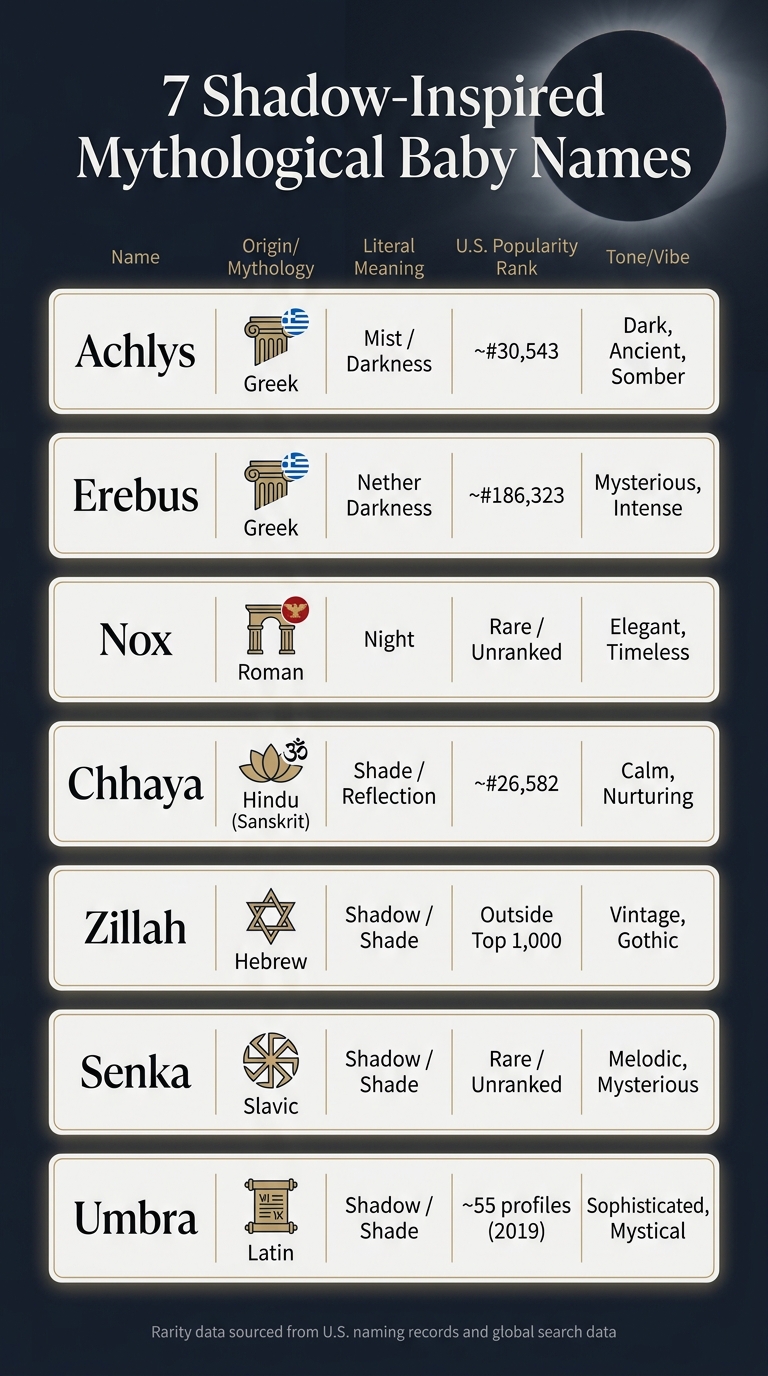
Looking for names with a mysterious, shadowy allure? These seven mythological names - Achlys, Erebus, Nox, Chhaya, Zillah, Senka, and Umbra - offer rare and meaningful options rooted in ancient stories. Each name reflects the balance between light and darkness, making them perfect for parents seeking something timeless and uncommon. If you need help narrowing down your aesthetic, use a baby name style planner to find similar themes. Here's a quick summary:
- Achlys: Greek origin, meaning "mist" or "darkness." Associated with death and doom in mythology.
- Erebus: Primordial Greek god of darkness and the underworld.
- Nox: Roman goddess of night, symbolizing elegance and strength.
- Chhaya: Hindu goddess of shadows, linked to protection and grace.
- Zillah: Hebrew name meaning "shadow" or "shade", with a vintage charm.
- Senka: Slavic for "shadow", also tied to spiritual essence.
- Umbra: Latin for "shadow", symbolizing mystery and resilience.
These names stand out for their depth, rarity, and connection to mythology. Whether you're drawn to Greek, Roman, Hindu, or Slavic traditions, these options bring a unique blend of history and meaning to baby naming trends.
7 Shadow-Inspired Mythological Baby Names: Origins & Meanings
1. Achlys
Mythological Origin
Achlys originates from Ancient Greek mythology, where her story is steeped in mystery and depth. In some versions of Greek cosmogony, she is said to predate even Chaos - the primordial void that existed before creation. Other accounts describe her as a daughter of Nyx, the goddess of night, or as one of the Keres, spirits associated with death and doom.
Hesiod's Shield of Heracles offers a haunting portrayal of Achlys:
"Beside them stood Death-Mist [Achlys], gloomy and dread, pallid, parched, cowering in hunger, thick-kneed; long claws were under her hands. From her nostrils flowed mucus, from her cheeks blood was dripping down onto the ground."
Her name also appears in Homer's Iliad, where achlys describes the fog or mist that clouds a dying warrior's eyes - the final vision before death.
Meaning
The name Achlys comes from the Ancient Greek word ἀχλύς, which translates to "mist", "darkness", or "misted eyes." This term was used in various contexts, including in the New Testament (Acts 13:11) and by Hippocrates to describe clouded vision. It even inspired the modern term achluophobia, the fear of darkness or mist.
U.S. Usability
Achlys is incredibly rare in the United States, currently ranking around #30,543 in popularity. It’s a name that stands far outside the top 1,000, making it a distinct and uncommon choice. Its mythological roots and dark, enigmatic feel may appeal to those drawn to gothic or academic aesthetics. Interestingly, Achlys is an isogram, meaning it contains no repeating letters, which lends it a visually striking simplicity.
Overall Tone
Achlys carries a weighty and somber tone, evoking themes of antiquity and the macabre. It’s far from lighthearted or whimsical - this is a name with serious, ancient gravitas. Beyond mythology, Achlys is also the name of a plant genus in the Berberidaceae family and a trans-Neptunian object (208996 Achlys), adding a scientific layer to its already mythic resonance. For parents seeking a name that blends mythological depth with a touch of science, Achlys offers a rare and enigmatic choice, though using a baby name app can help determine if such a bold pick is right for you.
sbb-itb-f13f980
2. Erebus
Mythological Origin
Erebus takes us deeper into the realm of mythological names tied to darkness. In Greek mythology, Erebus (or Erebos) is a primordial deity representing darkness itself. According to Hesiod's Theogony, Erebus emerged directly from Chaos, placing him among the earliest entities in the Greek cosmos, alongside Gaia, Tartarus, and Eros. Hesiod describes Erebus's origins and relationships as follows:
"From Khaos (Chaos) came forth Erebos (Erebus, Darkness) and black Nyx (Night); but of Nyx (Night) were born Aether (Bright Upper Air) and Hemera (Day), whom she conceived and bore from union in love with Erebos." - Hesiod, Theogony
Erebus's union with his sister Nyx gave rise to Aether (heavenly light) and Hemera (day). Beyond being a deity, Erebus also refers to a shadowy region in the underworld - a passageway for souls on their journey to Hades. This dual association with both a god and a place cements Erebus as a name that embodies the essence of darkness.
Meaning
The name Erebus comes from the Greek word érebos (ἔρεβος), which translates to "nether darkness". Some scholars believe its origins may stretch even further, possibly linked to the Semitic word erebh, meaning "sunset" or "evening", or the Proto-Indo-European root regw-es-, meaning "darkness". In English literature, Erebus has been used metaphorically to signify darkness since the late 16th century.
U.S. Usability
In the United States, Erebus is extremely uncommon, ranking around #186,323 in name popularity and approximately #421,414 globally. As of 2019, it garnered roughly 20 monthly Google searches and was associated with just 31 Facebook profiles. While traditionally seen as a masculine name, Erebus is considered unisex and pronounced "EH-ruh-bus." However, its rarity may require occasional pronunciation clarification.
Overall Tone
Erebus carries a rich, mysterious tone, steeped in mythological and historical significance. Its connection to the underworld and primordial darkness gives it an intense and enigmatic quality. This makes it a bold and unconventional name choice, one that stands out for its depth and rarity. Beyond mythology, the name is also tied to Mount Erebus, an active volcano in Antarctica, named after HMS Erebus, a Royal Navy ship lost during the Franklin expedition. This blend of myth, nature, and history adds further intrigue to the name's legacy.
3. Nox
Mythological Origin
Nox brings a Roman perspective to the concept of primordial darkness, serving as the personification of night. This ancient deity, closely tied to the Greek goddess Nyx, is said to have emerged from Chaos at the very beginning of creation. In Roman mythology, Nox is both the sister and consort of Erebus (Darkness). Even Zeus, the king of the gods, showed deference to her power. Homer captures this in the Iliad:
"True, Zeus shrank from doing a thing to outrage rushing Night." - Homer, Iliad
In some accounts, Nox is credited with independently giving life to figures like Mors (Death), Somnus (Sleep), the Fates, and Nemesis. Roman art often portrays her as a winged figure, cloaked in a black veil adorned with stars, steering a chariot through the shadowy depths of Tartarus. These depictions highlight how the Romans conceptualized the balance between light and darkness.
Meaning
The name Nox is the Latin word for "night", with its origins tracing back to the Proto-Indo-European term nókʷts. This makes it a linguistic cousin to Greek Nyx, Sanskrit nakta, and Old English niht. Beyond its literal translation, Roman literature often used "Nox" metaphorically to represent sleep, death, and the underworld, giving the name a layered and evocative quality.
U.S. Usability
In the U.S., Nox fits perfectly into the trend of short, striking names. Its resemblance to the popular name Knox gives it a sense of familiarity while maintaining an air of distinction. Though traditionally feminine in mythology, Nox has evolved into a gender-neutral name, making it a versatile option for parents finding your perfect baby name that is rare yet approachable. It works equally well as a bold first name or a distinctive middle name.
Overall Tone
Nox carries a sense of timeless elegance and quiet strength, blending its mythological roots with a modern edge. For those drawn to names with a shadowy allure, it offers a perfect mix of ancient mystique and contemporary charm.
4. Chhaya
From Greco-Roman tales to the mystique of Eastern mythology, the name Chhaya carries the allure of shadows in Hindu lore.
Mythological Origin
In Hindu mythology, Chhaya is known as the goddess of shadows and the second consort of Surya, the sun god. According to legend, Surya's first wife, Sanjna, struggled to endure his overwhelming radiance. To escape, she created Chhaya - a flawless shadow replica of herself - and left to pursue spiritual penance. The replacement was so perfect that even Surya was initially unaware of the deception.
"Chhaya was born from the shadow of Sanjna and replaced Sanjna in her house, after the latter temporarily left her husband." - Wikipedia
Chhaya's story extends further as she became the mother of Shani, the deity linked with Saturn and karma, the river goddess Tapti, and Savarni Manu, who is prophesied to usher in the next age of mankind. This rich mythology gives the name a profound and layered significance.
Meaning
The Sanskrit name Chhaya (छाया) translates to "shade" or "reflection." It embodies ideas of protection, comfort, and grace - like the soothing relief of shade on a scorching day. In Vedic philosophy, Chhaya also symbolizes the subtle body, a reflection of consciousness that connects the physical and spiritual worlds.
U.S. Usability
Chhaya's deep mythological roots have found a modest presence in the U.S., first appearing in naming records in 2014 at rank #26,582. Its popularity has been gradually increasing since then. While the traditional spelling "Chhaya" carries its full cultural weight, a simplified version, "Chaya", is sometimes used for ease of pronunciation internationally. However, this variant can overlap with the Hebrew name Chaya, which means "life" and has a completely different origin and pronunciation.
Overall Tone
Chhaya exudes a sense of calm strength and nurturing energy, much like the protective quality of shade. It offers a quiet yet profound cultural richness, making it a compelling choice for parents seeking a name with deep mythological roots and a serene, comforting presence. Chhaya stands as a name that balances ancient tradition with timeless appeal.
5. Zillah
Mythological Origin
Zillah has its roots in the Old Testament. In Genesis 4:19–23, she is mentioned as Lamech's second wife and the mother of Tubal-cain, known as the first to craft tools from bronze and iron, as well as a daughter named Naamah.
Meaning
The name Zillah comes from the Hebrew noun tsel (צל), which translates to "shadow" or "shade." (You can explore more origins with a baby name meaning finder). Its root verb, tsalal (צלל), conveys meanings like "to grow dark" or "to ring like a bell", evoking imagery of fleeting moments and delicate resonance.
U.S. Usability
In the U.S., Zillah is a rare choice, sitting far outside the Top 1,000 baby names. It had a brief moment of popularity in the late 19th century, making the Top 1,000 between 1881 and 1886 and peaking at #679. Pronounced ZIL-uh, it shares a similar rhythm with names like Delilah and Layla, making it approachable and easy to pronounce for English speakers. Its rarity adds to its charm for those seeking rare baby names.
Overall Tone
Zillah carries a vintage, slightly gothic vibe that feels both elegant and unique. With its -ah ending, it fits alongside trendy names like Delilah and Selah but remains far less common - ideal for parents aiming for something less mainstream. The name strikes a balance, feeling strong yet not overpowering, and shadowy without being somber.
6. Senka
Mythological Origin
The name Senka has its roots in South Slavic Proto-Slavic, specifically the word sěnь, which translates to "shadow" or "shade". In Balkan folklore, shadows were more than just physical phenomena - they were deeply tied to a person's spiritual essence. This connection imbued them with an air of mystery and a sense of protection.
In Japanese, Senka (泉下) carries a different but equally evocative meaning: "below the spring", a poetic reference to the afterlife. This dual heritage adds a rich layer of symbolism, connecting the name to themes of shadows and the spiritual realm. Historically, it’s also notable as the name of Japan’s 28th Emperor, who is said to have ruled from 536 to 539.
Meaning
In Serbian, Croatian, and Bosnian, Senka directly translates to "shadow" or "shade". Beyond its literal definition, the name evokes the comforting image of a cool shade on a sweltering day, suggesting a calm and protective presence. In some Slavic traditions, Senka is also used as a diminutive form of Ksenija (Xenia), which means "stranger" or "guest". This multifaceted meaning aligns well with modern American preferences for names that are rich in history and layered in significance.
U.S. Usability
While Senka is rare in the United States, its two-syllable structure (SEN-kah) is straightforward and easy for English speakers to pronounce. Its sound is reminiscent of Seneca, giving it a sense of familiarity without being overly common. Additionally, its connection to natural elements like "shade" aligns with the growing popularity of nature-inspired names in the U.S.
Overall Tone
Senka carries a melodic and mysterious quality, mirroring the fleeting yet powerful nature of a shadow. Traditionally considered a unisex name in Serbia, it aligns with contemporary gender-neutral naming trends and the preference for globally inspired names. For parents looking for something that blends ancient traditions with a subtle, modern flair, Senka offers a name that is both distinctive and deeply meaningful.
7. Umbra
Umbra takes its place as a name steeped in myth, seamlessly blending ancient history with a touch of modern mystique.
Mythological Origin
In Roman mythology, Umbra was revered as the goddess of shadows and ghosts, a protector who guided souls in the afterlife. The Latin word umbra was often used in Roman poetry to describe the "shade" or spirit of a deceased person - a presence lingering between life and the afterlife. Even Pluto, the Roman god of the underworld, was referred to as Umbrarum rex, or "King of Shadows".
Meaning
Derived from Latin, umbra translates to "shadow" or "shade". Its roots trace back to the Proto-Indo-European term andho-, meaning "blind" or "dark". The word is also related to "umber", a rich brown pigment used in art. In astronomy, the umbra signifies the darkest part of a shadow during a total solar eclipse, where light is completely obscured. This layered meaning ties together mythology, language, science, and art, making it a name with depth.
U.S. Usability
In the United States, Umbra is exceptionally rare as a personal name. A 2019 study found only about 55 Facebook profiles with this name, and global monthly Google searches average just 170. However, its appeal is growing - by May 24, 2026, online interest had jumped by 106%, with the name increasingly featured in categories like "Unique Word Names" and "Science and Technology Names" for babies. Its pronunciation - UHM-bruh - is straightforward for English speakers, adding to its accessibility.
Overall Tone
"Despite its association with darkness, Umbra carries a sense of strength and resilience." - MomJunction
"The concept of umbra has long been intertwined with the idea of duality, representing the interplay between light and darkness, presence and absence." - What-Name-Mean.com
Umbra exudes an air of mystery and sophistication. While it is a unisex name, it is more commonly associated with girls. In pop culture, it often represents characters tied to night and shadow, such as Umbra, Queen of the Night in the video game Child of Light, or as an alias for Shadow Lass in DC Comics. For parents choosing a baby name with mythological depth and a modern edge, Umbra offers a rare combination of ancient significance and contemporary appeal.
Conclusion
The names Achlys, Erebus, Nox, Chhaya, Zillah, Senka, and Umbra carry a mythic weight that sets them apart from most modern names. Each one is steeped in centuries of myth, symbolism, and cultural heritage.
"The most compelling names - the ones that stick with you - are steeped in story, myth, and the weight of history." - Louis Rumis, Founder of Name Meanings
What makes shadow-inspired names so intriguing is their duality. They symbolize the intersection of light and darkness, giving them a sense of depth and purpose. Their rarity also adds to their appeal - names like Zillah and Achlys are barely recorded in baby name analytics, making them a thoughtful choice for parents seeking something distinctive. Among the top baby names of 2026, this kind of quiet individuality, rooted in ancient stories, is becoming increasingly desirable. These names feel timeless, offering a connection to the past while remaining relevant for the future.
For those drawn to these evocative names, modern tools can simplify the search. NameHatch, an AI-powered baby name app, is designed to help parents find names by origin, style, or vibe. Its Mythical filter is perfect for exploring shadow-inspired options. The app allows users to swipe through suggestions, collaborate with a partner in real time, and build a shared shortlist - all without intrusive ads. It’s available on mobile and desktop, free to start, with a premium plan for $3/month.
FAQs
How do you pronounce Achlys, Erebus, and Chhaya?
Achlys is pronounced AK-lis (ˈæk.lɪs). Erebus is pronounced AIR-uh-bus (ˈɛrəbəs). Chhaya is pronounced CHHAA-ya, blending the 'chh' sound with 'ya'.
Are any of these shadow-inspired names considered unisex in the U.S.?
In the U.S., several shadow-inspired names are considered unisex. Umbra, derived from the Latin word for shadow, is a well-loved choice. Other gender-neutral options include Raven, Onyx, Storm, Salem, Ash, Noir, and Shade. While names like Kage and Umbriel have historically leaned masculine, modern naming trends increasingly embrace using these names for any gender based on individual preference.
Do any of these names have negative or heavy mythological meanings?
Some names inspired by shadows carry strong or somber associations in mythology. For instance, Erebus is a figure tied to darkness and the underworld in Greek mythology, and Chhaya is connected to stories of curses and conflict in Hindu lore. That said, interpretations aren’t uniform - cultures like Japan often see shadows as representing depth and harmony, rather than something purely negative.