Find a sibling name that fits with your children's names: enter one or more names and choose whether to match spelling length, ending sound, or a balance of both.
Made by NameHatch. The name lists use SSA data through 2025, current as of March 2026; the tool was last checked on November 10, 2026.
How to use the sibling name generator
- Enter the name or names of your existing children.
- Choose a candidate list and what you want the generator to match: balanced, similar spelling length, or similar ending sound.
- Read the closest suggestion and its reason. Try another preference if you want a different kind of match.
The suggestions are starting points. Say each name with your family name and alongside your children's names, then decide what feels right to you.
How the sibling names generator ranks suggestions
The generator compares unused candidates from the Social Security Administration's top-200 name lists for 2020–2025. Its length comparison uses spelling length, not syllables. In balanced mode, it combines the average spelling-length gap with the ending-sound mismatch rate, giving the mismatch rate twice the weight. Similar-length mode ranks by average spelling-length difference. Similar-ending mode ranks by ending-sound fit first, then spelling length.
For sound matching, the tool uses a held lookup of vowel/consonant ending classes derived from the first listed pronunciations in CMUdict, the Carnegie Mellon Pronouncing Dictionary. It stores the classes, not the pronunciations. If a name is missing from that lookup, its ending is unresolved rather than guessed. When none of the names you enter has a held class, sound modes fall back to spelling length alone.
The candidate names come from the SSA's popular baby names data. The SSA explains how its name records are collected and the limits of those data in its background notes. This generator ranks names for the selected fit; it does not rank them by meaning, style, or overall popularity.
Worked example: Emma and Noah
Enter Emma, choose All names, and select Balanced. The tool returns: “Try Noah for sibling name Emma, based on a balanced length-and-ending-sound fit.” The closest match is Noah. Its reason is: “Balanced score: average length gap plus 2 × ending-sound mismatch rate.” That describes the tool's ranking, not a rule that every family should choose names with matching sounds.
How to read a suggestion
“Closest match” means the top-ranked unused name for the list and preference you selected. A similar-length result compares spellings; a similar-ending result compares the available ending classes before length. Balanced mode combines those measures. The score is a sorting method, not a judgment about whether two names sound good together.
If an entered name has no held pronunciation class, the tool cannot infer its ending sound. When all entered names lack a class, sound matching uses spelling length alone, as in the Zyr example below. Results also depend on the tool's candidate lists, so a name outside those lists will not appear.
Common sibling-name generator results
| Names entered | Candidate list | Preference | Tool result and reason |
|---|---|---|---|
| Emma | All names | Balanced | “Try Noah for sibling name Emma, based on a balanced length-and-ending-sound fit.” Closest match: Noah. Balanced score: average length gap plus 2 × ending-sound mismatch rate. |
| Liam, Noah | All names | Similar length | “Try Emma for sibling names Liam, Noah, based on similar spelling length.” Closest match: Emma. Ranked by average spelling-length difference. |
| Max | SSA girls’ list | Similar ending sound | “Try Iris for sibling name Max, based on similar ending sounds, then spelling length.” Closest match: Iris. Ranked by ending-sound fit, then average spelling-length difference. |
| Zyr | All names | Balanced | “Try Mia for sibling name Zyr, based on spelling length only because the ending sound is unresolved.” Closest match: Mia. No entered name is listed in the tool’s held CMUdict lookup; ranking falls back… |
| No name entered | All names | Balanced | “Enter at least one child’s name to see suggestions.” Message: Enter at least one child’s name to see suggestions. |
Questions about sibling and twin name suggestions
Can I use the generator for twins?
Yes. Enter one twin's name to explore a suggestion for the other, or enter names you already have and look for another name that fits the group. The tool compares spelling length and, when its lookup has a class, ending sound. It does not judge whether names are too similar for your family, so listen to the pair and choose what feels comfortable.
Does it match names by meaning, style, or surname?
No. The ranking uses spelling length and vowel/consonant ending class; it does not compare name meanings, cultural origins, styles, initials, or your family name. Use the suggestions to build a shortlist, then check those qualities separately if they matter to you. The tool's ranking is one way to explore options, not a full name evaluation.
Why does a balanced result favor one name?
Balanced mode combines the average spelling-length gap with the ending-sound mismatch rate, multiplying the mismatch rate by two. That formula determines the tool's order; the result does not mean the name is objectively better. If you want the clearest single criterion, select similar length or similar ending sound instead and compare the suggestions.
Why might sound matching use spelling length alone?
The tool only compares ending classes for names represented in its held lookup, which is derived from CMUdict pronunciations. It does not guess a class for a name that is absent. If none of the names you entered has a stored class, sound-based modes fall back to spelling length, so the result may not reflect how your family pronounces the name.
Compare names together
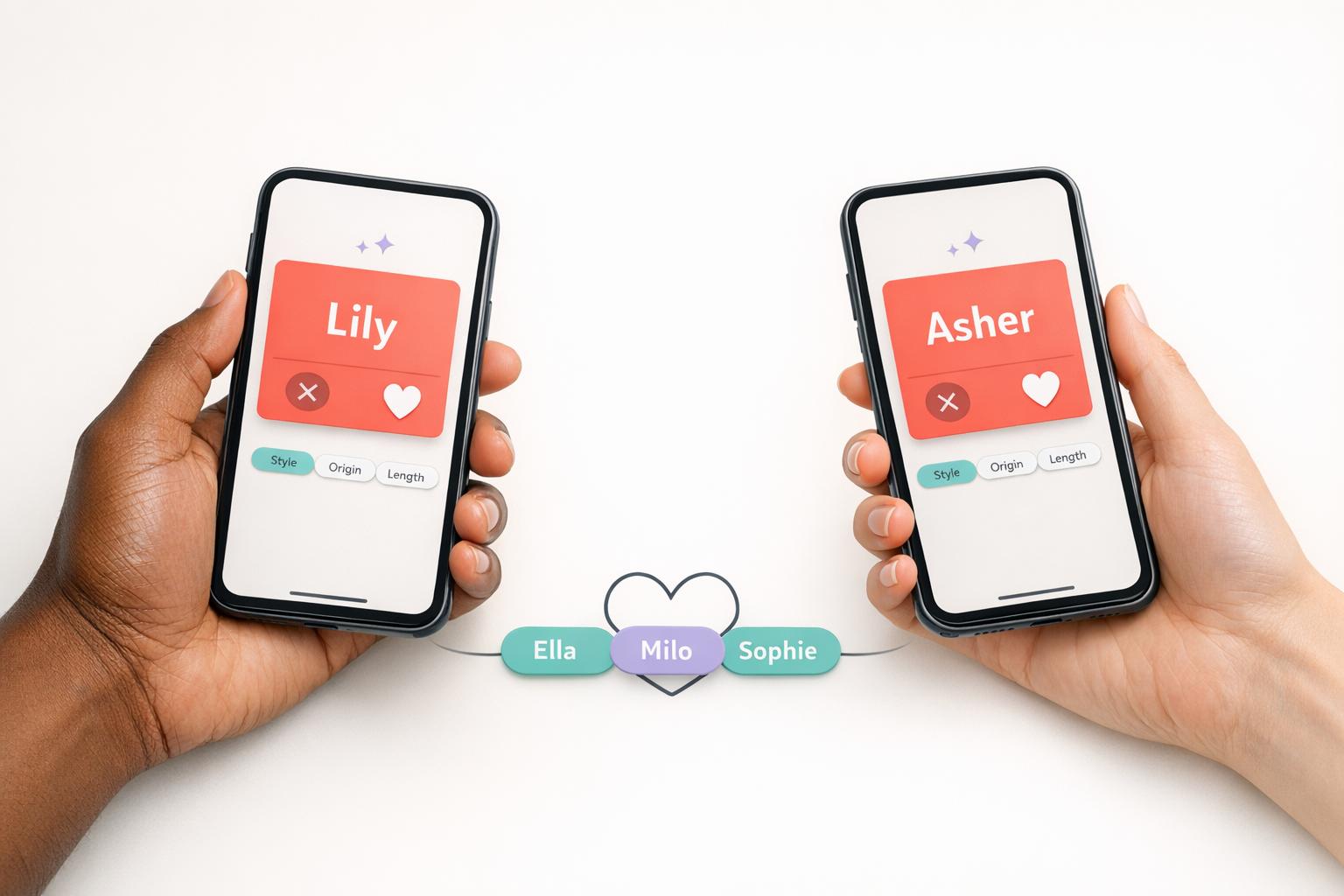
For another way to compare how two names sound together, try the Baby Name Compatibility Checker. When you have a few sibling-name ideas, swipe through baby names together in NameHatch and save the names you both like to a shared shortlist.