- William: A classic name meaning "resolute protection", consistently popular since 1922.
- Wyatt: Rugged and modern, meaning "brave in war", with ties to Western legends like Wyatt Earp.
- Wesley: "Western meadow", a name balancing historical roots and modern charm.
- Waylon: A country-inspired name meaning "road land", strongly associated with musician Waylon Jennings.
- Weston: "Western town", a surname-turned-first-name with a cowboy feel.
- Walter: "Army ruler", a vintage favorite making a quiet comeback.
- Warren: A name with French origins meaning "to protect", linked to figures like Warren Buffett.
- Walker: An occupational name with Western flair, tied to pop culture like Walker, Texas Ranger.
- Watson: "Son of Wat", with literary ties to Sherlock Holmes and scientific significance.
- Wilson: "Son of William", offering a polished yet approachable vibe.
- Wade: Meaning "river crossing", a simple and strong choice with a nature-inspired edge.
- Winston: "Joy stone" or "victory town", linked to historical figures like Winston Churchill.
- Wilder: A bold, adventurous name meaning "to roam" or "wild."
- Wells: Rooted in nature, meaning "spring" or "stream", with understated elegance.
- Waylen: A modern variation of Waylon, meaning "land beside the road."
These names span styles from traditional to modern, blending historical depth with contemporary appeal. Many carry meanings tied to protection, leadership, and nature. Whether you prefer a classic like William or a bold choice like Wilder, there's a W-name for every taste.
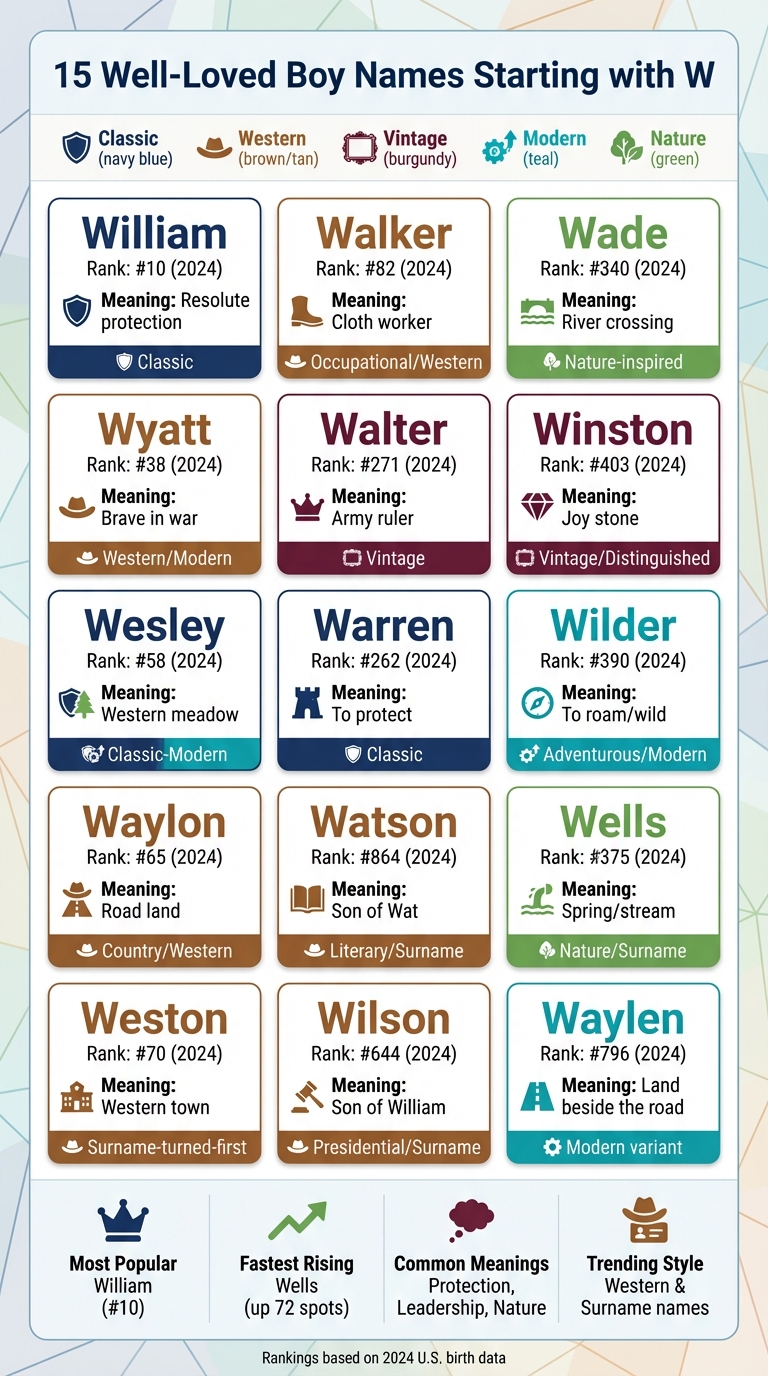
Top 15 Boy Names Starting with W: Popularity Rankings and Meanings 2024
1. William
Meaning and Origins
The name William traces back to the Germanic name Wilhelm, which merges two elements: wiljô (meaning "will, wish, or desire") and helmaz (meaning "helmet or protection"). Together, it symbolizes strength and protection [9, 10, 14]. The name gained prominence in England following the Norman Conquest of 1066, introduced by the Anglo-Normans, and quickly became a favorite among European nobility [9, 10, 14].
Popularity in the U.S.
William has been a consistent favorite in the United States for over a century. From 1880 to 1920, it held the position of the second most popular name for boys, accounting for 8.051% of male births in 1880 [12, 13]. Although its popularity dipped slightly - reaching #20 in 1995 - it rebounded strongly. Since 2006, William has remained a top 10 name, ranking #10 in 2024 with 0.574% of male births [10, 12]. This enduring popularity highlights its timeless charm and connection to influential historical and cultural figures.
Famous Namesakes and Cultural Impact
William’s rich history is reflected in its association with notable figures across various fields. From literary legend William Shakespeare to royalty like Prince William, and from political leaders such as President Bill Clinton to entertainment icons like William Shatner, the name carries a legacy of influence [9, 10]. Its flexibility is further emphasized by its many nicknames, including Will, Bill, Billy, and the increasingly popular Liam.
A Name for All Times
Author Vicky Yip describes William as "a timeless classic with English roots that dates back almost a thousand years yet is still popular today". The name strikes a balance between regal sophistication and everyday versatility, making it a choice that feels equally at home in formal and casual settings. Whether you're drawn to its historical significance or its modern adaptability, William remains a name that stands the test of time.
sbb-itb-f13f980
2. Wyatt
Meaning and Cultural Origins
Wyatt originates from the Medieval English name Wyot, which itself evolved from the Old English name Wigheard. The name combines the elements wig (meaning "war") and heard (meaning "brave", "hardy", or "strong"), giving it the meaning "brave at war" or "little warrior." In the Middle Ages, Normans used variations like Wiot and Gyot as nicknames for names such as William or Guy. Over time, it transitioned from an Old English name to the modern first name we know today. This historical depth adds to its appeal in contemporary America.
Popularity Trends in the U.S.
Wyatt's popularity has seen a steady rise over the last two decades. It broke into the top 100 names in 2004 and reached its peak at #29 between 2019 and 2021. By 2024, Wyatt ranked as the 38th most popular boy name in the U.S., representing about 0.357% of male births - or roughly 6,779 boys. The name's modern revival can be traced to 1986, when Goldie Hawn and Kurt Russell named their son Wyatt, giving it a notable boost in public awareness.
Notable Associations or Cultural Relevance
Wyatt is closely tied to the American Old West, thanks to the legendary lawman Wyatt Earp (1848–1929), famous for his role in the shootout at the O.K. Corral. This connection lends the name a rugged "cowboy" flair that many parents find appealing. Pop culture has further cemented Wyatt's popularity, with references in films like Easy Rider and TV shows such as Parks and Recreation (Ben Wyatt) and Charmed (Wyatt Halliwell). Notable real-life figures include civil rights leader Wyatt Tee Walker (1928–2018) and actor Wyatt Russell, son of Goldie Hawn and Kurt Russell, whose choice of the name helped bring it into the spotlight.
Modern or Classic Appeal
"With its easy Wyatt Earpish cowboy charm, it's relaxed but still highly respectable." - Grace Royal, Nameberry
Wyatt effortlessly bridges the gap between its rugged Western roots and a modern, stylish vibe. It’s often praised for its blend of casual charm and timeless sophistication, making it both a traditional and trendy choice. The name aligns with the current trend of using surnames as first names and has a rustic, outdoorsy feel that resonates with many parents. While it remains overwhelmingly a male name (99.4% of its usage), it gained brief attention as gender-neutral in 2014 when Mila Kunis and Ashton Kutcher named their daughter Wyatt. However, it continues to be predominantly chosen for boys.
3. Wesley
Meaning and Cultural Origins
The name Wesley traces its roots to the Old English surname Westlēah, which combines "west" (the cardinal direction) and "lēah" (a meadow or clearing). This translates to "western meadow" or "field to the west." Originally used as a habitational surname, Wesley gained prominence as a given name in the 18th century, largely due to its association with John Wesley, the founder of Methodism. Today, it appeals to parents for its blend of historical significance and modern charm. Common nicknames include Wes, West, and Lee.
Wesley's enduring appeal has been bolstered by its rich history and a growing interest in names with classic yet approachable qualities.
Popularity Trends in the U.S.
Wesley's popularity in the U.S. has seen a steady climb in recent years. After dropping to #189 in the mid-2000s, it made a strong comeback, reentering the Top 100 in 2020 at #98. By 2024, it reached #58, with 5,144 newborns bearing the name, accounting for 0.279% of male births [31,32]. This resurgence even surpassed its previous high of #66 in 1977. In Vermont, Wesley became especially popular, ranking as high as #7 in 2024.
Notable Associations and Cultural Relevance
Wesley has left its mark across various fields, from religion to entertainment. Its religious roots are tied to John Wesley, but its influence extends well beyond that. Actor Wesley Snipes, for example, has appeared in films grossing over $1.6 billion globally. In the creative world, directors Wes Anderson and Wes Craven have brought the name into the spotlight. Fictional characters like Wesley Crusher from Star Trek and Westley from The Princess Bride add a layer of pop culture recognition.
Historical figures such as Arthur Wellesley, the 1st Duke of Wellington, and U.S. Civil War General Wesley Merritt highlight the name's distinguished past. In sports, names like Dutch soccer star Wesley Sneijder and NBA player Wesley Matthews keep it relevant in contemporary discussions.
Modern and Classic Appeal
Wesley strikes a balance between its historical depth and a modern, versatile vibe. It fits seamlessly into the trend of using surnames as first names while also resonating with those drawn to nature-inspired choices. Its adaptability makes it equally appealing in secular and religious contexts.
"Wesley occupies a niche that reconciles historical gravitas with modern versatility, appealing to parents who value a name that is etymologically transparent, phonetically accessible, and culturally resonant."
- Susan Clarke, Assistant Editor
With 98.6% of its bearers being male [32,33], Wesley maintains a distinctly masculine identity without feeling overly formal. Its mix of legacy and contemporary appeal makes it a standout choice for parents seeking a name that feels both familiar and distinctive. For those drawn to Wesley, similar names like Weston, Wyatt, and Wells offer a similar sense of strength and natural charm.
4. Waylon
Meaning and Cultural Origins
Waylon traces its roots to Old English, where it combines the elements weg (meaning "road") and land ("land"). There's also a possible connection to Old Norse or Germanic origins through Wieland, which translates to "craft" or "cunning." Historical records, like the 1086 Domesday Book, show Waylon as a personal name used by landholders.
Popularity Trends in the U.S.
Over the past decade, Waylon has seen a dramatic rise in popularity. It jumped from #995 in 1990 to an impressive #65 in 2024, with 4,878 boys being given the name that year [37,38]. It first entered the Top 100 in 2021 and has held its position since. The name has particularly strong appeal in certain regions, ranking #2 in West Virginia, #6 in Kentucky, and #7 in Mississippi as of 2023.
Notable Associations and Cultural Relevance
Waylon Jennings, the legendary "Outlaw Country" musician, is the name's most iconic association. His influence in the 1970s and 1980s brought the name national recognition, and its popularity surged after his passing in 2002, as fans sought to honor his legacy. Beyond music, Waylon has made its mark in pop culture through characters like Waylon Smithers from The Simpsons, Killer Croc in DC Comics, and Waylon Forge in Twilight. In sports, figures such as soccer player Waylon Francis have also carried the name [36,37,39].
Modern and Classic Appeal
Waylon fits seamlessly into today’s trend of rugged, Western-inspired names like Wyatt, Weston, and Walker. With nearly 99% of Waylons being male, the name exudes a strong, masculine identity. Its outdoorsy and confident vibe makes it a standout choice for parents seeking a name with both history and contemporary edge.
"With its rugged, country charm and confident sounds, Waylon is among the wave of Old Western names that parents are choosing" - Madison Dresler, Nameberry Editor
Waylon strikes a balance between its historical roots and modern style, offering families a name that feels timeless yet fresh. Its rugged charm and distinctive sound make it a compelling choice for those drawn to classic Western-inspired names.
5. Weston
Meaning and Cultural Origins
The name Weston originates from Old English, combining west and tun, meaning "west town" or "western settlement." Initially a habitational surname in England, Weston eventually transitioned into a widely embraced first name in the United States. This shift reflects a broader trend of W-names that blend historical roots with a modern edge.
Popularity Trends in the U.S.
Weston has been steadily climbing the popularity charts since the 1970s, reaching its peak at #70 in 2024. That year, 4,660 baby boys were named Weston, accounting for 0.253% of all male births. The name first entered the Top 100 in 2021 at #95 and has remained a favorite ever since. For context, Weston ranked #617 in 1980 and #396 in 2000, showcasing a remarkable rise over a few decades. This upward trajectory aligns with the growing preference for names that combine a classic feel with a modern twist. While primarily a boys' name, it remains rare for girls, with only 13 given the name in 2023. Interestingly, Hawaii boasts the highest concentration of Westons, with 6.79 per 100,000 residents.
Notable Associations and Cultural Relevance
Weston has gained recognition through various cultural and celebrity connections. Actor Nicolas Cage named his son Weston in 1990, and actress Jenna Fischer followed suit in 2011. The character Michael Westen from the TV series Burn Notice has also brought attention to the name. Prominent individuals with the name include professional soccer player Weston McKennie, celebrated photographer Edward Weston, and electronic music producer Porter Weston Robinson. These associations span sports, the arts, and entertainment, adding depth to the name's cultural significance.
Modern and Classic Appeal
"Weston has gone from being a Jane Austenish British surname to a first name with a relaxed American western cowboy feel." - Linda Rosenkrantz, Nameberry
Weston embodies the trend of surnames becoming first names, offering a mix of British literary charm and rugged American style. Variations like Westin and Westyn further highlight its contemporary appeal.
6. Walter
Meaning and Cultural Origins
Walter has its roots in Germanic languages, combining wald ("rule" or "power") and hari ("army"). The name translates to "army ruler" or "powerful warrior". It first appeared in the 6th century with Lombard king Walthari and gained fame in Germanic folklore through the legendary hero Walther von Aquitaine. The Normans brought the name to England in the 11th century, where it replaced the Old English name Wealdhere. During medieval times, it was pronounced "Water", which led to the nickname "Wat".
Popularity Trends in the U.S.
Walter was a top choice for baby names in the U.S. from the late 19th century to the 1930s. It peaked at #10 in 1914, when it accounted for 1.312% of births. However, its popularity declined, reaching #372 by 2010, before rebounding to #271 by 2024. Outside the U.S., Walter maintains a stronger presence in Scandinavia, ranking #35 in Sweden and #39 in Denmark. These trends reflect the name's changing cultural significance over time.
Notable Associations and Cultural Relevance
Walter's rich history is matched by its association with an impressive array of figures. From Sir Walter Raleigh and Walt Whitman to Walt Disney and Walter Cronkite, the name has been borne by influential leaders in literature, entertainment, and journalism. Sports fans might think of NFL great Walter Payton or baseball legend Walter Johnson. Pop culture has also played a role in keeping the name relevant, with Walter White from Breaking Bad adding a modern edge. Celebrities like Rainn Wilson and Julia Roberts have also chosen Walter for their children, further boosting its appeal.
Modern and Classic Appeal
"Walter was seen as a noble name in the Sir Walter Raleigh and Sir Walter Scott era, but it then spent decades in baby name limbo. Now quite a few independent-minded parents are looking at it as a renewable, slightly quirky, classic." - Pamela Redmond, Nameberry
Walter is making a comeback as a vintage favorite, appealing to parents who appreciate its blend of tradition and individuality. Often shortened to Walt or Wally, it carries an old-school charm with a touch of modern flair.
7. Warren
Meaning and Origins
The name Warren has roots in Old French, stemming from "warenne", which referred to an animal enclosure, and the Germanic word "warin", meaning "to protect." Initially, it functioned as both a habitational and occupational surname. After the Norman Conquest in the 11th century, it became one of the earliest recorded surnames in England. Over time, Warren evolved into an occupational surname associated with park keepers or game wardens, symbolizing qualities like protection and guardianship [67–70].
Popularity Trends in the U.S.
Warren enjoyed its highest popularity in 1921, ranking #24 and accounting for 0.685% of births that year [73,75]. It stayed within the top 100 names until 1942 before gradually declining, reaching its lowest point at #550 in 2005 [73,76]. However, the name has seen a resurgence, jumping 42 spots in 2024 to rank #262, with 1,327 boys given the name in the U.S. that year [73,76]. This recent revival hints at a renewed appreciation for the name's enduring charm.
Notable Figures and Cultural Impact
Warren has been associated with several prominent figures, adding depth to its cultural significance. Billionaire investor Warren Buffett brings to mind financial acumen and stability, while historical figures like 29th U.S. President Warren G. Harding and Chief Justice Earl Warren add a sense of dignity and leadership. In entertainment and sports, names like actor Warren Beatty, rapper Warren G, and Pro Football Hall of Famers Warren Moon and Warren Sapp further enhance the name's appeal. Additionally, General Joseph Warren, a hero of the American Revolution, ties the name to American history and valor.
Timeless Appeal with a Modern Twist
"Long lingering in limbo, Warren suddenly seems to be on the cusp of revival." - Madison Dresler, Nameberry
Warren is making a comeback among parents who value its understated elegance and associations with reliability and trust. It aligns with trends like "Urban Prairie" and "Vintage Surname", exuding a polished yet approachable vibe. For a modern touch, nicknames like Ren or Wren offer a fresh, contemporary spin on this classic name.
8. Walker
Meaning and Cultural Origins
Walker originates from Old English as an occupational name, referring to someone who washed or processed cloth, also known as a fuller. Like many other W-names, it carries a historical significance while maintaining a modern edge. Today, Walker has transitioned from its surname roots to become a stylish first name for boys in the United States.
This deep heritage provides a strong foundation for Walker's growing popularity in recent years.
Popularity Trends in the U.S.
Walker has seen a remarkable rise in popularity, moving from #130 in 2021 to #78 in 2022, marking its first appearance in the U.S. Top 100. By 2024, it reached #82, with 0.218% of boys given the name. A key factor behind this surge is the 2021 reboot of the TV series Walker on the CW Network, which brought renewed attention to the name. Historically, Walker had its previous peak at #296 back in 1896.
Notable Associations and Cultural Relevance
The name Walker is deeply tied to pop culture and politics. It serves as the middle name for both Presidents George H.W. Bush and George W. Bush and gained fame through TV shows like Walker, Texas Ranger and its modern reboot. Celebrity parents, such as Idina Menzel and Taye Diggs, also chose Walker for their son. Current public figures like country singer Walker Hayes, MLB pitcher Walker Buehler, and actor Walker Scobell have further spotlighted the name's appeal.
These connections highlight Walker's ability to balance a sense of tradition with contemporary relevance.
Modern Appeal
Walker perfectly captures the "cool cowboy" aesthetic, blending Southern charm with a rugged, modern vibe. It fits into the trend of using occupational surnames as first names, alongside choices like Tucker and Parker. Particularly favored in Southern and Midwestern states, Walker appeals to parents drawn to names that combine a classic feel with Western flair, similar to Wyatt and Waylon. Its journey from a medieval trade to a modern favorite reflects the evolving appeal of W-names on this list.
9. Watson
Meaning and Cultural Origins
Watson is a patronymic name that translates to "son of Wat". The name Walter, from which it originates, has Germanic roots in Waltheri - a combination of walt (meaning "power" or "ruler") and heri ("army"), essentially signifying "power of the army". With English and Scottish origins, Walter was introduced to England by the Normans, eventually replacing the Old English name Wealdhere. During medieval times, Walter was often pronounced as "Water", giving rise to the interpretation "son of Water".
Popularity Trends in the U.S.
Watson has seen a surprising revival in the U.S. after being absent from the top 1,000 names between 1942 and 2018. It re-entered the charts and reached its peak at #511 in 2020, with 454 boys named Watson that year. However, by 2024, its rank had dropped to #864, with 278 boys receiving the name. This resurgence mirrors the growing popularity of vintage surnames being used as first names.
Notable Associations and Cultural Relevance
Watson carries a rich legacy in both literature and science. Its most famous literary connection is Dr. John Watson, the loyal companion of Sherlock Holmes in Sir Arthur Conan Doyle's classic mysteries. In science, James D. Watson, a co-discoverer of DNA’s double-helix structure and a Nobel Prize recipient, adds to its prestige. The name also gained technological recognition through IBM's Watson supercomputer, which famously triumphed on Jeopardy!. Additionally, Thomas A. Watson, who received Alexander Graham Bell's first telephone call, further cements the name’s historical significance.
Modern Appeal
Watson fits seamlessly into the modern trend of using surnames as first names, offering a "warm, friendly, and honest image". Parents who like Watson often gravitate toward similar names such as Walker, Hudson, and Wyatt. With its rich history and contemporary charm, Watson strikes a balance that appeals to families looking for a name with both depth and a touch of modernity.
10. Wilson
Meaning and Cultural Origins
Wilson is a patronymic surname from England, Scotland, and Northern Ireland, meaning "son of William". Its roots trace back to William, a name derived from Germanic elements: wil (meaning "will" or "desire") and helm (meaning "helmet" or "protection"). This lineage has led to interpretations of Wilson as a "valiant protector" or "vehement protector". Historically, the name first appeared as "Willeson" in England in 1324 and as "Wulson" in Scotland in 1405. These early records highlight its long-standing heritage.
Popularity Trends in the U.S.
Wilson's popularity as a first name in the U.S. peaked between 1910 and 1919, ranking at #145. Over time, its usage has decreased by about 89% from its late 19th-century high, though it has consistently stayed within the top 1,000 names. In 2024, Wilson is ranked #644, climbing 26 spots from #670 in 2023. As a surname, however, it remains far more common, ranking as the tenth most frequent surname in the U.S., with 783,051 occurrences recorded in the 2000 Census.
Notable Associations and Cultural Relevance
Wilson has left a mark in various cultural and historical contexts. It is closely tied to Woodrow Wilson, the 28th U.S. President who played a significant role during World War I. In music, figures like Brian Wilson, the creative force behind the Beach Boys, and Wilson Pickett, known for the classic "In the Midnight Hour", have added to its cultural weight. Literature fans may recognize Wilson Rawls, author of Where the Red Fern Grows. Even pop culture has embraced the name, with "Wilson" becoming iconic as the volleyball companion in the film Cast Away (2000).
Modern Appeal
Wilson fits perfectly into the growing trend of using surnames as first names. It offers a fresh option for those who like the nickname "Will" but want something less common than William. Naming expert Pamela Redmond points out:
"Wilson is a presidential choice far less prevalent than Taylor or Tyler, offering a fresh path to the friendly nickname Will".
Known for its classic, mature, and wholesome vibe, Wilson strikes a balance between timeless tradition and modern style. Its versatility ensures it remains appealing while keeping pace with the popularity of W-names highlighted throughout this article.
11. Wade
Meaning and Cultural Origins
The name Wade means "river crossing" or "ford", with roots in Old English and Scandinavian languages. It’s also connected to the idea of being "able to go." In folklore, Wade appears as a legendary sea-giant, the son of a king and a mermaid, tied to the coastal tribes of the North and Baltic Seas. This fascinating origin story adds a layer of depth to its enduring charm in the U.S.
Popularity Trends in the U.S.
Wade has consistently appeared in the U.S. Top 1,000 baby names since 1880. Its popularity peaked at #183 in 1966, dropped to #620 in 2009, and climbed back to #340 in 2024, accounting for 0.055% of male births that year. It’s particularly favored in the Southern and Western states, with Texas alone recording 89 births in 2024.
Notable Associations and Cultural Relevance
Wade has a strong presence in pop culture and history. It’s famously tied to Marvel’s Wade Wilson (Deadpool) and Wade Watts from Ready Player One. Sports fans might think of MLB legend Wade Boggs or pitcher Wade Davis. Historically, figures like Confederate General Wade Hampton and District Attorney Henry Wade, associated with Roe v. Wade, bring historical significance. On television, characters such as Wade Kinsella from Hart of Dixie and Wade "Unique" Adams from Glee add to its cultural footprint.
Modern Appeal
Wade strikes a balance between classic and contemporary. Nameberry editor Sophie Kihm explains its lasting popularity:
"Wade has never been outside the US Top 1000 for boys - there's a reason for that. It has a clean spelling, fresh sound and is neither too trendy (unlike Kade or Cade) or too old-school (like Richard or Albert)."
Wade’s simplicity, strength, and natural vibe align with today’s preference for western and nature-inspired names. It offers a grounded yet stylish choice for modern parents.
12. Winston
Meaning and Cultural Origins
Winston is an Old English name that translates to "joy stone" or "victory town." It comes from the elements wynn (joy) or wine (friend) and stān (stone) or tūn (settlement). Originally used as a surname linked to Winstone in Gloucestershire, the name transitioned into a given name in the 17th century, notably within the Churchill family. Sir Winston Churchill (born 1620) was one of the first notable individuals to bear it, named after his mother’s maiden name.
Popularity Trends in the U.S.
Winston hit its highest popularity in 1941, ranking at #234, likely influenced by Winston Churchill's prominent role during World War II. Afterward, its usage declined, reaching a low point at #877 in 2006. However, the name has recently gained traction again, climbing to #403 in 2024, with 797 boys (0.043% of male births) receiving the name. This resurgence aligns with the growing trend of reviving classic "old man names" like Edward and Alfred.
Notable Associations and Cultural Relevance
Winston carries a strong historical and cultural presence. Sir Winston Churchill (1874–1965), the British Prime Minister during World War II, remains the most famous bearer of the name. In literature, Winston Smith, the protagonist of George Orwell's 1984, adds a layer of intellectual and literary significance. The name also connects to American culture through Winston Groom (1943–2020), author of Forrest Gump.
Modern-day associations include actor Winston Duke, known for his role in Black Panther, and NFL quarterback Jameis Winston. Pop culture has embraced the name with characters like Winston Bishop from New Girl and Winston Zeddemore from Ghostbusters.
Modern Appeal
Winston strikes a balance between vintage elegance and contemporary style. Its sophisticated tone is complemented by approachable nicknames like Win and Winnie. Interestingly, Winston is more popular in the U.S., where it ranks in the Top 500, compared to England and Wales, where it sits at #756.
13. Wilder
Meaning and Cultural Origins
Wilder carries a sense of boldness and untamed energy. The name originates from the Middle High German word wildern, meaning "to hunt" or "to roam", and was initially an occupational surname for hunters and trappers [121,123]. In English, it developed as a surname or nickname for someone seen as "wild", "untamed", or "unruly" [122,125]. Its history dates back to at least 1273, with Conradus Wilderer being one of the earliest recorded bearers in Nuremberg, Germany. The name also has roots as a Danish and Jewish (Ashkenazic) variant of Wild. This rich history has paved the way for its modern resurgence.
Popularity Trends in the U.S.
Wilder's rise in the U.S. has been a relatively recent phenomenon. It first entered the U.S. Top 1000 in 2015 at #958 and quickly gained traction, ranking among the 10 fastest-growing boys' names by 2016 [126,127]. The name peaked at #365 in 2021, dipped slightly to #418 in 2023, and climbed back to #390 in 2024, with 830 boys receiving the name that year [127,128]. While primarily a boys' name, it has seen limited use for girls, with 49 girls named Wilder in 2024.
Notable Associations and Cultural Relevance
Wilder is tied to a number of influential figures. Literary legends like Thornton Wilder, a three-time Pulitzer Prize-winning playwright, and Laura Ingalls Wilder, author of Little House on the Prairie, have solidified its literary significance [123,126]. In entertainment, Gene Wilder is fondly remembered for his portrayal of Willy Wonka, while Billy Wilder is celebrated for directing iconic films like Some Like It Hot [129,130]. In politics, Douglas Wilder broke barriers as the first African American elected Governor of Virginia. The name also appears in pop culture, with characters such as Alex Wilder from Marvel Comics and the titular character in National Lampoon's Van Wilder [122,130].
Modern Appeal
"Rugged, outdoorsy, and full of energy, Wilder entered the US Top 1000 back in 2015. Part bad boy, part Western, part preppy, and part nature-loving..." - Brynn McKeon, Nameberry
Wilder has found its place in the growing trend of surnames being used as first names, alongside choices like Ledger, Forrest, and Maverick. Parents are drawn to its adventurous and free-spirited vibe, combined with a natural charm [125,126]. The name strikes a balance between rugged individuality and timeless appeal, making it a standout choice for those seeking something with both history and a modern edge.
14. Wells
Meaning and Cultural Origins
The name Wells has its roots in Old English, stemming from words like wælla, wielle, or wiell, which translate to "spring", "stream", or "water source". Originally, it was a habitational surname for people who lived near natural springs or streams, such as those in Wells, Somerset, or Wells-next-the-Sea in Norfolk. It also held an occupational meaning, referring to a "wellman", someone tasked with maintaining a village's water supply.
Popularity Trends in the U.S.
Wells has seen a notable surge in popularity in recent years. While it briefly appeared in the top 1,000 names in the late 1800s (1881 and 1886), it didn’t make a lasting impression until much later. The name re-entered the rankings in 2017 at #916 and has been climbing steadily ever since. By 2024, it reached #375, up from #447 in 2023, with approximately 877 boys given the name - a jump of 72 spots, making it one of the fastest-rising names of the year. Wells is predominantly a male name (97.1%), though it was also chosen for 12 girls in 2024. The average age of boys named Wells is currently around 7.78 years.
Notable Associations and Cultural Relevance
The rising popularity of Wells can be attributed to its strong cultural connections. Historical figures like Ida B. Wells, the groundbreaking African American civil rights activist and journalist, and H. G. Wells, the famous British science fiction author, lend the name a sense of legacy and depth. Additionally, Henry Wells, co-founder of Wells Fargo, ties the name to a notable American institution.
In modern times, personalities like Wells Adams, known from reality TV, have brought the name into the spotlight. Wells has also made its way into pop culture, appearing as Wells Jaha in the TV series The 100. These associations have contributed to the name's growing appeal, blending historical significance with contemporary relevance.
Modern Appeal
"Wells is a newly-famous baby name thanks to pregnancy guru Rosie Pope, who uses it as the short form of the buttoned-up Wellington." – Grace Royal
Wells fits right into the current trend of surnames being repurposed as first names, alongside others like Brooks, Hayes, and Banks. Its single-syllable structure gives it a clean, strong feel, making it both modern and timeless. Parents are drawn to its simplicity and understated elegance, offering a name that feels familiar yet distinct. Wells stands out as a refined choice for those seeking something that balances tradition with a fresh twist.
15. Waylen
Meaning and Origins
Waylen brings a modern twist to a name with deep historical roots. Stemming from Old English, it combines "weg" (meaning "way") and "land" to signify "land beside the road." Additionally, it’s associated with meanings like "small oak grove" and "brave in battle." A variant of Waylon and Wayland, Waylen also connects to Germanic and Old Norse traditions, notably tied to the legendary blacksmith Wayland the Smith from Germanic mythology.
Popularity in the U.S.
Waylen first entered the U.S. Top 1,000 names in 2022, debuting at #891. It climbed to #659 in 2023 with 371 recorded births, before settling at #796 in 2024 with 315 births. In contrast, the more traditional Waylon has gained broader recognition, breaking into the Top 100 in 2021.
Why It Stands Out
Waylen offers a sleek, modern alternative to Waylon while keeping a rugged charm that resonates with today’s parents. Its cowboy-inspired vibe makes it feel both timeless and trendy. The name’s unique spelling and sound pair well with other rising choices like Madden, Baylor, and Westyn. By blending a contemporary feel with historical depth, Waylen strikes a balance between tradition and individuality, making it a standout pick for those seeking something fresh yet familiar.
Conclusion
These 15 W names highlight recurring themes and trends in naming. The strong W at the beginning sets a distinctive tone, from enduring classics like William - a top-five U.S. boy name since 1922 - to bolder picks like Wilder and Wade. W names draw inspiration from diverse sources, including royal heritage, rugged cowboy charm, nature, and vintage styles quietly making a comeback across the country.
The meanings behind these names add another layer of appeal. Many W names are tied to ideas of protection (William means "resolute protection"), leadership (Walter translates to "army ruler"), and natural elements (Wells refers to a "spring"). These names also reflect modern naming trends, such as the revival of old-fashioned choices like Winston and the rising popularity of surname-inspired names like Walker and Watson.
If you're searching for the perfect W name, tools like NameHatch can simplify the process. Whether you're drawn to William with its 10,596 births in 2024 or prefer something more unique, you can explore names by origin, meaning, or style using their intuitive filters. The swipe-based interface makes it easy to sort through options, collaborate with your partner, and build a shared shortlist. Personalized suggestions help ensure you find a W name that truly resonates with your family.
When choosing a name, try saying it out loud to see how it feels over time. Consider the meaning to ensure it aligns with your values. Blending tradition with contemporary trends, selecting a W name can be both a thoughtful and forward-thinking choice.
FAQs
What are the current trends for boy names starting with W?
Modern trends for boy names starting with W strike a balance between tradition and individuality, offering choices that feel both timeless and distinctive. Parents today are drawn to names that carry meaning and stand out, often inspired by heritage, nature, or bold characteristics. For instance, names like Wilder, Wesson, and Wolfson exude a sense of adventure and strength. Meanwhile, classics such as William, Walter, and Winston continue to hold their charm, appealing to those who appreciate their enduring elegance.
There’s also a growing interest in names tied to nature or history, reflecting a preference for depth and personal significance. Many parents are choosing names that symbolize qualities like strength, wisdom, or individuality, ensuring their child’s name feels special while still offering a timeless quality. This trend showcases a thoughtful mix of modern creativity and classic appeal.
How do history and culture impact the popularity of boy names starting with W?
Historical and societal influences have a big impact on why certain boy names starting with W remain popular. Take William, for example - it’s a name that has stood the test of time in the U.S., thanks to its deep historical roots, royal connections, and ties to tradition and nobility. Names like Walter and Winston also carry a vintage appeal, and their resurgence can be credited in part to their portrayal in media and their enduring classic vibe.
Pop culture and notable figures often shape naming trends as well. A name like Wolfgang, for instance, brings to mind the brilliance of composer Mozart, lending it an air of refinement. On the other hand, modern picks such as Wade and Wilder are becoming more popular for their bold and adventurous feel. These connections allow parents to pick names that resonate with their personal values while also feeling stylish and meaningful.
Why are names like William and Wyatt so popular for boys in the U.S.?
Names like William and Wyatt continue to hold their place in the U.S. as favorites, thanks to their enduring charm and rich backstories. William, a name steeped in royal and historical importance, has been a top choice for parents for generations. Its classic nature ensures it remains relevant, no matter the era. Wyatt, by contrast, brings a modern edge with a rugged feel, appealing to those who want something that’s both memorable and approachable.
These names carry emotional weight and distinct associations. William often represents tradition, strength, and reliability, while Wyatt conjures images of adventure and independence. Together, they offer timeless options for parents looking for names that balance history with personality.