Choosing the perfect name for your baby boy is a big decision, and names starting with "P" offer a mix of charm, strength, and variety. From timeless classics like Peter and Paul to modern picks like Phoenix and Paxton, "P" names cater to diverse tastes. Here's a quick breakdown of the highlights:
- Parker: The most popular "P" name, ranked #97 in 2024.
- Preston: A stylish choice with English roots.
- Phoenix: A unisex name symbolizing renewal, ranked #275 for boys.
- Paul: A classic with deep biblical ties, ranked #264.
- Patrick: Inspired by St. Patrick, ranked #221.
- Pedro and Pablo: International favorites with Spanish heritage.
These names have rich meanings, historical significance, and modern-day appeal. Whether you're drawn to biblical roots, nature-inspired names, or trendy options, there's a "P" name to suit every preference.
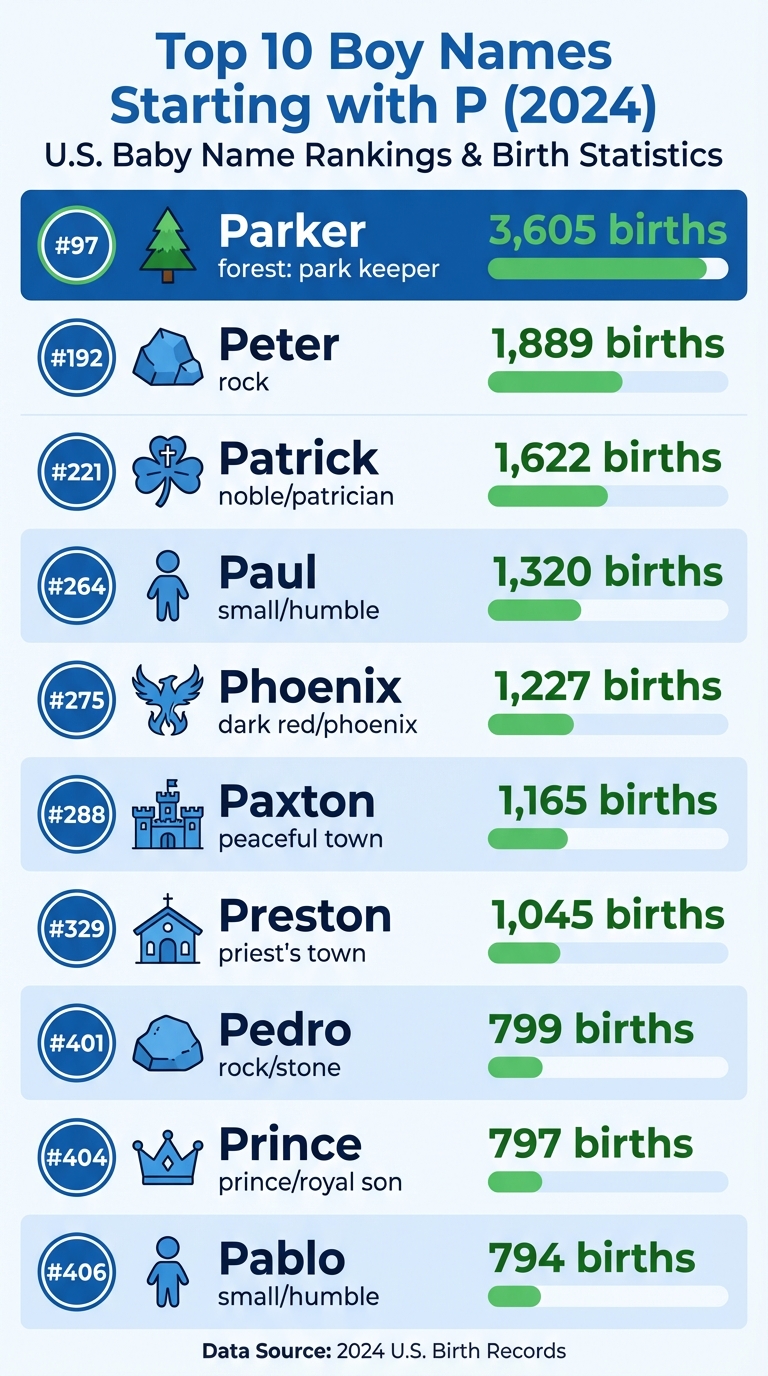
Top 10 Popular Boy Names Starting with P - 2024 Rankings and Birth Statistics
1. Parker
Meaning and Origin
Parker originates from Old English as an occupational surname, meaning "park keeper" or "keeper of the park." Historically, it referred to individuals who managed game parks for the nobility. Today, the name evokes a sense of nature and open green spaces, blending historical roots with a modern vibe.
Popularity Trends in the United States
In 2024, Parker stands as the #97 most popular boy name in the U.S., with 3,605 recorded births. The name has consistently held a spot in the Top 100 since 2009, reaching its highest rank at #72 in 2015. Its rise has been notable, climbing from #760 in 1980 to #127 by the year 2000.
Unisex Appeal
Though traditionally a boy's name, Parker has evolved into a gender-neutral choice. In 2024, it ranked #97 for boys and #104 for girls. Famous figures with the name include jazz icon Charlie Parker, actor Parker Stevenson, and reality TV personality Parker Schnabel.
sbb-itb-f13f980
2. Preston
Meaning and Origin
Preston comes from English roots, meaning "priest's estate." Originally a habitational surname tied to priestly lands, it has transitioned into a popular first name. This evolution reflects a growing trend in the U.S. of using surnames as given names, giving Preston a timeless appeal.
Popularity Trends in the United States
In 2024, Preston ranked #329 among boy names in the U.S., with 1,045 babies given the name that year. Its peak popularity came in 2007, when it reached #114, but it has gradually declined since. This drop in rank is part of a broader pattern seen in many names tied to specific cultural moments, such as Britney Spears naming her son Preston.
| Year | U.S. Rank | Usage % |
|---|---|---|
| 2024 | #329 | 0.057% |
| 2020 | #228 | 0.089% |
| 2015 | #169 | 0.120% |
| 2007 | #114 | 0.171% |
Data source:
Despite its decline, Preston continues to resonate with parents seeking a name with a mix of tradition and modernity.
Cultural Significance
Preston has left its mark in various spheres. Notable figures include Amazon founder Jeff Bezos and filmmaker Preston Sturges. The name has also made its way into pop culture, with characters like Preston Burke from Grey's Anatomy and Preston Scavo from Desperate Housewives adding to its recognition.
Gender-Specific Appeal
Preston remains a strong choice for boys, with minimal crossover into female naming trends. It hasn’t ranked in the top 1,000 names for girls, solidifying its identity as a predominantly male name. As of 2024, there are approximately 103,190 males named Preston in the U.S..
3. Phoenix
Meaning and Origin
The name Phoenix comes from the Greek word phoinix, which translates to "dark red" or "purplish-red." This term is tied to a red-dye plant and the mythical bird renowned for its ability to regenerate and rise from its own ashes. In both Greek and Egyptian mythology, the phoenix symbolizes immortality and renewal, making it a powerful and enduring figure across cultures.
Cultural Significance
The phoenix has captured imaginations for centuries, appearing in various traditions beyond Greek and Egyptian mythology. Similar "fire bird" legends exist in Persian and Chinese folklore. In early Christian teachings, the phoenix became a symbol of Christ's resurrection and the promise of eternal life.
Modern pop culture continues to embrace the phoenix's mystique. Think of Fawkes, Dumbledore's loyal companion in Harry Potter, or Jean Grey's "Phoenix Force" in Marvel Comics. These references keep the name relevant and layered with meaning for contemporary audiences.
Popularity Trends in the United States
In recent years, Phoenix has seen a steady rise in popularity in the U.S. For boys, it ranked #275 in 2024, with 1,227 newborns given the name that year. The name's growing appeal is evident in its average age - 9.8 years for males - showing that it's a relatively modern choice. By 2024, about 23,333 boys in the U.S. had been named Phoenix.
Among boy names starting with "P", Phoenix ranks 5th, following classics like Parker, Peter, Patrick, and Paul.
Unisex Appeal
While Phoenix is more commonly used for boys (#275), it also holds a solid spot for girls, ranking at #421. Its gender-neutral charm makes it a favorite for parents seeking a name that conveys strength and transformation. The phoenix's association with rising from challenges and embracing renewal resonates deeply with families who want a meaningful and empowering name for their child.
4. Paul
Meaning and Origin
The name Paul originates from the Latin family name Paulus, which means "small" or "humble". Its roots lie in the Latin adjective paulus (little) and connect to the Greek verb pauo, meaning "to stop" or "cease". These origins highlight its timeless charm and simplicity.
Paul’s most prominent association is with Saint Paul the Apostle, a pivotal figure in the New Testament known for spreading the teachings of Jesus. This connection gives the name a deep spiritual resonance, particularly for families who value humility and faith.
Cultural and Historical Significance
Paul has left its mark across religious, historical, and cultural landscapes. It has been borne by six popes and numerous saints, as well as historical figures like Paul Revere.
The name also adapts beautifully across languages: Pablo in Spanish, Paolo in Italian, Pavel in Russian, and Boulos in Arabic-speaking regions. Notable individuals with this name include Paul McCartney of The Beatles, actors Paul Rudd and Paul Newman, and artists Paul Cézanne and Paul Gauguin.
Popularity Trends in the United States
Paul enjoyed immense popularity in the U.S. during the 20th century. It consistently ranked among the top 20 boys’ names from 1900 to 1968, peaking at #12 in both 1930 and 1931.
However, its popularity began to wane after the 1960s. By 1991, it had dropped out of the top 50, and by 2001, it ranked #109. As of 2024, Paul stands at #264, with 1,320 baby boys named Paul that year. There are currently about 823,557 men named Paul living in the U.S., with an average age of 55.3 years. Among names starting with "P", Paul ranks as the 4th most popular based on 2024 birth data.
Though its usage has declined, Paul retains its appeal as a classic, vintage name. Its historical depth and modest meaning continue to attract parents who appreciate its understated charm.
Gender-Specific Appeal
Paul is traditionally a masculine name. However, it has feminine variations such as Paula, Paola, Pauline, and Paulette.
5. Paxton
Meaning and Origin
Paxton has roots in two distinct origins. The first comes from Old English, combining the personal name Pæcc with tun (meaning enclosure, farmstead, or town), translating to "Pæcc's farmstead". The second origin ties to Latin, where "pax" means peace, and when paired with the English suffix "-ton", it forms "peace town".
Originally used as a surname to identify families from the village of Paxton in Huntingdonshire, the name has been in recorded use since the 12th century, with various spellings documented over time. Today, Paxton carries a modern charm, particularly for its bold "X" and the tranquil nickname "Pax". This blend of historical depth and contemporary appeal has made it a standout in naming trends.
Popularity Trends in the United States
Paxton has steadily gained traction as a boy's name in the U.S., climbing the charts with its unique style. In 2024, it ranked #288, with 1,165 boys given the name, and it held the 6th spot among names starting with "P". Its surname-inspired, two-syllable structure - featuring the trendy "X" - puts it in the same league as names like Jaxon and Braxton. By January 2026, Nameberry placed Paxton at #766, with projections suggesting it could rise to #121 by 2028. For parents drawn to Paxton, similar names like Daxton, Preston, and Easton often come into consideration.
Unisex or Gender-Specific Appeal
While Paxton is predominantly used for boys, its usage for girls remains minimal. In 2024, it ranked #288 for boys but only #3,201 for girls. Notable figures bearing the name include NFL quarterback Paxton Lynch and actor Paxton Whitehead. The name also enjoys a presence in pop culture, appearing in characters like Paxton Powers from Batman Beyond and Andrew Paxton in The Proposal.
6. Prince
Meaning and Origin
The name Prince comes from the Latin word princeps, which translates to "royal son" or "royal sun". While alternative spellings like Prinze and Prynce exist, the traditional spelling remains the most widely used.
Cultural or Historical Significance
With its roots in nobility, Prince carries a sense of prestige and power. In the United States, the name is closely associated with the iconic musician Prince Rogers Nelson, whose legacy adds a layer of cultural depth. Beyond its pop culture ties, the name evokes imagery of nobility and leadership, often described as embodying "a true prince among men". As of 2024, about 19,504 individuals in the U.S. are named Prince, with an average age of 17.6 years. The name also reflects a broader trend of regal or title-inspired names gaining traction.
Popularity Trends in the United States
Over the last 20 years, Prince has seen consistent growth in popularity. In 2004, only 221 babies were given the name Prince, but by 2024, that number had risen sharply to 797 - nearly four times as many. The name reached its peak popularity in 2019 and currently ranks #404 among boy names in the U.S.. Among names starting with "P", Prince holds the ninth spot in 2024, following Parker (3,605 births) but surpassing Princeton, which had 464 births.
Unisex or Gender-Specific Appeal
Prince is overwhelmingly considered a masculine name, appearing exclusively in boy name databases. Its strong ties to royalty and its association with figures like Prince Rogers Nelson further solidify its appeal as a gender-specific choice. Parents often choose Prince for its bold, regal qualities paired with a modern, stylish flair.
7. Pablo
Meaning and Origin
Pablo is the Spanish variation of Paul, originating from the Latin word paulus, which translates to "small" or "humble."
Historical and Artistic Significance
Pablo carries a deep connection to Spanish and Latin American heritage. In the United States, it has remained a popular name within Hispanic communities for decades. The name also holds an artistic legacy through its association with Pablo Picasso, one of the most influential painters of the 20th century. As of early 2026, around 42,983 individuals in the U.S. are named Pablo, with an average age of 27.6 years.
Popularity Trends in the United States
Pablo reached its highest rank at #284 in 2005 but has seen a gradual decline since then. By 2024, it ranked #406 with 794 births and, as of early 2026, has dropped to #510 . Despite this downward trend, Pablo has consistently appeared in the U.S. Top 1000 baby names since at least 1880. Among names starting with "P", it ranked tenth in 2024 based on birth data.
Gender-Specific Usage
Pablo is almost exclusively used as a boy's name, emphasizing its strong, masculine identity. Its deep roots in Spanish-speaking cultures make it a meaningful choice for many parents, offering a timeless and distinguished alternative to the English name Paul.
8. Pedro
Meaning and Origin
Pedro is the Spanish and Portuguese version of Peter, derived from the Latin petra (Greek petros, meaning "stone" or "rock") and the Aramaic Kephas. Similar forms include Pierre in French, Pietro in Italian, and Boutros in Arabic. This rich linguistic background gives the name a strong historical foundation.
Cultural and Historical Significance
Pedro has played a prominent role in history, particularly in Europe and South America. It was the name of several monarchs, such as Pedro I through V of Portugal and Pedro I and II of Brazil. Pedro I of Brazil (1822–1831) is especially notable as the founder and first ruler of the Empire of Brazil. The name appears in literature too, with Don Pedro as the Prince of Arragon in Shakespeare's Much Ado About Nothing. In religious contexts, it is associated with saints like St. Pedro Calungsod and St. Pedro de San José de Betancur. In modern times, figures like actor Pedro Pascal, filmmaker Pedro Almodóvar, and baseball legend Pedro Martínez have carried the name into popular culture.
Popularity Trends in the United States
In the U.S., Pedro has remained a steady favorite over the years. It reached its peak at #188 in 1992. Although it dropped to #429 in 2021, the name has been making a comeback. By 2024, it climbed 18 spots to #401, with 799 recorded births. Among names starting with "P", it ranked eighth in 2024, showcasing its lasting appeal as a name that symbolizes strength and tradition.
Gender-Specific Usage
Pedro is exclusively used as a masculine name. Its deep connection to Spanish and Portuguese-speaking communities ensures its timelessness, making it a meaningful choice for parents looking for a name with historical and cultural depth.
9. Princeton
Meaning and Origin
The name Princeton, derived from an English surname meaning "princely town", brings a touch of sophistication and prestige. Its roots highlight a sense of nobility and grandeur.
Cultural and Historical Significance
Princeton is closely tied to Princeton University, one of the Ivy League schools in New Jersey, which adds an air of academic excellence and intellectual prestige to the name. This connection aligns with the growing popularity of using distinguished surnames as first names, a trend that often carries connotations of success and refinement.
Popularity Trends in the United States
In 2024, the name Princeton was given to 464 boys in the U.S., and about 9,728 individuals currently have this name. The average age of those named Princeton is 9.4 years, making it a relatively modern choice.
Gender-Specific Usage
Unlike names such as Parker or Phoenix, which are considered unisex, Princeton is exclusively used for boys in the United States.
10. Patrick
Meaning and Origin
The name Patrick comes from the Latin Patricius, which translates to "nobleman" or "patrician". This origin highlights its historical association with nobility and prestige.
Cultural and Historical Significance
Patrick is perhaps best known through its connection to St. Patrick, the 5th-century patron saint of Ireland. St. Patrick, a Romanized Briton, played a pivotal role in bringing Christianity to Ireland. For centuries, the name was so revered it was rarely used by laypeople. However, starting in the 17th century, it became more common as a tribute to the saint's legacy. Today, Patrick remains a familiar name in American culture, thanks to figures like NFL quarterback Patrick Mahomes and actors Patrick Dempsey, Patrick Stewart, and Patrick Wilson.
Popularity Trends in the United States
Patrick has enjoyed enduring appeal in the United States. It peaked in popularity during the mid-1960s, reaching #30 in 1964, 1967, and 1968. The name stayed within the Top 100 for nearly 70 years, from 1936 to 2004. While it has seen a gradual decline in recent years, Patrick ranked #221 in 2024, with 1,622 births recorded that year. Despite this drop, it remains the 3rd most popular boy name starting with "P" in the U.S..
Gender-Specific Usage
In the United States, Patrick is almost exclusively a boy's name. Popular nicknames include Pat, Rick, Paddy, and Patric, offering a variety of options for personalization. With its strong and classic appeal, Patrick pairs well with other timeless names.
11. Pierce
Meaning and Origin
Pierce is an English name that means "rock" and serves as a variant of Peter, which comes from a Greek word. Additionally, it originated as an English surname meaning "son of Piers", with Piers being a medieval version of Peter. This blend of historical and linguistic roots gives the name a timeless quality while offering a fresh twist on the classic Peter.
Cultural and Historical Significance
In American pop culture, Pierce is perhaps best recognized thanks to actor Pierce Brosnan, celebrated for his portrayal of James Bond. This association has given the name a polished and distinguished image. It’s often described as having a "strong, timeless feel" and a "straightforward charm", qualities that resonate with many modern parents.
Popularity Trends in the United States
Pierce has maintained a steady presence in U.S. baby name rankings over the years, though it has never broken into the top 100. The name peaked historically in 1886 at #383. After falling out of the top 1,000 between 1940 and 1983, it made a comeback in 1984 and has remained consistently ranked since. Its most recent high point was in 2013, when it reached #462. By 2024, it ranked #537, with 553 boys receiving the name that year - representing 0.030% of male births.
Gender-Specific Usage
In the U.S., Pierce is predominantly used for boys. Variations of the name include Pearce, Piers, and Pierson.
12. Peyton
Meaning and Origin
Peyton stems from an English surname that translates to "fighting man's estate" or "Poega's town." Some sources also attribute the Irish meaning of "Warrior's town" to the name. It is often considered a variant of Payton .
Historical and Popular References
Peyton’s rise in popularity has been influenced by notable figures and cultural mentions. NFL legend Peyton Manning is often credited with boosting its use as a boy’s name in the U.S. . Historically, Peyton Randolph, the first president of the U.S. Continental Congress, adds a layer of significance to the name. In popular media, it has appeared in the novel and TV series Peyton Place and on shows like One Tree Hill and CSI: NY.
Popularity Trends in the U.S.
The name Peyton hit its peak for boys in 2008, ranking #130. However, its popularity has declined over the years, falling to #658 in 2024 with 417 recorded births, making up about 0.023% of male births. Back in 2010, it ranked much higher at #148. This decline shows a clear shift in how the name is being used.
A Name for All Genders
Peyton is often seen as a gender-neutral name. Between 1880 and 2004, it was used almost equally for boys (49%) and girls (50%). However, recent data points to a growing preference for Peyton as a girl’s name. By 2024, it ranked #168 for girls, compared to #658 for boys. BabyCenter highlights this trend:
"While it's technically a unisex name – data shows it's now most commonly given to girls".
13. Percy
Meaning and Origin
Percy is an English surname that originates from the Norman town of Perci-en-Auge. Its roots may trace back to the Gaulish name Persius. The name is often interpreted as meaning "one who pierces the valley". Additionally, Percy is commonly used as a shortened form of Percival.
Cultural and Historical Significance
Percy holds a rich place in history and culture, stemming from its noble English roots. It was introduced to England during the Norman Conquest of the 11th century by the de Percy family, one of northern England's most influential houses. The name is also tied to notable figures like Romantic poet Percy Bysshe Shelley. More recently, it has gained attention in pop culture through Rick Riordan's Percy Jackson & The Olympians series and Percy Weasley from the Harry Potter franchise. Its association with literature and history lends it a timeless and refined appeal.
Popularity Trends in the United States
Percy's popularity has seen significant shifts over the years. It reached its height in the late 19th century, ranking #98 in 1897. However, the name gradually declined throughout the 20th century, falling to #216 by 1920 and #332 by 1950, before dropping out of the top 1,000 entirely after 1988, when it ranked #924. In 2024, the name saw a modest resurgence, with 157 baby boys named Percy in the United States, placing it at #1,257 - a jump of 301 spots from the previous year. This suggests a growing interest among parents in rediscovering classic names with historical significance.
14. Peter
Meaning and Origin
The name Peter comes from the Greek word Πέτρος (Petros), which translates to "stone." It has strong biblical ties, as it is the Greek equivalent of the Aramaic name Cephas, meaning "stone" as well. This name was given by Jesus to the apostle Simon to signify his pivotal role in the Christian church [52, 53]. The Normans introduced the name to England through its Old French form, Piers. By the 15th century, the spelling Peter replaced the earlier version.
Cultural and Historical Significance
Peter's origins help explain its lasting influence. As one of Jesus' 12 apostles, Peter holds a central place in Christianity. He is recognized as the leader of the apostles and was the first to witness Jesus' empty tomb. Tradition states that Peter was martyred in Rome between A.D. 64–67, choosing to be crucified upside down out of humility. Beyond its religious significance, the name has been associated with royalty in places like Aragon, Portugal, and Russia, with figures such as Russian Tsar Peter the Great standing out. In modern culture, characters like Peter Pan, Peter Rabbit, and Spider-Man’s Peter Parker have kept the name relevant and familiar.
Popularity Trends in the United States
Peter has maintained a steady presence in the U.S. baby name rankings. Impressively, it has never dropped out of the top 1,000 names since records began. It reached its highest rank at #31 in 1880 and remained strong, sitting at #37 by 1950. Over time, its popularity gradually declined, falling out of the top 100 in 1999 when it hit #105. In 2021, Peter ranked #215, but by 2024, it climbed back to #192 with 1,889 births [54, 5]. Thanks to its deep historical and religious roots, Peter continues to appeal to parents looking for a name with timeless significance.
15. Philip
Meaning and Origin
The name Philip comes from the Greek Philippos (Φίλιππος), which combines philos (meaning 'dear') and hippos (meaning 'horse'). This translates to 'fond of horses' or 'friend of horses' [57,58,60]. The name gained early recognition through figures like Philip II of Macedonia, the father of Alexander the Great. It also holds biblical importance, as Philip was both one of Jesus' twelve apostles and a figure known as Philip the Evangelist [57,60].
Cultural and Historical Significance
Philip has been a name of royalty for centuries, associated with six kings of both France and Spain. In more recent history, Prince Philip, Duke of Edinburgh (1921–2021), further cemented its association with tradition and prestige [57,60]. The name even influenced geography, with the Philippines named after King Philip II of Spain. In early American history, "King Philip" (Metacomet), a Wampanoag leader during King Philip's War (1675–1676), and Philip Hamilton, the eldest son of Alexander Hamilton, also carried this name.
Popularity Trends in the United States
Philip's popularity reflects its deep historical roots. It reached its peak at #52 in 1941 and was #53 in 1950. The name stayed in the top 100 from 1880 to 1988 but began to decline, ranking #255 in 2000, #403 in 2010, and #451 in 2020. By 2024, it had dropped to #521, with 586 births [59,5]. Despite its lower ranking, Philip remains a timeless choice. The alternative spelling "Phillip" (with two Ls) was used for 450 births in 2024.
16. Porter
Meaning and Origin
The name Porter has its roots in English and is tied to an occupational background. It comes from the French word for "doorkeeper" or "carrier", with additional influence from Latin origins. Historically, it described someone responsible for guarding gates or entrances, whether in towns or castles. This gives the name a sense of strength, dependability, and a connection to roles of service and protection.
Popularity Trends in the United States
Porter has had an interesting journey in terms of popularity. Back in 1880, it ranked at #273, but its usage steadily declined, eventually disappearing from the Top 1,000 between 1956 and 1998. However, it made a comeback in 1999 and reached its highest rank, #368, in 2014. As of 2024, Porter sits at #615, with 463 babies given the name that year, showing it continues to hold a steady presence.
Unisex or Gender-Specific Appeal
While Porter leans heavily toward being a masculine name - used about seven times more often for boys - it can also work as a gender-neutral middle name. In the U.S., it is primarily recognized as a boy's name. Some well-known individuals with this name include Cole Porter, Porter Wagoner, and Porter Robinson.
17. Penn
Meaning and Origin
The name Penn has English roots and translates to "enclosure", a term originally tied to fenced areas used for protecting animals. It carries a sense of security and stability, and with its clean, no-frills sound, it’s both strong and easy to remember.
Cultural or Historical Significance
Penn has found its way into modern pop culture, most notably through actor Penn Badgley. It aligns with the growing popularity of short, surname-inspired names for boys, offering a less conventional yet stylish alternative to more common picks. This niche appeal makes it stand out in a sea of trendier names.
Popularity Trends in the United States
Penn is not a widely chosen name across the country. As of January 2026, it held the #4,464 spot in national rankings. In 2024, only 42 babies were named Penn, making it far less common than names like Parker (3,605 births) or Peter (1,889 births). However, among baby boy names starting with "P", Penn still manages to secure a spot in the top 100. With an average age of 12.9 years among the 1,081 individuals named Penn in the U.S., it’s clear the name has a modern, understated charm that’s slowly gaining momentum.
Gender-Specific Appeal
In the U.S., Penn is overwhelmingly used for boys. While other "P" names - like Parker, Peyton, and Phoenix - are more commonly chosen for both genders, Penn has retained its distinctly masculine edge.
18. Palmer
Meaning and Origin
Palmer has roots in British and Old English traditions, with influences from Latin and Spanish. The name translates to "pilgrim", "he who holds the palm", "palm tree", or "carrying palm branches". Historically, it was a surname for those who completed a pilgrimage to the Holy Land, often returning with palm branches as a symbol of their journey. This connection ties the name to themes of travel and spiritual discovery.
Historical and Cultural Context
The name Palmer is deeply connected to medieval Christian pilgrimages, symbolizing a sense of exploration and introspection. Its historical significance has carried into modern times, where it evokes notions of worldliness and personal growth. Notable figures include legendary golfer Arnold Palmer and Laura Palmer, a character from the TV series Twin Peaks. These associations add depth to the name's contemporary appeal.
Popularity Trends in the United States
Between 1880 and 2004, Palmer appeared in the Top 1,000 names for boys 70 times but hasn’t ranked there since 1955. In 2024, only 202 boys were given the name, placing it at #1,076 in U.S. rankings. However, when considering both genders, Palmer ranks at #476 overall.
Unisex Appeal and Gender Trends
While Palmer was traditionally a boys' name from 1880 to 2004, it has seen a remarkable shift in recent years, becoming more popular for girls. In 2024, Palmer ranked #258 for girls, climbing 19 spots from the previous year. This shift highlights its growing appeal as a unisex name, marking it as one of the few names on this list to transition from predominantly male to female usage in contemporary times.
19. Phineas
Meaning and Origin
Phineas is a Hebrew name derived from Phinehas, often interpreted as meaning "the Nubian" or "bronze-colored one." This likely refers to the ancient Nubians, celebrated for their courage and strength. Other interpretations of the name include "oracle" and "snake's mouth", reflecting its diverse historical roots. Some scholars even propose Egyptian origins due to its ties to the Nubian people, adding another layer to its fascinating background.
Cultural and Historical Significance
Phineas carries deep biblical connections, linking it to religious and historical narratives that have persisted for centuries. In more recent times, the name has gained a modern twist, partly due to celebrity influence, such as its use by the O'Connell family. These factors have helped transform Phineas from a vintage relic into a trendy choice for contemporary parents.
Popularity Trends in the United States
Despite its rich history, Phineas remains a less common choice in the U.S. In 2024, only 114 boys were named Phineas, keeping it far outside the top 1,000 baby names. By early 2026, it ranked #2,631 in popularity. Notably, the name climbed 180 spots in 2024 compared to the previous year, showing a growing interest among parents looking for something distinctive yet classic. It offers a unique alternative to names like Parker and Patrick.
Gender-Specific Appeal
Phineas has consistently been used as a masculine name, as evidenced by major naming databases and historical records. Its enduring association with masculinity makes it a strong choice for parents seeking a name with both vintage charm and a clear gender identity.
20. Perry
Meaning and Origin
Perry is an English name that translates to "pear tree" or "dweller near a pear tree". Originally, it was a locational surname for individuals living near pear orchards. The name also has Welsh connections, where it can mean "son of Herry". Additionally, Perry is sometimes used as a shortened form of Peregrine or Percival.
Cultural and Historical Significance
Perry carries a mix of historical and pop culture relevance. Famous namesakes include actor Matthew Perry and singer Perry Como. Fictional characters such as Perry Mason and Perry White have also added to its recognition. This combination of real-life icons and fictional personas gives Perry a lasting presence across generations.
Popularity Trends in the United States
The name Perry saw its peak popularity in 1958–1959, reaching #132 on the charts. Its usage declined over the following decades, eventually dropping out of the top 1,000 after 2006. However, by early 2026, Perry made a modest comeback, ranking #964, with 160 boys given the name in 2024. Some experts believe its vintage charm could spark renewed interest in the coming years.
Unisex or Gender-Specific Appeal
Traditionally, Perry has been used primarily for boys, with around 99% of its usage being masculine in the U.S.. Recently, however, it has gained some traction as a gender-neutral option. For example, The Bump ranked Perry at #776 for boys and #1009 for girls in 2024. This shift reflects the growing trend of adopting surnames as unisex first names.
Conclusion
This list of 20 popular "P" names showcases a variety of meanings, origins, and styles. From timeless biblical choices like Peter and Paul to more modern options like Phoenix and Paxton, there’s a name to suit every preference.
These names reflect diverse roots, including Latin, Greek, English, Spanish, and Hebrew. Whether you're drawn to occupational names, nature-inspired options, or names that evoke strength and nobility, there’s something here to align with your family’s heritage and values.
When selecting a name, think about how it pairs with your surname and consider the initials it creates. Decide whether a vintage classic or a more modern choice feels right for your family’s identity. Exploring historical figures or notable associations tied to the name can also add depth to your decision.
Names starting with "P" strike a balance between being distinctive and familiar. Interestingly, no "P" name has cracked the top four most popular boy names in the U.S. since 1923, making it a choice that stands out without feeling uncommon. Choose a name that resonates with your family’s story and reflects the hopes you have for your son’s future.
FAQs
Why are names like Parker and Phoenix so popular for baby boys?
Names like Parker and Phoenix are gaining traction for baby boys, blending contemporary appeal with meaningful roots. Parker has a warm, approachable feel and consistently ranks among the top 100 boy names in the U.S., making it a favorite among parents looking for something stylish yet familiar. Meanwhile, Phoenix offers a distinctive edge, symbolizing rebirth and resilience - perfect for those who want a name with strong, symbolic significance.
These names capture a growing trend among parents: choosing names that balance classic charm with a modern twist.
How do history and culture shape the popularity of names like Paul and Pedro?
Names like Paul and Pedro carry deep historical and religious roots, shaping their enduring popularity. For instance, Paul has biblical origins, meaning "small" or "humble", and is closely associated with Saint Paul, a pivotal figure in early Christianity. This connection has kept the name relevant for centuries, especially in Christian communities.
Pedro, the Spanish equivalent of Peter, also has strong biblical ties. It is linked to Saint Peter, one of Jesus' apostles and a foundational figure in Christian tradition. The name remains particularly common in Spanish-speaking regions, where Catholic traditions and cultural heritage heavily influence naming choices. These rich historical and religious associations make names like Paul and Pedro resonate across generations and regions.
Why do some parents choose the name Phineas for their baby boy?
Parents are drawn to the name Phineas because it blends a timeless charm with a touch of individuality. With its historical and cultural roots, the name carries a sense of tradition while still standing out as fresh and memorable.
For many modern parents, Phineas resonates as a name with substance and significance, making it an elegant and meaningful option for their child.