Looking for boy names that start with “O”? Here’s a curated list of 10 names that combine history, meaning, and individuality. While Oliver and Owen are popular choices, names like Oberon, Octavio, and Otis offer something less common yet equally timeless. These names draw inspiration from mythology, nature, and literature, giving parents options that feel fresh yet rooted in history.
Key Highlights:
- Oberon: A Shakespearean name meaning “noble bear” with ties to mythology and astronomy.
- Octavio: A Latin-origin name meaning "eighth", reflecting strength and balance.
- Odell: An Old English name meaning "woad hill", connecting to nature and tradition.
- Ogden: Meaning "oak valley", it offers a grounded, nature-inspired choice.
- Oisín: A classic Irish name meaning "little deer", tied to Gaelic mythology.
- Olaf: A Norse name meaning "ancestor's descendant", rich in Viking history.
- Omari: A Swahili and Arabic name meaning "flourishing" or "long-lived."
- Orpheus: A Greek name symbolizing music and art, tied to ancient mythology.
- Orson: Derived from Latin, meaning "bear cub", blending strength and charm.
- Otis: An old-school favorite meaning "wealth" or "prosperity", now making a comeback.
Whether you’re drawn to mythology, nature, or vintage vibes, these names offer meaningful options beyond the usual choices.
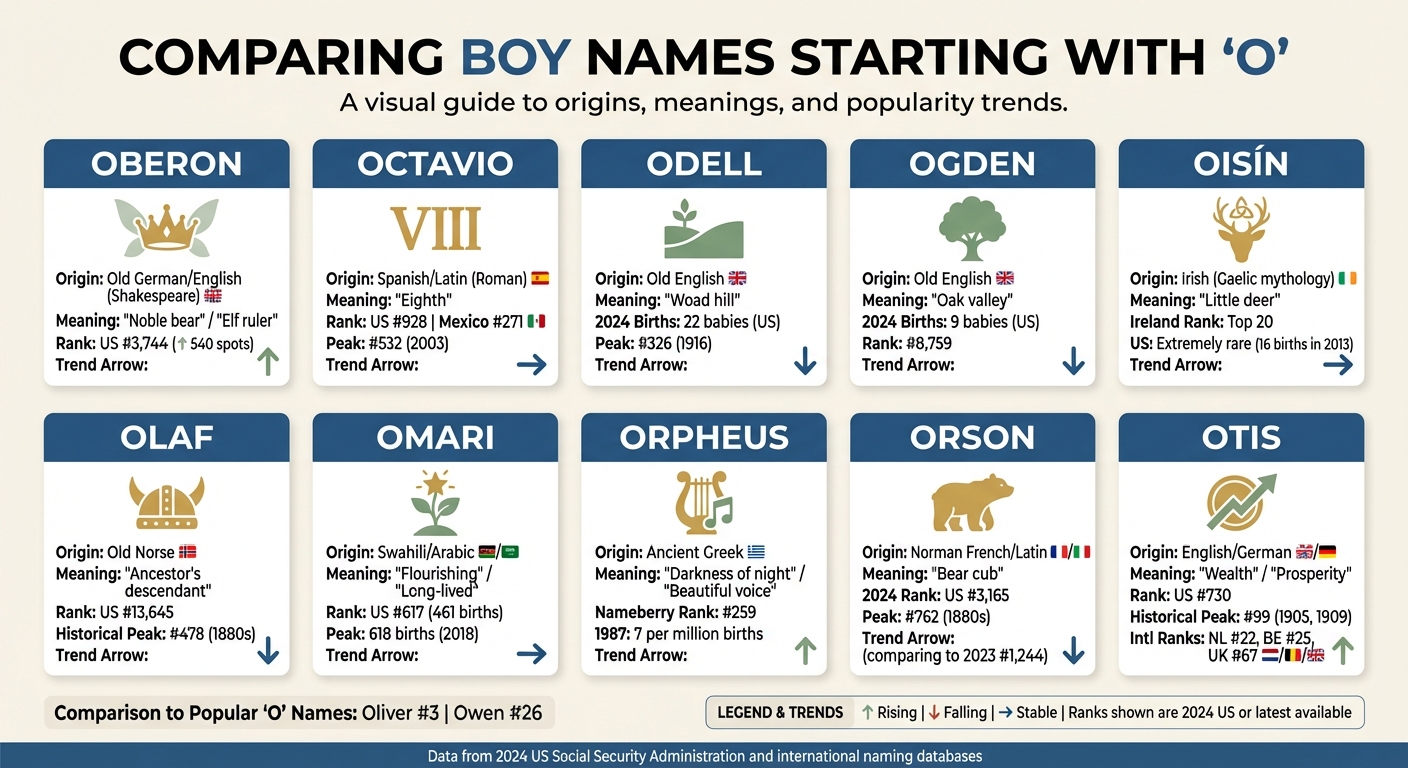
10 Unique Boy Names Starting with O: Origins, Meanings & Popularity Rankings
1. Oberon
Cultural Origin
The name Oberon has its roots in Old German (Alberich) and reached English through Old French (Auberon). It first appeared in English literature in the 13th-century epic Huon de Bordeaux, portraying Oberon as a strikingly handsome fairy king. Later, William Shakespeare immortalized the name in A Midsummer Night's Dream during the late 16th century, where Oberon reigns as the King of the Fairies.
Meaning or Symbolism
Oberon carries layered meanings. From Old High German, its elements adal (noble) and ber(n) (bear) give it the meaning "noble bear" or "royal bear". Additionally, its Germanic roots link it to "elf ruler" or "elf king". The name gained celestial significance when astronomer William Herschel named one of Uranus's moons Oberon on January 11, 1787.
Uniqueness
While names like Oliver and Owen dominate the charts, Oberon remains a rare choice. In 2024, it ranked #3,744 in U.S. births, a rise of 540 spots from the previous year, hinting at growing interest. Oberon offers a distinct blend of Shakespearean elegance, mythological wonder, and astronomical ties. Its modern appeal is bolstered by appearances in pop culture, such as the video game Warframe and the anime The Ancient Magus' Bride. This mix of literary, mythic, and cosmic charm makes Oberon a standout among names, especially for parents seeking something off the beaten path.
"As King of the Fairies, Oberon demands attention in Shakespeare's A Midsummer Night's Dream, and your little Oberon is sure to do the same." - Emma Lawler, Senior Content Writer, The Bump
sbb-itb-f13f980
2. Octavio
Cultural Origin
Octavio traces its roots to the Spanish adaptation of the Roman family name Octavius. This name carries historical weight, famously tied to Emperor Augustus. Variations like Ottavio in Italian and Otávio in Portuguese highlight its presence across different languages. In the U.S., it’s a favored choice among Hispanic families, though its appeal is steadily broadening.
Meaning or Symbolism
The name Octavio originates from the Latin word for "eighth." Traditionally, it was given to an eighth-born child or one born in October, the eighth month of the Roman calendar. This numerical tie brings associations with order, balance, strength, and prosperity.
Timelessness
Octavio bridges the historical with the contemporary. Figures like Nobel Prize-winning poet Octavio Paz add intellectual weight, while pop culture references, such as Octavio "Octane" Silva from Apex Legends, keep it relevant today. This blend of ancient significance and modern recognition makes Octavio stand out among other O names.
Uniqueness
Octavio reached its peak popularity in the U.S. in 2003 at #532 but has since become a more distinctive choice, currently ranking at #928. In Mexico, the name is more common, sitting at #271. Its Roman heritage and modern "-io" ending make it a stylish alternative to names like Leo and Mateo.
"Octavia and Octavio are two Spanish baby names that are moving out into the wider world." - Clare Green, Nameberry
3. Odell
Cultural Origin
Odell traces its origins to Old English, starting as a surname and place name in Bedfordshire, England. Its history dates back to the 11th or 12th century, when it was used to describe people living near a specific hill or village. One notable early figure, Odell de Deyncourt, was a Norman knight who received land in Lincolnshire after the Norman Conquest of 1066. Over time, surnames like Odell transitioned into use as first names, carrying with them a sense of history and tradition.
Meaning or Symbolism
The name Odell stems from Old English, combining wad (a plant used to create blue dye) and hyll (hill), which translates to "woad hill." Another interpretation ties the name to ideas of wealth and courage. Both meanings reflect a connection to nature and the English countryside, giving Odell a grounded, earthy feel. This name embodies qualities of strength, maturity, and refinement.
Timelessness
Odell’s rich history has helped it maintain relevance through the years. For example, Odell Shepard, an American poet and professor, earned a Pulitzer Prize in 1938 for his biography Pedlar's Progress: The Life of Bronson Alcott. More recently, British singer-songwriter Tom Odell brought fresh attention to the name with his hit song "Another Love." In the U.S., Odell experienced its peak popularity between 1920 and 1929, reaching its highest rank at #326 in 1916.
Uniqueness
In modern times, Odell remains a rare choice. In 2024, only 22 male babies in the United States were named Odell, keeping it well outside the top 1,000 names. However, NFL star Odell Beckham Jr. has given the name a contemporary edge, making it an appealing option for parents who appreciate English heritage with a touch of athletic charisma.
4. Ogden
Cultural Origin
The name Ogden has its roots in Old English and Anglo-Saxon traditions, originally serving as a locational surname for families living in oak-filled valleys. It first appeared in records as "Oggedene" in the Domesday Book of 1086. Ogden was particularly common in Northern England, especially in regions like Lancashire and Yorkshire, before it evolved into a given name. Prominent figures in fields such as law, military, and literature helped popularize it over time [33,34].
Meaning or Symbolism
Ogden combines the Old English words ac (oak) and denu (valley), translating to “oak valley” [33,38]. While many names starting with "O" carry literary or mythological connotations, Ogden stands out for its connection to the natural world. Its imagery of a sturdy oak tree and a tranquil valley suggests strength, resilience, and a serene beauty. Modern interpretations often tie Ogden to qualities like endurance and a profound connection to nature. This symbolism has helped the name maintain its charm across generations.
Timelessness
Ogden saw its peak in popularity in 1912, marking the year with the highest number of births bearing the name. Its recognition was further enhanced by figures such as Ogden Nash (1902–1971), a poet celebrated for his clever and whimsical verses, including the well-known line, "Candy is Dandy" [34,35].
Uniqueness
In today’s world, Ogden is a rare yet intriguing choice. In 2024, only nine male babies in the United States were named Ogden, placing it at #8,759 on the popularity charts - a drop of 2,644 spots from the previous year [34,37]. Despite its rarity, Ogden appeals to parents drawn to names that blend nature-inspired meanings with a vintage, sophisticated feel. As Isolde Quirante, Assistant Editor at The Bump, puts it:
"Ogden is a boy's name of Old English origin, meaning 'oak valley.' If you're any bit of a bookworm, you'll love Ogden for its connections to American poet Ogden Nash".
The name also aligns with the trend of two-syllable, surname-style names ending in "n", adding to its subtle appeal.
5. Oisin
Cultural Origin
Oisín is a classic Irish name deeply tied to Gaelic mythology and the Fenian Cycle. In Irish legend, Oisín is the son of the famed warrior Fionn mac Cumhaill and the goddess Sadhbh, giving him a dual identity as both a poet and a fighter. The name gained broader literary recognition in the 18th century thanks to James Macpherson's "Ossian" poems. Today, Oisín is gaining attention beyond Ireland, blending its historical roots with modern appeal.
Meaning or Symbolism
The name Oisín comes from the Irish word os (deer) and the diminutive suffix -ín, meaning "little deer." According to legend, Oisín’s mother was transformed into a deer by a druid, adding a layer of nature-inspired mystique to the name. Oisín is also remembered for his mythical journey to Tír na nÓg, the "Land of Youth", where he spent 300 years without aging - a story that reinforces the name’s connection to timelessness and adventure.
Timelessness
Oisín has long been a favorite in Ireland, consistently ranking among the top 20 boys' names since 2017. It even reached #8 in 2016 and was the 12th most popular name in 2021 [44, 45]. Between 1964 and 2019, nearly 9,000 boys in Ireland were named Oisín, while in England, about 1,000 boys have received the name over the last 25 years. The traditional pronunciation, "OSH-een", is sometimes adapted to "Osheen" or "Ossian" for easier use by non-Irish speakers. This enduring popularity highlights how Oisín bridges tradition and modern naming trends.
Uniqueness
While Oisín is well-loved in Ireland, it remains incredibly rare in the United States. In 2013, only 16 boys out of nearly two million male births were given the name. Clare Green of Nameberry notes, "Pronounced correctly, this name has an attractive sheen". Meanwhile, Laura Wattenberg, founder of Namerology, points out, "If you choose an 'O' name that isn't Owen or Oliver, it's probably going to be unusual". With its distinct pronunciation and rich Irish heritage, Oisín offers parents a truly original and meaningful choice.
6. Olaf
Cultural Origin
The name Olaf traces its roots back to the Old Norse Áleifr (or Ólafr). It’s a Scandinavian name that spread widely across Europe, thanks to the Vikings. They introduced it to England, and it later found a place in Gaelic traditions. Notably, five Norwegian kings carried the name, including Saint Olaf, Norway's patron saint. Today, in Norway, Olav is typically reserved for royalty, while Olaf is more commonly used among the general population. This rich history gives Olaf a timeless and storied character.
Meaning or Symbolism
Olaf translates to "ancestor's descendant" or "family heirloom." It combines the Old Norse elements anu (ancestor) and leif (inheritance or legacy). As Behind the Name explains:
"From the Old Norse name Áleifr meaning 'ancestor's descendant', derived from the elements anu 'ancestor' and leif 'inheritance, legacy'"
This meaning highlights a deep connection to family heritage and the importance of continuity. It’s a name that carries the weight of ancestry and tradition - qualities that resonate with many parents who choose it for their child.
Timelessness
Olaf had its moment of popularity in the United States during the 1880s, peaking at #478 on the baby name charts - a trend influenced by Scandinavian immigrants. By 1908, it had dropped slightly to #533, representing 0.014% of baby boys born that year. While its usage has dwindled in modern times, falling to #13,645 in 2024, Olaf's historical significance remains intact.
The name has also gained modern recognition through prominent figures like Olaf Scholz, the German Chancellor since 2021, and Disney’s Frozen, which brought Olaf the snowman into the global spotlight in November 2013.
Uniqueness
In the United States today, Olaf is extremely rare, with only 7 occurrences per million births in 2025. This rarity makes it a compelling choice for parents looking for something distinctive yet rooted in history. Adding to its appeal is its global versatility, with over 23 variants, including Olof (Swedish), Oluf (Danish), Ólafur (Icelandic), and Olavi (Finnish).
Although many now associate the name with Disney’s cheerful snowman, Olaf retains its strong, regal qualities and historical depth. For families who value heritage and want a name that stands out, Olaf offers a meaningful blend of tradition and individuality.
7. Omari
Cultural Origin
Omari has roots in both Swahili and Arabic, serving as a Swahili adaptation of Umar or Omar [60, 62]. It’s widely used in East African countries like Tanzania and Kenya [60, 66]. In the U.S., the name has gained traction among African-American and Muslim communities and also has Hebrew ties through the name Omri [60, 61, 62, 63]. These multicultural origins give Omari a rich and layered background.
Evelyn Grace Donovan, Assistant Editor at Name.baby, captures its essence perfectly:
"Omari offers a quietly confident choice - one that whispers longevity and prosperity while keeping a modern, worldly beat."
Meaning or Symbolism
In Swahili, Omari translates to "flourishing", while in Arabic, it signifies "long-lived" or "thriving" [60, 61]. The Hebrew interpretation, "speaker", adds another dimension [62, 63]. Together, these meanings evoke themes of growth, vitality, and leadership. The name also resonates with the African philosophy of ubuntu - “I am because we are” - emphasizing community and interconnectedness. This depth of meaning makes Omari a name that inspires strength and purpose [62, 63].
Timelessness
Omari’s diverse heritage is matched by its steady rise in popularity. It first appeared in the U.S. top 1,000 names in 1996 and has steadily gained recognition since. The name peaked in 2018 with 618 recorded births and, by 2024, ranked #617 with 461 male births [64, 60, 61]. Its prominence has been bolstered by figures like actor Omari Hardwick, known for his role as James "Ghost" St. Patrick in Power (2014–2020) [60, 61, 63]. Even Kanye West bears Omari as his middle name. Across the Atlantic, Omari reached #370 in England and Wales in 2021, reflecting its international appeal.
Uniqueness
Omari stands out with its rhythmic, three-syllable structure (oh-MAH-ree), setting it apart from more common two-syllable names [64, 67]. Around 97% of individuals named Omari are male, and its relative rarity offers parents a name that feels both familiar and distinctive. It’s often described as “exotic yet simple,” striking a balance that works in both formal and casual settings [60, 67]. Mama Natural captures its appeal well:
"Omari is a regal and powerful name that's sure to never go out of style. With its majestic and confident sound, this name is a great choice for parents looking for a name that's both versatile and timeless."
8. Orpheus
Cultural Origin
Orpheus hails from Ancient Greek mythology, celebrated as one of the greatest musicians and poets of all time. Traditionally, he is said to be the son of Calliope, the Muse of epic poetry, and King Oeagrus of Thrace. Beyond his unmatched musical abilities, Orpheus joined the Argonauts on their journey, using his music to guide Jason and his crew past the Sirens' deadly song. He is also associated with Orphism, a mystery religion in ancient Greece that focused on the purification of the soul and beliefs in reincarnation.
Meaning or Symbolism
The name Orpheus is thought to come from the Greek word orphne, meaning "darkness of night", though some interpretations suggest it could mean "beautiful voice." He symbolizes the extraordinary power of art and music - his songs were said to move not only people but also animals, trees, and even stones. As Pindar once wrote, Orpheus was "the father of songs." For parents who treasure creativity and artistic expression, Orpheus carries a deep and enduring resonance.
Timelessness
The legend of Orpheus has captivated imaginations for over two thousand years. His story has inspired countless works, from the poetry of Virgil and Ovid to operas by Monteverdi and Gluck. In recent years, his myth has continued to find new life in modern productions like the Broadway hit Hadestown and the video game Persona 3. As of February 2026, Orpheus ranks #259 on Nameberry, showing its steady appeal.
Uniqueness
In the United States, Orpheus remains a bold and rare name. In 1987, only seven babies per million were given this name, highlighting its distinctiveness. Pamela Redmond perfectly captures its charm:
"Name of the legendary ancient Greek poet and musician - whose music was so beautiful it made trees dance and rivers stop to listen - would provide a child with a challenging but indelible identity."
For parents seeking a name that stands out while carrying a rich artistic and mythological heritage, Orpheus is a striking choice. It offers a refreshing alternative among boy names starting with "O", blending timeless myth with creative inspiration.
9. Orson
Orson is a name that intertwines historical depth with a touch of natural charm, making it a standout choice among names starting with O.
Origin and History
The name Orson traces back to Norman French, derived from "ors", which comes from the Latin word ursus, meaning bear. It entered the English language after the Norman Conquest, evolving from a nickname to a surname and eventually a first name. Orson is also tied to the medieval tale of Valentine and Orson, where Orson, abandoned in the woods, is raised by a bear - a story that highlights themes of survival and strength.
Meaning and Symbolism
Orson translates to "bear cub" or "little bear", embodying qualities like courage, protection, and resilience. The name also carries a celestial nuance, thanks to its connection with the bear constellations, blending earthy strength with a hint of cosmic wonder.
Historical and Cultural Significance
Orson reached its peak popularity in the United States during the 1880s, ranking at #762. It gained broader recognition through Orson Welles, the legendary filmmaker behind Citizen Kane. More recently, the name has appeared in pop culture with characters like Orson Krennic in Rogue One: A Star Wars Story and Orson Hodge in Desperate Housewives. Renowned author Orson Scott Card, known for Ender's Game, has also kept the name in the public eye.
Modern Appeal
Despite its historical roots, Orson remains rare today. In 2023, it ranked #1,244 nationally, with its highest recent popularity in 2019, when 105 babies per million were given the name. By 2024, it had dropped to #3,165. While it shares the "-son" ending with more common names like Mason or Carson, Orson retains a unique, understated elegance that makes it a sophisticated and distinctive choice.
10. Otis
Otis wraps up our list with a name that seamlessly blends an old-school vibe with a modern edge. It’s one of those names that feels both classic and fresh, making it a standout choice.
Origins and Background
The name Otis has its roots in English, originally derived from medieval forms of the German name Otto. In American history, it’s tied to James Otis (1725–1783), a Revolutionary War figure known for the famous phrase, "taxation without representation is tyranny." Beyond that, Otis also has Greek origins, where it translates to "one who hears well." Interestingly, in Kenya, the Luo tribe uses Otis as a nickname for Otieno, adding another layer to its global story [89, 93, 94].
Meaning and Significance
Otis carries the Germanic meaning of "wealth", "fortune", or "prosperity", symbolizing success and abundance [89, 95]. From a Greek perspective, it’s linked to keen listening and attentiveness. As MomsWhoThink puts it:
"Otis is a powerful name for boys that is direct and commanding".
A Name That Endures
Otis enjoyed peak popularity in the U.S. during the early 1900s, hitting #99 in both 1905 and 1909. After falling out of the Top 1000 between 1995 and 2014, it made a comeback in 2015. As of 2024, it ranks at #730 in the U.S. and has gained traction in Europe, where it holds #22 in the Netherlands, #25 in Belgium, and #67 in England.
Why Otis Stands Out
The charm of Otis lies in its ability to feel both familiar and uncommon. It’s forever tied to the soulful legacy of Otis Redding and the innovative genius of Elisha Graves Otis, who invented the elevator safety brake [89, 92]. Celebrities have also embraced the name, such as Olivia Wilde and Jason Sudeikis, who named their son Otis Alexander in 2014, giving it a modern spotlight. The Netflix series Sex Education has further cemented its cool factor, with protagonist Otis Milburn bringing the name to a new generation [90, 93]. As Pamela Redmond from Nameberry highlights:
"Otis has real appeal for parents attracted to its catchy O initial and combination of strength and spunk".
Conclusion
Names starting with "O" offer an incredible variety, from the mythical charm of Oberon and Orpheus to grounded options like Ogden and Orson. Each name carries its own story - whether it's the Irish warrior-poet roots of Oisin, the Swahili depth of Omari, or the Scandinavian strength of Olaf. These names bring with them meanings as diverse as prosperity (Otis), nobility (Oberon), and flourishing (Omari), giving parents a rich palette of values to consider.
While Oliver and Owen dominate the popularity charts at #3 and #26 respectively, names like Octavio, Odell, and Otis offer a refreshing twist. They manage to stand out in a crowd without feeling too unfamiliar, making them great choices for parents who want something distinctive yet approachable. This balance between uniqueness and tradition aligns perfectly with current naming trends.
Nature-inspired options such as Ogden ("oak valley") and Orson ("bear cub") resonate with the rising interest in earthy, grounded names. At the same time, mythological names like Orpheus and Oberon are seeing renewed interest, and vintage picks like Otis are making a comeback, now ranked at #730 in U.S. name charts after years of obscurity.
Whether you're drawn to a name for its heritage, meaning, or sound, the decision ultimately reflects your family's story. Maybe you love the built-in nickname potential of Ozzy for Otis, or perhaps you prefer a name that stands strong on its own. Whatever your choice, the right "O" name will capture your family's values and aspirations beautifully.
FAQs
What are some cultural origins of boy names that start with O?
Many boy names beginning with 'O' carry rich and diverse histories. Take Obadiah, for instance - it has roots in biblical tradition and holds deep religious meaning. Then there's Omar, an Arabic name that translates to "flourishing" or "life", commonly found across the Middle East and North Africa. Another standout is Othello, tied to Italian origins and immortalized through Shakespeare's works.
Names like Oslo, borrowing inspiration from Norway's capital, showcase Scandinavian influence and are gaining traction among modern parents. These examples reflect the worldwide variety of 'O' names, offering parents meaningful, timeless options with a global touch.
Why do the meanings of 'O' names make them so appealing?
Boy names starting with 'O' often carry meanings that are both meaningful and appealing, reflecting qualities or values that many parents cherish. For example, Oak represents strength and honesty, while Oakland brings to mind a connection to nature and a sense of stability. Popular choices like Oliver (which means "olive tree" or "elf army") and Owen (interpreted as "youth" or "yew tree") are loved for their ties to ideas of peace, vitality, and growth.
For those looking for something less common, names like Obadiah, with its biblical origins, offer a timeless and deeply meaningful option. These thoughtful meanings often guide parents in selecting names that resonate with their aspirations and values for their child.
Why might parents choose uncommon 'O' names instead of popular ones like Oliver or Owen?
Many parents lean towards less common 'O' names to give their child a name that feels more distinctive and memorable. While classics like Oliver and Owen remain popular, their widespread use can make them feel a bit ordinary.
By choosing names like Ozzy, Otto, or Oslo, parents can embrace something more original and meaningful. These names often come with ties to history, culture, or personal significance, helping them stand out while carrying a deeper connection. Picking a name that's less common highlights a parent's wish to celebrate individuality and give their child a name that feels truly special.