Boy names starting with "I" are gaining traction for their blend of historical depth and modern appeal. Here are 10 names that stand out:
- Isaac: A timeless name meaning "laughter", ranked #40 in 2024.
- Ian: A sleek, Scottish name meaning "God is gracious", ranked #75 in 2024.
- Isaiah: A biblical favorite meaning "God saves", ranked #56 in 2024.
- Ibrahim: Revered in Abrahamic faiths, meaning "father of many."
- Iker: A Basque name meaning "visitation", popularized by soccer star Iker Casillas.
- Idris: Rooted in Arabic and Welsh traditions, symbolizing intellect and leadership.
- Ivan: A Slavic classic meaning "God is gracious", popular globally.
- Ilan: A Hebrew name meaning "tree", symbolizing growth and resilience.
- Ignatius: Latin for "fiery one", with strong Christian roots.
- Izaiah: A modern twist on Isaiah, offering a bold, distinctive spelling.
These names balance meaning, history, and a modern edge, making them a great choice for parents seeking something special.
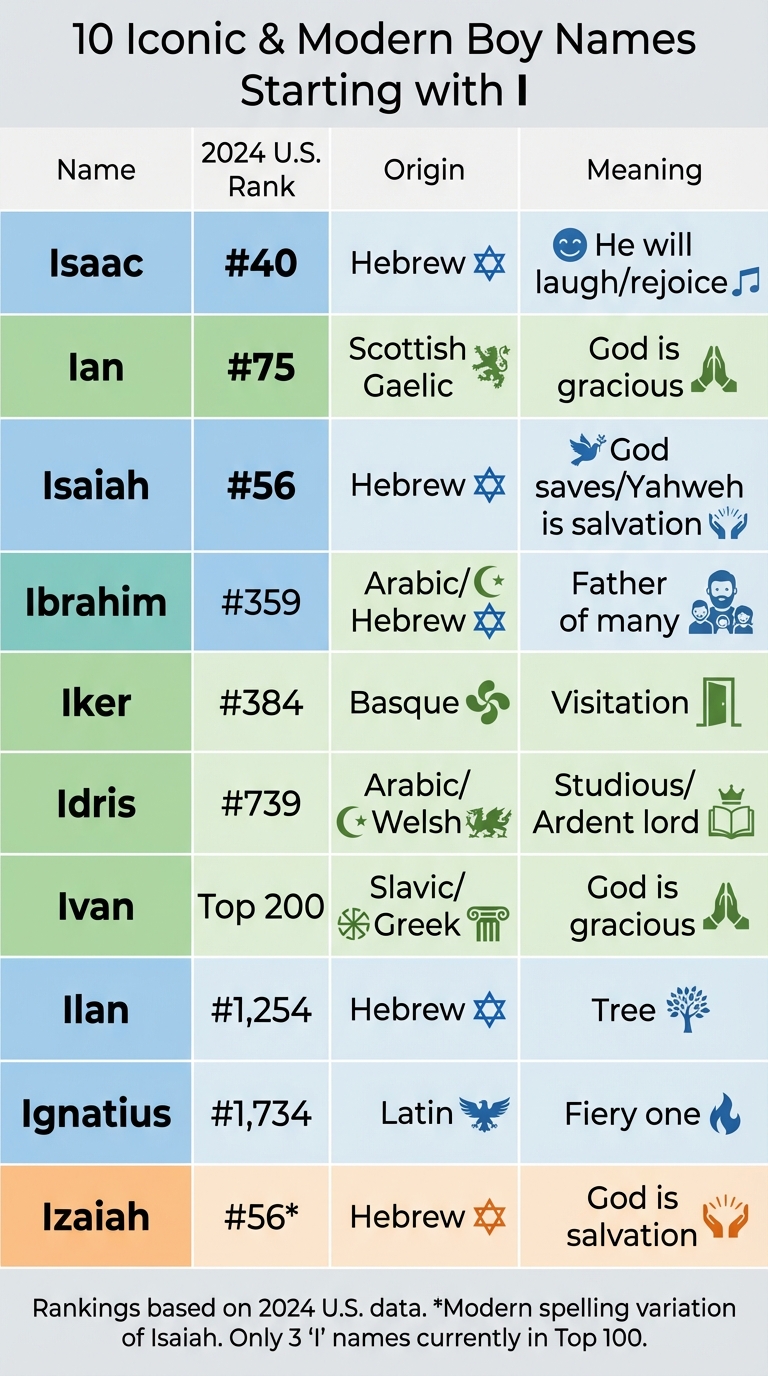
Top 10 Boy Names Starting with I: Rankings, Origins & Meanings
1. Isaac
Cultural significance and origins
The name Isaac comes from the Hebrew Yitzhak and holds a prominent place in Judaism, Christianity, and Islam. In the Bible, Isaac is one of the three patriarchs, born to Abraham and Sarah in a story filled with joyful disbelief - a reflection of the name's meaning. In Islamic tradition, he is recognized as the prophet Ishaq. The name has shown consistent popularity in the U.S., staying in the top 50 since 2001. In 2024, it ranks at #40, with 6,907 births recorded in 2021.
Meaning and symbolism
Isaac translates to "he will laugh" or "he will rejoice." Naming expert Abby Sandel highlights its unique connection to happiness:
Many names mean joy or happiness, but few names are so directly tied to laughter.
The name also carries profound symbolism through the biblical story of the Binding of Isaac, which represents unwavering faith and obedience. This combination of joy and historical depth makes Isaac a name that resonates on many levels.
Modern appeal and timelessness
Isaac’s enduring charm lies in its ability to balance its rich historical roots with a modern flair. Its versatility shines through in a variety of nicknames, from the classic Ike to the trendy Izzy or Zac. The name also gains recognition through iconic figures like Sir Isaac Newton and Isaac Asimov, further cementing its timeless appeal.
2. Ian
Origins and Cultural Roots
Ian is the Scottish Gaelic version of John, tracing its lineage back to the Hebrew name Yohanan, which passed through Latin as Iohannes. While deeply tied to Scotland, Ian has enjoyed widespread appeal, maintaining a spot in the U.S. Top 100 since 1982. By 2024, it ranked at #75 in popularity. This name is part of a global network of variations, including Ivan (Russian), Juan (Spanish), Giovanni (Italian), and Hans (German), all sharing a common origin. Its history and connections give Ian a sense of depth and universal charm.
Meaning and Symbolism
The name Ian translates to "God is gracious" or "the Lord is gracious", embodying qualities like kindness, intelligence, and honor. Sarah Vanbuskirk describes it as:
Ian is a strong but sweet name that also evokes a sense of whimsy and charm.
Beyond its literal definition, Ian carries an aura of compassion and sensitivity. Its Scottish roots lend a historical richness, yet it avoids feeling overly tied to the past.
Timeless Appeal in Modern Times
Ian’s short, three-letter structure aligns perfectly with today’s preference for sleek, minimalist names. While it reached its peak U.S. ranking at #65 in 2003, its consistent popularity over decades highlights its lasting relevance. Prominent figures like Ian Fleming, Sir Ian McKellen, and Ian Malcolm further emphasize its cultural significance. Vanbuskirk captures its essence by noting:
imbued with a sense of history and Scottish heritage while also feeling fresh and lively.
Ian remains a name that bridges history and modernity, offering both elegance and approachability.
3. Isaiah
Cultural Significance and Origins
The name Isaiah comes from the Hebrew Yeshayahu, which translates to "God saves." It is famously associated with the 8th-century prophet whose writings hold a key place in biblical tradition. In Christian circles, Isaiah is often referred to as the "Fifth Evangelist" because his prophecies vividly describe Christ's life and mission. Jerome once noted how Isaiah's writings beautifully capture the mysteries of Christ's church.
Though ancient in origin, Isaiah didn’t gain traction as an English Christian name until after the Protestant Reformation. Today, it ranks #56 in U.S. births and holds the #4 spot in places like American Samoa, Guam, the Northern Mariana Islands, and the U.S. Virgin Islands. Over the past two decades, it has consistently remained in the U.S. Top 100, rising from a modest position in the 1970s to its current popularity. This rich history adds to its enduring appeal and symbolic power.
Meaning and Symbolism
Isaiah means "Yahweh is salvation," a name deeply tied to themes of strength, perseverance, and hope. As a theophoric name, it incorporates the name of a deity, symbolizing divine protection and guidance. The prophet Isaiah himself is remembered for his truthfulness, compassion, and diplomacy - qualities that resonate with parents looking for a name with both depth and meaning.
Modern Appeal and Timelessness
Isaiah strikes a balance between its deep biblical roots and a contemporary feel. Its three-syllable rhythm and soft "-a" ending make it a natural fit alongside other popular names like Elijah and Luca. Carmen Elena Vasquez, Assistant Editor at Name.baby, describes it perfectly:
Isaiah mixes sacred roots with street-smart style, a perfect blend of halo and high-five, ready to navigate life with energy and optimism.
The name's versatility is another draw for modern parents. Options like Zay, Izzy, Iz, and Ike offer playful, energetic nicknames while preserving the dignity of the full name. Well-known figures such as NBA star Isaiah Thomas and actor Isaiah Mustafa highlight the name's cross-generational appeal. Celebrities like Carrie Underwood, Christina Milian, and Elisabeth Hasselbeck have also chosen Isaiah for their children, further cementing its reputation as a name that blends timeless tradition with contemporary charm. Like other popular "I" names, Isaiah effortlessly bridges the gap between heritage and modern style.
4. Ibrahim
Cultural Significance and Origins
Ibrahim, the Arabic form of the Hebrew name Abraham, holds a central role in the Abrahamic faiths. In Islam, he is revered as a prophet in the Quran, celebrated for his steadfast faith and devotion to God. Known as Khalīl Allāh, or "Friend of God", Ibrahim's legacy resonates deeply in religious and cultural traditions. This profound significance has made the name a staple across the Middle East and North Africa, while its popularity continues to grow in Western countries.
In 2022, Ibrahim reappeared in the Top 100 baby names in the United Kingdom and currently ranks #27 in France, #35 in Belgium, and #77 in England. In the United States, the name entered the Top 1000 in the 1990s, reached its peak at #389 in 2017, and now holds the #359 spot. Its blend of tradition and a modern, international appeal makes Ibrahim a standout choice today.
Meaning and Symbolism
The name Ibrahim translates to "father of many", symbolizing strength, leadership, and the continuation of family lines. Beyond its direct meaning, it represents virtues like courage and generosity. Its four-syllable pronunciation (ee‑BRAH‑heem) carries a sense of both grace and approachability.
Modern Appeal and Timelessness
Ibrahim bridges a rich historical legacy with a modern, global presence. Its deep-rooted meaning complements a contemporary flair, making it a name that feels both grounded and stylish. With a sound that is at once dynamic and dignified, Ibrahim fits seamlessly into multicultural environments. Prominent individuals like Zlatan Ibrahimovic and Anwar Ibrahim highlight its global resonance. As one of the fastest-climbing boy names in 2024, Ibrahim's rising popularity in France, the Netherlands, and the UK reflects a growing admiration for names that combine historical significance with modern sophistication.
5. Iker
Cultural Significance and Origins
Iker is a name deeply rooted in Basque heritage, originally crafted by Basque writer and linguist Sabino Arana. In his 1910 book Deun-Ixendegi Euzkotarra, Arana introduced Iker as a Basque equivalent to the Spanish name Visitación, which refers to the biblical Visitation - when the Virgin Mary visited her cousin Elizabeth. This effort was part of a broader movement to create distinctly Basque versions of traditional names.
The name gained global traction thanks to Iker Casillas, whose fame skyrocketed after Spain's 2010 World Cup victory. Casillas’ influence turned Iker from a regional favorite into an internationally recognized name. In the United States, it made a dramatic leap of over 250 chart positions between 2010 and 2011. Since 2002, more than 30,587 newborns in Spain have been named Iker, highlighting its growing popularity and cultural resonance.
Meaning and Symbolism
Iker carries the meaning of "visitation" and is also linked to the idea of being a "bearer of good news". This connection to religious themes underscores ideas of faith, connection, and community. Staying true to its Basque roots, the name is pronounced EE-kehr.
Modern Appeal and Timelessness
Iker’s charm lies in its blend of simplicity and cultural depth. Its two-syllable structure aligns with modern naming trends, while its Basque heritage gives it a distinct identity. The name reached its peak popularity in the U.S. in 2015, with 2,176 baby boys given the name that year. For 2024, it ranks at #384 in the United States. Internationally, it holds the #56 spot in Spain and #74 in Mexico, reflecting its strong appeal in Hispanic communities.
For parents looking for a name that combines athletic energy with a rich cultural story, Iker offers a perfect balance of contemporary style and historical roots. It’s a name that feels both modern and timeless, carrying the essence of Basque tradition while appealing to a global audience.
6. Idris
Cultural Significance and Origins
Idris stands out as a name with dual origins, rooted in both Arabic and Welsh traditions. In Arabic, Idris is a prophet mentioned in the Qur'an, often associated with the Biblical figure Enoch. Known for his trustworthiness and patience, he is also credited with advancing early writing. The name comes from the Arabic root darasa, meaning "to study" or "to learn."
In Welsh lore, Idris is tied to Idris Gawr ("Idris the Giant"), a 7th-century giant king who observed the stars from Cadair Idris ("Idris's Chair"). These origins weave together themes of intellect, leadership, and exploration, making Idris a name rich in history and meaning.
Meaning and Symbolism
In Arabic, Idris translates to "studious" or "interpreter", reflecting intelligence and a connection to the divine. The Welsh interpretation combines udd (lord) and ris (ardent), often interpreted as "ardent lord" or "fiery leader." This dual heritage allows the name to carry both the wisdom of a scholar and the passion of a leader.
"The name speaks of profound learning and divine connection, underlined by its associations with royalty and spiritual authority." - NamingQuest
With such layered meanings, Idris appeals to parents looking for a name that bridges intellect, spirituality, and leadership.
Modern Appeal and Timelessness
Idris manages to balance its ancient roots with a modern, approachable sound. British actor Idris Elba has brought the name into the spotlight, enhancing its contemporary charm. In 2024, Idris ranked #739 in the United States, climbing 49 spots from the previous year. Its popularity is even stronger in England and Wales, where it ranked #153.
The name’s concise, two-syllable structure aligns with current naming trends, while its historical depth - from prophetic traditions to Welsh mythology - ensures it remains timeless. Idris has also made appearances in pop culture, featuring in Doctor Who and The Mortal Instruments series, further cementing its relevance in the modern era.
sbb-itb-f13f980
7. Ivan
Cultural Significance and Origins
Ivan stands out as a name with both historical depth and modern relevance. It's a Slavic version of the Greek name Iōánnēs (John), which itself originates from the Hebrew Yôḥānnān. This lineage highlights its widespread use and appeal across different cultures. Historically, Ivan has held significant weight in Eastern Europe, particularly with figures like Ivan III and Ivan IV. In Bulgarian history, the name is even more prominent, with nine emperors bearing it.
In Russian culture, Ivan is often seen as a representation of the "common man." By 2013, it was the most popular male name in Bulgaria and Croatia, further cementing its place in the cultural fabric of these regions.
Meaning and Symbolism
The name Ivan carries the meaning "God is gracious" or "God has shown favor". This spiritual undertone has given it a timeless quality, resonating with parents across generations who value its connection to divine kindness and favor.
Modern Appeal and Timelessness
Ivan's enduring charm lies in its ability to bridge the past and the present. In the United States, it reached its highest popularity at #113 in 2012 and continues to stay within the top 200. Its concise, two-syllable structure fits well with today’s preference for strong, straightforward names.
The name is also tied to influential figures like Ivan Pavlov, known for his groundbreaking work in physiology, and tennis legend Ivan Lendl. Pop culture has played its part in keeping Ivan relevant, with mentions in The One and Only Ivan and the hit series Stranger Things. Since the 20th century, Ivan has also gained popularity in Romance-speaking countries like Italy, Spain, and Portugal, showcasing its adaptability across languages and cultures.
8. Ilan
Cultural Significance and Origins
The name Ilan comes from Hebrew and translates to "tree." It has deep roots in Jewish tradition, often given to boys born on Tu B'Shevat, the 15th day of the Jewish month of Shevat. This day, known as the "New Year for Trees", marks a turning point in Israel's agricultural calendar, when winter rains give way to the fruit-bearing cycle of trees. Over time, Tu B'Shevat has also become a day focused on ecological awareness, particularly tree planting, giving the name a modern connection to nature and conservation. This mix of ancient tradition and contemporary relevance makes Ilan a notable choice.
The name also shares a connection with the biblical name Alon, meaning "oak", which is often associated with strength and righteousness. While its origins are ancient, Ilan has taken on a Latin-inspired rhythm in the Americas, evoking the lush imagery of tropical landscapes in regions like the Caribbean and Mexico.
Meaning and Symbolism
Ilan stands for growth, resilience, and strength - qualities mirrored in the steadfast nature of trees. Mariana Castillo Morales, Assistant Editor at Name.baby, describes it beautifully:
Ilan springs from the Hebrew word for 'tree,' and the name extends like a branch toward new beginnings, illustrating an ageless journey.
The name is often seen as a balance between grounding roots and aspirational growth, symbolizing stability and ambition in equal measure.
Modern Appeal and Timelessness
In the United States, Ilan has steadily gained popularity, moving from #2,311 in 2000 to #1,254 in 2023, with a peak of 153 per million babies. It enjoys particular popularity in Puerto Rico, where it ranked #58, and in Switzerland, where it reached #158 in 2021. Its simple, nature-inspired sound resonates with current naming trends that favor botanical and earthy themes.
Notable individuals bearing the name include Ilan Ramon, the first Israeli astronaut who flew aboard the Space Shuttle Columbia in 2003, and Ilan Hall, winner of Top Chef's second season in 2007. With such a rich history and modern relevance, Ilan continues to stand tall as a name with enduring appeal. Up next, dive into another intriguing I-name with its own unique story.
9. Ignatius
Cultural Significance and Origins
The name Ignatius has its roots in ancient Rome, evolving from the Etruscan name Egnatius. Over time, it became linked to the Latin word ignis, which means "fire". This name carries a rich Christian heritage, thanks to two prominent saints: St. Ignatius of Antioch, an early martyr and disciple of the Apostle John, and St. Ignatius of Loyola, the 16th-century founder of the Jesuit order. Its legacy is reflected in over 47 variations, including Ignacio, Ignaz, and Ignacy.
In the United States, Ignatius enjoyed its peak popularity between 1910 and 1919, reaching #638 on the charts. Though it fell out of favor for much of the 20th century, the name is now making a comeback. This revival highlights its enduring appeal and historical depth.
Meaning and Symbolism
Ignatius translates to "fiery one" or "ardent", embodying energy, passion, and spiritual intensity. Sophie Kihm, Editor at Nameberry, explains its modern charm:
With its fiery qualities, Ignatius might just fit in with Blaze, Griffin, Ember, or Atticus.
This association with fire resonates with parents who want a name that conveys strength and intensity. In 2023, around 90 boys in the United States were named Ignatius. By 2024, it climbed to #1,734 on the popularity charts, jumping 79 spots from the previous year.
Modern Appeal and Timelessness
Ignatius combines its fiery symbolism with an academic elegance, offering a versatile charm through nicknames like Iggy, Nash, and Nate. Its mix of ancient dignity and contemporary flair makes it an excellent choice for parents seeking a name that stands out while carrying a sense of history and style.
10. Izaiah
Cultural Significance and Origins
Izaiah is a modern Americanized variation of Isaiah (Yeshayahu), a name rooted in Hebrew. It combines yasha (to save) and yah (God), creating a name that reflects deep spiritual significance. The name honors the Prophet Isaiah, a pivotal figure in Judaism, Christianity, and Islam. His prophecies are central to the Hebrew Bible and are interpreted by Christians as predicting the Messiah. Despite the traditional spelling being about twelve times more common, Izaiah still holds a strong position, ranking #56 among U.S. baby names as of February 3, 2026.
The rise of the "Izaiah" spelling began in the late 20th century, first appearing on American naming charts in 1998. By replacing the "S" with a "Z", this version gives the name a modern, bold edge, appealing to parents who want something distinctive yet tied to tradition.
Meaning and Symbolism
The name Izaiah translates to "God is salvation" or "Yahweh is salvation", carrying a message of hope, deliverance, and spiritual guidance. As NamingQuest describes:
The name Izaiah carries a modern twist on a classic, suggesting innovation and creativity.
In numerology, Izaiah aligns with the "Number Nine" personality, which represents compassion, a humanitarian outlook, and a drive to improve the world. This deeper symbolism reinforces the name's association with faith, resilience, and optimism.
Modern Appeal and Timelessness
Izaiah strikes a balance between honoring religious heritage and embracing a contemporary, unique identity. Its distinct spelling enhances its modern charm, while nicknames like Izzy, Zay, or Ziah offer playful, approachable options. This blend of tradition and individuality makes Izaiah a name that feels both meaningful and fresh.
Using NameHatch to Find More I-Names
If you're looking for even more boy names starting with "I", NameHatch makes the process easier than ever. This tool combines AI-powered recommendations with over 20 years of baby name preference data to suggest names tailored to your style. Whether you lean toward timeless classics, modern trends, or global influences, NameHatch adapts to your unique preferences.
The app’s swipe-based interface feels like a dating app but for baby names. You can quickly browse through thousands of options, swiping right on the ones you love. When both you and your partner swipe right on the same name, it’s instantly saved to a shared match list, cutting down on those lengthy back-and-forth discussions. Plus, you can invite friends and family to join in and help you narrow down the options.
NameHatch works seamlessly across devices - use the mobile app for quick swiping on the go, or access the desktop version for better management of your favorites and preferences. The free version gives you 30 swipes with basic filters, but upgrading to Premium unlocks unlimited swipes and advanced features for $7/month or $29 for six months (a 30% discount).
Whether you're considering biblical names like Isaac or Isaiah, international picks like Iker or Ibrahim, or modern spellings like Izaiah, NameHatch's filters and AI suggestions make it easy to find names that match your vision. Forget endless scrolling through generic baby name sites - explore, swipe, and save names effortlessly as you blend tradition with modern convenience.
Conclusion
These 10 "I" names blend timeless charm with a touch of modern style. From enduring biblical choices like Isaac and Isaiah that remain in the top 100 to international gems like Iker and Ibrahim, each name carries its own unique flair. The list balances historical depth with fresh takes, such as Izaiah, offering a modern spin on a classic.
What makes these names stand out is their ability to cross cultural and generational boundaries. Whether you're drawn to the straightforward elegance of Ian, the strong Slavic roots of Ivan, or the fiery Latin vibe of Ignatius, there’s something here for every naming preference. And with only three "I" names currently ranking in the U.S. top 100, your choice will feel special without being overly uncommon.
If you're searching for even more ideas, NameHatch's AI-powered tool can help you discover names tailored to your specific tastes. With options to filter by meaning, origin, or style - whether biblical, global, or modern - you can explore countless possibilities that align with what matters most to you.
Ultimately, the right name is the one that feels just right for you. These 10 names are just the beginning, combining the reliability of classics with the freshness of contemporary trends.
FAQs
What is the origin and meaning of the name Idris?
The name Idris carries significance in both Welsh and Arabic traditions. In Welsh, it translates to "ardent lord", embodying qualities of passion and leadership. In Arabic, it is associated with a prophet mentioned in the Qur'an and means "interpreter" or "studious", highlighting traits of wisdom and learning. This blend of origins gives Idris a deep and layered history.
What’s the difference between the names Izaiah and Isaiah?
Izaiah is a modern take on the classic name Isaiah, which means "Yahweh is salvation." While Isaiah has strong biblical roots and a timeless appeal, Izaiah brings a more current, youthful vibe to the table. Both names share the same deep meaning but suit different tastes when it comes to naming styles.
Why are boy names that start with 'I' becoming more popular?
Boy names starting with 'I' are gaining attention because they blend timeless charm with a touch of modern flair. Names like Isaac and Ian stand out for their strong biblical and historical roots, making them enduring classics. On the other hand, choices such as Idris, Ivo, and Inigo bring a global vibe that feels fresh yet still easy to embrace.
Many parents today are searching for names that feel both meaningful and distinct. 'I' names often come with deep cultural backgrounds and versatile pronunciations, making them appealing across different preferences. Whether you're after something traditional or leaning toward something more contemporary, 'I' names offer plenty of great options.