Choosing a baby name takes time - on average, parents spend 5.08 months (about 20 weeks) deciding. While some pick a name before conception (12%), others wait until after birth (25%). Factors like partner disagreements, family traditions, cultural considerations, and even waiting to meet the baby can impact the timeline. Most parents finalize the name in the second trimester (33%) or third trimester (25%).
Key stats:
- 23 hours: Average time spent researching names.
- 42%: Parents who wait to meet the baby before deciding.
- 46%: Grandmothers are the most vocal critics of name choices.
To simplify the process:
- Set clear criteria (e.g., origin, meaning, sound).
- Use tools like naming apps for collaboration.
- Avoid sharing the name early to reduce external pressure.
Ultimately, trust your instincts and remember that the name you choose will grow with your child.
How Long Does It Usually Take to Choose a Baby Name?
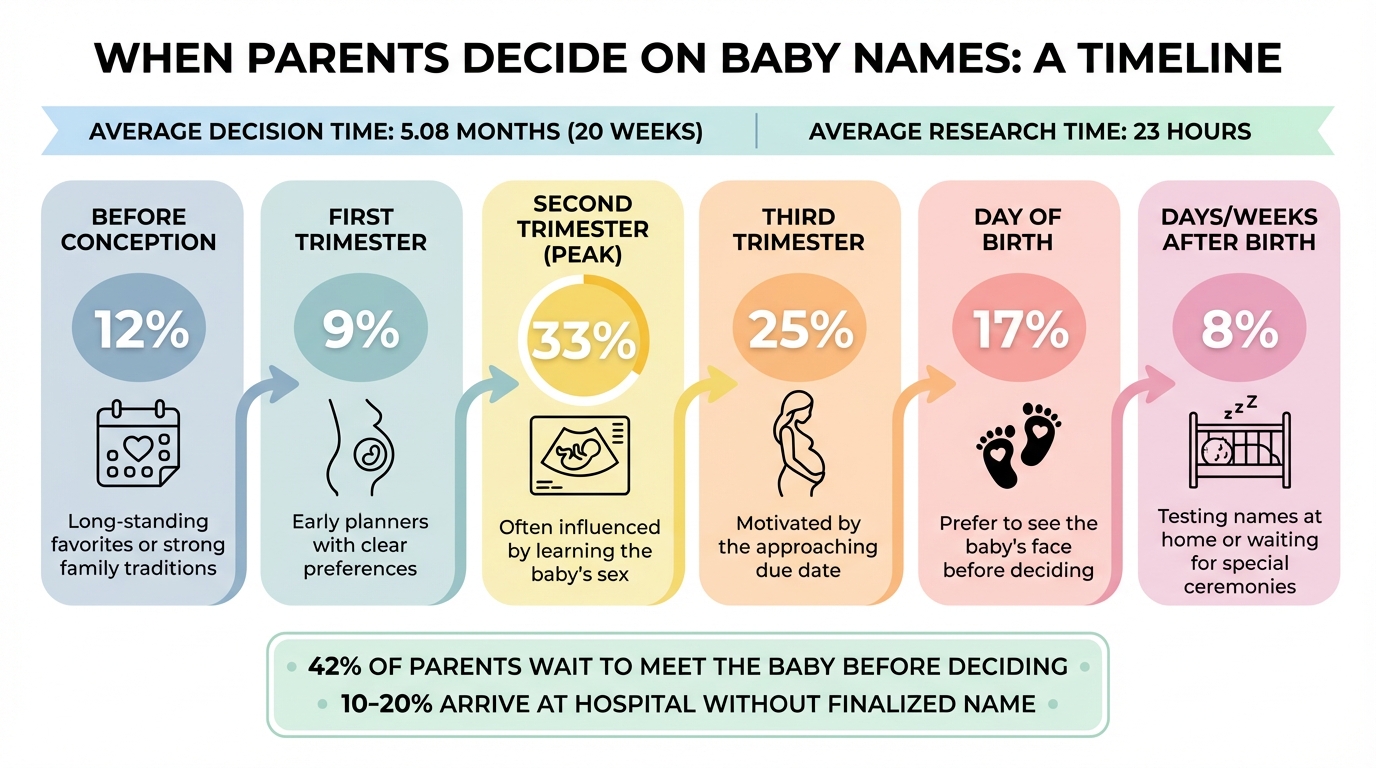
Baby Name Decision Timeline: When Parents Choose Names
The time it takes to pick a baby name can vary significantly from one family to another. On average, parents spend about 5.08 months deciding, though the timeline can range from years before conception to weeks after the baby is born. Research shows that parents dedicate roughly 23 hours to exploring and researching potential names.
When parents finalize their decision also follows some interesting trends. Around 33% of parents settle on a name during the second trimester, often after learning the baby’s sex. About 25% wait until the third trimester, while another 25% don’t finalize the name until after birth. On the extremes, 12% of parents choose a name before conception, and 9% decide during the first trimester.
What Affects the Timeline?
Several factors can influence how long it takes for parents to decide on a name. For instance, partner collaboration plays a big role. If one parent leans toward traditional names while the other prefers something more modern or unusual, finding common ground can take time. Similarly, cultural and religious traditions can either speed up the process by providing clear guidelines or slow it down when expectations clash.
Family involvement often adds another layer of complexity. While 58% of babies are given a family name as either their first or middle name, this tradition doesn’t always align with the parents’ personal preferences. In fact, 25% of parents report feeling pressured to consider names they dislike, and 9% ultimately choose a name they initially didn’t like due to such pressure. Interestingly, when parents face criticism about their choice, 46% say the baby’s grandmother is the most vocal critic.
Another factor is the desire to wait until meeting the baby. 42% of parents prefer to see their child before finalizing a name, believing that their baby’s appearance or personality might guide the decision. Additionally, names with cultural significance or those that work across multiple languages - chosen by 20% and 14% of parents respectively - often require extra thought and research.
These factors all contribute to the variety in how and when parents make their final decision, as outlined in the following timeline.
Typical Timeframes for Different Parents
Here’s a closer look at when parents tend to decide on a name and the characteristics of each group:
| Timing of Decision | Percentage of Parents | Common Characteristics |
|---|---|---|
| Before Conception | 12% | Long-standing favorites or strong family traditions |
| First Trimester | 9% | Early planners with clear preferences |
| Second Trimester | 33% | Often influenced by learning the baby’s sex |
| Third Trimester | 25% | Motivated by the approaching due date |
| Day of Birth | 17% | Prefer to see the baby’s face before deciding |
| Days/Weeks After Birth | 8% | Testing names at home or waiting for special ceremonies |
Parents who decide early - whether before conception or in the first trimester - often have a name they’ve loved for years or are honoring family traditions. The second trimester sees the highest percentage of decisions, usually prompted by ultrasound results revealing the baby’s sex.
For those who wait until the third trimester or later, the delay often stems from needing more time to agree on a name or ensuring it works across different languages and cultures. Interestingly, 10–20% of parents arrive at the hospital without a name finalized, preferring to try out a shortlist once the baby is born. As Sophia Khim, CEO of Nameberry, explains:
"I think one of the biggest contributing factors to name regret is really feeling rushed at the end."
sbb-itb-f13f980
What Affects How Long the Decision Takes
When it comes to choosing a baby name, some parents make their decision in minutes, while others take months of contemplation. Several factors can either speed up or slow down the process, shaping the journey to finding a meaningful name.
What Makes the Process Faster
Certain elements can make naming a baby a quicker task. For instance, having a long-time favorite name or following a family tradition significantly reduces decision time. About 11% of parents choose names they've loved since childhood, while others rely on traditions like naming the firstborn son after a paternal grandfather or using suffixes like "Junior" or "III" to honor family members.
Knowing the baby's sex early also simplifies things by narrowing the focus to either boys' or girls' names, instead of juggling two lists. Additionally, parents who prepare a shortlist of two or three names beforehand often finalize their decision more quickly than those searching for a single "perfect" name.
But what about the factors that can slow things down? Let’s explore those next.
What Makes the Process Longer
Perfectionism can drag out the naming process, as some parents chase the idea of a "perfect" name that may not exist. Disagreements between partners also create delays, especially when one prefers trendy names while the other leans toward more traditional options. Reaching a consensus in such cases can be tricky.
Another common hurdle is over-analyzing. Parents may spend endless hours researching how popular a name is or browsing through exhaustive name lists online, which only prolongs the decision. Adding extra layers of criteria - like ensuring the name works in multiple languages or meets an extensive checklist - can make the process even more complicated.
Post-birth changes also play a role. Hormonal shifts or "postpartum brain" can lead some parents to suddenly dislike a name they had previously chosen. This contributes to about 40% of baby name consultations being related to name regret.
External influences can further complicate matters, as shown below.
How Personal and Social Pressures Affect Decisions
Outside opinions often make naming decisions more challenging. Around 33% of parents-to-be receive negative feedback about their name choice, with grandmothers being among the most vocal critics. To avoid this, many parents choose to keep their decision private until the baby is born.
Concerns about "name-thievery" also affect timing. Some parents fear that sharing their chosen name too early might inspire others to use it first. This is why 64% of parents announce their baby’s name during pregnancy, while 31% wait until after the birth.
Etiquette expert Diane Gottsman offers this advice:
"If you have a name that's really special to you, hedge your bets and don't share it ― because someone is going to hear it and even subconsciously save it."
Cultural and religious expectations add yet another layer of complexity. Seeking approval from elders or adhering to specific naming ceremonies can significantly extend the decision-making timeline.
How to Speed Up the Name Selection Process
Feeling overwhelmed by endless name options? You’re not alone. But there are smart ways to move from browsing to deciding without dragging out the process. Here’s how to make naming simpler and faster.
Define Your Must-Haves
Start by locking in 3–5 key criteria that matter most to you. These might include:
- Cultural origin: Honoring heritage, like Irish or Italian roots.
- Meaning: Choosing names that symbolize strength (like "Liam") or nature (like "Evelyn").
- Length: Deciding between short names like "Ava" or longer ones like "Sebastian."
- Sound: Considering how the name flows or pairs with a last name.
This step narrows your options from thousands to a manageable 20–30 contenders.
For a practical approach, you and your partner can each list your must-haves, then score potential names on a 1–10 scale for each criterion. Toss out any name that scores below a 7. This scoring system helps cut through indecision and keeps things focused.
Work Together as Partners
Once you’ve set your criteria, teamwork is key. Collaborate with your partner using structured methods like:
- Shared pros-and-cons lists
- Mutual vetoes
- Ranking top choices
These techniques can save you months of back-and-forth. For instance, one couple vetoed trendy "Liam" variants, agreeing on the less common "Elias" in just a few weeks. The goal is to reach a decision efficiently while keeping the process enjoyable.
Use Baby Name Tools to Reduce Decision Fatigue
Modern tools can do some of the heavy lifting for you. Around 15% of surveyed parents use naming apps to speed up their search. One popular option is NameHatch, which uses a swipe-based interface - similar to dating apps. Swipe right to save names you like, left to discard the ones you don’t. This gamified method cuts down on the mental exhaustion of endless scrolling.
NameHatch also syncs with your partner’s choices. Both parents swipe independently, and the app automatically compiles a shared list of names you both like. This way, discussions start with mutual favorites, avoiding unnecessary debates. Additional features like filtering by style (Soft, Strong, Vintage), culture, or popularity - and even an initials matcher to avoid awkward acronyms - make the process even smoother. A free trial is available before subscribing.
How to Overcome Common Naming Challenges
Choosing a baby name can be tricky. In fact, nearly half of all parents face disagreements with their partner during the naming process. Add in opinions from family and friends, and it can quickly become overwhelming. To make things easier, here are some practical ways to tackle common naming challenges.
How to Resolve Partner Disagreements
If you and your partner can't see eye to eye, try approaching the conversation as a team effort. Lizzette Potthoff, a clinical social worker, suggests:
"Approach the situation as partners trying to solve a problem, rather than adversaries blaming each other".
Active listening is key. Show your partner you're hearing them by summarizing their concerns (e.g., "I understand you prefer names that aren't too trendy"). This can help foster mutual understanding.
You might also try structured methods to narrow down options. For example, each partner can create a list of names, swap lists, cross off the ones they dislike, and then rank the remaining names. If you're still at a standstill, consider dividing the responsibility - one partner picks the first name, and the other chooses the middle name. Planning for multiple kids? Take turns naming them.
How to Handle Family and Social Pressure
External opinions can complicate things even more. Family members might push for certain names, or you might worry about others' reactions. A simple solution? Keep your chosen name private until after the baby is born[9, 22, 23]. This avoids "name-thievery" (when someone unknowingly uses your name choice) and shields you from unsolicited critiques that might make you second-guess yourself.
If a legacy name is being heavily pushed, consider using it as a middle name. This honors family traditions while letting you and your partner choose a first name that feels right. When relatives offer suggestions, listen courteously to make them feel involved, but remember the decision ultimately belongs to you and your partner[21, 22]. Also, avoid asking for opinions on social media - just one negative comment can lead to weeks of uncertainty.
How to Feel Confident in Your Final Choice
It's natural to have doubts, but rest assured that children grow into their names. Baby name expert Laura Wattenberg reminds us:
"Popular just means well liked. No child's life was ruined by having a popular name".
If you're worried about a name being too trendy or too unusual, try the "test drive" method. Picture yourself calling the name at a playground or seeing it written on a diploma.
Still feeling stuck? Take a break from name discussions for a few weeks and revisit the topic with a fresh perspective. Some parents prefer to wait until meeting their baby to decide if the name feels like the right fit[9, 21]. And here's some reassurance: 91% of parents say they'd choose the same name again. Trust that the name you pick with love will be the perfect one.
How to Make Your Final Decision
After plenty of discussion and research, it's time to commit to a name and stop second-guessing yourself. Once you've narrowed down your options and worked through any challenges, it's time to make the final call.
How to Know When You've Found the Right Name
The right name might not hit you like a lightning bolt. As Lauren Barth, Associate Content Director at The Bump, puts it:
"It can be a slow and steady burn instead of an epiphany".
Some parents feel an instant connection to a name, while others find that the right choice grows on them over time.
A helpful approach is to test the name in real-life scenarios. Try saying the full name out loud to check its flow. Use the "coffee shop test" by imagining yourself calling out the name in public, or the "resume test" by picturing it on a business card. Check the initials to avoid any awkward acronyms, and think about potential nicknames. If you're using NameHatch's swipe feature with your partner, take note of the names that consistently stand out.
Once you've done these tests, the next step is deciding when to lock in your choice.
When to Decide: Early or After Birth
There's no single "right time" to finalize a name. Statistics show that about 33% of parents decide during the second trimester, 25% in the third trimester, and another 25% wait until after birth. Deciding early can reduce stress and help with planning, but it might also attract unsolicited opinions. On the other hand, waiting until after birth allows you to see if the name suits your baby's appearance and personality - though making a decision while sleep-deprived can be tough.
If you're unsure, consider bringing a shortlist of two or three names to the hospital so you can "test" them after meeting your baby. As Sophia Khim, CEO of Nameberry, advises:
"I think one of the biggest contributing factors to name regret is really feeling rushed at the end".
Keep in mind, you're not obligated to name your baby before leaving the hospital. Grace periods for naming vary by state - Texas and New Jersey allow 5 days, while North Carolina gives you 10 days. If no name is chosen within the legal timeframe, the birth certificate might be filed with a placeholder like "Baby Boy" or "Baby Girl" along with the mother's last name. This can be updated later.
Mistakes to Avoid in the Final Stages
As you approach the finish line, here are some common pitfalls to steer clear of.
One big mistake is overthinking every detail. While it's smart to check initials and test how a name sounds, overanalyzing can lead to decision paralysis. Another misstep is sharing your final choice too early. Doing so can invite unwanted opinions, so it’s often best to keep the decision between you and your partner until it’s official.
Don’t dismiss a name just because it’s popular. Popularity often reflects broad appeal, and that’s not necessarily a bad thing.
Lastly, avoid choosing a name solely to appease family traditions or external pressure. Research from Scotland revealed that 33% of parents regretted their child’s name, with 20% admitting they let others’ opinions sway them. Ultimately, your child will grow into their name, and over time, their identity will become intertwined with it. Trust your instincts, take a deep breath, and choose the name that feels right for your family.
Conclusion
Picking a baby name is a journey, and there’s no one-size-fits-all timeline. Whether you settle on a name early or wait until you meet your little one, the most important thing is finding a name that resonates with your family.
As Motherly aptly notes, "Choosing a baby name is one of the first parenting decisions you'll make together, so consider it practice for the many compromises to come". Tools like veto lists, saying names aloud, and keeping an open dialogue with your partner can make the process smoother. If decision fatigue sets in, NameHatch's swipe feature offers a quick and collaborative way to narrow down your options without feeling overwhelmed.
It’s also wise to set boundaries when it comes to outside opinions. Etiquette expert Diane Gottsman advises, "If you have a name that's really special to you, hedge your bets and don't share it ― because someone is going to hear it and even subconsciously save it". Keeping your choice private until it’s finalized can help protect your decision.
Sometimes, the perfect name reveals itself slowly. Trust your instincts, focus on what matters most, and don’t overthink it.
Naming your baby is a meaningful milestone. The name you choose will grow with your child, reflecting their individuality over time. So lean on your partner, trust your gut, and embrace this special moment.
FAQs
How do we narrow our list to a final 2–3 names?
To trim your list down to just 2–3 names, take a closer look at your top picks and think about factors like how easy they are to pronounce, the initials they create, and any deeper meanings they carry. Talk it over with your partner and eliminate any names that seem impractical or might cause confusion. Try saying each name out loud with your last name to hear how it flows - imagine it being used in everyday situations and throughout different stages of life. This approach can help you land on names that feel both meaningful and practical.
What if we still can’t agree on a name?
If you and your partner are struggling to agree on a name, start by creating a shared list of favorites. This can help you see where your preferences overlap. You might also revisit saved options or set clear criteria to guide your decision-making process. Taking the time to understand each other’s preferences is key, and tools like AI suggestions can provide fresh ideas to explore together.
If the disagreements continue, consider taking a break. Sometimes stepping away can reduce decision fatigue and give you a chance to reflect on names you’ve already considered. This pause might help you find common ground and move closer to a decision.
What’s the legal deadline to name a baby in my state?
Most states in the U.S. require parents to register a baby's birth within 10 days, but the exact deadline can vary. Some states give parents up to 42 days, and a few even allow as long as a year. To avoid any issues, it's important to check your specific state's rules for naming and registering your baby within the required timeframe.