Looking for a rare and meaningful girl name? Names starting with "Y" are uncommon in English but have rich histories from around the world. Here are six beautiful options to consider:
- Yasmin: Of Persian origin, meaning "jasmine flower" or "God's gift."
- Yara: A multicultural name with meanings like "small butterfly" (Arabic) and "lady of the lake" (Tupi-Guarani).
- Yelena: A Russian take on Helen, meaning "shining light" or "bright one."
- Yolanda: Derived from Greek, meaning "violet flower", with ties to royalty and modesty.
- Yvonne: French, meaning "yew tree" or "archer", symbolizing strength and longevity.
- Yakira: Hebrew for "precious" or "beloved", offering a heartfelt touch.
Each name combines history, beauty, and a personal story. With only a few "Y" names in the U.S. Top 1,000, these options are rare yet timeless.
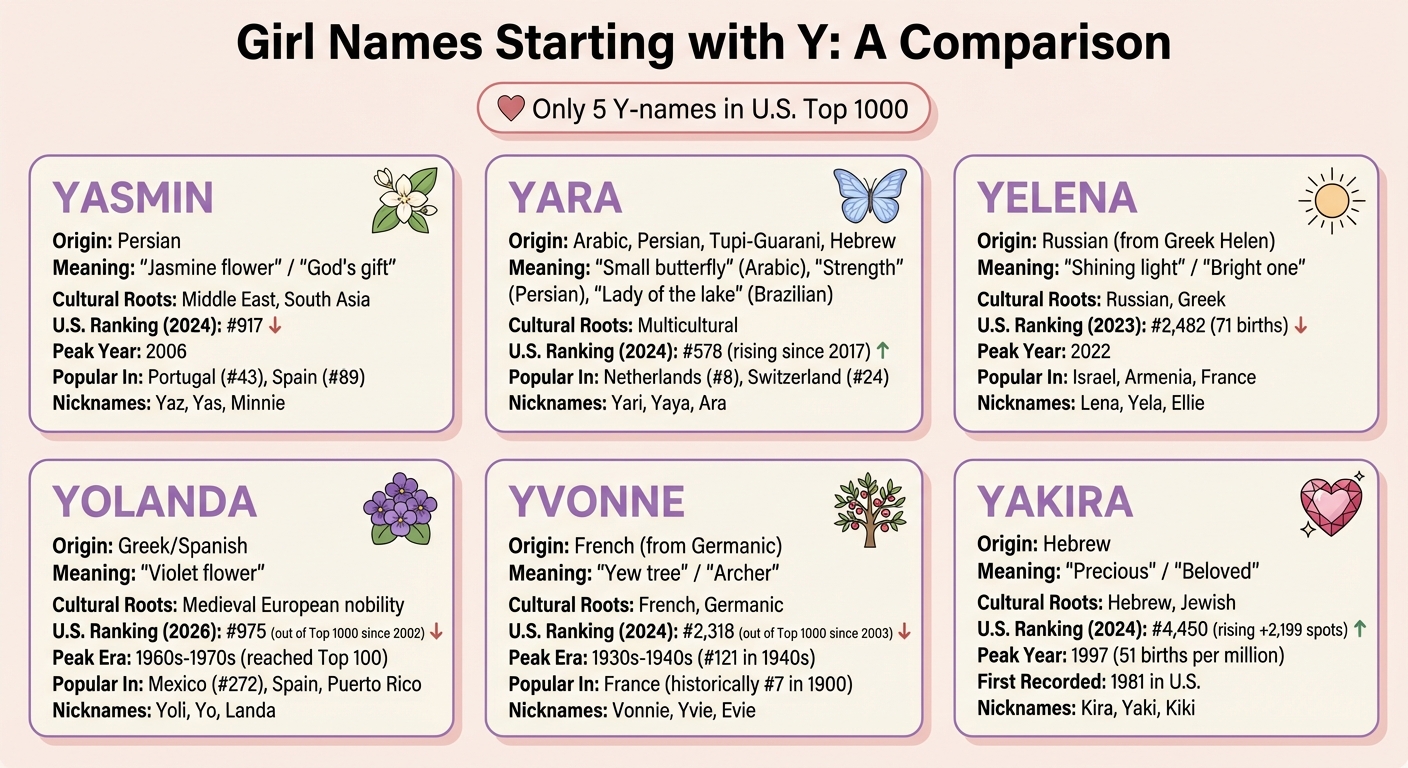
6 Girl Names Starting with Y: Origins, Meanings, and Popularity Comparison
1. Yasmin
Meaning and origin
The name Yasmin has its roots in Old Persian, originating from the word yāsamīn (یاسمین), which translates to "jasmine." This connection to the jasmine flower symbolizes beauty, grace, purity, and sweetness. In Persian tradition, Yasmin is also interpreted as "Gift from God" or "God's Gift."
Historically, the name Yasmin traveled from Persia across the Middle East and South Asia, carried along the Silk Road and other trade routes. Over time, it gained recognition in Western cultures, offering a more exotic alternative to the name "Jasmine." These ancient origins give Yasmin a sense of timelessness and cultural depth.
Cultural significance
In Islamic culture, the jasmine flower is often associated with love and purity, making Yasmin a meaningful choice for many Muslim families. Persian poetry frequently uses the name as a metaphor for beauty and grace, weaving it into themes of longing and admiration. The name transitioned into Arabic during the Islamic Golden Age, a time of rich cultural and literary exchange.
"The name evokes a climbing vine, cool to the touch yet alive with hidden perfume: a quiet elegance that Heian-era courtiers might have likened to the silvery hush of temple bells." – Nora Watanabe, Assistant Editor, Name.baby
Today, Yasmin is embraced across various languages and cultures, including Arabic, Hebrew, Urdu, Portuguese, and English. While it holds traditional significance in Muslim and Jewish communities, the name has also maintained steady usage in the United States since the early 2000s.
Popularity and variations
Yasmin reached its peak popularity in the U.S. in 2006 and is currently ranked #917 as of 2024. Although its domestic popularity has declined, it continues to be a beloved choice in Europe, ranking #43 in Portugal and #89 in Spain.
Variations of the name include Yasmine, Yasmeen, and Yasmina in Arabic-speaking regions; Yasemin in Turkey; Jazmín in Spanish-speaking countries; and Gelsomina in Italy. Common nicknames for Yasmin include Yaz, Yas, Yazzie, Minnie, and Mina.
2. Yara
Meaning and Origin
Yara is a name with rich, multicultural roots and a variety of meanings. In Arabic, it translates to "small butterfly" or "friend/helper". The Persian version, Yārā, conveys "strength" or "courage". In Tupi-Guarani traditions, Iara refers to the "lady of the lake", "water lady", or "river spirit". Meanwhile, in Hebrew, Yaʿra means "honeycomb" or "honeysuckle", and in Yoruba, Yara is associated with "someone who is loved". These diverse meanings highlight the name's universal appeal and cultural depth.
Cultural Significance
Brazilian mythology portrays Yara (or Iara) as a goddess and water nymph who resides in rivers and lakes, enchanting men with her mesmerizing songs and drawing them to her underwater world. Beyond folklore, Yara has made a mark in modern media. Notable examples include Yara Greyjoy from HBO's Game of Thrones, the Brazilian Wonder Woman Yara Flor featured in DC Comics, and the celebrated American actress and activist Yara Shahidi. This blend of mythical and contemporary influences has helped Yara gain global recognition, making it a favorite for parents seeking a name that is both melodic and versatile across languages.
Popularity and Variations
Yara made its debut in the U.S. Top 1,000 names in 2017 and has steadily risen, reaching #578 by 2024. The name also enjoys a strong presence in Europe, ranking #8 in the Netherlands and #24 in Switzerland. Variations of Yara include Iara (the Brazilian spelling), Yaara (Hebrew), Yaritza (common in Latin America), and Yarah. Popular nicknames like Yari, Yaya, Ara, and Ari add to its charm and adaptability.
3. Yelena
Meaning and Origin
Yelena is the Russian version of Helen, carrying the meanings "shining light", "torch", or "bright one." Its roots trace back to Greek, where selene means "moon" and helios translates to "sun." The name entered Russian tradition through Byzantine influence during the Christianization of Kievan Rus' in the 10th century. It also evokes the legendary beauty of Helen of Troy, linking it to timeless tales of allure and grace.
Cultural Significance
Yelena holds a special place in Russian literature, most notably in Anton Chekhov's Uncle Vanya, where the character represents themes of yearning and unfulfilled love. In modern times, the name has gained recognition through Marvel's Yelena Belova and appearances in anime, expanding its reach into pop culture. Prominent individuals like Olympic pole vaulter Yelena Isinbayeva and cosmonaut Yelena Kondakova further highlight its lasting presence.
Popularity and Variations
In the U.S., Yelena saw a peak in 2022 with 144 births (ranking 1,500th) but dropped to 71 births (ranking 2,482nd) in 2023. Globally, the name is especially common in Israel, where approximately 1 in 500 people bear it, and it remains popular in Armenia, France, and Belgium.
Variations of the name include Elena (Spanish/Italian), Helena (German/Scandinavian), Jelena (Croatian/Serbian), Olena (Ukrainian), and Ilona (Hungarian) [32,38]. Nicknames like Lena, Yela, Yelly, Ellie, and Nena are widely used, along with Russian diminutives such as Lenochka and Alyona. This mix of historical depth and modern relevance makes Yelena a name that continues to shine across cultures and generations.
4. Yolanda
Meaning and Origin
The name Yolanda translates to "violet", rooted in the Greek name Iolanthe, which combines ioles (violet) and anthos (flower). It also connects to the Latin viola through medieval French Yolande and Spanish Violante. In Christian symbolism, the violet flower represents modesty, humility, and the Virgin Mary, while its purple color has long been tied to royalty and luxury.
Historically, Yolanda was carried by notable figures of medieval nobility, such as Empress Yolanda of Flanders, who ruled the Latin Empire in Constantinople in the 12th century, and Queen Yolanda of Hungary, the queen consort of James I of Aragon in the 13th century. This noble lineage gives the name a sense of elegance and timelessness.
Cultural Significance
Yolanda carries a rich cultural legacy. In American history, it holds significance through Yolanda King (1955–2007), the eldest daughter of Martin Luther King Jr. and a civil rights activist. The name also shines in gospel music, thanks to Grammy-winning singer Yolanda Adams, and has made appearances in pop culture, from the film Pulp Fiction to DC Comics, where Yolanda Montez takes on the mantle of Wildcat.
"Bold and distinctive, Yolanda is a floral name that doesn't sound frilly or delicate." - Sophie Kihm, Editor, Nameberry
These associations contribute to Yolanda's enduring appeal, blending history, activism, and pop culture into its identity.
Popularity and Variations
Yolanda enjoyed its peak popularity in the United States during the 1960s and 1970s, even reaching the top 100 names. However, it hasn't appeared on the Social Security Administration's top 1,000 list since 2002, when it ranked at #973. As of March 2026, it holds the #975 spot in the U.S., making it a name with historical depth and individuality. In Spanish-speaking regions, Yolanda remains more common, ranking #272 in Mexico in 2021 and placing in the top 10 in Puerto Rico and Spain.
The name also offers a variety of international versions, including Yolande (French), Jolanda (German/Dutch/Italian), Iolanda (Portuguese/Romanian/Catalan), Jolanta (Polish/Latvian/Lithuanian), and Iolanta (Russian/Ukrainian). For those who love nicknames, Yolanda provides plenty of choices, such as Yoli, Yo, Landa, Yola, and Yoyo, giving it a personal and adaptable charm.
sbb-itb-f13f980
5. Yvonne
Meaning and Origin
Yvonne is a French name with roots in the medieval French name Yves and the Germanic name Ivo. It comes from the element iv, which means "yew tree". The name also carries the meaning "archer", as yew wood was traditionally used to craft bows. In ancient European traditions, the yew tree was a symbol of strength, longevity, eternity, and protection. Yvonne is further connected to Saint Ivo of Kermartin, a 13th-century Breton priest and lawyer who is the patron saint of Brittany, lawyers, and abandoned children.
"Renowned for their strength and being one of the longest-living trees in the world, yews are tall enchanting trees native to Europe, Africa, and Asia." – Mary-Anne Desai, Senior Content Writer, The Bump
Cultural Significance
Yvonne carries a strong association with French tradition, evoking elegance and a sense of nobility. The name is celebrated on various name days across Europe, including May 19 in Austria, May 26 in Sweden, and December 11 in Ireland and Scotland. Its cultural resonance is enriched by notable figures, such as Yvonne De Carlo, the Canadian-American actress best known for her role as Lily Munster in The Munsters; Yvonne Strahovski, the Australian actress recognized for her performances in The Handmaid's Tale and Chuck; and Yvonne Chaka Chaka, the South African singer affectionately called the "Princess of Africa". These associations have helped sustain the name's historical appeal and its variations.
Popularity and Variations
Yvonne reached the height of its popularity in the early 20th century, ranking as the 7th most popular name in France in 1900. For parents looking for a name with historical roots and enduring charm, Yvonne remains an appealing choice. In the United States, its popularity peaked in the 1930s and 1940s, climbing to #121 during the 1940s. However, its usage declined sharply after that, dropping out of the Top 1,000 by 2003. As of 2024, Yvonne ranks #2,318 in U.S. births.
Variations of the name include Yvette (a French diminutive), Ivonne (German/Spanish), Iwona (Polish), Ivona (Czech/Russian), and Evonne (English). Popular nicknames for Yvonne include Vonnie, Vonne, Yvie, Yvy, Yonnie, Evie, and Vivi.
6. Yakira
Meaning and Origin
Yakira is a feminine name with Hebrew roots, derived from the word yakir (or yaqar), which translates to "precious", "dear", "beloved", or "costly". As the feminine form of Yakir, the name reflects the idea of children being cherished gifts. Interestingly, in Japanese, Yakira carries an additional meaning: "to shine". It’s pronounced either yuh-keer-uh or yah-KEE-rah.
Popularity and Variations
Yakira is a rare choice in the U.S., making it a standout option for parents seeking something less common. It first appeared in the U.S. Social Security Administration records in 1981, reaching its highest point of 51 births per million in 1997. As of 2024, Yakira ranks #4,450, marking a rise of 2,199 spots from the previous year [65,66]. Over the last five years, its popularity has steadily grown, especially in states like New York, Florida, Georgia, California, and North Carolina.
The name has several spelling variations, such as Yakirah, Yakeera, Yakera, Yachira, Yaquira, and Jakira. In Spanish-speaking families, it’s sometimes spelled Jaquira, while the Slavic version often uses Yakirah. Common nicknames include Kira, Yaki, Kiki, Akira, Yaya, Ira, and Kiri [61,66].
Yakira’s distinctiveness adds a special flair to our collection of Y-names.
Conclusion
Choosing a name for your daughter is a deeply personal decision, and these six Y-names offer a wonderful mix of history and charm. Each one carries its own story - from Yasmin's Persian grace to Yara's global appeal.
This list highlights an impressive variety. Yelena shines with its Russian roots as a symbol of "bright, shining light", while Yolanda and Yvonne bring timeless Western European influences. Meanwhile, Yakira adds a heartfelt Hebrew touch with its meaning of "beloved."
As Laura Wattenberg, the creator of Namerology, explains:
"The letter Y is almost completely absent in traditional English girls names. But if you look around the world, it's a whole different story."
With only five Y-names currently in the U.S. Top 1000, selecting one of these options ensures your daughter will have a name that feels distinctive yet approachable.
Whether you're drawn to names inspired by nature, seeking something with meaningful cultural roots, or simply looking for a name that balances uniqueness with familiarity, these six options check all the boxes. Each name carries a rich heritage tied to beauty, strength, and uplifting qualities - traits any parent would wish for their child.
Explore the meanings and histories behind these names, and choose the one that feels right for your family. It's a gift that will stay with her for a lifetime.
FAQs
How do you pronounce Yakira?
Yakira is pronounced as Yaa-KIH-rah, with the emphasis placed on the second syllable. This gives the name a smooth and graceful sound, making it simple to articulate.
Which of these Y names is easiest to spell in the U.S.?
Yara stands out as one of the easiest names to spell in the U.S. Its four simple letters make it straightforward, memorable, and hassle-free - a great option for parents looking for a name that's both elegant and easy to write.
Are these Y names culturally appropriate to use?
Names starting with "Y" often carry rich histories and meanings, with their suitability depending on both the name itself and the context in which it's used. For example, Yara has roots in Arabic, Persian, Brazilian, and Hebrew cultures, while Yvette comes from French origins, and Yelena is tied to Portuguese heritage. Opting for a name that reflects your background or personal values can add a layer of significance. Names like Yara or Yasmin, which hold international recognition, can also resonate across different cultures.