Looking for a girl’s name starting with W? Here are six options that stand out for their rich meanings, history, and growing popularity:
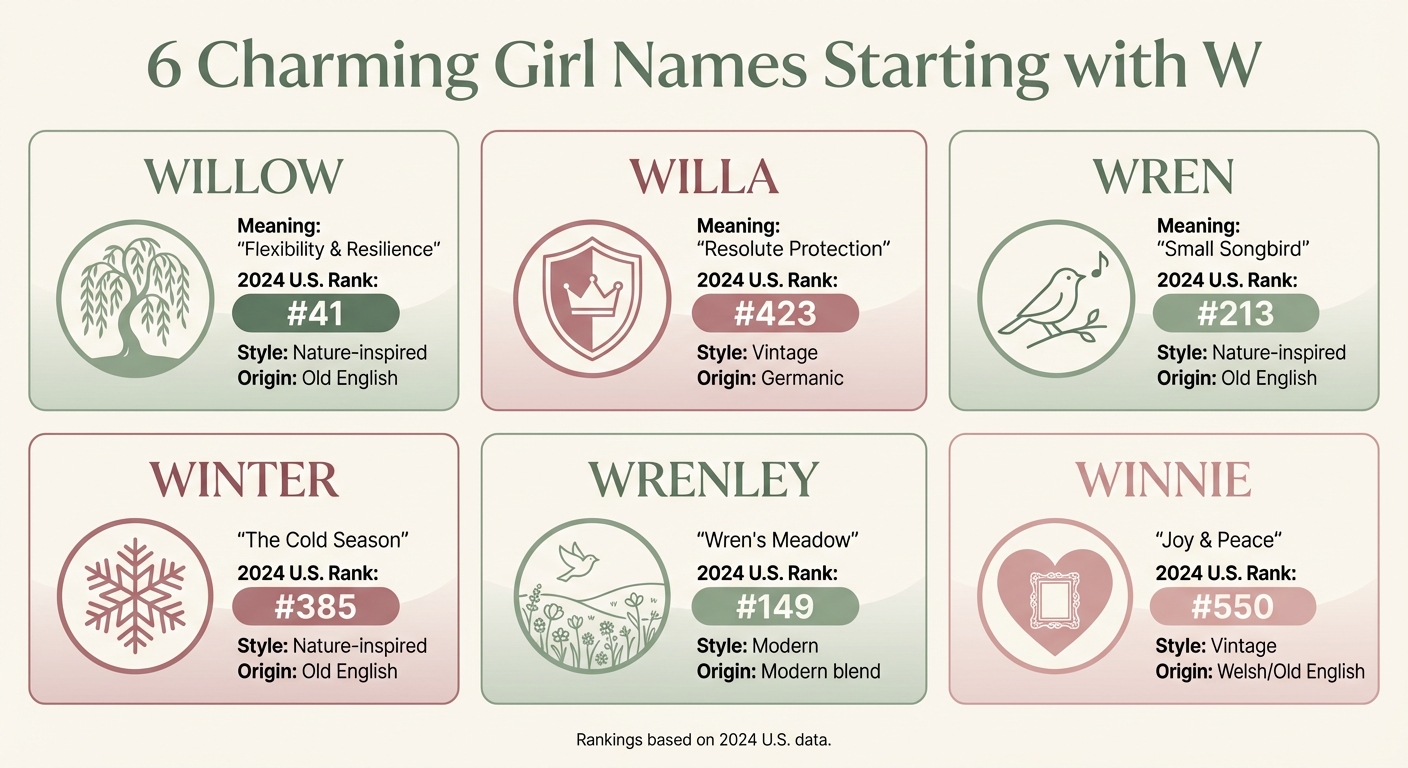
- Willow: Inspired by the willow tree, this name symbolizes flexibility and resilience. Popularized by celebrities and literature, it ranked #41 in the U.S. in 2024.
- Willa: A vintage choice meaning "resolute protection", with roots in Germanic royalty and connections to author Willa Cather.
- Wren: A sleek, nature-inspired name tied to the small songbird, celebrated for its cleverness. Ranked #213 in 2024.
- Winter: Evoking the serene beauty of the season, this name has steadily climbed the charts, ranking #385 in 2024.
- Wrenley: A modern blend of "wren" and "-ley", meaning "wren's meadow." It’s on the rise, ranking #149 in 2024.
- Winnie: A nostalgic favorite with ties to names like Winifred and Gwendolyn, known for its warmth and charm.
Each name offers a unique style - whether rooted in nature, vintage elegance, or modern trends. With options like these, there’s something to suit every taste.
Girl Names Starting with W: Popularity Rankings and Meanings Comparison
1. Willow
Meaning and Origins
The name Willow traces back to the Old English word welig or wilig, which translates to "willow tree". Its linguistic root, wei-, means "to bend" or "to twist", reflecting the tree's famously flexible branches. Historically, the name may have also been used to describe someone who lived near a grove of willow trees.
Cultural or Historical Significance
Willow trees have held a special place in literature and folklore for centuries. Shakespeare used the tree as a symbol of sorrow in Hamlet, while Kenneth Grahame celebrated its charm in The Wind in the Willows. More recently, the Harry Potter series introduced the Whomping Willow, bringing it into modern pop culture. In Romani traditions, the willow is associated with healing and renewal. Interestingly, the name Willow only entered the U.S. Top 1,000 names for girls in the late 1990s. These deep cultural connections have helped solidify its modern-day appeal.
Current Popularity or Trends
In the U.S., Willow ranked as the 41st most popular name for baby girls in 2024, standing out as the only "W" name in the Top 100. Globally, it reached the Top 10 in England and Wales in 2023 and gained significant traction in New Zealand and Wales in 2020. The name's rise can be partly attributed to the character Willow Rosenberg from Buffy the Vampire Slayer, which debuted in 1997. Additionally, celebrity parents like Will Smith and Jada Pinkett Smith, Pink, and Michelle Monaghan have chosen the name for their children, boosting its visibility.
Appeal and Associations
Willow resonates with parents for its symbolism of resilience and adaptability. Singer Pink once described the willow tree as "the most flexible tree that nothing can break - no wind, no elements, it can bend and withstand anything". The name’s natural elegance and strength align with the growing trend of botanical names like Wren, Juniper, and Sage. Popular nicknames include Will, Willa, Wills, and Lo, adding to its versatility.
sbb-itb-f13f980
2. Willa
Meaning and Origins
Willa is the feminine counterpart to William, derived from the German name Wilhelm. It combines wil (meaning "will" or "desire") and helm (meaning "helmet" or "protection"), giving it the interpretation of "resolute protection." Originally a diminutive of Wilhelmina, Willa eventually stood on its own as a name. Its roots trace back to Old Germanic royalty and gained prominence in England after William the Conqueror brought it over during the Norman Conquest in 1066 [10, 21]. This rich history adds depth to its enduring appeal.
Cultural or Historical Significance
Willa carries a strong literary connection through Willa Cather, the celebrated author of O Pioneers! and My Ántonia. Her influence lends the name a timeless, intellectual charm. Beyond literature, Willa has royal associations, such as Willa of Tuscany, who served as Queen consort to Berengar II of Italy. The name also has ties to aviation history - Willa Beatrice Brown became the first African American woman to earn a private pilot's license in 1938. She later co-founded the Cornelius Coffey School of Aeronautics, which played a pivotal role in training pilots for the Tuskegee Airmen [10, 17].
Current Popularity or Trends
After disappearing from the U.S. Top 1,000 for five decades, Willa reemerged in 2010, marking a modern revival. By 2024, it ranked at #423, with its highest point in recent years being 2019, when 889 babies per million were given the name [10, 18]. Its steady climb reflects a growing preference for vintage names with a modern twist.
Appeal and Associations
Willa's charm lies in its ability to balance old-world elegance with a modern edge. While it shares a phonetic similarity to Willow, which evokes nature, Willa is not directly linked to botanical themes. Instead, it offers a sense of strength and timelessness that aligns with the trend of reviving vintage names. Parents are drawn to its soft yet sturdy sound, and common nicknames like Will, Willy, Wills, and Lil add versatility [10, 20]. Willa effortlessly bridges the gap between classic and contemporary, making it a favorite among those seeking a name with both history and style.
3. Wren
Meaning and Origins
The name Wren comes from the Old English word "wrenna" (or "wrænna"), which translates to "small brown songbird". Its origins trace back to the Proto-Germanic wrandijô, with similar forms in Old High German (wrendilo) and Icelandic (rindill). Initially an English surname, Wren transitioned into a first name during the late 19th and 20th centuries. Its connection to nature lends it a grounded and simple charm.
Cultural or Historical Significance
In Celtic and Druidic folklore, the wren was celebrated as the "King of All Birds" for its cleverness rather than its physical size. One well-known legend tells of a bird contest where the tiny wren hid in an eagle's feathers, later emerging to fly higher, showing that wit can outshine strength. The name is also associated with "Wren Day" (St. Stephen's Day), an Irish tradition honoring the bird. Additionally, Sir Christopher Wren, the renowned 17th-century architect behind St. Paul's Cathedral in London, is a notable historical figure who carried the name. These stories and connections add depth to Wren’s appeal.
Current Popularity and Trends
Wren made its debut in the U.S. top 1,000 girls' names in 2013, ranking at #798, and rose to #184 by 2022. By 2024, it ranked #213, with 1,442 recorded births. While the name was predominantly male in the 1970s (about 70%), it has since become overwhelmingly female, with over 85% of its usage attributed to girls by the 2020s. Its popularity saw a recent surge after John Legend and Chrissy Teigen named their son Wren Alexander Stephens in June 2023. In England and Wales, Wren also gained traction, ranking at #128 in 2024.
Appeal and Associations
Parents today are drawn to Wren for its sleek, one-syllable simplicity and its connection to "cottagecore" and "eco-chic" trends. The name blends a vintage feel with a modern edge, making it a stylish alternative to classics like Rose or Grace. Its symbolism of resourcefulness and the idea that "small but mighty" qualities can triumph adds an extra layer of meaning.
4. Winter
Meaning and Origins
The name Winter comes from Old English "winter" and Proto-Germanic "wintruz", both directly tied to the chilly season. It also connects to older terms for water, likely referencing the rain and snow typical of wintertime. Interestingly, it also serves as an Anglicized version of the Irish surname "Mac Giolla-Gheimhridh", meaning "son of the lad of winter." First documented as a given name in the 17th century, Winter was initially more common for boys in the 1800s but has since gained popularity as a girl's name in the 21st century. These linguistic roots highlight Winter's deep historical and symbolic significance.
Cultural or Historical Significance
Winter symbolizes endurance, strength, and survival, while also evoking images of purity, tranquility, and the quiet beauty of snowy landscapes.
"Every name tells a story. 'Winter' weaves a tale of serene landscapes covered in untouched white snow – unique, memorable, and enchanting." - Little Miss Beauty
Current Popularity and Trends
Winter has grown steadily in popularity, reaching its highest rank of #315 in the United States in 2025. In 2024, it placed at #385 in the U.S. and #394 in England. The name has been part of the U.S. Top 1,000 since 2012, breaking into the Top 400 by 2018. In England and Wales, it has been among the Top 300 names since 2020. Celebrities have also played a role in its rise - Nicole Richie and Joel Madden gave Winter as a middle name to their daughter Harlow in 2008, actress Gretchen Mol named her daughter Winter Morgan Williams in 2011, and Sean Parker named his daughter Winter Victoria Parker in 2013. Additionally, the name gained attention through Winter (Kim Min-jeong), a member of the K-pop group Aespa.
Appeal and Associations
Winter stands out for its nature-inspired charm, making it a favorite alongside names like Willow and Meadow. Grace Royal of Nameberry explains, "Cooler than the other seasons, Winter has emerged as a fully embraced name for girls". Popular nicknames include Win, Winnie, and Winty, with playful options like Frost or Snow adding a touch of whimsy. For those seeking a twist, the variant spelling "Wynter" offers a creative alternative while keeping the same pronunciation.
5. Wrenley
Meaning and Origins
Wrenley is a modern, nature-inspired name that combines the charm of "wren" with the Old English suffix "-ley", which translates to "meadow" or "clearing". This gives the name a poetic meaning, often interpreted as "wren's meadow" or "small songbird." While the name Wren has a long-standing connection to the clever and spirited bird, Wrenley adds a fresh, feminine twist with its flowing two-syllable structure. The wren's symbolism of agility, wisdom, and resilience carries over, making Wrenley a name that feels both meaningful and contemporary. Its origins as an elaboration of Wren highlight its modern appeal, offering a lyrical choice for parents seeking something distinctive yet rooted in nature.
Current Popularity and Trends
Wrenley’s rise in popularity has been nothing short of impressive. From just 13 uses in 2014, the name soared to over 1,900 uses in 2024, landing at #149 on the U.S. baby name charts. Including alternative spellings, a total of 3,176 girls were named Wrenley in 2024, placing it on the cusp of the Top 100. It has found particular favor in Wyoming, where it ranks as high as #13. Interestingly, its first recorded use in 2013 may have been subtly influenced by the character Renly Baratheon from Game of Thrones.
Appeal and Associations
Wrenley perfectly aligns with the current trend of nature-inspired names that feature the popular "-ley" ending, much like Finley, Brinley, and Kinsley.
"Inspired by the sweet but solid bird name Wren, this longer form has been storming up the charts since 2018", says Pamela Redmond of Nameberry.
Rita Antonieta Salazar highlights its origins as "the blend of 'wren' and the Old English '-ley'". Beyond its melodic sound and natural ties, parents are drawn to Wrenley’s "blank-slate" quality, allowing their child to create a unique legacy unburdened by strong pop-culture ties. The name also offers a variety of delightful nicknames, including Wren, Ren, Lee, Wrenny, or even the whimsical Birdie.
6. Winnie
Meaning and Origins
Winnie carries a delightful vintage charm, rooted in history and tradition. Originally a nickname for names like Winifred, Edwina, Gwendolyn, and Guinevere, Winnie has since become a popular standalone name. Its origins trace back to Welsh and Old English, combining "gwen" (white, fair, pure) with "wyn" (joy) or "wine" (friend). Together, these elements create meanings like "holy peacemaking", "gentle friend", or "blessed peace." Much like other nickname-turned-names such as Pippa or Edie, Winnie has found its place as a modern favorite among parents.
Cultural and Historical Significance
Winnie’s appeal goes beyond its linguistic roots, bringing with it a fascinating cultural legacy. It’s tied to figures like Winnie Madikizela-Mandela, the anti-apartheid activist often referred to as South Africa's "Mother of the Nation", and Winnie Davis, daughter of Confederate President Jefferson Davis. Even British Prime Minister Winston Churchill was affectionately called "Winnie" by those close to him. In popular culture, the name is synonymous with A.A. Milne's beloved Winnie-the-Pooh, inspired by a real bear from the London Zoo. Other notable uses include Winnie Cooper from The Wonder Years and Winnie Foster from Tuck Everlasting.
Current Popularity and Trends
Winnie’s popularity has seen its ups and downs. It peaked in the U.S. back in 1901, securing the #190 spot. By the late 1970s, the name had faded from the spotlight, only to experience a resurgence in recent years. In 2024, it climbed to #550 in the U.S., with 551 girls given the name - a jump of 62 spots from the previous year. As of March 2026, Nameberry ranks Winnie at #197, while in England and Wales, it holds the #142 position. Celebrities have also played a role in its revival, with Jimmy Fallon naming his daughter Winnie Rose in 2013 and Tyler Hilton following suit with his daughter Winnie in 2020.
Appeal and Associations
"This pet form of such names as Winifred and Edwina and Gwendolyn has loads of vintage charm, a la Millie and Maisie, with a decidedly winning vibe", says Madison Dresler of Nameberry.
Winnie fits perfectly into the cozy, nostalgic aesthetics of today, like cottagecore and kindercore. Similar to names like Birdie, Goldie, and Dottie, it radiates warmth and simplicity. Its friendly, approachable nature, combined with the timeless appeal of Winnie-the-Pooh, makes it a name that resonates with both young and old alike. Parents are drawn to its whimsical, homespun quality, ensuring its continued popularity for years to come.
Conclusion
W names bring a special charm that’s hard to ignore, even after spending a century outside the top 100 U.S. girl names. But that trend is changing, with names like Willow making their way back into the spotlight.
What sets these six names apart is their variety. Whether you prefer nature-inspired options like Willow and Wren, the nostalgic feel of Willa and Winnie, or the contemporary vibe of Wrenley, there’s something for everyone. This mix of styles helps explain why W names are becoming more popular again.
These names aren’t just about how they sound - they’re rich with meaning too. For example, Willa signifies "resolute protection", while Winnie, a short form of Winifred, reflects "joy and peace". Plus, many of these names come with built-in nickname possibilities, giving you the best of both worlds: a formal name with a playful, everyday alternative.
FAQs
What are some good middle names for Willow, Willa, Wren, Winter, Wrenley, and Winnie?
When choosing a middle name for Willow, think about options that highlight its natural and graceful feel. Names like Rose, Skye, Flora, Hope, and Nova are lovely choices, bringing either a touch of elegance or a nod to nature.
For Willa, consider trendy or unique names that match its charm. Options like Wren, Winter, Wrenley, or even Wynter create a modern yet stylish vibe.
If Winnie is the first name, pairing it with timeless classics like Elizabeth or Marie adds a beautiful balance. These names offer a sense of tradition while letting Winnie’s playful side shine.
The key is to pick a middle name that complements the first name’s tone - whether you’re drawn to something nature-inspired, vintage, or contemporary. Together, they create a harmonious full name that feels just right.
Are any of these W names considered unisex?
Some names starting with "W" can be used for any gender, like Wynn, Walker, and Wendall. On the other hand, names such as Willa, Winter, and Wren are more commonly associated with girls.
How can I pick a W name that won’t feel too trendy later?
When selecting a name starting with "W", consider options like Willa, Winifred, or Wendy. These names carry a sense of history and charm, often tied to literary works or cultural icons, which helps them maintain their classic appeal over time.
On the other hand, more modern or invented names, such as Wynter or Wrenley, might feel trendy but lack the depth and staying power of their timeless counterparts. Choosing a name with a rich background not only adds elegance but also ensures it remains relevant as naming trends change.