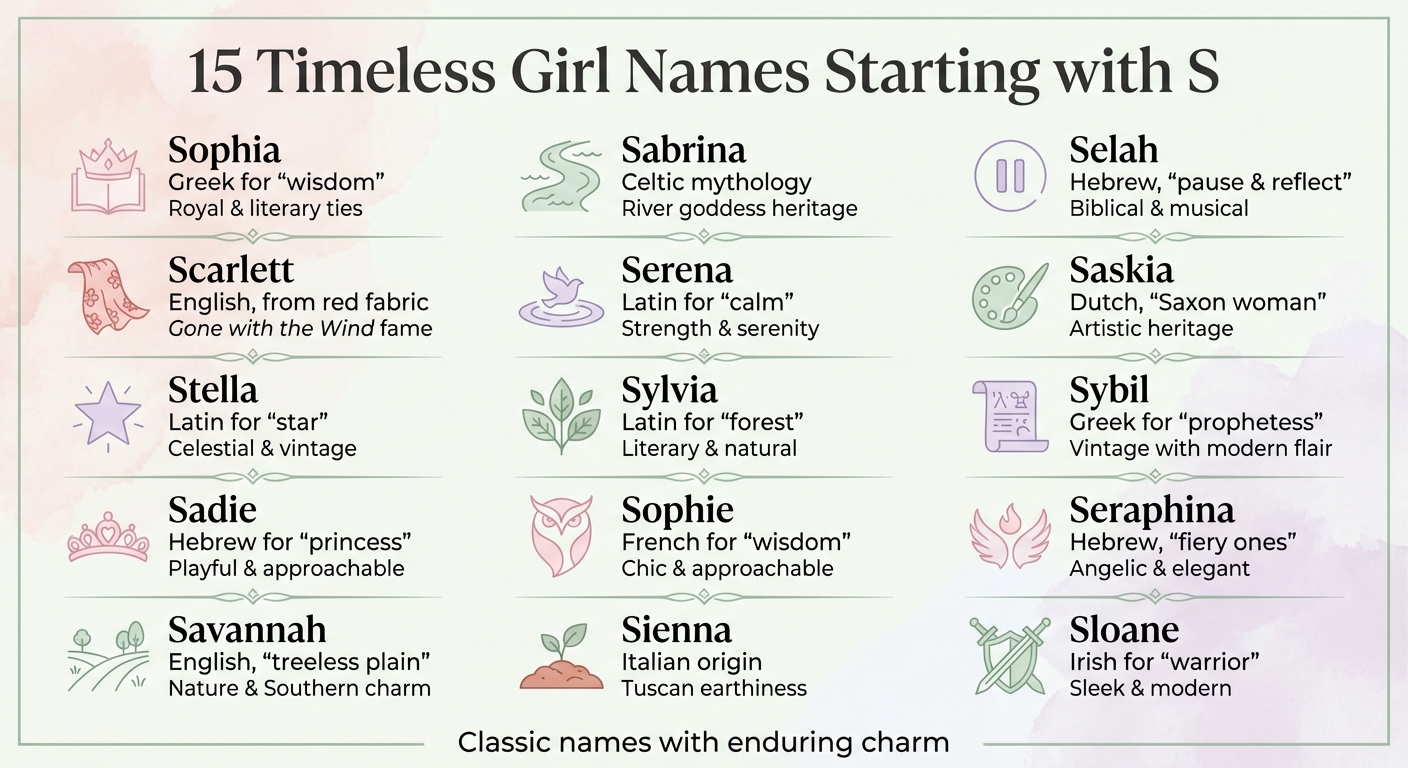
Choosing a name for your baby girl can feel overwhelming, but names starting with S have consistently been a favorite. Why? They combine rich meanings, historical significance, and a balance of elegance and simplicity. Here's a quick look at 15 standout S names, each with a unique story and lasting charm:
- Sophia: Greek for "wisdom", a global favorite with royal and literary ties.
- Scarlett: Inspired by luxurious red fabric, popularized by Gone with the Wind and Scarlett Johansson.
- Stella: Latin for "star", blending celestial beauty with vintage appeal.
- Sadie: A playful, approachable take on "princess" from Hebrew roots.
- Savannah: Evoking nature and Southern charm, tied to the historic Georgia city.
- Sabrina: From Celtic mythology and Hollywood elegance (Sabrina the Teenage Witch).
- Serena: Latin for "calm", now synonymous with strength thanks to Serena Williams.
- Sylvia: Meaning "forest", this literary gem has a timeless, natural vibe.
- Sophie: A softer, French variation of Sophia that's chic and approachable.
- Sienna: Italian in origin, tied to the earthy tones of Tuscany.
- Selah: A Biblical term meaning "pause and reflect", perfect for spiritual families.
- Saskia: Dutch for "Saxon woman", with artistic ties to Rembrandt's muse.
- Sybil: Greek for "prophetess", a vintage name with modern flair (Downton Abbey).
- Seraphina: Hebrew for "fiery ones", angelic and elegant.
- Sloane: Irish for "warrior", sleek and modern with a tailored feel.
Each name carries a unique blend of history, meaning, and style, making them perfect for parents seeking something classic yet fresh. Whether you're drawn to the grace of Sophia, the boldness of Scarlett, or the serenity of Serena, there's an S name to suit every taste.
15 Timeless Girl Names Starting with S: Meanings and Origins
1. Sophia
Meaning and Origin of the Name
The name Sophia originates from the Greek word "Σοφία" (Sophía), which translates to "wisdom". It embodies qualities like intuition, sound judgment, and refined skill. Interestingly, it's also the root of "philosophy", meaning "the love of wisdom".
Cultural and Historical Background
Sophia carries a rich historical and cultural legacy. It first appeared in written records during the 4th century and gained prominence through Saint Sophia of Rome, associated with the virtues of Faith, Hope, and Charity. In Christian theology, "Hagia Sophia" (Holy Wisdom) symbolized divine understanding, a concept immortalized by the iconic 6th-century Hagia Sophia basilica in Istanbul.
The name also found favor among European royalty. It became especially popular in Britain during the 18th century, thanks to the German House of Hanover and figures like Electress Sophia of Hanover. Literary works further cemented its appeal, with notable characters in Henry Fielding's Tom Jones and Oliver Goldsmith's The Vicar of Wakefield.
Enduring Popularity
Sophia has enjoyed enduring popularity, particularly in the U.S., where it was the #1 girls' name from 2011 to 2013. Since 2006, it has consistently ranked in the U.S. Top 10, placing 6th in 2024. It also remains a favorite in England and Wales, staying within their Top 100. This lasting appeal highlights its universal charm.
Appeal for Modern Parents
Sophia continues to resonate with modern parents, offering a perfect balance of intellectual depth and a soft, melodic sound. Its global adaptability, with variations like Sofia (Spanish/Italian), Sophie (French), and Zofia (Polish), makes it a name that transcends borders. Celebrities such as Sophia Bush, Sofia Vergara, and Sofia Coppola further enhance its contemporary appeal.
"It manages to be both a 'princess name' and an 'intellectual name' simultaneously, appealing to a wide variety of parents." - Mom Loves Best
Sophia's blend of wisdom, historical significance, and modern relevance ensures it remains a timeless choice for families seeking a name with both depth and beauty.
sbb-itb-f13f980
2. Scarlett
Meaning and Origin of the Name
The name Scarlett began as an English occupational surname for individuals who sold or crafted scarlet-dyed wool, a highly prized fabric in its time. Its roots trace back to the Persian word saqerlāt, which passed through Arabic, Latin, and Old French before becoming part of Middle English. Interestingly, in medieval times, "scarlet" referred to the quality of the fabric rather than its color. However, the luxurious red dye used in the material eventually made the word synonymous with the color red. During the Roman Empire and within the Catholic Church, scarlet-dyed clothing became a symbol of power and high authority. Cardinals, for instance, wore scarlet robes to represent the blood of Christ.
Cultural and Historical Background
Scarlett's journey from a surname to a popular first name is largely due to its literary and cinematic associations. Margaret Mitchell's 1936 novel Gone with the Wind and the iconic 1939 film adaptation introduced the world to Scarlett O’Hara, a character whose name became unforgettable. While the name saw a slight increase in use during the 1940s, it remained relatively uncommon until the early 2000s. A major boost came from actress Scarlett Johansson, whose breakout role in 2003 catapulted the name into the spotlight. In 2000, Scarlett ranked at 942 in the U.S., but by 2011, it had entered the Top 100 and has stayed in the Top 20 for American girls since 2021.
Enduring Popularity
Scarlett continues to captivate parents worldwide. In 2022, it was the 14th most popular name for girls in the U.S.. It also ranks highly in countries like the United Kingdom, Australia, and New Zealand, and was the 36th most popular name in Canada in the same year. The name’s appeal extends to celebrity circles, with figures like Sylvester Stallone, Jack White, and Rob Schneider choosing it for their daughters.
Appeal for Modern Parents
Scarlett strikes a balance between vintage charm and a bold, modern edge. It serves as a lively alternative to softer names like Charlotte or Violet, blending elegance with a touch of grit. The name pairs beautifully with short middle names such as Blake, Quinn, or Sloane, as well as nature-inspired options like Willow and Ivy. Its versatility is further enhanced by nicknames like "Scar", "Lettie", or "Red".
"Scarlett is a name that manages to be both colorful and historically deep. It carries the undeniable glamour of Old Hollywood... yet feels entirely fresh and spirited on a modern playground." - Mom Loves Best
3. Stella
Meaning and Origin
Stella comes from the Latin word for "star" and shares a connection with the Greek name Stylianos, which means "pillar". Its use as a first name gained attention in the 1580s, thanks to English poet Sir Philip Sidney and his sonnet sequence Astrophel and Stella. The name also holds religious significance through the Catholic title Stella Maris ("Star of the Sea"), an epithet for the Virgin Mary that symbolizes guidance for sailors. In American pop culture, Tennessee Williams' 1947 play A Streetcar Named Desire brought the name into the spotlight with the character Stella Kowalski. This celestial origin has given Stella a lasting appeal across history and culture.
Cultural and Historical Background
Stella made its debut at No. 60 in 1880, the first year Social Security began tracking baby name data, and stayed in the Top 100 through the early 1900s. However, by the mid-1980s, it had fallen out of the Top 1,000. The name saw a dramatic resurgence starting in 1998, climbing nearly 800 spots by 2008. Fashion designer Stella McCartney is often credited with helping to revive its popularity, and today, Stella is widely loved not just in the U.S. but also in countries like the UK, Canada, Australia, Sweden, and France.
Enduring Popularity
Stella’s popularity has continued to flourish in recent years. It ranked No. 41 in 2021, moved up to No. 40 in 2022, and held strong at No. 49 in 2024. This steady performance places it within the "vintage chic" naming trend, alongside other classics like Evelyn, Hazel, and Charlotte. Its timeless charm and international appeal make it a go-to choice for many parents.
Appeal for Modern Parents
Stella strikes a perfect balance between celestial elegance and grounded strength, fitting neatly into the popular "Ella-Bella" naming trend. Its short, easy-to-spell nature and adaptability across languages make it particularly appealing to today’s parents. Popular nicknames include Stell, Stellie, Ella, Ellie, and Star.
"Stella manages to feel incredibly vintage, calling to mind the golden age of Hollywood and 1920s glamour, while simultaneously feeling fresh, spunky, and modern." – Mom Loves Best
With its mix of old-world charm and contemporary flair, Stella remains a standout choice among classic 'S' names.
4. Sadie
Meaning and Origin
Sadie traces its roots to Hebrew, where it means "princess" or "noblewoman." It's derived from Sarah, which in Arabic translates to "joy" or "delight". The name gained traction in the late 18th and early 19th centuries, thanks to a trend of altering the "r" sound to a "d" in nicknames - much like how Richard became Dick. While it started as a playful nickname for Sarah, Sadie eventually took on a life of its own, becoming a standalone name by the late Victorian era.
Historical and Global Popularity
Back in 1900, Sadie was a favorite, ranking 84th in the U.S. with 895 recorded births. However, its charm waned by the mid-20th century, dropping to 987th in 1965 before disappearing from the top 1,000 entirely between 1966 and 1973. Fast forward to 2013, and Sadie made a strong comeback, climbing back into the Top 100. By 2024, it had risen to 57th in the U.S. and remained a popular choice in countries like Canada, Australia, Scotland, and Ireland. This cyclical rise and fall highlights its enduring charm and adaptability across generations.
Staying Power Through the Years
Sadie hit a modern high at 46th in 2014, and its popularity has held steady since. Pop culture has played a big role in keeping the name relevant. From the "Sadie Hawkins" dance tradition, born out of a 1937 comic strip, to actress Sadie Sink of Stranger Things fame, and trailblazer Sadie Tanner Mossell Alexander, the first African-American woman to earn a Ph.D. in economics, the name continues to resonate with both historical significance and modern flair.
Why Modern Parents Love It
Sadie’s appeal lies in its lively, approachable energy. Many parents describe it as being perfectly balanced - not overly trendy but far from outdated. It’s familiar without being overused, a sweet spot that makes it stand out among names like Emma or Olivia.
"Sadie is a 'spark plug' name; it is timeless and spunky, yet it vibrates with an energetic modernity that prevents it from ever feeling dusty." – Mom Loves Best
Its two-syllable structure and vowel ending make it incredibly versatile. Sadie pairs beautifully with short middle names like Rose or Quinn, as well as longer classics like Elizabeth or Catherine. It also complements sibling names effortlessly, whether they’re vintage-inspired (e.g., Nora, Hazel, Ruby) or more traditional (e.g., Jack, Leo, Oliver). This versatility and charm make it a favorite choice for today’s parents.
5. Savannah
Meaning and Origin of the Name
The name Savannah translates to "treeless plain". Its roots lie in the English term for a wide, open grassland. The word’s journey traces back to the Spanish sabana, which itself was borrowed from the Taino word zabana, a language spoken by the indigenous peoples of the Caribbean.
Savannah also serves as a place name, most notably tied to the historic city of Savannah, Georgia, founded in 1733 along the Savannah River. Some historians suggest a connection to the Shawnee tribe, deriving from the Algonquian word "Shawano", meaning "southerner". This rich mix of natural imagery and geographic significance gives the name a distinctive allure for many parents, grounded in both history and nature.
Cultural and Historical Background
Savannah’s rise in popularity began in the 1980s and 1990s, thanks in part to pop culture. The 1982 family film Savannah Smiles is credited with introducing the name to the U.S. Top 1,000. Its appeal grew even more with the 1994 bestseller Midnight in the Garden of Good and Evil, which shone a spotlight on the city of Savannah. By 1993, the name had entered the Top 100 and reached its peak in the mid-2000s.
International recognition followed in December 2010 when Peter Phillips, grandson of Queen Elizabeth II, named his daughter Savannah Phillips, making her the Queen’s first great-grandchild. Additionally, journalist Savannah Guthrie, co-anchor of NBC's Today Show, has kept the name prominent in modern media. These cultural milestones have cemented Savannah’s enduring charm and widespread appeal.
Enduring Popularity
Since 1993, Savannah has consistently held its place as a favorite name, remaining in the Top 100 for over 20 years. As of 2024, it ranks 107th in the U.S., with a steady following internationally.
Its popularity stems from its ability to fit multiple naming trends. It’s a nature-inspired name, like Sierra or Willow, a place name, like Brooklyn or Madison, and it carries a touch of Southern elegance, evoking images of historic homes and warm hospitality. During the 1980s and 1990s, Savannah stood out as a fresh alternative to the more common Samantha.
Appeal for Modern Parents
Savannah continues to attract modern parents with its blend of adventure and sophistication. It offers a timeless yet versatile charm, appealing to families seeking both elegance and a connection to nature.
"Savannah is a name of freedom and nature thanks to her meaning 'large, grassy plain.' She's isn't bound to one style, free to mix and mingle between name crowds with her versatile fit." – Mama Natural
The variety of nicknames - Sav, Vannah, Savi, Savvy, and Annie - adds to its appeal, offering flexibility as the child grows. This adaptability, combined with its historic and natural roots, makes Savannah a name that resonates with parents across generations.
6. Sabrina
Meaning and Origin of the Name
The name Sabrina has its roots in the Latinized form of Habren or Hafren, which were the Welsh names for the River Severn. Its Proto-Celtic origin, Sabrinā, translates to "from the River Severn" or "from the border". In Arabic, the name ties to sabr, meaning "patience" or "endurance". Some interpretations even link it to the Hebrew name Sarah, which means "princess".
Cultural and Historical Background
Sabrina's story is steeped in legend. Geoffrey of Monmouth's 12th-century tale describes Sabrina as a princess tragically drowned in the River Severn by her stepmother, Queen Guendolen. Over time, folklore transformed her into a protective water nymph or goddess of the river. John Milton's 1634 masque, Comus, further immortalized her as a virtuous nymph, solidifying her place in literary history.
The name gained modern popularity thanks to the 1954 film Sabrina, starring Audrey Hepburn. Its debut caused a significant jump in the name's ranking, from #789 in 1954 to #245 in 1955. Later, the TV series Sabrina the Teenage Witch propelled the name to its peak at #53 in the U.S. in 1997. Internationally, it also thrived, reaching #8 in France (1979–1981) and #8 in Germany.
Enduring Popularity
Sabrina's appeal has evolved over the years, balancing its historical roots with modern relevance. As of February 2026, it holds the #358 position in the United States. While no longer among the Top 100, its moderate ranking makes it an appealing choice for parents who want something familiar yet not overly common.
"Sabrina is an impeccable choice for a baby born in 2026. It offers the 'vintage charm' parents are currently seeking... but with a much cooler, more distinctive edge." – Cate Hoepner, Professional Blogger
The name has transitioned from a pop culture phenomenon to a modern staple - recognized and sophisticated without being overly popular. Figures like singer Sabrina Carpenter and WNBA star Sabrina Ionescu continue to bring it into the spotlight for new generations.
Appeal for Modern Parents
Sabrina is a name that blends myth, nature, and Hollywood elegance. Its ties to the River Severn bring a natural element, while its literary and cinematic associations add depth and sophistication. With nicknames like Bree, Rina, or Nina, it offers flexibility for different stages of life. Parents often pair Sabrina with sibling names such as Sebastian, Julian, Claudia, or Miranda, creating a stylish and cohesive set. This combination of history, versatility, and charm ensures Sabrina remains a timeless yet distinctive choice for today's parents.
7. Serena
Meaning and Origin of the Name
The name Serena originates from the Latin word "serenus," which translates to "clear, tranquil, and serene". In ancient Rome, it was often associated with clear, unclouded skies, evoking a sense of calm and peace. Its historical significance includes Saint Serena of Rome, who was the wife of Emperor Diocletian, leaving a notable mark during the late Roman Empire. The name also entered English literature in the 1590s, thanks to Edmund Spenser's The Faerie Queene, further solidifying its timeless charm.
Cultural and Historical Background
Serena has consistently held its place across generations, earning a reputation as a classic name with international appeal, particularly in Italy. Its popularity surged in the United States during the late 1990s, reaching its peak at #209 in 2000. This rise coincided with the global success of tennis legend Serena Williams, whose 23 Grand Slam singles titles redefined the name’s image - shifting it from one of quiet grace to one of undeniable strength and athleticism.
The 1990s also saw Serena gain additional cultural significance. The English dub of Sailor Moon introduced audiences to the character Serena, while Gossip Girl's Serena van der Woodsen added a layer of sophistication and modern glamour. These influences helped cement Serena’s place in pop culture and contributed to its enduring popularity.
Enduring Popularity
As of February 2026, Serena ranks #332 in U.S. births. While it no longer holds the peak position it achieved in the early 2000s, its steady presence reflects its ongoing appeal. Experts describe it as occupying a "Goldilocks Zone" - familiar enough to be recognizable but rare enough to remain distinctive. From its debut at #466 in 1880 to a consistent spot near #455 in 2014, Serena’s performance over the years showcases its lasting charm.
Appeal for Modern Parents
Serena strikes a perfect balance between timeless elegance and modern strength. As noted by experts:
"Serena is a masterclass in duality. On one hand, it is the phonetic definition of tranquility... On the other hand, thanks to modern icons like Serena Williams, the name now pulses with strength, athleticism, and sheer power." – MomLovesBest
Its versatility is another key draw. Serena feels equally at home in historical settings and contemporary contexts, offering a name that is both refined and fresh. It works seamlessly across English, Italian, and Spanish-speaking communities, and its nicknames - Sera, Rena, Nina, or Ree - add adaptability as a child grows. For parents seeking a name that blends historical depth with modern energy, Serena stands out as a compelling choice.
8. Sylvia
Meaning and Origin of the Name
Sylvia comes from the Latin word silva, meaning "forest." It has deep roots in Roman mythology, thanks to Rhea Silvia, the mother of Romulus and Remus, the legendary founders of Rome. The name also connects to Silvanus, the Roman god of forests and fields. In English-speaking cultures, Sylvia gained recognition through William Shakespeare's play The Two Gentlemen of Verona. Its Christian significance was solidified by Saint Sylvia, the mother of Pope Gregory the Great in the 5th century. By the 19th century, "Sylvia" had overtaken the earlier spelling "Silvia" in English. This combination of mythology, literature, and religious history gives Sylvia a rich and layered heritage.
Cultural and Historical Background
Sylvia was a standout name in early 20th-century America, peaking at #48 in 1932 and holding a place in the U.S. Top 100 from 1932 to 1948. At its height in 1937, 0.396% of all baby girls born in the U.S. were named Sylvia. It also enjoyed popularity in Britain, ranking as the 137th most common girl’s name in 1900.
The name has strong ties to literature and pop culture. Beyond Shakespeare, it’s associated with Pulitzer Prize-winning poet Sylvia Plath and Sylvia Fine, a character from the 1990s sitcom The Nanny. Other notable figures include marine biologist Sylvia Earle, transgender rights activist Sylvia Rivera, and Queen Silvia of Sweden.
Enduring Popularity
Sylvia has been making a "vintage revival" in recent years. As of 2024, it ranks #361 in the United States, with Nameberry projecting it at #176 by February 2026. Impressively, Sylvia has never fallen out of the U.S. Top 1000 since records began, a testament to its enduring charm.
"The musical, sylvan Sylvia seems poised to join former friends Frances and Beatrice and Dorothy back in the nursery." – Grace Royal, Nameberry
Appeal for Modern Parents
Sylvia strikes a perfect balance: it’s familiar and easy to spell but far less common than names like Olivia or Sophia. With its "-ia" ending, it fits right in with current naming trends, while still standing out. For parents who love nature-inspired names, Sylvia offers a subtle nod to the natural world without being as literal as names like Willow or River.
The name’s versatility is another selling point. Nicknames like Syl, Sylvie, Via, or even "Silver" offer modern twists, while international variations such as Silvia (Italian/Spanish), Sylvie (French), and Sylwia (Polish) make it adaptable across different languages and cultures. Sylvia’s mix of literary elegance and modern appeal makes it a timeless choice for today’s parents.
"Sylvia is a spectacular choice for a baby born in 2026. It hits the 'sweet spot' of popularity: recognizable and easy to spell, yet far from overused." – MomLovesBest
9. Sophie
Meaning and Origin of the Name
Sophie is the French version of the Greek name Sophia, which comes from the Greek word sophos, meaning "wisdom", "knowledge", or "intellect". While both names share the same origin, their pronunciations differ: Sophia has three syllables (so-fee-uh), while Sophie has two (so-fee). This name has been in use since the 4th century, giving it a long and storied history.
Cultural and Historical Background
Sophie rose to prominence among European royalty during the 17th and 18th centuries, particularly within the German House of Hanover in England. Beyond its royal connections, Sophie has been celebrated in literature and film, appearing in works like Roald Dahl's The BFG, The Da Vinci Code, and Mamma Mia!. Famous figures with this name include actress Sophie Turner, mathematician Sophie Germain, and Sophie, Duchess of Edinburgh. With such a rich background, Sophie bridges its historical roots with modern appeal, making it a timeless choice.
Enduring Popularity
Sophie has maintained steady popularity across the U.S. and Europe, consistently ranking among the Top 100 names. In 2021, it held the 76th spot in the U.S., with about 3,309 babies per million given the name. In Europe, Sophie is especially beloved, ranking in the Top 10 in countries like England, Wales, Ireland, France, and the Netherlands. Unlike trend-driven names, Sophie offers lasting charm - easy to recognize yet classic enough to suit any stage of life.
Appeal for Modern Parents
For many parents, Sophie offers a grounded and approachable alternative to the more formal Sophia. As Mom Loves Best puts it:
"While Sophia dominates the charts as the 'queen,' Sophie is the cool, approachable princess. It is gentle in sound yet strong in appeal".
They also describe Sophie as:
"the 'little black dress' of baby names: chic, versatile, and timeless".
The French "ie" ending gives it a lighter, more modern touch compared to the traditional "ia" ending, making Sophie a sophisticated yet relaxed option for parents looking for a name that feels both elegant and accessible.
10. Sienna
Meaning and Origin of the Name
Sienna is an Italian name inspired by the city of Siena in Tuscany. The term originates from terra di Siena ("earth of Siena"), a reddish-brown clay pigment found in the area. This pigment, rich in iron, was famously used by Renaissance painters to create warm, lifelike skin tones, leaving a lasting artistic legacy. The city's name itself may trace back to the Latin family name Saenius or the word senex, meaning "old" or "ancient." While the color name entered the English language around 1760, Sienna didn’t gain traction as a given name until the late 20th century.
Cultural and Historical Background
Sienna holds religious significance thanks to Saint Catherine of Siena, a 14th-century mystic and a beloved figure in the Catholic Church. Her influence has led some Roman Catholic families to choose the name in her honor. More recently, Sienna gained a touch of royal prestige in 2021 when Princess Beatrice named her daughter Sienna Elizabeth Mapelli Mozzi. This royal connection boosted the name's popularity in the UK, where it climbed to rank 16 in England and Wales.
Enduring Popularity
Sienna made its debut in the U.S. Top 1,000 in 1995 and has steadily gained popularity ever since. A notable surge occurred in 2006, when the name jumped 122 spots, a rise attributed to the growing fame of British-American actress Sienna Miller - a phenomenon often called "The Sienna Miller Effect." By 2022, Sienna reached its highest U.S. rank of 134, with 2,091 births. In 2023, it ranked 140th with 1,981 births. Internationally, Sienna remains a favorite, frequently appearing in the Top 10 in countries like the UK, Australia, and New Zealand.
Appeal for Modern Parents
Modern parents are drawn to Sienna for its unique blend of sophistication and natural charm. It brings together the warmth of the Tuscan sun, the artistry of the Renaissance, and the rugged beauty of nature. As MomLovesBest puts it:
"Sienna is a name that manages to feel both earthy and glamorous all at once. It evokes the warmth of the Tuscan sun, the richness of Renaissance art, and the rugged beauty of the natural world."
The site also highlights its versatility:
"It strikes a rare balance: it is cosmopolitan enough for a city girl yet grounded enough for a child who loves to play in the dirt."
Sienna's appeal lies in its simplicity and adaptability. It's easy to spell, pronounce, and works well across languages, making it an excellent choice for bilingual families, especially those with Spanish influences. Popular nicknames include Sisi, CeCe, Enna, and Sunny, adding even more charm to this timeless name.
11. Selah
Meaning and Origin of the Name
Selah is a Hebrew name that appears 74 times in the Bible - primarily in the Book of Psalms (71 times) and three times in the Book of Habakkuk. It is often seen as a musical or liturgical direction. Scholars generally interpret Selah to mean "pause and reflect" or "praise," serving as a cue for temple singers to pause for dramatic emphasis. The name also has a more concrete meaning: "rock" or "boulder," derived from the Hebrew root sela. Historically, Sela was the capital of Edom, a fortress city carved into rock that some archaeologists believe might be the ancient city of Petra in modern-day Jordan.
Cultural and Historical Background
For much of the 20th century, Selah was primarily recognized as a liturgical term rather than a personal name. That changed in 1999 when singer Lauryn Hill named her daughter Selah, sparking interest in the name’s use. Its profile rose again in 2019 with the release of Kanye West's gospel track "Selah" on his album Jesus Is King. While deeply tied to Biblical traditions, Selah has since evolved into what naming experts describe as "secular chic" - a choice embraced by both religious and non-religious families for its artistic and sophisticated feel. In the U.S., Selah is predominantly used for girls, though it hasn’t historically been a female name in Jewish communities. These cultural shifts have helped Selah gain traction as a modern, versatile name.
Enduring Popularity
Selah first entered the U.S. Top 1,000 baby names in 2005, debuting at #943. Since then, its popularity has steadily climbed, reaching a peak in 2023 when 1,010 out of every million babies were named Selah. By 2024, it had risen to #280 on the U.S. baby name charts. Selah occupies what experts refer to as the "Goldilocks zone" of baby names - familiar and easy to spell, yet not overly common.
Appeal for Modern Parents
Selah’s appeal lies in its blend of spiritual significance and contemporary charm. As described by Mom Loves Best:
"Selah is a linguistic whisper that commands a room. It is a name that manages to be both soft and unyielding, carrying a 'vibe' that is equal parts spiritual, musical, and earthy."
The name resonates with musical families who favor melodic names like Aria or Cadence, while also offering a fresh alternative to classic Biblical names like Sarah or Hannah. Its pronunciation is flexible: "SEE-lah" (rhyming with Sheila) is the most common in the U.S., though "SAY-lah" (rhyming with Kayla) is also widely accepted. Popular nicknames include Sel, Ellie, Ella, Lala, and CeCe. Choosing Selah often reflects a desire for their child to embrace a life of thoughtful reflection and moments of peace.
12. Saskia
Meaning and Origin of the Name
Saskia is a Dutch name with Germanic roots, meaning "Saxon woman" or "woman of Saxon descent". It stems from the Germanic term sachs or sahso, which translates to "knife", "short sword", or "dagger" - the signature weapon of the Saxon people. This layered meaning gives Saskia a mix of historical depth and cultural identity. The name has been used in the Low Countries since the Middle Ages.
Cultural and Historical Background
Saskia gained historical prominence through Saskia van Uylenburgh (1612–1642), the wife and muse of the famed Dutch painter Rembrandt van Rijn. She appeared in several of his works, including the 1634 portrait Saskia van Uylenburgh in Arcadian Costume, where she is depicted as Flora. This enduring connection to 17th-century Dutch art adds to the name's rich history. In the Netherlands, approximately 51,000 people share this name, with its popularity peaking in the 1970s. It also achieved notable recognition in Germany, ranking #19 in 1994.
Enduring Popularity
Although Saskia has a strong foothold in Europe, it remains uncommon in the United States. It has never appeared on the US Top 1,000 baby names list. The name's US popularity peaked in 2002 with 38 babies per million, dropping to 18 by 2021. On Nameberry's charts, Saskia ranked #233 as of February 2026. In Europe, it continues to thrive, ranking as high as #392 in the United Kingdom and securing a spot as a Top Ten favorite in Estonia.
Appeal for Modern Parents
Name expert Abby Sandel highlights Saskia's charm:
"The baby name Saskia seems like a rare find – a feminine name, easily spelled and pronounced, but seldom heard – and with no real drawbacks."
Its soft, flowing sound and international flair make Saskia a stylish choice for modern parents. It offers versatile nicknames like Sassy, Sas, Kia, Kiki, and Sia, and pairs beautifully with timeless middle names such as Rose, Claire, Elise, or Maeve.
13. Sybil
Continuing the tradition of timeless 'S' names, Sybil combines an air of ancient mystery with a modern revival.
Meaning and Origin of the Name
Sybil has Greek origins, stemming from "Sibylla", which translates to "prophetess" or "oracle." It draws from the Greek words "sios" (god) and "boule" (counsel). In ancient Greece and Rome, sibyls were respected as female prophets who conveyed divine messages at sacred sites like Delphi and Cumae. Despite its roots in pagan traditions, early Christians embraced the name, believing that sibyls had predicted the arrival of Jesus Christ.
Cultural and Historical Background
Sybil was brought to England by the Normans during the Middle Ages and became widely used across Christian Europe. Its popularity waned during the Protestant Reformation but saw a revival in the Victorian era, thanks in part to Benjamin Disraeli's 1845 novel, Sybil, or The Two Nations. In the U.S., the name gained traction in the 1920s, ranking among the Top 300 names. However, its popularity took a hit in the 1970s following the release of the book and film Sybil, which associated the name with dissociative identity disorder. Despite this, Sybil's fascinating history has contributed to its modern comeback.
Enduring Popularity
Recently, Sybil has experienced a resurgence, bolstered by Lady Sybil Crawley from the hit television series Downton Abbey. The name has steadily risen in popularity, with fewer than 20 babies named Sybil in 2012 climbing to 136 by 2024, and reaching a #159 ranking as of February 2026. Sybil also pops up in popular culture, from Professor Sybill Trelawney in Harry Potter to Sibyl Vane in Oscar Wilde's The Picture of Dorian Gray.
Appeal for Modern Parents
Linda Rosenkrantz, co-founder of Nameberry, describes the name's charm:
"Clunky-cute-and-cool, Sybil is a Nameberry gem, ranking in the Top 200 - and this popularity is beginning to reflect on the real world."
Today, Sybil appeals to parents seeking a vintage name with a fresh twist. It feels timeless, like Penelope, yet as simple and approachable as Alice. Its ties to trending aesthetics like Dark Academia and Witchy Names, along with adorable nicknames like Sibby, Sybbie, Billie, and Sy, make it an attractive choice for a new generation of parents.
14. Seraphina
Seraphina combines heavenly imagery with a fiery intensity, making it a name that feels both grand and elegant.
Meaning and Origin of the Name
Seraphina has its roots in Hebrew, derived from seraphim, which translates to "fiery ones". In Judeo-Christian theology, Seraphim are celestial beings with six wings, often associated with divine presence and purity. The name evolved from the Late Latin masculine form Seraphinus and gained traction in medieval Europe, particularly in Italy and Spain. Notable historical figures include Saint Seraphina, a 13th-century Italian girl known for her piety, and Seraphina Sforza, a 15th-century noblewoman.
Cultural and Historical Background
Seraphina first appeared in U.S. birth records in 1916 but remained obscure for much of the 20th century. However, the name saw a resurgence in 2009 when actors Jennifer Garner and Ben Affleck named their second daughter Seraphina Rose Elizabeth. This celebrity choice brought the name into the public eye, eventually helping it break into the U.S. Top 1000 for the first time in 2023. Seraphina has also made its mark in pop culture, featuring characters like Seraphina Picquery in J.K. Rowling's Fantastic Beasts series and Serafina Pekkala in Philip Pullman's His Dark Materials trilogy. Its blend of historical richness and modern relevance has cemented its appeal.
Enduring Popularity
As of February 2026, Seraphina ranks #57 on Nameberry's popularity charts, reflecting its steady rise in favor. The name hits a "sweet spot" for many parents - familiar and easy to spell but still rare enough to stand out in a classroom. Madison Dresler from Nameberry notes:
"Today's parents finally seem to be recognizing this name as a fresh and distinctive alternative to popular Sophia".
Seraphina aligns with the current trend of elaborate, vowel-rich names like Isabella and Evangeline, which are making a strong comeback. This makes it a standout choice for parents seeking something timeless yet stylish.
Appeal for Modern Parents
Seraphina resonates with modern parents for its spiritual undertones and melodic charm. It strikes a balance between softness and strength. The name offers a range of versatile nicknames - Sera, Fina, Raffi, Sephy, and Phi - allowing for personalization while maintaining its angelic and historical allure.
15. Sloane
Sloane blends Irish heritage with a sleek, modern vibe, making it a standout choice for parents who want a name rooted in history yet stylishly contemporary. Like other 'S' names, it strikes a balance between tradition and a fresh, polished feel. Originally a surname, Sloane has gained popularity as a first name, appealing to those seeking something distinctive yet refined.
Meaning and Origin of the Name
Sloane originates from the Irish surname Ó Sluaghadháin, derived from the given name Sluaghadhán. The name carries meanings like "raider", "warrior", or "mobilizer", often linked to expeditions or raids. Historically, it was tied to people from Slane, a town in County Meath, Ireland. Additionally, it honors Sir Hans Sloane (1660–1753), an Irish physician whose collection became the foundation of the British Museum.
Historical and Cultural Background
The name Sloane entered the U.S. Top 1000 for girls in 2009 and climbed to rank #153 by 2024. Its rise in American culture was partly fueled by Sloane Peterson, a character in the 1986 movie Ferris Bueller's Day Off. In Britain, Sloane became synonymous with the "Sloane Rangers", an upper-middle-class subculture associated with Sloane Square in West London, famously linked to Princess Diana. The name has also made appearances in popular TV shows like Entourage and The Newsroom, adding to its sophisticated image. Notably, tennis champion Sloane Stephens, who won the 2017 U.S. Open, has further cemented the name’s modern appeal.
Rising Popularity
Sloane continues to gain traction across North America. In Canada, it has ranked among the top 100 names for girls since 2017. In the U.S., the spelling "Sloane" is significantly more popular than "Sloan." For instance, in 2014, Sloane ranked #143, while Sloan came in at #574. The name has consistently been a top 200 choice for girls in the U.S. since 2018, reflecting a broader trend of turning sleek surnames into first names.
Why Parents Love Sloane
Sloane’s mix of historical depth and modern sophistication makes it a favorite among today’s parents. Its meaning, tied to warriors and strength, offers a sense of empowerment, while its crisp, tailored sound feels effortlessly stylish. Abby Sandel from Appellation Mountain describes it as:
"A sleek and tailored surname echoing ties to Princess Diana, Ferris Bueller, and Entourage."
Additionally, Sloane stands out as a refreshing alternative to the many vowel-heavy names currently in vogue. Pamela Redmond from Nameberry explains:
"S names naturally contain a softness that's appealing, and names that start with consonants are starting to feel fresh again."
Even celebrities have embraced the name. Rapper Macklemore named his daughter Sloane Ava Simone Haggerty in 2015, while actor Rob Corddry chose Sloane Sullivan Corddry for his daughter back in 2006.
What Makes These Names Last
The letter S has consistently held its spot as the fourth most popular starting letter for girls' names over the past century, following A, E, and M. This enduring appeal comes down to a mix of meaningful associations and adaptability.
Many S-names are packed with deep, timeless meanings. Take Sophia, which signifies "wisdom", or Stella, meaning "star." Serena conveys "peace", while Sloane stands for "warrior." These connections to virtues and qualities give the names a lasting charm. Notably, Sophia has been a top-five name for girls in the U.S. every year since 2009. Beyond their meanings, these names thrive because they resonate globally.
Their ability to cross linguistic and cultural boundaries is another key factor. Many S-names have roots in Greek, Latin, Hebrew, Sanskrit, and Dutch, making them easily adaptable across regions. For instance, Sophia transforms smoothly into Sofia in Spanish-speaking areas or Sophie in French-speaking ones, maintaining its universal appeal.
The sound of S-names also keeps them relevant. They adapt well to changing naming trends. For example, Stella aligns with the popular "Ella-Bella" sound pattern, while names like Sadie and Sophie work beautifully as both full names and affectionate nicknames. Brynn McKeon from Nameberry highlights the allure of names like Sylvie:
"Sylvie has a mysterious, magical, silvery sound, and has been climbing in the Top 1000 since 2016".
This ability to balance vintage charm with a modern edge helps these names stay appealing across generations.
Pop culture also plays a big role in keeping these names fresh. By reintroducing classic S-names through movies, TV shows, and books, each generation finds new reasons to fall in love with these enduring choices.
Conclusion
Picking a name for your baby girl is one of the most heartfelt decisions you'll make as a parent. The 15 S-names we've discussed offer a wonderful blend of history and modern charm, giving your daughter a name that feels meaningful and enduring.
These names have stood the test of time for good reason. Whether it’s Sophia symbolizing wisdom or Stella evoking the stars, each name carries a deeper significance that goes beyond fleeting trends. They resonate across languages and cultures, suit a variety of personalities, and strike a balance between being familiar yet distinct. As Abby Sandel, Founder of Appellation Mountain, says: "S is for steady. It’s been a Top Five favorite for over a century".
From biblical choices like Selah to vintage gems like Sadie and Sylvia, or even modern picks like Sloane, there's an S-name to match your family's values and style. The beauty of these names lies in their adaptability - they can feel formal or casual, classic or contemporary, depending on how they’re used.
Think about what matters most to you: the meaning behind the name, how it sounds with your last name, or simply how it feels when you say it. Exploring variations can also open new possibilities - if Sophia feels too common, perhaps Sophie or Sylvie offers a similar elegance with a twist.
Take your time as you decide. Each of these 15 names has earned its place as a timeless favorite, and one of them might just be the perfect match for your little girl.
FAQs
How do I choose between Sophia and Sophie?
When choosing between Sophia and Sophie, it’s all about the vibe you’re going for. Sophia, meaning "wisdom", carries a timeless and refined elegance, often evoking a sense of tradition and grace. On the other hand, Sophie, a delightful variation of Sophia, has a more relaxed and contemporary feel. Both names share the same origin and meaning, so the decision really hinges on whether you’re drawn to the classic, regal charm of Sophia or the friendly, down-to-earth appeal of Sophie.
What are some popular yet uncommon S names for girls?
Popular but less common girl names that start with "S" include Saskia, Sabine, and Sloane. These names bring a unique appeal while steering clear of the more widely used options like Sophia or Scarlett.
What are good S-name middle names?
Great middle names starting with "S" include timeless classics like Grace, Rose, and Marie, alongside more modern and distinctive options such as Sienna, Sage, and Sky. These choices blend traditional charm with a contemporary touch, making them adaptable to a wide range of first names.