Choosing a name for your daughter is a meaningful step in shaping her identity. Names starting with "R" often symbolize strength, leadership, and resilience, drawing from diverse origins like Irish, Latin, and Welsh traditions. Here are 12 impactful "R" names for girls, each with unique meanings and stories:
- Ramona: "Wise protector" with Germanic roots; known for its literary and historical significance.
- Raven: Inspired by the intelligent bird, symbolizing wisdom and independence.
- Reagan: Irish for "little ruler", reflecting authority and adaptability.
- Regina: Latin for "queen", exuding leadership and grace.
- Rhiannon: Welsh for "divine queen", rooted in mythology and strength.
- Riley: Irish for "valiant", blending courage with nature-inspired charm.
- Rhea: Greek for "flowing" or "earth", tied to mythology and maternal bravery.
- Roma: Latin for "from Rome", symbolizing resilience and cultural depth.
- Romilly: French and Latin origins, meaning "citizen of Rome" or "strong ruler."
- Rory: Gaelic for "red king", a unisex name with noble roots.
- Rowena: Old English for "fame and joy", a vintage name with literary and historical ties.
- Ruby: Latin for "red", inspired by the gemstone symbolizing vitality and strength.
These names blend historical depth, cultural significance, and empowering meanings, offering a strong foundation for your daughter's future. Whether you prefer timeless classics like Regina or modern favorites like Riley, these names provide a mix of elegance and strength to inspire her journey.
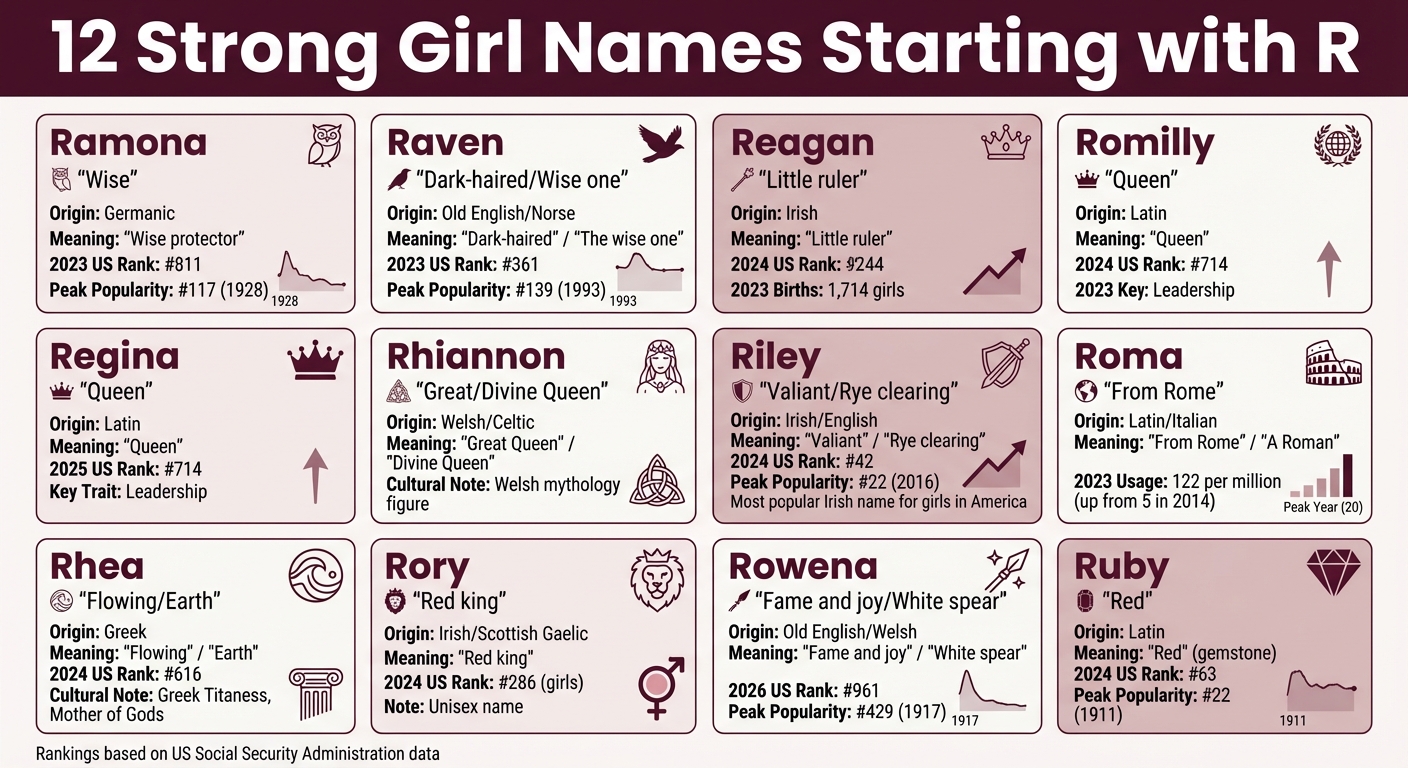
12 Strong Girl Names Starting with R: Origins, Meanings, and Popularity Rankings
1. Ramona
Name Origin and Meaning
Ramona, the feminine counterpart of Ramón, traces its roots back to the Old German name Raginmund. Its components, ragin (meaning "counsel") and munt (meaning "protection"), combine to signify a "wise protector".
"The comforting hand, from the Germanic ragin (counsel) and munt (a protecting hand)." – Mama Natural
This historical depth adds to Ramona’s vintage appeal. While its peak popularity was in 1928, ranking at #117, it has softened in usage over the years. In 2023, it was ranked #811, with 299 babies named Ramona, signaling a modest revival as a charming vintage choice.
Cultural and Historical Significance
Ramona’s significance extends far beyond its linguistic roots. Helen Hunt Jackson’s 1884 novel Ramona brought the name into the spotlight, portraying a resilient, half-Native American heroine navigating life during Spanish colonization. Decades later, Beverly Cleary’s Ramona Quimby series further cemented its legacy, associating the name with a clever, spirited, and independent young character.
The name also carries revolutionary energy, thanks to Comandante Ramona (1959–2006), a prominent leader in the Zapatista Army of National Liberation. She became a symbol of indigenous women’s rights and empowerment in Mexico.
Symbolism of Strength and Empowerment
With its meaning tied to protection, Ramona naturally exudes strength. It’s frequently described as strong, timeless, and wholesome in surveys, and it often appears on lists celebrating bold, heroine-inspired names.
sbb-itb-f13f980
2. Raven
Name Origin and Meaning
The name Raven traces its roots to the Old English hræfn and Old Norse hrafn, both referring to the large black bird from the Corvid family. It also carries meanings like "dark-haired" or "the wise one".
Raven stands out as a name that blends nature, literature, and gothic flair. As one naming expert notes:
"Raven commands attention and inhabits a unique space as a nature name, literary reference, and gothic revival symbol." – Mom Loves Best
Unlike lighter bird-inspired names like Robin or Wren, Raven conveys a more profound, intellectual tone, appealing to parents who want a name with depth and character.
Cultural and Mythological Significance
The name Raven is steeped in rich cultural and mythological history. In Norse mythology, Odin relied on two ravens, Huginn (Thought) and Muninn (Memory), as symbols of wisdom and omniscience. On the West Coast, Native American traditions honor the raven as a transformative figure - often seen as a messenger, trickster, or bringer of light. Even biblical texts mention the raven, which was the first bird Noah released from the ark.
Raven gained widespread popularity in the early 1990s, peaking in 1993 at #139 on the baby name charts. This surge was largely inspired by actress Raven-Symoné's debut on The Cosby Show in 1989, which caused the name to leap 446 spots in just two years. By 2023, Raven ranked #361, with 841 births recorded that year. It continues to resonate, particularly within the African American community and among parents drawn to nature-inspired or alternative names.
These cultural and historical layers give Raven a modern yet timeless appeal.
Symbolism of Strength and Empowerment
Raven has evolved into a name that symbolizes intelligence, independence, and strength. Known for their exceptional problem-solving abilities, ravens are often seen as symbols of cleverness. Their solitary nature - unlike the more social crows - reflects independence and self-reliance. As one source puts it:
"The raven is actually a mysterious, curious, talkative, solo-driven and care-free bird." – Oh Baby! Names
The name also carries connotations of prophecy and foresight, tied to the Latin cry "cras! cras!" meaning "tomorrow". While Victorian-era interpretations often associated ravens with omens and darkness, today's perspectives embrace the bird’s connection to mystery, dark academia aesthetics, and personal empowerment. Raven is a bold choice for parents who value intelligence, independence, and a touch of mystery.
3. Reagan
Name Origin and Meaning
Reagan comes from the Irish surname Ó Riagáin, which means "descendant of Riagán." The name itself combines the Irish word rí (king) with a diminutive suffix, giving it the meaning "little king", "little ruler", or "kingly".
Historically, the Ó Ríagáin clan was part of the "Four Tribes of Tara", a powerful group in the ancient Kingdom of Meath during the 6th century [34,35]. Originally a masculine surname, Reagan has evolved into a unisex first name, particularly popular in North America. In the United States, it has become more commonly used for girls. In 2023, 1,714 baby girls were named Reagan, and it ranked #244 among girls' names in 2024.
Cultural or Mythological Significance
The name Reagan is closely associated with Ronald Reagan, the 40th President of the United States, whose time in office (1981–1989) contributed to the name's surge in popularity during the 1980s [34,41].
In literature, Reagan (spelled as Regan) appears in Shakespeare's King Lear as one of the king's three daughters. The name also has a modern cultural presence through figures like actress Reagan Gomez-Preston and singer Reagan Strange from The Voice. As described by one expert:
"Reagan is a name that manages to feel both polished and spirited, straddling the line between a distinguished surname and a friendly first name." – Mom Loves Best
Symbolism of Strength and Empowerment
Reagan carries a sense of authority and approachability. With its roots in royalty - literally meaning "little king" - the name conveys dignity and leadership. The historical ties to the Ó Ríagáin clan, known for their influence in Irish politics and their resistance against Viking invaders, further highlight its connection to resilience and strength [34,35].
The name reflects personal power and a sense of destiny. The association with a U.S. president adds to its commanding presence, while its modern usage reflects confidence and adaptability. As naming expert Keshia Roelofs noted:
"Reagan embodies a youthful majesty, holding great promise and a calming presence." – Keshia Roelofs, Editor, The Bump
Reagan is well-suited for someone destined for leadership, offering a balance of elegance and strength. Its rise as a feminine first name reflects the broader trend of adopting Irish surnames with a sophisticated sound, making it a bold yet approachable choice [34,38]. This combination of royal heritage and contemporary appeal makes Reagan a name that stands out with purpose and charm.
4. Regina
Name Origin and Meaning
The name Regina comes from the Latin word for "queen" and is tied to rex (Latin for "king") and the Proto-Indo-European root reg-, meaning "to lead" or "to rule." This connection suggests not only royalty but also the qualities of leadership and authority.
Historically, Regina has crossed cultural boundaries. For instance, Queen Victoria used "Regina" as part of her official title, and the Canadian city of Regina was named in her honor, further cementing its regal legacy.
Religious and Historical Significance
Regina's history and religious associations add depth to its significance.
The name carries spiritual weight, as seen in Saint Regina and its use as an honorific for the Virgin Mary, often referred to as "Regina Coeli" or "Queen of Heaven." Variations of the name appear in different languages - like Reina in Spanish, Régine in French, Raina in Bulgarian, and Ríona in Irish - yet all retain the meaning of "queen."
In the U.S., Regina holds the #714 spot in baby name rankings, with approximately 735 babies per million expected to receive the name in 2025. While its popularity dipped from the 1980s to 2009, it has recently gained traction as parents gravitate toward names that are timeless and carry a sense of strength.
These layers of cultural and spiritual meaning contribute to Regina's lasting appeal as a name that balances tradition with elegance.
Symbolism of Strength and Leadership
Regina radiates confidence and authority. As Mama Natural puts it:
"Regina is Latin for 'queen,' and it's a strong, powerful name with a regal air about it. It's a name that suggests a woman who is confident, self-assured, and able to lead."
The name is frequently linked to qualities like strength, refinement, and maturity in surveys. Prominent individuals like Academy Award-winning actress Regina King and singer-songwriter Regina Spektor further showcase the name's commanding presence. By blending royal heritage, religious significance, and modern charm, Regina stands as a name that embodies both power and grace.
5. Rhiannon
Name Origin and Meaning
Rhiannon has its roots in Welsh and Celtic traditions, originating from the reconstructed Old Celtic name Rigantona. The name translates to "Great Queen" or "Divine Queen," combining the Celtic root rigan- (queen) with the divine suffix -on. This name carries a sense of authority and strength, reflecting its regal and powerful origins.
The name Rhiannon saw a revival during the late 19th century when old Welsh names regained popularity. In the U.S., it experienced a surge in use following Fleetwood Mac's iconic song but has since declined in modern baby name apps.
Mythological and Legendary Significance
Rhiannon is a prominent figure in the Mabinogi, a collection of medieval Welsh legends. Her introduction is unforgettable - she appears riding a pale-white horse that moves at a leisurely pace, yet no one can catch her unless she allows it. This otherworldly entrance highlights her mystique and power.
She is deeply connected to horses and is often compared to Epona, the Gaulish horse goddess. Rhiannon is also linked to the "Birds of Rhiannon" (Adar Rhiannon), mythical creatures known for their magical songs that could "wake the dead and lull the living to sleep". Historian Ronald Hutton described her as "one of the great female personalities in World literature".
Symbolism of Strength and Resilience
Rhiannon’s story in the Mabinogi is a testament to her independence and inner strength. She defied societal expectations by choosing her own husband, Pwyll, over an arranged marriage, using her wit and magical abilities to secure her choice. Scholar Miranda Green notes that Rhiannon embodies two classic mythological archetypes: the gracious and generous queen-goddess, and the "wronged wife" falsely accused of a crime.
Her resilience shines through when she endures a seven-year penance after being falsely accused of infanticide. Forced to sit at the castle gate and bear travelers on her back, she maintained her dignity until her innocence was proven. The Mabinogi portrays her as "strong-minded", "intelligent", and "politically strategic", making Rhiannon an inspiring name for those who value both grace and determination. Up next, explore another R name that radiates a modern, energetic vibe.
6. Riley
Name Origin and Meaning
Riley brings together Irish and English origins, blending meanings of bravery and nature. From the Irish surname Ó Raghallaigh, it translates to "valiant" or "courageous", rooted in the personal name Raghallach, associated with a historical figure who fell in the Battle of Clontarf in 1014 AD. On the English side, Riley comes from Old English terms ryge ("rye") and lēah ("wood", "clearing", or "meadow"), describing a "rye clearing". This dual heritage gives Riley its modern charm, combining strength with a connection to nature.
Cultural and Historical Significance
The O'Reilly clan, known for ruling the Kingdom of Breifne (modern-day County Cavan), solidified Riley's association with Irish power and legacy. In the U.S., Riley entered the top 1,000 baby girl names in 1990 at rank 827 and reached its highest point at 22 in 2016. By 2024, it remained a popular choice, ranking 42nd among girls' names and holding the distinction of being the most popular Irish name for girls in America.
Symbolism of Strength and Empowerment
Riley weaves together the courage of Irish warriors with the calm imagery of a meadow, making it a name that represents both strength and gentleness. Nameberry describes it as:
"Riley - an upbeat, friendly surname name - is red hot for girls and still going strong for boys"
This evolution highlights its growing appeal as a gender-neutral choice that resonates with modern parents. Riley's dual meanings - bravery and serenity - offer an inspiring balance, making it a name that embodies empowerment and grace for girls. Its unique blend of heritage and symbolism ensures its enduring popularity among strong, meaningful names.
7. Rhea
Name Origin and Meaning
The name Rhea is rooted in the Greek word rheo, meaning "flowing" or "stream", and is also tied to the Greek word era, which translates to "earth." This blend of meanings suggests a balance between movement and groundedness. In the U.S., it's typically pronounced "REE-ah", while "RAY-ah" is more common in Europe and India.
Cultural and Mythological Significance
In Greek mythology, Rhea stands as a Titaness, the daughter of Gaia (Earth) and Uranus (Sky), and is revered as the "Mother of the Gods." She gave birth to Zeus, Poseidon, Hades, Hera, Demeter, and Hestia - the first generation of Olympian deities. The name also appears in Roman mythology through Rhea Silvia, the mother of Romulus and Remus, the legendary founders of Rome.
After falling off the U.S. top 1,000 names list in 1968, Rhea made a comeback in 2015 and has been steadily climbing, reaching #616 in 2024. In Ireland, it surged into the Top 100 as the fastest-rising girls' name of the year. These stories and trends underscore Rhea's lasting appeal and connection to resilience and strength.
Symbolism of Strength and Empowerment
Rhea's mythological tales highlight her maternal bravery and cleverness. She famously saved Zeus from Cronus by substituting a stone in swaddling clothes, a move that required both wit and courage. Some myths even describe her as "skilled in wrestling", including a struggle with the goddess Eurynome to secure her position as a ruler.
As Maryana Vestic, writer and editor, notes:
"It is soft on the ear but strong in history, suitable for parents looking for a name that is feminine but undeniably powerful".
Modern icons like WWE champion Rhea Ripley and NASA astronaut Rhea Seddon - who flew on three Space Shuttle missions between 1985 and 1993 - further cement the name's association with strength and determination.
8. Roma
Name Origin and Meaning
Roma stands out as a name that carries both historical depth and modern strength. Rooted in Latin and Italian origins, it derives from Rome, famously known as the "Eternal City", and from Romanus, meaning "a Roman" or "from Rome." This connection to one of history’s most enduring civilizations gives the name an air of authority and resilience.
In Hindu tradition, Roma holds an entirely different yet equally rich meaning, signifying "one with shiny hair." It is also associated with the goddess Lakshmi, symbolizing wealth, fortune, and prosperity. Beyond these interpretations, Roma has a geographic connection in Spain, where it serves as a habitational name linked to regions like Valencia and Galicia. These varied roots make Roma a name steeped in both history and cultural significance.
Cultural and Mythological Significance
In Roman mythology, Roma was more than just a name - it was personified as a feminine deity who embodied the essence of the city of Rome. She represented its culture, values, and enduring influence, making her a symbol of strength and authority.
The name has grown in popularity in the United States, with its usage increasing from 5 occurrences per million babies in 2014 to 122 per million in 2023. This surge reflects a broader appreciation for names that balance historical richness with contemporary appeal.
Symbolism of Strength and Empowerment
Roma is a name that resonates with resilience and timeless endurance, much like the city it represents. Known as the "Eternal City", Rome has stood as a symbol of strength for millennia, and the name Roma carries that legacy forward. As NamingQuest notes:
"Roma is imbued with timeworn elegance, bearing tales of an ancient city... a stoic bastion"
This connection to an ancient civilization, combined with its role in both Roman and Hindu traditions, highlights Roma's empowering qualities. Figures like Roma Mitchell, the first woman to serve as Governor of an Australian state, and actress Roma Downey further showcase the name’s association with leadership and achievement. Roma continues to be a name that exudes strength, history, and multifaceted significance.
9. Romilly
Name Origin and Meaning
Romilly stands out as a name with a rich blend of Latin, French, and Old English roots. It traces back to the Latin Romilius, which is tied to Romulus, the legendary founder of Rome. The name also carries connections to French towns like Romilly-sur-Seine and Romilly-sur-Aigre, as well as Old English elements like rum (spacious) and leah (woodland clearing). Together, these influences give Romilly meanings like "citizen of Rome" or "from the village surrounded by meadows". In Welsh tradition, Romilly links to Rhiwallon, which translates to "strong ruler".
Cultural or Mythological Significance
Romilly made its way to England during the Norman Invasion of 1066, introduced as a surname by Robert De Rumilly. Over time, it gained recognition in literature, appearing as a brave Trojan warrior in Homer’s Iliad and in Samuel Taylor Coleridge’s "The Rime of the Ancient Mariner". More recently, the name found a place in pop culture through Dr. Romilly, a NASA scientist in the 2014 film Interstellar.
In the United States, Romilly has seen a gradual rise in popularity. It first appeared in Social Security Administration data in 2013, with seven baby girls receiving the name. By 2024, that number had grown to 20, marking its peak so far. This steady growth highlights its increasing appeal thanks to its distinctive sound and layered history.
Symbolism of Strength and Empowerment
Romilly carries a strong legacy of resilience and reform, particularly through its association with Sir Samuel Romilly (1757–1818). A key figure in English history, he was a legal reformer and abolitionist who worked tirelessly to overturn harsh criminal laws and combat slavery. His dedication to justice and moral courage adds a layer of principled strength to the name.
The name also holds an air of intellectual sophistication, tied to the Romilly family in Britain, known for their contributions to politics and academia. This includes the 1st Baron Romilly, further cementing its reputation for leadership and distinction. As NamingQuest notes:
"The name is attached to a British family of scholars and politicians... which has further lent it an air of intellectualism and distinction"
Romilly seamlessly combines historical depth with a sense of reformist spirit, making it a name that symbolizes strength, intellect, and independence.
10. Rory
Name Origin and Meaning
Rory, a name with roots steeped in Irish and Scottish Gaelic traditions, originates from Ruaidhrí (Irish) and Ruairidh (Scottish Gaelic), translating to "red king." The name combines the Gaelic words ruadh (red) and rí (king). While it was historically a masculine name, Rory has gained traction as a unisex choice, especially in the United States and Canada since the early 2000s. In 2024, it ranked 286th among girls in the U.S.. This blend of heritage and adaptability gives Rory a timeless appeal.
Cultural or Mythological Significance
Rory carries a legacy of strength and leadership. Historical figures like Ruaidrí Ua Conchobhair (Rory O'Connor), the last High King of Ireland (1166–1170), symbolize its noble heritage. He famously defended Irish sovereignty against Anglo-Norman forces. In popular culture, Rory is equally iconic, thanks to Lorelai "Rory" Gilmore from the beloved series Gilmore Girls (2000–2007). The name also boasts a lineage of at least 10 Irish kings and lords. Modern bearers like Rory Elizabeth Katherine Kennedy, an acclaimed documentary filmmaker and the youngest daughter of U.S. Senator Robert F. Kennedy, further cement its association with strength and independence. These connections highlight Rory's enduring reputation as a name tied to resilience and distinction.
Symbolism of Strength and Empowerment
With its meaning of "red king", Rory embodies qualities of nobility and vigor. Choosing this name for a daughter reflects a modern embrace of strength and independence, blending traditional masculinity with contemporary versatility. Its rise as a unisex name mirrors a broader trend toward names that balance power with warmth. In 2022, Rory ranked 335th for girls and 280th for boys in the U.S.. The association with the color red adds an extra layer of vitality, suggesting a spirited, energetic personality ready to take on leadership roles. Rory is a name that carries both historical weight and a modern sense of empowerment.
11. Rowena
Name Origin and Meaning
Rowena carries a mix of historical and linguistic roots. One interpretation ties it to Old English, combining hroð ("fame") and wynn ("joy" or "bliss"), which gives it the meaning "fame and joy." Another theory links it to Welsh origins, where rhon ("spear" or "pike") and gwen ("white", "fair", or "blessed") suggest meanings like "white spear" or "slender and fair".
The name gained prominence through Sir Walter Scott's 1819 novel, Ivanhoe, where Rowena is portrayed as a noble Saxon heroine. In the United States, Rowena reached its peak popularity in 1917, ranking at #429. However, by 2014, only 14 baby girls were given the name. Fast forward to early 2026, Rowena has seen a revival, ranking #961 in the U.S. and #229 on Nameberry, reflecting a growing appreciation for vintage literary names.
Cultural or Mythological Significance
Rowena's origins are steeped in legend and history. In British lore, she is described as the daughter of the Saxon leader Hengist and the wife of King Vortigern, a story chronicled in Geoffrey of Monmouth's Historia Regum Britanniae from the 12th century. In Welsh tradition, she is known as Rhonwen and is celebrated as the "Mother of the English Nation". Additionally, Frisian folklore credits her with introducing the tradition of the "welcoming kiss" to England.
In modern times, Rowena has found a place in pop culture. Rowena Ravenclaw, a character from the Harry Potter series, represents creativity and intellectual excellence. Meanwhile, Rowena MacLeod from Supernatural brings a different energy as a 300-year-old witch known for her magical abilities, adding layers of mystique and resilience to the name.
Symbolism of Strength and Empowerment
The interpretation of "white spear" conjures images of a warrior, while "fame and joy" suggests a leader who uplifts and inspires. Many view Rowena as a name that exudes strength, maturity, and a sense of formality. It's often highlighted on lists of names associated with heroines. Pamela Redmond of Nameberry aptly describes it:
"Rowena is a retro feeling choice with literary charm".
With its historical depth and connotations of strength, Rowena stands as an empowering and timeless choice.
12. Ruby
Name Origin and Meaning
The name Ruby comes from the Latin word ruber, which means "red." Over time, it evolved through Medieval Latin rubinus to describe the red gemstone we know today. While its roots are ancient, Ruby didn't emerge as a given name until the 16th century. It gained popularity in the late 19th century during the Victorian era, a time when gemstone-inspired names like Pearl and Opal were in vogue.
Ruby is directly tied to the gemstone, which is the traditional birthstone for July. In the U.S., the name reached its highest rank at #22 in 1911. After a long period of decline, Ruby made a comeback, reentering the Top 100 in 2013 and climbing to #63 in 2024. Its appeal isn’t limited to the U.S.; Ruby is also a favorite internationally, ranking #12 in New Zealand and #19 in Australia in 2024.
Cultural or Mythological Significance
In Hinduism, the ruby is revered as the "king of gemstones" (Ratnaraj), linked to the sun and believed to promote both physical and mental well-being. The gemstone is also mentioned in the Bible, where it appears as one of the stones on the High Priest’s ceremonial breastplate. Folklore from ancient times describes rubies as containing an eternal, inextinguishable flame, symbolizing vitality and resilience.
The name Ruby holds biblical significance as well. Proverbs 31:10 famously states: "A virtuous woman's price is 'far above rubies'". In Catholic tradition, the ruby’s red color is sometimes associated with divine love. A modern historical connection comes from Ruby Bridges, born in 1954, who became a symbol of the American civil rights movement as the first African American child to integrate an all-white elementary school in the South.
Symbolism of Strength and Empowerment
The ruby gemstone is known for its incredible hardness - it’s the third hardest mineral - making it a symbol of strength and lasting energy. This toughness is reflected in the name Ruby, which is often seen as vibrant and full of life. Pamela Redmond Satran and Linda Rosenkrantz, authors of The Baby Name Bible, describe Ruby as having a "sassy and sultry" charm. Unlike more delicate Victorian-era names, Ruby exudes a lively and dynamic personality.
Often called the "King of Gems", the ruby represents power, success, and protection. The name has also earned its place as a "comeback queen", following the "100 Year Rule", where names popular in the 1910s experience a revival a century later. With its ties to passion, vitality, and historical courage, Ruby is a bold choice that blends a vintage feel with a modern sense of resilience and strength. Its enduring appeal makes it both radiant and robust, a name that truly stands the test of time.
Conclusion
These R names beautifully intertwine heritage with a sense of modern strength. From Ramona's protective wisdom to Ruby's enduring resilience, each name carries a story of leadership, courage, and historical significance. Whether you’re drawn to the commanding presence of Regina and Rhiannon, the mythological charm of Rhea, or the bold spirit of Riley and Rory, these names provide a meaningful foundation for a bright future.
Choosing the perfect name is deeply personal. For instance, Riley continues to lead as the most popular R name for girls in the U.S., with over 7,000 babies receiving the name in 2023. Meanwhile, nature-inspired choices like Raven are gaining traction among parents seeking names that feel distinct yet meaningful.
To simplify your search, NameHatch offers an easy-to-use platform. With its Tinder-style swipe interface, you can filter names by origin (like Gaelic, Latin, or Welsh), meaning (such as "wise protector", "courageous", or "queen"), or style (vintage, modern, or nature-inspired). The partner matching feature even allows real-time collaboration, letting you and your partner explore options together. Try saying each name aloud with your last name or imagining it in professional contexts - like "Dr. Ramona" or "Judge Reagan" - to see how it fits. As naming expert Alex Holland explains:
"Choosing your daughter's name is one of the most beautiful gifts you'll give her – it's the word she'll hear most often, the foundation of her identity, and the beginning of her story."
Whether you’re inspired by meanings like "queen", "protector", or "red king", these R names offer strength, elegance, and a legacy to carry forward. Start curating your list today and find a name that will inspire and empower her throughout her life.
FAQs
Which R girl names are the most popular in the U.S. right now?
As of 2024, some of the most popular girl names in the U.S. that start with the letter "R" are Riley, Ruby, Reagan, Raelynn, and Reese. These names have captured attention for their blend of modern style and enduring appeal.
How do I choose between a vintage R name and a modern R name?
When choosing a name for your daughter, think about the style and meaning you want it to carry. Vintage R names such as Rachel, Ruth, and Rebecca have a timeless charm. These names often come with historical or biblical significance, offering a sense of tradition and familiarity. On the other hand, modern R names like Ryleigh, Raelynn, and Ripley bring a trendy and distinctive feel, showcasing individuality. Whether you lean toward classic elegance or a more current, fresh vibe, both styles can reflect qualities like strength and resilience.
What are strong middle names that pair well with R girl names?
Strong middle names for girl names starting with "R" include timeless picks like Grace, Elizabeth, and Marie, as well as more distinctive options like Rae, Luna, and Jade. The best choice depends on whether you're going for a classic feel or something a bit more unique.