Girl names beginning with "P" stand out for their charm, historical significance, and timeless appeal. From mythological roots to literary elegance, these names offer a mix of strength, grace, and individuality. Whether you're drawn to popular picks like Penelope or rare gems like Perpetua, there's a name to suit every style and story.
Here are nine standout "P" names for girls:
- Penelope: Rooted in Greek mythology, symbolizing loyalty and cleverness. Nicknames include Penny, Nell, and Poppy.
- Portia: Famous from Shakespeare's works, known for intelligence and sophistication.
- Priscilla: A biblical name with historical depth and versatile nicknames like Pris and Cilla.
- Philippa: A royal and literary name meaning "lover of horses", with playful nicknames like Pippa and Pip.
- Perpetua: A rare Latin name tied to early Christian martyrdom, meaning "everlasting."
- Phoebe: Bright and radiant, with ties to Greek mythology and popular culture.
- Philomena: Meaning "lover of strength", this name combines vintage charm with modern relevance.
- Patience: A virtue name reflecting endurance and grace, popular among Puritans.
- Persephone: A mythological name associated with the changing seasons and rich symbolism.
These names balance historical depth with contemporary flair, offering a range of options from classic to unique. Whether you're inspired by mythology, literature, or virtue, these "P" names provide meaningful choices for your baby girl.
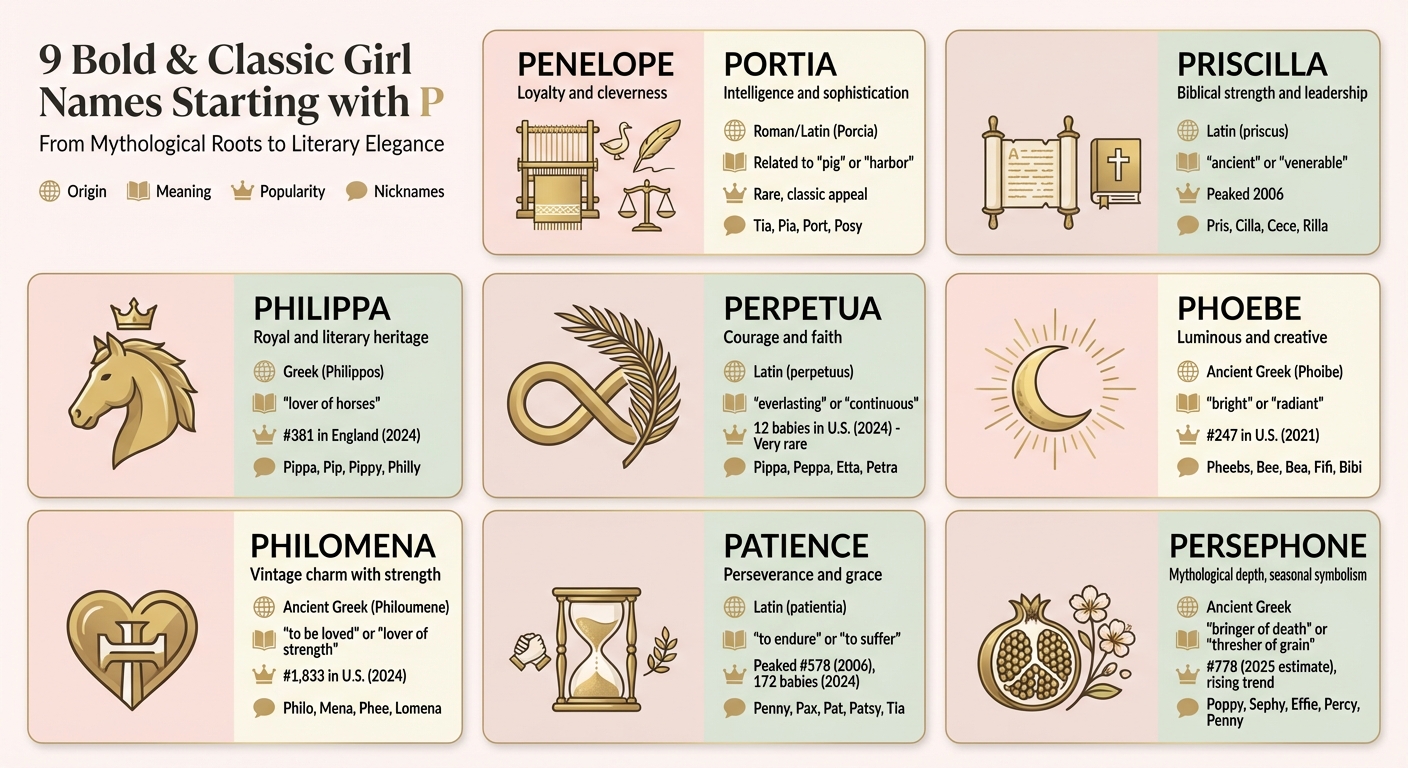
9 Girl Names Starting with P: Origins, Meanings, and Popularity Comparison
1. Penelope
Meaning and Origin
The name Penelope comes from Ancient Greek, rooted in the words pēnē (meaning "weaver") and ops/lepo. It may also connect to pēnelops, a type of wild goose revered for its resourcefulness and adaptability.
Historical and Literary Significance
Penelope's legacy shines through Homer’s Odyssey, where she is celebrated as the devoted wife of Odysseus. For 20 years, she cleverly resisted 108 suitors while awaiting Odysseus's return from the Trojan War. Her ingenious strategy of weaving a burial shroud by day and unraveling it by night made her name a symbol of loyalty and cleverness. This timeless story continues to resonate, giving the name an enduring sense of strength and ingenuity.
Enduring Popularity
Penelope has been part of English-speaking cultures since the mid-16th century, maintaining its charm across centuries. Its modern resurgence owes much to pop culture, with Kourtney Kardashian naming her daughter Penelope in 2012, boosting the name to No. 28 in U.S. baby name rankings. Celebrities like Penélope Cruz and characters from shows like Bridgerton have further cemented its appeal.
Versatility and Charm
With its rich mythological roots, Penelope embodies resilience and independence. The name also offers a wide range of nickname options, from classics like Penny and Nell to more contemporary choices such as Poppy, Pip, and Pepper, making it adaptable for any personality.
sbb-itb-f13f980
2. Portia
Meaning and Origin
Portia carries a mix of historical weight and contemporary charm. The name comes from the Roman family name Porcia, which traces its roots to the Latin word porcus (meaning "pig"). Some also connect it to portus (harbor) or portitor (gatekeeper). Originally a surname, it transitioned into a first name, gaining prominence thanks to Shakespeare. This layered origin gives Portia a rich historical and linguistic background.
Historical and Pop Culture Significance
Portia owes much of its fame to Shakespeare’s The Merchant of Venice. In the play, Portia is an intelligent and resourceful heiress who disguises herself as a male lawyer to save Antonio, delivering the iconic line, "The quality of mercy is not strained." Beyond fiction, the name has historical significance through Porcia Catonis, the wife of Marcus Junius Brutus, remembered for her stoic strength and loyalty.
In modern times, Portia has been kept in the spotlight by figures like actress Portia de Rossi, known for her roles in Arrested Development and Ally McBeal. Portia White, a trailblazing Canadian concert singer, further cemented the name’s association with talent and resilience.
Timeless Appeal
Though not widely used today, Portia retains its allure as a name that feels both classic and current. It has appeared in popular TV series like Bridgerton (Portia Featherington) and The White Lotus, reinforcing its association with sophistication. The name carries an air of refinement while remaining approachable, with endearing nicknames such as Tia, Pia, Port, or Posy adding to its charm.
Strength and Elegance
Portia’s enduring appeal comes from its association with intelligence, determination, and grace. Shakespeare’s Portia embodies legal brilliance and wit, while the historical Porcia reflects unwavering moral courage. These qualities give the name a reputation for strength and poise.
As Julia Bancroft, Assistant Editor at Name.baby, observes:
"Portia continues to evoke an image of classical erudition and measured refinement, appealing to those who favor names imbued with historical depth."
While variations like Porsha, Porshia, and Porsche exist, the traditional spelling of Portia remains tied to its literary and historical roots, making it a sophisticated choice for those seeking a name with depth and elegance.
3. Priscilla
Meaning and Origin
The name Priscilla traces back to the Latin word priscus, which translates to "ancient" or "venerable." Originally a diminutive of the Roman family name Priscus, it carries a sense of timelessness and dignity. With roots stretching back over two millennia, the name has stood the test of time.
Historical and Biblical Significance
Priscilla holds a notable place in biblical history. She appears in the New Testament as a key figure in early Christianity, working alongside the apostle Paul as a teacher and tentmaker. Interestingly, her name is often mentioned before her husband Aquila, a detail that many scholars interpret as evidence of her prominence and leadership in the early church. This legacy highlights qualities like intelligence, strength, and spiritual courage.
The name gained renewed popularity among the Puritans in the 17th century, who admired its biblical modesty. Priscilla Mullins, a passenger on the Mayflower who later became Priscilla Alden, helped introduce the name to America. Her story was later immortalized in Henry Wadsworth Longfellow's 1858 poem The Courtship of Miles Standish, with its famous line: "Prithee, John, why do you not speak for yourself?" Over the years, figures like actress Priscilla Lane and Priscilla Presley have kept the name in the spotlight.
Timeless and Versatile Appeal
Priscilla strikes a balance between grace and approachability. It carries an air of elegance while remaining relatable. The name's literary presence in works like Edmund Spenser’s The Faerie Queene and Nathaniel Hawthorne’s The Blithedale Romance further enhances its enduring charm. Meanwhile, modern figures like Priscilla Chan contribute to its continued relevance, bridging its historical depth with contemporary appeal.
Nicknames and Global Variations
One of the name's strengths lies in its adaptability. Nicknames such as Pris, Cilla, Cece, Scilla, or Rilla offer options for both formal and casual settings. International versions like Priscila (Spanish/Portuguese), Priscille (French), and Priska (German) showcase its global reach while staying true to its ancient origins. This blend of flexibility and history makes Priscilla a name that feels both timeless and universally appealing.
4. Philippa
Meaning and Origin
Philippa traces its roots to the Greek name Philippos, which merges philos (meaning "friend" or "lover") and hippos ("horse"). Together, the name signifies "lover of horses" or "friend of horses". This equestrian connection dates back to King Philip II of Macedon, the father of Alexander the Great, who was famously fond of horses. The name Philippa began appearing in medieval church records as a distinctly feminine form of Philip, and by the 1800s, it had firmly established itself as a feminine name in English.
Cultural or Historical Background
Philippa boasts a rich history, steeped in royalty and literature. Two notable queens carried the name: Philippa of Hainault (1310–1369), queen consort to Edward III of England, and Philippa of Lancaster (1360–1415), who became Queen of Portugal. The name also has literary ties through Philippa de Roet, wife of the renowned medieval poet Geoffrey Chaucer. Beyond its royal and literary connections, Philippa has been associated with accomplished women like Philippa Fawcett, the first woman to top the Cambridge Mathematical Tripos, and Philippa Boyens, the Oscar-winning screenwriter of The Lord of the Rings.
Classic and Modern Appeal
Philippa has been a popular choice in England since the 14th century, but it gained renewed attention in 2011 during the wedding of Prince William and Catherine Middleton. The bride's sister, Philippa "Pippa" Middleton, served as maid of honor, sparking fresh interest in both Philippa and its nickname, Pippa. In the United Kingdom, Philippa has been among the top 1,000 names since 1996, climbed to the top 200 by 2012, and ranked #381 in England in 2024. However, it has yet to break into the Top 1,000 names in the United States, making it a distinctive and timeless option for American parents.
Strength and Flexibility
Philippa strikes a balance between sophistication and playfulness. While the full name exudes elegance and formality, its nicknames - Pippa, Pip, Pippy, and Philly - add a lighthearted, approachable touch. The nickname Pippa has even become a standalone favorite, ranking in the Top 100 in Ireland, Australia, and New Zealand. Variations like Filippa (Italian/Swedish), Felipa (Spanish), and Philippine (French) showcase its versatility across different languages and cultures. This combination of regal charm and everyday adaptability makes Philippa a name that transitions effortlessly between professional settings and casual conversations.
5. Perpetua
Meaning and Origin
The name Perpetua comes from the Latin word perpetuus, meaning "continuous", "everlasting", or "perpetual". It gained recognition in the 3rd century through Vibia Perpetua, a noblewoman from Carthage who became a Christian martyr in 203 AD. Pronounced as either per-PEH-twa or per-PET-yoo-ah, the name also has international variations like Perpétua in Portuguese and Spanish, and Perpétue in French.
Historical and Religious Significance
Saint Perpetua is celebrated for her courage and faith, leaving behind one of the earliest first-person narratives of imprisonment and spiritual visions in The Passion of Saints Perpetua and Felicity. At just 22 years old and a nursing mother, she stood firm in her beliefs despite facing immense pressure to renounce her faith. Today, she is honored as the patron saint of mothers, expectant mothers, ranchers, and butchers. Her feast day is observed on March 7 in Western Christian traditions and February 1 in Eastern Orthodox churches. This rich history adds a deep sense of meaning to the name, making it resonate even in modern times.
Usage and Popularity
Perpetua remains a rare choice in the United States. In 2024, only 12 baby girls were named Perpetua, with its highest recorded usage occurring in 2013, when 17 girls per million were given the name. It has never ranked within the Top 2,000 names in U.S. naming records. However, it holds steady appeal in Catholic communities and countries like Portugal, Italy, and Spain. The name also gained a pop culture reference as the difficult coworker in Bridget Jones's Diary.
Timeless Elegance and Modern Options
Perpetua's historical weight is balanced by its adaptability. Despite its four syllables, it offers charming nickname options like Pippa, Peppa, Etta, or Petra, making it approachable and versatile. The full name exudes a sense of strength, formality, and refinement, ideal for professional settings, while the nicknames provide a more casual and friendly feel. As Emma Lawler, a Senior Content Writer at The Bump, puts it:
This Latin girl's name will remind baby of how long your love for them will last.
With its blend of historical significance and modern flexibility, Perpetua stands out as a name that bridges the past and present beautifully.
6. Phoebe
Meaning and Origin
The name Phoebe originates from the Ancient Greek name Phoibe (Φοίβη), which stems from the Greek word phoibos, meaning "bright" or "radiant". It is the feminine form of Phoebus, a title often associated with the Greek god Apollo. In Greek mythology, Phoebe is a Titan linked to the moon and prophecy, and she is also recognized as the grandmother of Artemis and Apollo. The name has a biblical connection as well, appearing in the New Testament (Romans 16:1–2) where Phoebe is described as a deaconess of the church in Cenchreae and a trusted messenger for the Apostle Paul. These deep roots give the name a timeless and meaningful foundation.
Cultural or Historical Background
Phoebe gained popularity in England after the Protestant Reformation and was fairly common in the 19th century. The name made its way into literature, with William Shakespeare featuring a lively shepherdess named Phoebe in As You Like It. It also appeared in classic American works like J.D. Salinger’s The Catcher in the Rye and Nathaniel Hawthorne’s The House of the Seven Gables. Beyond literature, Phoebe has made its mark in science: one of Saturn’s moons bears the name, and a genus of North American flycatcher birds, known for their distinct call, is also called "Phoebe".
Classic and Modern Appeal
Phoebe saw a revival in the 1990s, thanks in part to iconic pop culture characters like Phoebe Buffay from Friends and Phoebe Halliwell from Charmed. This resurgence brought the name back into the spotlight for modern parents, blending its vintage charm with contemporary appeal. In 2021, Phoebe ranked as the 247th most popular girl name in the United States, with nearly all registrations being for girls. The name also remains a favorite in the United Kingdom, Australia, and New Zealand. As noted by Mom Loves Best:
Phoebe is an exceptional choice for a baby born in 2026. It offers a 'Goldilocks' level of popularity, familiar but not ubiquitous, and possesses a radiant meaning that will serve as a beautiful legacy for your child.
Strength and Flexibility
Phoebe’s strength lies in its ability to balance its mythological depth with a modern, creative edge. It works well in both formal and casual settings, offering nicknames like Pheebs, Bee, Bea, Fifi, and Bibi for added flexibility. Additionally, variations such as Febe in Italian, Spanish, Portuguese, and Dutch showcase its global adaptability. The name continues to shine through contemporary figures like singer Phoebe Bridgers, actress and writer Phoebe Waller-Bridge, and actress Phoebe Dynevor, further cementing its place as a name that feels both classic and fresh.
7. Philomena
Meaning and Origin
The name Philomena comes from the Ancient Greek Philoumene (Φιλουμένη), which means "to be loved." It combines philos (meaning "love") and menos (meaning "strength"), giving it a layered meaning of "lover of strength" or "friend of strength".
Historically, Philomena is closely tied to Saint Philomena, a young martyr whose remains were uncovered in Rome's Catacomb of Priscilla in 1802. This discovery inspired a resurgence of the name, especially in Italy. Known as "The Wonderworker", Saint Philomena is celebrated as the patron saint of babies, infants, and youth. In the United States, the name reached its height of popularity in 1915, ranking at #355 and accounting for 0.028% of baby girls born that year.
Cultural or Historical Background
Philomena’s rich history extends beyond its religious roots. After Saint Philomena's rediscovery in 1802, the name gained widespread attention in Italy and other countries. It also appeared in literature, such as Giovanni Boccaccio's The Decameron, and has been adapted into various forms, including Filomena (Italian, Spanish, Portuguese), Philomène (French), and Filimena (Macedonian). In more recent times, the 2013 film Philomena helped keep the name in the spotlight. By 2024, 110 baby girls in the U.S. were named Philomena, showing its continued, albeit modest, usage.
Classic and Modern Appeal
Philomena strikes a balance between old-world charm and modern sensibility. Its flowing, four-syllable sound gives it a distinctive elegance, while its rarity adds to its allure. In 2024, it ranked #1,833 for girls in U.S. births, making it a less common yet appealing choice. Emily McNamara, Senior Content Writer at The Bump, describes it well:
This vintage-chic title has already stood the test of time, proving to be a classic choice for baby.
Strength and Flexibility
What makes Philomena even more appealing is its adaptability. While it carries a formal and elegant tone, it offers plenty of nickname options like Philo, Mena, Phee, Phila, and Lomena. Families with Italian, Spanish, or Portuguese roots might also prefer the variant Filomena. Its association with strength and resilience resonates with modern parents seeking names with deeper, empowering meanings.
8. Patience
Meaning and Origin
The name Patience traces its roots to the Latin word patientia, which comes from pati, meaning "to suffer" or "to endure." It made its way into English through Old French as pacience. At its heart, the name reflects the qualities of endurance, tolerance, and the ability to persist through challenges.
During the 17th century, Puritans introduced Patience as one of the virtue names, aiming to inspire moral strength and spiritual growth. Within Christianity, patience is viewed as a key virtue and even considered a gift of the Holy Spirit.
Historical and Literary Background
After vanishing from U.S. birth records for nearly a century, Patience made a comeback in 1994, re-entering the Top 1,000 names. Its popularity peaked in 2006, ranking at #578 with 508 occurrences per million. This resurgence may have been partly influenced by the 2004 movie Catwoman, where Halle Berry's character is named Patience Phillips.
The name has also left its mark on literature, appearing in works like Shakespeare’s Henry VIII, Anthony Trollope’s The Eustace Diamonds, and Gilbert & Sullivan’s operetta Patience. Today, it remains particularly popular in English-speaking African nations such as Nigeria, Ghana, and Gabon. By 2024, 172 baby girls in the U.S. were given this name, showcasing its enduring appeal.
Timeless and Modern Appeal
Pamela Redmond of Nameberry highlights the name's unique charm, stating:
Patience is a passive virtue turned engaging name, fresher than Hope, Faith, or even Charity.
Its revival in the late 20th and early 21st centuries may have been helped by its phonetic closeness to the trendy name Payton. Though it has declined in popularity since its 2006 peak, Patience continues to stand out among virtue-inspired names.
Strength and Versatility
While the name carries a formal tone, it offers plenty of flexibility. Nicknames like Penny, Pax, Pat, Patsy, Patty, and Tia make it approachable and adaptable. Variants include Paciencia in Spanish, Pazienza in Italian, and Patienza. As Ashley from MomsWhoThink puts it:
The name Patience evokes feelings of perseverance and pristine character.
This combination of strength and grace ensures Patience remains a meaningful and distinctive choice.
9. Persephone
Meaning and Origin
The name Persephone comes from the Ancient Greek Περσεφόνη and may trace back even further to Pre-Greek origins. Scholars debate its exact meaning. One interpretation combines pherein ("to bring") and phonos ("death" or "murder"), suggesting "bringer of death" or "destroyer." Another theory ties it to agriculture, translating it as "she who beats the ears of corn" or "thresher of grain", linking her to Demeter, the goddess of harvest. These contrasting meanings reflect Persephone’s dual role as a symbol of both spring's renewal and the queen of the underworld.
Cultural and Historical Background
In Greek mythology, Persephone is the daughter of Zeus and Demeter. Her story begins with her abduction by Hades, who takes her to the underworld to become his queen. This myth explains the changing seasons: spring and summer represent her joyful reunion with Demeter, while autumn and winter signify her return to the underworld. Due to her association with death, ancient Greeks often avoided saying her name outright, using euphemisms like "Kore" (meaning "the maiden") for her role in nature and "Despoina" ("the mistress") for her connection to the underworld. As scholar Günther Zuntz noted:
No farmer prayed for corn to Persephone; no mourner thought of the dead as being with Kore.
This layered mythology adds to her enduring mystique.
Classic and Modern Appeal
Persephone’s rich mythological roots have found new life in modern naming trends. The name first appeared in the U.S. top 1,000 baby names in 2019. Its popularity has surged, growing from 19 babies per million in 2002 to an estimated 364 per million by 2025, landing at #778. This rise reflects a growing interest in names inspired by mythology and nature, similar to other Greek names like Penelope. Pop culture has also played a role, with references in Hadestown, the Matrix trilogy, and Red Rising boosting its visibility. Gabriella Bianchi, Assistant Editor at Name.baby, describes its allure:
This name marries drama and grace... carrying the irresistible contrast Italians call chiaroscuro: dark and light in the same brushstroke, a playful wink amid gravitas.
Persephone’s timeless mythology and modern flair make it a standout choice.
Strength and Flexibility
While Persephone is a four-syllable name, it offers plenty of nickname possibilities. Options like Poppy, Sephy, Effie, Sephie, Persy, Percy, Penny, Pippa, and Perry provide flexibility for different stages of life and personal styles. In Roman mythology, she was called Proserpina, and her symbols include the pomegranate, seeds of grain, flaming torches, and deer. This versatility and rich symbolism add to her enduring appeal.
Conclusion
These nine P names combine boldness with timeless charm. From the mythological depth of Penelope (currently the most popular P name in the U.S.) and Persephone to the literary elegance of Portia and the royal flair of Philippa, each name tells a story all its own. The vintage grace of Priscilla and Patience brings a sense of calm and historical richness, while rare finds like Perpetua and Philomena offer a lasting appeal for parents looking for something truly distinctive. And then there’s Phoebe, radiating a bright, bubbly energy that feels both ancient and modern.
This collection showcases a resurgence of P names that blend historical meaning with modern appeal - perfect for honoring tradition while fitting seamlessly into today’s world.
When choosing a name, make sure it pairs well with your surname, avoids awkward initials, and offers flexible nickname options. Many of these names naturally adapt to different life stages and personal preferences, making them versatile choices.
To simplify the naming process, platforms like NameHatch can be a game-changer. With tools to swipe through thousands of names, filter by style and origin, and collaborate with your partner, it’s designed to make finding the perfect name easier. You can save favorites, create custom lists, and get personalized suggestions based on 20 years of data. Whether you’re drawn to mythological richness, literary sophistication, or vintage charm, NameHatch helps you keep track of the names that align with your family’s values.
Say the names aloud, trust your instincts, and discover the one that feels just right.
FAQs
What are easy nicknames for these P girl names?
Nicknames for girl names starting with "P" often have a sweet and playful vibe. For instance, Penelope can turn into Penny, Patricia might become Pat or Patsy, and Paula could be affectionately called Polly. If you're feeling more imaginative, options like Pixie or Princess can add a unique flair, reflecting personality or charm. These nicknames tend to be short, easy to say, and highlight the "P" sound, making them naturally warm and endearing.
What rare P names in the U.S. are still easy to spell?
Some less common yet easy-to-spell girl names that start with "P" include Paden, Palma, Palsea, Patina, Paxton, Payson, Paz, and Pelia. These names stand out with their distinctive charm while being straightforward to say and write.
How do I pick a P name that fits well with our last name?
To find a "P" name that works well with your last name, keep these pointers in mind:
- Match the style and length: If your last name is short, names like Poppy or Paige can create a nice balance. For longer surnames, consider something equally substantial like Penelope or Phillip.
- Say it out loud: Test the full name by saying it aloud. A smooth flow between the first and last name is key.
- Think about initials: Double-check the initials to avoid any unintended combinations, and make sure potential nicknames are ones you'd like.
Considering these elements can help you choose a "P" name that feels just right.