Girl names starting with "Lu" are timeless and versatile, blending history, beauty, and modern trends. Many of these names are inspired by Latin roots like lux (light) and luna (moon), offering meanings connected to brightness and celestial charm. From vintage classics like Lucille to trendy choices like Luna, these names cater to a variety of preferences.
Here’s a quick glimpse of 10 popular "Lu" names and what makes them special:
- Luna: A celestial favorite, meaning "moon", ranked #13 in 2024.
- Lucia: Derived from "light", offering international appeal and three pronunciations.
- Luciana: A sophisticated choice tied to Latin heritage and Shakespearean roots.
- Luisa: A melodic name meaning "famous warrior", popular in Hispanic communities.
- Lucy: A vintage revival, symbolizing "light", ranked #34 in 2024.
- Lucille: A retro gem with French origins, tied to "light" and cultural icons.
- Louisa: A charming, historical name meaning "renowned warrior."
- Lula: A rare, vintage option with ties to "light" and "pearl."
- Luz: A one-syllable name meaning "light", popular in Spanish-speaking regions.
- Luella: A 19th-century blend of "Lou" and "-ella", exuding elegance.
These names combine rich histories, global influences, and modern popularity, making them perfect for parents seeking meaningful and stylish options.
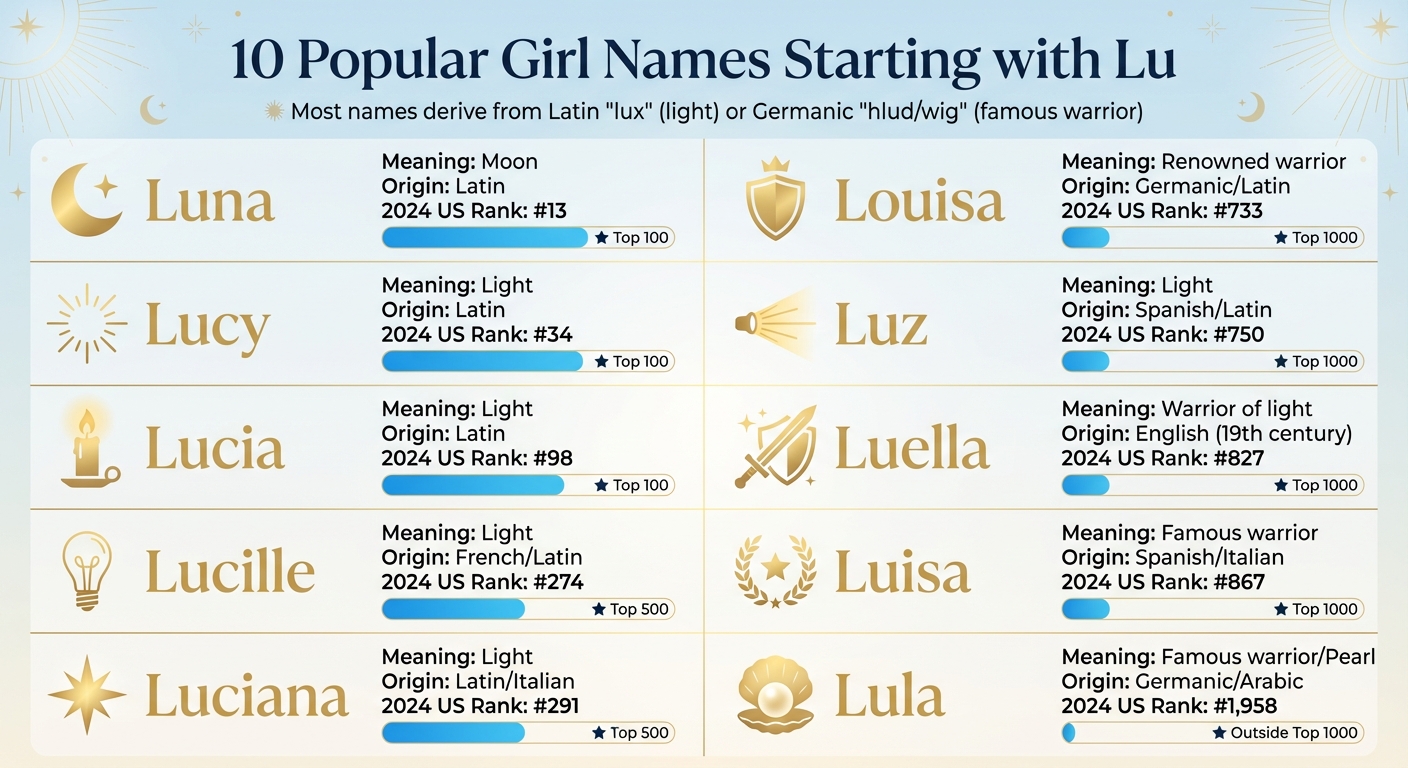
Top 10 Girl Names Starting with Lu: Popularity Rankings and Meanings
1. Luna
Meaning and Origin
The name Luna comes from the Latin word for "moon" and holds a deep connection to Roman mythology. Its celestial charm extends across several Romance languages, where it is commonly used as a feminine name.
This timeless origin has helped Luna shine brightly in modern times.
Current Popularity in the US
Luna has become a standout favorite among baby girl names in the United States. By 2024, it ranked #13, following peak popularity at #10 in both 2022 and 2023. In 2022 alone, 8,922 baby girls were named Luna.
Historical Background
Luna first appeared as a top 1,000 name in the late 19th and early 20th centuries, reaching its highest rank of #403 in 1881. However, it disappeared from the charts after 1922, only to make a comeback in 2003. Since then, Luna has steadily risen in popularity, reflecting a growing love for nature-inspired names.
This revival highlights Luna's enduring appeal across generations.
Style and Appeal
Luna blends vintage elegance with a modern, minimalist vibe. Often described as "strong yet luminous", the name feels both magical and grounded. Parents are drawn to its easy spelling, clear pronunciation, and global adaptability. Luna also pairs wonderfully with other celestial names like Aurora, Nova, and Stella, adding to its universal allure.
2. Lucia
Meaning and Origin
Lucia is derived from the Latin word lux, meaning "light." As the feminine form of the Roman name Lucius, it carries a bright and radiant essence. Though its roots are firmly planted in Latin tradition, the name has traveled far and wide, finding a home in languages like Italian, Spanish, German, English, Portuguese, and various Scandinavian dialects.
One of the most notable historical ties to this name is Saint Lucia of Syracuse, a 4th-century Christian martyr and the patron saint of the blind. Her feast day, celebrated on December 13th, is a festival of light in many cultures, especially in Italy and Scandinavia. Here, Lucia is often represented wearing a crown of candles, symbolizing the triumph of faith over darkness.
This rich history only adds to its growing modern charm.
Current Popularity in the US
In 2024, Lucia hit #98 on the U.S. baby name charts, with 2,658 births recorded. This marked its debut in the top 100, showcasing a steady climb over the last five years. It rose from #136 in 2021 to its current position, reflecting its growing appeal among parents.
Historical Background
Lucia has been a fixture in the U.S. top 1,000 baby names since 1880. For much of the 20th century, it hovered around the #500 mark, but recent years have seen a resurgence, as parents are drawn to its vintage charm.
Style and Appeal
With its graceful "-ia" ending, Lucia offers a sophisticated and melodic alternative to Lucy. The name aligns with the current trend for elegant, flowing names. Its versatility is another draw, with three distinct pronunciations depending on cultural context: loo-SEE-uh (Spanish), loo-CHEE-uh (Italian), and LOO-sha (English). Popular nicknames like Lu, Lulu, Luci, and Lia add to its appeal, making it a timeless and adaptable choice for families across the globe.
3. Luciana
Meaning and Origin
Luciana stems from the Latin word lux, meaning "light" or "to shine". It's the feminine form of Lucianus, with roots tracing back to Ancient Rome and connections to the Etruscan civilization.
This name, deeply tied to Latin heritage, has found a home in Italian, Spanish, Portuguese, and Romanian traditions. It even graced the stage in Shakespeare's 1594 play The Comedy of Errors, where Luciana symbolizes family loyalty and sisterly devotion. These historical and cultural connections give the name its timeless appeal.
Current Popularity in the US
As of late 2025, Luciana sits at #291 in U.S. baby name rankings. It reached a notable high in 2018, securing the #349 spot. After sporadic appearances in the 1970s, it made a strong comeback in 2006, partly due to public interest following Matt Damon's 2005 marriage to Luciana Bozán Barroso.
Another boost came in 2018 with the introduction of Luciana Vega, the American Girl of the Year doll. This aspiring astronaut character helped bring the name into the spotlight for many American families. While Lucy remains more widely used - about five times as popular - Luciana offers a sophisticated alternative.
Style and Appeal
Luciana stands out as an elegant option compared to Lucy or Lucia. Its three- or four-syllable structure pairs beautifully with romantic names like Isabella or Adriana. The name carries a "regal air" and a worldly charm, making it appealing across different languages and cultures.
There are several ways to pronounce Luciana, including loo-CHAH-nah in Italian, loo-SYAH-nah in Latin American Spanish, and loo-THYAH-nah in European Spanish. Popular nicknames like Lucy, Lulu, Ana, Lu, and Ciana add to its versatility and charm.
4. Luisa
Meaning and Origin
Luisa is the feminine form of Louis or Luis, stemming from the Old German name Ludwig. Its roots lie in the Germanic elements hlud (famous) and wig (warrior), translating to "famous warrior" or "renowned warrior". While Louisa is the English and Dutch variant, Luisa takes center stage in Italian, Spanish, and Portuguese traditions. Unlike Lucia, which is tied to light and illumination, Luisa draws its strength from Ludwig's warrior heritage. Over time, this name has not only preserved its historical depth but also gained traction in modern naming trends.
Current Popularity in the US
As of 2024, Luisa climbed to #867 in the U.S. rankings, up from #994 in 2020, accounting for 0.018% of births. It enjoys particular popularity in Hispanic communities, with California recording the highest total count (6,817) and Florida boasting the highest density (23.71 per 100,000).
Style and Appeal
Luisa carries a melodic elegance and an air of sophistication. It serves as a chic alternative to names like Lucy or Louise, offering a blend of classic charm and contemporary appeal. The name pairs beautifully with timeless English names like Charlotte and Violet, as well as Spanish names such as Guillermo. Common nicknames include Lu, Lulu, Lou, and Sia, adding versatility to its use. The meaning, "renowned warrior", resonates with parents who value both grace and resilience. This combination of historical depth and modern style makes Luisa a standout choice in today’s baby name landscape.
5. Lucy
Meaning and Origin
Lucy comes from the Latin word lux, meaning "light", symbolizing brightness and the break of dawn. It is the English version of Lucius and a variation of Lucia. The name made its way to England through the Old French form Lucie. Historically, it was often given to girls born at sunrise, tying its meaning to the first light of day.
Current Popularity in the US
Lucy has seen a notable resurgence in recent years. By 2024, it climbed to #34 in U.S. name rankings, accounting for 0.305% of births, with 4,858 baby girls named Lucy in 2023. This marks a sharp rise from #50 in 2020, jumping 16 spots in just four years. The name has steadily grown in popularity, moving from its low point at #588 in 1978 and #324 in 2000 to its current top-40 status. Regionally, Lucy is especially beloved, ranking #5 in Utah, #10 in Nebraska, #14 in Minnesota, and #15 in Pennsylvania.
Historical Background
Lucy’s historical roots are closely tied to Saint Lucy, a 4th-century martyr and the patron saint of the blind. This religious connection helped the name gain prominence during the Middle Ages. In 1900, Lucy ranked #61, representing 0.392% of births. While its popularity waned during the mid-20th century, the name has since made a remarkable comeback. Its rich history adds to its enduring appeal today.
Style and Appeal
Lucy strikes a balance between timeless elegance and modern charm, offering a vintage, whimsical vibe. This makes it a favorite among parents embracing the trend of reviving "old lady names". Its simple two-syllable structure gives it a polished yet approachable feel. Pop culture has also played a role in its popularity, with memorable associations like Lucy Ricardo from I Love Lucy, Lucy Pevensie from The Chronicles of Narnia, and The Beatles’ classic song "Lucy in the Sky with Diamonds". Cute nicknames such as Lulu, Luce, Lu, and CeCe add to its versatility. Plus, Lucy pairs effortlessly with both traditional and modern middle names, making it a flexible and stylish choice for families.
6. Lucille
Meaning and Origin
Lucille is the French version of Lucilla, which itself is a diminutive of Lucia or Lucy. The name traces its meaning back to "light" and has origins in the Roman era, enjoying a revival in the 19th century. It’s also associated with Saint Lucia, the fourth-century patron saint of the blind, adding a layer of historical and spiritual significance to its charm [47,49,50].
Current Popularity in the US
In 2024, Lucille claimed the #274 spot for U.S. births, with 1,086 occurrences recorded in 2023. The name made its way back into the top 1,000 in 2003, starting at #938. According to BabyCenter, it jumped an impressive 45 spots in 2025 to rank #456. Lucille enjoys particular favor in states like Alaska, New York, Wisconsin, New Jersey, and California. While Lucy, ranked #51, remains the more popular choice, Lucille offers a more formal and elegant alternative, complete with playful nicknames [47,48,50,51,53].
Historical Background
Lucille reached its peak in the 1910s, climbing as high as #29 in 1920 and accounting for 0.7707% of baby names in 1915. However, its popularity waned, hitting a low of #1,444 with just 35 births by 1978. Its resurgence today reflects a broader trend of revisiting vintage names. The name's enduring charm owes much to its most iconic bearer, Lucille Ball, the legendary comedian and actress whose influence continues to shape its retro appeal. Blues legend B.B. King also left his mark by naming his famous Gibson guitars "Lucille", further cementing the name’s cultural legacy [47,49,50,53].
Style and Appeal
Lucille embodies vintage sophistication, making it a favorite among modern parents seeking a retro yet stylish name. Its versatility shines through in its variety of nicknames, such as Lucy, Lulu, Lu, Cece, and Luci. When actress Maya Rudolph and director Paul Thomas Anderson named their daughter Lucille in 2009, the name saw a spike in interest among trend-conscious parents. Those drawn to Lucille often gravitate toward other timeless names like Charlotte, Evelyn, Alice, or Genevieve [47,48,50,53].
sbb-itb-f13f980
7. Louisa
Meaning and Origin
Louisa is the feminine form of Louis, rooted in Latin, and means "renowned warrior." Its origins trace back to the Old German name Ludwig, where hlud means "fame" and wig translates to "warrior." Over time, it transitioned through the French Louis, gaining a regal legacy in Denmark, Sweden, France, and England.
Current Popularity in the US
In 2024, Louisa ranked #733 in the U.S., with 380 births, accounting for 0.022% of all names. After a 45-year hiatus, it made its way back into the Top 1,000 in 2014. On Nameberry's 2025 charts, Louisa currently holds the #134 spot, while its French variation, Louise, ranks at #540.
Historical Background
Louisa enjoyed its peak popularity in the 18th and 19th centuries, reaching as high as #119 in 1881, with 0.144% of births. However, its prominence waned as Louise began to take center stage by the late 19th century. The name carries a rich legacy, shared by figures like Louisa May Alcott, the celebrated author of Little Women; Louisa Catherine Adams, the only foreign-born U.S. First Lady before 2016; and Louisa Ann Swain, the first woman to legally vote in the United States. It also features prominently in classic literature by authors like Jane Austen and Charles Dickens.
With its deep historical roots, Louisa offers a blend of vintage charm and contemporary relevance.
Style and Appeal
Louisa's enduring appeal lies in its ability to feel both timeless and modern.
"Louisa, a quaint but strong vintage name, might feel fresher in English speaking countries than old favorite Louise, just as Diana and Julia have more energy than Diane and Julie." – Linda Rosenkrantz, Co-founder of Nameberry
Like other names with the 'Lu' sound, Louisa exudes a mix of elegance and modernity. Its Latinate "a" ending lends it a lively, contemporary vibe compared to the more traditional Louise. The name also offers a variety of charming nicknames, including Lou, Lu, Lulu, and Ouida. It pairs beautifully with other stylish names like Luna, Lucy, and Lucia, or vintage classics such as Eloise, Josephine, and Beatrice.
8. Lula
Meaning and Origin
Lula is a name with rich and varied roots. At its core, it means "famous warrior" or "renowned in battle," tracing back to Louise, which has Germanic origins. It also takes on the meaning of "pearl" in Arabic (Lulu) and connects to "light" or "born at daybreak" through Latin ties to Lucy or Lucia.
Beyond its standalone charm, Lula often serves as a nickname for names like Tallulah, Lucinda, and Lourdes, showcasing its adaptability across French, Germanic, and Latin traditions. This blend of meanings and origins gives Lula a unique appeal in the world of baby names.
Current Popularity in the US
Lula's charm lies in its rarity. In 2024, it ranked #1,958 in the U.S., dropping 130 spots from the previous year. In 2023, 110 baby girls were named Lula, compared to 98 in 2022. Over the past 182 years, more than 84,794 babies in the U.S. have been given this name.
Though it currently sits outside the top 1,000 names, Lula offers parents a less common yet historically rich choice. For those looking for something distinctive, Lula provides a softer, more uncommon alternative to popular names like Luna, which holds the #23 spot.
Historical Background
Lula was a standout name in the late 19th century, reaching its peak popularity at #36 in 1881, with 1,778 babies named Lula that year - accounting for 1.96% of all names. It was especially beloved in the Southern United States, often chosen as a standalone name rather than a nickname.
By 1911, it remained strong at #69 with 970 births but gradually declined throughout the 20th century. The name is tied to notable figures like Lula Mae Hardaway, songwriter and mother of Stevie Wonder, and Brazilian guitarist Lula Galvão. It also appears in literature, such as William Faulkner's works, and in the Carradine family of entertainers.
Style and Appeal
Lula captures a perfect mix of vintage charm and modern simplicity, fitting right into the "Grandma name" revival trend. Its friendly, two-syllable structure and warm "Lu" sound make it approachable and versatile.
"Lula has a firecracker personality, a singing and dancing extrovert." – Grace Royal, Nameberry
Whether used as a standalone name or as a nickname for longer names like Tallulah or Lucinda, Lula brings a sense of nostalgia with a fresh twist. Popular middle name pairings - like Lula Mae, Lula Rose, Lula Grace, and Lula June - add to its vintage appeal. With its historical depth and timeless style, Lula stands out as a rare yet memorable choice for parents seeking something special.
9. Luz
Meaning and Origin
The name Luz carries the meaning of "light" in both Spanish and Latin, stemming from the word lux. In Hebrew, it translates to "almond" or "almond tree", while in Armenian, it has ties to the "moon." Luz holds significant religious importance in Spanish-speaking communities, often used as a title for the Virgin Mary (Nuestra Señora de la Luz). It also appears in the Bible as the ancient name for the city of Bethel. Additionally, Luz is recognized as the Spanish form of Lucy. These diverse associations have shaped its usage and appeal, especially in the U.S.
Current Popularity in the US
As of 2024, Luz ranked #750 among baby girl names in the U.S., climbing 93 spots from the previous year. Its highest historical ranking was at #463 in 1999, and interest in the name saw a 12% rise by late 2024. Luz remains especially popular in states with large Hispanic populations, reflecting its deep cultural and religious significance. While it hasn’t reached the widespread popularity of other "Lu" names like Luna, Luz stands out as a rare, one-syllable choice that is both meaningful and distinctive. Its unique background and modern appeal make it a compelling option for parents today.
Style and Appeal
Luz fits perfectly with the current trend for short, impactful names. As a one-syllable option, it offers a blend of elegance and simplicity while carrying a timeless charm. Its contemporary relevance has been amplified by characters like Luz Noceda, the Dominican-American lead in Disney's animated series The Owl House. This name strikes a balance between historical richness and modern flair, making it a versatile choice.
"Luz encompasses eternal love, beauty, and heavenly purity." – Keshia Roelofs, Editor at The Bump
Nicknames like Lulu, Lu, and Zee add a playful touch to its spiritual depth. With its multicultural roots and minimalist style, Luz radiates a hopeful and luminous quality that resonates with many parents today.
10. Luella
Meaning and Origin
Luella is a name that emerged in the 19th century, combining "Lou" (from Louise) with the suffix "-ella." This blend gives it a poetic meaning, often interpreted as "renowned warrior" or "warrior of light." The name carries a timeless elegance, making it a standout choice for those drawn to vintage-inspired names.
Current Popularity in the US
In 2024, Luella ranked #827 in the U.S., with 331 baby girls given the name, an increase from 285 in 2023. It has gained particular traction in states like Minnesota (10% of its popularity), Wisconsin (8%), and California (6%). The modern spelling, Luella, adds a contemporary touch to this classic name.
Historical Background
Luella enjoyed its height of popularity in 1907, ranking #166 and accounting for 0.105% of baby girls born that year. By 1918, the name had been given to 949 newborns. However, it gradually faded from the Top 1,000 by the 1950s and remained off the charts for over six decades. Luella made a notable return in 2017, signaling its renewed appeal in modern times.
Style and Appeal
Luella's charm lies in its ability to bridge the past and present. It fits seamlessly into the current trend of vintage-inspired names, offering a soft yet spirited alternative to names like Eloise or Lucy. The "-ella" ending adds a touch of grace, balancing the strength implied by its meaning. As Grace Royal from Nameberry puts it:
"The blend of classic sounds in Luella come together to make a name that feels stylish and fresh but also vintage."
With 331 births recorded in 2024, Luella continues to stand out as a name that is both familiar and delightfully unique, appealing to parents looking for something with a touch of history and charm.
Conclusion
Names starting with 'Lu' bring together a rich tapestry of cultural origins and meanings. From Latin to Germanic influences, these names carry stories of light, legacy, and individuality.
Whether you're drawn to timeless classics or sleek, modern names, 'Lu' names have been steadily regaining popularity over the past decade. They seamlessly combine a sense of tradition with a contemporary edge, making them stand out in a world of ever-changing naming trends.
What truly sets these names apart is their universal appeal. They honor heritage while embracing modernity, offering a harmonious blend of historical significance and a fresh, current vibe. It's this unique balance that makes them so captivating.
If you're looking for inspiration, consider exploring the 338 'Lu' names available on NameHatch. You can filter by meanings like "light", "moon", or "warrior", search by cultural origin, and even collaborate with your partner to create a personalized shortlist. The app’s swipe-based interface makes the process simple and enjoyable, helping you find a name that perfectly reflects your family's story.
Whether you choose a celestial name like Luna, a timeless option like Lucy, or a vintage treasure like Luella, 'Lu' names offer a beautiful combination of elegance, depth, and individuality for your little one.
FAQs
What are the origins and cultural significance of names starting with 'Lu'?
Names beginning with 'Lu' carry a rich history and diverse roots across various cultures. In English, 'Lu' often serves as a short form for names like Louise or as a nickname for Latin-based names such as Luna, Lucinda, or Luisa. These names are closely tied to Latin origins, with meanings like 'light' (lux) or 'moon' (luna).
But 'Lu' isn’t limited to English or Latin traditions. In Chinese, it can symbolize 'green pearl,' adding a sense of elegance and rarity. Hawaiian names like Lua or Luana bring meanings of joy and a connection to nature. Meanwhile, in Vietnamese, Luan holds unique cultural significance, reflecting its own traditions. Whether rooted in English, Latin, Chinese, Hawaiian, or Vietnamese heritage, names starting with 'Lu' weave together a beautiful global story.
How have girl names starting with 'Lu' changed in popularity over time?
Girl names beginning with Lu have experienced notable changes in popularity over the years. Back in the early 1900s, these names were quite fashionable. In 1910, about 1.58% of baby girls were given a "Lu" name, and 16 of these names made it into the top 1,000. Over time, though, their appeal waned, dropping to just 0.82% of births by 2018. Interestingly, the 2010s brought a slight uptick in interest for "Lu" names, hinting at a modest comeback.
As for the name Lu on its own, it has always been a rarity. Over the last 50 years, it’s been used almost exclusively for girls - about 85% of the time - but in very small numbers. For instance, in 2024, only 8 baby girls were named Lu. While "Lu" names as a category are enjoying a mild resurgence, the single-letter name remains a distinctive and uncommon choice.
Why are 'Lu' names so popular with modern parents?
'Lu' names have captured the hearts of modern parents for being short, charming, and adaptable. They shine as standalone names but also make wonderful nicknames for timeless classics like Luna, Lucinda, or Luisa. This duality lets families embrace tradition while giving it a fresh, contemporary vibe.
The soft, melodic "Lu-" sound feels both modern and enduring, resonating across languages like English, Spanish, and German. Many of these names come with uplifting meanings such as bright, joyous, or warrior, adding an extra layer of significance. Their blend of simplicity, cultural appeal, and positive connotations makes 'Lu' names an increasingly popular pick for U.S. parents.