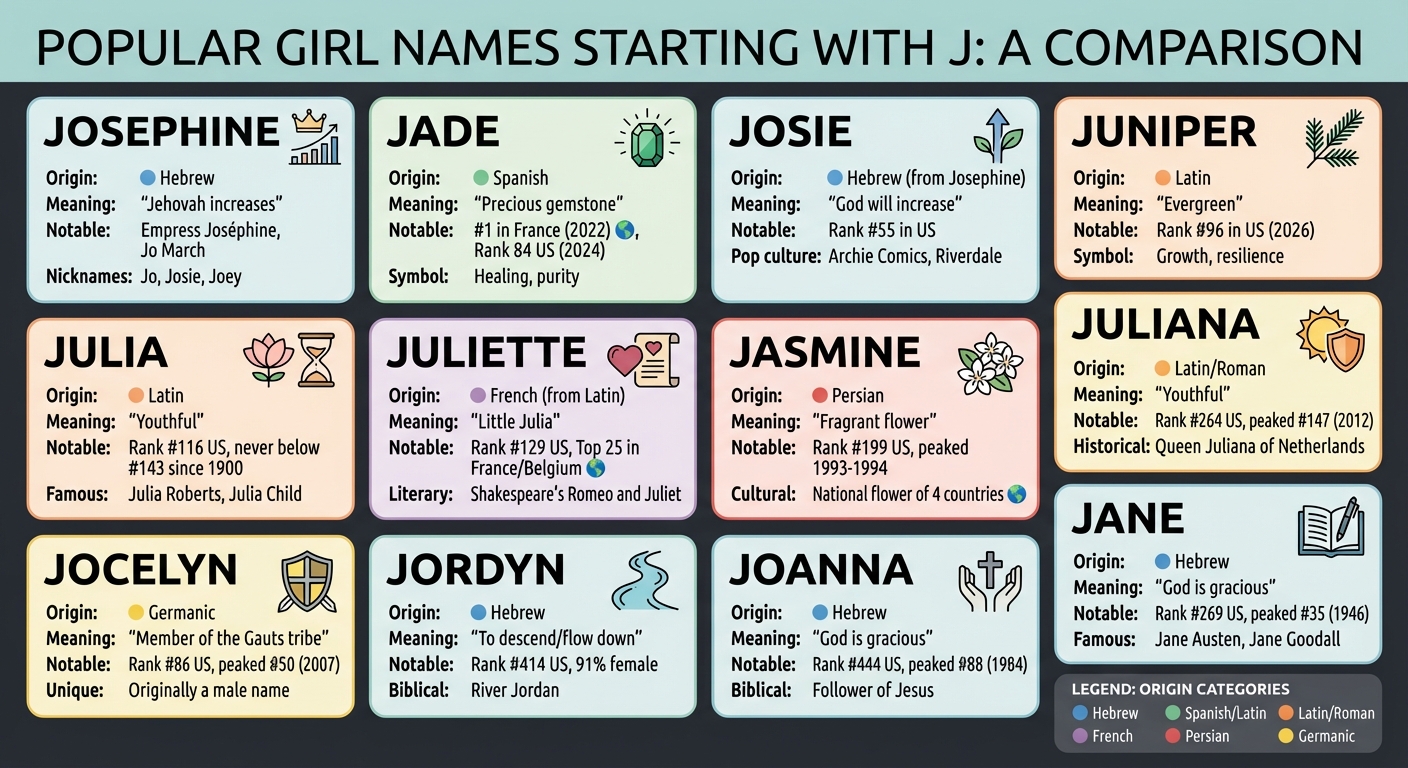
Girl names starting with J have been a favorite for generations, combining rich history, meaningful origins, and modern appeal. From timeless classics like Jane and Julia to nature-inspired choices like Juniper, these names offer something for everyone. Here’s a quick look at 12 popular J names, their origins, meanings, and why they stand out:
- Josephine: Hebrew origin, meaning "Jehovah increases." Known for historical figures like Empress Joséphine and literary characters like Jo March from Little Women.
- Jade: Spanish origin, meaning "precious gemstone." Associated with healing and valued across cultures, including China and the Aztec civilization.
- Josie: A lively nickname for Josephine, meaning "God will increase." Popular in modern culture through TV shows and literature.
- Juniper: Latin origin, meaning "evergreen." A nature-inspired name tied to growth and resilience.
- Julia: Latin origin, meaning "youthful." A classic name with roots in ancient Rome, linked to figures like Julia Child and Julia Roberts.
- Juliette: French form of Julia, meaning "little Julia." Known for elegance and literary connections like Shakespeare’s Romeo and Juliet.
- Jasmine: Persian origin, meaning "fragrant flower." Popularized by Disney's Aladdin and symbolic in various cultures.
- Juliana: Latin origin, meaning "youthful." A regal name with ties to saints and historical queens.
- Jocelyn: Germanic origin, meaning "member of the Gauts tribe." Once a male name, now widely used for girls.
- Jordyn: Hebrew origin, meaning "to descend." A modern variation of Jordan, tied to biblical and natural symbolism.
- Joanna: Hebrew origin, meaning "God is gracious." A biblical name with historical and literary significance.
- Jane: Hebrew origin, meaning "God is gracious." Celebrated for its simplicity and association with figures like Jane Austen and Jane Goodall.
Each name carries its own story, blending historical depth with modern relevance, making J names a timeless choice for parents. Whether you want something classic, modern, or nature-inspired, there’s a perfect J name for your baby girl.
12 Popular Girl Names Starting with J: Origins, Meanings and Cultural Significance
1. Josephine
Name Origin
Josephine is the feminine form of Joseph, which originates from the Hebrew name Yosef (יוֹסף). The name made its way into English, German, and Dutch through the French Joséphine. Initially a diminutive of Josèphe, it became a widely recognized name by the 19th century.
Meaning
The name carries a powerful meaning rooted in its Hebrew origin: "Jehovah increases", "God shall grow", or "He shall add".
Cultural or Historical Significance
Josephine owes much of its global popularity to Joséphine de Beauharnais, the wife of Napoleon Bonaparte and Empress of France, whose influence after 1800 brought the name into the spotlight. Additionally, Saint Josephine Bakhita, a Sudanese-born former slave who became a Canossian Religious Sister and was later canonized, adds spiritual depth to the name’s legacy. In literature, Louisa May Alcott’s beloved character Josephine "Jo" March from Little Women further solidified its charm.
In the United States, the name has seen notable fluctuations in popularity. After ranking as low as 498th in 1987, it experienced a resurgence, climbing to 72nd by 2025, with usage increasing from 596 per million in 1993 to 3,364 per million. Common nicknames include Jo, Josie, Joey, Fifi, and Posy.
sbb-itb-f13f980
2. Jade
Jade combines a vibrant, modern feel with a rich history that stretches back to ancient traditions, making it a name that feels both fresh and timeless.
Name Origin
The name Jade traces back to the Spanish phrase piedra de la ijada, meaning "stone of the flank." This connects to the French term l'ejade and the Latin word ilia, both of which also mean "flank." In ancient practices, jade gemstones were believed to offer healing properties, such as easing kidney pain when placed on a baby’s side.
While jade has been prized as a gemstone since Neolithic times, it only became a popular given name in the 1970s. Its rise was partly fueled by Mick and Bianca Jagger naming their daughter Jade in 1971. Initially used as a gender-neutral name, it became more commonly associated with girls by the early 2000s.
Meaning
Jade refers to the green gemstone highly valued in jewelry and art, symbolizing a "precious gemstone". It fits into the trend of nature-inspired names and offers a contemporary yet grounded alternative to names like Sapphire or Pearl.
Cultural or Historical Significance
Jade carries deep significance across many cultures. In China, Confucius linked jade to virtues such as purity, courage, and honesty. Chinese emperors were even buried in jade suits, which were believed to grant immortality. Among the Aztecs and Mayans, jade was revered as the "stone of heaven", thought to enable communication with the divine and protect against evil.
The name Jade enjoys widespread popularity worldwide. It was the most popular name for newborn girls in France in 2022 and has consistently ranked in France’s top 10 since the mid-2000s. In the United States, it peaked at rank 86 in 2002 and held steady at rank 84 in 2024. It’s also a favorite in England, Wales, Monaco, Belgium, Canada, and Brazil.
3. Josie
Josie brings a youthful and lively vibe, holding the #55 spot among U.S. girl names.
Name Origin
Originally a nickname for Josephine, Josie traces its roots back to the Hebrew name Yosef (Joseph). Over time, it passed through Greek and Latin influences to become the form we know today. While it started as a diminutive, Josie has grown into a beloved first name in its own right.
Meaning
Josie carries a deeply spiritual meaning: "God will increase", "God will give", or "He shall add/grow". These interpretations tie back to its biblical origins, making it a meaningful choice for many parents.
Cultural and Historical Significance
Short and sweet names like Josie are increasingly preferred over longer counterparts like Josephine. The name has made its mark in pop culture, appearing in characters such as Josie McCoy from Archie Comics and Riverdale, as well as in shows like Dawson's Creek, Twin Peaks, The Vampire Diaries, and Supernatural. Its enduring popularity is reflected in its steady presence on the U.S. top 1,000 names list.
Next, discover the natural charm of Juniper.
4. Juniper
Juniper brings a fresh, nature-inspired appeal and currently holds the #96 spot in the United States as of February 2026. It first made its way into the SSA top 1,000 names in 2011.
Name Origin
The name Juniper comes from the Latin word iuniperus, which refers to an evergreen shrub or tree. Its meaning, "evergreen", evokes ideas of growth and vitality. Historically, Juniper was used as a masculine name, with Saint Juniper, a companion of Saint Francis of Assisi, being a notable example. Linguistically, it shares roots with names like Guinevere, Jennifer, and Ginevra.
Meaning
The name Juniper is closely tied to the idea of being "evergreen", symbolizing life, renewal, and resilience.
Cultural and Historical Significance
The juniper tree holds a special place in biblical history, providing shelter to the prophet Elijah during his escape from Queen Jezebel. During the Renaissance, the juniper tree symbolized chastity in art, famously appearing in Leonardo da Vinci's portrait of Ginevra de' Benci. Beyond history and art, the name has modern cultural ties as well. Gin, for instance, gets its name from the French word genièvre, meaning juniper. Additionally, Juniper Beatrice, the main character in the Junie B. Jones children's book series, has brought the name into the spotlight for younger audiences.
Let’s now explore the enduring grace of Julia.
5. Julia
Julia is a name steeped in history, tracing its roots back to ancient Rome. In 2024, it holds the 116th spot among the most popular girl names in the United States. Remarkably, it has never fallen below the 143rd position since 1900, showcasing its lasting charm.
Name Origin
Julia is the feminine counterpart of Julius, a name tied to the distinguished gens Julia. This Roman family included iconic figures like Gaius Julius Caesar. The name itself comes from the Latin word iuvenis, meaning "youthful". While Julia was uncommon during the Middle Ages, it saw a resurgence during the Italian Renaissance and gained popularity in English-speaking countries by the 18th century.
Meaning
The name Julia is most often interpreted as "youthful".
Cultural and Historical Significance
Julia has left its mark across religion, literature, and modern culture. It appears in the New Testament, is associated with early saints such as Saint Julia of Corsica, and was carried by prominent Romans like Julia Augusta and Julia the Elder. In literature, Shakespeare gave the name to a character in The Two Gentlemen of Verona, while George Orwell used it for a key figure in 1984.
The name reached its highest U.S. ranking at #27 in 2001, a rise often linked to actress Julia Roberts and her celebrated role in Erin Brockovich. Other well-known Julias include culinary legend Julia Child, Emmy-winning actress Julia Louis-Dreyfus, and Julia Gillard, Australia’s first female Prime Minister. On a global scale, Julia enjoys widespread admiration: it was the 2nd most popular name for girls in Poland in 2013 and has frequently topped charts in Austria. Variations of the name - such as Giulia in Italian, Juliette in French, Yulia in Russian, and Júlia in Portuguese - add to its universal appeal.
Next, discover the romantic allure of Juliette.
6. Juliette
Juliette takes the classic appeal of Julia and gives it a French twist, adding a touch of elegance and sophistication.
The name hit its highest popularity in the U.S. at rank 179 in 2019 and currently sits at 129. While the simpler "Juliet" is still more common in English-speaking regions, "Juliette" has steadily gained traction since the late 1990s.
Name Origin
Juliette is a diminutive of Julie, tracing its roots back to the Latin name Julia and the Roman "Julia gens", an aristocratic family line in ancient Rome. Over time, it evolved into the medieval version "Juliet." The Italian form "Giulietta" first gained attention in 1524 thanks to Luigi Da Porto, and Shakespeare immortalized the anglicized "Juliet" in his 1596 play Romeo and Juliet. Today, the French spelling "Juliette" stands out for its polished and refined feel.
Meaning
The name Juliette translates to "little Julia." Its Latin origins also link it to themes of youth and vitality, as well as a connection to Jove, the chief deity in Roman mythology.
Cultural and Historical Significance
Juliette's charm has been shaped by notable figures and cultural references throughout history. Juliette Gordon Low, who founded the Girl Scouts of the USA, left a lasting legacy in American society. In France, Juliette Récamier was a celebrated socialite known for her influential literary and political salon in the early 19th century. The name remains highly popular in Europe, consistently ranking among the top 25 in countries like France and Belgium.
Modern icons like Academy Award-winning actress Juliette Binoche and American actress Juliette Lewis have kept the name in the spotlight. It also features prominently in contemporary media, with characters like Juliette Barnes from Nashville and Juliette Ferrars from the Shatter Me series. These connections highlight Juliette's timeless appeal, blending historical depth with modern relevance.
7. Jasmine
Jasmine radiates a soft floral elegance and brings to mind warm, serene summer evenings.
This name first appeared in the U.S. top 1,000 baby names in 1973, climbed into the top 100 by 1986, and reached its peak popularity in 1993–1994, likely influenced by Disney's Aladdin [53, 55]. As of now, Jasmine holds the No. 199 spot in the United States.
Its enduring appeal comes from its modern charm and deep linguistic roots.
Name Origin
Jasmine traces back to the Persian word yāsamīn (or yasmin), which refers to a fragrant climbing plant [53, 54, 55]. The name journeyed through Arabic, then Old French, before becoming part of the English language [53, 54]. Initially used as a botanical term, it gained popularity as a feminine name in the Western world during the 20th century, especially taking off in the 1970s [53, 54].
Meaning
The name translates to "fragrant flower" and, in Persian contexts, can also mean "gift from God" [53, 55]. This dual meaning ties it to both the natural world and spiritual significance.
Cultural and Historical Significance
The jasmine flower carries rich symbolism across the globe, representing purity, motherhood, and even political change. It is the national flower of Indonesia, Pakistan, the Philippines, and Tunisia, and it became a symbol of the 2011 Tunisian Revolution. In Thailand, jasmine signifies motherhood, while in Shia Islam, it honors Fatimah al-Zahra, the daughter of the prophet Muhammad. Variations of the name, such as Yasmin (Arabic/Portuguese), Jasmijn (Dutch), and Yasemin (Turkish), reflect its worldwide popularity [53, 54].
8. Juliana
Juliana continues the legacy of timeless J names, combining its ancient Roman heritage with a touch of modern elegance.
This name has been a steady favorite in the U.S., consistently ranking in the top 200 since 2001. It hit its highest point of popularity in 2012, when 0.115% of baby girls were named Juliana, earning it the #147 spot. As of February 2026, it stands at #264 in U.S. rankings. Its enduring charm lies in its classic sophistication and deep historical roots.
Name Origin
Juliana is the feminine form of the Roman name Iulianus (Julian), which traces back to the Roman family name Julius. This name has been in use since the 12th century and was once spelled "Gillian" during its early history. It experienced a revival in the 18th century. In the Netherlands, Queen Juliana (1909–2004), who ruled from 1948 to 1980, added a regal touch to its legacy.
Meaning
The name Juliana carries the meaning "youthful" and can also signify "downy-bearded" or "devoted to Jove". These interpretations reflect vitality and a connection to Roman mythology.
Cultural and Historical Significance
Juliana gained prominence during the Middle Ages thanks to several Christian saints, particularly St. Juliana of Nicomedia, a 4th-century martyr who became the patron saint of those suffering from illness. Another notable figure was Juliana of Norwich (1342–1416), a mystic and the first known woman to write a book in English. Today, the name has over 30 global variations, including Giuliana (Italian), Iuliana (Romanian), and Yuliana (Russian/Bulgarian).
Next, dive into the charm and diverse stories behind other J names.
9. Jocelyn
Jocelyn started as a medieval masculine name and has transformed over time into a widely embraced feminine name, carrying both Germanic and Norman heritage.
The name first appeared on U.S. charts in 1927 and reached its peak popularity in 2007, ranking 50th with a usage rate of 0.251%. By 2018, it had dropped to 194 but has since climbed back to 86. Interestingly, despite its origins as a male name, Jocelyn has been overwhelmingly used for girls in the United States for the past 125 years.
Its rich history adds an extra layer of interest to its shifting popularity.
Name Origin
Jocelyn traces back to the Frankish name Gautselin (or Gauzlin), derived from the Germanic term gautaz, linked to the Gauts, a North Germanic tribe. The Normans introduced it to England in the 11th century as Goscelin or Joscelin. Over time, Old French diminutives shaped its modern form, and by the 14th century, its masculine usage had faded. The name gained a new life as a feminine choice thanks to John Galsworthy's 1898 novel Jocelyn. Interestingly, in modern France, Jocelyn remains a male name, with Jocelyne as the feminine counterpart.
Meaning
The traditional meaning of Jocelyn is "member of the Gauts tribe" or "little Goth." It also connects to the Old Germanic word geutan ("to pour") and possibly the Breton iodoc ("lord"). However, modern interpretations often lean toward meanings like "happy" or "joyful".
Cultural and Historical Significance
Throughout history, notable figures like Jocelyn of Louvain, a 12th-century nobleman, and various medieval Crusader lords have carried the name. In more recent times, people like astrophysicist Jocelyn Bell Burnell - who discovered the first radio pulsars in 1967 - and NASA scientist Jocelyn Gill have brought it into the spotlight. The rising trend of names ending in "-lyn", such as Brooklyn and Madelyn, has further contributed to its popularity.
Jocelyn's mix of historical depth and modern appeal makes it an enduring and attractive choice for parents.
10. Jordyn
Jordyn is a modern, feminine twist on the biblical name Jordan. It reached its peak popularity in 2010, with 371 babies per million receiving the name. As of February 2026, Jordyn ranks at #414 in the U.S. popularity charts.
Interestingly, over 91% of those named Jordyn are female. The inclusion of the "y" gives the name a more contemporary feel. In 2024, 945 baby girls were named Jordyn, compared to just 73 boys.
Name Origin
The name Jordyn stems from the Hebrew word Yarden, which means "to descend" or "flow down." This refers to the River Jordan, which flows between Jordan and Israel. During the Middle Ages, Crusaders popularized the name in Europe by using water from the Jordan River for baptisms. While Jordan has remained a unisex name, the spelling "Jordyn" has emerged as a distinctly feminine variation in recent years.
Meaning
Jordyn's meaning, "down-flowing", reflects the natural movement of the River Jordan.
Cultural and Historical Significance
The River Jordan holds deep religious significance in both Christian and Jewish traditions. It is famously known as the site where Jesus was baptized and is often referred to as a "garden of God" due to its fertility.
Several notable women have helped bring attention to the name. Jordyn Wieber, an Olympic gold medalist in gymnastics at the 2012 Summer Olympics, later became the head gymnastics coach at the University of Arkansas. Jordyn Woods made waves in the fashion world by launching her clothing line, SECNDNTURE, in August 2018. Meanwhile, Jordyn Huitema has gained recognition as a Canadian soccer player representing OL Reign.
Jordyn is often highlighted in discussions about names for Black girls that balance biblical heritage with modern cultural significance. These accomplished figures have helped cement Jordyn's appeal, blending timeless tradition with a contemporary edge.
11. Joanna
Joanna combines a timeless biblical charm with a modern appeal, standing alongside contemporary variations like Jordyn. This classic name reached its peak in the U.S. back in 1984, ranking #88 with about 3,330 babies per million receiving the name that year. By early 2026, its ranking had dropped to #444. Even with this decline, its melodic three-syllable flow and elegant sound ensure it remains a beloved choice.
The name carries rich religious significance. Saint Joanna, a follower of Jesus and wife of Chuza (steward to Herod Antipas), is celebrated as one of the myrrhbearers who discovered Jesus' empty tomb. Her feast day is observed on May 24.
Name Origin
Joanna traces its origins to Hebrew, derived from Yohannah or Yochanan, which combines "yo" (a reference to Yahweh) with "chanan" (meaning "to be gracious"). It transitioned through Greek as Ioanna (Ἰωάννα), the feminine form of Ioannes (John), and then into Latin as Iohanna before evolving into the modern English and Polish forms. During the Middle Ages, Joanna was often used as a Latinized version of Joan, but it didn’t gain widespread popularity in England until the 19th century.
Meaning
Joanna translates to "God is gracious" or "Yahweh is merciful." Some contemporary interpretations also see it as a blend of "Jo" and "Anna".
Cultural and Historical Significance
Joanna has a rich history, reflected in figures like Joanna of Castile ("Joanna the Mad"), who ruled as Queen regnant of Castile in the 16th century, and Joanna of Navarre, who served as queen consort to King Henry IV of England.
In more recent years, the name has been associated with notable personalities such as Joanna Gaines, the American interior designer and TV star known for Fixer Upper; Joanna Lumley, the British actress and activist celebrated for her role in Absolutely Fabulous; and Joanna Jędrzejczyk, the Polish mixed martial artist and former UFC Women’s Strawweight Champion.
12. Jane
Jane is a timeless and graceful name, celebrated for its simplicity and deep roots in history. It reached its highest popularity in the U.S. back in 1946, when it ranked as the 35th most popular name for girls. From 1911 to 1965, it consistently stayed within the top 100 names. By 2024, it had settled at #269, with 1,180 baby girls being named Jane that year.
Its adaptability makes it a favorite for both first and middle names, as seen in combinations like Mary Jane or Eliza Jane. The name is further elevated by its connection to remarkable women such as novelist Jane Austen, primatologist Jane Goodall (1934–2025), and actress Jane Fonda, all of whom embody intelligence and strength.
Name Origin
Jane has its roots in the Hebrew name Yochanan (or Yehochanan), which evolved through Greek (Ioannes), Latin (Iohannes), and Old French (Jehanne), eventually leading to the feminine form Johanna. In medieval England, Jehanne served as a variation of Joan. By the mid-16th century, Jane became popular among the aristocracy, and by the 17th century, it had surpassed Joan as the preferred feminine version of John.
Meaning
The name Jane translates to "God is gracious" or "Yahweh is merciful". Some interpretations also view it as meaning "gift from God". Its spiritual undertones and biblical connections have played a role in its enduring appeal.
Cultural and Historical Significance
Jane’s legacy is enriched by historical figures like Lady Jane Grey, who briefly ruled England for nine days in 1553, and Jane Seymour, the third wife of Henry VIII, who provided him with a male heir. In literature, Jane has been immortalized through works like Charlotte Brontë's Jane Eyre and the novels of Jane Austen, cementing its association with sophistication and intellect. Beyond history and literature, the name appears in legal terms such as "Jane Doe" and phrases like "Plain Jane", further embedding it into everyday language.
Conclusion
Choosing a name for your daughter is a deeply personal decision, and these 12 J names offer a mix of timeless appeal and contemporary style.
Each name carries its own story, blending historical depth with practical charm. Whether you're drawn to spiritual meanings like Jane or Joanna ("God is gracious"), nature-inspired choices like Jasmine or Jade, or names with versatile nicknames like Josephine (Josie), there’s something here to suit your family’s values and preferences. Think about how the name sounds with your last name, its cultural roots, and the potential for personalization.
J names once dominated baby name charts, peaking in 1941 when 12.196% of baby girls received one, but their popularity dropped to 2.889% by 2018. Despite this, classics like Jane continue to hold a special place, maintaining their historical significance even if they rank lower today.
This list also highlights the adaptability of J names. For instance, Julia remains a favorite in countries like Spain, France, and Germany, making it a strong choice for multicultural families. On the other hand, Juniper has recently surged into the top 150, appealing to parents seeking something more modern and distinctive. Whether you’re captivated by the romantic sophistication of Juliette or the contemporary flair of Jordyn, there’s a J name that aligns with your vision.
Take time to explore each name’s meaning, origin, and story. Ultimately, the perfect J name will reflect your family’s unique journey and values. If you're still undecided, you can find the perfect name using an interactive swipe app designed for couples.
FAQs
Which J girl names have the best nickname options?
Names like Josephine, Julia, Jade, Jasmine, and Josie are perfect for creating nicknames because they’re so flexible and well-known. You can spin them into options like Josie, Jules, Jay, Jazzy, or Jo, giving you plenty of ways to make them feel personal and fun.
How do I pick a J name that sounds good with our last name?
When picking a J name to go with your last name, think about how it sounds together. A short last name pairs well with longer J names like Josephine or Juliette, while a longer last name might feel more balanced with shorter options like Jade or Jenna. Say the full name out loud to get a sense of the flow, avoid repeating similar sounds, and double-check the initials to make sure they don’t accidentally form unwanted words.
What are the most popular J girl names in the U.S. right now?
Some of the most popular girl names starting with J in the U.S. are Josephine, Julia, Jade, Jasmine, Jordyn, Juliana, and Juliette. Among these, Josephine holds the top spot. Meanwhile, Juniper is climbing the charts, having recently broken into the top 150 and showing no signs of slowing down.