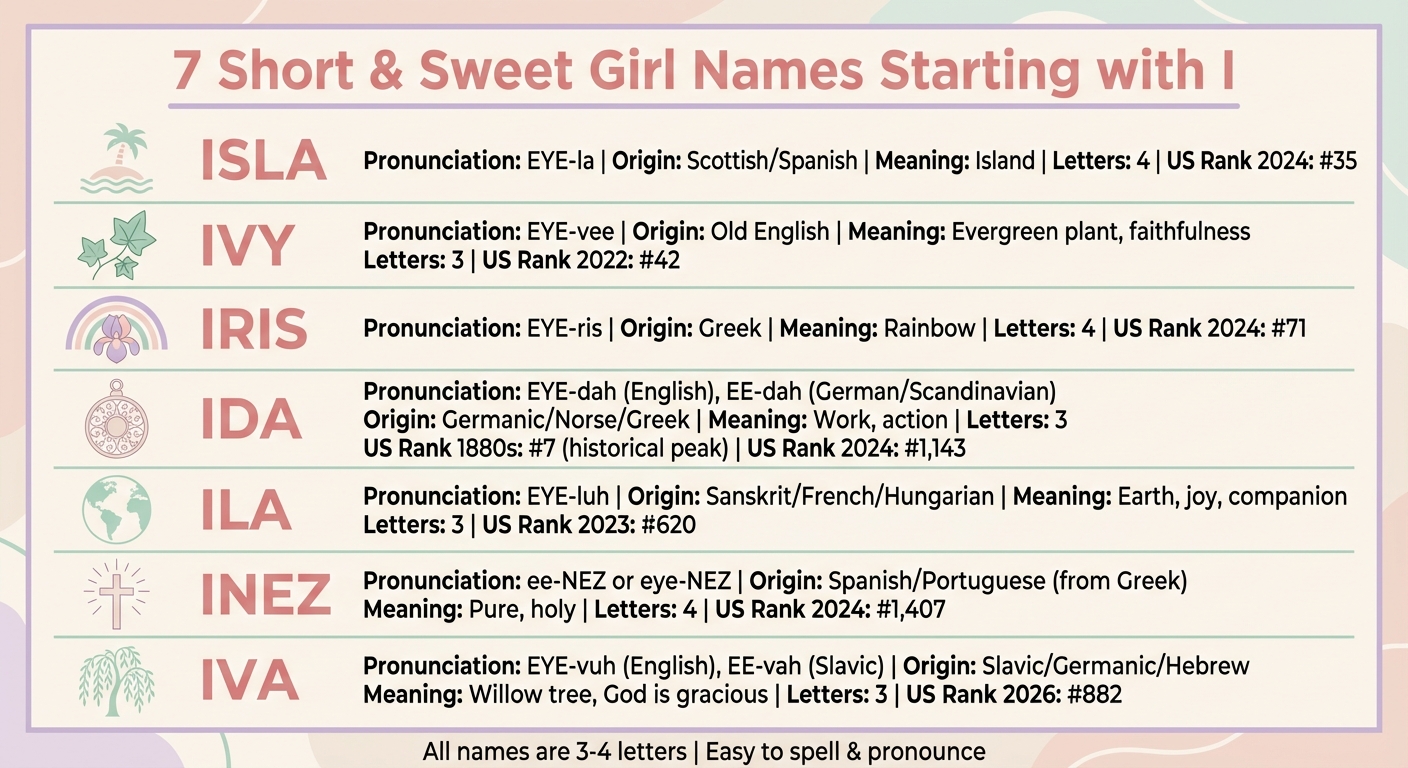
Looking for a short, elegant name for your baby girl that starts with "I"? Here's a curated list of seven names that are easy to spell, pronounce, and carry rich meanings from various traditions. These names blend simplicity with charm, making them popular choices among parents today.
Top Picks:
- Isla – A Scottish name meaning "island", ranked #35 in the U.S. in 2024.
- Ivy – Inspired by the evergreen plant, symbolizing loyalty and eternal life.
- Iris – Greek for "rainbow", with ties to mythology and February's birth flower.
- Ida – A vintage favorite with Germanic and Norse roots, meaning "work" or "action."
- Ila – A multicultural name linked to meanings like "earth" and "joy."
- Inez – A Spanish take on Agnes, meaning "pure" or "holy."
- Iva – A Slavic name tied to the willow tree and "God is gracious."
These names stand out for their rich histories, global influences, and timeless appeal. Whether you prefer nature-inspired options like Ivy and Iris or vintage classics like Ida, there's something for every taste.
7 Short Girl Names Starting with I: Meanings, Origins & Popularity Rankings
Benefits of Short Girl Names Starting with I
Short "I" names come with practical perks that make life easier for both parents and kids. Names like Isla, Ivy, and Ida, with just two to four letters, are simple to spell and less likely to result in typos or mispronunciations compared to longer names like Isabella or Isadora. This simplicity also means fewer mistakes on forms and helps children learn to write their names more quickly.
These names also stand out for their phonetic variety. The letter "I" offers a surprising range of sounds, from the "eye" in Isla and Iris to the long "E" in Inez and Iva. This flexibility adds personality to the names while keeping them straightforward.
Short "I" names also carry a rich history and timeless appeal. While names starting with A, E, and O often dominate baby name charts, "I" names offer a refreshing yet approachable option. Many of these names have vintage roots - Ida, for example, was a top name in the U.S. during the 1880s and continues to be popular in countries like Denmark and Norway.
Additionally, names like Iris (Greek for "rainbow") and Ivy, inspired by nature and mythology, create vivid mental images, making them both memorable and meaningful. This mix of historical charm and modern simplicity gives these names a unique balance of classic and contemporary style, making them a smart choice for parents looking for something both elegant and easy to manage.
sbb-itb-f13f980
1. Isla
Meaning and Origin
The name Isla has roots that tie back to the concept of an "island" in two distinct ways. In Scotland, it comes from Islay, an island in the Inner Hebrides often called the "Queen of Hebrides". In Spanish, "isla" directly translates to "island". There's also a Gaelic connection, with the word "aileach" meaning "rocky place". According to Scottish folklore, the island of Islay might have been named after a Danish princess named Iula (or Yula), who, as legend has it, dropped stones from her apron while traveling, creating the islands between Scotland and Ireland.
Short and Easy to Pronounce
Isla is a simple, two-syllable name pronounced "eye-la" (/ˈaɪlə/). Its clarity and brevity make it easy to say, especially in English-speaking regions. With just four letters, the name feels light and melodic. As Namekon puts it, "Isla is literally 50% vowels (I and A), which gives it that melodic quality".
Stylish and Contemporary Appeal
Isla has seen a surge in popularity, reaching the #35 spot for girl names in the United States in 2024. Its usage peaked in 2021, with 5,540 babies given the name that year. Today, about 89.6% of people named Isla belong to Gen Alpha, showcasing how quickly the name has gained traction over the last 15 years. Globally, Isla is a favorite too - it ranks #1 in New Zealand and consistently appears in the top 10 in Scotland, England, and Wales.
Historical and Modern Significance
Historically, the original forms of Isla, such as "Ilay" or "Islay", were used as masculine names. However, Isla has become firmly established as a feminine name in modern times. Its royal connection was bolstered by the birth of Isla Phillips, the great-granddaughter of Queen Elizabeth II, in 2012. Famous figures with the name include Australian actress Isla Fisher and Scottish singer Isla St Clair. Up next, discover the charm of Ivy, another short and captivating name that begins with "I."
2. Ivy
Meaning and Origin
The name Ivy comes from the Old English word ifig, which refers to the climbing evergreen plant. Over time, Ivy has come to symbolize ideas like faithfulness, loyalty, and eternal life. It became especially popular in the late 1800s during the Victorian era, a time when botanical names were a trendy choice for girls.
Short and Easy to Pronounce
Ivy is short, sweet, and easy to say. With just three letters and two syllables, it’s pronounced as "EYE-vee" (/ˈaɪvi/). Some popular nicknames include Ives, Vee, and ViVi, giving it added versatility.
Elegant and Modern Appeal
Ivy continues to be a favorite, ranking as the 42nd most popular name for girls in the U.S. in 2022 and reaching the 6th spot in England and Wales in 2020. Its vintage charm fits perfectly with today’s love for nature-inspired names. The name gained even more attention with the birth of Blue Ivy Carter in January 2012, further cementing its modern relevance.
Cultural and Historical Significance
Ivy has a rich history, peaking in popularity in England and Wales in 1904, when it was the 16th most popular name. Influential figures like novelist Ivy Compton-Burnett, reggaeton artist Ivy Queen, and fictional characters such as Poison Ivy and Ivy Stuart showcase the name's timelessness. The plant itself also holds a special place in tradition, often associated with Christmas celebrations, adding another layer of meaning.
3. Iris
Meaning and Origin
Iris is a name with deep roots in Greek mythology, where it means "rainbow". In ancient tales, Iris was the goddess of the rainbow and served as a messenger for Zeus and Hera. The name made its way into the English language during the 1500s and gained popularity in the Victorian era, a time when botanical names were especially trendy.
Short and Easy to Pronounce
Iris is as simple as it is elegant. With just four letters and two syllables, it's pronounced "EYE-ris", making it easy to remember and say. This straightforward pronunciation complements the name's timeless charm.
Elegant and Modern Appeal
Iris strikes a perfect balance between vintage grace and modern flair. Despite its historical origins, it feels fresh and stylish today. In fact, the name has seen a remarkable rise in popularity, ranking as the 71st most popular name for baby girls in the United States in 2024 - a significant jump from its 414th spot in 2000. Its appeal has even caught the attention of celebrities, who have chosen Iris for their daughters, further cementing its status as a fashionable choice. The name also aligns with the "Grandmillennial" trend, where classic names are being rediscovered and embraced as contemporary favorites.
Cultural and Historical Significance
The iris flower has long been a symbol of faith, wisdom, and valor, particularly during the Victorian era when the "language of flowers" was widely celebrated. In Ancient Greece, purple irises were often planted on women's graves to honor the goddess Iris, who was believed to guide souls to the afterlife. The name's appeal extends beyond the U.S., as it ranked among the top 100 names for girls in countries like Belgium, England, France, Italy, Norway, Spain, and Sweden during the 2010s. Adding to its charm, Iris is also the birth flower for February, making it a meaningful choice for babies born in that month.
4. Ida
Meaning and Origin
Ida carries a rich tapestry of origins and meanings. From the Germanic "id" (work, labor) to the Old Norse "ið" (deed, action), the name also connects to Greek mythology with Mount Ida on Crete, where the nymph Ida cared for the infant Zeus. Additionally, it serves as an anglicized form of the Irish Gaelic name Íde (or Ita), meaning "thirsty".
Introduced to England by the Normans in the 11th century, Ida's popularity waned by the 15th century. However, it experienced a revival in the 19th century, thanks to Alfred Tennyson's poem The Princess and the Gilbert and Sullivan opera Princess Ida. During this resurgence, it soared in popularity, ranking as the #7 name for girls in the U.S. during the 1880s.
Short and Easy to Pronounce
Ida’s simplicity is part of its charm. It’s short - just three letters - and easy to say. In English, it’s pronounced "EYE-dah", while in German and Scandinavian languages, it’s "EE-dah". Its straightforward spelling and pronunciation make it accessible and memorable, adding to its universal appeal.
Historical and Modern Connections
Ida has a legacy of inspiring namesakes. Among them are Ida B. Wells (1862–1931), a trailblazing African-American journalist and activist who fought against lynching; Ida Tarbell (1857–1944), a journalist famed for her exposé on Standard Oil; and Ida Saxton McKinley, First Lady of the United States from 1897 to 1901. In more recent years, actress Jenny Slate chose the name for her daughter, Ida Lupine Shattuck, born in 2021. These associations add depth and enduring relevance to the name.
Timeless Appeal
Ida’s vintage roots are finding new life in the modern era. As part of a broader revival of Victorian-era names, it climbed 58 spots to rank #1,143 in the U.S. in 2024. It also remains a favorite in Nordic countries, ranking #7 in Denmark, #12 in Germany, and consistently landing in the top 50 in Norway and Sweden. This blend of historical depth and modern resurgence makes Ida a timeless choice for parents seeking a name that’s both classic and distinctive.
5. Ila
Meaning and Origin
Ila carries a mix of meanings from different cultures and languages. In Sanskrit, it means "earth", "speech", or "sacred speech." It also has French roots, tied to the Old French word for "island." In Hungarian, Ila is a diminutive of Ilona (a variation of Helen), which translates to "torch" or "shining light." Among Inuit and Yupik speakers, it means "companion." In Finnish, the name is linked to "joy", while in Georgian, it serves as a short form for names meaning "cheerful".
Short and Easy to Pronounce
At just three letters and two syllables, Ila is simple and quick to say. It’s commonly pronounced "EYE-luh", though in some cases, it’s said as "EE-luh". Its straightforward, vowel-heavy structure makes it a sleek alternative to the more familiar Isla. This simplicity fits perfectly with modern naming trends favoring short, easy-to-pronounce names.
Cultural or Historical Significance
Ila is rich in cultural and historical importance. In Hindu mythology, Ila is a deity connected to the earth and eloquence, often referred to as the daughter of Manu, the ancestor of humanity. In Samoan legends, Ila is celebrated as the first woman on the island of Tutuila. The name has also been associated with trailblazing figures like Ila Borders, the first woman to pitch in a men’s professional baseball league, and Ila Mitra, a revolutionary leader in India’s peasant movement.
Elegant and Modern Appeal
After falling off U.S. charts in 1954, Ila made a strong comeback in 2020, ranking at #864. By 2023, it had risen to #620, with 478 baby girls given the name that year. This revival is part of a broader trend of rediscovering vintage names from the early 20th century. Once a top 300 name, Ila’s return highlights its timeless charm and the growing appeal of names that balance historical depth with a clean, modern feel.
6. Inez
Meaning and Origin
Inez is the Spanish and Portuguese version of Agnes, carrying meanings like "pure", "holy", "chaste", or "virginal". Its roots go back to the Greek word hagnē, the feminine form of hagnos, which translates to "sacred" or "morally upright". Typically pronounced as either ee-NEZ or eye-NEZ, the name is closely tied to Saint Agnes of Rome, a 4th-century martyr and the patron saint of young girls.
Short and Easy to Pronounce
With just four letters and two syllables, Inez is straightforward to spell and say.
Historical and Pop Culture Connections
Inez has a rich history, highlighted by figures like Inez Milholland, the American suffragist who led the iconic Woman Suffrage Procession in Washington, D.C., in March 1913. It has also made appearances in literature, such as in Lord Byron's poetry, where Inez is the mother of Don Juan. In modern pop culture, the name gained attention through Taylor Swift's song "Betty" from her 2020 Folklore album, where Inez features as a character. This blend of historical and cultural ties adds depth to its charm today.
Timeless Yet Modern Appeal
Inez enjoyed popularity in the early 20th century, peaking at #104, before experiencing a decline. However, it saw a renewed interest when Ryan Reynolds and Blake Lively named their second daughter Inez in 2016. This choice helped bring the name back into the spotlight, and by 2024, it ranked at #1,407 in the U.S.. Nameberry editor Brynn McKeon captures its essence perfectly:
"Also spelled Ines, this name... has a touch of mystery, but has also been fully integrated into the American name pool."
With its European elegance and modern sound, Inez continues to attract parents looking for a name that feels timeless and sophisticated.
7. Iva
Meaning and Origin
Iva carries rich and varied meanings depending on its origins. In Bulgarian, Croatian, and Serbian, it translates to "willow tree." As a short form of Ivana, it connects to the Hebrew meaning "God is gracious" or "God is merciful", derived from its ties to Ivan and John. The name also has Germanic roots as the feminine version of Ivo, stemming from iwa, which means "yew tree." Additionally, it links to the Old Norse name Ívarr, meaning "bow warrior". Pronunciation differs by region: in Spanish and Slavic languages, it’s often "EE-vah", while in English, it’s commonly "EYE-vuh".
Short and Easy to Pronounce
Iva’s simplicity is part of its charm. With just three letters and two syllables, it’s easy to spell and say. Sophie Kihm, Editor at Nameberry, highlights its appeal:
"Iva packs a lot into its three letters, and in the US, it could make a familiar-but-underused alternative to Eva and Ivy."
This concise structure makes it an excellent choice for parents seeking a name that’s both practical and distinctive.
Cultural or Historical Significance
Iva has a notable history, especially in the United States, where it peaked at #113 in the late 19th century. In Europe, the name remains popular, ranking #12 in Croatia, #23 in Slovenia, and #44 in Bosnia and Herzegovina as of 2024. Several prominent figures have carried the name, including Croatian tennis champion Iva Majoli, who won the 1997 French Open, and Czech avant-garde violinist Iva Bittová. Iva has also made appearances in American pop culture, with characters like Iva Snyder from As the World Turns and Iva Archer in the classic film The Maltese Falcon.
Elegant and Modern Appeal
Iva is experiencing a resurgence in popularity as a vintage gem. Ranked #882 in the United States as of 2026, it combines botanical imagery with spiritual depth. Rachel Elizabeth Morgan, Assistant Editor at Name.baby, perfectly sums up its essence:
"Iva becomes a pocket-sized powerhouse - perfect for a daughter you expect will bend with the wind but never break."
Its global appeal and adaptability make it a strong choice for bilingual families or those looking for a name with both history and a modern feel.
Find More Names with NameHatch
If you're still searching for the perfect name, NameHatch offers thousands of options tailored to your preferences. Whether you prefer short, simple names or want to explore different themes and letters, this app has you covered.
With its swipe-based interface, NameHatch makes sorting through suggestions quick and easy - swipe right to save a name or left to skip it. The app learns your preferences as you go, and you can use filters like starting letter, name length, or style to narrow down your choices even further.
One standout feature is partner syncing, which allows both of you to swipe independently. Names you both like are automatically added to a shared list, simplifying the decision-making process. This feature is backed by two decades of data on name trends and preferences, giving you a smarter way to choose.
Create an account to build custom lists and get real-time updates on your favorite names and trends. You can even involve friends and family to make the process more collaborative and fun.
The free plan includes 30 swipes and basic filtering. If you want unlimited swipes, favorites, and advanced filters, premium plans start at just $7 per month. Sign up now to receive launch notifications and enjoy a discount on full access.
Conclusion
Short names starting with 'I' have a way of blending simplicity with sophistication. These names are not only stylish but also carry deep historical and cultural roots, ranging from Greek to Norse origins. Whether it’s the vintage allure of Ida - once the 7th most popular name in the 1880s - or the modern charm of Isla, which recently climbed to No. 33, each name offers a timeless appeal in a compact form.
What makes 'I' names stand out is their adaptability. They shine on their own and pair seamlessly with longer middle or last names. Names like Iris and Ivy bring to mind the beauty of nature, while Inez adds a touch of global elegance.
As Sophie Kihm, Editor at Nameberry, explains:
"Baby names that start with I are a small but mighty group. There may not be many of them, but lately many names with the I initial have been zooming up the charts".
This surge reflects a growing preference for vowel-starting names, with 'I' stepping into the spotlight following the popularity of 'A', 'E', and 'O' names.
Whether you’re drawn to these names for their simplicity, historical significance, or modern appeal, they strike a balance between tradition and contemporary style. And if none feel like the right fit, tools like NameHatch can help you explore thousands of personalized options, informed by two decades of naming trends and insights.
FAQs
How do I choose between Isla and Ila?
When deciding between Isla and Ila, their origins and meanings might help guide your choice.
Isla is a Scottish name, inspired by the beautiful island of Islay. It carries poetic and mythological significance, making it a name with deep ties to nature and storytelling traditions. On the other hand, Ila has French roots, meaning "from the island." It also holds connections to Hinduism and Polynesian mythology, offering a multicultural depth.
Both names exude a sense of grace and tranquility. Choosing between them might come down to which aligns better with your personal preferences or family heritage.
Which of these I-names work best in bilingual families?
Names that work well across languages are a great choice for bilingual families. Ivy, Iris, and Isabella stand out because they’re easily recognized and pronounced in both English and Spanish. These names carry a timeless charm and fit seamlessly into different linguistic and cultural settings, offering a blend of simplicity and elegance.
What middle names pair well with short I-names?
Middle names like Grace, Marie, and Elizabeth bring a sense of timeless elegance to short I-names. If you're aiming for something more modern, options like Sky, Rose, or Belle create a stylish and balanced vibe. For a touch of tradition or poetic charm, combinations such as Ivy Rose, Ione Marie, or Ines Grace strike the perfect note. The key is to choose a middle name that matches the tone you're going for - whether that's classic, contemporary, or rooted in tradition.