Looking for a soft and elegant girl name starting with "H"? Here's a curated list of nine beautiful options, each with unique meanings and rich histories:
- Hazel: Inspired by nature, this name connects to the hazel tree and symbolizes wisdom.
- Hannah: A timeless biblical name meaning "grace" or "favor."
- Harper: Rooted in musical tradition, it means "harp player" and blends old-world charm with modern popularity.
- Harmony: Represents peace, unity, and balance, with ties to Greek mythology.
- Holly: A festive name linked to the evergreen tree, symbolizing protection and foresight.
- Hailey: Derived from Old English, it evokes images of serene hay meadows.
- Hope: A virtue name symbolizing faith and optimism.
- Helena: A radiant name meaning "sun", with ties to mythology and literature.
- Heidi: A cheerful name meaning "noble", popularized by the classic Alpine tale.
Each name offers a distinct charm, from nature-inspired choices like Hazel and Holly to meaningful virtues like Hope and Harmony. Whether you're drawn to biblical roots, literary connections, or modern trends, there's an "H" name to suit your style.
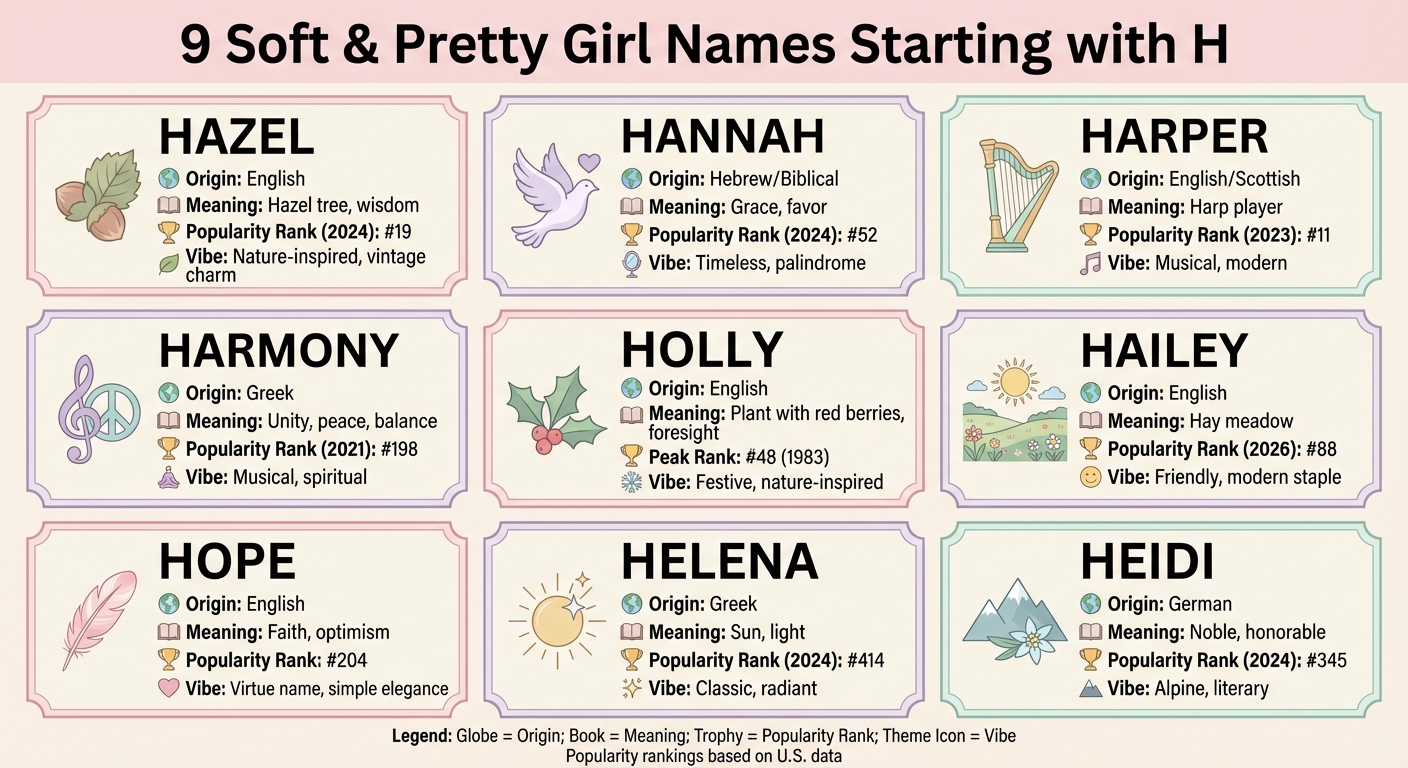
9 Beautiful Girl Names Starting with H: Meanings and Origins Comparison Chart
1. Hazel
Meaning and Significance
Hazel traces its roots to the Old English word hæsel, which refers to the hazel tree and its light greenish-brown nuts. This connection to nature gives the name a grounded, earthy vibe that resonates with many parents.
The name also carries strong symbolic associations. In Celtic and Druidic traditions, hazel trees were revered as sacred, with hazelnuts believed to hold the power of wisdom. Greek mythology adds another layer, where goddesses wore hazel branch headpieces for protection, and hazel wands were seen as symbols of authority.
Cultural Origin
Hazel has English origins and began as a topographic surname for people living near hazelnut trees or groves. Initially used as a masculine name, it was rare until 1865 and reached its highest rank at No. 438 in 1904. However, by 1897, Hazel gained traction as a feminine name, thanks in part to the character in Steele MacKaye's 1880 play Hazel Kirke . While its popularity waned in the mid-20th century, Hazel saw a resurgence in the late 1990s.
Unique Qualities
Hazel strikes a balance between vintage charm and modern appeal. When actress Julia Roberts named her daughter Hazel Patricia Moder in November 2004, it sparked renewed interest in the name. This trend continued when actors John Krasinski and Emily Blunt chose Hazel for their daughter in February 2014. The name also gained a boost from the character Hazel Grace Lancaster in John Green's 2012 novel The Fault in Our Stars. By 2024, Hazel had climbed to No. 19 on the list of most popular girl names in the United States. Its rich history and contemporary relevance make Hazel a standout choice among names starting with H.
sbb-itb-f13f980
2. Hannah
Meaning and Significance
The name Hannah comes from the Hebrew word Channah, which translates to "favor" or "grace."
In the Old Testament, Hannah is a deeply devoted figure, known as the wife of Elkanah and the mother of the prophet Samuel. Her story is one of faith and perseverance - she prayed fervently for a child after struggling with infertility and was blessed with a son by God. Her name reflects this sentiment of divine favor, as noted in A Dictionary of First Names: "He (God) has favoured me with a child."
Cultural Origin
Hannah's biblical roots laid the foundation for its rise in English-speaking regions, particularly after the Protestant Reformation. It became especially popular among Puritans in the 1600s. While similar names like Anne, Ann, and Anna were already common during the late Middle Ages, the specific usage of Hannah grew more consistent later on.
The name saw a major resurgence in the late 20th century. It was the second most popular name for girls in the United States for three consecutive years in the late 1990s. By 2024, it ranked as the 52nd most popular name for girls in the U.S.. Beyond America, it has also been a top choice in countries like Germany, Ireland, Australia, and New Zealand, showcasing its widespread appeal.
Unique Qualities
One of Hannah's standout features is its palindrome structure, offering a visually pleasing symmetry. Its soft, flowing sound - starting with a gentle "H" and ending with a melodic "ah" - adds to its charm, making it feel both elegant and approachable.
Many parents describe Hannah as timeless and unpretentious, with qualities like simplicity, grace, and refinement. Tara Rhiannon Dawn Fietz from FamilyEducation captures its essence well, calling it "a beautiful baby girl's name that means 'grace'."
3. Harper
Meaning and Significance
The name Harper, which translates to "harp player", has its roots in the Old English word hearpe. Historically, it referred to individuals who played a crucial role in noble households during medieval times in Scotland and Northern England.
Cultural Origin
Harper's connection to music ties into its English, Scottish, and Irish origins. In Scotland, it is often an Anglicized version of the Gaelic Mac Chruiteir, meaning "son of the harper." Additionally, it shares ties with the German surname Härpfer. Although it began as a surname, Harper has transitioned into a widely loved first name. Its popularity surged thanks to literary connections - such as the renewed interest in Harper Lee after the release of Go Set a Watchman - and celebrity influence, notably when David and Victoria Beckham named their daughter Harper in 2011. By 2023, Harper had climbed to the No. 11 spot among the most popular names for girls in the United States, with 7,769 births recorded under this name.
Unique Qualities
Harper carries a sense of artistry, harmony, and imagination. While it started as a unisex name, it is now predominantly associated with girls. Its gentle sound paired with a confident tone strikes a perfect balance - offering elegance with a touch of modern flair. It's a great choice for parents looking for something both timeless and contemporary.
4. Harmony
Meaning and Significance
The name Harmony conveys a sense of unity, peace, and balance. Its origins trace back to Greek mythology, where Harmonia, the goddess of harmony and order, was the daughter of Aphrodite. This mythological link gives the name a timeless charm, blending ancient traditions with a modern sensibility. As a virtue name, Harmony reflects the ideals of peaceful coexistence and balance, making it a meaningful choice for parents who value these qualities. Its symbolic depth adds to its appeal as a name that radiates a gentle yet profound elegance.
Cultural Origin
Harmony has its roots in the Greek word harmonia and the Latin term for unity, further enriching its symbolic meaning. The name gained renewed popularity in the late 20th century. It first appeared among the top 1,000 U.S. baby names between 1975 and 1983 and has consistently remained popular since 1997. By 2021, it ranked as the 198th most popular name for newborn girls in the United States. Pop culture has also played a role in its rise, with characters like Harmony Kendall in Buffy the Vampire Slayer and Angel and appearances in Glee and Toy Story 4 bringing it into the spotlight.
Unique Qualities
Harmony stands out as both a word name and a musical name, often grouped with other lyrical choices like Aria and Melody. Its soft, flowing sound and associations with peace and unity make it especially appealing. Many see it as a name that feels natural and serene. It also carries a "new age" or "flower child" vibe, resonating with parents looking for a name that feels spiritual yet grounded. While technically gender-neutral, Harmony is predominantly chosen for girls - 1,499 American girls were named Harmony in 2021, compared to fewer than five boys. Notable figures with this name include Harmony Tan and Harmony Santana.
5. Holly
Holly is a name that draws inspiration from nature and carries a festive, cheerful charm with deep botanical roots.
Meaning and Significance
The name Holly comes from the Old English words holen or holegn, which mean "plant with red berries". In the language of flowers, holly represents "foresight". Historically, the evergreen holly tree symbolized eternal life, protection, and fertility, as it stayed vibrant even during the harshest winters. This gives the name an enduring and graceful strength.
Cultural Origin
Holly has its roots in England, with some Irish influences. In Ireland, it was linked to the surname Mac Cuilinn, derived from the Gaelic word cuileann, meaning holly tree. Originally a locational surname in England, Holly transitioned into a feminine first name in the late 19th and early 20th centuries. Its popularity soared after Truman Capote's 1958 novella Breakfast at Tiffany's and the 1961 film adaptation, where Audrey Hepburn portrayed the iconic Holly Golightly. The name reached its peak in the United States in 1983, ranking at #48.
Unique Qualities
Holly is often associated with festive joy, especially for girls born on Christmas Day in Ireland. The name strikes a balance between timeless sophistication and a fresh, youthful energy. Its soft "l" sounds and two-syllable structure make it feel approachable and warm. While variations such as Hollie, Holley, and Holli exist, the traditional spelling remains the most widely used.
6. Hailey
Hailey is a name that strikes a balance between rustic charm and a contemporary feel, making it a warm and inviting choice for parents seeking something both timeless and current.
Meaning and Significance
The name Hailey translates to "from the hay clearing", "hay meadow", or "hayfield." Its roots trace back to the Old English words heg (hay) and leah (clearing, meadow, or wood), evoking serene countryside imagery. Beyond its pastoral origins, Hailey also has Irish ties, stemming from the Gaelic word ealadhach, which means "ingenious" or "distinct." This dual heritage gives the name both a nature-inspired softness and an intellectual undertone.
Cultural Origin
Hailey began as an English locational surname, referencing places in Oxfordshire and Hertfordshire. While it appeared as a first name as early as 1910, it wasn’t until the late 20th century that it gained widespread popularity. Actress Hayley Mills played a significant role in this shift during the 1940s and 1960s. The name hit its peak in the U.S. around 2010, ranking 19th on the Baby Names Popularity Charts at the time. As of February 2026, it holds the #88 spot for popularity and is ranked #100 in total U.S. births. Among its many spellings, "Hailey" became the most favored in the U.S. by 2001, overtaking "Haley".
Unique Qualities
As Mom Loves Best describes, "Hailey is the auditory equivalent of a sunny afternoon; it is bright, approachable, and effortlessly friendly". It embodies a "girl next door" charm, suiting a variety of personalities, from athletes to academics. The name also bridges the gap between vintage classics and the modern trend of using surnames as first names, solidifying its place as a modern staple. According to Mom Loves Best, "It has graduated from being a 'trendy' name of the early 2000s to a stable, recognized staple. It is familiar without being overused". Parents often experiment with alternative spellings - Hayley, Hailee, Haleigh - but Hailey remains the most popular and enduring version in the U.S.
7. Hope
Hope carries a deep and enduring significance. Coming from the Old English word hopian, it translates to "faith", "expectation", "belief", or "desire of fulfillment". As a virtue name, it represents optimism and the belief that brighter days are possible, even in tough times. It also holds a special place in Christian theology, being one of the three theological virtues - Faith, Hope, and Charity - mentioned in I Corinthians 13:13.
Meaning and Significance
The name Hope is simple yet profoundly meaningful. According to Mama Natural, "The meaning of the name 'Hope' is straightforward: it represents the feeling of hope. It's a reminder that even in the darkest of times, there is always something to look forward to". This makes it a particularly heartfelt choice for parents who have faced loss. It’s often chosen for rainbow babies - children born after a pregnancy loss - because of its emotional depth and message of resilience. Laura Kissee, a parent, shared: "It is a reminder that hope can prevail even in the darkest times". This emotional connection highlights its timeless appeal.
Cultural Origin
The name Hope became popular in the 17th century, especially among Puritans who favored virtue names. In the United States, it has consistently ranked among the top 1,000 names for girls since 1880. Its peak popularity came in 1999, when it ranked 144th, and it currently holds the 204th spot. A fun fact: in 2009, 40 sets of twins in the U.S. were named Faith and Hope, making it the second most popular twin name pairing that year.
Unique Qualities
Hope blends simplicity with elegance. Its single syllable makes it easy to say and remember, while its rich meaning gives it depth. The name is famously tied to Emily Dickinson’s poem "Hope is the thing with feathers". Notable individuals named Hope include Hope Solo, the American World Cup soccer champion and Olympic gold medalist, and actress Hope Davis, known for her work in About Schmidt and Succession. It pairs beautifully with middle names like Noelle, Allison, or Riley, and complements sibling names such as Grace, Faith, or Joy.
8. Helena
Helena, the Latinized version of Helen, originates from the Greek word helios, meaning "sun", giving the name a radiant and celestial essence. Its history is enriched by Saint Helena, the mother of Emperor Constantine, who is credited with discovering the True Cross. The name also carries a mythological connection to Helen of Troy, celebrated as the most beautiful woman in Greek mythology.
Meaning and Significance
Helena's sunny roots contribute to its enduring charm. The name balances a youthful vibrancy with a sense of classic elegance. In literature, Helena has made a mark as the heroine in Shakespeare's All's Well That Ends Well and as a central figure in A Midsummer Night's Dream.
Cultural Origin
While its roots lie in Ancient Greece, Helena has been embraced by diverse cultures worldwide. It’s found in German, Scandinavian, Portuguese, Polish, and English-speaking communities. In the United States, the name reached its peak popularity in 1902, ranking at #270. After a period of decline, it made a comeback, climbing 42 spots between 2023 and 2024 to settle at #414. Elsewhere, Helena remains a favorite, ranking in the top 10 in Slovakia and the top 100 in Portugal.
Unique Qualities
Helena offers a variety of nickname options, including Lena, Nell, Leni, Ellie, and Ella, making it adaptable to different stages of life. Famous namesakes include actress Helena Bonham Carter and supermodel Helena Christensen. The name day for Helena is celebrated on August 18 in the Roman Catholic tradition and is recognized in Austria, Czechia, and Slovakia.
9. Heidi
Heidi is a German diminutive of Adelheid, the German form of Adelaide. It combines the roots adal (meaning "noble" or "honorable") and heit (meaning "kind" or "type") to convey the idea of "nobility" or "exalted nature". The name’s soft sounds, starting with a gentle "H" and ending with a cheerful "ee", give it a youthful and endearing quality. This blend of meaning and sound has helped Heidi maintain its timeless charm.
Meaning and Significance
Heidi became widely recognized thanks to Johanna Spyri’s 1880 children’s novel, Heidi, which tells the tale of a spirited young girl living in the Swiss Alps. This literary classic has forever linked the name to themes of nature and adventure. Emily McNamara, Senior Content Writer at The Bump, perfectly captures this connection:
The main character, Heidi, is an adventurous and fearless little girl who has forever ingrained her Alpine image into the name.
The name's association with the Alps is so iconic that Maienfeld, Switzerland, a key setting in the story, is now marketed as "Heidiland" to attract visitors.
Cultural Origin
Following its literary success, Heidi gained popularity in English-speaking countries, particularly after the 1937 movie adaptation starring Shirley Temple. Despite its Old German roots, the name experienced a surge in the United States, peaking in 1974 when it reached #60 on the baby name charts, with 0.299% of baby girls receiving the name that year. As of 2024, Heidi ranks at #345, showing a slight revival in popularity. Beyond the U.S., Heidi remains a favorite in Scandinavia, consistently ranking in Norway’s top 10 names. It also has designated name days in several European countries, including July 27 in Finland and June 4 in Norway.
Unique Qualities
Heidi’s appeal lies in its blend of literary heritage and natural imagery, often evoking a "romantic cottagecore" vibe tied to its Alpine roots. In German-speaking regions, it’s also used as a nickname for longer names like Heidrun, Heidelinde, and Heidemarie. Shortened versions like Dee and Didi add to its approachable charm. The name’s versatility is further highlighted by famous figures like German supermodel Heidi Klum and American comedian Heidi Gardner.
Conclusion
These nine H names bring a special charm and meaning to families. Whether it's Hazel's vintage appeal, Hannah's timeless biblical grace, Harper's literary flair, or Harmony's melodic flow, each name tells its own story. Holly evokes the cozy spirit of winter, Hope offers a simple yet elegant virtue, Helena exudes romantic sophistication, Hailey feels approachable and modern, and Heidi carries a noble and distinctive vibe. Together, they showcase a range of styles and meanings, from classic to contemporary.
What makes H names stand out is their adaptability. As Sophie Kihm, Nameberry Editor, puts it:
Girl names that start with H tend to fall on the extreme ends of the spectrum - very vintage or ultra-modern.
This diversity means there's an H name for every preference, whether you're drawn to nature-inspired choices, spiritual depth, or global influences.
These names captivate with their gentle sounds and meaningful roots. For instance, you might honor tradition with a biblical name like Hannah, celebrate the beauty of nature with Holly, or embrace the enduring quality of Hope, which has remained a mainstay in the US Top 1000 for over a century. Each name carries its own significance and history.
Think about which meaning - grace, harmony, light, or nobility - resonates most with your family values. You might even explore nicknames like Lena or Ellie from Helena for added flexibility. The perfect name will feel right when spoken aloud and will grow alongside your daughter, adapting beautifully through all stages of her life.
FAQs
What are the most popular H girl names in the U.S. right now?
As of February 2026, Harper holds the top spot as the most popular girl name starting with H in the U.S., with Hazel and Hannah following close behind. These names are cherished for their classic charm and gentle sophistication.
What are good middle names for Hazel, Hannah, or Harper?
Good middle names for Hazel, Hannah, or Harper can vary depending on the vibe you're going for.
For Hazel, middle names like Grace, Elizabeth, or Mae emphasize its old-fashioned elegance.
Hannah shines with classic pairings such as Rose, Marie, or Anne.
If you're leaning toward a more contemporary feel for Harper, names like Jane, Claire, or Elizabeth strike a nice balance.
Ultimately, pick something that feels meaningful - whether it ties to your family, personal taste, or even a special tradition.
Which H names have easy nicknames?
Many girl names that start with 'H' naturally come with sweet and easy-to-use nicknames. Take Hannah, for instance - it can be affectionately shortened to Nan or Nanny. Harriet often becomes Hattie or Hat, adding a touch of charm. For names like Helen, you’ve got choices like Ellie, Ella, or even Lena. Even modern picks like Heidi or Harlow can inspire endearing nicknames, giving parents plenty of options to personalize the name.