Choosing a rare girl’s name starting with “F” can give your child a beautiful, meaningful, and uncommon identity. Here are eight options, each with unique origins, historical ties, and charming qualities:
- Fenna: Dutch/Frisian name meaning "peace" or "marsh dweller." Rare in the U.S. but popular in the Netherlands.
- Fable: A literary-inspired name symbolizing storytelling and morals, with growing interest in the U.S.
- Fiadh: Irish name meaning "wild" or "untamed", linked to nature and mythology.
- Femie: Greek origin, derived from Euphemia, meaning "good speech."
- Frideswide: Anglo-Saxon name meaning "strong and peaceful", tied to a saint and Oxford history.
- Fedelma: Irish name meaning "beauty" or "forever good", tied to mythology and early Christianity.
- Fiammetta: Italian for "little flame", with literary and artistic significance.
- Ffion: Welsh name meaning "foxglove", connected to folklore and nature.
These names combine rarity with meaningful stories, offering a range of choices for parents seeking something special. Whether inspired by nature, history, or literary roots, each name provides a distinct charm.
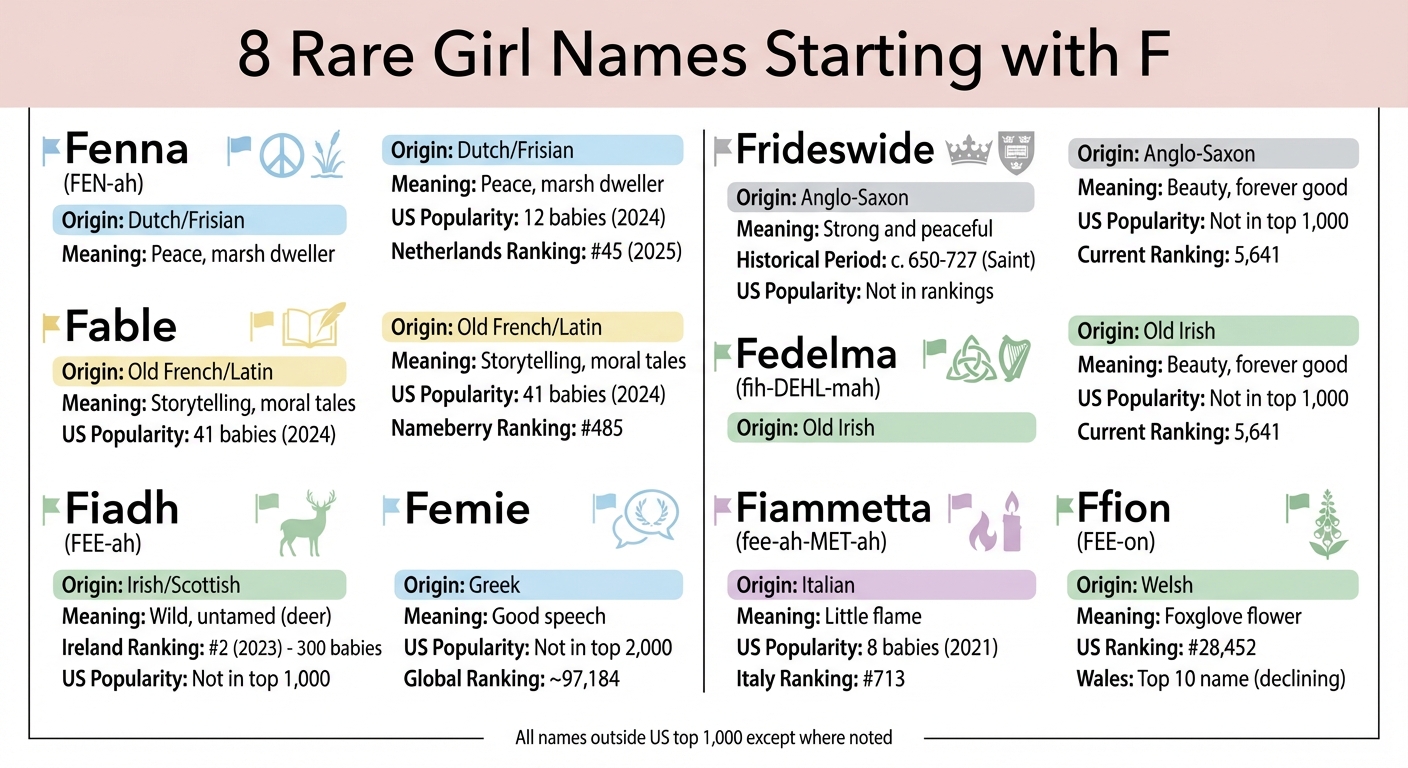
8 Rare Girl Names Starting with F: Origins, Meanings, and Popularity Rankings
1. Fenna
Meaning and Cultural Origin
Fenna is a Dutch and Frisian name originating from Friesland, a region in the northern Netherlands. Its meaning is twofold: it is most commonly associated with "peace", but it also stems from the Old Frisian word fenn, which translates to "marsh dweller" or "from the fen". This dual meaning reflects both a sense of tranquility and a deep connection to the natural landscapes of its origins.
The name has a long history, appearing in Frisian legal texts as early as the 9th century. Among notable historical figures are Fenna van Stavoren, a prominent 12th-century personality, and Fenna Oosterhoff (1924–2019), a courageous Dutch resistance fighter during World War II. Oosterhoff’s heroic efforts to aid Allied forces and shelter refugees earned her the Dutch Resistance Memorial Cross.
Uniqueness and Rarity
In the United States, Fenna is a rare gem. In 2024, it was given to only 12 female babies nationwide, and it does not appear in the top 1,000 U.S. baby names. By contrast, it enjoys much greater popularity in the Netherlands, where it ranked #45 in 2025, securing a spot among the country’s top 50 names.
The name gained some recognition in English-speaking circles when Canadian comedian Katherine Ryan chose it for her daughter in 2023. Despite this moment in the spotlight, Fenna remains an uncommon choice, making it a fresh and distinctive pick.
Charm and Appeal
What sets Fenna apart is its familiar yet unique sound. Clare Green, editor at Nameberry, highlights this perfectly:
Rhyming with Jenna, it's both rare and familiar and could conceivably enjoy wider usage in the English-speaking world as well.
Fenna aligns with current naming trends, often described as boho, hipster, sleek, and cool. It also fits into the growing appeal of vintage names, part of a movement to revive "old lady names" with a modern twist. With its two syllables and soft yet confident tone, Fenna strikes a perfect balance - distinctive enough to stand out, yet approachable and easy to love.
This blend of historical depth and contemporary charm makes Fenna a name worth considering, especially for those seeking something rare and meaningful. Stay tuned as we explore more unique F names!
sbb-itb-f13f980
2. Fable
Meaning and Cultural Origin
The name Fable has deep literary roots, originating from Old French and Latin. Its Latin root, fari, translates to "to speak", tying it to the tradition of storytelling. First seen in Middle English between 1250 and 1300, Fable embodies the essence of narratives that convey morals or legendary tales. Whether referring to a supernatural legend or a brief story with talking animals and a moral lesson, the name carries a timeless connection to storytelling.
Uniqueness and Rarity
Fable is a rare gem among baby names in the United States. In 2024, only 41 baby girls were named Fable, and it remains outside the top 1,000 U.S. baby names. This is a marked rise from just 6 babies named Fable in 2008. Between 2023 and 2024, the name climbed an impressive 1,184 spots in the girls' rankings. On Nameberry, Fable holds the #485 spot as of early 2026. While about 92% of individuals named Fable are female, it’s gaining traction as a gender-neutral choice [19, 20, 22]. Its rarity makes it a standout pick for parents seeking something truly distinctive.
Charm and Appeal
Fable captivates with its blend of literary elegance and playful whimsy. As Grace Royal from Nameberry puts it:
Fable, like Story, is a word name with real potential, combining enchanted tale-telling with a moral edge.
The name's "-abel" ending, which echoes familiar names like Mabel and Abel, gives it a balance of novelty and comfort. Parents drawn to Fable often appreciate other imaginative names such as Sonnet, Poet, Story, and Reverie. Ready to discover another rare "F" name with its own fascinating background? Let’s continue.
3. Fiadh
Meaning and Cultural Origin
Fiadh (pronounced "FEE-ah") has deep roots in Irish and Scottish traditions. The name comes from the Old Irish word fiad, which means wild or untamed and is often linked to the grace and majesty of deer. Despite its ancient origins, Fiadh was virtually unknown in Ireland until the late 20th century. In fact, its recorded use began in 1994, with just three instances by 2002.
Uniqueness and Rarity
Fiadh has surged in popularity in Ireland, becoming the #1 baby girl name in 2021 and holding the #2 spot in 2023, with 300 girls named Fiadh that year. However, it remains rare in the United States. As of February 2026, it hasn’t appeared in U.S. national birth data rankings. On Nameberry, it ranks at #476, and it broke into the Top 1,000 names in England and Wales in 2020.
Charm and Appeal
Fiadh strikes a balance between a lively, untamed essence and a gentle, folkloric charm. It is tied to Irish mythology through the legendary na fianna. Its unique Irish spelling, paired with a simple and familiar pronunciation, makes it stand out while still being accessible. Fiadh also shares a rhythmic quality with popular names like Mia, Thea, and Sofia, giving it a modern yet timeless appeal. This mix of heritage and contemporary style makes Fiadh a compelling choice for anyone seeking a rare name with a rich backstory.
4. Femie
Meaning and Cultural Origin
Femie (pronounced "FEE-mee") traces its roots to Greek origins, derived from the name Phemia. It serves as a diminutive of Euphemia, an Ancient Greek name that translates to "good speech" or "one who speaks well". The name’s meaning is often connected to "language". Historically, it has ties to St. Euphemia, a 3rd-century Christian martyr, adding a layer of historical significance. In modern usage, Femie is sometimes seen as a variation of the Dutch names Femke or Femme, blending ancient heritage with contemporary influences.
Uniqueness and Rarity
Femie’s rarity is one of its most appealing qualities. In the United States, it hasn’t appeared in the top 2,000 baby names as of 2018, making it a standout choice for parents seeking something less common. Globally, it holds a popularity rank of approximately 97,184. While uncommon in English-speaking countries, Femie sees its highest relative usage in Suriname, where it ranks 3,897th, and in the Philippines, where it ranks 7,620th. Its unique blend of simplicity and scarcity makes it an excellent option for those looking for a name that’s easy to spell and pronounce yet remains distinctive.
Charm and Appeal
Femie’s charm lies in its harmonious sound and meaningful roots. Its two-syllable structure gives it a light, melodic quality that feels both sweet and vibrant. It fits effortlessly into the trend of short, playful names ending in "ee", like Jamie or Emmie, but stands out due to its rarity. The name’s "good speech" etymology often leads parents to associate it with qualities like confidence in communication and public speaking. Additionally, Femie is tied to positive traits such as kindness, grace, resilience, and creativity, making it a thoughtful choice for parents hoping to bestow a name with depth and inspiration.
5. Frideswide
Meaning and Cultural Origin
Frideswide (pronounced "FRYS-wide" or "FRY-des-wide") traces its roots to Anglo-Saxon origins, combining friþ (meaning "peace") and swīþ (meaning "strong"). Together, the name is often interpreted as "strong and peaceful". Its historical significance is deeply tied to Saint Frideswide (c. 650–727), an English princess and abbess who founded the monastery that would later become Christ Church Cathedral in Oxford. In 1440, Archbishop Henry Chichele declared her the patron saint of Oxford University. According to legend, Saint Frideswide fled from an unwanted marriage to King Algar, and when he pursued her to Oxford, he was struck blind until he repented. The name’s rich history adds to its unique charm today.
Uniqueness and Rarity
Frideswide is undeniably rare. As of February 2026, it does not appear in U.S. birth rankings and remains absent from the top 100 name charts. Its survival is particularly noteworthy - while many Old English names faded after the Norman invasion of 1066, Frideswide endured until the 15th century, largely due to the enduring reverence for its namesake. This blend of historical significance and rarity makes it a standout choice for parents seeking something distinctive.
Charm and Appeal
Frideswide strikes a balance between strength and tranquility, offering a name that feels both powerful and serene. Its association with Oxford lends it a scholarly and prestigious aura, while its formal and classic tone evokes an air of refinement. For those who love vintage names, Frideswide brings authentic medieval English character without feeling overly ornate. Adding to its appeal is the playful, modern nickname "Friday", which gives this timeless name a fresh and approachable twist. Together, these qualities make Frideswide a name that blends history with contemporary charm.
6. Fedelma
Meaning and Cultural Origin
Fedelma (pronounced "fih-DEHL-mah") carries a rich history and meaning. This name, a Latinized form of the Old Irish Fedelm, translates to "beauty, forever good", reflecting ideas of enduring virtue and constancy. Some linguists also connect it to the Proto-Celtic root wēd-/wid-, meaning "to know" or "to see", which hints at a prophetic quality.
In Irish mythology, Fedelm was a prominent figure in the Ulster Cycle. She was a prophet and a fili - a learned poet - who famously predicted events in the epic Táin Bó Cuailnge. The name also has religious significance. In the 5th century, Saint Fidelma, a variant of Fedelma, was the daughter of King Laoghaire and one of Saint Patrick's earliest converts to Christianity.
Uniqueness and Rarity
Fedelma is undeniably rare. It doesn't appear in the top 1,000 baby names in the United States, and as of February 2026, it ranks at a modest 5,641. While modern Irish names like Fiadh are gaining traction, Fedelma remains a lesser-known gem, described as "archaic-chic" for its timeless yet underappreciated charm. Shortened versions like Delma and Elma saw some popularity in the early 20th century but have since faded into obscurity. Its rarity, combined with its historical and mythological significance, makes it a standout choice for those looking for something distinctive.
Charm and Appeal
The appeal of Fedelma lies in its blend of historical depth and symbolic meaning. As Isolde Quirante, Assistant Editor at The Bump, notes:
Flowing from the Old Irish expression feideil, meaning "ever-good", "enduring", or "constant", it symbolizes steadfast love for your child.
Fedelma is often seen as a name that embodies grace, maturity, and refinement. Its three syllables give it an elegant rhythm, while its ties to Irish mythology and early Christian history add layers of cultural richness. For parents seeking a name that feels both timeless and meaningful, Fedelma offers a perfect balance of character and heritage.
7. Fiammetta
Meaning and Cultural Origin
Fiammetta (fee-ah-MET-ah) is an Italian name that translates to "little flame", derived from the word fiamma (flame). The name gained literary fame through Giovanni Boccaccio, who used it as a pseudonym for his muse, Maria d'Aquino, in works like The Decameron, The Filocolo, and Elegia di Madonna Fiammetta.
Although its literary significance peaked during the Renaissance, Fiammetta has roots in Northern Italy dating back to the Middle Ages. It likely started as a nickname for eloquent or fiery speakers. Beyond literature, the name has inspired art, appearing in Dante Gabriel Rossetti's 1878 Pre-Raphaelite painting A Vision of Fiammetta and as the title of a 19th-century ballet.
Uniqueness and Rarity
In the United States, Fiammetta is extremely rare. Only 8 girls were given the name in 2021, and just 5 in 2018. It doesn’t appear in the top 1,000 names, ranking #1,541 on Nameberry for 2024. In Italy, however, it holds the 713th spot.
Charm and Appeal
Fiammetta combines elegance with a fiery spirit. Grace Royal from Nameberry describes it perfectly:
Fiammetta, from the Italian word for flame, has both femininity and fire.
This four-syllable name exudes an artistic and timeless quality, while offering approachable nicknames like Fia or Etta. Notable namesakes include Fiammetta Wilson, a pioneering English astronomer, and Fiammetta Cicogna, a modern Italian model and TV presenter. For those seeking a less conventional Italian name, Fiammetta offers a striking alternative to classics like Giovanna or Francesca. Its rich history and rarity make it a standout choice among Italian names starting with F.
8. Ffion
Meaning and Cultural Origin
Ffion (pronounced FEE-on) is a Welsh name that means "foxglove", referencing the foxglove flower (Digitalis purpurea). The double "F" reflects traditional Welsh spelling rules, giving the name a distinct look and feel. Though sometimes linked to Fiona, which means "fair" or "white", Ffion has its own identity rooted in nature. In British folklore, foxgloves were associated with fairies, earning names like "folk's gloves" and "Fairy Thimbles" in Ireland. In Wales, they’re called "Goblin's Gloves." One whimsical tale even suggests that fairies gave foxes these flowers as gloves to help them sneak into chicken coops undetected. While Ffion is a relatively modern creation, it draws heavily from Welsh linguistic and cultural traditions.
Uniqueness and Rarity
In the U.S., Ffion is incredibly rare. It doesn’t appear in the Social Security Administration's top 1,000 names and ranks at #28,452 in popularity. Globally, it sits around #23,857. However, in Wales, Ffion has been a top 10 name, though its popularity there has started to decline. In England, it ranked #469 in 2024, and on Nameberry, it holds the #1,220 spot as of February 2026. Brynn McKeon from Nameberry highlights its appeal:
This unusual (to non-Welsh speakers) name is near the top of the charts in Wales, carried by the recent taste for native Welsh names.
Charm and Appeal
Ffion has a soft, melodic quality that feels both elegant and grounded in nature. Its connection to foxgloves adds a layer of intrigue, as the flowers are not only visually stunning but also known for their medicinal potency and toxicity. Namesaurus captures its essence well:
Ffion's soft and lyrical sound evokes a sense of otherworldliness. It flows beautifully and has a dreamlike quality.
Notable figures named Ffion include Ffion Hague, a Welsh biographer and the wife of UK politician William Hague, and Ffion Davies, a world champion Brazilian jiu-jitsu athlete from Swansea. The name even appeared in pop culture, with the character Ffion Foxwell in the Black Mirror episode "The Entire History of You". For parents seeking a name that honors Welsh heritage while standing out, Ffion offers a perfect blend of elegance and individuality. Nicknames like Fi, Ffi, or Fia add an approachable touch, making it a versatile choice. This entry wraps up our F name collection and highlights how NameHatch can support you in finding the perfect name.
How NameHatch Helps You Find Rare F Names
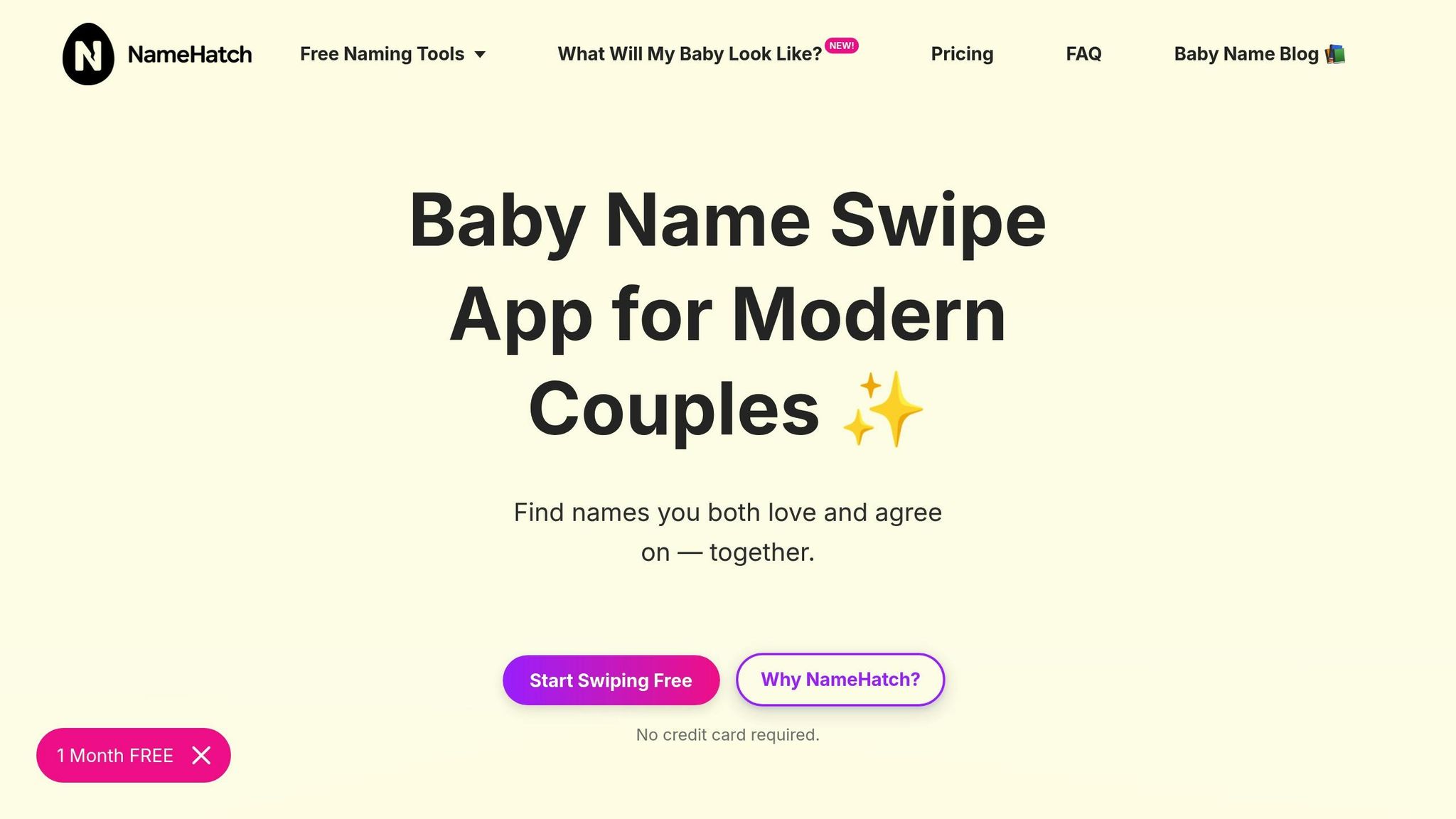
NameHatch makes finding rare and meaningful F names easier and more enjoyable with its AI-powered platform. Instead of endlessly scrolling through long lists, you can use NameHatch's swipe-based interface - similar to popular dating apps - to browse through 682 girl names starting with F. Swipe right on names you love and left on those you don’t, creating a seamless and interactive way to narrow down your options.
The platform doesn’t stop at swiping. Its AI learns your preferences as you go, drawing on 20 years of name preference data[5,6]. Whether you’re into nature-inspired names, vintage classics, or international options, the system adapts, surfacing rare and meaningful names you might have missed otherwise[5,9].
For couples, NameHatch offers a clever solution to the often tricky process of agreeing on a name. The partner syncing feature lets both of you swipe independently, and when you both swipe right on a name, it’s automatically added to a shared list. You can even invite friends and family to contribute, making the decision process smoother and more collaborative[5,6].
To refine your search further, NameHatch includes both basic and advanced filters. Free users can sort names by categories like Classic, Modern, Soft, or Strong, while premium users gain access to filters such as Nature-Inspired, Global, Mythical, and Unique. This flexibility allows you to find rare F names that match specific origins or meanings - like the Welsh name Ffion or the Italian Fiammetta.
Accessible on both mobile and desktop, NameHatch also offers launch notifications and discounts, making it an affordable and personalized tool for finding the perfect name[5,6].
Conclusion
Looking back at the histories and meanings behind these rare F names, it's clear they offer a wide array of distinctive choices. From the serene Dutch appeal of Fenna to the vivid Italian spark of Fiammetta, each name tells its own story. Whether it's the untamed Irish essence of Fiadh, the imaginative charm of Fable, or the floral grace of Welsh Ffion, these names carry a deep sense of heritage and individuality.
Choosing a rare name ensures that your daughter’s identity will stand out - she’s unlikely to share her name with classmates. These options combine true rarity with beauty and meaning, giving you the best of both worlds.
Ultimately, the decision comes down to what feels right to you. Whether your heart leans toward names symbolizing peace (like Fenna or Frideswide), strength (Frideswide), loyalty (Fedelma), or nature (Ffion), the best choice will align with your values and hopes for your child.
"Every parent’s journey is unique, so let your intuition guide you."
Follow your instincts, and you’ll find the perfect rare F name for your little one.
FAQs
How do you pronounce Fiadh, Ffion, and Frideswide?
The pronunciations differ based on their origins:
- Fiadh (Irish, meaning "wild"): Pronounced "FEE-a", with the stress on the first syllable.
- Ffion (Welsh, meaning "fair one"): Pronounced "FEE-on", featuring a soft "F" sound.
- Frideswide (Old English): Typically pronounced as either "FREED-swide" or "FREED-swine", depending on regional accents.
Which F names are easiest to spell in the U.S.?
When it comes to girl names starting with "F", those with simple and familiar letter combinations tend to be the easiest to spell in the U.S. Examples like Faith, Fiona, Frankie, and Freya fit this description perfectly. These names follow common phonetic patterns and are widely recognized.
On the other hand, names such as Fátima or Fíona, which include accents or less familiar variations, might pose more challenges for spelling or pronunciation. In general, names without special characters or accents are simpler to handle and more intuitive for most people.
What are good nicknames for these rare F names?
Nicknames for rare F names tend to be short and sweet. For instance, Fable might turn into "Fae" or "Fabbie", while Fallon could be called "Fally" or "Fae." With Farrah, options like "Farra" or "Faye" work well. Names like Fiadh and Fiamma naturally shorten to "Fia" and "Fiam." These nicknames are casual, fun, and perfect for everyday use.