Choosing the perfect name for your daughter is a big decision, especially if you're looking for something meaningful and timeless. Names that begin with "Da" offer a blend of elegance, strength, and history. Here's a quick look at 10 standout names:
- Dahlia: Inspired by the flower, it symbolizes dignity and inner strength. Popular and steadily climbing in rankings.
- Daphne: Rooted in Greek mythology, it represents laurel trees and victory. Recently gained attention through pop culture.
- Danica: A Slavic name meaning "morning star", tied to hope and new beginnings.
- Daria: With Persian origins, it means "possessing goodness" and exudes intelligence and independence.
- Darcy: A name with French and Irish roots, it carries sophistication and charm.
- Dana: A unisex option with diverse meanings, from "wise" in Persian to "beautiful pearl" in Arabic.
- Dawn: Representing daybreak, it evokes renewal and hope.
- Danielle: A classic French name meaning "God is my judge", popular in the late 20th century.
- Damaris: A rare name from Greek origins, meaning "gentle" or "wife", with biblical ties.
- Davina: The feminine form of David, meaning "beloved", with a modern yet historical appeal.
These names combine history, nature, mythology, and cultural significance, making them timeless choices. Whether you prefer floral elegance, celestial charm, or mythological roots, there's a "Da" name to match every style and personality.
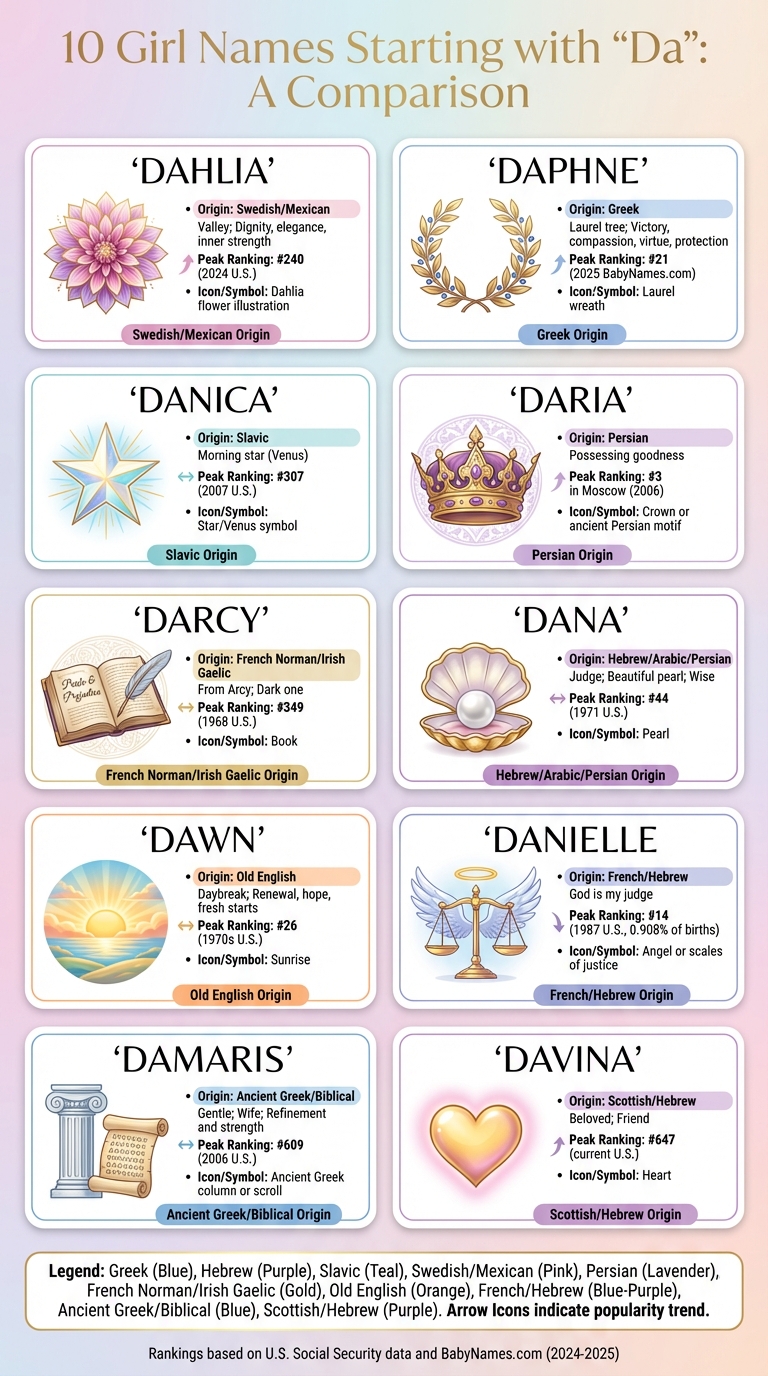
10 Girl Names Starting with Da: Origins, Meanings, and Popularity Rankings
1. Dahlia
Historical and Origin Background
The name Dahlia pays homage to Anders Dahl, an 18th-century Swedish botanist, and was officially given to the flower in 1791. Originally native to Mexico and Central America, the flower was cherished by the Aztecs, who called it "Acocotle" or "Cocoxochitl", meaning "water cane." It made its way to Europe in 1789.
By the late 19th century, Dahlia had become familiar among English speakers. Its literary presence was cemented in works like George Meredith's Rhoda Fleming and P.G. Wodehouse's Jeeves stories.
Meaning and Character
Dahlia carries a rich symbolism rooted in its history. The "Dahl" component, derived from Germanic and Scandinavian origins, translates to "valley". In the Victorian language of flowers, the dahlia represents dignity, elegance, and inner strength. These qualities add a timeless allure to the name, making it both meaningful and charming.
Timelessness
Dahlia's appeal has stood the test of time, showing consistent popularity in recent years. It has been in the top 1,000 names in the U.S. since 2006 and climbed into the top 300 by 2022. By 2024, it reached #240 in U.S. baby name rankings. This steady rise highlights its enduring charm, effortlessly combining classic elegance with a connection to nature.
sbb-itb-f13f980
2. Daphne
Historical and Origin Background
The name Daphne comes from the Greek word for "laurel" or "bay tree". In Greek mythology, Daphne was a naiad nymph who transformed into a laurel tree to escape Apollo’s relentless pursuit. Though the name saw some use during the Roman era, it largely fell out of favor until it experienced a revival in the 18th century.
Daphne made a notable return in the late 19th century, coinciding with the trend of naming children after plants and flowers. It became especially popular among British aristocratic families during this time. In the United States, Daphne has consistently appeared in the top 1,000 names for girls since 1889. A significant surge in its use occurred between 1960 and 1962, thanks to the ABC television series Surfside 6, which featured Diane McBain as the glamorous socialite Daphne Dutton. These layers of history and cultural touchpoints add depth to the name's charm.
Meaning and Character
Rooted in mythology, the connection to the laurel tree gives Daphne a rich symbolism. After Apollo fashioned a crown from Daphne’s leaves, the laurel wreath became a celebrated emblem of victory and achievement, famously used in the ancient Pythian Games. The expression "resting on one's laurels" even originates from this tradition.
The name Daphne is often linked to qualities like compassion, virtue, and protection. It also carries a sense of elegance and purity, with a natural and timeless appeal.
Timelessness
Daphne has experienced waves of popularity, reaching its peak in U.S. history in 2024. A December 2020 Netflix series gave the name a fresh boost, and by late 2025, it ranked #21 on BabyNames.com. Its ties to nature and Greek mythology make it a perfect fit for modern naming trends, while its classic roots ensure its appeal endures across generations.
Author Abby Sandel observes, "The baby name Daphne has traveled from Greek myth to Saturday morning television and back to Regency England."
3. Danica
Historical and Origin Background
The name Danica has deep Slavic origins, derived from a term that means "morning star", symbolizing Venus. In ancient Slavic mythology, Danica was honored as the daystar and considered the Sun's younger sister. Before the spread of Christianity, she was celebrated as a deity. While the name has been a fixture in Serbia, Croatia, and Slovenia for centuries, it made its debut on U.S. naming charts in 1977.
Meaning and Character
Danica carries the essence of the morning star, embodying brightness, hope, and the promise of new beginnings. It is often associated with qualities like strength, grace, and resilience. In numerology, Danica is linked to an adventurous and quick-witted personality, someone who thrives in social settings and adapts with ease.
"Danica, the morning star, would unlock the gates of the Sun's palace, letting the light spread across the sky and creating daylight." – MomJunction
Much like other "Da" names, Danica blends ancient significance with a modern flair.
Timelessness
The luminous symbolism of Danica has helped it maintain its appeal through the years. The name gained widespread recognition in the U.S. following the success of racecar driver Danica Patrick. In April 2008, she became the first woman to win an IndyCar Series race at the Indy Japan 300, a groundbreaking achievement that brought the name into the spotlight. Danica reached its peak popularity in 2007, ranking #307 on the Social Security charts, with about 1,109 occurrences per million. As of 2024, it now ranks at #1,555, continuing to charm as a name that bridges ancient roots with a modern, celestial touch.
4. Daria
Historical and Origin Background
Daria, the feminine counterpart of Darius, traces its roots to the Old Persian name Darayavahush. This name combines daraya (to possess) and vahu (good), giving it the meaning "possessing goodness." Its adoption into Christian tradition stemmed from Saint Daria of Rome, a 3rd-century martyr honored by both the Eastern Orthodox and Roman Catholic churches.
In 18th-century Russia, Daria was quite common, with approximately 4% of women bearing the name. However, by the late 19th century, it was considered old-fashioned and fell out of favor. By the 1960s, during the Soviet era, it had nearly disappeared altogether. This rich historical journey adds depth to its modern appeal.
Meaning and Character
The meaning of Daria - "one who maintains the good" or "possessor of goodness" - reflects its strong and virtuous origins.
"Daria is the female form of Darius, which is the Persian word for 'possessing goodness', which gives this ancient name a sweet and kind association." – Emma Lawler, Senior Content Writer
In contemporary culture, Daria is often associated with intelligence, independence, and a touch of rebellion. These traits were amplified by the 1990s animated series featuring Daria Morgendorffer, a character celebrated for her wit and sharp personality. Today, the name carries a mix of "sassy" and "spunky" qualities, blending its ancient regal roots with a modern edge.
Timelessness
Though its popularity has waxed and waned, Daria has consistently found its way back into favor. After fading during the Soviet era, the name saw a significant resurgence in Eastern Europe. By 2006, it was the third most popular name for baby girls in Moscow and Saint Petersburg. In 2014, it ranked as the eighth most popular name in Romania. Its enduring appeal stretches across cultures, from Russia and Poland to Italy and English-speaking countries, showcasing its ability to adapt and resonate globally.
5. Darcy
Historical and Origin Background
The name Darcy has roots in both French Norman and Irish Gaelic traditions. From the French Norman side, it originates from "d'Arcy", meaning "from Arcy." On the Irish Gaelic side, it stems from "Ó Dorchaidhe", which translates to "descendant of the dark one." Sir John D'Arcy introduced the surname to Ireland and England during the 14th century. By the late 1500s, it had evolved from a surname tied to a place into a given name, particularly among the gentry.
Darcy's literary prominence can be traced to Jane Austen's Pride and Prejudice (1813), which introduced the world to Fitzwilliam Darcy. This character solidified the name's association with sophistication and classic literature. As Oxford Reference notes, "It has always had a somewhat aristocratic flavour, which has added to its popularity as a first name". Though initially a masculine name, Darcy has since gained popularity as a feminine and unisex name in both the UK and the US. Influential figures like English ballerina Darcey Bussell have further shaped its appeal. This rich history contributes to Darcy's modern charm. For parents exploring more options, a baby name swipe app can help narrow down the perfect choice.
Meaning and Character
Darcy carries layered meanings, including "dark one", "from the fortress", and "from Arcy." While its origins suggest a connection to darkness, the name today conveys a sense of elegance and strength. Sophie Kihm from Nameberry describes it as "a unisex option with delicacy, grace, and strength". It strikes a balance between classic refinement and a contemporary, versatile vibe, embodying qualities that feel both formal and approachable.
Timelessness
Darcy’s journey through time highlights its enduring allure. In the US, it reached its highest popularity for girls in 1968, ranking #349 with 0.038% of births. After disappearing from the charts for three decades, it recently made a comeback, ranking #983 in 2024 - a rise of 44 spots from the previous year. Across the Atlantic, the spelling "Darcie" is currently in the UK's Top 100, while "Darcy" holds a spot in the Top 150. Its lasting appeal is further reinforced by its presence in modern media, from Darcy Olsson in Heartstopper to Darcy Lewis in the Marvel Cinematic Universe. With a history spanning Norman nobility, literary classics, and contemporary pop culture, Darcy continues to stand the test of time.
6. Dana
Historical and Origin Background
Dana is a name with a rich tapestry of meanings and origins. As an English surname, it translates to "Dane", while in Hebrew, it means "judge" or "God is my judge". In Arabic, Dana takes on a poetic meaning, referring to "the most perfectly sized, valuable, and beautiful pearl." In Persian, it signifies "wise." The name also serves as a diminutive for names like Daniela and carries historical significance through figures like American author Richard Dana. In the Arab states of the Persian Gulf, Dana is tied to the region's pearl diving heritage, adding yet another layer to its story. These diverse roots make Dana a name steeped in meaning and symbolism.
Meaning and Character
Dana's varied origins bring together themes of wisdom, beauty, and strength. In Gaelic, it represents bravery, and in Celtic traditions, it is sometimes associated with the Mother Goddess. The name often evokes a sense of strength, elegance, seriousness, and wholesomeness.
"Dana has gone from all-boy to almost all-girl, retaining a strong, unisex quality." – Sophie Kihm from Nameberry
Timelessness
Dana enjoyed widespread popularity in the United States, ranking among the top 100 names for girls from 1960 to 1990. Its peak came in 1971, when it reached #44, with 0.396% of baby girls given the name that year. While its popularity has waned in recent years - falling to #1077 in 2024 - this decline has made it a more distinctive option for parents seeking a name with depth and history. Dana's enduring charm is reflected in cultural icons like Dana Scully from The X-Files and Queen Latifah, cementing its place as a name that resonates across generations.
7. Dawn
Historical and Origin Background
Dawn stands out as a name with a natural, poetic essence. Its roots trace back to the Old English word dagung, meaning "daybreak". While the Latin equivalent, Aurora, has been in use for over 1,500 years, the English name Dawn only began gaining traction in the late 1920s. The name also shares a connection with the Roman goddess Aurora, who symbolically renewed herself every morning to herald the sun's arrival. Additionally, some evidence links the name to a Norman habitational origin in northern France, where it means "alder grove".
Meaning and Character
Dawn represents the first light of day, embodying themes of fresh starts, hope, and renewal. It carries a sense of reliability, determination, and nurturing qualities. The name captures the transition from darkness to light, serving as a powerful metaphor for new beginnings. Its simplicity and grounded nature also evoke a wholesome and refined charm.
"Dawn embodies the awakening of the world, representing renewed hope, freshness, and the beginning of a new chapter." – Ancestry
Timelessness
Dawn enjoyed peak popularity during the 1960s and 1970s, climbing to #26 in the 1970s and even breaking into the Top 20 in 1971. Though its ranking has since declined to #1850 in 2024, the name retains its vintage appeal. Figures like Dawn Staley and Dawn French continue to keep it in the public eye, and its enduring association with new beginnings ensures its charm remains intact.
8. Danielle
Historical and Origin Background
Danielle is the French feminine version of the Hebrew name Daniel, derived from two elements: din (to judge) and el (God). The original name traces back to the Old Testament Prophet Daniel, celebrated for his wisdom and his miraculous survival in the lion’s den. The feminine form, however, emerged in medieval France. It wasn’t until the 20th century that Danielle gained traction in English-speaking countries, becoming the favored spelling in these regions.
The name saw a surge in popularity from the 1960s through the 1990s, peaking in 1987 at #14, when 0.908% of baby girls in the U.S. were named Danielle. By 1989, it had become exclusively feminine in usage. This historical depth gives the name a meaningful foundation.
Meaning and Character
Danielle translates to "God is my judge", a phrase that conveys integrity and inner strength. It reflects a person who is guided by their moral compass rather than the opinions of others, embodying a strong sense of justice.
"While the phrase 'God is my judge' might sound severe, historically it is interpreted as a message of comfort and protection. It suggests that the bearer answers only to the Divine, relieving them of the burden of satisfying human critics." – Mom Loves Best
The name’s biblical roots further connect it to symbols of strength and loyalty, often tied to lions and angels. Danielle is frequently associated with qualities like fairness, mercy, and righteousness.
Timelessness
Danielle has gracefully transitioned from an '80s favorite to what many now consider a "modern classic". After spending over a decade in the Top 20, its popularity has waned, currently ranking #442 as of 2025. This shift makes it an appealing choice for parents seeking a name that’s familiar but not overused.
"Danielle is an excellent choice for a baby born in 2025 because it sits in the 'sweet spot' of nomenclature: everyone can pronounce it, everyone can spell it, yet your daughter will likely be the only Danielle in her kindergarten class." – Maryana Vestic, Writer and Editor
The name also offers a range of nickname options to suit different personalities. "Dani" provides a sporty vibe, "Elle" or "Ellie" adds a touch of sophistication, and "Nell" brings a vintage charm. Prominent figures like best-selling author Danielle Steel, with over 800 million books sold, and actress Danielle Brooks (Orange Is the New Black, The Color Purple) continue to keep the name relevant and admired.
9. Damaris
Damaris stands out as a name that bridges ancient history with a touch of modern rarity, making it an intriguing choice for parents looking for something unique.
Historical and Origin Background
The name Damaris traces its roots back to Ancient Greece, where it originated from damalis (δάμαλις, meaning "calf" or "heifer") or damar (δάμαρ, meaning "wife"). It appears in the Bible, specifically in Acts 17:34, as the name of an Athenian woman converted by Paul, hinting at her prominent social status. The name saw a revival during the 17th century, thanks to the Puritans, and even made its way into history as part of the Mayflower passenger list. Today, it is celebrated by the Greek Orthodox Church on October 3.
Meaning and Character
Damaris carries a duality of meanings, blending gentleness with strength. While its literal translation refers to "calf" or "heifer", it is also associated with qualities like refinement and maturity. Latin interpretations tie the name to gentleness, while other origins suggest a commanding presence.
In numerology, Damaris aligns with Master Number 11, which represents an intuitive, idealistic personality with a natural talent for bringing people together. These qualities give the name an air of sophistication and depth.
Timelessness
Though Damaris peaked in popularity in 2006 at #609, it has since dropped off the Top 1,000 list in the United States, making it a rare and distinctive choice for parents today.
"Damaris might be deserving of more attention by parents in search of a New Testament name that is unusual but accessible, especially since girls' names ending in 's' are coming back into fashion." – Grace Royal, Nameberry
While it’s less common in the U.S., Damaris enjoys popularity in Chile, where it ranks among the Top 100 names. This could be influenced by Peruvian folk singer Damaris Mallma Porras. The name also offers plenty of nickname options, like Mari, Demi, Dara, or Maris, adding a layer of versatility. Additionally, notable figures such as supermodel Damaris Lewis and TV chef Damaris Phillips keep the name relevant in modern culture.
10. Davina
Davina brings together a rich history spanning 3,000 years and a modern charm. This Scottish feminine form of David translates to "beloved" or "friend", originating from the Hebrew word dod. It’s a name that feels both strong and inviting.
Historical and Origin Background
Davina traces its roots back to the Hebrew name David, famously associated with the 10th-century BC King of Israel. Over time, it evolved into a distinct Scottish form in the early 20th century. The name also carries a touch of royalty through Lady Davina Lewis, daughter of the Duke of Gloucester and a cousin to Queen Elizabeth II. Lady Davina is 31st in line to the British throne. Historically, the name's significance in Scotland is underscored by its use among two Scottish kings during the 1100s and 1300s. Globally, it’s estimated that at least 30,000 people share this name, making it a symbol of enduring heritage and heartfelt meaning.
Meaning and Character
Davina’s meaning, "beloved" or "friend", carries an emotional resonance that appeals across generations. Its distinctive “middle V” sound aligns it with other stylish names like Olivia, Ava, and Genevieve. Additionally, numerology often links the name to qualities of boldness and spirituality.
Timelessness
Davina’s journey through time reflects its unique blend of history and modernity. It appeared in the U.S. Top 1,000 from 1968 to the 1980s, experienced a decline, and then reemerged in 2016. Today, it ranks at #647, striking a perfect mix of being recognizable yet uncommon. Pop culture has also played a role in its revival, with characters like Davina Claire from The Originals bringing fresh attention to the name. Abby Sandel, founder of Appellation Mountain, aptly notes:
"Davina serves as the feminine form of classic David, only far less popular – for now."
With its biblical roots, royal ties, and contemporary appeal, Davina offers a meaningful and distinctive choice for parents seeking a name with depth and charm.
Conclusion
Choosing a name for your daughter is a deeply personal and meaningful decision. The ten "Da" names highlighted here bring together a rich mix of history, significance, and timeless charm. From the floral elegance of Dahlia to the lyrical grace of Davina, each name tells a story that spans generations and cultures.
These names manage to feel both familiar and distinctive. While some were once widely popular, they’ve evolved into choices that stand out without feeling out of reach. As Brynn McKeon, Editor at Nameberry, points out:
"Girl names that start with D are surprisingly far and few between, with none making the Top 100 in recent years."
What makes these names particularly special is the depth and variety they offer. Whether you’re drawn to the mythological roots of Daphne from Greek lore, the spiritual resonance of Danielle with its meaning "God is my judge", or the celestial beauty of Danica, meaning "morning star", each name carries layers of meaning that can accompany her throughout life. This blend of heritage and modern appeal gives these names a unique charm.
Choosing a name that respects tradition while feeling fresh is no small task, but these names strike that balance beautifully. As Mama Natural aptly notes:
"D names for girls aren't afraid to be different and they're a wonderful choice for those looking to color outside the lines a bit."
FAQs
Why are girl names starting with 'Da' so timeless and appealing?
Girl names that begin with 'Da' strike a wonderful balance between enduring charm and a touch of modern flair. Names like Daisy, Dahlia, and Danielle often draw from nature, biblical stories, or European roots, giving them a classic feel that appeals across generations. They're familiar and comforting, yet the distinct 'Da-' sound keeps them fresh and a little unexpected.
The sound of 'Da' names is part of what makes them so appealing. The letter D has a grounded yet graceful quality, blending strength with femininity. Names like Dahlia or Dove have a soft, almost melodic tone, while choices such as Denim or Domino exude boldness and confidence. This range of styles means there's likely a 'Da' name to match any personality or preference, and they're easy to pronounce and remember in everyday American life.
Another bonus? Many 'Da' names come with adorable nickname options, like Dani for Danielle. They also work beautifully across different backgrounds, reflecting the rich diversity of the U.S. Their combination of history, versatility, and distinct sound makes 'Da' names a popular and meaningful choice for today’s parents.
How do culture and history shape the meanings of girl names starting with 'Da'?
Cultural and historical backgrounds lend a special appeal to girl names starting with 'Da-', each carrying its own story and significance. In Western traditions, names like Dabney or Dabnea often trace back to French origins, frequently linked to geographical locations or descriptive surnames. On the other hand, names such as Dabida from Hebrew translate to "beloved" or "darling", offering a tender and heartfelt meaning. In East Asia, the Chinese character 大 (dà), meaning "big" or "great", conveys strength and importance. Similarly, Sanskrit-based names like Daksha, meaning "brilliant", highlight South Asian heritage and mythology.
In the United States, "Da-" names enjoyed a wave of popularity from the 1910s through the 1970s, peaking in the early 1970s before gradually fading. This trend mirrors shifting naming preferences, moving from vintage and nature-inspired choices to names influenced by global cultures. Despite these changes, these names remain deeply rooted in their cultural origins, offering timeless significance and a meaningful choice for parents today.
Why might parents pick a unique 'Da' name instead of a popular one?
Parents often gravitate toward unique "Da" names to give their child a sense of individuality while keeping the familiar and appealing sound of the prefix. These names strike a balance - distinct enough to help a child stand out in school or social circles, yet simple enough to pronounce and understand.
Many of these rare "Da" names also carry deep personal or cultural meaning. Take Delice, for example, which means "delight" in Latin, or Daksha, a name of Indian origin that reflects heritage and tradition. Choosing a name like this allows parents to blend uniqueness with significance, creating a choice that feels both personal and memorable.