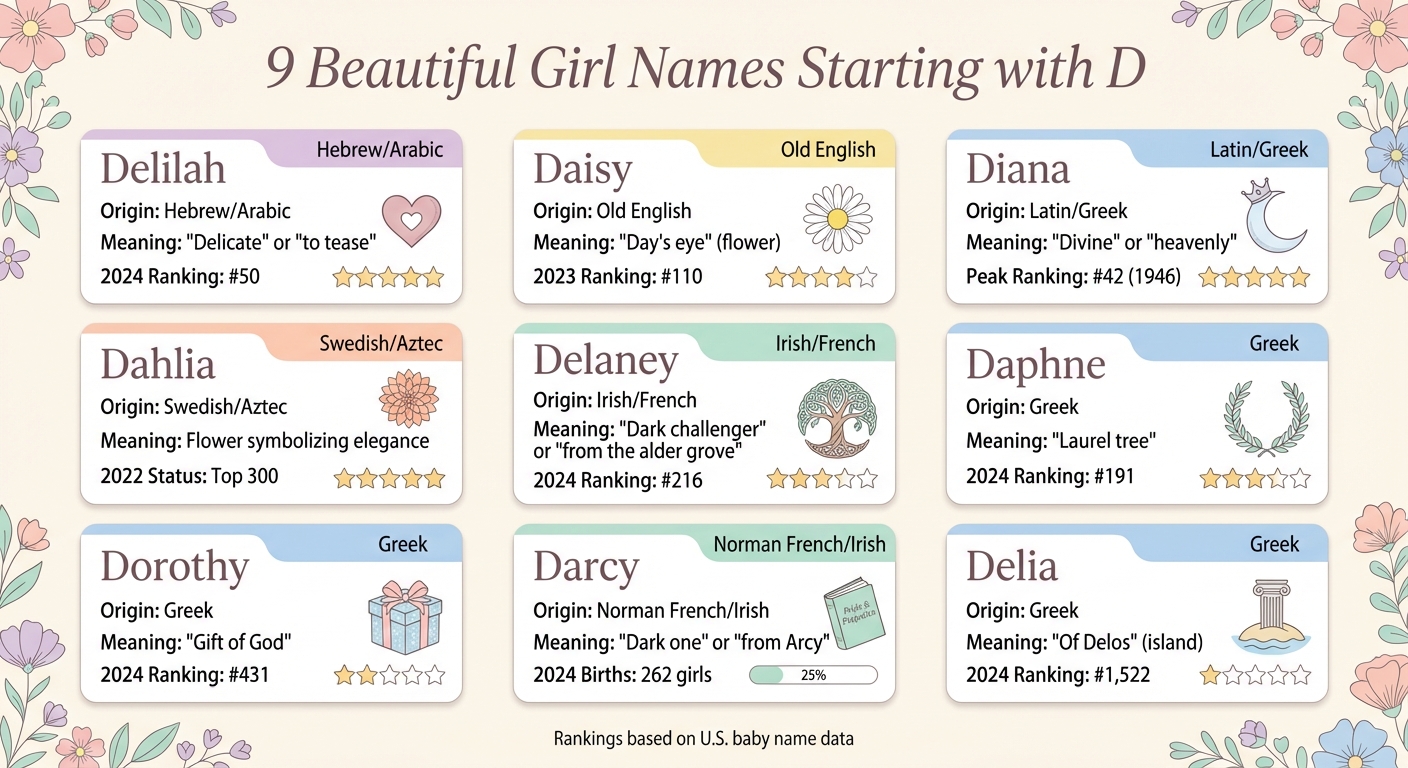
- Delilah: A name with Hebrew and Arabic roots, meaning "delicate" or "to tease." Popular and romantic, it ranked No. 50 in 2024.
- Daisy: Inspired by the cheerful flower, this name has Old English origins and conveys energy and simplicity.
- Diana: Latin for "divine", this name is tied to Roman mythology and Princess Diana's legacy of grace.
- Dahlia: Named after the flower, it symbolizes elegance and has multicultural roots, including Swedish and Aztec.
- Delaney: Of Irish and French origin, meaning "dark challenger" or "from the alder grove", it blends strength and nature.
- Daphne: Greek for "laurel", this name has mythological ties and a timeless appeal boosted by modern media.
- Dorothy: Meaning "gift of God", this vintage name has literary and cultural significance, including "The Wizard of Oz."
- Darcy: A name with French and Irish origins, meaning "dark one", it carries literary charm from "Pride and Prejudice."
- Delia: Rooted in Greek mythology and tied to the island of Delos, it also serves as a poetic and elegant choice.
These names range from timeless classics to modern favorites, offering a variety of meanings, cultural ties, and styles. Whether you're looking for something bold, floral, or mythological, there's a "D" name here for every taste.
9 Beautiful Girl Names Starting with D: Origins, Meanings, and Popularity Rankings
1. Delilah
Cultural Origin
Delilah is a name with deep roots in both Hebrew (Dəlīlā) and Arabic (Dalīlah) traditions. Its most famous reference comes from the Old Testament, where Delilah is known as Samson's lover who betrayed him by revealing the secret of his strength. For her betrayal, she received 1,100 silver coins from each Philistine lord. This biblical story shaped the name's reputation for centuries, linking it to themes of treachery and the "femme fatale" archetype. Despite this, Puritans began adopting the name in the 17th century, and it eventually gained popularity in English-speaking cultures.
This rich history gives the name Delilah a layered and complex identity.
Meaning/Significance
In Hebrew, Delilah means "delicate", "weak", or "languishing". Meanwhile, the Arabic root dalla translates to "to tease" or "to flirt". Today, many parents are drawn to Delilah for its romantic and graceful charm, as well as its vintage appeal.
Popularity/Trendiness
The name saw a dramatic rise in popularity in 2007, climbing to the 297th spot on U.S. baby name charts shortly after the release of the Plain White T's hit song "Hey There Delilah" in 2006. By 2023, 4,031 baby girls in the U.S. were named Delilah, and it has consistently stayed in the top 100 since 2018. A similar upward trend has been noted in England and Wales.
Unique Qualities
Delilah fits seamlessly into the trend of names featuring prominent "L" sounds, such as Lily, Lila, and Leila. It also offers a variety of endearing nickname options like Lila, Lilah, Lily, Deli, and Lala. Its three-syllable structure lends it a melodic quality, making it appealing to parents who want a name that feels both classic and stylish. Beyond its use as a baby name, Delilah has been celebrated in music by artists like Florence and the Machine, Queen, Tom Jones, and Regina Spektor. This musical connection adds to its timeless yet modern allure.
sbb-itb-f13f980
2. Daisy
Cultural Origin
The name Daisy traces back to the Old English word dægeseage, which means "day's eye." This beautifully reflects how the daisy flower opens with the sun each day. The name gained popularity in the Victorian era, a time when botanical names were especially trendy. Interestingly, Daisy has also been used as a traditional nickname for Margaret, as the French version of Margaret - Marguerite - is the word for the oxeye daisy.
Meaning/Significance
In their book The Baby Name Bible, Linda Rosenkrantz and Pamela Redmond Satran describe Daisy as having a "fresh, wholesome, and energetic" vibe. It’s a name that feels timeless yet lively.
Popularity/Trendiness
Daisy's charm has endured for over a century. Back in 1900, it was given to 0.293% of baby girls in the U.S. and stayed within the top 200 names until 1940. After a dip in the 1970s, it made a comeback and has remained in the top 200 since 1990. By 2023, Daisy ranked #110 in the U.S., with 2,412 baby girls receiving the name. Beyond the U.S., Daisy has been a top-100 name in the United Kingdom since 1996 and is also well-loved in Australia, Ireland, and New Zealand.
Unique Qualities
Daisy stands out for its blend of historical depth and botanical simplicity. Its connection to nature resonates with the growing interest in eco-inspired baby names. Additionally, the name has gained modern appeal thanks to actresses like Daisy Ridley (Star Wars) and Daisy Edgar-Jones (Normal People). With its cheerful sound and built-in nickname possibilities, Daisy continues to hold a special place in baby naming trends.
3. Diana
Cultural Origin
The name Diana has roots in both Latin and Greek, tracing back to the Proto-Indo-European word dyeu, which means "to shine." In Roman mythology, Diana was celebrated as the goddess of the hunt, the moon, forests, and childbirth, paralleling the Greek goddess Artemis. This rich mythological background lends the name its timeless and graceful appeal.
Meaning/Significance
Diana translates to "divine" or "heavenly", carrying a sense of radiance and sophistication. Its modern-day prominence owes much to the enduring legacy of Princess Diana, whose elegance and compassion further cemented the name's connection to grace and nobility.
Popularity/Trendiness
Diana reached its highest rank in the U.S. at #42 in 1946. The name saw a resurgence in 1981 following the marriage of Prince Charles and Princess Diana. While it has since stabilized within the top 1,000 names in the U.S., it continues to enjoy global popularity, ranking as a top-10 choice in countries like Azerbaijan, Costa Rica, Ecuador, Russia, and Ukraine. It also remains a cherished middle name within the British royal family.
Unique Qualities
Diana seamlessly blends ancient mythology with modern-day significance. Beyond its royal and mythological ties, the name has a place in classic literature and pop culture, most notably as the alter ego of Wonder Woman. This duality of strength and elegance has helped Diana maintain its enduring charm and steady presence among popular names in the U.S. and beyond.
4. Dahlia
Cultural Origin
Dahlia is a name that beautifully bridges natural elegance with historical depth. It originates from the dahlia flower, named in 1791 to honor Anders Dahl, a Swedish botanist from the 18th century. The surname "Dahl" traces back to Germanic roots, meaning "valley." The flower itself is native to Mexico and Central America, where the Aztecs referred to it as "Chichipatl" or "Acocotle", translating to "water cane" or "hollow stem flower." Interestingly, Dahlia also ties to Hebrew as a variant of Dalia, meaning "hanging branch."
Meaning/Significance
In the Victorian era, flowers carried messages, and the dahlia symbolized dignity and elegance. As Mexico's national flower, it carries additional cultural weight, making the name Dahlia synonymous with grace and refinement.
Popularity/Trendiness
The name Dahlia first gained attention during the late 19th century, aligning with a trend of botanical-inspired names. It appeared in George Meredith's novel Rhoda Fleming, further cementing its literary appeal. After a quieter period, Dahlia saw a resurgence in the early 2000s. It entered the top 1,000 baby girl names in the U.S. in 2006 and climbed into the top 300 by 2022. In 2016, about 0.044% of baby girls in the U.S. were named Dahlia. The name also ranked 294th in Canada in 2021 with 106 recorded uses and made its way into the top 1,000 names in England and Wales in 2013.
Unique Qualities
Dahlia captivates with its mix of natural charm and literary flair. It gained cultural recognition through Aunt Dahlia, a cherished character in P.G. Wodehouse's Jeeves stories. Unlike more common floral names, Dahlia feels both exotic and vintage, offering a sophisticated alternative. Its multicultural roots - from Swedish and Germanic to Hebrew and Aztec - add layers of richness, making it a name that resonates with parents looking for something elegant yet distinctive.
5. Delaney
Cultural Origin
Delaney carries a rich dual heritage, blending Irish and Norman French influences. On the Irish side, it is an anglicized version of the Gaelic surname Ó Dubhshláine, meaning "descendant of Dubhshláine". Its French roots trace back to the Old French de l'aunnaie, translating to "from the alder grove". This surname gained prominence in England after the Norman Conquest and later crossed the Atlantic, where it found a home as a given name in the Southern United States, dating back to at least the 1850s.
Meaning/Significance
In its Irish origin, Delaney translates to "dark challenger" or "dark river", referencing the River Slaney, while its French meaning highlights natural beauty - "from the alder grove". Historically, the name is tied to an ancient clan from County Laois, Ireland, anchoring it firmly in Celtic tradition. As Sophie Kihm from Nameberry puts it:
buoyant, bright, and cheerful, it ranks in the US Top 250 and is given to nearly 1300 babies every year
Popularity/Trendiness
Delaney gained traction in the 1990s, aligning with the trend of Irish surnames becoming popular first names, much like Cassidy, Kennedy, and Mallory. It reached its highest U.S. ranking at #169 in 2004 and currently stands at #216 as of 2024, with about 1,300 babies receiving the name annually. It enjoys particular popularity in states like Maryland (#98) and Pennsylvania (#99). Pop culture has also played a role in its rise, with actress Dana Delany's work in China Beach and the Delaney family in The Baby-Sitters Club series boosting its appeal. This mix of historical roots and modern recognition makes Delaney a standout choice.
Unique Qualities
Delaney’s melodic sound and adaptable nicknames - like Laney, Lainey, Del, and Lane - set it apart. It fits seamlessly into the trend of surname-inspired names while maintaining a distinctly feminine touch. The name balances tradition and modernity, offering historical depth alongside contemporary charm. Its soft, flowing syllables create what experts describe as a "preppy", "sassy", and "wholesome" vibe, making it a name that feels both timeless and fresh.
6. Daphne
Cultural Origin
Daphne stands out as a name with deep roots in mythology and a touch of timeless elegance. Originating from Old Greek, it comes from the word daphne (Δάφνη), meaning "laurel" or "laurel tree" [50, 51, 55]. In Greek mythology, Daphne was a naiad who transformed into a laurel tree to escape Apollo's pursuit [50, 52, 55]. The name gained traction in English-speaking countries during the late 19th century, a time when plant-inspired names were especially popular [50, 55].
Meaning/Significance
The story of Daphne carries rich symbolism. After her transformation, Apollo used her laurel leaves to create a crown, leading to laurel wreaths becoming a traditional symbol of victory at the ancient Pythian Games [52, 55]. Parents are often drawn to Daphne for its classical heritage and its graceful, wholesome feel [51, 53]. This name uniquely ties together ancient mythology, 19th-century trends, and modern sensibilities [50, 54].
Popularity/Trendiness
In the U.S., Daphne saw its peak popularity in 2024, ranking at #191 and representing 0.088% of baby girls born that year [57, 53]. This marks a significant rise from its #415 rank in 2020. The increase is largely credited to the Netflix series Bridgerton, which introduced audiences to the character Daphne Bridgerton in late 2020. Daphne has experienced similar boosts in the past - its usage tripled between 1960 and 1962 after the TV series Surfside 6 featured a character named Daphne Dutton. Earlier spikes in the 1940s and 1950s were likely influenced by the celebrated author Daphne du Maurier. These examples show how Daphne has consistently balanced historical depth with modern appeal.
Unique Qualities
Daphne’s enduring charm lies in its ability to blend ancient mythology with a modern flair. The name feels sophisticated yet accessible. It’s also versatile, with variants like Daphné in France, Dafne in Italy and Spain, and Dafna in Hebrew giving it international appeal [51, 55]. Its soft consonants and gentle sound make it both distinctive and easy to love. Daphne fits perfectly with today’s trend of reviving names inspired by mythology and nature, offering a perfect mix of vintage charm and contemporary relevance.
7. Dorothy
Cultural Origin
Dorothy comes from the Greek name Dōrothéa, which combines dōron (meaning "gift") and theós (meaning "god"). The name became notable in early Christian history, thanks to Saint Dorothy of Caesarea, a 4th-century martyr. By the 15th century, English speakers began using Dorothy, and by the 16th century, it had become a more casual alternative to the formal Latinate version, Dorothea. This long history gives Dorothy a deep spiritual and cultural foundation.
Meaning and Significance
Dorothy translates to "gift of God", giving it a lasting spiritual meaning. Its cultural reach expanded significantly with L. Frank Baum’s The Wonderful Wizard of Oz and the beloved 1939 film adaptation. Several notable individuals have carried the name, such as Dorothy Vaughan, a pioneering African-American mathematician at NASA, and Dorothy Day, who co-founded the Catholic Worker Movement in 1933. Interestingly, the term "doll" originated in the 16th century as a nickname for Dorothy. With its mix of historical depth and cultural connections, Dorothy remains a meaningful option for parents drawn to names with rich backstories.
Popularity and Trendiness
Dorothy dominated U.S. baby name charts from 1904 to 1940, consistently ranking in the top 10 and peaking at #2 in 1923, when 3.115% of baby girls were given the name. Although it stayed in the top 100 until 1961, Dorothy's popularity declined sharply, eventually dropping out of the top 1,000 by 2007. However, it made a comeback in 2011 and rose to #431 by 2024. In 2023 alone, 658 newborn girls were named Dorothy. This revival reflects a growing trend of parents rediscovering vintage names with enduring charm.
Unique Qualities
Dorothy’s appeal lies in its rich history and adaptability. It comes with a variety of nicknames - like Dot, Dottie, Dolly, Dee, Dodie, Dora, and Thea - which allow the name to evolve with its bearer through different life stages. Its international variants, such as Dorota (Polish), Dorothée (French), and Dorotea (Spanish/Italian), further enhance its global reach. This blend of timeless elegance and flexibility makes Dorothy a name that feels both classic and approachable.
8. Darcy
Darcy brings a modern flair to a name steeped in historical and linguistic richness.
Cultural Origin
Darcy has roots in both Norman French and Irish traditions. Originally a Norman French baronial surname, d'Arcy referred to the village of Arcy in northern France. It also evolved as an anglicized version of the Irish Gaelic surname Ó Dorchaidhe, meaning "descendant of the dark one." First noted as a surname in the Domesday Book of 1086, it became a male given name by the late 1500s. By the 20th century, Darcy shifted predominantly to a female name, with around 92% of people named Darcy in the past 50 years being women.
Meaning and Significance
The name Darcy carries dual meanings: "from Arcy" or "of the fortress" (from Old French arx) and "dark one" (from Gaelic dorcha). Its most iconic association is with Mr. Fitzwilliam Darcy from Jane Austen's Pride and Prejudice, symbolizing a blend of reserved passion and aristocratic charm. In more recent years, Darcy has reappeared in pop culture through characters like Darcy Lewis, played by Kat Dennings in the Marvel Thor films and WandaVision, giving the name a fresh, contemporary edge.
Popularity and Trendiness
Darcy reached its peak popularity in the late 1970s and early 1980s, with over 460 births during that time. After a dip to just 107 female births in 2004, the name has been making a comeback. In 2024, 262 girls and 29 boys in the United States were named Darcy. This balance of familiarity and individuality keeps Darcy relevant in today’s naming trends.
Unique Qualities
Darcy is a short, two-syllable name that’s easy to pronounce and often used in its full form. Its French origins bring a touch of elegance, while its Irish lineage adds a sense of intrigue. The name strikes a balance between sophistication and approachability, avoiding any sense of pretension. Variations like Darcey, Darci, and Darcie allow for personalization while staying true to the name’s essence.
9. Delia
Delia blends mythological roots with an understated elegance.
Cultural Origin
Delia's story begins on the Greek island of Delos, the legendary birthplace of Artemis and Apollo. In ancient Greece, the name was closely tied to Artemis, the goddess of the moon and hunting, serving as one of her epithets. Its literary significance emerged in the 1st century BC when the Roman poet Tibullus used "Delia" as a pseudonym for his lover, Plania. Later, it found a place in English literature, particularly in Samuel Daniel's 1592 sonnet cycle Delia. In Ireland, the name took on a different identity, becoming an English version of the Gaelic name Brighid, which translates to "exalted one." By the 1901 Irish census, Delia was a well-established name, with 6,260 recorded across the country. Today, Delia stands strong as both an independent name and a nickname for names like Adelia, Cordelia, Amelia, or Bedelia.
Meaning and Significance
Delia primarily translates to "of Delos" or "person from Delos", reflecting its sacred Greek origins. However, its layered history adds depth. Through Adelia, it conveys a sense of "nobility", and through Bedelia, it connects to the idea of being "exalted." This rich blend of meanings makes Delia a versatile and meaningful choice for parents.
Popularity and Trendiness
Delia enjoyed its peak popularity in the U.S. during the 1880s, ranking at #141. By 2024, it had moved to #1,522 in U.S. births. Currently, it ranks #989 in the U.S. Top 1,000 names, with a particularly strong showing in New Hampshire, where it holds the #40 spot. Almost exclusively feminine, 99.83% of individuals named Delia are girls.
Unique Qualities
Delia strikes a balance between classic sophistication and modern ease. As Maria Conti, Assistant Editor, describes:
Delia feels as fresh as a Sicilian sea breeze - classic yet unpretentious, with a refreshing zest that matches modern ambitions.
Its three-syllable rhythm (DEE-lee-uh) gives it a graceful flow, making it both timeless and approachable. With its literary and mythological background, Delia is a name that offers a sense of history while remaining distinct and charming for contemporary use.
Conclusion
From the Hebrew grace of Delilah to the mythological charm of Delia, these nine names present a stunning variety of options for your baby girl. Each one tells its own story, blending vintage charm, nature-inspired themes, and mythological strength. Delia, for instance, stands out with its timeless sophistication paired with a contemporary edge.
Some of these names, like Delilah, which ranks at No. 50 in 2024, are enjoying a surge in popularity. Others, such as Delia, offer a less common yet equally striking choice. By delving into the rich histories of these names, you can find one that will grow beautifully with your child.
Naming your baby is an incredibly personal journey. As Cradlewise Staff aptly says:
A name is the very first gift you give your baby, and it'll carry their story for a lifetime.
When choosing, think about how each name reflects your heritage, complements your family's style, and fits across all stages of life - from childhood to adulthood.
If none of these nine names feel like the perfect fit, tools like NameHatch can help you discover even more possibilities. With its easy swipe interface, you can filter by origin, meaning, and style, sync with your partner, and get personalized AI-driven suggestions. Dive into NameHatch’s interactive features to create a shortlist that truly reflects your family’s story.
FAQs
Which D girl names are most popular in the U.S. right now?
Some of the most popular girl names starting with "D" in the U.S. right now include Delilah, Daisy, Diana, and Dakota. These names have become favorites, admired for their charm and enduring style.
Which D girl names are rare but still easy to spell and pronounce?
Rare but easy-to-pronounce girl names that start with D include Dixie, Della, Diya, Drew, Darcy, Darla, Delia, Dior, Daya, and Daphne. These names strike a nice balance - they're not overly common but are still simple to spell and say. Names like Daphne and Daya stand out with their distinct sounds while maintaining a sense of familiarity.
What are good nickname options for these D names?
Nicknames for girl names beginning with "D" often evolve from shortened versions or affectionate tweaks. For instance, "Daisy" might turn into Dai or Daze, while "Dahlia" could become Dahl or Lia. For "Delilah", options like Lila or Deli work well, and "Daphne" might be lovingly called Daph or Dafy. If the name is "Daya", nicknames like Day or Dai are simple yet sweet. These nicknames can reflect personality, family traditions, or just what feels right!