Classic girl names starting with "C" offer a timeless appeal, blending historical depth and elegance. From royal connections to literary charm, these names have captivated parents for generations. Here's a quick look at 12 enduring choices:
- Charlotte: A Top 10 favorite, tied to royalty and literary icons like Charlotte Brontë.
- Caroline: Popular since the 1600s, linked to regal figures and cultural moments like "Sweet Caroline."
- Clara: A Victorian-era gem, known for its clarity and ties to The Nutcracker.
- Cecilia: Rooted in Roman history, celebrated as the patron saint of music.
- Catherine: A name of purity, with a royal legacy and versatile nicknames like Kate or Cathy.
- Claudia: With Roman origins, it balances strength and sophistication.
- Constance: Symbolizing loyalty, it peaked in the mid-20th century.
- Cornelia: A name of Roman nobility, offering nicknames like Cora or Nelly.
- Clarissa: A decorative twist on Clara, with literary and historical ties.
- Cordelia: Shakespearean elegance, meaning "heart" or "daughter of the sea."
- Celeste: Meaning "heavenly", it carries a celestial grace.
- Camilla: A Roman classic, tied to mythology and modern royalty.
These names remain popular for their meaningful origins and enduring charm, offering a blend of history, elegance, and modern usability.
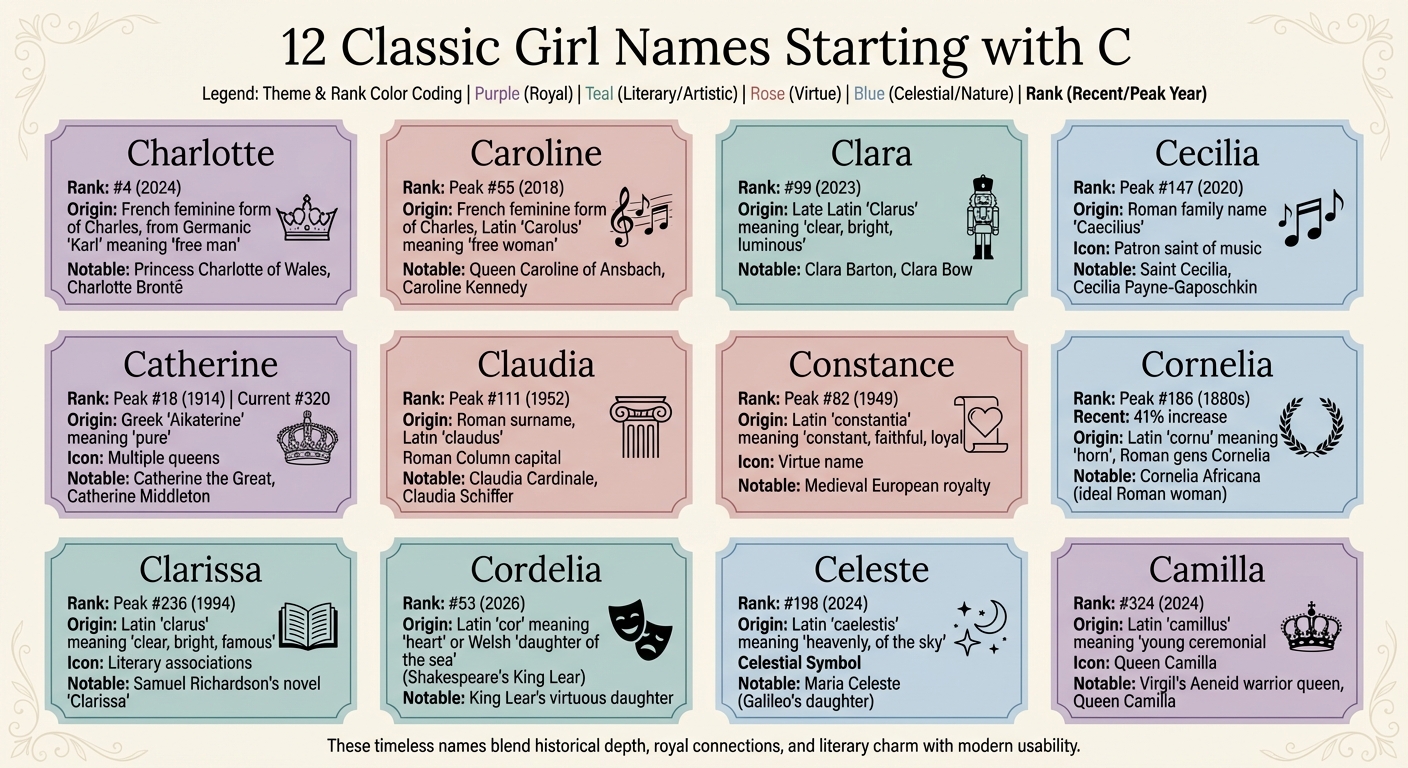
12 Classic Girl Names Starting with C: Origins, Meanings, and Popularity Rankings
1. Charlotte
Charlotte continues to hold its place as a cherished classic, consistently ranking high among popular names in the United States. In 2024, it sits at No. 4 on the list of most popular names. Back in 2022, 12,891 babies were named Charlotte, showcasing its enduring appeal. This name has been a staple, appearing in or near the top 300 names since the beginning of U.S. naming records.
The name Charlotte is the French feminine form of Charles, which traces its roots to the Germanic word Karl (or the Old English ceorl), meaning "free man". This connection gives the name a sense of freedom and strength, blending power with a refined elegance.
In the U.S., Charlotte is typically pronounced SHAR-lot, while in British English, it’s more often SHAR-lit. Name expert Linda Rosenkrantz highlights its appeal:
"It's a name at the very center of the Sweet Spot of names with a ton of great attributes and references - literary, historic, and royal. She's demure, yet solid and strong, classic but not stuffy, British with the slightest trace of a French accent".
Charlotte's royal legacy adds to its charm. Queen Charlotte Sophia, for whom Charlotte, North Carolina was named in 1761, established its regal connections. This tradition continues today with figures like Princess Charlotte of Wales.
The name also offers delightful nicknames like Lottie and Charlie. Its cultural resonance is bolstered by literary icons such as Charlotte Brontë, the author of Jane Eyre, and the unforgettable spider from E.B. White's Charlotte's Web, published in 1952.
Next, we’ll dive into the history and charm of another timeless name: Caroline.
sbb-itb-f13f980
2. Caroline
Caroline has been a beloved choice in the U.S. for well over a century. It’s consistently ranked among the top 1,000 names since 1880 and broke into the top 100 in 1994. Its popularity peaked in 2018, when it climbed to No. 55 on the charts.
The name Caroline, a French feminine form of Charles, originates from the Latin Carolus and the Germanic karl, meaning "free man." Over time, this evolved to signify "free woman". Its rise in the English-speaking world began in the 1600s, linked to Kings Charles I and II, and gained further prominence in the 18th century due to Queen Caroline of Ansbach. This regal history adds to its enduring appeal.
In English, Caroline is commonly pronounced as KARE-uh-line or KARE-uh-lin, while French speakers say ka-RO-leen. The name experienced a surge in popularity during the late 1950s and early 1960s, thanks to high-profile figures like Princess Caroline of Monaco (Grace Kelly’s daughter) and Caroline Kennedy (daughter of President John F. Kennedy). These cultural moments cemented its status as a timeless yet modern choice.
As one naming expert observed:
"Caroline has pretty much maintained moderately high usage in the United States for over 100 years... it feels neither old-fashioned nor over-used." - Oh Baby! Names
Beyond the U.S., Caroline enjoyed top-ten status in Ireland during the 1970s and in Denmark from the late 1990s through 2010. Its cultural resonance is further highlighted by Neil Diamond’s iconic song "Sweet Caroline" and its appearance in literature, such as Jane Austen’s Pride and Prejudice through the character Caroline Bingley.
3. Clara
Clara, which held the rank of 594 in 1978, made a striking comeback by reentering the U.S. Top 100 in 2015 and climbing to #99 by 2023. In 2024, about 3,060 newborns were named Clara, and it even achieved the impressive rank of #17 in Washington, D.C., highlighting its strong regional popularity.
The name Clara originates from the Late Latin Clarus, meaning "clear", "bright", "famous", or "luminous". It gained prominence through Saint Clare of Assisi, a 13th-century figure who founded the Order of Poor Clares. While the version "Clare" was widely used during the Middle Ages, the more Latinate "Clara" became dominant in the 19th century.
In terms of pronunciation, Americans typically say KLAR-uh, while British and German speakers lean toward KLAH-rah. Laura Gibson, Assistant Editor at Name.baby, describes the name as:
"Phonetically economical... and resistant to creative misspelling, Clara offers parents a high-visibility, low-maintenance option whose very meaning promises a lifetime of clarity".
Clara also holds a special place in cultural history. It’s the name of the heroine in Tchaikovsky’s beloved ballet The Nutcracker, which has cemented its association with the holiday season. The name is further tied to Clara Barton, the founder of the American Red Cross, and Clara Bow, the 1920s silent film star known as the original "It Girl." Abby Sandel, Founder of Appellation Mountain, notes:
"Clara combines the enchanting tale of The Nutcracker with the glam of flapper icon Clara Bow and resolve of Red Cross founder Clara Barton".
Beyond the U.S., Clara enjoys global appeal, ranking among the top 10 names in countries like Belgium, Denmark, France, and Germany. Its rise aligns with the current trend of reviving vintage names, putting it in the company of timeless choices like Alice, Grace, and Cora. Up next, we delve into the enduring charm of Cecilia.
4. Cecilia
Cecilia is a name steeped in history and musical heritage, making it a timeless favorite. It has consistently ranked among the top 500 girl names in the United States for over a century, peaking at #147 in 2020. As of early 2026, it holds the #96 spot on BabyNames.com and ranks #123 in total U.S. births. The name's popularity has grown significantly, with births rising from 512 in 1975 to 2,238 in 2024.
The name originates from the Roman family name Caecilius and later evolved into Cecily in England. It gained widespread use in the 18th century. Its connection to Saint Cecilia, the patron saint of music, adds to its enduring charm.
Pronunciations vary by region: Americans often say seh-SEE-lee-uh or seh-SEEL-yuh, Italians prefer cheh-CHEE-lyah, and Spanish speakers use theh-THEE-lyah in Spain or seh-SEE-lyah in Latin America. Its lyrical quality enhances its classic and sophisticated appeal.
Cecilia's influence extends beyond its saintly ties. Cecilia Payne-Gaposchkin (1900–1979), a trailblazing astronomer, was the first to identify that stars are primarily composed of hydrogen and helium. Cecilia Gallerani (c. 1473–1536), a Renaissance poet, is famously depicted in Leonardo da Vinci's Lady with an Ermine. The name also offers versatile nicknames like Cece, Ceci, Celia, and Lia, making it a flexible choice for everyday use. Next, explore the regal allure of Catherine.
5. Catherine
Catherine is a name that has stood the test of time. It reached its peak popularity in the U.S. in 1914 at #18 and, while it has gradually declined, it still holds a respectable position at #320 as of early 2026. This steady presence highlights its enduring charm and appeal over the years.
The name has deep roots, originating from the Ancient Greek Aikaterine (Αἰκατερίνη) and connected to the word katharos, meaning "pure." Over centuries, it transitioned through Latin and French before becoming the English Catherine we know today. Interestingly, the "h" in the English spelling was added in the 16th century to emphasize its association with purity. Its widespread use in Christian traditions can largely be credited to St. Catherine of Alexandria, a 4th-century martyr revered as the patron saint of philosophers, students, nurses, and librarians.
In English, Catherine is pronounced as /ˈkæθ.ə.ɹɪn/ (KATH-uh-rin) or /ˈkæθ.ɹɪn/ (KATH-rin), while the French pronunciation is /ka.tə.ʁin/. Its timeless elegance has inspired variations across cultures, such as Italian Caterina, Spanish Catalina, Russian Ekaterina, and Irish Caitríona.
Catherine also boasts a royal pedigree. Historical figures like Catherine the Great, Catherine de' Medici, and English queens Catherine of Aragon and Catherine Parr have cemented its regal status. More recently, the marriage of Catherine Middleton into the British Royal Family brought renewed attention to the name. Her preference for the "C" spelling has been admired for its "gently old-fashioned" and refined feel. Author Michael O. Gregory captured this sentiment beautifully:
"The name had character a noble ring to it she really liked it".
Beyond its formal elegance, Catherine offers a variety of nicknames - Kate, Katie, Cathy, Cat, Cate, and Kit - making it both versatile and approachable for everyday use. Its rich history and adaptability continue to make it a beloved choice. Next, delve into the timeless appeal of Claudia.
6. Claudia
Claudia carries with it a rich heritage that traces back to ancient Rome. As the feminine form of the Roman surname Claudius, it originally identified women from the prestigious Claudia gens. The name stems from the Latin word claudus (meaning "lame"), though some scholars suggest it could also connect to clausus ("enclosure"), further emphasizing its ancient origins.
In the United States, Claudia enjoyed its peak popularity during the baby-boom era, reaching #142 in the 1940s and climbing to #111 in 1952. However, by 2018, it had fallen to #872, accounting for just 0.017% of births.
Claudia's charm transcends borders, with its pronunciation varying across languages - KLAW-dee-uh in English, KLOU-dee-a in German, and KLOW-dyah in Italian and Spanish. Its global resonance is evident, with the name ranking among the top 10 in countries like Germany and Brazil.
The name has been brought to life by notable figures such as Italian actress Claudia Cardinale and German supermodel Claudia Schiffer, both of whom have contributed to its sophisticated image. In American history, Claudia Alta "Lady Bird" Johnson added a touch of Southern grace to the name, while Claudia Sheinbaum recently made headlines as the 66th President of Mexico. Claudia also boasts biblical significance, appearing in 2 Timothy 4:21 as a Christian woman in Rome.
Clare Green, Editor at Nameberry, aptly summarized the name's enduring attraction:
"Claudia is a classic name with ancient Roman roots. Never truly in or truly out, Claudia feels like a strong, modern choice that hits the sweet spot between too popular and too unusual."
With its blend of historical depth and timeless elegance, Claudia strikes a perfect balance for parents seeking a name that is both meaningful and quietly confident. Now, let’s move on to the steadfast sophistication of Constance.
7. Constance
Constance reflects a quality many parents admire and hope to nurture in their daughters - steadfastness. Rooted in the Latin constantia, meaning "constant", "faithful", or "loyal", the name symbolizes unwavering strength and dependability.
The name made its way to England with the Normans after 1066. During medieval times, it was favored by European royals, including Constance of Sicily and Constance of Arles. By the 17th century, Puritans embraced it as a virtue name, often opting for variations like "Constant" or "Constancy" to emphasize religious devotion.
In the United States, Constance had its heyday in the mid-20th century. It reached its peak at #82 in 1949, holding a spot in the Top 100 from 1946 to 1953. At its height in 1950, about 0.253% of baby girls were given this name. However, its popularity has since waned, ranking at #1,676 in 2018. By 2024, only 125 baby girls in the U.S. were named Constance.
The name's pronunciation varies: KAHN-stans in American English, KON-stans in British English, and kɔ̃s-tɑ̃s in French. While "Connie" was especially popular in the 1950s as a nickname, modern parents are revisiting the name Constance for its timeless elegance. Abby Sandel, Founder of Appellation Mountain, captured its appeal:
"For families looking for something meaningful, accessible, and rare all at once, this feels like a potentially perfect choice".
With its historical roots and virtuous undertones, Constance stands as a polished and distinctive choice. Next, let’s explore Cornelia’s rich Roman legacy.
8. Cornelia
Cornelia carries the weight of ancient Roman nobility. As the feminine form of Cornelius, it originates from the prestigious gens Cornelia - a prominent aristocratic family responsible for producing at least 75 consuls starting in 485 BC. The name itself comes from the Latin word cornu, meaning "horn", and is also associated with the cornel tree, symbolizing strength and courage.
Throughout history, Cornelia has stood as a testament to noble lineage, a trait shared by many classic names beginning with "C." One of the most famous bearers, Cornelia Africana, lived in the 2nd century BC and became renowned as "the ideal Roman woman." As the daughter of Scipio Africanus and the mother of the Gracchi brothers - key reformers of their time - she represented maternal dedication and resilience. She is particularly remembered for her decision not to remarry after her husband's death, choosing instead to focus on her family.
In the United States, Cornelia reached its peak popularity in the 1880s, ranking at #186. Interest in the name has seen a resurgence, with a 41% increase as of January 2025. Globally, Cornelia enjoys even stronger appeal, placing #98 in Sweden in 2021 and #152 in the Netherlands in 2015.
Pronunciation varies slightly depending on the region. In American English, it's typically pronounced kor-NEEL-yuh, while British English leans toward a more refined kor-NEE-lee-uh. The Italian version, kor-NEH-lyah, adds an elegant twist. For those who prefer a more casual take, Cornelia offers a range of nicknames, such as Cora, Lia, Nelly, Nel, Connie, and Corrie.
With its deep Roman roots and growing modern appeal, Cornelia is a name that blends timeless sophistication with contemporary versatility. Next, discover Clarissa, a name that combines literary elegance with a cheerful undertone.
9. Clarissa
Clarissa comes from the Latin word clarus, which means "clear", "bright", "famous", or "illustrious". While Clara offers a simpler charm, Clarissa brings an elegant, decorative flair that has captivated parents for generations.
The name's roots trace back to ancient Rome, where noblewomen like Clarissa Paulina, recorded in the 2nd century AD, carried it with distinction. It gained further prominence during the Middle Ages, particularly among European aristocracy, who admired its association with fame and prestige. Later, literary works such as Samuel Richardson's 1748 novel Clarissa, or, the History of a Young Lady and Virginia Woolf's Mrs. Dalloway elevated its status as a name with sophistication and depth.
In the U.S., Clarissa reached its peak popularity in 1994, ranking #236 with 1,185 births. However, by 2024, the number had dropped to just 207 births, reflecting a general preference for shorter alternatives like Clara and Claire. Despite this decline, Clarissa retains its charm. As Linda Rosenkrantz, co-founder of Nameberry, describes:
"the daintier, frillier sister of the family has strong literary associations".
Pronounced kluh-RISS-uh, the name offers a pleasing three-syllable rhythm that feels both lyrical and approachable. Some notable figures who have carried the name include Clarissa Harlowe Barton, famously known as Clara Barton, the founder of the American Red Cross, and Clarissa Ward, CNN's chief international correspondent. These women embody the name's timeless connection to strength and clarity. Next, we’ll dive into the Shakespearean elegance and regal charm of Cordelia.
10. Cordelia
Cordelia carries a timeless elegance, steeped in literary history. Its most famous association comes from William Shakespeare's King Lear, where Cordelia is the youngest and most virtuous daughter, known for her honesty and loyalty. Shakespeare borrowed the name from earlier sources, including Geoffrey of Monmouth's 12th-century Historia Regum Britanniae, where it appeared as "Cordeilla".
The name has roots in multiple languages. From Latin, it connects to cor (cordis), meaning "heart", while in Welsh, it ties to Creiddylad, which translates to "daughter of the sea" or "jewel of the sea".
Cordelia is pronounced either kor-DEEL-yah or kor-DEE-lee-uh, and its lyrical four-syllable rhythm adds to its appeal. In the United States, the name reached its highest popularity at #202 in the late 19th century. Though it later disappeared from the top 1,000, a recent resurgence has brought it back into favor. By February 2026, Cordelia ranked #53, with 233 girls given the name in 2024.
This name offers plenty of endearing nickname options, such as Cora, Delia, Lia, Cordy, and Coco. Beyond Shakespeare, Cordelia has made its mark in modern pop culture, appearing in Buffy the Vampire Slayer and American Horror Story. It’s also celebrated in classic literature like Anne of Green Gables, where its grace and sophistication shine.
Next up, explore the celestial allure of Celeste.
11. Celeste
Celeste has a radiant and timeless charm that has drawn parents in for over a hundred years. Its roots lie in the Latin word caelestis, meaning "heavenly" or "of the sky", which itself comes from caelum, translating to "sky", "heaven", or "abode of the gods." This gives the name an air of grace and sophistication that feels both classic and enduring.
In English, Celeste is pronounced suh-LEST, with the emphasis on the second syllable. However, it takes on slightly different sounds across Romance languages: French speakers say seh-LEST, Italians pronounce it cheh-LEH-steh, and in Spanish, it's seh-LEH-steh. This variety in pronunciation highlights its global appeal and versatility, making it a favorite among parents worldwide.
Celeste has had a steady presence in the U.S. Top 1,000 baby names since 1880. It reached its highest rank of #198 in 2024 and held the #94 spot on BabyNames.com as of February 2026. Beyond the U.S., it remains a popular choice, ranking in the Top 100 in both France and Italy.
"The baby name Celeste hits a sweet spot – it's familiar, but not too common. Add in elegant style and a great meaning, and this could be a perfect choice for a daughter." – Abby Sandel, Founder, Appellation Mountain
The name's appeal is deepened by its fascinating history. Between the 5th and 13th centuries, five popes bore the masculine form Celestine. Maria Celeste, the daughter of famed astronomer Galileo Galilei, born in 1600, adds a unique connection to both spirituality and science. Additionally, Celeste ties to the celesta, a keyboard instrument known for its ethereal, bell-like tones, famously featured in Tchaikovsky’s The Nutcracker. These layers of history and culture make Celeste not only a beautiful name but one rich with meaning and legacy.
12. Camilla
Camilla carries a sense of Roman heritage and timeless elegance. Its roots lie in the Latin word camillus, meaning "young ceremonial attendant". Originally a Roman family name, it was famously associated with Marcus Furius Camillus, often referred to as the "Second Founder of Rome".
The name's legendary status is further cemented in Roman mythology. In Virgil's Aeneid, Camilla is portrayed as a fearless warrior queen of the Volsci, a huntress devoted to the goddess Diana. Her speed was so extraordinary that she could run without bending a single blade of grass. Over time, the name has evolved, maintaining its mythological and historical resonance.
In English, Camilla is pronounced kuh-MIL-uh (/kə.ˈmɪl.ə/), while the Italian pronunciation is kah-MEEL-lah (/ka.ˈmil.la/). Its modern popularity can be traced back to the 16th century and was notably boosted by Fanny Burney's 1796 novel, Camilla. Today, Queen Camilla, the wife of King Charles III, has brought renewed attention to the name, reinforcing its association with sophistication and class.
In the United States, Camilla ranked #324 in 2024, showing steady growth since the early 2000s. Globally, it holds the #11 spot in Italy and is a top 10 favorite in Greenland and Norway. The Spanish variation, Camila (spelled with one L), is far more common in the U.S., being used seven times more frequently than the traditional spelling as of 2018. Camilla’s enduring appeal lies in its ability to balance historical depth with modern charm, making it a polished choice for today’s parents. As name expert Linda Rosenkrantz explains:
"The Spanish Camila, pronounced ka-MEE-la, is the fastest rising version of this ancient Roman name, but recent royal Camilla may have helped promote the British brand." – Linda Rosenkrantz, Co-founder of Nameberry
Conclusion
These 12 classic C names continue to hold their charm, blending sophistication and meaning. They carry a sense of royal heritage, virtue, and timeless appeal. As name expert Kara Nesvig notes, "There's a reason these classic monikers have been go-tos for decades".
Names like Charlotte and Camilla have stood out, ranking among the most popular choices for baby girls in 2024. This highlights how vintage charm still resonates today. These names often carry literary elegance or mythological significance, making them both beautiful and meaningful. For example, Catherine embodies "purity", Constance reflects "steadfastness", and Celeste brings a "heavenly" essence to the mix.
The growing trend of revisiting vintage names shows that parents are increasingly drawn to options that feel both rooted in tradition and fresh. These names also adapt well over time, offering flexibility as children grow - Charlotte can transform into Charlie, while Catherine opens the door to nicknames like Kate or Cate.
For those seeking inspiration beyond these timeless classics, tools like NameHatch offer personalized name suggestions. With smart filters and AI-driven recommendations, NameHatch allows you to explore names by style, origin, or meaning. Whether you're drawn to Greek, Roman, Biblical, or Celtic influences, their extensive database makes it easy to find a name that feels just right for your family. These classic C names prove that you don’t have to choose between tradition and modernity - they offer the best of both worlds.
FAQs
Which of these C names are rising fastest in the U.S. right now?
Charlotte and Camila are two of the quickest-climbing names for girls starting with "C" in the U.S. Charlotte claimed the top spot as the most popular name in 2023 and has only grown in favor through early 2026.
What are the easiest nicknames for these classic C girl names?
Nicknames for classic girl names starting with "C" are often short, easy to say, and closely tied to the original name. For instance, "Catherine" can turn into Cathy or Cate, while "Charlotte" becomes Char or Lottie. Similarly, "Cecilia" might be shortened to Celia or Cissy. Other examples include Cassie for "Cassandra", Carrie for "Caroline", and Clem for "Clementine." These options are both familiar and endearing.
How do you choose between similar names like Clara, Clarissa, and Cecilia?
Choosing between Clara, Clarissa, and Cecilia can be a delightful challenge, especially when you explore their meanings, origins, and the feelings they evoke.
- Clara: This name translates to "bright" or "clear", exuding a sense of simplicity and elegance. It has a timeless quality that feels both classic and modern.
- Clarissa: Also meaning "bright" or "famous", Clarissa carries a vintage appeal, offering a slightly more elaborate and romantic vibe.
- Cecilia: With ties to Saint Cecilia, the patron saint of music, this name holds a rich musical and spiritual connection, adding depth and charm.
Think about how each name sounds, the meaning behind it, and any personal connections you might have. The right choice will be the one that resonates most with your heart and preferences.