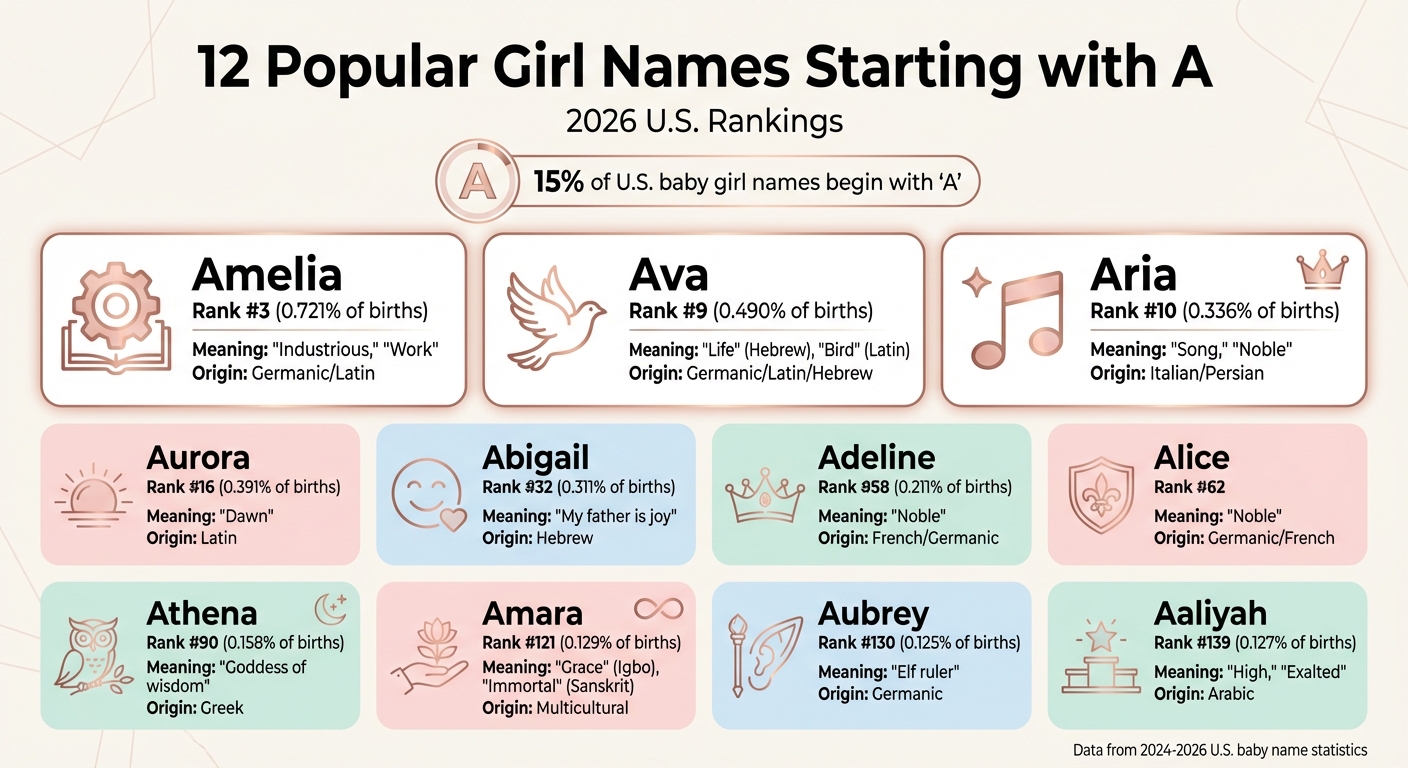
Looking for a baby girl name starting with "A"? You're not alone - 15% of U.S. baby girl names begin with this letter, and for good reason. Names starting with "A" often carry positive associations like being first in the alphabet, uplifting sounds, and global appeal. Here's a quick look at 12 popular "A" names that are trending in 2026:
- Ava (#9): Short, elegant, and rooted in meanings like "life" (Hebrew) and "bird" (Latin).
- Amelia (#3): A timeless name symbolizing "industrious" and "work", tied to Amelia Earhart's legacy.
- Abigail (#32): A Hebrew name meaning "my father is joy", with strong biblical and historical ties.
- Aria (#10): Musical and airy, meaning "song" (Italian) and "noble" (Persian).
- Aubrey (#130): A name with Germanic roots meaning "elf ruler", popularized by modern culture.
- Aurora (#16): Latin for "dawn", linked to Roman mythology and celestial beauty.
- Adeline (#58): French in origin, meaning "noble", with a vintage yet modern vibe.
- Athena (#90): Greek goddess of wisdom, symbolizing strength and intelligence.
- Alice (#62): A classic name meaning "noble", made famous by Alice in Wonderland.
- Aaliyah (#139): Arabic for "high" or "exalted", popularized by the late R&B singer Aaliyah.
- Ariana (#103): A name of Greek and Latin origins meaning "most holy" or "pure."
- Amara (#121): A multicultural gem with meanings like "grace" (Igbo), "immortal" (Sanskrit), and "peaceful" (Mongolian).
These names combine rich histories, diverse cultural roots, and modern appeal. Whether you're drawn to Ava's simplicity, Athena's strength, or Aurora's celestial charm, "A" names offer a perfect blend of elegance and meaning.
12 Popular Girl Names Starting with A: Rankings, Meanings & Origins 2026
1. Ava
Meaning and Origin
The name Ava carries rich and diverse origins, making it a favorite across cultures. In medieval Germanic tradition, it stems from the Old High German word awa, meaning "flowing water". From Latin, avis translates to "bird". In Hebrew, Havva signifies "life", while Persian Āvā means "voice" or "melody". Historically, the name appears as early as the 9th century, tied to Saint Ava, a princess and Benedictine nun whose feast day is celebrated on April 29. Though it faded from use for some time, it reemerged in the early 20th century, partly due to figures like Ava Lowle Willing, a prominent American socialite.
Popularity in the U.S. (2026)
Ava holds the #9 spot in 2026, accounting for 0.490% of all female births. It has remained in the top 10 since 2005, with its peak at #3 between 2016 and 2020. In 2024 alone, 8,662 baby girls were named Ava.
Cultural and Historical Significance
The name Ava owes much of its glamour to Hollywood legend Ava Gardner (1922–1990). Her association with old Hollywood elegance continues to influence the name's allure. A modern surge in its popularity can be traced to high-profile parents like Heather Locklear and Richie Sambora, who named their daughter Ava Elizabeth in October 1997, leading to a 268-place jump in the name's ranking. Reese Witherspoon and Ryan Phillippe followed suit in September 1999, naming their daughter Ava as a tribute to Ava Gardner.
Appeal and Modern Trends
In 2026, Ava remains a top choice for parents due to its lyrical, vowel-rich sound that feels both gentle and strong. Its three-letter simplicity makes it easy to spell and pronounce, while its vintage charm gives it a timeless elegance. The name's adaptability across cultures is another draw; in 2023, it ranked among the top five names for Black and Asian baby girls in Virginia. Contemporary figures like filmmaker Ava DuVernay and singer Ava Max also keep the name in the spotlight. Ava’s enduring appeal ensures it remains a favorite, while its versatility inspires interest in other A names.
sbb-itb-f13f980
2. Amelia
Meaning and Origin
Amelia combines a sense of Latin refinement with Germanic resilience. Its roots trace back to the Germanic term "amal", which translates to "work", "industrious", or "vigorous." It's also tied to the Latin name Aemilia, the origin of Emily, which means "rival". This dual heritage gives Amelia a personality that feels both diligent and competitive.
The name gained prominence in 18th-century Europe, thanks to royal influence. After enjoying a vintage charm for decades, Amelia surged back into the spotlight in the 21st century, leaping from #207 in 2000 to a top-five favorite by 2021.
Popularity in the U.S. (2026)
By early 2026, Amelia had climbed to the #3 spot for girls' names in the United States. In 2024 alone, 12,740 babies were named Amelia, making up 0.721% of total births. The name held steady at #4 from 2021 to 2023 before rising to its current rank, even reaching #1 in some states. This enduring popularity reflects its strong historical roots and modern charm.
Cultural and Historical Significance
Amelia Earhart, the trailblazing aviator, is perhaps the most iconic figure associated with the name, symbolizing bravery and perseverance. Another notable namesake, Amelia Bloomer, a women's rights advocate, further cements the name's connection to strength and independence.
Appeal and Modern Trends
In 2026, Amelia continues to captivate parents with its timeless yet contemporary vibe. Its popularity aligns with the trend of names ending in "‑ia", such as Sophia and Olivia. Cleveland Kent Evans, writing for the Omaha World Herald, remarked:
Amelia sounds elegant and evokes a strong image.
The name's adaptability also adds to its appeal. With nicknames like Mia, Millie, Lia, Amy, and Ames, it offers plenty of options for personal expression as a child grows. Its cultural versatility and graceful sound make it a favorite choice for modern families.
3. Abigail
Meaning and Origin
Abigail is a Hebrew name that translates to "my father is joy". In the Old Testament, Abigail is known as the wife of Nabal who later became King David's third wife. She stands out for her beauty, wisdom, and diplomacy.
The name gained popularity in England during the Protestant Reformation, especially among Puritans. However, after the 1616 play The Scornful Lady introduced a character named Abigail as a lady's maid, the name became associated with servitude and fell out of favor for nearly 200 years. It wasn’t until the 1960s that Abigail saw a revival, thanks to the trend of bringing back Old Testament names.
Popularity in the U.S.
As of 2024, Abigail ranked #32 in the United States, representing 0.311% of female births. While this is a drop from its peak at #4 in 2005, the name has consistently remained in the Top 100 since the late 1980s and held a place in the Top 10 from 2001 to 2017. Its current ranking positions it as a "sweet spot" name - well-known and timeless without feeling overly common.
Cultural and Historical Significance
Abigail carries a rich legacy in American history and culture. It was the name of two U.S. First Ladies: Abigail Adams and Abigail Fillmore. In modern times, the name continues to resonate through figures like actress Abigail Breslin and fictional characters such as Abby Sciuto from NCIS and Abby Cadabby from Sesame Street.
Appeal and Modern Trends
Abigail's enduring charm lies in its classic yet flexible nature. As Madison Dresler from Nameberry notes:
Abigail's biblical and historic roots make it a fashionable classic.
The name also offers a variety of nicknames, including Abby, Abi, and Gail. Vicky Yip from Parents.com highlights its broad appeal:
If you're looking for a baby name that is both wholesome and adaptable for a variety of tastes, Abigail might be the right choice.
With its blend of traditional depth and modern versatility, Abigail remains a strong option for parents seeking a name with lasting appeal.
4. Aria
Meaning and Origin
Aria carries a variety of meanings, drawing from its roots in different languages and traditions. In Italian, it translates to "air" and is also used to describe a "song" or "melody", particularly a vocal solo in an opera. Elisa Cinelli from Parents.com explains:
"Aria means 'song' or 'melody' in Italian. Its literal translation is 'air,' a musical term that refers to an elaborate vocal solo usually found within a larger piece of music, generally an opera."
In Greek and Hebrew, Aria is connected to the image of a lion, symbolizing strength and passion. Meanwhile, in Persian, it’s a gender-neutral name meaning "noble", and in Albanian, it translates to "treasure" or "gold" [35,37,38,41]. Despite its ancient roots, Aria didn’t emerge as an English name until the 20th century. This diverse linguistic background has helped make Aria a favorite in modern naming trends.
Popularity in the U.S. (2026)
As of February 2026, Aria ranks #10 on BabyNames.com's popularity charts. In 2024, it held the #26 spot in the U.S., accounting for 0.336% of female births. Its journey into mainstream popularity began when it entered the U.S. top 1,000 at #957 in 2000, climbed into the top 100 at #92 in 2012, and reached the top 20 by 2017 [35,39]. Factoring in the variant spelling "Arya" (ranked #162 in 2024), Aria effectively places among the overall Top 10.
Cultural and Historical Significance
Aria’s rise is tied to both its historical roots and its presence in modern pop culture. Characters like Arya Stark from Game of Thrones and Aria Montgomery from Pretty Little Liars have played a big role in its popularity. The name also appears in franchises like My Little Pony and the Mass Effect video game series [35,37]. Historically, Saint Aria (or Arria) was an early Christian martyr in Rome, and in Greek mythology, Aria was a Cretan woman who had a son, Miletos, with the god Apollo [35,37].
Appeal and Modern Trends
By 2026, Aria has become a name that balances simplicity with a touch of elegance, making it appealing to parents across cultures. It aligns with the trend of "raindrop" names - short, vowel-heavy, and melodious, evoking a light and airy feel. Grace Royal from Nameberry highlights its versatility:
"Aria is a multi-cultural name with two extremely popular versions: this more word-like one along with Arya, the spelling used for the feisty young heroine of Game of Thrones."
The operatic association also resonates with music enthusiasts. Beyond the U.S., Aria has gained traction globally, ranking in the Top 100 in countries like Canada (#22), Australia (#30), and New Zealand (#17) as of 2024. Popular nicknames include Ari, Riri, Ri, and Ree.
5. Aubrey
Meaning and Origin
Aubrey has its roots in the Germanic elements alb (meaning "elf") and ric (meaning "power" or "ruler"), which combine to mean "elf ruler" or "ruler of the elves". The name made its way into English via Norman French (Aubry), which itself originates from the Old High German name Alberich. In early Germanic mythology, elves were seen as powerful supernatural beings, not the small, whimsical figures we imagine today. This gives Aubrey a rich and storied heritage.
Historically, Aubrey was used as a unisex name in the Middle Ages but became less common for women by the 15th century. It reemerged as a masculine name in the 19th century before shifting mostly to a feminine name after the release of the 1973 Bread song. By 1974, it was predominantly considered a girl's name and is now used for girls in about 96% to 98% of cases.
Popularity in the U.S. (2026)
Aubrey hit its highest U.S. popularity ranking in 2012, when it reached #15 and accounted for 0.415% of female births. Since then, its popularity has gradually declined, ranking #130 in 2024 with 0.125% of female births. Despite this drop, the name continues to be chosen for around 3,000 baby girls each year in the U.S.. As of February 2026, Aubrey is ranked #307 on Nameberry's internal popularity charts. Over the years, more than 160,000 people in the U.S. have been named Aubrey since 1880.
Cultural and Historical Significance
Aubrey owes much of its modern popularity to the 1972 song "Aubrey" by Bread. Written by David Gates and inspired by Audrey Hepburn's performance in Breakfast at Tiffany's, the song brought the name into the spotlight. Before its release, fewer than 10 girls were named Aubrey annually, but by 1973, it had entered the Top 1,000.
Historically, notable figures with the name include Aubrey de Vere, the 1st Earl of Oxford, and the 19th-century artist Aubrey Beardsley. More recently, well-known Aubreys include actress Aubrey Plaza (Parks and Recreation), child actress Aubrey Anderson-Emmons (Modern Family), and rapper Drake (born Aubrey Drake Graham).
Appeal and Modern Trends
Aubrey's rise reflects the broader trend of names that balance historical roots with a modern feel. Pamela Redmond of Nameberry captures its charm:
Almost like a fusion between vintage Audrey, bubbly Ruby, and unisex Avery, Aubrey has been a popular choice for girls since the mid 2000's.
This description highlights the name's mix of old-fashioned elegance and contemporary style. Its whimsical meaning, "elf ruler", and its connection to the trend of using surnames as first names (like Avery or Addison) make it especially appealing to modern parents.
While Aubrey's popularity has dipped in the U.S., it is gaining traction in England and Wales. Common nicknames include Aub, Aubs, Bree, Breezy, and RiRi, while alternative spellings like Aubree and Aubrie add a personalized touch.
6. Aurora
Meaning and Origin
Aurora, a name rooted in Latin, translates to "dawn." In Roman mythology, Aurora was the goddess who announced the arrival of the sun each morning, her tears turning into the morning dew. The name also brings to mind the breathtaking natural light displays of the aurora borealis and aurora australis, adding an ethereal quality to its charm. These mythological and natural connections have contributed to Aurora's growing popularity in recent years.
Popularity in the U.S. (2026)
Aurora has steadily climbed the ranks of baby name charts in the U.S. It peaked at #16 in 2024, accounting for 0.391% of female births that year. Back in 2000, it was ranked #488, but its rise was swift - it entered the top 100 by 2015 and broke into the top 50 by 2018. As of February 2026, Aurora holds the #11 spot on BabyNames.com, and Nameberry predicts it could reach #9 by 2035. Globally, it’s also highly favored, ranking #2 in Italy, #5 in Brazil, #20 in Portugal, and #24 in Norway.
Cultural and Historical Significance
Aurora has made its mark in various cultural and historical contexts. It’s famously the name of the princess in Disney’s 1959 animated film Sleeping Beauty, which introduced the name to generations of viewers. In literature, Elizabeth Barrett Browning's epic poem Aurora Leigh further solidified its literary significance. Historically, the Russian cruiser Aurora played a pivotal role in the 1917 Revolution, adding a layer of historical depth to the name. More recently, celebrities like Gypsy Rose Blanchard, Dak Prescott, and Troian Bellisario have chosen the name for their children, boosting its modern-day appeal.
Appeal and Modern Trends
Aurora strikes a balance between nature-inspired beauty and timeless sophistication. Its connection to celestial phenomena and the growing popularity of nature-inspired names - fueled by trends like the cottagecore aesthetic - has helped it resonate with modern parents. The name’s meaning, symbolizing "renewal" and "new beginnings", has become particularly meaningful in the wake of the COVID-19 pandemic, as many seek names with uplifting connotations. Sophie Kihm, Editor at Nameberry, highlights Aurora's multifaceted charm:
The radiant Aurora, also the name of Disney's Sleeping Beauty, would be sure to make any little girl feel like a princess. Or if that's not her vibe, the strong R sounds and the nickname Rory lend it plenty of spark and toughness.
Aurora also offers a variety of nickname options, including Rory, Aura, Arie, Ro, and Dawn, with Rory standing out as a sporty, gender-neutral choice. It pairs beautifully with other celestial or nature-inspired names like Luna, Stella, Caspian, and Augustus.
7. Adeline
Meaning and Origin
Adeline comes from the Old High German word adal, which means "noble" or "nobility." It’s a French diminutive of Adele, giving it a softer, more delicate tone. The name was introduced to England by the Normans in the 11th century, gaining popularity during the Middle Ages. It made a strong comeback during the Victorian Gothic revival. In the U.S., Adeline is most commonly pronounced "AD-uh-line", while in France, it’s said as "ah-duh-LEEN". This rich history has contributed to its modern revival and increasing popularity.
Popularity in the U.S. (2026)
Adeline has experienced a significant surge in popularity over the past few years. In 2024, it ranked #58 in the United States, accounting for 0.211% of female births - about 3,723 baby girls. This marks a dramatic rise from its #805 ranking in 2000 and a jump of 13 spots from #71 in 2023. It’s now the ninth fastest-rising girl name based on the absolute number of births, with an increase of 635 babies. As of February 2026, Adeline is #87 on Nameberry's popularity charts and trending as the #36 name in the U.S. Top 100.
Cultural and Historical Significance
Adeline carries a rich legacy, tied to historical and literary figures. One of the most notable is Adeline Virginia Woolf (1882–1941), a leading British modernist author. Other figures include Adeline Genée (1878–1970), a celebrated Danish-British ballet dancer, and Adeline Yen Mah (born 1937), a Chinese-American author known for her memoir Falling Leaves. The name also gained cultural significance through the 1903 barbershop quartet song "Sweet Adeline", which became a theme for Boston Mayor John F. Fitzgerald. It has also made appearances in popular media, including The Loud House, American Horror Story, and the Kirby video game series.
Appeal and Modern Trends
Adeline’s vintage charm and elegance make it a favorite among modern parents. It pairs well with timeless nicknames like "Addie" and complements other classic names such as Charlotte and Eloise. Layla Hashemi, Assistant Editor at Name.baby, beautifully describes its appeal:
"In Persian gardens one might liken Adeline to a white jasmine: not ostentatious, yet unmistakably refined, leaving a faint, lingering fragrance that announces good lineage without actually saying a word."
The name aligns with the current trend of reviving Victorian-era names and the enduring popularity of girl names starting with "A", the most common initial, chosen 16.48% of the time. Variations like Adalynn, Adalyn, and Adelyn have also contributed to its widespread use in nurseries today.
8. Athena
Meaning and Origin
Athena is a feminine name of Greek origin that translates to "Goddess of Wisdom". It pays homage to the ancient Greek goddess associated with wisdom, warfare, and handicraft. According to mythology, Athena emerged fully grown and armored from Zeus's forehead. The name itself likely traces back to the city of Athens (Athȇnai) and has pre-Greek linguistic roots. As the protector of Athens, Athena is often linked with symbols like the owl and the olive tree, both representing knowledge and peace.
Popularity in the U.S. (2024)
In 2024, Athena was ranked #90 in the United States, accounting for 0.158% of total births. This marks a slight drop from its peak at #76 in 2023. Athena first entered the U.S. Top 100 in 2021 and has maintained its popularity since. Historically, it has been among the top 1,000 names for girls in the U.S. since the mid-1950s. Beyond the U.S., Athena enjoys global recognition, ranking in the Top 100 in Canada (#82), England (#96), and Australia (#99). This international appeal highlights its enduring charm.
Cultural and Historical Significance
Athena has long been a symbol of wisdom, the arts, and intellectual pursuits, a reputation solidified during the Renaissance. Plato even linked the name to intellectual concepts, explaining:
meant by Athena 'mind' [noũs] and 'intelligence' [diánoia]... 'divine intelligence' [theoũ nóēsis].
In modern times, the name gained attention through celebrity choices. Actress Tina Fey named her second daughter Penelope Athena in 2011, which contributed to its rise in popularity during the 2010s. More recently, in 2025, Princess Beatrice of the British Royal Family chose Athena Elizabeth Rose for her second child. Similarly, in 2024, singer Sophia Grace Brownlee named her daughter Athena Rose. Athena also appears frequently in pop culture, featured in the Percy Jackson series, Disney's The Little Mermaid (as Ariel's mother), and video games like God of War and Borderlands.
Appeal and Modern Trends
Athena fits perfectly with the trend of choosing strong, historically rooted names starting with "A." It represents power, intelligence, and influence, offering a more dynamic alternative to softer, traditional names. The name balances a sense of magic and distinction with familiarity, making it appealing to modern parents. During uncertain times, Athena resonates as a symbol of strength and resilience. As journalist Jancee Dunn noted in The New York Times:
They're searching the heavens, and through family history, for strong monikers in a pandemic.
Adding to its charm, popular nicknames like Thea, Attie, and Nena provide flexibility and variety.
9. Alice
Meaning and Origin
Alice comes from the Old French name Alis, a shortened form of Adelais, which traces back to the Old High German name Adalhaidis. Its roots lie in the Proto-Germanic words aþala- ("noble") and haidu- ("appearance"), making its meaning tied to "nobility".
The name gained popularity in France and England during the 12th century and stayed in use through the 16th century. Its revival in the 19th century, particularly during the Victorian era, was largely influenced by Lewis Carroll’s famous 1865 novel, Alice's Adventures in Wonderland. Interestingly, Carroll wrote the story for a real-life Alice - Alice Pleasance Liddell.
Popularity in the U.S. (2026)
As of February 2026, Alice holds the #62 spot in U.S. baby name rankings, marking a strong recovery from its lowest point at #444 in 2002. Since 2010, the name has steadily climbed in popularity. Historically, Alice was a top 10 favorite in the late 19th and early 20th centuries, peaking at #8 in 1880 and 1882. Its appeal isn’t limited to the U.S.; in 2022, Alice ranked #11 in Canada and has recently placed in the top 10 in countries like Sweden and Italy.
Cultural and Historical Significance
Alice has a rich history of literary and royal connections. Beyond its association with Lewis Carroll’s famous heroine, the name is tied to figures like Princess Alice, Queen Victoria’s daughter, and Alice Roosevelt Longworth, the outspoken daughter of President Theodore Roosevelt, affectionately called "Princess Alice." The name is also linked to influential women such as Nobel Prize-winning authors Alice Walker and Alice Munro, celebrated artist Alice Neel, and pioneering chef Alice Waters. These associations lend Alice an air of sophistication while keeping it approachable and down-to-earth.
Appeal and Modern Trends
Alice blends vintage charm with a modern vibe, fitting neatly into the Victorian revival trend. In 2026, parents are increasingly drawn to names that evoke a sense of timeless elegance, reflecting a broader desire for escapism and nostalgia. Pop culture has also played a role in its resurgence, with celebrities like Tina Fey naming her daughter Alice in 2005 and the character Alice Cullen from the Twilight series adding to its current relevance. The name’s versatility is enhanced by sweet nicknames like Allie, making it an enduring favorite. Up next: another classic A name with a rich and distinct heritage.
10. Aaliyah
Meaning and Origin
Aaliyah is the feminine version of the Arabic name Aali, meaning "high", "lofty", "sublime", or "exalted". The name comes from the verb alah, which translates to "to ascend" or "to go up". In Hebrew, often spelled as Aliyah, it signifies "ascent" or "rising" and historically refers to Jewish immigration to the Land of Israel. Within Islamic tradition, it connects to Aliya bint Ali, a daughter of the fourth caliph of Islam. The spelling "Aaliyah" gained fame thanks to the American R&B artist Aaliyah Haughton (1979–2001), who brought this variation into the spotlight.
Popularity in the U.S. (2026)
By 2026, Aaliyah is expected to rank #139 among girl names in the U.S., making it the 12th most popular name starting with "A". Around 4,611 baby girls are predicted to be named Aaliyah that year, accounting for 0.127% of all female births. Virtually unknown in the U.S. before 1993, its trajectory shifted after Aaliyah Haughton's debut album, entering the Top 300 in 1994. Following her passing in 2001, the name surged into the Top 100 and peaked at #36 in 2012. It has since remained a consistent favorite, transitioning from a celebrity-inspired choice to a modern staple. Globally, it holds spots like #75 in Germany, #95 in New Zealand, and #98 in Australia as of 2024–2025.
Cultural and Historical Significance
The name's rise in popularity is closely tied to the legacy of R&B star Aaliyah Haughton. Her success in the 1990s and her untimely death in 2001 left an indelible mark on American culture. Aaliyah herself once spoke about her name's meaning:
"My name is the feminine form of the Arabic 'Ali', meaning 'highest, most exalted one, the best.' I am very proud of it and strive to live up to my name every day."
- Aaliyah Dana Haughton, Singer
Beyond her influence, the name is associated with accomplished women in sports, such as basketball players Aaliyah Wilson and Aaliyah Edwards, and British taekwondo athlete Aaliyah Powell.
Appeal and Modern Trends
In 2026, parents are drawn to Aaliyah for its lyrical, vowel-rich sound (pronounced ah-LEE-yuh) and its uplifting meaning of ascension and spiritual elevation. The name aligns with the growing preference for multicultural names with inspiring meanings, alongside others like Layla, Zara, and Aisha. Julia Bancroft, Assistant Editor at Name.baby, notes:
"Aaliyah's sustained popularity reflects both the continuing appeal of Arabic-derived nomenclature within a multicultural society and a broader preference for names whose phonetic cadence and semantic payload jointly suggest upward movement and distinction."
- Julia Bancroft, Assistant Editor, Name.baby
The name also offers flexibility with alternative spellings like Aliyah, Aleah, Alia, and Alaya. Its combination of strength and elegance makes it a versatile and contemporary choice.
Next up: a name rooted in Latin with a modern edge.
11. Ariana
Meaning and Origin
Ariana is a Latinized version of the Greek name Ariadne, which combines ari (most) and adnos (holy) to mean "most holy" or "very pure". It also ties to the Old Persian word ariya and the Sanskrit term arya, both meaning "noble." In Welsh, arian translates to "silver". Historically, "Ariana" referred to a vast region in Central Asia, covering parts of what are now Afghanistan and Iran. This rich blend of historical and linguistic roots adds to its enduring charm.
Popularity in the U.S. (2026)
In the U.S., Ariana currently holds the #103 spot. The name reached its peak at #37 in 2014, accounting for 0.281% of births, but its popularity has since declined to 0.145% in 2024. However, experts suggest it may climb back to #88 by 2028. This fluctuating popularity reflects a trend toward names that combine historical significance with a modern feel. Internationally, Ariana is also well-loved, ranking #31 in Portugal, #52 in Mexico, and #20 in Romania, with strong appeal in Hispanic and Mexican-American communities.
Cultural and Historical Significance
Ariana owes much of its recent popularity to pop star Ariana Grande, whose fame in the 2010s brought the name widespread recognition. Other prominent figures include Oscar-winning actress Ariana DeBose and journalist Arianna Huffington. The name also appears in fiction, such as Ariana Dumbledore in Harry Potter and Queen Arianna in Disney's Tangled: The Series.
Appeal and Modern Trends
Parents in 2026 are drawn to Ariana for its graceful, four-syllable rhythm, often described as both elegant and sophisticated. It's sometimes referred to as a "Little Black Dress" name - classic and versatile, fitting for any era. Like many names starting with "A", Ariana blends a rich history with a contemporary vibe that resonates with modern parents. The nickname "Ari" offers a gender-neutral option, while variations such as Arianna (Italian), Ariane (French/German), and Ariadne (Greek) provide additional versatility.
12. Amara
Meaning and Origin
Amara is a name with roots that stretch across the globe, carrying a variety of meanings depending on the culture. In Igbo, it translates to "grace" or "kindness." In Sanskrit, it means "immortal" or "deathless." Greek interpretations include "unfading" or "eternal beauty", while in Latin and Italian (from amarus), it means "bitter." It also signifies "peaceful" in Mongolian, "tribe" in Arabic, and "to love" in Spanish and Portuguese. This diverse background adds to its growing popularity in contemporary naming trends.
Popularity in the U.S. (2026)
Amara holds the #121 spot in the U.S., with 2,288 baby girls (0.129% of births) given the name in 2024. It first appeared in the top 1,000 in 2000 at #797. By February 2026, it is projected to rank at #165, with predictions suggesting it could climb to #56 by 2035. The name has strong regional popularity, especially in Hawaii, where it ranks #19. Globally, Amara is also well-loved, ranking #118 in England, #97 in Australia, and #91 in New Zealand.
Cultural and Historical Significance
Amara’s appeal goes beyond numbers; it carries rich cultural and historical significance. While commonly used for girls in the U.S., it is also a popular choice for boys in Igbo culture and other parts of Africa. The name has gained recognition in pop culture through characters like Amara Tenoh (Sailor Uranus) in Sailor Moon, the immortal Amara in The Vampire Diaries, "The Darkness" in Supernatural, and Amara Aquilla (Magma) from the Marvel Universe. Notable real-life figures include Afro-Latina singer Amara La Negra, British actress Amara Karan, and American journalist Amara Walker.
Appeal and Modern Trends
Amara’s timeless charm continues to captivate parents in 2026. Its three-syllable, vowel-rich structure is reminiscent of popular names like Amelia and Aria but offers a more distinctive choice. The name strikes a balance between softness and strength, giving it a universal yet approachable feel. Popular nicknames such as Ama, Mara, and Amy add to its versatility, and it pairs beautifully with sibling names like Aliyah, Ezra, Asher, or Freya. With its global resonance and elegant simplicity, Amara remains a top contender for parents seeking a name with depth and style.
Conclusion
These twelve names bring together vowel-rich sounds, meaningful origins, and timeless charm. As Laura Wattenberg, Founder of Namerology, points out:
The letter 'A' in particular is full of positive connotations.
From Ava's elegant simplicity to Athena's mythological strength, these names strike a perfect balance between classic beauty and modern appeal.
Names starting with "A" hold a special allure due to their global reach and meaningful roots. Whether it's Aaliyah's Arabic origin meaning "high" and "lofty", Amara's Igbo interpretation of "grace", or Aurora's Latin ties to the dawn, these names celebrate diverse traditions while staying relevant today. With 15% of American baby girls receiving names beginning with "A", it's clear that parents are drawn to their uplifting sound and rich heritage.
To make your search easier, tools like NameHatch offer advanced filters to explore nearly 4,000 "A" names by style, meaning, or origin. Its partner sync feature lets you and your partner save favorite names together, while personalized suggestions help you find the perfect fit quickly.
Whether you're inspired by family traditions, honoring cultural roots, or simply seeking a name with a smooth, flowing sound, these tools make the journey enjoyable. From vintage gems like Alice and Adeline to modern favorites like Aria and Aubrey, "A" names continue to captivate parents across the country with their blend of history and contemporary appeal.
FAQs
How can I pick an A name that doesn’t feel too common?
If you're on the hunt for an A name that's a little off the beaten path, consider options like Ada, Adelaide, Agnes, or Alani. While these names are becoming more well-known, they’re still far less common than popular choices like Ava or Amelia.
Want to add a layer of meaning? You could draw inspiration from history or notable figures. For instance, Ada Lovelace, a pioneer in computing, gives the name Ada a rich, intellectual legacy.
The key is finding a name that feels rare but also carries beauty and significance - something that will stand out while still being timeless for your child.
Which A names are easiest to spell and pronounce?
Short, easy-to-pronounce names like Ava, Anna, and Aria are some of the simplest to spell and say. These names are clear, straightforward, and widely familiar across the U.S., which makes them accessible to nearly everyone. Ava stands out as a concise, one-syllable option, while Anna and Aria have a smooth, vowel-heavy structure that adds to their appeal and usability.
What are good nickname options for these A names?
Nicknames for girl names beginning with 'A' often keep the essence of the original name while adding a playful twist. For instance, Ava can turn into Avie or Avi, while Amelia might be shortened to Mel or Mia. The name Abigail often becomes Abby, and Aria can transform into Ari or Ri. Similarly, Avery might be affectionately called Ave or Vee, and Aurora could be shortened to Rory or Aura.