Choosing a name for your son is a meaningful decision. Names starting with "Ma" have a long-standing appeal due to their strong sounds, rich histories, and versatile origins. From biblical classics to modern favorites, these names offer a balance of tradition and contemporary style. Here’s a quick look at 15 standout "Ma" names:
- Matthew: Hebrew origin, meaning "Gift of God." A timeless favorite with global variations like Mateo and Matteo.
- Malcolm: Scottish Gaelic roots, meaning "disciple of Saint Columba." Linked to royalty and resilience.
- Mason: Derived from Old French, meaning "stoneworker." A modern top choice with historical depth.
- Maverick: Represents independence, inspired by Samuel Maverick's refusal to brand cattle.
- Magnus: Latin for "great", tied to European kings and leaders.
- Malachi: Hebrew origin, meaning "messenger of God." Known for its biblical significance.
- Manuel: A Spanish form of Immanuel, meaning "God is with us."
- Marshall: English and French origins, meaning "keeper of the horses." Associated with leadership.
- Matthias: Hebrew roots, meaning "gift of God." A historical alternative to Matthew.
- Maximilian: Latin for "the greatest", linked to European royalty.
- Maddox: Welsh origin, meaning "fortunate" or "goodly." Popularized by celebrity use.
- Marco: Latin origin, meaning "warlike." Known for Marco Polo's adventurous legacy.
- Marvin: English and Welsh roots, meaning "friend of the sea." A classic choice.
- Mateo: Spanish variation of Matthew, meaning "gift of God." A rising favorite in the U.S.
- Maxwell: Scottish origin, meaning "Mack's stream." Symbolizes strength and renewal.
These names combine meaningful origins, historical ties, and modern relevance, making them enduring choices for parents. Whether you're drawn to spiritual meanings, royal connections, or bold sounds, this list has something for everyone.
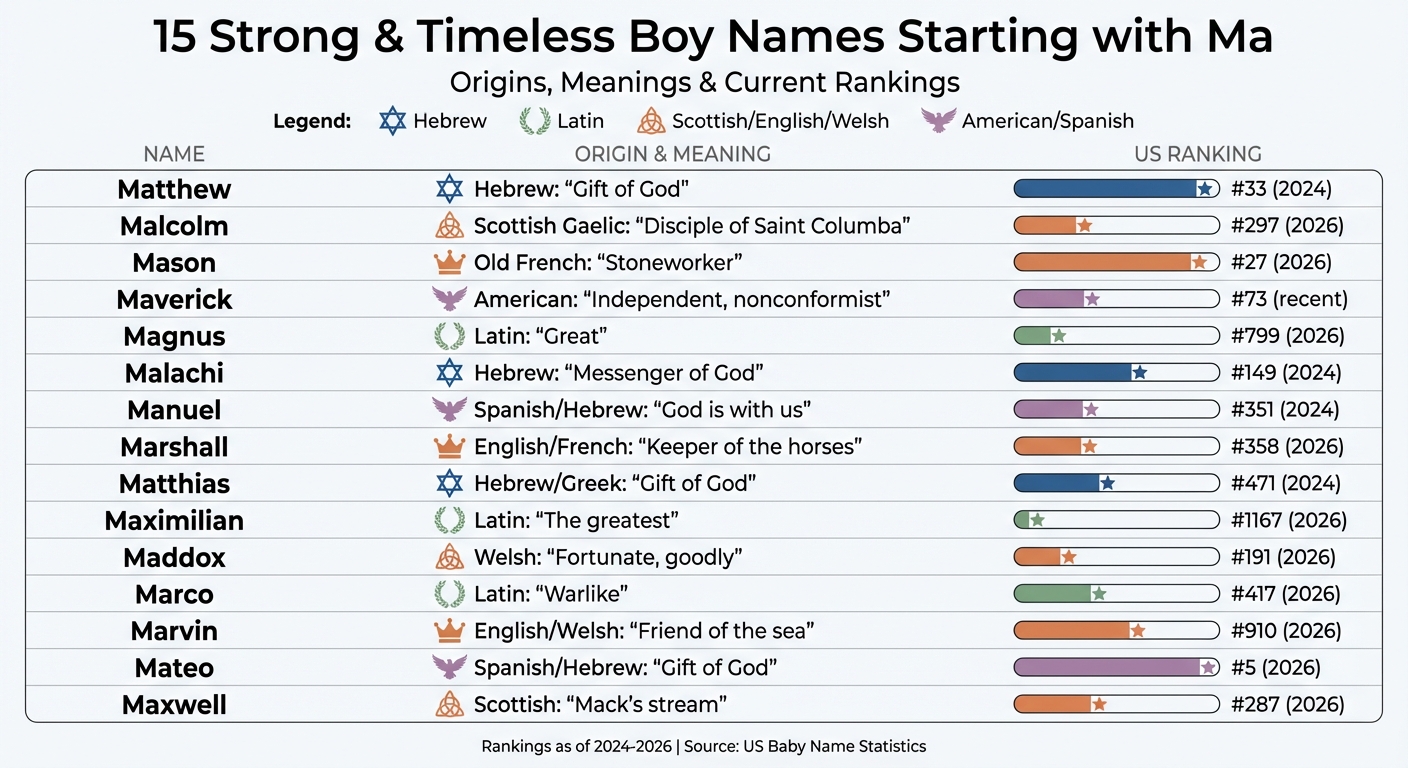
15 Boy Names Starting with Ma: Origins, Meanings, and Popularity Rankings
Why Choose Boy Names Starting with 'Ma'
Names starting with 'Ma' have a distinctive charm that has stood the test of time. They carry a sound that feels strong yet approachable, often exuding authority and confidence. Many of these names trace their origins to Latin roots and the Roman god Mars, adding a layer of historical depth. This phonetic strength is intertwined with a rich legacy that spans various traditions.
What makes 'Ma' names even more appealing is their adaptability across different cultures. For instance, Hebrew names like Matthew and Malachi bring a sense of spiritual meaning. Latin names such as Magnus (meaning "great") and Marcus (linked to Mars) highlight leadership qualities - Magnus, in particular, was the name of several Norwegian and Swedish kings. From the Gaelic tradition, Malcolm (meaning "disciple of Saint Columba") carries royal significance, having been the name of four Scottish kings. Arabic names like Muhammad and Malik add their own heritage of honor and strength.
Today, parents are drawn to these names not just for their historical significance but also for their modern appeal. Names like Matthew have remained consistently popular over the years, while variations such as Mateo climbed to the #7 spot in 2023. Maverick, a name with a bold and adventurous feel, reached #36. Even names like Mason, which originally meant "stoneworker", have become top picks, ranking #9 in 2018. This blend of tradition and trendiness makes 'Ma' names an attractive choice.
Another factor boosting their popularity is the trend of using surnames as first names. Names like Mason, Maxwell, Marshall, and Maddox, which began as surnames, are now widely used as first names. This shift reflects a growing preference for names that feel both grounded and unique - names that can suit any setting, whether it’s a professional environment or a casual one.
sbb-itb-f13f980
1. Matthew
Origin and cultural significance
The name Matthew traces its roots back to the Hebrew name Mattityahu, which later transitioned through Greek (Matthaios) and Latin (Matthaeus) before settling into its modern English form. With strong biblical ties, Matthew is most famously linked to Saint Matthew, one of Jesus's twelve apostles and the traditional author of the first Gospel in the New Testament. Its influence spans the globe, with more than 25 linguistic variations. For instance, it appears as Mateo in Spanish, Matteo in Italian, and Matthieu in French. Interestingly, in Ireland, it has also been used as an anglicized version of Mathúin. This deep historical and linguistic background adds to the name’s enduring appeal.
Meaning and symbolism
Matthew translates to "Gift of God" or "Gift of Yahweh". The name has enjoyed consistent popularity in the United States, staying within the top 50 names for nearly 60 years. It carries a sense of divine blessing while maintaining a warm, accessible quality.
Historical and modern associations
The name has been borne by many notable figures, including naval officer Matthew C. Perry, actors Matthew McConaughey and Matthew Broderick, and NFL quarterback Matthew Stafford. Matthew reached its peak popularity in 1995–96, ranking at #2, and remains a favorite, holding the #33 spot in 2024.
2. Malcolm
Origin and cultural significance
Malcolm is the anglicized version of the Scottish Gaelic name Máel Coluim. It has deep roots in Scotland's Christian history, honoring Saint Columba, a 6th-century Irish monk known for spreading Christianity across Scotland. This connection to Saint Columba made Malcolm a popular name among Scottish royalty. In fact, four Scottish kings bore the name, starting in the 10th century. Among them was Malcolm III, who defeated Macbeth to reclaim the throne - a story that later inspired Shakespeare's Macbeth. Beyond Scotland, Malcolm has enjoyed consistent popularity in the United States, always remaining within the top 1,000 names.
Meaning and symbolism
Malcolm translates to "disciple of Saint Columba", combining the Gaelic words máel (disciple, servant, or shaven one) and Colum (referring to Saint Columba). The name is often associated with qualities like resilience, maturity, and a sense of refinement. Unlike trend-driven names, Malcolm has a timeless appeal that keeps it relevant without becoming overly common. As of January 2026, it ranks #297 in popularity in the U.S.. Its blend of tradition and modern charm makes it a favorite for parents drawn to names with enduring strength and sophistication.
These qualities are mirrored in the lives of influential people who have carried the name.
Historical and modern associations
Malcolm X (1925–1965), the iconic civil rights leader, is perhaps the most powerful example of the name's legacy. Other notable figures include Malcolm Gladwell, the celebrated journalist and author, and Malcolm Young, a founding member and rhythm guitarist of AC/DC. The name also gained broader cultural recognition through the hit television series Malcolm in the Middle.
3. Mason
Origin and Cultural Significance
Mason traces its roots back to the Old French word "masson" (or "maçon"), an English occupational name that originally referred to medieval stone and brick workers. The name embodies a sense of craftsmanship and resilience. While it began as a surname, Mason transitioned into a popular first name in the 1980s, reflecting its blend of historical depth and modern charm.
Meaning and Symbolism
Mason directly translates to "stoneworker" or "one who works with stone". This meaning conveys qualities of strength and creativity, making it an attractive choice for parents today. As of early 2026, Mason holds the #27 spot in U.S. baby name rankings. It reached its peak popularity at #2 in 2011–2012 and has consistently remained in the top 100 since 1997.
Historical and Modern Associations
The name's historical prominence is bolstered by figures like George Mason, a Founding Father of the United States, and Charles Mason, the English astronomer and surveyor best known for the Mason-Dixon line. Mason also gained a surge in popularity in 2009 when it was chosen by a celebrity family on Keeping Up with the Kardashians.
Today, Mason continues to shine through a variety of modern figures, including NFL players Mason Crosby and Mason Rudolph, English soccer player Mason Mount, and composer Mason Williams, famous for the instrumental piece Classical Gas.
4. Maverick
Origin and Cultural Significance
The name Maverick traces its roots back to Samuel A. Maverick (1803–1870), a Texas lawyer and pioneer. In 1847, he famously refused to brand his cattle, leading local ranchers to refer to stray, unbranded cattle as "mavericks." Over time, the term expanded beyond ranching. By 1866, "maverick" was being used as a noun, and by 1886, it had taken on its modern meaning as an adjective describing individuals who defy conformity or group norms. This historical background gives the name a sense of independence and boldness.
Meaning and Symbolism
"Now maverick is most often used to speak of a person who acts in an individual way and refuses to be 'branded' as a member of any particular group." - Merriam-Webster
Maverick represents nonconformity and independent thought. It’s a name for those who carve their own path, appealing to parents who value uniqueness and self-reliance.
Historical and Modern Associations
The name has been associated with influential figures known for their independent spirit. Senator John McCain of Arizona earned a reputation as a political maverick by often crossing party lines. In the field of aviation, Burt Rutan gained fame for his daring and unconventional aircraft designs. The name also appears in sports, with professional golfer Maverick McNealy and basketball player Maverick Morgan carrying it forward.
Maverick's popularity has skyrocketed in recent years. It entered the top 100 U.S. boy names in 2017 and climbed into the top 50 by 2020. As of recent data, it ranks #73 nationally and holds the fifth spot among boys' names starting with "M".
5. Magnus
Origin and Significance
The name Magnus, meaning "great" in Late Latin, began as a Roman cognomen. It gained recognition through historical figures like Pompey the Great and Emperor Magnus Maximus. By the 11th century, it transitioned into a given name in Scandinavia, influenced by King Magnus I, who honored Charlemagne (Carolus Magnus) in adopting the name[33,35,36].
Magnus holds a strong connection to Northern European royalty, having been the name of seven Norwegian kings and three Swedish kings[33,35]. As it spread during the Middle Ages to Scotland and Ireland via the Shetlands, it transformed into forms like Manus and Mághnus. Today, Magnus remains a popular choice, ranking among the top 10 baby boy names in Denmark and Norway.
Meaning and Symbolism
The name Magnus translates directly to "Great" in Latin, symbolizing qualities like nobility, leadership, and influence. Historically, the name has been associated with the epithet "The Great", often reserved for leaders and saints of significant impact[33,38].
Historical and Modern Connections
Magnus carries a rich legacy, from medieval saints such as Albertus Magnus and Magnus of Füssen to contemporary figures like world chess champion Magnus Carlsen[33,35,36].
In the U.S., Magnus has seen a steady rise in popularity since the 2010s. It reached its peak in 2017, ranking #721 with a usage rate of 0.017% for baby boys[36,38]. As of January 2026, it stands at #799 nationally. With its blend of historical depth and modern charm, Magnus offers American parents a name that feels both strong and enduring.
6. Malachi
Origin and Background
The name Malachi comes from the Hebrew word Malʾaḵi, which is rooted in malʾaḵ, meaning "messenger" or "angel." It holds a strong connection to biblical history as one of the twelve minor prophets and is also linked to Irish heritage through St. Malachy, the first Irishman to be canonized by the Roman Catholic Church. Some interpretations suggest the name translates to "My Messenger."
Meaning and Spiritual Importance
Malachi carries a profound spiritual meaning that has resonated through time.
"Malachi is of Hebrew origin and means 'messenger of God.' It is from the Hebrew name Mal'akhi, meaning either 'my messenger' or 'my angel'." - FamilyEducation
This name embodies the idea of divine communication, making it a popular choice for parents who value its spiritual depth and timeless strength.
Historical and Contemporary Connections
Over the years, Malachi has been associated with notable figures, both historical and modern. For instance, Malachi Fallon became San Francisco's first chief of police, while actors like Malachi Kirby and Malachi Throne have kept the name relevant in contemporary culture. It has consistently been a favorite in the U.S., staying in the top 200 names since 2003 and ranking #149 in 2024. Dwyane Wade also brought attention to the name by including it in his son’s full name, Zion Malachi Airamis Wade. Variations like Malakai, Malaki, and Malachai further highlight its adaptability and enduring charm.
7. Manuel
Origin and Cultural Significance
The name Manuel traces its roots to the biblical Immanuel (עִמָּנוּאֵל), meaning "God is with us." It journeyed through the Byzantine Empire, where it appeared as Μανουήλ, before making its way to Western Europe. By the 13th century, it had become a popular choice in Spain, Portugal, and Germany, often favored by Iberian royal families due to their connections with Byzantine traditions. This rich history lends the name a sense of timeless significance.
Meaning and Symbolism
As a theophoric name, Manuel carries a profound religious meaning: "God is with us". Its roots in Old Testament prophecy about the Messiah highlight its spiritual importance within Christian traditions. In France, the name is celebrated on December 25, tying it directly to Christmas and further emphasizing its religious resonance.
Historical and Modern Associations
In the United States, Manuel reached its peak popularity in 1929, ranking #111 with a usage rate of 0.146%. By 2024, it has settled at #351. The name continues to stay relevant, thanks to notable figures like Lin-Manuel Miranda, whose groundbreaking work on Hamilton has brought renewed attention to the name. Other prominent individuals include German soccer star Manuel Neuer and Philippine President Manuel L. Quezon. Additionally, nicknames such as Manny, Manu, and Manolo add to its adaptability and charm.
8. Marshall
Origin and Cultural Significance
Marshall originated as an occupational surname with roots in both English and French traditions. Its name stems from the Germanic words marh (horse or mare) and skalk (servant), which later transformed into the Old French mareschal. Initially, it referred to someone responsible for tending horses, but over time, it evolved into a title for high-ranking military officers and court officials. This journey from humble beginnings to a symbol of authority and prestige gives Marshall a timeless appeal.
Meaning and Symbolism
At its core, Marshall means "keeper of the horses". While its origins point to a practical role, the name has come to represent qualities like dependability, strength, and leadership. The connection to horses ties it to nature and grounded qualities, while its later association with military and legal roles emphasizes honor and responsibility.
Historical and Modern Associations
Marshall has been borne by several influential figures throughout history. Chief Justice John Marshall (1755–1835) played a pivotal role in defining the power of the Supreme Court. Thurgood Marshall (1908–1993) broke barriers as the first African American Supreme Court Justice and a champion of civil rights. General George C. Marshall (1880–1959) is remembered for his leadership during World War II and his role in the European recovery plan that earned him a Nobel Peace Prize.
In modern culture, the name has gained prominence through figures like Marshall Bruce Mathers III, better known as rapper Eminem. Sports enthusiasts might recognize Marshall Faulk, an NFL Hall of Famer. The name also pops up in popular entertainment, from the character Marshall Eriksen in How I Met Your Mother to the beloved fire dog Marshall in Paw Patrol.
As of January 2026, Marshall ranks #358 in U.S. name popularity, a decline from its peak at #165 during the 1910s. This shift makes it an ideal choice for parents looking for a name that balances historical significance with modern familiarity. Marshall effortlessly combines a rich past with contemporary relevance, offering a name that feels both strong and timeless.
9. Matthias
Origin and Cultural Significance
Matthias carries a legacy that weaves through various cultures and languages. Its origins trace back to the Hebrew name Matityahu, which later transformed into the Ancient Greek Mattathias. Interestingly, this Greek version predates the more familiar English name, Matthew, making Matthias an older and historically richer choice. The name holds deep Biblical importance, notably as the name of the apostle chosen to replace Judas Iscariot among the twelve disciples. Beyond its Biblical roots, Matthias connects to Celtic heritage through the Irish mathúin, meaning "bear", adding a rugged and earthy dimension to its character. Variations of Matthias are found worldwide, such as Mattias in Scandinavian and German-speaking regions, Matias in Spanish and Portuguese, and Matteo in Italian. This blend of cultural influences enriches Matthias with a timeless and versatile appeal.
Meaning and Symbolism
The name Matthias translates to "gift of God". This meaning resonates deeply with parents looking for a name that reflects gratitude and blessing. It strikes a balance between spiritual depth and a grounded, resilient charm, making it a compelling choice for many.
"Matthias is a refreshing twist to the ancient masculine name Mathew sure to give baby a distinctive edge." - Keshia Roelofs, Editor, The Bump
Historical and Modern Associations
Matthias's historical significance is rooted in its Biblical association with the apostle who replaced Judas, giving it an enduring sense of tradition. In the United States, Matthias ranked #471 for boys in 2024, climbing 12 spots from the previous year. This growing popularity highlights its appeal as a distinctive alternative to Matthew, offering a name that feels both fresh and steeped in tradition.
Internationally, Matthias enjoys strong recognition. For example, it ranks #30 in Norway, #39 in Denmark, and #99 in both Austria and Chile as of early 2026. The name also provides flexibility with nicknames like Matt, Matty, and Mads, making it adaptable as a child grows and develops their own identity.
10. Maximilian
Origin and Cultural Significance
Maximilian traces its roots back to Latin, derived from the Roman name Maximilianus, which itself comes from Maximus. The name gained prominence in the 15th century when Holy Roman Emperor Frederick III named his heir Maximilian, combining elements from two revered Roman generals. This choice cemented Maximilian's association with nobility and power, a connection that was later reinforced by its use among European royalty, including two Holy Roman Emperors, two Bavarian kings, and a Habsburg emperor of Mexico. Additionally, the name holds religious importance, having been adopted by several Christian saints, such as a 3rd-century martyr. Even today, Maximilian enjoys widespread popularity, especially in Germany and Austria, where it consistently ranks among the top names for boys. Its historical and royal ties make it a name steeped in grandeur and significance.
Meaning and Symbolism
Maximilian translates to "the greatest", embodying ideas of strength, ambition, and leadership. For parents seeking a name that reflects excellence and aspiration, Maximilian is a compelling choice. Beyond its commanding meaning, the name also conveys warmth and approachability. Nicknames like Max, Maxi, Mac, Maks, Maxim, and Milian offer flexibility and a personal touch as a child grows. These qualities contribute to the name's timeless charm and enduring appeal.
Historical and Modern Associations
Maximilian first entered the U.S. top 1,000 names in 1986, peaking at #429 in 2013. By 2020, it had dropped to #491 and continued to decline, ranking #1167 by early 2026. Despite these shifts, the name retains its historical weight and cultural resonance. Celebrity parents like Jennifer Lopez and Marc Anthony, who named their son Maximilian David, and Hugh Jackman, who also chose the name for his son, have helped keep it in the spotlight. Famous figures such as Academy Award-winning actor Maximilian Schell and 1930s world heavyweight champion Maximilian Baer further highlight the name's prominence. It also features in popular culture, with characters like General Maximilian Veers from The Empire Strikes Back and Maximilian Morrel from The Count of Monte Cristo. These associations ensure Maximilian remains a name that balances historical gravitas with modern relevance.
11. Maddox
Origin and Cultural Significance
Maddox traces its roots to Welsh heritage, specifically as a patronymic form of "Madog" - a traditional naming practice that means "son of Madoc". The name originates from the Welsh word mad, which translates to "fortunate", "goodly", or "generous".
It also carries a fascinating historical connection. According to Welsh lore, Prince Madoc ab Owain Gwynedd is said to have sailed to the Americas in 1170, centuries before Columbus. This association with adventure and exploration adds a layer of intrigue, making Maddox an appealing choice for parents who value names with rich narratives.
Meaning and Symbolism
Maddox is steeped in meanings of good fortune, generosity, and strength. The root word mad reflects positive traits like kindness and optimism, giving it a warm and uplifting vibe.
The name also benefits from its edgy "x" ending, which adds a modern, rugged charm. With nicknames like Max and Mads, Maddox offers versatility while maintaining its stylish appeal.
Historical and Modern Associations
Maddox saw a meteoric rise in popularity after Angelina Jolie adopted her son in 2002, catapulting the name up nearly 400 spots on the U.S. baby name charts by 2003. As of January 2026, Maddox holds the #191 spot in U.S. name rankings.
"When Angelina Jolie adopted her son Maddox in 2002, she transformed a dusty surname into an instant Hollywood hit."
The name has also made its mark in pop culture and sports, with figures like professional basketball player Tito Maddox and football quarterback Maddox Kopp. These associations lend Maddox a strong and athletic image.
Blending its historical roots with a contemporary edge, Maddox stands alongside names like Matthew and Mason, offering a balance of tradition and modern flair. It’s a name that feels both timeless and current, making it a standout choice for parents.
12. Marco
Origin and Cultural Significance
The name Marco traces its roots to the Latin Marcus, which is connected to Mars, the Roman god of war. It carries particular importance in Venice, Italy, where it gained prominence during the Middle Ages. This rise in popularity is tied to the belief that Saint Mark the Evangelist was buried in Venice, intertwining the name with both Christian traditions and Venetian identity. Marco’s name day is traditionally celebrated on April 25, further emphasizing its deep historical and religious ties.
Meaning and Symbolism
Marco is often interpreted as meaning "warlike", "warring", or "dedicated to Mars". While these meanings might sound combative, they embody qualities like strength, bravery, and determination - attributes that many parents aspire to instill in their children. Over time, the name has also come to symbolize adventure and exploration, reflecting the spirit of notable historical figures.
Historical and Modern Associations
One of the most enduring connections to the name Marco is Marco Polo (1254–1324), the Venetian explorer whose travels to Asia significantly influenced European understanding of the world. Today, the name remains relevant thanks to figures like U.S. Senator Marco Rubio and Marco Pierre White, a renowned English chef and restaurateur. In sports, legends such as Dutch footballer Marco van Basten, a three-time Ballon d'Or winner, and American racing driver Marco Andretti continue to highlight the name’s appeal.
As of January 2026, Marco is ranked #417 in popularity in the U.S. and remains a top 10 name in countries like Italy, Costa Rica, and Switzerland. The name also lends itself to a variety of nicknames, including Mark, Marc, Mace, and Rico, preserving its timeless Italian elegance.
13. Marvin
Origin and Background
Marvin is an English name with roots in Welsh Merfyn and Old English Mærwine. It saw its peak in popularity during the early 1930s and, as of January 2026, it holds the #910 spot in U.S. name rankings. While its popularity has waned over time, Marvin remains a classic choice, appealing to those who favor traditional names.
Meaning and Appeal
The name Marvin carries meanings like "friend of the sea" or "sea noble", stemming from its Welsh origins, while its Old English roots translate to "famous friend" or "famous joy." These associations evoke a sense of loyalty, strength, and adventure, making it an appealing choice for parents who value timeless and meaningful names. Its symbolic ties to the sea add a layer of charm and depth.
Historical and Cultural Connections
Marvin has left its mark in both history and modern pop culture. A notable figure is Marvin Gaye (1939–1984), the legendary soul singer and songwriter whose influence continues to resonate. Historically, the name is linked to Mathew Marvin, one of the original founders of Hartford, Connecticut, in 1635. In pop culture, Marvin brings a playful energy with characters like Marvin the Martian from Looney Tunes and Marvin the Paranoid Android from The Hitchhiker's Guide to the Galaxy. Beyond entertainment, the name has been carried by prominent figures in various fields, such as EGOT-winning composer Marvin Hamlisch and athletes in the NBA and NASCAR. This versatility highlights Marvin's enduring appeal across generations.
14. Mateo
Origin and Cultural Significance
Mateo strikes a balance between tradition and modern appeal, making it a standout among 'Ma' names. It’s the Spanish version of Matthew, which originates from the Hebrew name Matityahu [78,80]. This name carries significant religious weight, tied to Saint Matthew - one of Jesus's 12 apostles and the author of the first Gospel in the New Testament. Additionally, it honors Saint Mateo Correa, a Catholic martyr. While rooted in Spanish heritage, Mateo has gained popularity far beyond, becoming a favorite in Latin America, the United States, and even Croatia, where it’s often linked to the Italian Matteo [78,79]. Its layered history gives it a profound sense of meaning.
Meaning and Symbolism
Mateo means "gift of God", a combination of the Hebrew words mattan (gift) and Yah (God) [78,80,81]. This meaning holds special significance, especially in Spanish-speaking communities, where the name reflects the idea of a child being a divine blessing. This timeless interpretation has played a key role in its growing appeal.
Historical or Modern Associations
Mateo’s popularity has surged over the years. It first entered the top 1,000 names in the U.S. in 1995 and climbed into the top 100 by 2015. By 2023, it reached the sixth spot in the U.S., with 11,229 newborns given the name. As of January 2026, it ranks fifth in the U.S.. Prominent figures like soccer player Mateo Kovačić and composer Mateo Messina, along with appearances in shows like Jane the Virgin and Elena of Avalor, highlight its modern relevance [78,80]. Its steady climb in popularity reflects its enduring charm and widespread appeal.
15. Maxwell
Origin and Cultural Significance
Maxwell traces its roots back to Scotland, originating as a habitational surname from the River Tweed area. The earliest recorded version of the name, Mackeswell, dates back to 1144 CE. While its origins are distinctly Scottish, the name also has a presence in Ulster, Ireland, and has been adopted as an Americanized form of similar Jewish surnames. This broad appeal has allowed Maxwell to remain relevant across various communities while retaining its timeless charm.
Meaning and Symbolism
The name Maxwell translates to "Mack's spring" or "Mack's stream". The "Mack" prefix is derived from the Scandinavian name Magnus, meaning "great", paired with the Old English term wella, which refers to a "stream" or "spring". Together, Maxwell can be interpreted as "great stream". The name is historically tied to Clan Maxwell, whose motto, Reviresco ("I flourish again"), reflects themes of resilience and renewal. Since medieval times, Maxwell has symbolized strength, courage, and the ability to overcome challenges. These qualities have contributed to its enduring legacy.
Historical or Modern Associations
Maxwell has made its mark across various fields and generations. Maxwell Perkins, a celebrated American book editor, worked with literary legends like Ernest Hemingway and F. Scott Fitzgerald. In science, Max Planck gained global recognition with a Nobel Prize for his contributions to physics and mathematics. More recently, Maxwell Frost became the first member of Generation Z elected to the U.S. Congress. In the arts, the R&B artist known simply as Maxwell has left a lasting imprint on contemporary music.
The name has consistently ranked among the top 150 baby names for the past 20 years, peaking at #107 in 2014. As of January 2026, it holds a U.S. popularity rank of #287. Celebrity parents like Lance Armstrong, Jessica Simpson, and Lindsay Sloane have chosen Maxwell for their children, sparking a shift in its gender usage. The name also has a strong presence in pop culture, appearing in characters like Maxwell Smart from Get Smart, Maxwell Sheffield from The Nanny, and Maxwell Edison in the Beatles' song "Maxwell's Silver Hammer".
Find Your Perfect 'Ma' Name with NameHatch
Ready to find the ideal 'Ma' name for your little one? NameHatch makes the process simple, fun, and efficient.
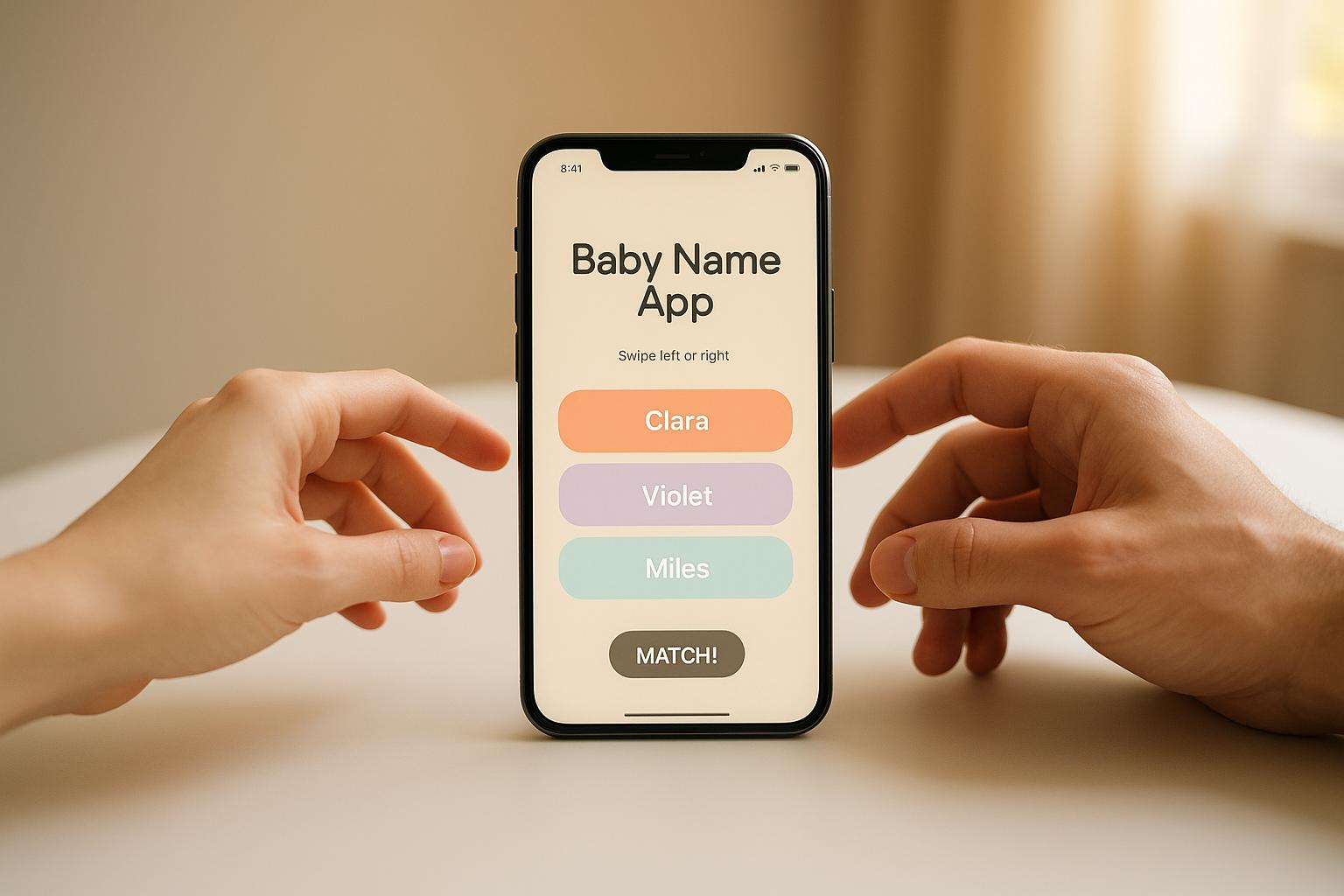
With a database of over 2,300 'Ma' names, NameHatch uses an baby name swipe app - much like popular dating apps. Instead of scrolling through endless lists, you can quickly browse names like Matthew, Maverick, or Mateo. Swipe right to save a favorite or left to move on. It’s that easy.
The tool offers customizable filters to tailor your search. Narrow down names based on origin (like English, Latin, or Hebrew) or meaning (such as strength, courage, or wisdom). Whether you stick with the free plan (30 swipes and basic filtering) or upgrade to premium for unlimited swipes and advanced filters (starting at $7/month), there’s an option for every family.
Couples will love the partner syncing feature, which allows both parents to connect and share mutual favorites. No more endless debates - just a streamlined shortlist you both agree on.
NameHatch works on mobile and desktop, with AI-powered suggestions that get smarter with every swipe. Premium users can save unlimited favorites and revisit their lists anytime. It’s a modern, stress-free way to pick a timeless name.
Conclusion
Throughout this article, we've highlighted how boy names starting with "Ma" carry a unique blend of history and contemporary appeal. From the biblical roots of Matthew and Malachi to the adventurous spirit of Maverick and the enduring strength of Magnus, these names reflect values that stand the test of time.
Rooted in traditions from Hebrew, Latin, Gaelic, and Germanic origins, "Ma" names continue to resonate across generations. Whether it's the gentle, spiritual tone of Mateo or the sturdy, occupational vibe of Mason and Marshall, there's a "Ma" name to match every family's preferences. Their enduring popularity in naming trends only reinforces their timeless charm.
Whether you're drawn to meanings like "gift of God", "warrior", or "great", names beginning with "Ma" combine meaningful origins with approachable sounds. They strike a balance, fitting seamlessly into both professional settings and childhood adventures. Ultimately, the right name is one that reflects your family's values and individuality.
FAQs
What is the cultural significance of boy names starting with 'Ma'?
Boy names that begin with "Ma" often carry rich historical and traditional significance. Many stem from Hebrew origins, representing spiritual themes like being a "gift of God" - examples include Matthew and Mateo. Others, like Malik from Arabic, emphasize power and authority, translating to "king."
Some names also highlight ancestral roots, such as MacKenzie, which has Gaelic ties, or Mason, derived from Old French and associated with craftsmanship and heritage. These names often symbolize traits like strength, spiritual depth, and a connection to one's roots, making them enduring and thoughtful choices for parents.
How do names starting with 'Ma' combine tradition and modern style?
'Ma' names strike a perfect balance between honoring tradition and embracing contemporary trends. Classic names like Malcolm and Martin carry a sense of heritage and stability, deeply rooted in history. These timeless options are ideal for parents who want to celebrate a strong connection to the past.
In contrast, modern picks such as Maverick and Maddox offer a more current, stylish vibe. These names stand out for their trendy appeal while still feeling approachable and familiar. This mix of old and new makes 'Ma' names a versatile choice for families who want to combine tradition with a touch of modern flair.
Why are boy names starting with 'Ma' so popular?
Boy names that start with 'Ma' have long been a favorite among parents, often because of their rich roots and meaningful origins. Many of these names come from traditions like Hebrew, Arabic, and Latin, carrying powerful meanings such as “gift”, “king”, or “strength”. For instance, names like Mateo, Mason, and Malik have a timeless quality while also appealing to modern tastes with their strong, memorable sounds.
Another reason these names stand out is their flexibility. Whether you're looking for something traditional and faith-based or a name with a more modern vibe, 'Ma' names offer plenty of options. This blend of history and contemporary appeal ensures they stay relevant and meaningful for families across generations.