Searching for the perfect boy name beginning with "M"? Here's a curated list of 15 names that combine history, meaning, and modern appeal. From classics like Michael and Matthew to bold picks like Maverick and Milo, these names offer something for every style. Each name comes with its origin, significance, and why it continues to resonate with parents today.
Highlights:
- Michael: A biblical classic and former #1 U.S. favorite for 44 years.
- Miles & Myles: Linked to strength and grace, with rising popularity.
- Mateo & Matteo: Stylish global variants of Matthew, now trending in the U.S.
- Maverick: A symbol of independence, boosted by pop culture.
- Micah: A softer biblical name with enduring charm.
- Malcolm: Scottish heritage meets modern-day relevance.
- Muhammad: The most-used name globally, rich in spiritual meaning.
These names strike a balance between timeless tradition and modern trends, offering versatility for every family. Dive into the full list for origins, meanings, and why these names remain favorites.
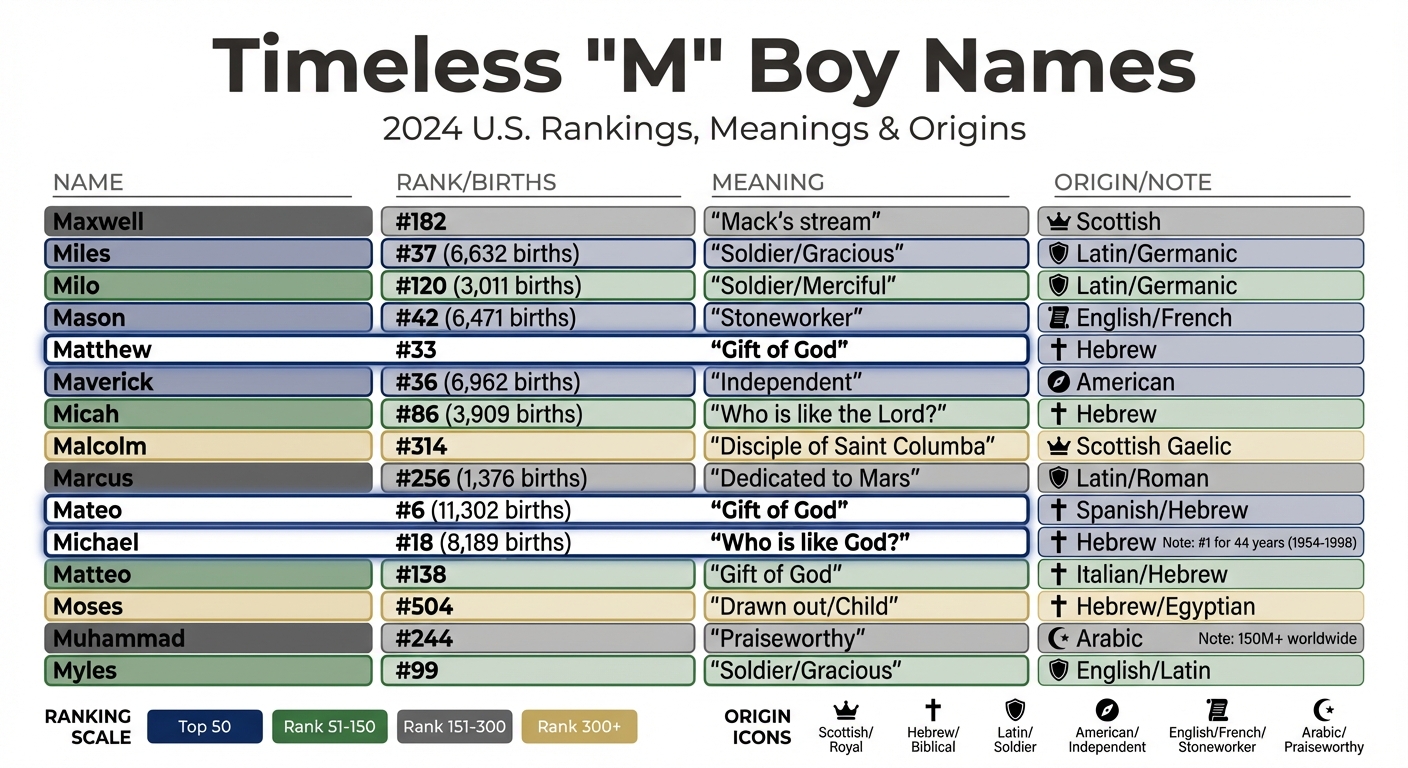
15 Timeless Boy Names Starting with M: Popularity Rankings and Meanings Comparison
1. Maxwell
Meaning and Origin of the Name
Maxwell traces its roots to a Scottish place near the River Tweed, close to Melrose. The name translates to "Mack's stream" or "Mack's spring", stemming from the Old Norse personal name "Mack" (a shortened form of Maccus, related to Magnus) and the Old English word "wella", meaning "well" or "stream." The earliest recorded use of the name was in 1144 CE as "Mackeswell". Initially a clan surname, Maxwell gained popularity as a first name in the 19th and 20th centuries.
Cultural and Historical Significance
Maxwell carries a legacy of intellectual achievement, most notably through James Clerk Maxwell (1831–1879), the Scottish physicist who developed the theory of electromagnetism. This association gives the name a reputation for brilliance and innovation. Beyond science, Maxwell has made its mark in pop culture, appearing in television and music.
"Maxwell is the sartorial equivalent of a tailored tweed jacket: classic, and smart." – MomLovesBest
Popularity and Familiarity in the United States
In the U.S., Maxwell has remained a steady favorite. Over the past two decades, it has consistently ranked among the top 150 names, peaking at #107 in 2014. As of 2024, it holds the #182 spot. The name is overwhelmingly used for boys, with a 50:1 ratio compared to girls. Parents are drawn to its flexible nickname options, such as the energetic "Max", the trendy "Wells", or the rugged "Mack".
Timelessness and Enduring Appeal
Maxwell strikes a balance between tradition and modernity. It gained traction during the 1980s and 1990s, riding the wave of surnames as first names, and has remained a solid choice ever since. Its blend of historical depth and contemporary style makes it equally fitting for professional settings and casual environments. This versatility continues to resonate with parents today.
"A happy medium between the weighty Maximilian and the laid-back Max, Maxwell is one of the most classic and attractive Scottish names." – Linda Rosenkrantz
sbb-itb-f13f980
2. Miles
Meaning and Origin of the Name
The name Miles carries a rich dual heritage. Its roots can be traced to the Latin word miles, meaning "soldier" or "knight", and the Germanic term mil, which translates to "gracious" or "merciful". Introduced to England by the Normans in the 11th century as "Miles" (from the Germanic "Milo"), the name later found its way to Ireland and Scotland, where it was used as an Anglicized version of Gaelic names like "Maoilios", meaning "servant of Jesus". Additionally, Miles is sometimes considered a diminutive of Michael. This layered history has helped establish Miles as a name with broad appeal and timeless charm.
Popularity and Familiarity in the United States
Miles has seen a significant surge in popularity in the U.S. over the past two decades. It entered the Top 100 names in 2018 and climbed to #37 by 2024, with 6,632 boys being named Miles that year - a remarkable leap from its position at #257 in 2000, when it was chosen for only 0.062% of boys. Its rise has been supported by cultural figures like jazz legend Miles Davis and Marvel’s Spider-Man, Miles Morales, both of whom give the name a "permanent veneer of cool". The name has also been embraced by celebrity parents such as John Legend and Chrissy Teigen, Elisabeth Shue, and Mayim Bialik, further cementing its modern appeal. This growing popularity reflects the name's historical depth and contemporary relevance.
Cultural and Historical Significance
Originally, the term miles referred to a foot soldier but later came to signify a knight, symbolizing bravery and honor. The name has been carried by historical figures like Myles Standish and Myles Coverdale, showcasing its enduring significance over centuries.
"Miles is the definition of a 'slow burn' success story. It is currently a very popular name, but it did not achieve overnight fame." – MomLovesBest
From its medieval roots to its modern associations, Miles bridges the gap between history and the present, making it a name that feels both classic and current.
Timelessness and Enduring Appeal
Miles offers the perfect mix of sophistication and approachability. Its soft, melodic sound makes it stand out while remaining easy to say and remember. The name’s brevity and clarity make it suitable for every stage of life, from childhood to adulthood.
"Miles is an exceptional choice for a baby born in 2026. It offers the 'vintage cool' aesthetic parents are currently chasing but remains timeless enough to never feel like a passing fad." – MomLovesBest
Miles seamlessly combines strength and gentleness, embodying qualities of both resilience and warmth. Its historical roots, cultural associations, and modern flair ensure it will remain a favorite for years to come.
3. Milo
Meaning and Origin of the Name
Milo carries a rich tapestry of meanings from various origins. In Latin, it stems from "miles", meaning "soldier", while its Germanic roots connect it to "mild", symbolizing mercy, love, or gentleness. In Slavic languages, the prefix "mil-" translates to "gracious", "dear", or "loving." Ancient Greek adds another layer, where "milos" refers to a yew tree or flower. Meanwhile, in Gaelic and Celtic traditions, Milo has been used as the English adaptation of the Irish Máelmuire (devotee of Mary) or the Scottish Maoilios (servant of Jesus) [33, 34, 35, 36, 37].
Cultural and Historical Significance
One of the earliest figures to carry the name was Milo of Croton, a Greek wrestler from the 6th century BC, renowned for his extraordinary strength. The Normans introduced the name to England in the 11th century, where it gained traction. After a period of decline, Milo saw a revival in the 19th century, influenced by a renewed interest in Classical antiquity. However, it nearly faded from use between 1966 and 2000 before making a striking comeback in the early 2000s. This resurgence was partly driven by pop culture, with notable figures like actor Milo Ventimiglia and Disney's Milo Thatch from Atlantis: The Lost Empire playing a role in bringing the name back into the spotlight [34, 35, 39].
"Milo is a linguistic chameleon of a name; it manages to be both rugged and incredibly gentle all at once." – Mom Loves Best
Popularity and Familiarity in the United States
Over the past two decades, Milo has seen a remarkable rise in popularity in the U.S. In 2024, it ranked #120, with 3,011 newborn boys given the name - a sharp climb from its #981 ranking in 2001, when it accounted for just 0.008% of births. By 2015, Milo had broken into the top 300 for the first time in over a century. Its growing appeal aligns with a broader trend of short, vowel-heavy names ending in "o", like Arlo, Leo, and Theo. Celebrity endorsements have also played a role, with stars like Liv Tyler, Alyssa Milano, Ricki Lake, and Craig Ferguson choosing the name for their children, further boosting its recognition [40, 41, 42].
Timelessness and Enduring Appeal
Milo strikes a balance between vintage charm and contemporary style. Its short and soft sound makes it endearing for children, while its sophistication ensures it ages well into adulthood. Globally, Milo enjoys widespread use, appearing in countries like Belgium, Canada, Finland, France, Germany, Italy, the Netherlands, Sweden, Switzerland, the United Kingdom, and Uruguay. Its universal appeal and adaptability make it a standout choice among classic 'M' names.
4. Mason
Meaning and Origin of the Name
Mason is a name with roots in craftsmanship, meaning "one who works with stone" or "stoneworker". It began as an English occupational surname in the 11th century, derived from the Old French word masson (or maçon), which traces back to the Germanic/Frankish word macian, meaning "to make". After the Normans introduced it to England following the 1066 Conquest, it transitioned from a surname to a first name by the 19th century. While not directly linked to biblical texts, some families see a spiritual connection through its ties to masonry and the concept of "living stones". Over time, Mason has come to symbolize both craftsmanship and resilience.
Cultural and Historical Significance
The name Mason carries historical weight, particularly in the United States. George Mason, an 18th-century patriot, is a notable figure associated with the name. He authored the Virginia Declaration of Rights, which influenced the U.S. Bill of Rights. In the 17th century, Puritan settlers in America adopted Mason as a reflection of hard work and craftsmanship. The name also gained literary recognition through Mason Locke Weems (1759–1825), who popularized the legendary tale of George Washington and the cherry tree. Additionally, during the Civil War, Mason Brayman served as a Union Army officer and major general at the Battle of Chickamauga.
Popularity and Familiarity in the United States
Mason has been a popular choice for baby boys in the U.S. since 1997, consistently ranking among the top 100 names. Its popularity surged after Kourtney Kardashian named her son Mason in 2009. The name jumped from #34 to #2 in 2011 and 2012, with 19,522 boys named Mason during its peak years. It remained in the top 10 until 2019 and ranked #42 in 2024, with 6,471 births that year. Beyond the U.S., Mason is also a favorite in countries like Australia, Scotland, and England, where it frequently appears in the top 100.
Timelessness and Enduring Appeal
Mason strikes a balance between its working-class origins and a polished, modern feel. It aligns with the popular "n-ending" trend found in names like Aiden, Logan, and Ethan. Parents are drawn to its straightforward, two-syllable structure, which is easy to spell and pronounce. Offering a fresh alternative to names like Jason, Mason has become a go-to choice for families seeking a solid yet stylish option. It also fits into the broader appeal of occupational surnames - such as Hunter, Cooper, Carter, and Parker - that evoke strength, dependability, and craftsmanship.
5. Matthew
Meaning and Origin of the Name
The name Matthew comes from the Hebrew Mattityahu (מַתִּתְיָהוּ), which translates to "Gift of God." Over time, it evolved through Greek (Matthaios) and Latin (Matthaeus) before becoming the English name we know today. It was introduced to England by the Normans after their conquest in 1066 and has been in use since the 12th century. Its biblical significance is rooted in Matthew the Apostle, a tax collector who became one of Jesus's twelve disciples and is traditionally credited with writing the first Gospel.
Cultural and Historical Significance
Matthew has a rich history and has remained relevant across centuries. Its biblical origins have made it a cornerstone in Christian tradition, while its influence extends beyond religion. For instance, American naval officer Matthew C. Perry (1794–1858) played a key role in opening Japan to Western trade. In the United States, the name gained additional popularity in the 1960s, climbing from #61 in 1960 to #24 by 1969, partly due to the popularity of the Western TV series Gunsmoke.
In modern times, celebrities like Matthew McConaughey, Matthew Broderick, Matt Damon, and Matthew Perry have kept the name familiar and appealing.
"The New Testament Matthew is the epitome of the fashionable classic - safe and sturdy, yet with a more engaging personality than John or William." – Pamela Redmond
These associations, both historical and contemporary, have helped Matthew maintain its cultural resonance and popularity.
Popularity and Familiarity in the United States
Matthew has been a consistent favorite among American parents for decades. From 1972 to 2008, it ranked in the top 10 most popular boy names in the U.S., peaking at #2 in 1995 and 1996. It also held the #3 spot throughout much of the 1980s and 1990s. At its height in the mid-1980s, around 2.69% of all boys born in the U.S. were named Matthew. While its popularity has declined slightly since its peak, it still ranked at #33 in 2024 and has remained in the top 50 for nearly 60 years.
Timelessness and Enduring Appeal
Matthew's charm lies in its ability to balance tradition with a sense of approachability. Popular nicknames like Matt and Matty add a casual, friendly vibe, while international variants such as Mateo (Spanish) and Matthias (Greek/German) offer fresh twists. Mateo, in particular, has seen a rise in popularity, even breaking into the top 10 recently. Despite shifts in naming trends, Matthew's spiritual meaning - "Gift of God" - continues to resonate with many.
"Matthew is the name equivalent of a navy blue blazer; it is classic, handsome, versatile, and appropriate for every occasion."
This combination of history, versatility, and modern appeal ensures that Matthew remains a timeless choice among 'M' names.
6. Maverick
Meaning and Origin of the Name
Maverick originates as an English and American surname, meaning "independent" and "nonconformist." Its roots trace back to Samuel Augustus Maverick (1803–1870), a Texas lawyer, politician, and rancher. Samuel Maverick became famous for refusing to brand his cattle, leading to unbranded calves being called "mavericks." Over time, the term came to represent individuals who reject conformity and embrace independence.
Cultural and Historical Significance
This name spans across generations of American culture, from the Wild West to modern aviation. It gained early recognition through the 1950s TV series Maverick, but its popularity skyrocketed with the Top Gun films in 1986 and 2022. Beyond Hollywood, Maverick is also tied to American sports through the Dallas Mavericks NBA team and was famously associated with Senator John McCain, who was nicknamed "Maverick." Its enduring popularity aligns with the current "Cowboy Cool" naming trend, placing it alongside rugged choices like Waylon, Walker, and Wyatt.
"Maverick symbolizes an unfettered, free spirit." – Grace Royal, Editor, Nameberry
Popularity and Familiarity in the United States
Maverick's rise from obscurity to mainstream prominence has been dramatic. It entered the U.S. Top 100 names for boys in 2017 and has continued to climb ever since. By 2024, it ranked #36, with around 6,962 boys in the United States named Maverick that year - an increase of nearly sixfold compared to a decade prior. While over 98% of babies with the name are boys, it occasionally appears as a daring choice for girls [65, 68, 73, 76]. This surge reflects the name's rebellious charm and growing appeal.
Timelessness and Enduring Appeal
Although Maverick's popularity is a recent development, its historical roots and strong meaning give it lasting appeal. It combines the edgy vibe of modern, punchy names like Jett or Ace with a rich historical backstory. Nicknames such as Mav, Rick, and Ace add versatility, while its blend of rugged individuality and contemporary flair ensures its staying power.
7. Micah
Meaning and Origin of the Name
Micah comes from the Hebrew names Mikha or Micaiah, translating to "Who is like the Lord?" or "Who is like Yahweh?". It’s a theophoric name, meaning it incorporates a reference to God, emphasizing the unmatched nature of the Divine. The name is best known from the biblical Prophet Micah, one of the twelve "Minor Prophets" in the Old Testament. He lived in the 8th century BCE and is remembered for his teachings on justice, kindness, and humility. One of his most quoted verses, Micah 6:8, says: "He has told you, O man, what is good; and what does the Lord require of you but to do justice, and to love kindness, and to walk humbly with your God?".
Cultural and Historical Significance
Micah’s use dates back to ancient biblical times, but it saw a revival during the 17th century when Puritans brought it to prominence, eventually bringing the name to America with the early Pilgrims. Over the years, it has remained relevant, appearing in various forms of media. Notable mentions include Arthur Conan Doyle’s novel Micah Clarke, the character Micah Sanders in the TV show Heroes, the animated series She-Ra and the Princesses of Power, and the video game Red Dead Redemption 2.
The name has also been carried by modern figures like NFL linebacker Micah Parsons and former English footballer Micah Richards. While Michael, a related name, connects to El (symbolizing judgment), Micah’s connection to Yahweh emphasizes love and compassion. These historical and cultural layers have helped Micah maintain its relevance over time.
Popularity and Familiarity in the United States
Micah’s biblical roots helped it enter the U.S. Top 1,000 names in 1959, with its popularity growing significantly during the 1970s and 1980s. By 2024, it ranked #86 among boys’ names, with 3,909 boys and 320 girls given the name that year. Unlike names that rise and fall quickly, Micah has remained steady, staying close to the Top 100 for nearly 30 years. It even saw a notable 115.19% increase in usage in 2007. Though traditionally used for boys, Micah has also gained traction as a girl’s name, ranking #582 in 1998, highlighting its versatility.
Timelessness and Enduring Appeal
Micah strikes a balance between its ancient biblical origins and its modern, approachable sound, making it a "modern classic". Many parents see it as a refreshing alternative to the more common Michael. Grace Royal, editor at Nameberry, describes it as: "The bright, playful Micah feels like the middle ground between the safe, solid qualities of Michael and the flair and energy of Luca." Its vowel-ending sound aligns with current trends in biblical boy names, like Noah and Ezra, further cementing its place in today’s naming landscape.
8. Malcolm
Meaning and Origin of the Name
The name Malcolm comes from the Scottish Gaelic Máel Coluim (or Maol Chaluim), which translates to "disciple of Saint Columba". The word máel means "shaven-head", "monk", "devotee", or "servant", while Coluim refers to Saint Columba, a 6th-century Irish abbot known for spreading Christianity in Scotland. Interestingly, Columba is derived from the Latin word for "dove", a symbol of peace and the Holy Spirit. Saint Columba also established Iona Abbey, a key center for Christian learning in Scotland.
Cultural and Historical Significance
Malcolm carries a deep connection to Scottish royalty, with four kings bearing the name between the 10th and 12th centuries [86, 92]. Among them, King Malcolm III stands out as a national hero, celebrated for his efforts in securing Scottish independence. He is also thought to have inspired Shakespeare’s portrayal of Prince Malcolm in Macbeth. In the U.S., Malcolm gained modern recognition through Malcolm X, who adopted the name to honor his African heritage lost to slavery [88, 94]. The 1992 film Malcolm X, starring Denzel Washington, further amplified its cultural resonance.
In addition to its historical and activist associations, notable Americans named Malcolm include publisher Malcolm Forbes, actor Malcolm-Jamal Warner from The Cosby Show, and astronaut Malcolm Scott Carpenter [88, 90]. This blend of ancient Scottish roots and modern influence keeps the name relevant across generations.
Popularity and Familiarity in the United States
Malcolm has consistently appeared on U.S. naming charts since 1880, though it has never cracked the Top 100. The name saw its peak in 1992, with 1,495 babies per million named Malcolm - a surge likely tied to the release of the Malcolm X biopic. While its popularity dipped to 432 babies per million in 2009, it rebounded to 1,218 babies per million by 2025. In 2024, Malcolm ranked #314 among U.S. baby names. The name experienced notable popularity spikes during the 1910s–1920s and again in 1965. Its enduring appeal reflects a balance of historical depth and contemporary charm, making it a thoughtful choice for modern parents.
Timelessness and Enduring Appeal
Malcolm stands out as a name that feels both grounded in history and approachable. It carries a sense of strength and refinement without being overly formal. Pamela Redmond of Nameberry captures its charm perfectly:
"a warm and welcoming Scottish appellation... that fits into that golden circle of names that are distinctive but not at all odd".
Author Malcolm Gladwell adds his perspective:
"Malcolm seems substantial. It's not a fly-by-night, suspicious name. It's sturdy, forthright".
Pop culture has also helped keep Malcolm in the spotlight, with characters like the lead in Malcolm in the Middle and Captain Malcolm Reynolds from Firefly adding to its familiarity. For many parents, Malcolm remains a name that embodies classic strength, maturity, and a touch of sophistication.
9. Marcus
Meaning and Origin of the Name
Marcus is a name with deep classical roots and a rich history. Originating from Ancient Rome, Marcus is derived from Mars, the Roman god of war, and is often interpreted as meaning "dedicated to Mars" or "warlike." Other interpretations include "hammer", "defender", or "gleaming". It may also trace back to the Etruscan name Marce. In Roman tradition, it was common for boys born in March, the month named after Mars, to be given this name. Far from being purely about conflict, the name carried connotations of honor, bravery, and vitality, reflecting the Roman admiration for martial qualities.
Cultural and Historical Significance
Marcus was one of the most popular names in Ancient Rome, ranking just behind Lucius and Gaius. It has been borne by many notable historical figures, such as Emperor Marcus Aurelius, known for his philosophical writings, the famed orator Marcus Tullius Cicero, and the military leader Marcus Antonius (Mark Antony). The name also holds religious weight through St. Mark the Evangelist, often referred to as Marcus in Latin, and Pope St. Marcus from the 4th century.
In more recent times, Marcus has maintained its cultural relevance through figures like civil rights leader Marcus Garvey, musician Marcus Mumford, and athletes such as Marcus Rashford and Marcus Allen. These associations underscore the name's enduring appeal across different eras and fields.
Popularity and Familiarity in the United States
Marcus enjoyed its peak popularity in the United States in 1984, ranking at #108 with 5,996 babies given the name. While it has remained consistently within the top 300 names for decades, it dropped out of the top 100 in the early 2000s. As of 2024, Marcus ranked #256, with 1,376 boys receiving the name. California and Texas saw the highest usage, with 156 births each, followed by Florida with 98. Interestingly, about 99% of individuals named Marcus are male. Its steady popularity, combined with its historical significance, makes it a strong choice for parents today.
Timelessness and Enduring Appeal
Marcus strikes a perfect balance: it's familiar and easy to spell, yet not overly common. The name combines an ancient sense of strength and valor with a sleek, modern feel. One naming expert describes its appeal as "rugged, athletic charm" - a name that feels disciplined but approachable. As noted by MomLovesBest:
"Marcus carries the weight of empires; it is the name of emperors, philosophers, and saints, yet it feels perfectly at home on a playground in 2026".
Its Latinate ending gives Marcus a contemporary edge, making it pair beautifully with concise middle names like Jude, Cole, or Reid, as well as softer choices like Oliver, Julian, or Elias. With its roots in antiquity and its adaptability to modern tastes, Marcus continues to resonate as a timeless choice for parents seeking a name with depth and charm.
10. Mateo
Meaning and Origin of the Name
Mateo, the Spanish version of Matthew, originates from the Hebrew name Matityahu, which combines mattan (meaning "gift") and yah (meaning "God") to signify "gift of God." It carries strong biblical ties through Saint Matthew the Apostle, who transitioned from being a tax collector to one of Jesus's twelve disciples and the author of the first Gospel. For generations, Mateo has held a special place in Spanish and Croatian naming traditions.
Popularity and Familiarity in the United States
Mateo has seen a meteoric rise in popularity in the U.S. After breaking into the Top 100 in 2015, it climbed all the way to #6 by 2023, with 11,229 boys receiving the name that year. The momentum continued into 2024, with 11,302 newborn boys named Mateo. Sophie Kihm, Editor-in-Chief at Nameberry, highlighted this surge:
"Mateo had a huge jump. … The fact that Mateo went from No. 11 in 2022 to No. 6 in 2023 is insane. We don't see that very often at the top of the charts".
The name's popularity is particularly pronounced in states like California, Texas, and Florida, reflecting demographic trends and a broader embrace of cultural heritage.
Cultural and Historical Significance
Long cherished in Spanish-speaking communities, Mateo has become a favorite among parents from various backgrounds. Its ability to resonate with both English and Spanish speakers adds to its broad appeal. As Sophie Kihm remarked:
"It's pretty much the first identifiably Latino name, too, at least on the boys' side".
Historically, figures like Master Mateo, a renowned 12th-century sculptor, and Mateo Ricci, a Jesuit missionary in 16th-century China, have carried this name with distinction. Modern media has also played a role in its rise, with characters named Mateo appearing in popular shows like Jane the Virgin, Superstore, and Disney's Elena of Avalor.
Timelessness and Enduring Appeal
With its melodic three-syllable rhythm and fashionable "-o" ending, Mateo strikes a balance between tradition and modernity. Sophie Kihm explained its charm:
"It feels friendlier and more accessible than Matthew. It has that nice '-o' ending, which people really like right now. … It feels very fresh, but it still is traditional".
This combination of historical depth and contemporary style makes Mateo a standout choice for parents seeking a name that honors the past while feeling current. Its enduring popularity ensures it will remain a favorite for years to come, paving the way for other timeless M names.
11. Michael
Meaning and Origin of the Name
Michael originates from the Hebrew name Mikha'el, which translates to the rhetorical question, "Who is like God?" This phrase symbolizes humility and devotion, making the name deeply meaningful. Michael holds significant religious importance, as it is one of the few names acknowledged as an archangel in Judaism, Christianity, and Islam. Religious texts portray Michael as a protector of Israel, a leader of heaven's armies, and an angel of mercy.
Cultural and Historical Significance
The name Michael has a rich history, having been borne by nine Byzantine emperors and various rulers in Russia, Romania, Poland, and Portugal. It has been a familiar choice in English-speaking countries since the 12th century. Its widespread use is evident in the achievements of notable figures across diverse fields: Michael Jordan in sports, Michael Jackson in music, Michael Phelps in the Olympics, and Michael Faraday in science. The name also has a strong presence in pop culture, with iconic characters like Michael Corleone from The Godfather and Michael Scott from The Office.
Popularity and Familiarity in the United States
Michael dominated the U.S. baby name charts, holding the #1 spot for an impressive 44 years, from 1954 to 1998 (with the exception of 1960). As of 2021, there are approximately 3.83 million people in the U.S. named Michael, making it the most common name among the current living population. Madison Dresler, Editor at Nameberry, highlighted its dominance:
"Michael was the Number 1 American boys' name for almost half a century".
Even after its reign at the top ended, Michael remained in the top five from 1949 to 2011. In 2024, it ranks at #18, with 8,189 boys receiving the name. These numbers reflect its enduring popularity among American parents.
Timelessness and Enduring Appeal
Once the go-to name for boys in America, Michael has transitioned into a classic choice in the 2020s, much like William or James. As Mom Loves Best describes:
"Michael is a mountain... it manages to feel royal without being pretentious, and rugged without being rough".
The name's international variations, such as Miguel (Spanish/Portuguese), Mikhail (Russian), and Mikkel (Scandinavian), showcase its global reach. Experts often refer to Michael as the "universal donor" of names - strong yet approachable, suitable for anyone from a CEO to a rock star, or even the boy next door.
12. Matteo
Meaning and Origin of the Name
Matteo is the Italian version of the Hebrew name Matityahu, which translates to "gift of God." The name traveled through various languages - starting with Greek forms like Matthias and Matthaios, then Latin Matthaeus - before becoming the Italian form we know today. While the exact spelling "Matteo" isn't found in the Bible, it’s closely tied to Matthew the Apostle, one of Jesus's twelve disciples and the traditional author of the First Gospel [127, 109, 54].
Historical and Cultural Significance
Matteo has a rich history and strong ties to European heritage. Figures like Matteo Visconti, a 14th-century ruler of Milan, and Matteo Ricci, a Jesuit missionary, highlight its historical importance. Though its origins are Italian, the name has gained popularity across Europe and in Latin American countries like Brazil and Mexico. More recently, celebrities like Ricky Martin and Colin Firth have chosen the name for their children, adding a touch of modern appeal. Matteo has also made its mark on television through characters like Matteo Solano Villanueva in Jane the Virgin and Matteo Liwanag in Superstore [128, 129, 110].
Popularity in the United States
Matteo saw its peak in U.S. popularity in 2016, with 2,385 babies per million given the name. As of 2024, it holds the #138 spot, offering a distinct Italian flair compared to the widely popular Spanish variant Mateo, which ranks at #7 [128, 129, 26]. Meanwhile, the English version, Matthew, has settled at #33 - a steady classic after dominating for decades [129, 61]. These rankings highlight Matteo's growing appeal as a stylish yet meaningful choice.
Enduring Appeal and Modern Charm
Matteo strikes a perfect balance between tradition and contemporary style. It blends the timelessness of biblical names with the modern trend of boy names ending in "O", such as Leo, Theo, and Milo. As noted by The Bump:
"Matteo airs a romantic and continental appeal that's full of style".
The name’s three-syllable rhythm adds an energetic yet polished feel, and its playful nickname "Teo" makes it even more versatile. Spanning English, Spanish, and Italian cultures, Matteo continues to charm parents with its effortless blend of elegance and approachability [128, 110].
13. Moses
Meaning and Origin of the Name
Moses is a name steeped in history, carrying both Hebrew and Egyptian roots. In Hebrew, it comes from mashah, meaning "to draw out", while its Egyptian connection lies in mes, which translates to "child" or "son" and appears in names like Thutmose and Ramesses. According to the Book of Exodus, Pharaoh's daughter named him Moses after drawing him from the water.
Cultural and Historical Significance
Moses stands as a monumental figure across the three major Abrahamic religions. He is most recognized for leading the Israelites out of Egypt and receiving the Ten Commandments on Mount Sinai. In Islam, where he is called Musa, he is the most frequently mentioned individual in the Quran. Over the centuries, notable figures have carried this name, such as the 12th-century philosopher Moses Maimonides and Moses Mendelssohn, often referred to as the "father of Reform Judaism". During the Protestant Reformation, the name gained traction among Christians, particularly within Puritan communities, who favored names from the Old Testament.
Popularity and Familiarity in the United States
In the U.S., Moses ranked #504 in 2024, climbing from #547 in 2023. While it enjoyed a spot in the Top 200 during the late 19th century, its popularity waned throughout the 20th century. A modern revival can be credited partly to celebrity influence, such as Gwyneth Paltrow and Chris Martin naming their son Moses in 2006. Leigha Mayers from MomLovesBest describes the name as:
"Moses is an exceptional choice for a baby born in 2026. It offers the 'Goldilocks' balance of being universally recognized but not overused."
This blend of historical depth and contemporary relevance has helped Moses maintain its charm.
Timelessness and Enduring Appeal
Moses has transitioned from a strictly biblical name to one that feels fresh and vintage-inspired. Its gentle opening sound and soft ending align with the current trend of "soft masculinity", making it comparable to names like Silas, Elias, and Amos. The three-syllable structure gives it a scholarly yet approachable vibe, and nicknames such as Mo, Moe, and Moss add to its versatility. Additionally, its international variants - like Moshe in Hebrew, Musa in Arabic, and Moïse in French - highlight its global recognition and adaptability.
14. Muhammad
Meaning and Origin of the Name
Muhammad is an Arabic name meaning "praiseworthy." It comes from the verb ḥammada ("to praise") and is rooted in the Semitic triconsonantal root Ḥ-M-D. The name’s significance goes beyond simple admiration, reflecting deep respect for one’s deeds. It is mentioned four times in the Quran, and Surah 47 is named after the Prophet Muhammad.
Cultural and Historical Significance
The name Muhammad is most famously associated with the Prophet Muhammad (570–632 AD), the founder of Islam. It has also been carried by many influential figures throughout history, such as several Abbasid caliphs, six Ottoman sultans (commonly written as Mehmet in Turkish), and the 9th-century Persian mathematician Muhammad ibn Musa al-Khwarizmi, who laid the foundations of algebra. In modern times, icons like Muhammad Ali have further elevated the name’s prominence, particularly in the United States. Today, around 150 million men and boys worldwide share this name.
Popularity and Familiarity in the United States
In 2024, Muhammad ranked as the 244th most popular boy name in the United States. It first entered the U.S. top 1,000 in 1977 at #975 and has steadily climbed ever since. In New York City, the name reached the top 10 for boys in 2024, tying for 10th place, reflecting its strong presence in Muslim communities.
Timelessness and Enduring Appeal
Muhammad’s appeal lies in its profound spiritual significance and global recognition. Variations like Mohammad, Mohammed, Mohamed, and Mehmet highlight its adaptability across cultures, while nicknames like Mo and Moe add a modern touch. Though its strongest foothold remains in regions like the Middle East, North Africa, and Pakistan - home to about 60% of those named Muhammad - the name has become a meaningful choice worldwide. In England and Wales, Muhammad was the most popular baby boy name in both 2023 and 2024, with over 5,721 boys given this specific spelling in 2024, reflecting a 23% rise from the previous year. This widespread appeal cements Muhammad as a standout among timeless M names.
15. Myles
Meaning and Origin of the Name
Myles is the English version of Miles, a name introduced to England by the Normans during the 11th-century Norman Conquest. It has roots in several languages, giving it a rich blend of meanings. The name’s Latin origin comes from miles, meaning "soldier", which later referred to knights in Medieval Latin. It also ties to the Germanic name Milo or the Slavic element mil, which translates to "gracious", "merciful", or "favor". In Irish contexts, Myles often replaced names like Maolra or Maolmhuire ("devotee of Mary"). Some even suggest a connection to the Greek word myle, meaning "mill", linked to a mythical King of Laconia.
Popularity and Familiarity in the United States
Myles broke into the U.S. top 100 baby names in 2024, ranking at #99 for the first time. This marks a steady rise from #124 in 2020 and #832 in 1980. The name has been in use in the U.S. for over a century, with about 1,500 boys named Myles annually. While "Miles" remains the more common spelling, "Myles" offers a slightly old-world charm and a personalized touch, making it a popular choice for parents. Over the past 125 years, Myles has been almost exclusively a male name, used nearly 100% of the time for boys.
Cultural and Historical Significance
The name has historical weight thanks to figures like Myles Standish, a Mayflower passenger and military leader in the 1600s, and Myles Coverdale, who created the first complete printed English Bible in 1535. Myles also appears in literature, such as James Joyce's Ulysses (Myles Crawford) and Longfellow's The Courtship of Miles Standish. These connections add depth and historical resonance to the name.
Timelessness and Enduring Appeal
By blending the Latin "soldier" with the Slavic "gracious", Myles offers a name that feels both strong and approachable. It transitions seamlessly from childhood to adulthood, making it suitable for any stage of life. Its combination of a soft "M" at the start, a bright "i" vowel, and a crisp "s" ending gives it a modern yet classic feel. The name's steady rise in popularity reflects a broader trend of choosing names with deep historical roots that stand the test of time. Myles strikes a perfect balance between tradition and contemporary style, making it a lasting favorite.
Using NameHatch to Find More M Names
If you're drawn to the charm and variety of "M" names but want something a little different or more modern, NameHatch can make the search easier. With access to over 68 top "M" names, the app uses AI to suggest options tailored to your style - whether you lean toward classics like Marcus or bold, contemporary picks like Maverick.
While our list focuses on timeless favorites, NameHatch offers even more curated options to expand your possibilities. Its swipe-based interface works a lot like dating apps, allowing you to browse hundreds of names by style and origin. Whether you're into modern trends or traditional roots, you’ll find names from various backgrounds, like Spanish (Mateo) or Italian (Matteo). Plus, the shared shortlist feature makes it easy for couples to collaborate. Both partners can swipe independently, and when you both like the same name, it’s added to a mutual list with an instant alert.
"Parents still love the sound today, but they're getting more creative with it - no single style dominates." - Laura Wattenberg, Creator of Namerology
The app also learns from your preferences as you go, offering suggestions you might not have thought of, like vintage picks such as Mack or trendy, location-inspired names like Memphis. Whether you’re after something with a rich history or a modern flair, NameHatch adjusts to your priorities, helping couples find common ground quickly and easily.
Conclusion
After delving into their history, meanings, and enduring appeal, these 15 "M" names stand out as timeless options for any family's naming journey. Whether it's the spiritual resonance of Michael and Matthew, the adventurous charm of Maverick, or the global flair of Mateo and Matteo, each name offers a rich story and a connection to tradition.
These names are not only steeped in history but also practical for everyday use, with approachable nicknames like Max, Matt, or Mav. They effortlessly balance formal elegance with modern trends, making them suitable for any stage of life.
"Names beginning with M convey strength, tradition and individuality - attributes any parents hope to bestow upon their new son." - OurBabyAI
Use this list as a starting point to find a name that reflects your family's values. Think about the origins, meanings, and nicknames that resonate most with you. And if these names don’t quite fit, tools like NameHatch can guide you through a broader selection of "M" names, from classic to contemporary, ensuring you find the perfect match.
FAQs
Which of these M names are rising fastest in the U.S. right now?
Mason, Maverick, Miles, and Mateo are gaining traction as some of the most popular boy names starting with "M" in the U.S. Among them, Mateo has seen remarkable consistency, staying in the top 20 for the last five years. These names appeal to parents looking for choices that feel both contemporary and enduring.
What nicknames work best for each of these M names?
Many names starting with M come with fun and personal nickname options. For instance, Michael often turns into "Mike" or "Mick", and Matthew becomes "Matt." If you're looking at something less traditional, Maverick can be shortened to "Mav", and Mateo to "Teo." For timeless choices, Mark usually stays as is, while Martin might be affectionately called "Marty." More contemporary picks like Maddox often go by "Maddie", and Memphis could easily be shortened to "Mem."
How do I choose between similar options like Miles vs. Myles or Mateo vs. Matteo?
When choosing between names like Miles and Myles or Mateo and Matteo, it’s worth thinking about their origins, meanings, and personal significance. Miles has a sleek, modern vibe, while Myles adds a distinctive twist with its alternative spelling. Similarly, Mateo is widely favored in the U.S., whereas Matteo carries strong Italian heritage. Your decision might come down to your personal style, cultural connection, or even how the name flows with your last name to create a timeless and meaningful combination.