Looking for timeless boy names starting with "G"? Here's a curated list of 10 classic names, each rich in history and meaning. These names have maintained their charm for generations, offering a mix of strength, cultural significance, and global appeal. Here's the list:
- Gabriel: Hebrew origin meaning "God is my strength", popular worldwide.
- George: Greek origin meaning "farmer", tied to royalty and historical figures.
- Gerald: Germanic origin meaning "rule of the spear", peaked in the 1930s.
- Gerard: Germanic origin meaning "brave spear", associated with saints and nobility.
- Gideon: Hebrew origin meaning "hewer", a biblical name with lasting appeal.
- Gilbert: Germanic origin meaning "bright pledge", with vintage charm.
- Glen: Gaelic origin meaning "valley", nature-inspired and straightforward.
- Gordon: Scottish origin meaning "great hill" or "spacious fort", tied to Scottish heritage.
- Graham: Old English origin meaning "gravelly homestead", sophisticated yet approachable.
- Grant: French origin meaning "great" or "tall", steady in popularity.
Each name blends historical depth with modern usability, making them excellent choices for parents seeking names that stand out while remaining classic.
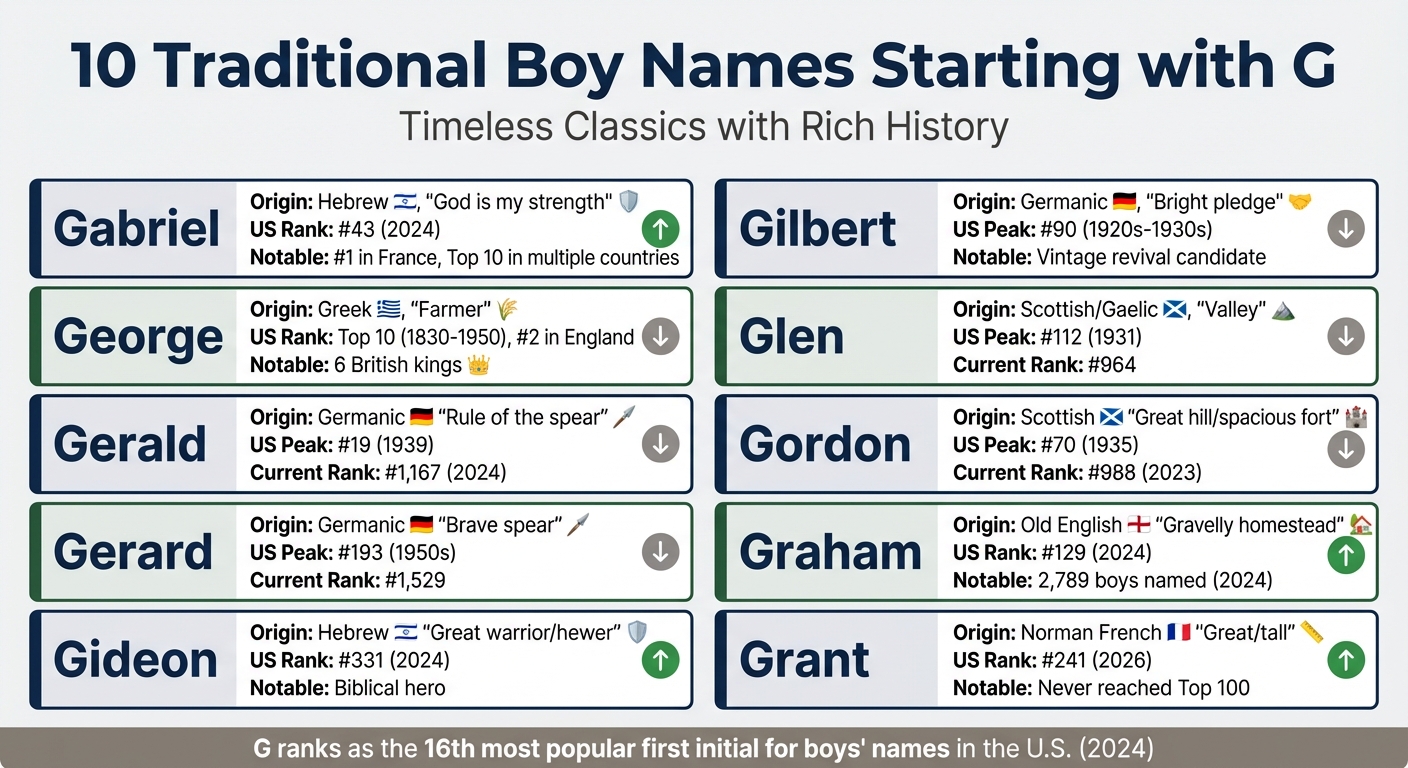
10 Traditional Boy Names Starting with G: Origins, Meanings, and Popularity Rankings
1. Gabriel
Meaning and Origin
The name Gabriel traces back to the Hebrew name Gavri'el (גַבְרִיאֵל), which combines gever (meaning "strong man" or "hero") and el (meaning "God"). Together, it translates to "God is my strength", highlighting its deeply spiritual roots.
This powerful meaning has made Gabriel a name of significance across various religious and cultural traditions.
Historical and Religious Significance
Gabriel is prominently featured in Abrahamic religions as a high-ranking archangel. In the Bible, he interprets Daniel's visions and announces the births of John the Baptist and Jesus. In Islam, Gabriel, known as Jibril, is revered as the angel who delivered the Quran to Muhammad. These roles have solidified his place as a symbol of divine communication and guidance. Gabriel is also recognized as the patron saint of broadcasters, diplomats, messengers, and postal workers.
While the name appeared sporadically in England as early as the 12th century, it only began gaining broader popularity in English-speaking countries during the late 20th century. Today, Gabriel is a top choice for baby names worldwide. For example, it holds the #1 spot in France and consistently ranks in the top 10 in countries like Belgium, Brazil, Portugal, Romania, Switzerland, and Venezuela.
Why It Stays Popular
Gabriel strikes a unique balance between a soft, melodic sound and a strong, meaningful origin. It feels timeless yet modern, making it an appealing choice for parents across generations. As Mama Natural explains:
"Gabriel is a consistent charter on the U.S. Top 1000 list... avoiding the label of being dated or trendy. He's a classic with widespread appeal, spanning generations with ease."
In 2024, Gabriel ranked #43 in the U.S.. Its versatility across languages - including English, Spanish, French, Portuguese, and German - further contributes to its global popularity. The nickname Gabe provides an approachable, casual option, adding to its everyday charm.
Gabriel’s enduring appeal reflects the timeless allure of traditional G names, a theme explored further in the following entries.
sbb-itb-f13f980
2. George
Meaning and Origin
The name George comes from the Greek Georgios, which means "farmer" or "earthworker." Before its adoption in Christian contexts, it was associated with Zeus Georgos, the deity overseeing agriculture.
This connection to farming gives the name a sense of enduring simplicity that has stood the test of time.
Historical and Cultural Background
George's significance grew largely due to Saint George, a Roman soldier martyred in 303 AD [18,19]. Medieval legends famously depict him slaying a dragon, symbolizing the victory of good over evil [18,21,22]. Though Saint George became England's patron saint in the 14th century, the name wasn’t commonly given to children until the 18th century [18,20,23].
Its popularity soared with the rise of King George I in 1714, followed by five more British monarchs bearing the name [18,21,23]. For over a century, George was synonymous with British royalty. In the United States, the name carries a special connection to George Washington, the nation’s first president and the "Father of Our Country" [22,24]. Between 1830 and 1950, George consistently ranked as a Top 10 name in the U.S..
This mix of royal influence and historical importance has solidified George's place as a timeless classic.
Why It Remains Popular
George balances royal elegance with approachable simplicity. As Mom Loves Best puts it:
"George is a mountain. Solid, unpretentious, and historically rich, George is a name that manages to feel simultaneously royal and rugged."
Modern figures like Prince George of Wales have reinforced the name’s appeal, helping it climb to #2 in England [2,25]. In the U.S., George remains a steady favorite, admired for its charm, straightforward spelling, and professional credibility. It fits seamlessly into the vintage revival trend, alongside names like Arthur and Henry, ensuring its enduring popularity [22,25].
3. Gerald
Meaning and Origin
Gerald is a name with deep historical roots, originating from the Germanic elements ger (meaning "spear") and wald (meaning "rule", "power", or "authority"). Together, it translates to "rule of the spear". Introduced to Britain by the Normans after the 1066 Conquest, the name's popularity waned in England after 1300 but held strong in Ireland, thanks in large part to the influential FitzGerald dynasty. Gerald also has a religious legacy, being associated with figures like Gerald of Mayo, a 7th-century monk, and Gerald of Aurillac, a 9th-century French count and patron saint of bachelors.
Historical and Cultural Background
The name Gerald experienced a resurgence in the 19th century, fueled by historical novels. Writers such as Ann Hatton and Charles Lever, who featured characters named Gerald Fitzgerald, played a key role in reviving its appeal. In the United States, Gerald reached its peak popularity in 1939, ranking as the 19th most popular name for boys. This era also cemented its association with leadership, particularly through Gerald Ford, the 38th President, who served from 1974 to 1977. By 2024, however, the name had fallen significantly, ranking at #1,167, with only 178 baby boys given the name that year.
Why It Remains Popular
Despite its decline on baby name charts, Gerald continues to attract parents looking for a name with vintage charm and a rich history. Jamie Allen, Operations Manager at The Bump, describes its appeal:
"The name has since fallen silent on baby name charts but certainly has its own vintage charm and fantastic history."
Gerald's enduring allure also lies in its versatility. Nicknames like Gerry and Jerry offer a friendly, approachable vibe while maintaining the name's dignified roots. Its mid-century decline has given it a distinctive, classic feel, making it a "hidden gem" for modern parents. Up next, we’ll dive into another G name with a timeless legacy.
4. Gerard
Meaning and Origin
Gerard is a name with rich Germanic origins, derived from the elements ger (meaning "spear") and hard (meaning "brave" or "strong"). Together, the name translates to "brave spear." The Normans introduced Gerard to Britain after 1066, where it appeared in Old French forms such as Gerard, Gerart, and Girart. During medieval times, Gerard was more commonly used than the similar-sounding Gerald, with its meaning emphasizing courage and strength.
Historical and Cultural Background
Gerard became widely recognized across Europe, thanks in part to several saints who bore the name. Notable examples include Saint Gerard of Toul, a 10th-century bishop known for his devout nature, and Saint Gerard Majella, an 18th-century Italian lay brother revered as the patron saint of expectant mothers. The name also held significance among medieval nobility, such as the Counts of Paris and the Dukes of Lorraine. Its military connotations are underscored by figures like Blessed Gerard, who founded the Knights Hospitaller, and Gerard de Ridefort, a Grand Master of the Knights Templar.
In the United States, Gerard experienced its peak popularity in the 1950s, reaching as high as #193 in the rankings. By 1956, it accounted for about 0.0837% of all births. However, its usage has steadily declined since then, dropping from 366 babies per million in 1982 to an estimated 119 per million by 2025. In recent years, Gerard has ranked #1,529 in the U.S., though it remains a favorite in certain regions, such as Catalonia, where it consistently appears in the Top 10.
Why It Remains Popular
Although Gerard's popularity has waned in the U.S., it continues to attract parents who value its timeless, sophisticated charm and strong European heritage. Grace Royal from Nameberry notes:
"Gerard is currently in style limbo, after reaching peak popularity in the 1950s. With its strong meaning and gentle sound, it may be back in a generation or two."
The name's visibility is further supported by modern figures like actor Gerard Butler, musician Gerard Way, and footballer Gerard Piqué. Additionally, Gerard offers a range of nicknames - such as Gerry, Jerry, and Ged - that suit a variety of personalities. This combination of strength, versatility, and enduring appeal ensures Gerard remains a classic choice among G names, setting the stage for the next timeless option.
5. Gideon
Meaning and Origin
Gideon is a masculine name rooted in the Hebrew name Gid'on (גִּדְעוֹן), meaning "hewer", "feller", or "one who cuts down." It is often associated with interpretations like "great warrior" or "destroyer", symbolizing strength and resilience. In the Bible, Gideon is a heroic figure who led a small force of 300 men to victory over the Midianites. During the 16th century, English Puritans and French Huguenots adopted the name as a Christian identifier, adding to its historical depth.
Historical and Cultural Background
Though its use in Great Britain waned during the 1930s, Gideon has seen a resurgence over the years. In the United States, it gained modest traction in the 1980s and reached peak popularity in 2017, with about 1,160 babies per million given the name. As of 2024, Gideon holds the #331 spot in U.S. baby name rankings. Beyond its Biblical and historical roots, the name carries legal significance, thanks to the Supreme Court case Gideon v. Wainwright, which affirmed the right to legal counsel. This rich history has helped Gideon resonate with parents looking for a name with substance and meaning.
Why It Remains Popular
Gideon strikes a balance between timeless strength and contemporary style, making it a compelling choice for modern parents. It offers a refreshing alternative to more widely used Biblical names like Benjamin and Jacob. Pamela Redmond of Nameberry highlights this appeal:
"Gideon is a no longer neglected Old Testament name, but still makes an excellent choice for parents looking to move beyond such overused biblicals as Benjamin and Jacob."
The name's presence in popular culture has also contributed to its charm. Characters like Jason Gideon from Criminal Minds, Gideon Prewett from Harry Potter, Moff Gideon from The Mandalorian, and Gideon Graves from Scott Pilgrim have kept it in the public eye. Celebrity endorsements, such as Neil Patrick Harris and Ziggy Marley naming their sons Gideon, have further cemented its status as a sophisticated, vintage-inspired pick for today's families.
6. Gilbert
Meaning and Origin
The name Gilbert has its roots in Germanic languages, blending gisil (which means "pledge" or "hostage") and beraht (meaning "bright"). Together, the name translates to "bright pledge" or "shining pledge." It was introduced to England after the Norman Conquest in 1066 and has since undergone several spelling variations. Saint Gilbert of Sempringham, who founded the Gilbertine Order in the 12th century - the only monastic order native to England - helped popularize the name during the Middle Ages.
Historical and Cultural Background
Gilbert had its heyday in the early 20th century. In England and Wales, it consistently ranked between the mid-60s and low-70s, while in the United States, it climbed as high as #90 during the 1920s and 1930s [55, 56, 57]. The name is associated with notable figures like painter Gilbert Stuart and writer G.K. Chesterton. Fictional characters, such as Gilbert Blythe from Anne of Green Gables, have also kept the name relevant in popular culture [55, 57, 59].
Why It Remains Popular
Although Gilbert is less common today, its rarity has become part of its charm. Many parents seeking vintage names are turning to Gilbert, much like they are rediscovering classics such as Walter, Harold, and Harvey [57, 58]. Sophie Kihm, Editor at Nameberry, notes:
"Now though, like Albert and Alfred and Walter and Frank, it could be in for a style revival."
The name also comes with a variety of nickname options, including Gil, Bert, Gib, and Gibby, making it both adaptable and approachable [57, 62]. Its dignified, intellectual aura appeals to parents looking for a name with history and character. International versions like Gilberto (used in Spanish, Portuguese, and Italian) and Guilbert (in French) further enhance its appeal across different cultures [53, 54, 55]. Moving forward, the next name on the list showcases another enduring classic, continuing the exploration of timeless G names.
7. Glen
Meaning and Origin
The name Glen has its roots in Scottish and Gaelic traditions. It comes from the Gaelic word gleann, which translates to "a narrow, wooded valley." Originally, Glen was a surname used to describe people who lived near a valley, but by the 18th and 19th centuries, it transitioned into a first name and made its way to the United States. The earliest known record of the name dates back to 1264, appearing in the Scottish Exchequer Rolls as "Glendonyn".
Historical and Cultural Background
Glen officially entered U.S. name records in 1880 and saw its peak popularity in 1931, ranking #112 nationally. It remained within the top 200 names until 1971 and experienced a notable surge in 1957, particularly in states like California, Illinois, Ohio, New York, and Michigan. By 1981, Glen reached a high point, with 609 out of every million babies being given the name.
Famous individuals have kept Glen in the public eye over the years. Country music icon Glen Campbell (1936–2017), known for classics like "Rhinestone Cowboy" and "Wichita Lineman", is one of the most recognizable namesakes. More recently, actor Glen Powell has brought attention to the name with standout performances in Top Gun: Maverick and Hidden Figures. These figures contribute to Glen's enduring presence in popular culture.
Why It Remains Popular
Glen's straightforward charm and connection to nature continue to attract modern parents. While its popularity has declined - ranking #964 in the U.S. as of March 2026, with 61 male births recorded in 2024 - its vintage appeal and strong Scottish heritage still hold sway. Sophie Kihm, Editor at Nameberry, captures its appeal perfectly:
"Former cool-boy name now in middle-aged limbo, but with a nice naturey meaning to endear it to modern parents."
8. Gordon
Meaning and Origin
Gordon is a name steeped in Scottish heritage. Originally a surname, it traces back to a location in Berwickshire, Scotland. Its roots are Brythonic or Welsh, combining "gor" (meaning "spacious" or "large") and "din" or "dun" (meaning "fort"). Some interpretations suggest it means "great hill", while others link it to the French place name Gourdon in Saône-et-Loire, derived from the Gallo-Roman name Gordus.
The name gained prominence as a first name in the 19th century to honor Major-General Charles George Gordon, who famously died defending Khartoum in 1885. Additionally, Gordon is tied to Clan Gordon, a powerful Scottish clan that held influence over northeastern Scotland from the 12th century onward. This deep historical and geographical connection gives the name its enduring strength and character.
Historical and Cultural Background
Gordon enjoyed considerable popularity in the U.S. during the early 20th century, peaking at 70th in 1935 and remaining in the Top 100 until 1943. It also ranked highly in Canada and New Zealand during that era. By 2023, its U.S. ranking had fallen to 988, with 153 boys named Gordon, while in 2024, 199 boys received the name.
The name has been carried by several notable figures, including celebrity chef Gordon Ramsay, former British Prime Minister Gordon Brown, astronaut Gordon Cooper, and musician Gordon Lightfoot. In pop culture, Gordon appears as Gordon the Big Engine from Thomas & Friends and Gordon Gekko from the 1987 film Wall Street.
Why It Remains Popular
Gordon continues to appeal to parents who value its vintage charm and dignified feel. It aligns with the trend of reviving "grandpa names" that feel classic but not outdated. As Nameberry's Clare Green explains:
"Conservative but not stodgy, Gordon was a Top 100 name from 1911 to 1943 and is showing some new signs of life."
Many parents see Gordon as a thoughtful alternative to more common names like Jordan, drawn to its rich Scottish roots and historical significance. Its association with accomplished individuals, from Gordon Ramsay to Gordon Brown, reinforces its reputation as a name that represents leadership and distinction.
9. Graham
Graham is a name that effortlessly bridges historical significance with a modern touch, making it a timeless choice for parents.
Meaning and Origin
Graham traces its roots to Old English, combining "grand" (gravel) and "ham" (homestead) to mean "gravelly homestead" or "grey home." It originated as an Anglo-French adaptation of the English place name Grantham, a town in Lincolnshire documented in the Domesday Book. While its origins are English, Graham became closely tied to Scotland after Sir William de Graham, a Norman baron, established Clan Graham in the 12th century. The name also has variations like the Scottish "Graeme" or the older "Grahame." Interestingly, pronunciation differs across regions - Americans typically say it as one syllable (GRAM), while British and Scottish speakers use two (GRAY-uhm).
Historical and Cultural Background
In 2024, Graham ranked #129 in the U.S., with 2,789 boys named Graham. Its popularity in the U.S. has grown steadily since the mid-2000s, while in the U.K., it peaked at #20 back in 1959. The name carries a rich legacy, with notable figures like Alexander Graham Bell, inventor of the telephone; novelist Graham Greene; TV personality Graham Norton; and musician Graham Nash. Even Graham crackers, named after dietary reformer Sylvester Graham, add a quirky cultural nod. This blend of historical depth and modern associations ensures its lasting charm.
Why It Remains Popular
Graham is perfect for parents who want a name that feels timeless yet fresh. As Mom Loves Best puts it:
"Sophisticated yet approachable, Graham is a name that manages to feel both vintage and refreshingly modern."
Its connection to the "dark academia" aesthetic adds an intellectual and vintage vibe, making it appealing without being overly trendy. Graham strikes a balance - traditional but not outdated, familiar yet distinctive - making it a versatile choice that grows effortlessly from childhood into adulthood.
10. Grant
Grant strikes a perfect balance between heritage and contemporary charm. Its concise, strong sound gives it a sophisticated edge, making it a standout among traditional boy names.
Meaning and Origin
Grant originates from the Norman French word "grand" or "graunt," which translates to "great", "large", "tall", or "big". Initially a surname, it transitioned into a given name over time. Rooted in English, Scottish, and French traditions, it began as a nickname for individuals of impressive stature or as a way to distinguish family generations. Some sources also trace it back to the Old English byname "Granta".
Historical and Cultural Background
As of 2026, Grant ranks #241 in U.S. births. The name gained prominence in 19th-century America, largely due to Ulysses S. Grant, the 18th U.S. President and a revered Civil War general. Over the years, it has been carried by notable figures like Cary Grant, Hugh Grant, artist Grant Wood, and actor Grant Gustin. In pop culture, the name appears in iconic characters such as Dr. Alan Grant from Jurassic Park and Grant Ward from the Marvel Cinematic Universe.
Why It Remains Popular
Grant is a name that manages to feel both familiar and distinctive. While it has never entered the Top 100, its steady popularity appeals to parents who want a classic name with a touch of individuality. The name exudes strength, intelligence, and authority, making it a timeless choice. Its short, polished sound fits the trend of using surnames as first names, offering a refined alternative to more common options like Grayson. Grant’s enduring appeal lies in its ability to combine traditional strength with a modern edge, making it a lasting favorite among "G" names.
Conclusion
These ten classic G names - Gabriel, George, Gerald, Gerard, Gideon, Gilbert, Glen, Gordon, Graham, and Grant - combine rich history, spiritual significance, and timeless charm. Whether you’re drawn to the royal elegance of George, the biblical strength of Gabriel, or the serene, nature-inspired feel of Glen, each name carries a legacy that connects your child to generations of tradition. As Emma Waterhouse from Nameberry explains:
"G-starting names for boys are also a rich category for adventurous parents looking for a unique name that's ahead of the curve".
These names strike a balance between being familiar and standing out. Many have avoided overexposure, often staying out of the Top 100, making them distinctive yet approachable choices. From the soft, melodic tone of Gabriel to the strong, classic sound of George, G names offer something for every taste. Parents today are revisiting these vintage gems, with names like Gilbert and Gerard offering meaningful alternatives to trendier options.
With G ranking as the 16th most popular first initial for boys' names in the U.S. as of 2024, these enduring favorites continue to blend individuality with a sense of belonging. Whether you’re looking for something bold or understated, these G names provide plenty of inspiration.
FAQs
Which G boy names have the strongest meanings?
Boy names that begin with G often carry deep meanings tied to history, the Bible, or tradition. Take Gabriel, for example - it signifies strength and divine connection, as he’s known as an archangel in the Bible. Gideon, another biblical figure, stands for courage and leadership through his role as a judge and warrior. Then there are names like Gannon, which means "fair-skinned", and Garrison, associated with protection, both evoking ideas of resilience and strength. These names are not only meaningful but also timeless in their appeal.
What are the best nicknames for these G names?
Nicknames for classic boy names starting with "G" tend to be short and catchy. For instance, Gabriel often becomes Gabe or Gabs, while George might be called Geo or Georgie. Gavin can turn into Gav or even Gavinny. Other names like Grant or Graham sometimes get playful options like G or G-Man. For names such as Gaius or Gael, simple nicknames like Gai or just G are common.
Which of these G names are rare in the U.S. today?
Names like Gad, Gaerwn, and Gabin are rarely heard in the U.S. today. With their unique origins and infrequent use, these names offer parents an uncommon yet meaningful choice, perfect for those looking to pick something that truly stands out.