Looking for boy names starting with "Fran"? Here's a quick guide to 8 timeless options that blend heritage and charm:
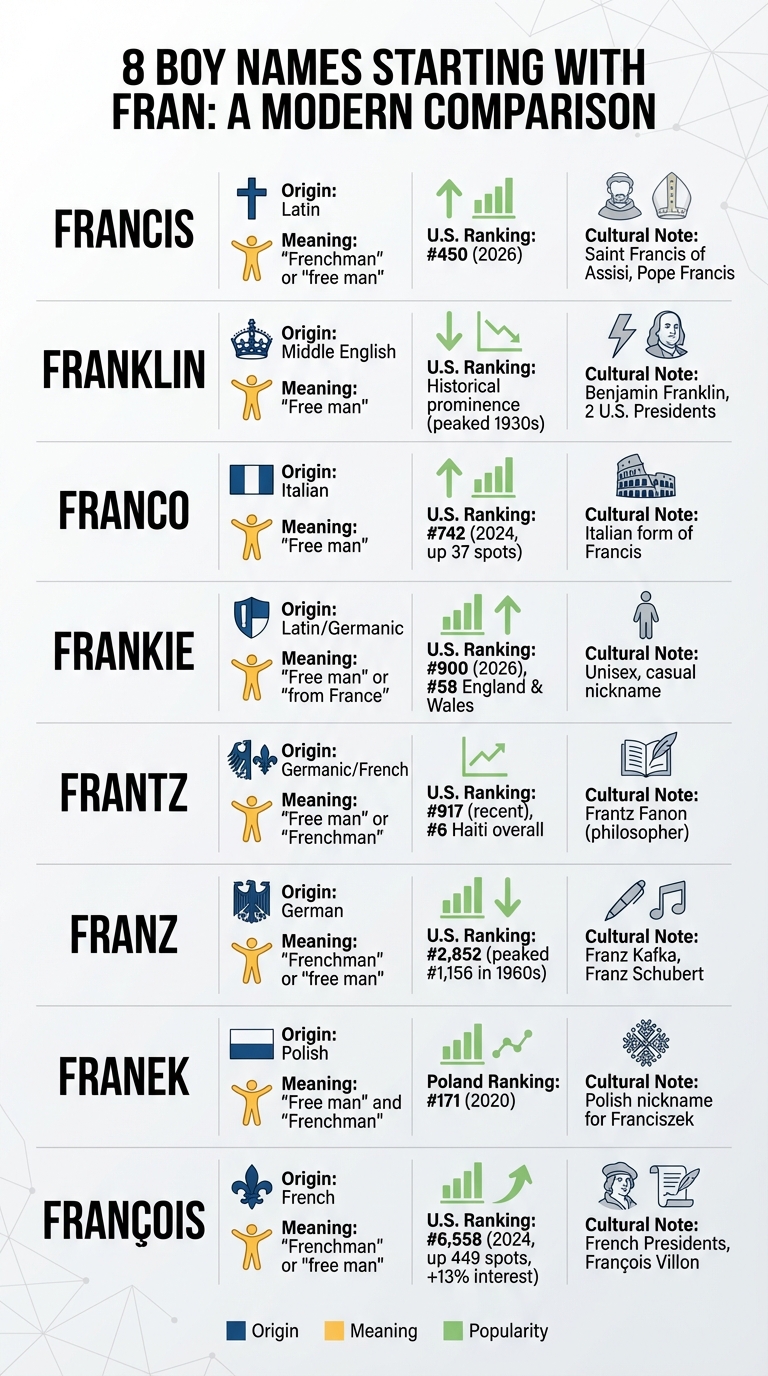
- Francis: A name with Latin roots meaning "Frenchman" or "free man", tied to Saint Francis of Assisi and Pope Francis. Ranked #450 in 2026.
- Franklin: Originates from Middle English, meaning "free man." Popularized by Benjamin Franklin and two U.S. Presidents. Known for its historical weight.
- Franco: The Italian form of Francis, meaning "free man." Recently regained popularity, ranking #742 in 2024.
- Frankie: A casual, friendly nickname for Francis or Franklin. Popular for both boys and girls, ranking #900 in 2026.
- Frantz: A bold variation of Franz, popular in Haiti and tied to figures like Frantz Fanon. Rare in the U.S.
- Franz: German in origin, associated with historical figures like Franz Kafka and Franz Schubert. Known for its cultural depth.
- Franek: A Polish nickname for Franciszek, symbolizing independence and resilience. Popular in Poland and among Polish-American families.
- François: The French variation of Francis, meaning "Frenchman." Known for its elegance and connection to historical figures like François Mitterrand.
Each name carries its own history, meaning, and cultural ties, making them perfect for parents seeking classic yet approachable options. Whether you're drawn to the vintage charm of Francis or the European flair of François, these names offer a rich blend of tradition and individuality.
Boy Names Starting with Fran: Origins, Meanings, and Popularity Rankings
1. Francis
Origin and meaning
The name Francis comes from the Late Latin Franciscus, translating to "Frenchman". Its roots go even deeper, connecting to the Franks, a Germanic tribe named after their weapon of choice, the frankô spear.
In Old French, the term franc - linked to the Franks - took on meanings like "free", "noble", and "generous". This shift happened because the Franks, as rulers, held the unique status of freemen. This blend of meanings ties the name to both heritage and liberty.
Historical background
Francis owes much of its historical significance to key figures. Its popularity skyrocketed in the Middle Ages, largely thanks to Saint Francis of Assisi (1181–1226). Born Giovanni di Pietro di Bernardone, he earned the nickname Francesco ("Frenchman") due to his family’s admiration for French culture. His dedication to the poor and his love for animals made the name cherished across Europe.
In the U.S., Francis was a common choice for boys between 1880 and 1940, consistently ranking around the 40th spot. Its peak came in the 1910s when it reached #31. Though it dropped out of the Top 100 in 1956 after 75 years, it has never fallen out of the top 1,000. As of early 2026, Francis holds the #450 spot in U.S. births.
Why parents choose this name
Francis continues to attract parents with its enduring charm. Many are drawn to its classic, wholesome vibe. The religious connection is particularly strong - Saint Francis of Assisi, known as the patron saint of animals and the environment, remains a powerful inspiration. Pope Francis has also helped bring renewed attention to the name. One parent, Alyssa, shared her thoughts:
"It is a timeless name and named after one of our favorite saints, St. Francis of Assisi. Honestly the name fits him so well!"
The name also offers versatility. While Francis has a formal, sophisticated tone, it easily transitions to casual nicknames like Frank or Frankie. Many parents love the option of using "Frankie" for everyday interactions while keeping the more formal Francis as the official name.
sbb-itb-f13f980
2. Franklin
Origin and meaning
The name Franklin traces back to Middle English, derived from the word "frankelin", which means "free man." This term combines the Old French word "franc" with a Germanic suffix, reflecting its roots in medieval Europe. Initially used as a surname in the 12th century, Franklin transitioned into a first name in the United States, where it gained prominence and became a symbol of American heritage.
Historical background
Franklin's journey from its medieval origins to a quintessential American name owes much to its association with prominent historical figures. Benjamin Franklin (1706–1790), the celebrated scientist, inventor, and Founding Father, played a significant role in cementing its legacy. The name also gained further recognition through two U.S. Presidents: Franklin Pierce and Franklin Delano Roosevelt. Roosevelt's presidency in the 1930s contributed to the name's peak popularity during that era, and it has recently experienced a resurgence in U.S. birth trends.
Why parents choose this name
Franklin continues to attract modern parents, thanks to its rich history and timeless charm. Its meaning - "free man" - resonates with families who value independence and individuality. The name carries a sense of vintage sophistication while remaining approachable and warm. As Emily McNamara, Senior Content Writer at The Bump, puts it:
"Intellectual, vintage, and diligent, Franklin is for a child poised to forge their own path."
Another reason for its appeal is its adaptability. Franklin offers several endearing nicknames, like Frank, Frankie, or Franky, giving it a friendly and versatile edge. It also fits the growing trend of using surnames as first names, striking a balance between classic tradition and modern style.
3. Franco
Origin and Meaning
Franco is the Italian version of the name Francis, carrying the meaning "free man" or "Frenchman." The name originally referred to the Franks, a Germanic tribe that established a kingdom in what is now France.
Historical Background
Franco's history is rich and layered. While it was once heavily associated with Francisco Franco, those ties have faded in modern times. Today, many people in the U.S. are more likely to connect the name with actor James Franco. Interestingly, Franco vanished from U.S. naming charts between 1981 and 2004 but has since made a notable comeback. As of 2024, it ranked #742 in the U.S., climbing 37 spots from the previous year . This resurgence reflects a broader trend of revisiting names that combine deep historical roots with a fresh, modern vibe.
Why Parents Choose This Name
Franco appeals to parents for its strong meaning and distinctive sound. The idea of a "free man" resonates with those who value independence and individuality. Additionally, Franco fits the popular trend of boy names ending in "o", offering a blend of timelessness and modernity. As Linda Rosenkrantz explains:
"A classic Italian name still heard in the Italian-American community. Once tainted by the association with the Spanish dictator, it's now more likely to call up actor James Franco."
For many, Franco provides a more approachable and casual alternative to the more formal Francesco. The increased attention around Pope Francis has also sparked interest in related names. Next, dive into another 'Fran' name that carries its own unique mix of history and contemporary charm.
4. Frankie
Origin and Meaning
Frankie is a shortened version of names like Frank, Francis, and Franklin, with roots in Latin and Germanic languages. It carries the meaning of "free man" or "from France" and is often associated with honesty and openness. The adjective "frank", which conveys straightforwardness, ties into the name's essence. Historically, it also connects to the Germanic tribe known as the Franks.
Historical Background
The name traces back to the Proto-Germanic word frankô, meaning spear, which evolved into the Old High German "Francho" by the 8th century. Fast-forward to today, Frankie holds a unique spot in naming trends. In the U.S., it ranked #900 for boys in 2026 but is used more than twice as often for girls. Across the Atlantic, it has gained even more traction, ranking #58 in England and Wales and #76 in Ireland as of 2024. This blend of historical significance and modern popularity makes it an attractive choice for many parents.
Why Parents Choose This Name
Frankie resonates with parents looking for a friendly, approachable alternative to more formal names like Francis or Franklin. Avril Whelehan, Senior Content Writer at The Bump, notes:
"Frankie is particularly popular in the United States as a catchy twist on the classics. When it's considered a down-to-earth, friendly name that is popular for babies of all genders, it's hard to think there's a better fit out there!"
The name also aligns with a modern trend of using traditional nicknames as standalone names on birth certificates. Its vintage vibe, paired with a contemporary feel, makes it appealing. Add in its association with honesty and straightforwardness, and it's easy to see why parents are drawn to it. As of early 2026, Nameberry ranks Frankie at #630, further highlighting its enduring charm.
5. Frantz
Origin and Meaning
Frantz is a variation of the name Franz, rooted in both Germanic and French traditions. It stems from the Late Latin Franciscus, which translates to "free man" or "Frenchman." In some contexts, the name can also symbolize bravery. It shares its origins with other names like Francis, Francisco, Francesco, and François.
Historical Background
The name gained prominence in Europe partly due to Saint Francis of Assisi in the 13th century. In the U.S., Frantz reached its highest rank at #1,121 in 1988 and more recently climbed to #917. Meanwhile, in Haiti, it holds significant popularity as the 6th most common name overall. This rich history gives Frantz a distinctive edge when compared to its more familiar counterparts.
Why Parents Choose This Name
Frantz appeals to parents for its deep historical significance and modern charm. It embodies themes of freedom and independence, making it a powerful choice. The sharp "tz" ending sets it apart from more traditional names like Francis or Frank, giving it a bold and distinctive sound. As Isolde Quirante, Assistant Editor at The Bump, notes:
"With any luck, a legendary name like Frantz will lead your little one on a similar search for justice, peace, and freedom."
The name also carries the legacy of influential figures such as Frantz Fanon, the Martiniquais psychiatrist and philosopher whose work has shaped post-colonial studies. For families with French or German heritage, Frantz serves as a meaningful nod to their ancestry. Its rarity in the U.S. - with only 14 boys named Frantz in 2023 - adds an extra layer of uniqueness, making it a standout choice for parents looking for something uncommon yet significant.
6. Franz
Origin and Meaning
Franz is the German version of Franciscus, a name steeped in history. It connects to the ancient Germanic Franks, a tribe first documented in the 3rd century. The name carries meanings like "Frenchman" or "free man", with a subtle nod to a warrior past through the term frankô, meaning "spear."
Historical Background
Franz has graced the names of emperors and cultural icons alike. Think of composer Franz Schubert (1797–1828), piano virtuoso Franz Liszt (1811–1886), and writer Franz Kafka (1883–1924). Even Archduke Franz Ferdinand, whose 1914 assassination triggered World War I, adds a dramatic historical layer to the name. In the United States, Franz reached its peak popularity in the 1960s, ranking at #1,156, but has since fallen to #2,852. Its blend of historical depth and cultural significance continues to appeal to modern parents.
Why Parents Choose This Name
Franz stands out for its timeless strength and sense of independence. Like Francis or Franklin, it connects to a rich past while maintaining a unique, modern edge. Keshia Roelofs, Editor at The Bump, highlights its essence:
"Born in defiance of any ties or restrictions, perhaps dear Franz may find their most fitting name meaning in the German term frank, which simply means 'free' or 'free man.'"
Its short, one-syllable structure makes Franz easy to say, yet it carries a weight of historical and cultural importance. For families with German or Austrian roots, it offers a meaningful way to honor their heritage, celebrating legendary figures in music, literature, and history - all while standing out as a distinctive choice in the U.S.
7. Franek
Origin and Meaning
Franek is a Polish nickname for Franciszek, and in Czech, it corresponds to František. Both names trace their roots to the Latin Franciscus. The meaning of Franek is twofold: "free man" and "Frenchman". These interpretations tie the name to themes of independence and European heritage, giving it a rich historical and cultural resonance.
Historical Background
This name is deeply embedded in Polish literature and folklore, often symbolizing bravery and resilience. Franek has remained consistently popular in Poland, ranking #171 in 2020. Beyond Poland, it has also made appearances in countries like Slovakia (#2,638), Slovenia (#3,243), and Lithuania.
Several notable individuals have carried the name Franek. Franek Kimono, a character portrayed by actor Piotr Fronczewski, gained fame in the Polish music world during the 1980s and 1990s with his quirky style and comedic performances. Another example is Franek Trefalt, born on March 11, 1931, in Kranj, who was a prominent Slovenian sports commentator, journalist, and actor. Additionally, Franek Haschke, born on March 28, 1980, in Potsdam, competed internationally as a German middle-distance runner.
Why Parents Choose This Name
For Polish-American families, Franek is a meaningful way to honor their roots while benefiting from its straightforward English pronunciation (FRAH-nehk). The name resonates with parents for its association with freedom and strength - qualities that align well with the American ethos. Franek also offers a refreshing alternative to more common names like Frank or Francis, maintaining a balance of tradition and individuality. Its connection to creativity, energy, and resilience makes it a standout choice for modern parents. Up next, discover the final variation in the enduring "Fran" lineage.
8. François
Origin and Meaning
François is the French variation of the Latin name Franciscus, which means "Frenchman" or "free man." Its origins trace back to the Germanic Franks, the tribe that eventually lent its name to France. The name's connection to freedom and French heritage gives it a timeless appeal. François became widely popular during the Middle Ages, thanks in part to Saint Francis of Assisi's influence. Its royal association was later solidified by French monarchs Francis I and Francis II.
Historical Background
François has graced the names of many influential figures throughout history. French poet François Villon (1431–1463), Renaissance writer François Rabelais, and Baroque composer François Couperin are just a few who left an indelible mark on literature and the arts. In modern times, the name is tied to political leaders like François Mitterrand and François Hollande, who served as Presidents of France. The business world recognizes François Pinault, founder of the luxury conglomerate Kering, and his son François-Henri Pinault, who continues to lead the company. In science, Belgian particle physicist François Baron Englert gained international recognition when he was awarded the Nobel Prize for his contributions to physics.
Why Parents Choose This Name
François continues to captivate parents with its rich history and elegant charm. In the U.S., the name has gained attention for its sophisticated European appeal. By 2024, François climbed to #6,558 in U.S. baby name rankings, a jump of 449 spots. Interest in the name surged by 13% on baby name platforms by early 2026. Emma Lawler, a Senior Content Writer at The Bump, notes:
"Offering a traditional feel with distinct French elegance, Francois is a name for those destined to make their mark."
Grace Royal of Nameberry echoes this sentiment:
"Francois is the ultimate sophisticated French name."
Beyond its elegance, François carries a spiritual connection to Saint Francis of Assisi, the patron saint of ecology and animals, inspiring a love for nature. With its blend of tradition, strength, and refinement, François offers parents a name that feels both timeless and distinctive.
Conclusion
The names Francis, Franklin, Franco, Frankie, Frantz, Franz, Franek, and François bring together a mix of timeless tradition and approachable charm. Whether it’s the vintage warmth of Francis or the refined European flair of François, each name carries its own story, shaped by its cultural roots.
These names draw from Latin, German, Italian, French, and Slavic traditions, showcasing a rich tapestry of linguistic heritage. Their growing popularity reflects a renewed appreciation for names that feel both nostalgic and inviting, offering families meaningful choices that stand the test of time.
Looking for more inspiration? Discover additional classic and inviting names on NameHatch. With tools like smart filters, partner matching, and real-time alerts, finding the perfect name has never been easier. Sign up for your free NameHatch account today!
FAQs
Why is 'Francis' considered a timeless name for boys?
The name 'Francis' has remained popular over the centuries, thanks to its rich history and meaningful origins. Derived from Latin, it translates to "Frenchman" or "free man." Its rise to prominence in medieval Europe was largely influenced by Saint Francis of Assisi, whose legacy left a lasting mark on the name.
What makes 'Francis' stand out is its timeless charm and adaptability. It feels equally fitting in formal occasions and casual, everyday conversations. This balance of tradition and warmth continues to make it a top choice for parents seeking a name with both depth and approachability.
How has the name 'Franco' trended in popularity over the years?
The name Franco has experienced a steady decrease in popularity over the years. By 2024, it holds the rank of approximately #1,603 among baby boy names in the United States, a noticeable decline from its earlier prominence. Although its usage has diminished, this shift makes it a less common and more stand-out choice for parents looking for something with a touch of individuality.
Why do parents often choose the name 'François' for its cultural significance?
Parents often pick the name François for its enduring charm and connection to tradition. This classic French name translates to "Frenchman" or "free man" and exudes a sense of grace and historical depth. With ties to France's rich heritage and allure, it stands out as a thoughtful and refined choice for a baby boy.