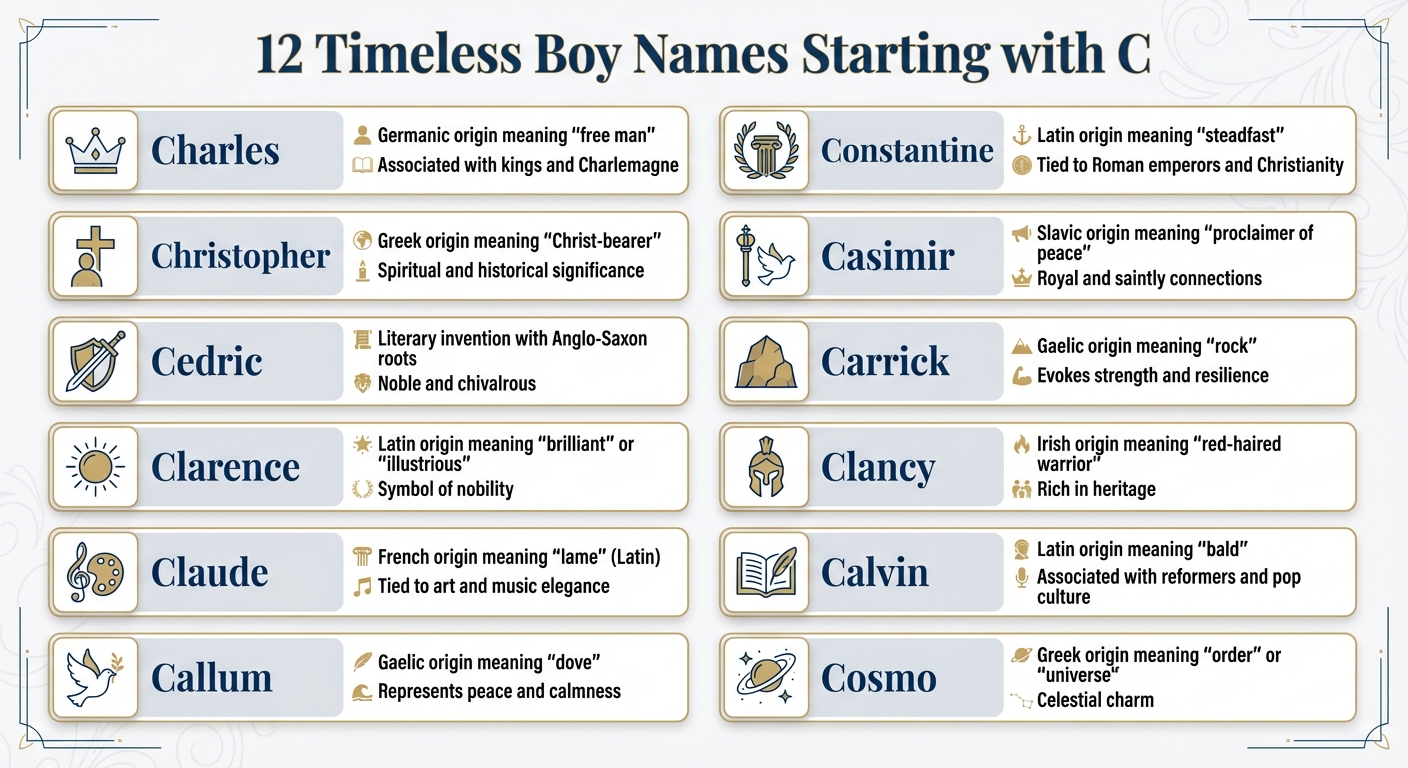
Choosing the right name for your son can feel overwhelming, but names starting with "C" offer a mix of history, depth, and charm. From classics like Charles to unique picks like Cosmo, these names balance elegance and modern appeal. Here's a quick look at 12 timeless options:
- Charles: Meaning "free man", linked to kings and historical figures like Charlemagne.
- Christopher: "Christ-bearer", steeped in spiritual and historical significance.
- Cedric: A literary invention with noble Anglo-Saxon roots.
- Clarence: Rooted in Latin, symbolizing brilliance and nobility.
- Claude: French elegance tied to art and music.
- Callum: Gaelic for "dove", representing peace and calmness.
- Constantine: A name of steadfastness, tied to Roman emperors and Christianity.
- Casimir: Slavic origins with royal and saintly connections.
- Carrick: Gaelic for "rock", evoking strength and resilience.
- Clancy: Irish for "red-haired warrior", rich in heritage.
- Calvin: Latin for "bald", associated with reformers and pop culture icons.
- Cosmo: Greek for "order" or "universe", with celestial charm.
These names have stood the test of time thanks to their historical significance, strong meanings, and versatility. Whether you're inspired by royalty, literature, or nature, there's a "C" name here for every style and preference.
12 Timeless Boy Names Starting with C: Origins and Meanings
1. Charles
Origin and Meaning
The name Charles comes from the Germanic name Karl, which was later adapted into Latin as Carolus. Its roots trace back to the Proto-Germanic word karlaz, meaning "man" or "free man." In Old English, the related term ceorl referred to a free person. This historical depth gives the name Charles a strong connection to independence and dignity.
Historical and Cultural Significance
Charles gained prominence through Charlemagne (Charles the Great), the 8th-century King of the Franks and Holy Roman Emperor who played a pivotal role in uniting much of Europe. His legacy was so influential that his name became synonymous with "king" in several Eastern European languages, such as Czech (král), Hungarian (király), and Russian (король). In the United States, Charles was a Top 10 name for 65 straight years (1890–1954) and remains popular, ranking 51st in 2024 with 5,593 boys given the name. This enduring popularity highlights its timeless appeal.
Why It Remains a Classic Choice
Charles strikes a perfect balance between elegance and approachability. The full name carries a sense of formality and sophistication, while nicknames like Charlie, Chuck, and Chip make it feel friendly and down-to-earth. Its association with influential figures, such as Charles Darwin and Charles Dickens, adds to its lasting appeal. Whether in casual settings or professional environments, Charles remains a versatile and modern choice that bridges generations with ease.
sbb-itb-f13f980
2. Christopher
Origin and Meaning
The name Christopher traces back to the Late Greek name Christophoros (Χριστόφορος), a combination of Christos (meaning "Christ" or "Anointed") and pherein (meaning "to bear" or "to carry"). Its literal translation, "Christ-bearer," held deep significance for early Christians, symbolizing the idea of carrying Christ in their hearts. The legend of Saint Christopher, a 3rd-century giant who famously carried the Christ child across a treacherous river, brought this meaning to life. During the Middle Ages, he became the patron saint of travelers, further solidifying the name's spiritual and symbolic resonance.
Historical and Cultural Significance
Christopher has been a staple in English-speaking countries since the 15th century, with its popularity peaking in Northern England during the 16th century. Throughout history, it has been associated with notable figures like explorer Christopher Columbus, architect Christopher Wren, and playwright Christopher Marlowe. Its enduring appeal carried into modern times, especially in the United States, where it dominated the charts. From 1979 to 1994, Christopher held the #2 spot for 15 consecutive years and remained in the Top 10 from 1967 to 2009. By 2024, it ranks 61st, evolving from being a go-to name to a distinguished classic - widely recognized but no longer overused. This longevity reflects its strong historical roots and its ability to balance tradition with modern appeal.
Why It Remains a Classic Choice
One reason Christopher continues to resonate is its flexibility. Parents have several nickname options to choose from, each offering a distinct vibe. Kit brings a charming vintage feel, Topher adds a modern edge, and Chris exudes a friendly, approachable quality. The name also benefits from Hollywood's "Chris club", featuring stars like Chris Evans, Chris Hemsworth, Chris Pratt, and Chris Pine, keeping it relevant and visible. Brynn McKeon, Editor at Nameberry, sums it up perfectly:
"Christopher is an evergreen classic... in spite of its appealingly strong, sincere, straightforward image, combined with a softer, more modern sound than, say, Robert or Richard".
Its adaptability across European languages ensures its global appeal while retaining its timeless dignity, making it a name that feels both enduring and contemporary.
3. Cedric
Origin and Meaning
The name Cedric was created by Sir Walter Scott for his 1819 novel, Ivanhoe, where it was given to the character Cedric of Rotherwood. Scott likely drew inspiration from the historical name Cerdic, the semi-legendary 6th-century founder of the Kingdom of Wessex, though it may have been a misspelling. The name Cerdic itself traces back to the Brythonic name Caratācos, rooted in the Celtic element "car", meaning "love." Other interpretations suggest Old English origins, translating to "kind and loved", or combining cēd (battle) and rīc (ruler) to mean "mighty warrior." Some also link it to the Welsh name Cedrych, meaning "pattern of bounty" or simply "bounty".
Historical and Cultural Significance
Though it began as a fictional creation, Cedric quickly gained cultural traction. Its popularity soared after the release of Little Lord Fauntleroy in 1886, where the character Cedric Errol even inspired a children's fashion trend - the "Fauntleroy suit". In the U.S., Cedric peaked at #230 in 1974 and reached 977 per million in 1982. However, its popularity has since waned, ranking #958 in 2022 and #944 in 2024, with 242 births recorded that year. Despite this decline, Cedric remains a favored choice in French-speaking areas like France, Belgium, Switzerland, and Quebec.
Why It Remains a Classic Choice
Cedric carries an air of nobility and chivalry, thanks to its Anglo-Saxon roots and literary beginnings. Modern commentators often describe it as a "hidden gem" with rich historical and cultural depth. As noted by Oh Baby Names:
"Cedric is a great name to consider for the thoughtful parent. It's a name with a lot of substance and dimension."
The name is often associated with qualities like maturity, formality, and refinement, making it an attractive option for parents seeking something timeless and distinguished. Famous bearers of the name, such as Oscar-winning art director Cedric Gibbons, actor Sir Cedric Hardwicke, and comedian Cedric the Entertainer, highlight its versatility and enduring appeal.
4. Clarence
Origin and Meaning
The name Clarence traces back to the Latin title Clarensis, which originates from clarus, meaning "clear" or "illustrious." It also has ties to geography, specifically the town of Clare in Suffolk, England, which inspired the title Duke of Clarence. Eleanor Foy from The Bump explains:
"Clarence and Clarensis are thought to have roots in the Latin word clarus, which means 'clear,' 'bright,' 'brilliant,' or 'illustrious,' a collection of words that might begin to describe baby's impact on the world!"
The name’s noble connection is further emphasized by the Dukedom of Clarence, created in 1362 for Lionel of Antwerp, the son of King Edward III.
Historical and Cultural Significance
Clarence carries a rich history, deeply intertwined with nobility and cultural milestones. It reached its peak popularity in 1901, ranking #17 nationally, with 1.035% of baby boys given the name. Its rise was influenced by the Victorian era's admiration for medieval history and aristocratic titles, as well as the public mourning of Albert Victor, Duke of Clarence, who died in 1892.
The name has been borne by several influential Americans over the years. Clarence Darrow became a household name for his defense of evolution in the famous Scopes "Monkey" Trial. Clarence Birdseye transformed food preservation with his quick-freezing process, and Clarence Thomas has served as an Associate Justice on the U.S. Supreme Court. In popular culture, Clarence Odbody, the lovable guardian angel from the 1946 classic It's a Wonderful Life, further solidified the name’s enduring charm.
Why It Remains a Classic Choice
Clarence continues to captivate parents with its vintage elegance and noble legacy. Although its popularity has waned in recent years, its historical significance and polished appeal keep it relevant . The name exudes a sense of formality and timelessness, making it a top pick for those who appreciate a refined, old-fashioned option. It has also gained traction in the "Old Man Names" revival, where Victorian-era names are being rediscovered for their mature and distinguished qualities. Clarence, much like other classic names starting with C, offers a perfect blend of rich history and modern sophistication, making it a name that stands the test of time.
5. Claude
Origin and Meaning
Claude is the French version of Claudius, a name rooted in the Latin word claudus, meaning "lame" or "crippled." Some modern interpretations, however, suggest meanings like "enclosure" or "strong-willed", offering a fresh perspective on its origins. Historically, it was tied to a prominent Roman family, including Emperor Claudius I, and gained prominence in medieval France, partly due to Saint Claude of Besançon in the 7th century. By the 16th century, the name crossed into Britain, notably through the Hamilton family, cementing its place as a name with deep historical resonance.
Historical and Cultural Significance
Claude carries a rich artistic and intellectual heritage. It’s impossible to ignore its association with French Impressionist painter Claude Monet (1840–1926), whose works like Water Lilies transformed the art world. Similarly, composer Claude Debussy (1862–1918) left a lasting mark with pieces like Clair de Lune, which redefined music in his era. As Grace Royal of Nameberry aptly notes:
"Claude is a soft-spoken French name that conjures up the pastel colors of Monet and harmonies of Debussy."
Beyond the arts, figures like Claude Shannon, the pioneer of information theory, and poet Claude McKay, a key voice of the Harlem Renaissance, have added layers of depth to the name's legacy. In the U.S., Claude reached its peak popularity in the 1880s, ranking #52, and remained in the top 100 until 1922.
Why It Remains a Classic Choice
Claude stands out as a refined and understated option in the wave of vintage name revivals. Ranked #476 on Nameberry as of March 2026, it saw a 27% spike in interest during the first week of that month. Its soft, elegant sound and European charm make it a sophisticated alternative to more common names. The name’s strong ties to art, music, and intellectual pursuits give it lasting appeal. Additionally, Claude’s flexibility - gender-neutral in France but traditionally masculine in the U.S. - adds to its enduring charm and versatility.
6. Callum
Origin and Meaning
Callum is a name with Scottish Gaelic roots, derived from the Latin name Columba, meaning "dove." This connection ties the name to symbols of peace and purity, as the dove has long represented the Holy Spirit in Christian traditions. Additionally, the Gaelic word calma adds another layer, linking Callum to ideas of calmness and serenity. While Callum is a variant of Calum and shares some ties with Malcolm, each name carries its own unique history and meaning.
Historical and Cultural Significance
The name Callum is steeped in history, with strong ties to St. Columba, a 6th-century Irish abbot and missionary. St. Columba’s founding of the Iona monastery and his role in spreading Christianity throughout Scotland cemented his legacy as one of Ireland's three patron saints and a member of the "Twelve Apostles of Ireland." Beyond religious history, Callum also appears in the annals of Scottish history, associated with figures like Calum mac Aillene, a 9th-century king of Dalriada, and Calum Mór, a 14th-century Clan MacGregor chief who played a key part in the Wars of Scottish Independence.
In more recent times, Callum has found its way into popular culture through notable figures like footballer Callum Hudson-Odoi and singer Calum Scott. Scott's 2015 hit "Dancing On My Own" brought international attention to the name, helping to modernize its appeal.
Why It Remains a Classic Choice
Callum’s popularity has been steadily climbing. It first entered the U.S. top 1,000 baby names in 2008 at rank 972 and rose to rank 159 by 2024, with 2,258 boys receiving the name that year. Vermont, in particular, saw the name peak at rank 11.
Lucia Estrella Mendoza from Name.baby eloquently describes its charm:
"Callum - pronounced with a soft, lilting KAH-lum or KAL-um - glides through the air like the dove from which it springs, for this Gaelic treasure is born of the Latin 'Columba,' the bird of peace."
Parents are drawn to Callum for its balance of familiarity and uniqueness. It offers a softer, more relaxed alternative to sharper-sounding modern names. Its ties to other popular "Cal-" names like Caleb and Calvin, combined with its gentle meaning, resonate with the growing trend of names inspired by nature and softer masculinity. The availability of endearing nicknames like Cal, Cally, and Cam only adds to its lasting charm. Callum’s timeless appeal lies in its ability to blend historical depth with contemporary relevance, making it a standout choice for parents today.
7. Constantine
Origin and Meaning
Constantine stands out as a name that bridges historical depth with a modern edge. Its roots trace back to the Latin Constantinus, derived from Constans and Constantius. The name conveys meanings like "constant", "steadfast", "firm", and "unwavering". Variations of the name appear across different languages, such as Konstantin in German and Russian, Constantino in Spanish and Italian, and Konstantinos in Greek.
Historical and Cultural Significance
Few names carry as much historical weight as Constantine. It was the name of 13 Roman and Byzantine emperors, with Constantine the Great (272–337 AD) being the most famous. As the first Roman emperor to embrace Christianity, Constantine the Great left a lasting impact on both religion and governance. He issued the Edict of Milan in 313 AD, which ended the persecution of Christians, and convened the First Council of Nicaea in 325 AD, resulting in the Nicene Creed. Beyond religious reforms, his contributions included founding Constantinople (modern-day Istanbul) and introducing the solidus, a gold coin that became a European monetary standard for over a millennium.
The legacy of the name extends through figures like Constantine XI Palaiologos, the last Byzantine Emperor, who died defending Constantinople during the Ottoman siege in 1453. In Eastern Christianity, Constantine the Great is venerated as a saint, highlighting the name's enduring spiritual importance. The name also holds a noble reputation in Greece and Cyprus and remains widely used among Eastern Orthodox communities in Albania, Bulgaria, Russia, and Serbia. This rich history ensures Constantine retains its appeal across generations.
Why It Remains a Classic Choice
Constantine’s storied past continues to resonate with modern parents. The name saw a rise in U.S. popularity starting in 2003, peaking in 2007. In 2024, 106 boys were named Constantine, placing it at #1608 in the rankings - a testament to its timeless charm and strength.
Meena Kumari Singh, Assistant Editor at Name.baby, eloquently captures its allure:
"Constantine is a name that wears centuries like a royal cloak... its endurance over a hundred years proves that fashionable breezes may come and go, but Constantine stands firm."
The name effortlessly blends its imperial gravitas with modern-day relevance, partly thanks to the DC Comics character John Constantine. Despite its formal tone, Constantine offers approachable nicknames like Con, Stan, Costa, and Tine, making it both regal and practical for everyday use. Its combination of historical significance and contemporary versatility ensures Constantine remains a standout choice among classic names.
8. Casimir
Origin and Meaning
Casimir, derived from the Latinized form of Kazimierz, has roots in Slavic languages. Its components - kaziti ("to destroy") or kazać ("to proclaim") and miru ("peace" or "world") - give rise to interpretations like "destroyer of peace" or the more optimistic "proclaimer of peace." Variants of the name include Kasimir (German), Casimiro (Spanish, Italian, Portuguese), and Kazimír (Czech, Slovak).
Historical and Cultural Significance
The name Casimir carries a regal legacy, thanks to its association with four Polish kings. Among them, Casimir III the Great (1310–1370) is particularly notable for strengthening Poland and founding one of the oldest universities in the world. Another celebrated figure is Saint Casimir (1458–1484), a Polish prince and the patron saint of Poland and Lithuania, remembered for his piety and generosity. His legacy lives on through the annual Kaziuko mugė trade fair in Vilnius, held every March 4th.
The name also honors other historical figures, such as Casimir Pulaski (1745–1779), known as the "father of American cavalry" for his contributions during the Revolutionary War. Illinois even observes Casimir Pulaski Day on the first Monday of March. Additionally, Casimir Funk (1884–1967), a pioneering biochemist, is credited with introducing the concept of vitamins.
Why It Remains a Classic Choice
Casimir combines a rich historical background with a contemporary feel. It currently ranks #987 in the U.S. Top 1000 and has climbed to #433 on Nameberry's predictions for 2026. The name reached its peak popularity in 2025, with 40 babies per million being named Casimir. It’s particularly favored in Polish-American communities across states like Illinois, New York, Pennsylvania, Michigan, and New Jersey.
Madison Dresler, Editor at Nameberry, explains its growing appeal:
"Casimir, a traditional name of Polish kings, could do quite well these days as we see the rise of Caspian, Cassius, Castiel, et. al."
The name fits comfortably into the rising "Cas-" trend, offering practical and approachable nicknames like Caz, Cas, or Kazi. With its blend of deep historical roots and a modern vibe, Casimir continues to shine as a standout choice among classic C names.
9. Carrick
Origin and Meaning
The name Carrick comes from the Gaelic word carraig and the Old Welsh carreg, both translating to "rock" or "rocky place" [85, 88, 91]. It began as a habitational surname for people living near rocky landscapes, particularly in Ayrshire, Scotland [85, 86, 88]. In some Irish contexts, it may also stem from McCarrick, which means "hound of the rock" or "hound of the fort".
Historical and Cultural Significance
Carrick has a rich history, appearing in medieval records and regional folklore. It is mentioned in the Annals of Ulster, a 15th-century chronicle detailing medieval Irish history. The name is also linked to a notable Scottish clan and several historic Irish towns, such as Carrickfergus and Carrick-on-Suir. Prominent individuals with the name include Carrick Knott (1924–2008), a Canadian WWII hero awarded the Distinguished Service Order for his role in Normandy; Carrick Brebner (1836–1917), a Scottish-born mayor of Melbourne, Australia; and Michael Carrick, the well-known English soccer player and manager [88, 89]. These connections add depth and character to the name's legacy.
Why It Remains a Classic Choice
Carrick, with its meaning of "rock", evokes strength, resilience, and stability - qualities that appeal to parents looking for a name with substance [87, 90]. It fits into the modern trend of turning heritage surnames into first names [85, 87]. Despite its historical roots, Carrick is still uncommon. Its popularity peaked in the U.S. in 2014, with 35 babies per million given the name [85, 90]. By 2024, only 7 boys were named Carrick [88, 90], making it an appealing choice for those seeking something timeless yet rare. Its rugged, nature-inspired vibe and straightforward pronunciation ensure its enduring charm.
10. Clancy
Origin and Meaning
Clancy is an Irish name with roots in Gaelic tradition, derived from the surname Mac Fhlannchaidh or Mac Fhlannchadha [97,101]. It translates to "red-haired warrior" or "son of the red warrior", combining the Gaelic words flann (red or ruddy) and cath (battle or warrior) [95,97,101]. This name carries a sense of strength and history, making it an appealing choice for many parents.
Historical and Cultural Significance
Clancy is steeped in Irish history, with connections to the Dál gCais dynasty of Munster, a prominent Gaelic kingdom [98,101]. It appears in the Annals of the Four Masters, with figures like 10th-century chieftain Diarmaid Ó Clónsigh highlighting its noble heritage [98,100]. Beyond Ireland, Clancy gained cultural prominence in Australia through Banjo Paterson's poem "Clancy of the Overflow", which celebrates the adventurous spirit of a bushman [95,97]. The name also became internationally recognized thanks to the Clancy Brothers, a folk music group that popularized Irish culture in the mid-20th century [97,100]. In more recent times, the name has been associated with bestselling author Tom Clancy and even fictional characters like Chief Clancy Wiggum from The Simpsons [95,97,101].
Why It Remains a Classic Choice
Clancy's rich history and cultural connections give it a lasting charm.
"Clancy, one of the original crossover Irish surname names, is as energetic and appealing as ever - full of moxie, more distinctive than Casey, and also one of the less obvious of the red-headed names."
- Clare Green, Editor, Nameberry
Originally a family name in County Clare and Tipperary, Clancy transitioned into use as a first name by the 19th century [95,98]. Its popularity has grown steadily in the United States, reaching a rank of 882nd in 2023, with 37 male births recorded in 2024 [98,99,96]. The name's vibrant personality, strong ties to Irish heritage, and enduring presence in literature and music make it a standout option for parents looking for something both meaningful and distinctive.
11. Calvin
Origin and Meaning
The name Calvin traces back to the Latin word calvus, which translates to "bald" or "hairless." It stemmed from the Roman family name Calvinus and later took on the French form Cauvin (or Chauvin), meaning "little bald one" [104, 107, 108, 110].
Historical and Cultural Significance
Calvin became widely recognized as a first name due to John Calvin (1509–1564), a pivotal figure in the Protestant Reformation and a renowned French theologian [103, 104, 105, 110]. Its popularity in the U.S. soared during the 1920s, particularly when Calvin Coolidge served as the 30th President, peaking at #42 on the popularity charts [105, 112]. Impressively, the name has remained in the top 250 since the 1880s, showcasing its enduring appeal [105, 106].
In more modern times, Calvin has stayed in the spotlight thanks to figures like fashion designer Calvin Klein, whose minimalist style left a mark in the 1970s, and Bill Watterson’s beloved comic strip Calvin and Hobbes (1985–1995) [107, 110]. Other prominent namesakes include DJ Calvin Harris, baseball icon Cal Ripken Jr., and rapper Snoop Dogg, whose birth name is Calvin Broadus [103, 105, 107].
Why It Remains a Classic Choice
Calvin’s combination of historical depth and contemporary connections makes it a timeless option. As of 2024, it held the #140 spot in U.S. baby name rankings, appealing to parents who appreciate vintage names with modern flair.
"Calvin is a slightly quirky but cozy name that has a fashion edge thanks to Calvin Klein."
- Grace Royal, Nameberry
Often described as a "Goldilocks" name, Calvin strikes a balance between professionalism and creativity. Its association with theological brilliance and pop culture charm allows parents to imagine diverse futures for their child. Plus, with affectionate nicknames like Cal, Vin, and Vinnie [107, 112], Calvin blends formality with a welcoming warmth - a quality that has kept it relevant for over a century.
12. Cosmo
Origin and Meaning
Cosmo comes from the Greek word kosmos, which translates to "order", "beauty", "universe", and "decency." It also serves as the English version of the Italian name Cosimo, adding layers of meaning like "world", "ornament", or "lawful".
Historical and Cultural Significance
The name made its way to Britain in the 18th century when the Scottish Duke of Gordon named his son Cosmo after his friend, Cosimo III de' Medici. This connection links the name to the renowned Medici family of Renaissance Florence, particularly Cosimo de' Medici (1389–1464), a major supporter of the arts and education [113, 119]. Additionally, Cosmo carries religious significance through Saint Cosmas, a 3rd-century martyr and the patron saint of doctors.
In popular culture, the name gained widespread recognition in the U.S. thanks to the quirky Seinfeld character Cosmo Kramer. More recently, Scarlett Johansson and Colin Jost naming their son Cosmo in 2021 has given the name a fresh, modern spotlight.
These deep historical roots and cultural moments explain why Cosmo continues to resonate today.
Why It Remains a Classic Choice
Cosmo currently ranks #970 in the U.S. and holds the #188 spot on Nameberry, reflecting its growing popularity. In a recent year, nearly 100 boys were given the name, and by 2024, it climbed 68 spots to rank #1,683 [113, 118]. Its trendy "-o" ending and its celestial connection make it a standout alternative to other names like Atlas.
"With a touch of celestial power, a hint of clunky charm, and the totally cool -o ending, Cosmo may well be finally shaking itself free of the Seinfeld association."
- Pamela Redmond, Nameberry
Cosmo strikes a balance between classic and forward-thinking, making it a versatile choice. Whether honoring Saint Cosmas or embracing its Renaissance and pop culture ties, the name offers a timeless charm that feels equally fitting for a doctor, artist, or any path a child may take. Its mix of heritage and modern appeal ensures it remains relevant for generations to come.
What Makes These C Names Last Across Generations
These twelve names have qualities that help them stand the test of time. One standout feature is their strong phonetic appeal. Names like Carrick and Casimir carry a hard C sound that exudes strength and stability, while softer options like Clarence and Claude bring a more melodic, refined tone.
Beyond their sound, these names are deeply rooted in history. Many of them come with meaningful associations that add depth and significance. For instance, Charles, which means "free man", has royal connections, while Christopher, meaning "Christ-bearer", carries saintly ties. Similarly, Constantine comes from Latin and symbolizes steadfastness, while Cosmo, with Greek origins, is tied to ideas of order, beauty, and the universe.
What truly distinguishes these names is their ability to remain relevant across generations. Their historical depth and rich origins make them feel timeless. They aren’t tied to any specific period, which allows them to transition effortlessly through the years. As noted by Names and Nursery:
"Classic boy names starting with C... go back eons, but feel perfectly baby-appropriate in 2026."
Another reason for their lasting charm is the balance they strike between tradition and modernity. These names often come with built-in nicknames, offering flexibility for parents. For example, formal names like Calvin or Callum can easily be shortened to the casual and approachable Cal. This mix of vintage appeal and modern usability is what keeps these names fresh and enduring. Together, their historical significance, pleasing sound, and adaptability make these C names timeless favorites for parents today.
FAQs
What are the easiest C names to spell and pronounce?
Simple, easy-to-pronounce names like Cal, Calo, and Kai are fantastic choices. Their short and straightforward nature gives them a classic charm, making them easy for kids to say and parents to love.
Which C names are rare but still feel classic?
Rare but timeless C names like Calder, Caius, Carver, Cassian, Cove, Crew, and Cullen offer a perfect blend of individuality and classic charm. These names are ideal for parents looking for something distinctive that still feels enduring and elegant.
What are good nicknames for these C names?
Nicknames for boy names starting with "C" often stem from the full name or well-loved abbreviations. For instance, "Charlie" is a timeless pick for Charles, while "Cal" works perfectly for Caleb. "Chris" or the less common "Kit" are great options for Christopher. Other choices include "Cody" for Cody, "Chet" for Chester, and "Cam" for Cameron. These names feel approachable, easy to use, and often reflect individual or family preferences.