Looking for timeless boy names starting with "Jo"? Here's a quick guide to 15 popular options, blending biblical roots, historical significance, and modern appeal. These names remain favorites among parents for their meaning, versatility, and cultural connections.
Key Highlights:
- Biblical Origins: Many "Jo" names, like John, Joseph, and Joshua, have Hebrew roots, often linked to Yahweh.
- Popularity Trends: Names like Josiah (#53) and Jonah (#149) are trending, while classics like John and Joseph remain steady choices.
- Global Appeal: Names like Jonas and Jovan showcase international variations and charm.
- Notable Figures: From John F. Kennedy to Joshua Bell, these names have been carried by influential personalities across history.
Top Picks:
- Joel: "Yahweh is God" – A steady classic ranking #207 in 2026.
- Jonah: "Dove" – Peaceful and rising in popularity (#149).
- Joseph: "He will add" – A timeless favorite, ranked #32 in 2024.
- Jordan: "To flow down" – Inspired by the Jordan River, peaked in the 1990s.
- Joshua: "Yahweh is salvation" – A consistent top name, now at #57.
- Josiah: "Yahweh supports" – A trendy choice, climbing to #34.
- Jude: "Praised" – Simple yet meaningful, ranked #179.
- Jonas: "Dove" – A European variation of Jonah, ranked #556.
- Jonathan: "Yahweh has given" – A name of loyalty, ranked #83.
- Joey: Casual and friendly, often a nickname for Joseph, gaining attention.
- Julian: "Youthful" – A modern classic, ranked #30.
- Julius: "Downy-bearded" – Rooted in Roman history, ranked #447.
- John: "God is gracious" – A historical staple, now at #21.
- Josh: A casual take on Joshua, still holding relevance (#797).
- Jovan: "God is gracious" – A Slavic take on John, ranked #924.
These names offer a mix of tradition, meaning, and modern charm. Whether you're drawn to biblical significance, historical depth, or global flair, there's a "Jo" name for every preference. To simplify your search, you can find the perfect name using a collaborative swipe app.
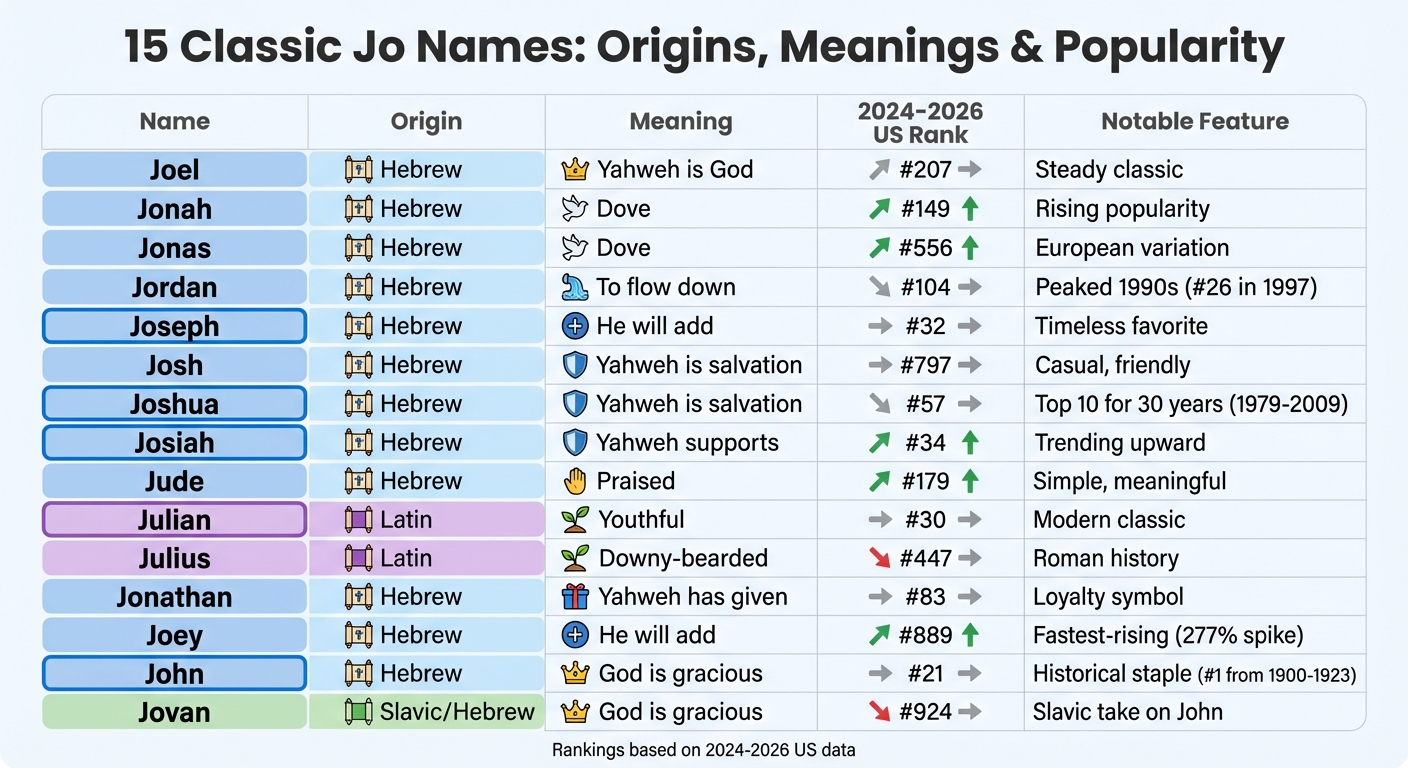
15 Classic Jo Names: Origins, Meanings & Popularity Rankings Comparison
1. Joel
Cultural and Linguistic Origin
The name Joel has its roots in the Hebrew name יוֹאֵל (Yo'el), which combines "yo" (a reference to Yahweh) and "el" (meaning God). It holds a prominent place in the Old Testament, where the prophet Joel is credited with writing the Book of Joel, one of the twelve minor prophetic books. While its origins are deeply Hebrew, the name gained traction in England during the 16th century, particularly after the Protestant Reformation. Today, it is embraced across various languages and regions, including English, Spanish, Portuguese, Swedish, Finnish, and Estonian.
Meaning and Significance
Joel carries the profound meaning of "Yahweh is God" or "The Lord is God." Its straightforward and classic nature, paired with its biblical roots, gives it a timeless appeal. This spiritual weight and simplicity have helped the name maintain its relevance over time.
Popularity and Timelessness
Joel has consistently been a favorite in the United States, reaching its peak at #71 in the 1980s. As of January 2026, it ranks #207 in the U.S. top 1,000 names. Beyond the U.S., Joel has made its mark internationally, ranking in the top 10 in countries like Finland, Switzerland, and the Philippines. Within the U.S., it is especially popular in states such as Pennsylvania, New Jersey, the District of Columbia, Delaware, and Connecticut. Many see Joel as a name that is both strong and classic, which has contributed to its enduring popularity.
Notable Associations
The name Joel has left its mark on various spheres of culture and entertainment. Famous figures like musician Billy Joel, Good Charlotte's Joel Madden, acclaimed director Joel Coen, and actor Joel McHale are just a few examples of its widespread recognition. In sports, NBA star Joel Embiid continues to shine. The name also features prominently in pop culture, with characters like Joel Miller from the video game and HBO series The Last of Us, Joel Barish from Eternal Sunshine of the Spotless Mind, and Joel Goodson from Risky Business further cementing its cultural significance.
sbb-itb-f13f980
2. Jonah
Jonah, much like Joel, is a name with deep roots and a fascinating biblical history that continues to resonate today.
Cultural and Linguistic Origin
Jonah is a Hebrew name that comes from the word Yonah. It gained prominence thanks to the biblical prophet Jonah, the central figure in the Book of Jonah, who is famously swallowed by a great fish. Over time, the name evolved in different regions. While the Hellenized version "Jonas" was once popular, "Jonah" became the favored form in England after the Reformation. Today, the name transcends borders, with variations like Yunus in Arabic, Giona in Italian, and Jonás in Spanish.
Meaning and Symbolism
The name Jonah translates to "Dove", a creature often linked to peace, purity, and gentleness. Beyond its literal meaning, the name carries rich biblical themes, including obedience, repentance, and redemption. Interestingly, sailors once used the term "a Jonah" to refer to someone bringing bad luck, but the dove symbolism continues to evoke a sense of calm and hope.
Popularity Over Time
Jonah has stood the test of time. As of January 2026, it ranks #149 in the U.S., showing a steady rise in popularity since its resurgence in the 1970s. Its natural pairing with other timeless names, like Noah, has further cemented its appeal. Jonah's mix of historical depth and modern charm makes it a favorite among parents today.
Notable Figures and Characters
The name Jonah has been carried by several well-known individuals and fictional characters. Hollywood actor Jonah Hill and BuzzFeed founder Jonah Peretti are two prominent examples. In pop culture, Jonah appears in characters like J. Jonah Jameson from Spider-Man, Jonah Hex from DC Comics, and Jonah Byrde from Netflix's Ozark. The name is also represented in sports by figures such as football player Jonah Jackson, basketball player Jonah Bolden, and baseball player Jonah Bayliss.
3. Jonas
Jonas builds on the timeless appeal of Jonah, presenting a polished, European variation of the name. As the Greek version of Jonah, Jonas brings an international flair to the Hebrew name Yonah. While both names share the same meaning - "dove" - Jonas stands out with its distinctly European elegance.
Cultural and Linguistic Origin
Jonas traces its roots to the Greek adaptation (Ίωνας) of the Hebrew Yonah. Interestingly, in Lithuania, Jonas takes on a different lineage. There, it stems from the Hebrew Yohanan (John) rather than Jonah, making it the country’s most common male name. Beyond Lithuania, Jonas has traveled far, taking on various forms across cultures: Yunus in Arabic and Turkish, Joona in Finnish, and Giona in Italian. This widespread use highlights its universal charm while maintaining a sense of individuality.
Meaning and Symbolism
Jonas translates to "dove", a symbol of peace, hope, and renewal. The name’s European touch adds a layer of sophistication to its serene meaning.
Popularity Across Regions
In the United States, Jonas ranks #556 as of 2024, but its popularity is far more pronounced in Europe. It holds impressive positions in several countries: #3 in Lithuania, #8 in Austria, #23 in Germany, #48 in Norway, and #49 in Switzerland. Its adaptability across languages and cultures, combined with a retro-inspired charm, makes Jonas a favorite in modern European naming trends.
Famous Figures and Cultural References
Jonas has been carried by many notable individuals and characters, cementing its place in history and pop culture. Jonas Salk, the scientist behind the 1955 polio vaccine, is celebrated for his role in nearly eradicating a disease that once devastated countless lives. The Jonas Brothers - Kevin, Joe, and Nick - have brought the name into the global spotlight with their chart-topping music career. In sports, Jonas Vingegaard, the Danish cyclist, achieved back-to-back victories in the Tour de France in 2022 and 2023.
The name also appears in literature and entertainment, from the protagonist in Lois Lowry's The Giver to the mysterious Jonas in the Netflix series Dark. Even The Bronx, New York City, owes its name to Jonas Bronck, a Swedish settler from the 17th century. These associations give the name Jonas a rich blend of historical and contemporary significance.
4. Jordan
Jordan’s name is closely tied to its connection with the Jordan River in the Southern Levant. The name comes from the Hebrew word Yarden, meaning "to flow down" or "descend". This link to a significant geographical landmark has shaped its historical and cultural importance.
Cultural and Linguistic Origin
The name Jordan has an intriguing history. It gained recognition during the Middle Ages when Crusaders used water from the Jordan River for baptisms, spreading its popularity across Europe. After falling out of favor post-medieval times, it made a comeback in the 19th century. However, its most notable rise happened in the late 20th century, especially in the United States and other Western countries.
Meaning and Significance
Jordan’s meaning goes beyond "descending." The name carries deep religious significance. In the Old Testament, the Jordan River is where the Israelites crossed into the Promised Land. In the New Testament, it’s where John the Baptist baptized Jesus Christ. This dual religious importance has made Jordan a symbol of freedom and redemption, often celebrated in gospel music, literature, and poetry. Its layered meaning adds to its enduring charm.
Popularity and Timelessness
Jordan reached its peak popularity in the U.S. in 1997, ranking #26, and stayed in the top 100 for decades. The name’s rise was strongly influenced by basketball icon Michael Jordan, whose dominance in the 1980s and 1990s cemented its appeal. By 2024, Jordan ranked 104th for boys in the U.S.. Over time, it has also become a favored unisex name, with males making up about 72.5% of those named Jordan in the U.S. as of 2006.
Notable Associations or Famous Figures
Jordan has been associated with several notable individuals across various fields. Michael Jordan is perhaps the most famous, thanks to his legendary basketball career. Jordan Peele has made his mark as an Oscar-winning director, while golfer Jordan Spieth has claimed multiple major championships. In pop culture, Jordan Knight gained fame as the lead singer of New Kids on the Block, and Jordan Belfort became widely known through his memoir The Wolf of Wall Street. The name also has international variations, such as Giordano in Italian, Jourdain in French, and Jordán in Spanish.
5. Joseph
Joseph is one of those names that has stood the test of time, tracing its roots back to the Hebrew name Yosef (יוֹסֵף), which stems from the verb yasaf, meaning "to increase" or "to add". Its translation - "God shall add" or "He will add" - carries a sense of hope and blessing.
Cultural and Linguistic Origin
The name Joseph has a long history, evolving through multiple languages and cultures. Starting from the Hebrew Yosef, it transitioned into Greek as Ioseph and then into Latin as Josephus. Eventually, it made its way into English, French, and German. Over time, this evolution gave rise to many variations worldwide, such as Giuseppe in Italian, José in Spanish and Portuguese, Yusuf in Arabic and Turkish, and Iosif in Russian. Its popularity surged during the late Middle Ages, particularly in Spain and Italy, as devotion to Saint Joseph grew. The Protestant Reformation later introduced the name to England.
Meaning and Significance
Joseph holds deep biblical importance. In the Old Testament, he is remembered as Jacob's beloved eleventh son, who overcame betrayal and slavery to rise as a powerful leader in Egypt. In the New Testament, Joseph is honored as the husband of the Virgin Mary and the earthly father of Jesus. These stories highlight qualities like forgiveness, resilience, and compassion, which have made the name resonate across generations.
Popularity and Timelessness
In the United States, Joseph has enjoyed remarkable longevity. From 1900 to 1935, it consistently ranked among the top 10 boys' names, peaking at #5 between 1912 and 1917. It was one of just two names - along with Robert - to stay in the top 10 from 1925 to 1972. While its popularity has waned slightly in recent years, falling out of the top 25 in 2020 and ranking #32 in 2024, its century-long prominence highlights its enduring appeal.
Notable Associations or Famous Figures
The name Joseph has been carried by many influential individuals across history and fields. In politics, it is tied to figures like U.S. President Joe Biden and Soviet leader Joseph Stalin. In entertainment and sports, we see names like actor Joseph Gordon-Levitt, NFL legend Joe Montana, and author Joseph Conrad. The name also has royal associations, including Holy Roman Emperors Joseph I and II and several Kings of Portugal. Meanwhile, the Italian variant Giuseppe was the most popular male name throughout the 20th century in Italy.
6. Josh
Josh, a Hebrew name, is the more casual form of Joshua. Derived from the Hebrew name Yehoshua, it translates to "the Lord is salvation" or "God is salvation" [32, 11]. Its simplicity and meaningful roots have kept it relevant through the years.
Cultural and Linguistic Origin
Much like other enduring 'Jo' names, Josh has strong biblical ties. It stems from the Old Testament figure Joshua, the leader who guided the Israelites into the Promised Land. Josh reflects themes of leadership and faith while maintaining a friendly and approachable vibe.
Meaning and Significance
Josh carries the weight of its biblical origins without feeling overly formal. It bridges the gap between tradition and modernity, offering a name that feels both grounded and contemporary. Its short, straightforward nature adds to its appeal in today's naming trends.
Popularity and Timelessness
Josh continues to resonate with parents who prefer short, friendly names. As of January 5, 2026, it ranks #797 in U.S. baby name popularity. It pairs effortlessly with classic names like Jacob, Ryan, and Jake, aligning with the ongoing preference for shorter, more informal versions of traditional names.
7. Joshua
Joshua, the formal version of Josh, comes from the Hebrew name Yehoshua, which translates to "Yahweh is salvation" or "God is deliverance". The name combines yeho (a reference to God or Yahweh) with yasha (to save or deliver). As a theophoric name, it incorporates a deity's name directly into its structure, reflecting its deep historical and spiritual roots.
Cultural and Linguistic Origin
The name Joshua has traveled through time and languages, evolving along the way. Its Hebrew "Y" sound became "I" in Greek and Latin, and later shifted to "J" in English. Interestingly, Joshua and Jesus share an etymological connection - Jesus originates from Yeshua, a shorter Aramaic form of Yehoshua. Initially popular within Jewish communities, the name gained wider usage after the Protestant Reformation. This linguistic journey not only refined its pronunciation but also preserved its profound meaning.
Meaning and Significance
In biblical history, Joshua is celebrated as the leader who succeeded Moses and guided the Israelites into the Promised Land. His story highlights themes of faith and leadership. Despite its ancient roots, Joshua has remained adaptable over time. It can be used formally as Joshua or informally as Josh, with variations like Joaquín in Spanish and Giosuè in Italian.
Popularity and Timelessness
Joshua enjoyed immense popularity in the United States, holding a top-10 position for 30 straight years from 1979 to 2009. It even reached No. 3 from 2002 to 2006. Across the Atlantic, it ranked as high as No. 2 in England and Wales between 2003 and 2005. While its popularity has dipped since those peak years, Joshua still ranked No. 57 in the U.S. in 2024 and has consistently stayed in the top 100 since 1971 [34,36]. Its enduring appeal proves its status as a classic name that transcends trends.
Notable Associations or Famous Figures
The name Joshua has left its mark across various fields. In music, Joshua Bell stands out as an acclaimed violinist, while Josh Groban has enjoyed a successful singing career. In acting, Joshua Jackson gained fame for roles in Dawson's Creek and The Mighty Ducks, and Josh Gad became beloved as the voice of Olaf in Disney's Frozen. History also offers notable figures like Joshua Lawrence Chamberlain, a Union brigadier general during the Civil War, and Joshua Slocum, the first person to sail solo around the world. These individuals highlight the name's broad influence in culture and history.
8. Josiah
The name Josiah comes from the Hebrew Yoshiyahu, which translates to "Yahweh supports" or "God supports and heals". It gained popularity in England following the Protestant Reformation. Variations of the name appear in different languages, including Josias in Latin, Josías in Spanish, and Josia in Dutch and German. Its biblical roots give it a sense of depth and significance.
Meaning and Significance
Josiah carries a rich biblical legacy. He was a King of Judah who took the throne at just eight years old and ruled for 31 years. Known for his sweeping religious reforms, he worked to renew the covenant with God. This history imbues the name with a sense of moral strength and leadership. Modern parents are drawn to Josiah for its ability to balance a deep historical resonance with a fresh, contemporary feel, making it a natural fit alongside other "-iah" names like Isaiah and Jeremiah.
Popularity and Timelessness
In the United States, Josiah has enjoyed consistent popularity. It entered the top 100 names in 2008 and reached its peak at 45th in 2019. More recent data places it as high as 34th. This steady rise reflects a broader trend of favoring timeless biblical names that offer a vintage charm.
Notable Associations or Famous Figures
Several notable figures have carried the name Josiah, including Josiah Wedgwood, a renowned porcelain manufacturer; Josiah Bartlett, a signer of the Declaration of Independence; and scientist Josiah Willard Gibbs. In popular culture, the name is associated with President Josiah "Jed" Bartlet from The West Wing.
9. Jude
Cultural and Linguistic Origin
The name Jude has its roots in Hebrew, originating from Yehuḏa (Judah), and later adapted through Ancient Greek into English. While traditionally masculine, it has become a unisex name and is sometimes used as a shortened form of Judith or Judy. The name translates to "praised" and carries a rich linguistic history that adds to its modern-day charm [50, 52].
Meaning and Significance
Jude holds a special place in Christian tradition, as Jude the Apostle is venerated as the patron saint of lost causes and hopeless cases. This connection gives the name a deep spiritual resonance. Its single-syllable structure and easy pronunciation make it a timeless choice that appeals across generations [53, 54].
Popularity and Timelessness
Jude has seen a remarkable rise in popularity, climbing from #948 in 1999 to consistently ranking in the top 200 names since 2010. By 2024, it holds the #156 spot in the United States, and projections for January 2026 place it at #179 on BabyCenter [51, 52]. Its popularity has been shaped by cultural influences, including the iconic 1968 Beatles song "Hey Jude" and the enduring fame of actor Jude Law [53, 54].
Notable Associations and Famous Figures
The name Jude has been carried by several well-known individuals, such as English actor Jude Law, footballer Jude Bellingham, and Northern Irish actor Jude Hill. It also holds a place in literature, appearing in Thomas Hardy's Jude the Obscure and Holly Black's The Folk of the Air series.
10. Julian
Julian stands out as one of those classic 'Jo' names that balances a rich historical background with a modern, approachable vibe.
Cultural and Linguistic Origin
The name Julian traces back to the Roman name Julianus, which itself stems from Julius. Its roots lie in the Latin word iuvenis (meaning "youthful") and the Greek ioulos (referring to "downy" or soft-haired). Additionally, it's connected to Jupiter, often referred to as the "sky father." While Julian was historically unisex, today it is predominantly used as a masculine name.
Meaning and Significance
Julian embodies the essence of youth and carries a sense of historical gravitas. It’s tied to the gens Julia, a prominent Roman family that famously claimed descent from Venus, the goddess of love and beauty. The name also holds religious significance, thanks to early Christian saints like St. Julian the Hospitaller, the patron saint of travelers. This blend of Roman heritage and spiritual importance has made Julian a name that resonates across cultures and generations.
Popularity and Timelessness
Julian has maintained a steady presence in the U.S., consistently ranking among the top 1,000 names since 1900. By 2024, it’s projected to peak at 30 on the list. Its rise gained momentum in the 1960s, partly due to public figures like Julian Lennon [55,59,61].
Notable Associations and Famous Figures
The name Julian has been carried by a variety of influential figures, including the 4th-century Roman Emperor Julian, whistleblower Julian Assange, musician Julian Casablancas, NFL star Julian Edelman, and, of course, Julian Lennon. It’s also made its mark in pop culture through characters like King Julian from Madagascar and Dr. Julian Bashir from Star Trek: Deep Space Nine. These associations, combined with its rich history, ensure Julian continues to be a name that feels both classic and contemporary.
11. Julius
Julius carries the weight of ancient Roman dignity while maintaining a modern charm. It has consistently found a place in the U.S. top 1,000 names.
Cultural and Linguistic Origin
Julius traces its roots to the Latin family name gens Julia, one of the most distinguished families in ancient Rome. The name may stem from the Greek word ioulos (ἴουλος), meaning "downy-bearded", or from the Latin Jovilius, meaning "devoted to Jove" - a reference to Jupiter, the Roman king of gods [63, 64, 66]. The Julian family even claimed lineage from the mythological Julus, son of Aeneas. While Julius was uncommon in the Middle Ages, it saw a revival during the Renaissance in Italy and France before spreading to England and other regions.
Meaning and Significance
Julius carries both literal and symbolic meanings. Its "downy-bearded" origin hints at youthfulness, while its connection to Jupiter adds a divine and noble resonance. Over the centuries, the name has been associated with early Christian saints and three Catholic popes, including Pope Julius I [63, 64]. This rich history contributes to its enduring popularity.
Popularity and Timelessness
Julius reached its peak U.S. popularity in the 1880s, ranking at #94. By 2024, it had climbed to #389, an 11-spot increase from the previous year. As of early 2026, it ranked #447. Its vintage appeal has made it a favorite among modern parents who appreciate its Roman heritage.
Notable Associations and Famous Figures
The name Julius is forever tied to the legendary military leader Julius Caesar, whose influence shaped Western history [63, 64]. In more recent times, it has been carried by figures like Julius Erving, or "Dr. J", who revolutionized basketball and became an NBA icon [64, 66]. Other notable namesakes include J. Robert Oppenheimer, the theoretical physicist known as the "father of the atomic bomb", and Julius Nyerere, the first president of Tanzania. Pop culture has also embraced the name, with characters like Dr. Julius Hibbert from The Simpsons, Julius the Cat (Walt Disney's first recurring animated character), and Julius Pringles, the face of Pringles potato crisps.
12. Jonathan
Jonathan remains one of the most enduring biblical names in America. With its roots in Hebrew, this name carries an ancient charm while still appealing to modern sensibilities. It's a meaningful choice for parents who value spiritual depth and historical richness.
Cultural and Linguistic Origin
The name Jonathan originates from the Hebrew Yehonatan (יְהוֹנָתָן), later shortened to Yonatan (יוֹנָתָן). It combines two elements: yeho, referring to Yahweh, and natan, meaning "to give." In the Old Testament, Jonathan is best known as King Saul's eldest son and the devoted friend of David. Despite its biblical presence, the name didn't gain widespread use in English-speaking countries until after the Protestant Reformation. Variations of Jonathan appear across different languages, such as Jonatan (Spanish, German, Swedish), Gionata (Italian), and Jônatas (Portuguese). This linguistic diversity adds to the name's historical and cultural significance.
Meaning and Significance
Jonathan is often translated as "Yahweh has given" or "Gift of God." Its biblical roots highlight themes of loyalty and strength, especially through Jonathan's unwavering friendship with David. This legacy of faith and steadfastness continues to resonate with many parents, making the name a powerful symbol of both spiritual and personal values.
Popularity and Timelessness
Jonathan's popularity in the United States peaked in 1988, ranking as the 15th most popular boy name. Impressively, it remained in the top 50 for nearly 50 years, from 1969 to 2015. As of 2024, it holds the 83rd spot with a usage rate of 0.218%. Its steady presence over generations reflects a rare balance: it feels familiar without being overused and traditional without seeming outdated.
Notable Associations and Famous Figures
The name Jonathan has been borne by many influential figures across history and culture. Renowned author Jonathan Swift (1667–1745), famous for Gulliver’s Travels, remains a literary icon. In entertainment, actors like Jonathan Banks (Breaking Bad), Jonathan Rhys Meyers (The Tudors), Jonathan Groff (Hamilton), and Jonathan Van Ness (Queer Eye) have kept the name in the spotlight. In the tech world, Sir Jonathan Paul Ive, Apple's former chief design officer, played a pivotal role in designing some of the company's most iconic products. Fictional characters also carry the name, such as Jonathan Harker in Dracula, Jonathan Kent (Superman’s adoptive father), and Jonathan Byers from Stranger Things.
13. Joey
Joey, once a nickname for Joseph (derived from the Hebrew name Yosef), has grown into a standalone name with a friendly and approachable vibe. Its meaning, "God shall add" or "Jehovah increases", reflects ideas of growth and blessings. While it often serves as a diminutive for names like Josephine or Johanna, Joey has carved out its own identity over time.
Meaning and Significance
Names like Joseph and Joshua carry a sense of tradition and weight, but Joey offers a more casual and modern take. Its meaning, "God shall add", symbolizes growth and divine favor, giving it a positive and uplifting connotation. This easygoing name continues to attract parents looking for something timeless yet fresh.
Popularity and Timelessness
In the United States, Joey ranked #889 in 2024, with some platforms projecting it as high as #339 by early 2026. It also gained recognition as one of the "Fastest-Rising Boy Names" in 2024, showing a notable 277% spike in interest. Beyond the U.S., Joey has found favor internationally, ranking #78 in Ireland, #103 in Scotland, and #168 in England in 2024. Its appeal spans generations, resonating with both Millennial and Gen Z parents.
Notable Associations and Famous Figures
Joey has made its mark across music, television, sports, and pop culture. In music, icons like Joey Ramone (lead singer of The Ramones), Joey Fatone from *NSYNC, Joey McIntyre of New Kids on the Block, and Aerosmith drummer Joey Kramer have brought the name to the spotlight. On TV, characters like Joey Tribbiani from Friends and Joey Gladstone from Full House have given the name a lovable, relatable charm. In sports, figures such as NASCAR driver Joey Logano, baseball player Joey Votto, and competitive eater Joey Chestnut have carried the name with pride. Even in animation, Joey Wheeler from Yu-Gi-Oh! adds to its widespread recognition and appeal.
14. John
Continuing our look at classic "Jo" names, John stands out as a name with rich historical and biblical significance, firmly rooted in tradition.
The name John traces back to the Hebrew Yôḥānān (יוֹחָנָן), meaning "God is gracious." It passed through Greek and Latin before becoming the familiar name we know today. Its biblical importance is tied to two key figures in the New Testament - John the Baptist and John the Apostle - both of whom played pivotal roles in spreading Christianity. This spiritual resonance, combined with its deep historical roots, has cemented John as a name of enduring strength and appeal.
Meaning and Significance
At its core, John means "God has been gracious." It's worth noting that while John (from Yohanan) is sometimes confused with Jonathan (which means "given by God"), the two names have distinct origins. As Wendy Wisner aptly puts it:
"John is an ever-popular, traditional name that exudes strength, responsibility, and kindness."
Popularity Through the Ages
John's popularity is nothing short of remarkable. In England, it dominated as the most common male name from the 13th through the 20th century, with about 20% of boys being named John during the late Middle Ages. In the United States, John was the #1 boys' name from 1900 to 1923 and stayed in the top five for an impressive 73 years (1900–1973). Even today, John remains a beloved choice, ranking as the 21st most popular boys' name in 2024. Beyond its widespread use, the name has been carried by 21 popes, eight Byzantine emperors, and numerous kings in England, France, Sweden, and Poland.
Famous Figures and Cultural Impact
The name John has been associated with countless influential figures across history. In U.S. politics, presidents like John Adams, John Quincy Adams, and John F. Kennedy left lasting legacies. Philosophy and science were shaped by thinkers like John Locke. In literature, luminaries such as John Milton, John Steinbeck, and John Keats have borne the name. Music, too, has its share of iconic Johns, from John Lennon of The Beatles to contemporary artist John Legend.
The name even extends into cultural idioms, appearing in terms like "John Bull", symbolizing England, and "John Q. Public", representing the average American citizen. With its deep roots and broad influence, John continues to be a name that stands the test of time.
15. Jovan
Jovan blends Slavic heritage with classical mythology, giving a modern edge to traditional "Jo" names.
Cultural and Linguistic Origin
Jovan is the Serbian and Macedonian version of John (from the Hebrew Yochanan). It also serves as a Latin variant of Jove, which originates from Jupiter. This dual origin weaves together biblical tradition with the grandeur of Roman mythology, adding layers of depth to its meaning.
Meaning and Significance
In Slavic languages, Jovan translates to "God is gracious". Its Latin connection to Jupiter, often referred to as the "sky father", brings associations of power, majesty, and the natural elements of thunder and lightning. The name holds a special place in Eastern Orthodox traditions, with approximately 20 saints bearing the form Jovanus.
Popularity and Timelessness
In the U.S., Jovan reached its highest rank at #554 in 1979. It remained in the top 1,000 names until 2009 and made a comeback at #924 in early 2026. Globally, it enjoys widespread use, ranking among the top 10 names in North Macedonia. It is often described as strong, classic, and formal.
Notable Associations or Famous Figures
Several well-known individuals have carried the name Jovan. Linebacker Jovan Belcher played for the Kansas City Chiefs from 2009 to 2012, while footballer Jovan Acimovic earned 55 national team caps between 1968 and 1976. In music, rapper Jovan Campbell, better known as Jibbs, reached #7 on the Billboard Hot 100 in 2006 with his hit "Chain Hang Low". Television personality Daphne Oz also chose this name for her son, Jovan Jovanovic, born in 2015. Beyond people, Jovan is also recognized as the name of a prominent perfume brand.
Name Comparison Table
The table below highlights the origins, meanings, and popularity trends of 15 classic "Jo" names. These names not only carry deep spiritual and historical roots but also remain staples in American naming traditions.
Take a look at the summary to quickly compare the key characteristics of these timeless names.
| Name | Origin | Meaning | Popularity Notes |
|---|---|---|---|
| Joel | Hebrew | Yahweh is God | Maintains steady popularity |
| Jonah | Hebrew | Dove | Known for its biblical ties; consistently used |
| Jonas | Hebrew | Dove | A variation of Jonah |
| Jordan | Hebrew | Descend, flow down | Gained fame during the Crusades; linked to the Jordan River |
| Joseph | Hebrew | He will add | Ranked #23 in 2018; a historical favorite |
| Josh | Hebrew | Yahweh is salvation | A common nickname for Joshua |
| Joshua | Hebrew | Yahweh is salvation | Highly popular; associated with the biblical leader |
| Josiah | Hebrew | Yahweh supports | A trendy choice; ranked #53 |
| Jude | Hebrew | Praised | Often linked to Judah; gaining popularity |
| Julian | Latin | Youthful / Downy-bearded | A classic name with medieval roots (Jolyon) |
| Julius | Latin | Downy-bearded | Has ancient Roman origins; less common than Julian |
| Jonathan | Hebrew | Yahweh has given | A biblical name; the variant Johnathan is less trendy |
| Joey | Hebrew | He will add | A diminutive of Joseph; widely used as a given name |
| John | Hebrew | God is gracious | Once dominant; usage has dropped by 70% over the past century |
| Jovan | Slavic/Hebrew | God is gracious | A modern take on John/Giovanni |
Many of these names share theophoric elements, meaning they include references to God, which explains their enduring spiritual and cultural importance . For instance, John reached its height of popularity a century ago, accounting for 11.66% of births, but has since declined by about 70%. Despite this, names like Joseph have held strong, with Joseph being the most popular "Jo-" name in 2018, making up 0.4954% of baby names.
Up next, discover how these names align with NameHatch's baby naming tools.
Find Jo Names with NameHatch
If you're on the hunt for timeless "Jo" names, NameHatch is here to make the process easier and even a little fun. This AI-powered baby name app uses a swipe-based interface: swipe right to save the names you love, swipe left to skip the ones that don’t fit. The more you swipe, the smarter the app gets, learning your preferences to suggest names that align with your style.
One of the standout features is partner syncing, which tackles the often tricky task of getting both parents on the same page. By connecting with your partner through the app, you'll get a shared list of names that both of you have swiped right on. This means you can instantly see the names you both love without endless back-and-forth discussions. Plus, with customizable filters, you can focus your search on specific criteria - like boy names starting with "Jo." This makes it easy to go beyond classics like John or Joseph and uncover less common gems like Joash.
NameHatch offers flexible pricing to suit your needs. The Free plan gives you 30 swipes, limited favorites, and basic filtering. If you're looking for more, the Premium plan - priced at $7/month or $29 for six months - unlocks unlimited swipes, unlimited favorites, advanced filtering tools, and priority AI-powered name suggestions.
Whether you're on your phone or computer, NameHatch provides an intuitive, ad-free experience to help you find the perfect name anytime, anywhere.
Conclusion
Jo names have stood the test of time in the United States, rooted in biblical tradition and meanings that still resonate today. Over a century ago, 11.66% of boys were given Jo names, a figure that has now shifted to around 3.48%, with Josiah climbing as high as #53 in popularity.
These names bring a wonderful balance of history and flexibility. A name like Jonathan exudes formality, making it perfect for professional settings, while a nickname like Jonny feels warm and approachable for everyday life. Jo names also cross cultural boundaries, making them a great option for families from diverse backgrounds or anyone looking for a name that feels both timeless and familiar.
If you're still searching, NameHatch can simplify the process. With customizable filters, partner syncing, and AI-driven suggestions that adapt to your preferences, the app helps you find the perfect Jo name that matches your family's style.
Each Jo name carries its own story - one that might be just right for your little one.
FAQs
What are the cultural and historical origins of names starting with 'Jo'?
Names starting with 'Jo' carry a deep connection to history and tradition, especially within Hebrew culture. Many of these names trace their roots back to the Bible and often incorporate references to Yahweh, the Hebrew name for God. For example, Joab means "praise to the Lord", while Joachim translates to "Yahweh will establish."
Throughout history, these names have held strong ties to Judeo-Christian traditions and have been cherished across generations for their spiritual significance. Over the years, 'Jo' names have also found their way into various languages and cultures, making them enduring and meaningful options for parents.
Why are boy names starting with 'Jo' still popular today?
Names starting with "Jo" remain a favorite for many because they carry a sense of timelessness and depth. Classics like Joseph, Joshua, and John are steeped in history and often connected to religious or biblical traditions, adding a layer of meaning that resonates with many parents.
Another reason for their popularity is their simplicity and familiarity. These names are easy to recognize and pronounce in English-speaking countries, making them practical and approachable choices. Their lasting appeal and ties to tradition ensure they continue to be cherished across generations.
What do boy names starting with 'Jo' mean in different cultures?
Boy names that begin with "Jo" often carry profound meanings and connections to tradition. Many of these names have Hebrew origins, frequently linked to religious or biblical themes. For example, "Jo" comes from Hebrew and translates to "Yahweh will add" or "Yahweh is gracious." Names like Joseph, meaning "Jehovah increases", and Joab, meaning "praise the Lord", reflect these deep-rooted spiritual connections.
In English-speaking regions, names starting with "Jo" are often shortened versions of longer names, such as Jonathan or Joseph. These names are associated with traits like kindness, wisdom, and faith. Beyond English-speaking cultures, "Jo" names also enjoy popularity across Europe, where they are often chosen to honor religious or historical traditions. With their timeless charm and rich heritage, "Jo" names offer parents a meaningful and versatile option.