Boy names starting with "Fr" offer a mix of history, style, and meaning. These names often connect to themes like freedom, peace, and strength, appealing to modern parents seeking names that balance tradition with a contemporary feel. Here are eight standout "Fr" names:
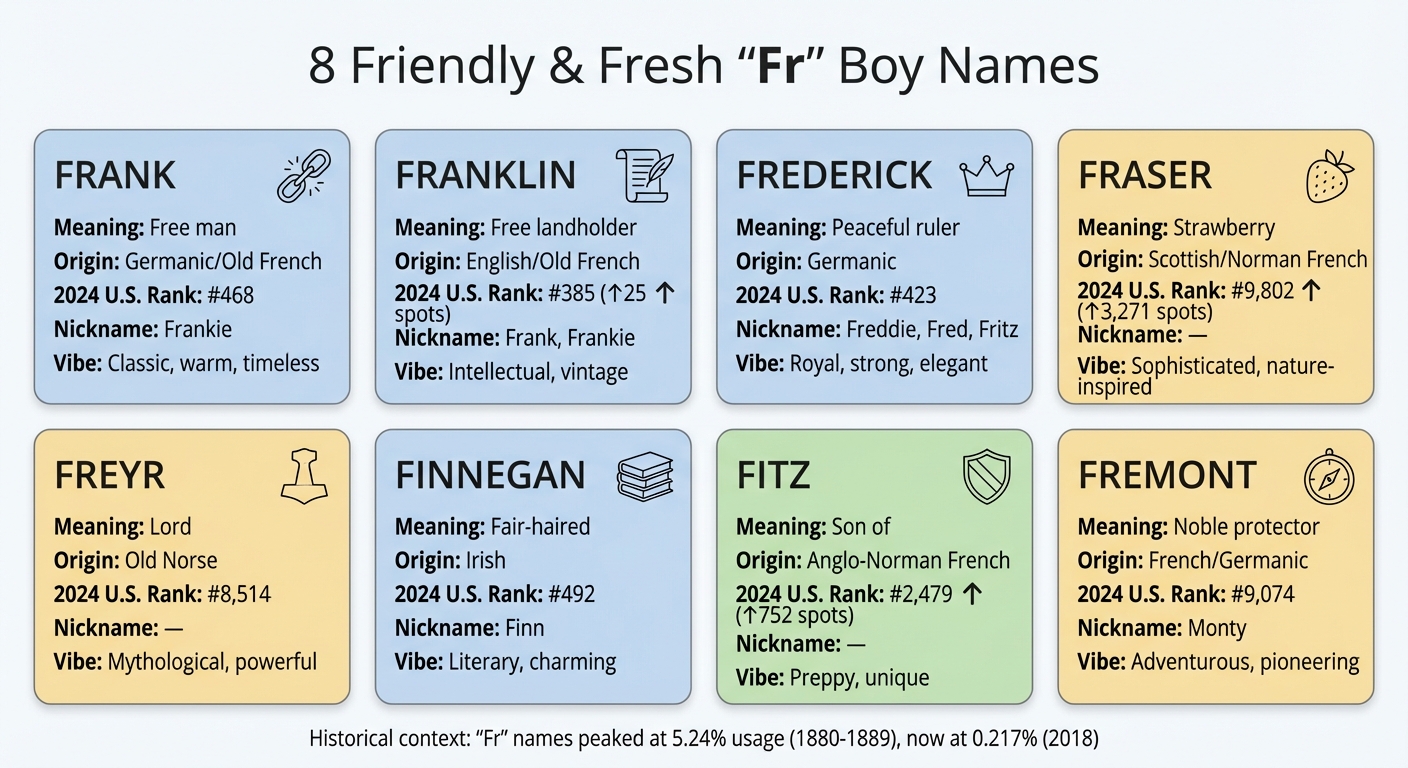
- Frank: Means "free man" and has a long history of popularity, recently ranking #468 in 2024.
- Franklin: Associated with freedom and self-reliance, it honors figures like Franklin D. Roosevelt and Benjamin Franklin.
- Frederick: A name of Germanic origin meaning "peaceful ruler", linked to royalty and historic leaders.
- Fraser: A Scottish name tied to nature and history, gaining attention through pop culture like Outlander.
- Freyr: A Norse mythological name symbolizing fertility, sunlight, and prosperity, rare yet meaningful.
- Finnegan: An Irish name meaning "fair-haired", offering the popular nickname "Finn."
- Fitz: Derived from Anglo-Norman French meaning "son of", it has historical and literary significance.
- Fremont: A French-Germanic name meaning "noble protector", tied to exploration and adventure.
Each name blends rich history with modern appeal, offering options for parents who want something familiar yet uncommon.
8 Boy Names Starting with Fr: Meanings, Origins & 2024 Rankings
1. Frank
Meaning and Origin
The name Frank has roots in both Germanic and Old French languages, where it translates to "free man". Its origins trace back to the Franks, a Germanic tribe that settled in areas now known as France, Belgium, and the Netherlands. Frank is also linked to the Latin name Franciscus, a form of Francis, symbolizing freedom and strength. Over time, the name has come to represent qualities like being "open-hearted" and "generous".
Historical and Cultural Significance
Frank has a long history of popularity in the United States, consistently ranking among the Top 10 names from the 1880s through the 1920s. Its peak was between 1900 and 1911, when it reached number 8, bolstered by figures like Frank Sinatra and Frank Lloyd Wright. Historically, the Franks were a powerful tribe that shaped Western Europe between the 6th and 9th centuries. Under leaders such as Clovis I and Charlemagne, they established a significant empire, and their legacy lives on in the name of France itself. This rich historical backdrop adds depth to the name's modern appeal.
Contemporary Appeal
After decades of waning popularity, Frank is experiencing a resurgence. For the first time in a century, its downward trend has reversed, and as of 2024, it ranks #468 in the United States. Remarkably, it has never fallen out of the Top 500 for boys.
"Frank still has a certain warm, friendly real-guy grandpa flavor that could come back into style, like other such choices as Jake and Jack." – Sophie Kihm
Modern parents are drawn to Frank for its straightforward, one-syllable charm and timeless authenticity. The growing popularity of Frankie as a gender-neutral nickname has also breathed new life into this classic name, making it a favorite among a new generation of parents.
2. Franklin
Meaning and Origin
Franklin carries a timeless charm that bridges the gap between tradition and modernity. Rooted in English and Old French, the name means "free landholder" or "free man". Its origins trace back to the Middle English word frankeleyn, derived from the Anglo-Norman French franc (meaning "free") and the Germanic suffix -ling. Historically, a franklin referred to a prosperous landowner who was independent of the nobility, symbolizing freedom and self-reliance. This historical depth gives the name a sturdy foundation and enduring appeal.
Historical and Cultural Significance
Franklin is deeply woven into American history, most notably through figures like presidents Franklin Pierce and Franklin Delano Roosevelt, as well as the brilliant legacy of Benjamin Franklin. The name gained immense popularity during the 1930s, peaking at #70, thanks in part to FDR's influence. Beyond politics, Franklin resonates in other cultural spheres, with icons such as Aretha Franklin, the "Queen of Soul", and evangelist Franklin Graham adding to its significance.
Contemporary Appeal
Franklin’s vintage roots have found a fresh audience today, making it a name that feels both classic and current. In 2024, it climbed to #385 in the U.S., jumping 25 spots from the previous year.
"Intellectual, vintage, and diligent, Franklin is for the baby ready to craft a life of their own." – Emily McNamara, Senior Content Writer, The Bump
Parents are drawn to its balance of history and versatility. The name offers charming nicknames like Frank and Frankie, which add a playful yet polished touch. Franklin stands out as a name that is familiar yet not overly common - perfect for parents seeking something meaningful and distinctive.
3. Frederick
Meaning and Origin
Frederick is a name with deep roots in Germanic history, blending the elements "frid" (peace) and "ric" (ruler or power) to mean "peaceful ruler." Its origins trace back to the Proto-Germanic frithu-rik, which later evolved into Friedrich. The name made its way to England with the Normans in the 11th century but gradually fell out of favor. It wasn’t until the 18th century, during the reign of the German House of Hanover, that Frederick saw a revival. This timeless name carries a legacy of authority and calm leadership.
Historical and Cultural Significance
Frederick’s history is steeped in royalty and influence. It was the name of several Holy Roman Emperors, including Frederick I Barbarossa, and was carried by nine Danish kings and notable Prussian leaders like Frederick the Great. Beyond the royal courts, it has been associated with influential figures such as abolitionist Frederick Douglass, insulin co-discoverer Frederick Banting, and Frederick Law Olmsted, the visionary behind many iconic American landscapes.
Contemporary Appeal
Frederick has experienced shifts in popularity over the years. While it was a Top 100 name from 1880 to 1957, it dipped to #536 in 2009 before climbing back to #423 in the U.S. and reaching #55 in England in 2024.
"With a name like this, you can expect baby to keep things under control on the playground." – Emma Lawler, Senior Content Writer, The Bump
What makes Frederick stand out is its adaptability. The full name carries an air of strength and elegance, while nicknames like Freddie, Fred, and Fritz bring a friendly, approachable vibe. It’s a name that balances tradition with charm, making it a solid choice for parents seeking something classic yet versatile.
4. Fraser
Meaning and Origin
Fraser is a Scottish name with roots in Norman French, originating from the surname de Fresel, which arrived in the British Isles during the Norman conquest. The name is most commonly linked to the French word fraise, meaning "strawberry." Some interpretations expand on this with meanings like "strawberry flowers" or "of the forest men", giving the name a natural, earthy charm. While the U.S. audience may be more familiar with the variant popularized by the show Frasier, Fraser is the original Scottish form.
Historical and Cultural Significance
Fraser holds a significant place in Scottish history, becoming a notable clan name after the Norman conquest. It carries connotations of strength, elegance, and a sense of maturity. Over the years, several notable individuals have carried the name, including Fraser Walters, a member of the operatic pop group The Tenors; Fraser Minten, a Canadian hockey player for the Toronto Maple Leafs; and Penn Fraser Jillette, the magician from Penn & Teller.
Contemporary Appeal
Fraser has seen a surge in interest recently, thanks in part to the character Jamie Fraser from the Outlander series of books and television. In 2024, the name climbed 3,271 spots to rank #9,802 in U.S. births. It also holds a strong presence in the UK, ranking #101 in Scotland and #307 in England for the same year.
"The renaissance of this handsome name comes from an even more handsome Jamie Fraser from the Outlander series." – Jamie Allen, Operations Manager, The Bump
Distinctiveness or Uniqueness
Fraser stands out as a rare and sophisticated choice in the United States, where it remains outside the top 1,000 names. Its blend of surname appeal and botanical significance aligns well with modern naming trends. Fraser often appears on lists like "Best Unique Baby Names" and "Cool Classic Boy Names", offering parents a name that feels both fresh and deeply rooted in tradition. Its Scottish roots and nature-inspired meaning make it a compelling alternative to more common names.
5. Freyr
Meaning and Origin
Freyr is an Old Norse name derived from the Germanic root fraujô, which translates to "lord." In Norse mythology, Freyr is a significant deity linked to fertility, sunlight, rain, peace, prosperity, agriculture, and weddings. As a member of the Vanir gods, he is the twin brother of the goddess Freya and the son of Njord. Freyr is prominently featured in both the Poetic Edda and the Prose Edda and is recognized as an ancestral figure in Swedish folklore.
Historical and Cultural Significance
Freyr's influence runs deep in Scandinavian history and Viking traditions. Some researchers suggest his original name was Yngvi, with "Freyr" serving as a title that means "lord." As a god of fertility and favorable weather, he played a vital role in Norse worship, particularly among farming communities who depended on his blessings for successful harvests. The name embodies themes of leadership, abundance, and harmony - qualities that resonated strongly throughout the Viking Age. These associations continue to give Freyr a timeless appeal.
Contemporary Appeal
Freyr's mythological heritage has sparked renewed interest in recent years. For example, during the week of January 25, 2026, searches for the name surged by an impressive 1,000%. In 2024, it ranked #8,514 for baby boys in the United States, signaling a growing curiosity among modern parents.
Distinctiveness and Uniqueness
Freyr remains a rare and striking choice, standing apart from the top 1,000 baby names in the U.S. While its feminine counterpart, Freya, has gained mainstream popularity, Freyr offers a bold and meaningful masculine alternative rooted in Norse mythology. With its ties to Viking heritage and themes of ancient spirituality, the name feels both powerful and approachable. Pronounced "FRAY-er" or "FRAYR", it’s a name that combines strength with a touch of mystique.
sbb-itb-f13f980
6. Finnegan
Meaning and Origin
Finnegan is an Irish name that translates to "fair", "white", or "fair-haired". It originates from the Irish surname Ó Fionnagáin, which also inspired names like Fionn and Finn. The name ties back to Fionn mac Cumhaill (Finn MacCool), a legendary Irish hero celebrated for his strength, wisdom, and generosity. James Joyce further cemented its place in literary history with Finnegans Wake, a novel influenced by an Irish-American folk song. This deep cultural and historical backdrop gives the name its timeless charm.
Contemporary Appeal
In 2024, Finnegan ranked #492 in the United States, making it a stylish yet uncommon choice. It combines the elegance of a three-syllable name with the approachable and popular nickname, Finn.
"A longer surname name in the key of Cameron and Sullivan, with the bonus of nickname Finn" – Abby Sandel, Founder of Appellation Mountain
This balance of sophistication and familiarity makes Finnegan an appealing option for modern parents looking for a name that stands out without feeling too formal.
Distinctiveness and Uniqueness
Finnegan aligns with the trend of Irish surnames being used as first names, such as Harrigan, Mulligan, and Flanagan, while remaining outside the Top 100.
"Baby names that start with F are fashionable but not popular, with not a single F name ranking among the Top 100 most popular names for girls or boys in the United States" – Sophie Kihm of Nameberry
While the shorter "Finn" has risen higher in popularity, Finnegan offers a fresh and distinctive alternative with the same lively charm. Its steady rank at #492 from 2023 to 2024 reflects its growing appeal without becoming overly common. The name strikes a perfect balance between historical roots and modern-day style.
7. Fitz
Meaning and Origin
Fitz originates from Anglo-Norman French, where it means "son of". The name comes from the Old French word filz (modern fils) and the Latin term filius. In Anglo-Norman England, it was commonly used as a patronymic marker. For instance, "fitz Bernard" translated to "son of Bernard". This straightforward yet historically layered origin gives Fitz a rich background.
Historical or Cultural Significance
Fitz has deep ties to English history, particularly through its royal connections. English kings often used the prefix for the surnames of their acknowledged illegitimate children. Examples include Fitzroy ("son of the king") for Charles II's children and FitzClarence for William IV's offspring. The name also appears in literature, such as Jane Austen's iconic Fitzwilliam Darcy and Robin Hobb's FitzChivalry "Fitz" Farseer. In Ireland, Fitz played a role in anglicizing Gaelic patronymic surnames; for example, Fitzpatrick is derived from the Gaelic Mac Giolla Phádraig.
Contemporary Appeal
Once primarily a surname prefix, Fitz has gained popularity as a first name. In 2024, it ranked #2,479 among U.S. births, climbing 752 spots from the previous year. Its rise reflects a growing trend toward short, striking names with unique endings.
"You'll often see this name used as a prefix for English and Anglicized last names like Fitzgerald or Fitzpatrick, but it's just as capable of standing on its own." – Emma Lawler, Senior Content Writer, The Bump
Distinctiveness and Uniqueness
Fitz is notable for its rare "z" ending, giving it a vintage charm with a modern twist. It fits into the trend of preppy surname-inspired names like Foster and Fletcher but remains far less common than traditional choices such as Francis or Franklin. Its meaning makes it a thoughtful option for a middle name to honor a father. Fitz strikes a balance between brevity, meaning, and style, making it a standout pick among "Fr" names.
8. Fremont
Meaning and Origin
Fremont has its roots in French and Old Germanic languages. It blends fara (meaning "journey") with mund (meaning "protection"), resulting in interpretations like "noble protector" or "freedom mountain." Originally spelled Frémon in French, the "t" was later added, giving the name a sense of adventure and strength.
Historical or Cultural Significance
The name Fremont carries a rich history tied to exploration and discovery. It's closely associated with John C. Frémont, the 19th-century explorer famously known as "The Pathfinder." His expeditions across the American West left an indelible mark, making Fremont a recognized surname and geographical name in the U.S., most notably in Fremont, California. The name also echoes the legacy of the pre-Columbian Fremont culture, further deepening its historical resonance.
Contemporary Appeal
Today, Fremont appeals to parents drawn to its adventurous and pioneering vibe. While it ranks #9,074 in U.S. name popularity, its rarity makes it a standout choice for those seeking something distinctive yet meaningful.
"If you're looking for a name that inspires your little one with an adventurous spirit and reach for the highest peaks, Fremont fits the bill." – Sadiyah Qureshi, Content Writer
The nickname "Monty" adds a friendly, approachable touch, making it versatile for both formal and everyday use.
Distinctiveness and Uniqueness
Fremont strikes a balance between historical depth and modern originality. While many are familiar with it as a surname or place name, it remains uncommon as a first name, offering a unique yet recognizable option. Its straightforward pronunciation (FREE-mont) ensures it’s easy to remember. As part of the growing trend of using surnames and geographical names as first names, Fremont connects to American history while offering a fresh and adventurous choice.
Conclusion
These eight 'Fr' names strike a perfect balance between honoring tradition and embracing contemporary charm. From timeless classics like Frank, Franklin, and Frederick to more daring picks like Freyr and Fremont, this collection spans generations of naming heritage. They bring a touch of formality when needed but can easily transition to friendly nicknames like Frankie or Freddie.
Historically, 'Fr' names enjoyed their peak popularity between 1880 and 1889, accounting for 5.24% of names during that period. By 2018, however, their usage had decreased significantly to just 0.217% . This decline means your child's name is less likely to be shared by many peers, while still remaining familiar and easy to pronounce.
Each name carries its own unique meaning, from "free man" to "peaceful ruler" or "noble protector", offering positive and inspiring associations. These names combine a pleasing sound with a sense of purpose, creating a meaningful choice for your child.
"This age-old name has stood the test of time and remains a beloved title today, its gender-neutral stance appealing to the modern era." – The Bump
With their friendly and fresh 'Fr' sound, these names offer something for everyone. Whether you're drawn to the polished, surname-inspired style of Fraser or the mythological allure of Freyr, there's a name here to reflect your family's values. Each option blends rich history with modern appeal, giving your son a name that feels both distinctive and deeply meaningful.
FAQs
Why are boy names starting with 'Fr' so popular with modern parents?
Boy names beginning with 'Fr' have become a favorite among modern parents, offering a blend of timeless charm and a fresh, contemporary feel. Classics like Franklin, Francis, and Frank carry a sense of history while reflecting qualities like strength, independence, and warmth.
For those drawn to names with international roots, options such as Francisco and Franco add a layer of cultural richness, drawing inspiration from French, Spanish, and broader European traditions. These names are not only easy to pronounce but also strike a balance between being familiar and standing out. If you're looking for a name that's meaningful and stylish, 'Fr' names seamlessly combine tradition with a modern twist.
Why are boy names starting with 'Fr' a great mix of traditional and modern styles?
Boy names that start with 'Fr' offer a mix of timeless appeal and modern charm. Names like Frank and Francisco carry a rich history and a sense of tradition that has stood the test of time. On the other hand, shorter variations like Frankie add a more casual, approachable vibe, aligning well with today’s naming trends.
This combination of classic roots and a contemporary touch makes 'Fr' names a great option for parents looking for something meaningful yet current.
What is the most unique boy name starting with 'Fr'?
One of the lesser-known boy names starting with "Fr" is Fraco. Unlike familiar names such as Francisco or Frank, Fraco is rarely chosen, which gives it a unique charm. With Spanish origins, the name carries the meaning "weak." While this might seem unexpected, it adds a layer of depth and individuality that makes it stand out.
For parents looking for a name that's uncommon, meaningful, and tied to a specific heritage, Fraco provides a rare and memorable alternative to the more traditional "Fr" names.