Looking for a boy's name that starts with "Ed"? Here's a quick guide to eight strong, historically rich options:
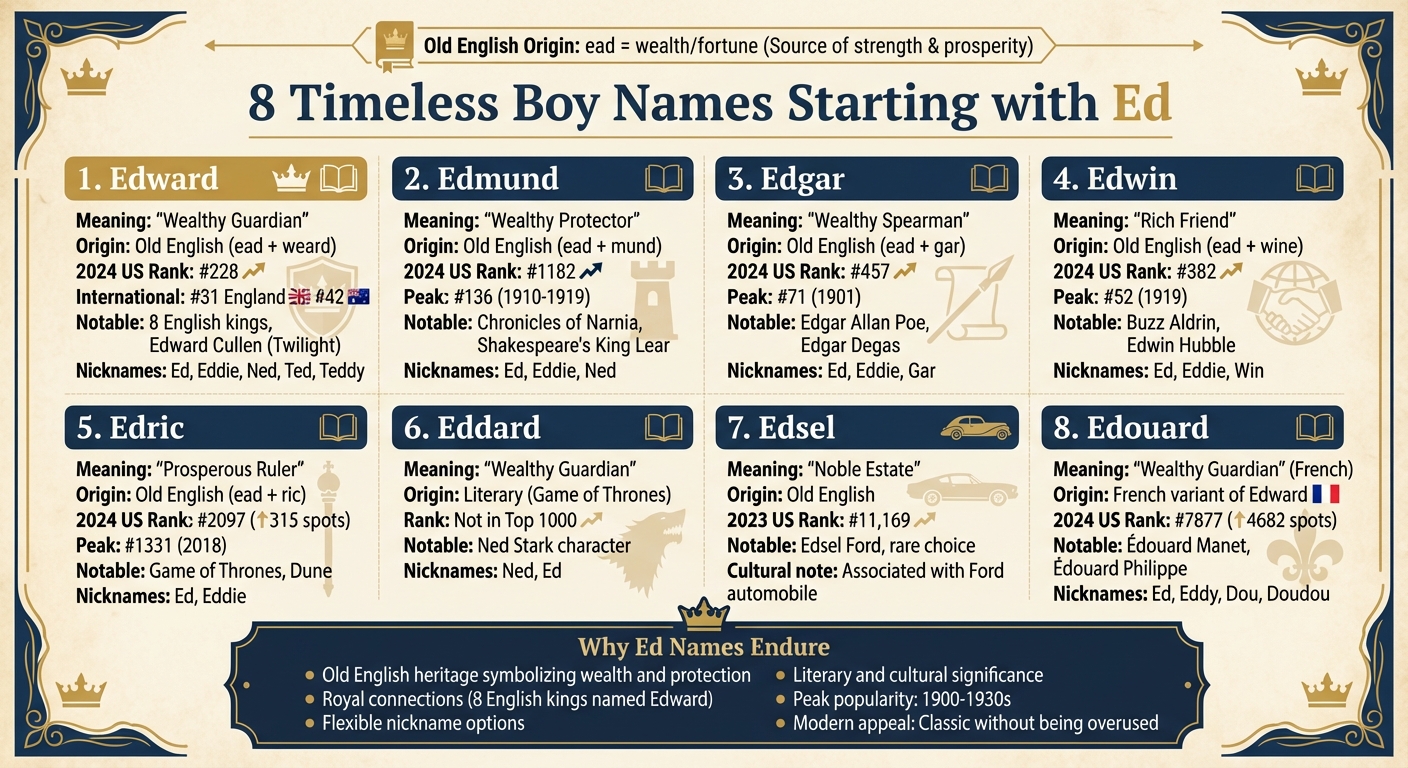
- Edward: Meaning "wealthy guardian", this classic name has royal roots and literary ties, from English kings to Edward Cullen from Twilight.
- Edmund: Translating to "wealthy protector", it's a vintage favorite seen in works like The Chronicles of Narnia and Shakespeare's King Lear.
- Edgar: Known as "wealthy spearman", Edgar combines royal history with an artistic edge, thanks to figures like Edgar Allan Poe.
- Edwin: A "rich friend", this name dates back to Anglo-Saxon kings and has a steady, approachable charm.
- Edric: Meaning "prosperous ruler", it's a less common choice with medieval roots and modern appeal.
- Eddard: A fictional twist on Edward, popularized by Game of Thrones' honorable Eddard Stark.
- Edsel: Rare and tied to Ford's automotive history, this name suggests "noble estate" but remains uncommon due to cultural associations.
- Edouard: The French version of Edward, offering a sophisticated European flair.
Why these names endure:
"Ed" names are tied to Old English heritage, symbolizing wealth, protection, and prosperity. Their royal connections, literary presence, and flexible nicknames (like Ed, Eddie, Ned, or Ted) have kept them relevant for centuries. Whether you prefer the classic Edward or the rare Edric, these names offer strength and history for any era.
8 Boy Names Starting with Ed: Meanings, Origins and Popularity Rankings
1. Edward
Edward stands as the foundation of all "Ed" names. Its roots trace back to Old English, combining ead (meaning "wealth") and weard (meaning "guardian"), giving it the powerful meaning of "wealthy guardian". Remarkably, Edward is one of the few Anglo-Saxon names to endure the Norman Conquest of 1066, largely due to the legacy of King Edward the Confessor, celebrated for his Christian humility and sense of justice.
The name’s strength and prestige are evident in its royal history - eight English kings have carried the name. The tradition began with Edward I, whose father, Henry III, named him in honor of the Anglo-Saxon saint. This royal connection helped cement Edward’s popularity, especially in the United States, where it remained in the Top 25 names through 1957.
However, Edward’s ranking has shifted over time. In 2024, it placed at #228 in U.S. births, dropping 15 spots from the previous year and marking a notable decline from its #108 ranking in 2000. Despite this, Edward still enjoys widespread appeal internationally, ranking #31 in England and #42 in Australia in 2024.
Modern culture has also played a role in shaping Edward’s image. The Twilight saga introduced Edward Cullen, casting the name in a romantic and mysterious light. Meanwhile, literary and cultural figures like Edward Rochester from Jane Eyre, composer Edward Elgar, and painter Edvard Munch have solidified its association with sophistication and creativity.
Edward’s versatility adds to its charm. It offers a range of nicknames, including Ed, Eddie, Ned, Ted, and Teddy. Interestingly, many parents today are leaning toward using the full name or bringing back vintage nicknames like Ned and Ted. Celebrity parents, such as Jessa Duggar and Ben Seewald, have also embraced the name, choosing Edward Owen Seewald for their son, born in 2025.
With its rich history, cultural significance, and adaptability, Edward remains a name of enduring appeal, paving the way for exploring other timeless "Ed" names like Edmund.
sbb-itb-f13f980
2. Edmund
The name Edmund shares its Old English roots with Edward, stemming from ead, which means "wealth" or "fortune", combined with mund, meaning "protection." Together, these elements create the meaning "wealthy protector" or "fortunate guardian".
Edmund is one of the rare Anglo-Saxon names that withstood the Norman Conquest of 1066. Its survival is closely tied to its royal and saintly associations. The name was carried by two Anglo-Saxon kings - Edmund I and Edmund II (known as "Ironside") - as well as several saints, including St. Edmund the Martyr. Later, King Henry III revived the name's prominence by naming one of his sons Edmund, honoring its Anglo-Saxon heritage. This historical significance has allowed Edmund to endure and evolve over centuries.
In the United States, Edmund enjoyed its peak popularity between 1910 and 1919, reaching #136 on the baby name charts. However, its popularity steadily declined throughout the 20th century, dropping about 100 spots per decade before disappearing from the U.S. Top 1000 in 1997. By 2024, it ranked #1182 in U.S. births, falling 82 positions from the previous year. This relative rarity makes Edmund an attractive choice for parents who want a classic name without the familiarity of Edward.
Edmund’s cultural presence adds to its charm. It appears in literature like Shakespeare’s King Lear, Jane Austen’s novels, and C.S. Lewis’s The Chronicles of Narnia. Modern figures, such as Sir Edmund Hillary, further highlight its association with strength and achievement.
While some may see Edmund as old-fashioned, it has found a niche among those who appreciate vintage elegance. The name frequently appears on "Dark Academia" and "Victorian" baby name lists, reflecting its timeless, refined appeal. International variations include the French Edmond, which accounted for 63 births in recent data, as well as Éamonn (Irish), Edmundo (Spanish/Portuguese), and Edmondo (Italian).
3. Edgar
Edgar is rooted in Old English, blending ead (meaning "wealth", "fortune", or "prosperity") with gar (meaning "spear"). Together, the name translates to "wealthy spearman", evoking a sense of strength and refinement that has resonated with parents for generations. Unlike other regal or protective names, Edgar carries a bold, artistic edge.
Historically, Edgar has royal ties, most notably through King Edgar the Peaceful, who ruled England from 959 to 975. His reign was marked by stability and prosperity, adding a noble air to the name. After losing popularity post-Norman Conquest, Edgar made a comeback during the 18th and 19th centuries, thanks to its appearances in literature. The legacy of Edgar Allan Poe, famous for works like The Raven, further cemented the name's connection to creativity and gothic allure. This rich history has helped Edgar maintain a steady, if fluctuating, presence over the years.
In the United States, Edgar peaked in popularity in 1901, ranking at #71. While its usage has declined over the decades, it still ranked #457 in 2024, and it has never fallen out of the U.S. Top 1000 since record-keeping began in 1880. The name holds particular significance in Latino communities, where the Spanish variant Edgardo is widely used.
Today, Edgar appeals to parents seeking a vintage name that blends rugged charm with artistic sophistication. Famous namesakes include French Impressionist painter Edgar Degas, Tarzan author Edgar Rice Burroughs, and British filmmaker Edgar Wright. Popular nicknames include Ed, Eddie, Eddy, and occasionally Gar.
4. Edwin
Edwin comes from the Old English words ead (wealth) and wine (friend), translating to "rich friend" or "prosperous friend." The name carries a sense of reliability and success, rooted in its strong linguistic origins.
Historically, Edwin gained prominence through King Edwin of Northumbria, a 7th-century ruler who converted to Christianity in 627 and was later venerated as a saint. After falling out of favor following the Norman Conquest in 1066, Edwin saw a revival during the Victorian era when traditional names came back into fashion. In the U.S., it has consistently ranked in the Top 1000 since 1880.
The name reached its highest popularity in 1919, ranking #52 in the United States. Edwin remained in the Top 100 for an impressive 62 years, from 1880 to 1941, before gradually declining in use. By 2024, it ranked #382, with approximately 824 boys given the name, accounting for about 0.046% of male births.
"The baby name Edwin offers an elegant compromise – it's a classic name with deep roots, and literary and scientific associations." – Abby Sandel, Founder, Appellation Mountain
Edwin has been carried by notable figures such as astronaut Edwin "Buzz" Aldrin, astronomer Edwin Hubble, and actor Edwin Booth. The name also appears in literature, including Charles Dickens' The Mystery of Edwin Drood and as Edwin Jarvis, the Stark family butler in Marvel's Avengers. Popular nicknames include Ed, Eddie, and Win.
5. Edric
Edric is rooted in Old English, combining ead (meaning wealth, fortune, or prosperity) with ric (ruler, king, or power). Together, the name translates to "prosperous ruler" or "wealthy ruler", reflecting a sense of leadership and success tied to its medieval origins.
This name was once widely used in Anglo-Saxon England but saw a decline after the Norman Conquest in 1066. Recently, Edric has experienced a resurgence as parents are drawn to its medieval charm and polished feel. It strikes a balance between the familiar Cedric and the more fantastical Eddard.
In 2024, Edric ranked #2,097 among boy names in the United States, climbing 315 spots from the previous year. Its recent peak was in 2018, when it reached #1,331. While still outside the Top 1,000, its rarity adds to its appeal as a distinctive and historically rich choice.
Edric has also made appearances in popular culture, including George R.R. Martin's A Song of Ice and Fire (with characters Edric Storm and Edric Dayne), Frank Herbert's Dune (Edric, a Guild Navigator), and Disney's The Owl House (Edric Blight). Shortened forms like Ed and Eddie are common nicknames, and alternative spellings include Edrick, Edrik, and Edrich.
Parents are drawn to Edric for its classic and strong qualities, often associating it with an air of sophistication and maturity. Its rarity and powerful meaning make it a standout option among names starting with "Ed", offering a timeless yet unique choice.
6. Eddard
Eddard is a literary spin on the name Edward, rooted in Old English. It combines ead (meaning wealth or fortune) and weard (guardian), translating to "wealthy guardian".
Unlike Edward - a name borne by eight English kings and several saints - Eddard has no historical usage outside of fiction. Its rise to recognition is largely credited to George R.R. Martin's A Song of Ice and Fire series and the Game of Thrones TV adaptation. In these stories, Eddard "Ned" Stark is a character who symbolizes honor, justice, and loyalty, making the name an appealing choice for parents wanting a modern twist on a classic , often using a baby name swipe app to narrow down their favorites. Despite its literary fame, Eddard hasn’t made its way into mainstream baby name rankings. However, its nickname "Ned" ties it back to its more traditional counterpart, Edward. This unique connection to literature and its fresh take on a timeless name give Eddard a distinct place among the "Ed" names.
7. Edsel
Edsel is an English name with Old English origins, carrying meanings such as "wealthy man's estate" or "noble." Some interpretations suggest that combining "Ed" (wealth) with "El" (God) evokes the idea of a "mighty guardian." The name also has ties to Etzel, the Germanic version associated with Attila the Hun.
The most notable bearer of this name was Edsel Ford (1893–1943), the son of Henry Ford. Edsel Ford played a key role in the creation of the 1957 Edsel automobile division. Unfortunately, the car line failed to meet sales expectations, and the name became closely linked to commercial failure. This misstep not only tainted the product's reputation but also altered how the name was culturally perceived.
Because of this association, Edsel has become a symbol of failure, which has significantly affected its usage. In the United States, the name is now extremely rare, ranking #11,169 in 2023, with just 11 babies named Edsel in 2021. However, it has maintained a stronger presence in the Philippines, where over 9,200 people have been recorded with the name.
Despite its connection to a historic automotive flop, Edsel remains an intriguing option for parents looking for a rare "Ed" name with deep historical roots and unique meaning.
8. Edouard
Edouard, the French equivalent of Edward, translates to "wealthy guardian" and carries a sophisticated French pronunciation (ay-DWAR) that adds a touch of elegance and charm. This unique twist gives the name both a historical richness and a modern, stylish appeal.
The name Edouard has long been associated with French nobility and prominence. Some of its most notable bearers include Édouard Manet (1832–1883), the influential painter who played a pivotal role in the transition from Realism to Impressionism, and Édouard Philippe, who served as France’s Prime Minister from 2017 to 2020. In the world of sports, the name is carried by Édouard Mendy, a celebrated goalkeeper, and Odsonne Édouard, a footballer famous for setting a Premier League record by scoring just 28 seconds into his debut [63, 64, 67].
In the United States, Edouard remains a rarity. As of 2024, it ranks at #7,877. Its peak popularity was in 2000, when it was given to 15 out of every million babies. By 2021, however, fewer than five babies received the name. Interestingly, the name has experienced a recent upswing, leaping 4,682 spots between 2020 and 2024, and as of January 2026, it’s trending with 100% interest on Nameberry [62, 64].
For parents looking for a sophisticated alternative to Edward with a European flair, Edouard is a compelling choice. It offers a balance of historical significance and modern appeal, along with endearing nickname options like Ed, Eddy, Dou, or the charming French diminutive Doudou.
Why Ed Names Stay Popular
Names beginning with "Ed" have held their charm for centuries, thanks to their Old English roots tied to themes like wealth, protection, and prosperity. The prefix "Ed" originates from the Saxon word ead, meaning "happy" or "fortunate" - a positive foundation that has shaped modern perceptions of these names as strong and dependable. This rich history and cultural significance have ensured their lasting appeal.
Royal and noble connections have also played a major role in keeping these names relevant. For example, Edward was among the top 10 names for American baby boys for three decades straight, from 1900 to 1930. While its peak usage reached 3.2% in the 1880s, it has since settled to about 0.4%, maintaining its reputation as a classic choice without feeling overused.
Another reason for their longevity is their flexibility. Formal variations like Edward and Edmund exude professionalism and authority, while nicknames such as Ed, Eddie, or Ned bring a more casual, approachable vibe. This versatility is evident in well-known figures like Ed Sheeran, Eddie Murphy, Ed Helms, and Thomas Edison.
"Edward is timeless and classic, strong and sturdy. Sitting just outside the US Top 200, Edward is by no means overused today."
– Brynn McKeon, Nameberry
In recent years, parents have embraced newer takes on the "Ed" sound, such as Edison and Eden, which have seen a rise in popularity. International variations like Eduardo, Edouard, and Edvard further highlight the global admiration for the Ed prefix. These qualities continue to make Ed names a reliable and appealing choice, with their many nicknames and variations offering even more options for modern families.
Common Nicknames and Variations
Names beginning with "Ed" open up a variety of nickname possibilities that suit different stages of life and social settings. Ed and Edd are the simplest options, offering a clean and professional vibe that’s perfect for more formal or adult environments. On the flip side, casual versions bring a relaxed tone, making them ideal for day-to-day interactions.
For a more approachable feel, nicknames like Eddie and Eddy inject a friendly, informal charm into names such as Edward, Edmund, Edgar, and Edwin. While their popularity dipped by 39.1% between 2008 and 2018, Eddie still holds a spot, ranking #941 for boys in U.S. births as of 2024. These options work well for both childhood and everyday use, keeping them familiar yet adaptable.
If you’re after something with a touch of vintage flair, Ned is a standout choice. Rooted in Irish and Scottish heritage, it originates from the Gaelic name Eideard. Similarly, Ted and Teddy are versatile picks. While often linked to Theodore, they’re equally traditional for Edward, Edwin, Edgar, and Edmund. Teddy, in particular, brings a playful and affectionate tone that resonates across ages.
For those leaning toward less common options, Woody offers a quirky, nature-inspired twist. Meanwhile, international variations like Edu (Portuguese/Spanish) and Edo (Italian) provide meaningful alternatives for families with global ties.
What makes these nicknames special is their flexibility. Someone named Edward might be Eddie at home, Ed at work, and Ted among friends - each nickname adapting effortlessly to different situations while staying rooted in the same strong name.
Conclusion
"Ed" names have a rich history, blending timeless significance with a modern touch. Rooted in Old English origins, these names carry meanings like "wealth", "protection", and "nobility." Over the centuries, they've been associated with everything from Anglo-Saxon royalty to contemporary households, symbolizing strength and prosperity across generations.
What sets these names apart is their versatility. They come with a variety of nickname options that can evolve with different life stages and social settings - think playful "Eddie" for childhood and the straightforward, professional "Ed" for adulthood. This balance of approachability and distinction makes them both memorable and practical.
For parents looking for a name with depth and adaptability, "Ed" names check all the boxes. They convey strength, friendship, and a sense of heritage while offering flexibility that grows with your child - from the sandbox to the boardroom. Whether you choose Edward, Edmund, Edric, or any other variation, you're selecting a name with a timeless foundation and enduring appeal.
FAQs
What is the history behind names that start with 'Ed'?
Names that begin with Ed trace their origins back to Old English, where the prefix ead signifies "wealth", "prosperity", or "good fortune." These names typically pair ead with another element, such as weard (meaning "guardian") or mund (meaning "protection"). This combination gives us names like Edward, meaning "wealthy guardian", and Edmund, meaning "wealthy protector."
Throughout history, names like Edward gained prominence thanks to English royalty, including figures like King Edward the Confessor, which added an air of prestige and nobility. Over time, "Ed" naturally evolved as a nickname for many of these names, carrying with it a sense of strength, dependability, and a connection to noble traditions in English-speaking cultures.
Why are names starting with 'Ed' so popular and timeless?
Names that begin with "Ed" continue to hold their charm, thanks to their association with strength, tradition, and a touch of nobility. Many of these names carry meanings linked to prosperity and protection - like "wealthy protector" - which makes them a popular pick for parents looking for something meaningful and enduring for their child.
These names also boast rich historical roots and a strong presence in various traditions, making them both recognizable and adaptable. Their timeless nature ensures they remain classic without ever feeling old-fashioned, striking a perfect balance between honoring the past and embracing the present.
What are some creative nicknames for boy names starting with 'Ed'?
When it comes to boy names starting with "Ed", there are plenty of great nickname options. The classic Ed is simple and timeless, while the charming Eddie (or Eddy) adds a playful touch. These nicknames pair perfectly with names like Edward, Edgar, Edmund, and Edwin. For something a bit different, Edd offers a fresh, modern vibe while still tying back to the traditional full name. These choices strike a nice balance between honoring tradition and adding a personal touch.